


Madrid
Madrid travel guide: the Prado and Reina Sofía, Retiro Park, tapas in La Latina, day trips to Toledo and Segovia, plus transport, safety tips and when to go.
Quick Facts
- Best time to visit
- April to June and September to November
- Budget per day
- $80 - $200 per day
🌎 Introduction
Madrid is the kind of capital where the best plan is often the one you did not make: a vermouth that turns into lunch, a museum visit that ends in a park at sunset, a late dinner at an hour when other European cities are already asleep. It is the political and cultural centre of Spain, and it works just as well for a long weekend as for a week-long base. If you want to compare tours, tickets and day trips in Madrid before you start planning, you can do it in a couple of minutes.
The city is flat enough to explore on foot, has one of the most complete metro networks in Europe, and sits less than an hour by train from several UNESCO World Heritage cities. It rewards travelers who adapt to the local rhythm: lunch around 14:00, dinner after 21:00, and plenty of life in the streets well past midnight. This guide covers what to see, where to stay, what to eat, how to get around and how to avoid the usual tourist traps.
🎟️ Tours and Activities
Madrid has a lot to book in advance, especially in spring and autumn. The most useful reservations are the big museums, a guided walk through the old town, and day trips to nearby cities that are awkward to organize on your own in a single day. You can compare guided tours and day trips from Madrid or, if you prefer the evening scene, take a look at this Madrid pub crawl. Always read the cancellation conditions before you pay.
Tip: Book the Prado and the Royal Palace for the first slot of the day. Queues grow quickly after 11:00, and you will see the rooms with far fewer people.
📷 What to See
The Paseo del Arte
Three of the most important art museums in Spain stand within a short walk of each other. The Prado Museum holds Velázquez, Goya and El Greco, including Las Meninas. The Reina Sofía is home to Picasso’s Guernica and a strong 20th-century collection. The Thyssen-Bornemisza fills the gap between them with a century-by-century tour of Western painting. Several of them offer free or reduced entry during certain late-afternoon slots; check the official websites for current hours, because they change.
Retiro Park
The Retiro is the city’s living room: a boating lake, rose gardens, street performers and the glass Crystal Palace. The park and the Paseo del Prado are part of a UNESCO World Heritage landscape. Come on a weekend morning if you want to see how Madrileños actually use it.
Royal Palace and Plaza Mayor
The Royal Palace is the official residence of the Spanish monarchy, used for state ceremonies, and one of the largest palaces in Europe. A few minutes away, the Plaza Mayor is a 17th-century square lined with arcades. It is beautiful, but the terraces are expensive, so treat it as a photo stop rather than a lunch stop.
Puerta del Sol and Gran Vía
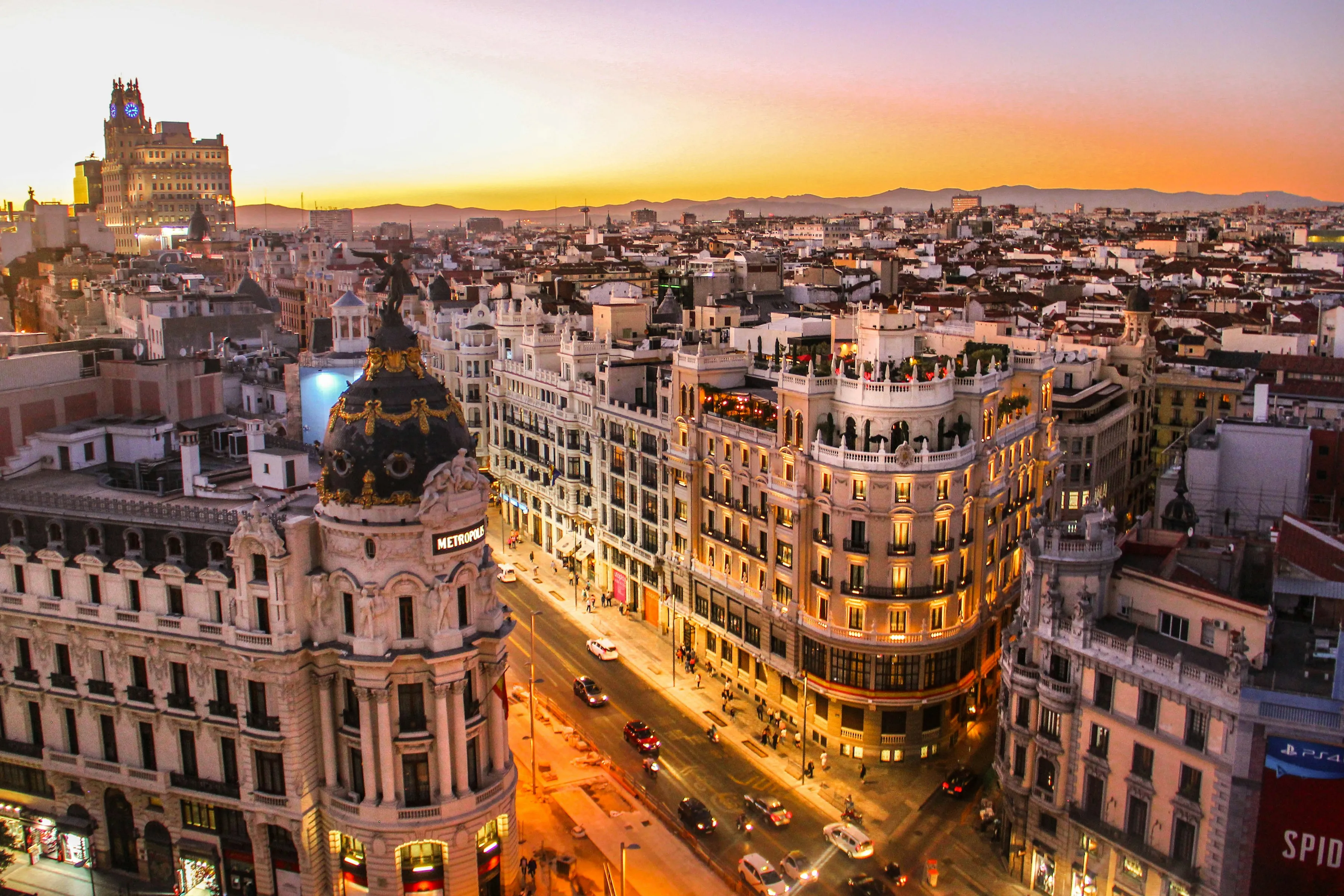
The Puerta del Sol is the symbolic centre of the country and home of the Kilometre Zero marker. Gran Vía is the grand avenue of theatres, cinemas and early 20th-century façades. Both are crowded and great for people-watching, and also the places where you need to keep your phone in a zipped pocket.
Temple of Debod
An Egyptian temple, donated to Spain in the 1960s and rebuilt in a park near the Royal Palace. The surrounding park is one of the best places in the city to watch the sunset.
Day trips: Toledo, Segovia and Ávila
Toledo is under an hour away by high-speed train and packs cathedrals, synagogues and mosque-era streets into a small hill town. Segovia is famous for its Roman aqueduct and its fairytale alcázar. Ávila keeps one of the best-preserved medieval walls in Europe. All three are comfortable day trips by train or bus, or you can join a guided excursion that handles tickets and timing.
🏘️ Neighborhoods and Where to Stay
- Centro and Sol: the most convenient base for a first visit. Everything is walkable, but it is noisy and busy at night.
- Las Letras (Barrio de las Letras): literary streets close to the Prado, with good restaurants and a more relaxed feel than Sol.
- La Latina: the heart of the tapas scene, especially Calle Cava Baja, and the home of the El Rastro flea market on Sundays and public holidays.
- Malasaña and Chueca: young, creative and nightlife-oriented, with independent cafés, vintage shops and a lot of bars.
- Salamanca: elegant and quiet, with upscale shopping; a good choice if you prefer a calmer base and do not mind a metro ride to the sights.
If you are comparing hotels versus apartments, our guide to hostels, hotels and apartments will help you decide.
🍛 Typical Gastronomy
Madrid does not have a coastline, but it has a deep tradition of hearty, inland food and a bar culture built around small plates. Do not expect paella here; look for the local classics instead.
| Dish | Description | Where to try it | Tip |
|---|---|---|---|
| Cocido madrileño | A slow-cooked chickpea stew with meats and vegetables, traditionally served in stages. | Traditional taverns in the centre | A winter dish and a heavy lunch; skip dinner afterwards. |
| Bocadillo de calamares | A baguette filled with fried squid rings, the classic cheap Madrid snack. | Bars around Plaza Mayor | A famous local order; ask for a caña (small draught beer) with it. |
| Huevos rotos | Fried eggs broken over potatoes, often with ham. | Casual restaurants across the centre | Share one between two as a starter. |
| Churros con chocolate | Fried dough sticks dipped in thick hot chocolate. | Chocolatería San Ginés, open since 1894 | Go early morning or after midnight to avoid queues. |
| Tortilla de patatas | Spanish omelette with potato, with or without onion. | Almost any bar | Order it with a small bread slice as a pincho. |
Many bars in La Latina and Las Letras still serve a free tapa with each drink, though the habit is less common than it used to be. Madrid is also home to Sobrino de Botín, which claims to be the oldest restaurant in the world; it is a famous stop, but book ahead and compare menus first.
🚌 Getting Around
From the airport. Madrid-Barajas is connected to the city centre by metro (Line 8, with an airport supplement), by commuter train and by a 24-hour express bus that reaches the centre in roughly half an hour, depending on traffic. A taxi from the airport has a fixed fare to the centre, which makes it worth considering if you arrive with luggage and late at night.
Metro. The Metro de Madrid is fast, air-conditioned and very easy to use. Buy a rechargeable Multi card and top it up with the number of rides you need, or look into a tourist pass if you plan many trips. Keep in mind that the metro is also where pickpockets work, especially on crowded lines at rush hour.
On foot and by bike. The centre is compact. From Sol to the Prado is about 15–20 minutes on foot, so many visitors need the metro only to reach Retiro, Chamartín or the stadiums.
Trains. Madrid has high-speed links to Seville, Córdoba, Valencia and Barcelona, as well as to Toledo and Segovia. Book ahead for the best fares. For more on how to use local transit in a city you do not know, see our guide to public transport in unfamiliar countries.
🛡️ Safety and Common Scams
Madrid is a safe city for visitors, and violent crime against tourists is rare. The real risk is pickpocketing, which concentrates in a few places: Puerta del Sol, Gran Vía, the Royal Palace area, the metro, and El Rastro.
- Distraction tricks: someone asks you for directions, drops something or “accidentally” bumps into you while a partner takes your phone or wallet.
- Fake petitions and bracelets: a friendly stranger approaches with a clipboard or ties something to your wrist, then asks for money.
- Taxi and restaurant overcharging: use licensed taxis or ride-hailing apps, and check the menu prices before you sit down.
- Gold-ring and street-game scams: ignore anyone who tries to sell you something “found” or invites you to play a street game.
Keep your phone and wallet in front pockets or a zipped bag, do not leave anything on a café table, and use a cross-body bag in crowded places. The emergency number across Spain is 112. For a deeper look at how these scams work, read our tips to avoid robberies and scams while traveling.
✈️ Best Time to Visit
| Season | What to expect | Notes |
|---|---|---|
| Spring (April–June) | Mild and sunny days, terraces everywhere | Ideal for walking; the festival of San Isidro is in mid-May |
| Summer (July–August) | Very hot, often above 35 °C in the afternoon | Many locals leave in August and some small businesses close; plan indoor visits for midday |
| Autumn (September–November) | Pleasant temperatures, cultural season starts | Fewer crowds than spring and often good weather |
| Winter (December–February) | Cold mornings, clear and dry weather | Christmas lights and markets; much cheaper hotels outside the holidays |
If you only have a few days, aim for April–June or late September–October. When you have chosen your dates, look at guided tours and tickets in Madrid and book the popular ones early.
Planning more of Spain? Continue with Barcelona for architecture and the sea, or Seville for the south, and read the full Spain travel guide.