


Vatican City
Spiritual center of Christianity that houses priceless artistic treasures, millenary history, and impressive architecture in the heart of historic Rome.
Quick Facts
- Capital
- Vatican City
- Language
- Italian
- Latin, French
- Currency
- Euro (EUR)
- Best time to visit
- Spring and autumn to avoid intense heat and the largest crowds of pilgrims.
- Budget per day
- $50 - $180 per day
- Climate
- Mediterranean climate with mild winters and hot summers, conditioned by its geographical location within Rome.
- Connectivity
- good
- Italian cards purchased in Rome are used, as the state does not have its own network operators.
- Electricity
- Type C / F / L (230V)
- Local transport
- good
- Card usage
- widespread
- Tipping
- optional
🌎 Introduction
Walking through this small enclave is to perceive how the pulse of the city surrounding it transforms into a peaceful silence. Protected by stone walls, this corner of the world unfolds an atmosphere where time seems to have stopped among marble columns and squares that open under the gaze of imposing domes. At sunset, when the golden light bathes the pavement, a calm is breathed that invites one to observe the details of its architecture without haste.
Life here has its own beat, marked by the sound of bells and the colorful traditions that remain intact, such as the firm step of the Swiss Guard or the slow bustle of its postal service. In the spring months, the gardens hidden behind the main buildings offer a green and fresh contrast, while winter envelops the silhouettes of its monuments in an intimate and gathered atmosphere, ideal for appreciating the serenity of its less-traveled corners.
Beyond its historical importance, the identity of this place is built through art and the legacy of those who left their mark on ceilings and walls. It is a space where human creativity manifests in every fresco and every sculpture, coexisting with a simple daily life where people from all corners of the planet cross paths. A cultural mosaic that, despite its small size, holds a diversity of stories that reveal themselves naturally to those who observe them carefully.
🛡️ General safety
Vatican City is considered one of the safest places in the world due to its small size, its religious character, and the very high presence of security forces. Being an enclave within Rome, security is constant and the environment is highly controlled, allowing tourists to feel calm at all times.
The general safety level is very high. Unlike other international destinations, the risks of violent crimes are practically non-existent. The context for the traveler is that of a monumental and sacred space where the main concern is usually the management of large crowds of people and not physical integrity.
Common crime and risks
Although it is an extremely safe place, the large influx of visitors attracts certain opportunistic criminals. The most common risks are:
- Pickpocketing and theft: This is the main problem. Pickpockets take advantage of crowds in St. Peter’s Square, access queues, and inside the Vatican Museums to steal wallets or mobile phones.
- “Skip the line” scams: In the surroundings of Vatican City (Italian territory), it is common to find people offering supposedly official tickets to avoid waiting. Often these are inflated prices or unnecessary services.
- Persistent street vendors: Although they are not a security risk per se, they can be annoying when trying to sell souvenirs, water, or umbrellas at the entrances.
Safety in cities and tourist areas
As it is a microstate composed almost exclusively of monuments and official buildings, security is concentrated in very specific points:
- St. Peter’s Square: It is an open but guarded space. It is recommended to keep backpacks closed and in front during times of high density of people.
- Vatican Museums: These are enclosed spaces with strict security controls similar to those of an airport. Once inside, the environment is very safe, although it is advisable not to lose sight of personal items in the busiest rooms, such as the Sistine Chapel.
- St. Peter’s Basilica: Access requires passing through metal detectors. Internal security is impeccable.
Transport safety
Vatican City does not have an internal public transport network for tourists, as almost the entire tour is done on foot.
- Access public transport: Most tourists arrive by the Rome metro or bus. Special care should be taken with belongings on metro line A (Ottaviano or Cipro stops), known for the presence of pickpockets.
- Taxis and private vehicles: They do not circulate inside the Vatican. If you use a taxi to reach the boundaries, make sure it is an official vehicle with a meter.
- Driving: Tourist vehicle driving is not allowed in the Vatican. In the adjacent area of Rome, people drive on the right.
Natural and climatic risks
Natural risks are minimal and coincide with those of the city of Rome:
- Extreme heat: During the summer months, temperatures can be very high. St. Peter’s Square is a very open space with little shade, which can lead to heat stroke or dehydration.
- Seasonal storms: In autumn, heavy rains can occur, making the stone ground (cobblestones) somewhat slippery.
- Seismicity: Although the area has some historical seismic activity, the risk of a serious earthquake during a short visit is statistically very low.
Local legislation and norms
The Vatican has very strict rules of behavior and dress that must be respected to avoid expulsion or denial of entry:
- Dress code: It is mandatory to cover shoulders and knees. Entry with tank tops, shorts, or miniskirts is not allowed. This rule is strictly applied in both the Basilica and the Museums.
- Behavior in sacred places: Silence or a low tone of voice is required. Eating, drinking (except water in permitted areas), or smoking inside the premises is prohibited.
- Photography: It is strictly forbidden to take photographs or videos in the Sistine Chapel. In the rest of the Museums, it is generally allowed without flash, unless otherwise indicated.
- Prohibited items: Access with large umbrellas, tripods, knives, or any sharp object is not allowed. These must be left in the cloakroom.
Safety for specific groups
- Female travelers: The Vatican is an exceptionally safe place for women traveling alone. There are no specific risks of harassment.
- LGTBIQ+ travelers: Although it is a religious state with conservative doctrine, there is no risk to physical safety. It is recommended to maintain a respectful and discreet attitude in accordance with the religious environment.
- Children and the elderly: The main challenge is physical fatigue and crowds. It is recommended to identify children with a contact wristband, as it is easy to get lost in the crowd. There are medical assistance services for those suffering from fatigue or fainting.
Emergencies and assistance
In case of needing help, the Vatican has its own security force and health services:
- Emergency number: 112 is the standard emergency number that also works in this area (connected to Italian services).
- Gendarmerie Corps: This is the police force of Vatican City. You will see them in uniform at different points and you can turn to them for any incident.
- Swiss Guard: They are mainly responsible for the protection of the Pope and the entrances to the state, but they can also guide tourists in situations of need.
- Medical assistance: There is a first aid post near St. Peter’s Square to attend to minor tourist incidents.
Tip: Always carry a large scarf or pashmina in your backpack; it will serve to cover your shoulders or legs quickly if your clothing does not comply with the entry code for the Basilica, preventing you from being denied access after hours of queuing.
📝 Entry requirements
To visit Vatican City, it is essential to have a valid passport with sufficient residual validity, usually recommended to be at least three or six months after the planned date of departure from the territory. As a microstate completely surrounded by the city of Rome, main access is naturally from Italian territory, so entry conditions are usually linked to the regulations in force in the surrounding area.
In most cases, travelers moving for short periods do not usually require a specific visa to access the public areas of the Holy See, such as St. Peter’s Square or the Vatican Museums. The maximum permitted stay for tourist purposes usually adjusts to the regional standards of ninety days within a given period, allowing visitors to explore the artistic and religious heritage with sufficient margin.
Although there are no permanent physical border controls when crossing on foot from the streets of Rome, it is advisable to have documentation that can prove a return ticket or departure to a third destination. Similarly, having financial means or proof of funds to cover expenses during the stay is a common practice that may be verified at the entry points to the territory surrounding the microstate.
Regarding customs restrictions, it is recommended to follow common guidelines on the transport of medications for personal use, which should preferably be in their original packaging. The transport of food or personal objects of high value is governed by standard international transit rules, always seeking a balance between the security of the enclave and the comfort of the visitor.
From the point of view of health requirements, mandatory vaccinations are not usually required to access this destination, although it is considered convenient to have the usual vaccination schedule up to date. The health infrastructure in the surroundings is of high quality, which guarantees a peaceful stay for those who decide to visit this world-renowned historical and spiritual center.
Below are some relevant aspects for planning a visit to this destination:
- Decent dress is an essential requirement for accessing sacred spaces and museums, covering shoulders and knees.
- The use of cameras is allowed in most areas, although there may be specific restrictions in areas of special artistic or liturgical value.
- Security controls via scanners and metal detectors are standard at the entrances to St. Peter’s Basilica and the Vatican Museums.
- The official currency used in all commercial transactions within the territory is the euro.
- Advance booking is recommended for visits to the areas of greatest tourist interest to avoid long wait times.
- The territory has its own postal service, highly valued by collectors and tourists for its uniqueness.
🏥 Basic health considerations
When you visit Vatican City, you will realize that, due to its size, its health infrastructure is closely linked to that of Rome. You will find medical services of excellent quality, although access for tourists is usually through private centers or specific emergency services. The cost of private medicine is relatively high, so it is advisable to go prepared. Medical staff usually speak Italian and English, so communication is not usually a serious problem for most travelers.
Taking out travel medical insurance is something you will appreciate if any unforeseen event arises. Although it is not a mandatory requirement to enter the country, it is fully recommended. I advise that your policy include broad coverage for hospitalization, medical transfers, and repatriation. This way, you will avoid medical bills that could ruin your travel budget.
Regarding vaccines, you will not need any special or mandatory protection to cross the border. Usually, it is enough to have your standard vaccination schedule up to date, the one we all usually have from childhood. There are no strange epidemiological risks, so you can travel with total peace of mind in this regard.
If you need to carry your own medication, you can do so without major legal complications. Ideally, you should carry your medicines in their original packaging accompanied by a medical prescription or certificate explaining the treatment, especially if they are specific drugs or those you must use with syringes. A curious fact you might like to know is that the Vatican Pharmacy is famous for having medicines that are sometimes difficult to find elsewhere, so you will find almost anything you need there.
About health risks, the most important factor you will notice is the climate, especially the intense heat during the summer months. Large crowds of people and waiting in the sun can cause dehydration or dizziness. Otherwise, you won’t have to worry about dangerous insects or tropical diseases. Most likely, the greatest risk you will find is a sprained ankle from walking a lot on uneven stone floors.
The water is drinkable throughout the premises and you will see many fountains where you can refill your bottle without fear. Hygiene in food establishments and public spaces is impeccable, so you can try any food with total confidence. The level of food safety is very high, following the most demanding European standards.
For any health emergency situation, the number you should dial is 112, which is the general emergency number. This service coordinates ambulances and urgent care very efficiently. If you find yourself within the tourist area, you can also ask for help from the Vatican Gendarmerie, who are very used to assisting visitors.
As final practical recommendations, I suggest you always carry a reusable water bottle with you to stay hydrated and use comfortable shoes, as you will be on your feet for a long time. Don’t forget sunscreen if you’re going to spend hours in St. Peter’s Square and always keep a digital copy of your medical insurance on your mobile to have it quickly at hand if you ever need it.
🚌 Transport within the country
Moving around Vatican City is a unique experience due to its small dimensions, as it is a state of very limited extent. The main and practically only means of transport for visitors is going on foot. Being a mostly pedestrian and monumental enclosure, the journeys between the different points of interest are naturally done by walking, which allows for a calm observation of the surroundings and architecture.
Although the state does not have an internal public transport network, such as its own metro lines or urban buses, its integrated location in a large metropolis greatly facilitates access from the outside. Travelers usually use the transport means of the surrounding city to reach the walls or the main square. There are underground railway stops and various bus lines that drop visitors off a short distance from the main entrances.
The signage in areas accessible to the public is clear and designed to guide people of multiple nationalities, usually using several languages. Buying tickets for the transport that reaches the vicinity is simple and takes place at standard points of sale. Being an entirely urban and monumental territory, there are no differences between rural areas and cities, maintaining a compact and easy-to-navigate structure.
Regarding the use of taxis and similar services, these do not circulate inside the enclosure, but they are a frequent option for approaching the entrances. It is common to find vehicles available around the border limits, offering a comfortable alternative for the initial transfer. The general feeling for the tourist is one of comfort and reliability, as distances are minimal and the environment is very well adapted for the movement of people.
Tip: Because most of the tour is done walking on stone surfaces, it is highly recommended to use appropriate footwear to avoid fatigue during the day.
🤵 Culture and etiquette
Vatican City is a state with an atmosphere of solemnity and respect, where daily life is intrinsically linked to religious and administrative activity. Visitors are expected to maintain discreet behavior, especially in the vicinity of St. Peter’s Basilica and the Vatican Museums. The treatment is usually courteous and formal, and it is common to observe an environment of tranquility that invites contemplation, avoiding unnecessary noise or effusive gestures in public and sacred spaces.
Regarding interpersonal treatment, kindness and formality are the pillars of communication. When addressing security personnel, such as the Swiss Guard, or members of the clergy, it is recommended to use a moderate tone of voice and maintain a respectful physical distance. Punctuality is considered a fundamental value, especially regarding papal audiences or scheduled guided tours, where arriving at the indicated time is perceived as a sign of consideration towards the organization and the rest of the attendees.
Respect for traditions and hierarchies is a central aspect of coexistence. During ceremonies or moments of prayer, silence and an attitude of recollection are valued, even if one does not actively participate in the rite. Likewise, clothing plays a crucial role in local etiquette; wearing garments that cover shoulders and knees is understood as a gesture of courtesy towards the sacred character of the buildings and towards the community that resides and works there.
Although dining options within the enclosure are limited, customs around food follow patterns of simplicity and correctness. There is no mandatory tipping culture, but a small economic gesture is welcomed if the service in the cafeterias or bookstores has been particularly attentive. In brief interactions, such as when purchasing souvenirs or publications, a brief and polite greeting is sufficient to maintain the fluidity and mutual respect that characterizes this international environment.
“Tip”: Make sure your clothing is appropriate (shoulders and knees covered) before accessing any building, as it is the most observed etiquette rule to show respect for the sacred character of the place.
🍛 Typical gastronomy
Gastronomy in Vatican City is closely linked to the culinary tradition of Rome and the Lazio region. Being an enclave within the Italian capital, its flavors are defined by simplicity and the use of local products, inheriting recipes that have been passed down from generation to generation. Cooking in this environment is characterized by transforming humble ingredients into nutritious and tasty dishes, where fresh pasta, legumes, and seasonal vegetables are the main protagonists.
Local eating habits follow the traditional pace of southern Europe. The day usually begins with a quick breakfast, typically consisting of a coffee and a piece of pastry. Lunch and dinner are moments of greater relevance, where the consumption of fresh food is prioritized. The use of aged cheeses, such as Pecorino Romano, and the use of high-quality olive oils to season both stews and salads is very common.
Regarding cultural considerations, meals are usually structured in several courses, starting with an appetizer and followed by a first course of pasta or rice. Meal times are regular, with lunch around noon and dinner from eight in the evening. In the establishments in the area, it is common to find a respectful atmosphere, where sobriety is valued. The most common drinks are mineral water and regional wines, which usually accompany main meals in a regular but moderate way.
| Dish | Description | Main ingredients | Where to try it | Tip |
|---|---|---|---|---|
| Carbonara | Pasta with a creamy sauce emulsified with egg and cheese. | Pasta, egg, pecorino cheese, guanciale, and pepper. | Restaurants and trattorias in the area. | Avoid places that add cream to the traditional recipe. |
| Cacio e Pepe | A simple pasta dish that stands out for its balance of flavor. | Pasta, pecorino romano cheese, and black pepper. | Traditional Roman cuisine local. | Mix it well so the cheese forms a silky cream. |
| Carciofi alla Romana | Tender artichokes slow-cooked with herbs. | Artichokes, garlic, mint, and olive oil. | Eating houses and classic restaurants. | Try them especially during the spring months. |
| Saltimbocca alla Romana | Thin veal cutlets that melt in your mouth. | Veal, prosciutto, sage, and white wine. | Restaurants specializing in meats. | Best enjoyed freshly made and accompanied by fresh bread. |
| Supplí | Rice croquette filled with cheese, ideal as an appetizer. | Rice, tomato sauce, and mozzarella cheese. | Fast food establishments and street stalls. | Eat it hot so the inner cheese is melted. |
📷 Areas and places to visit
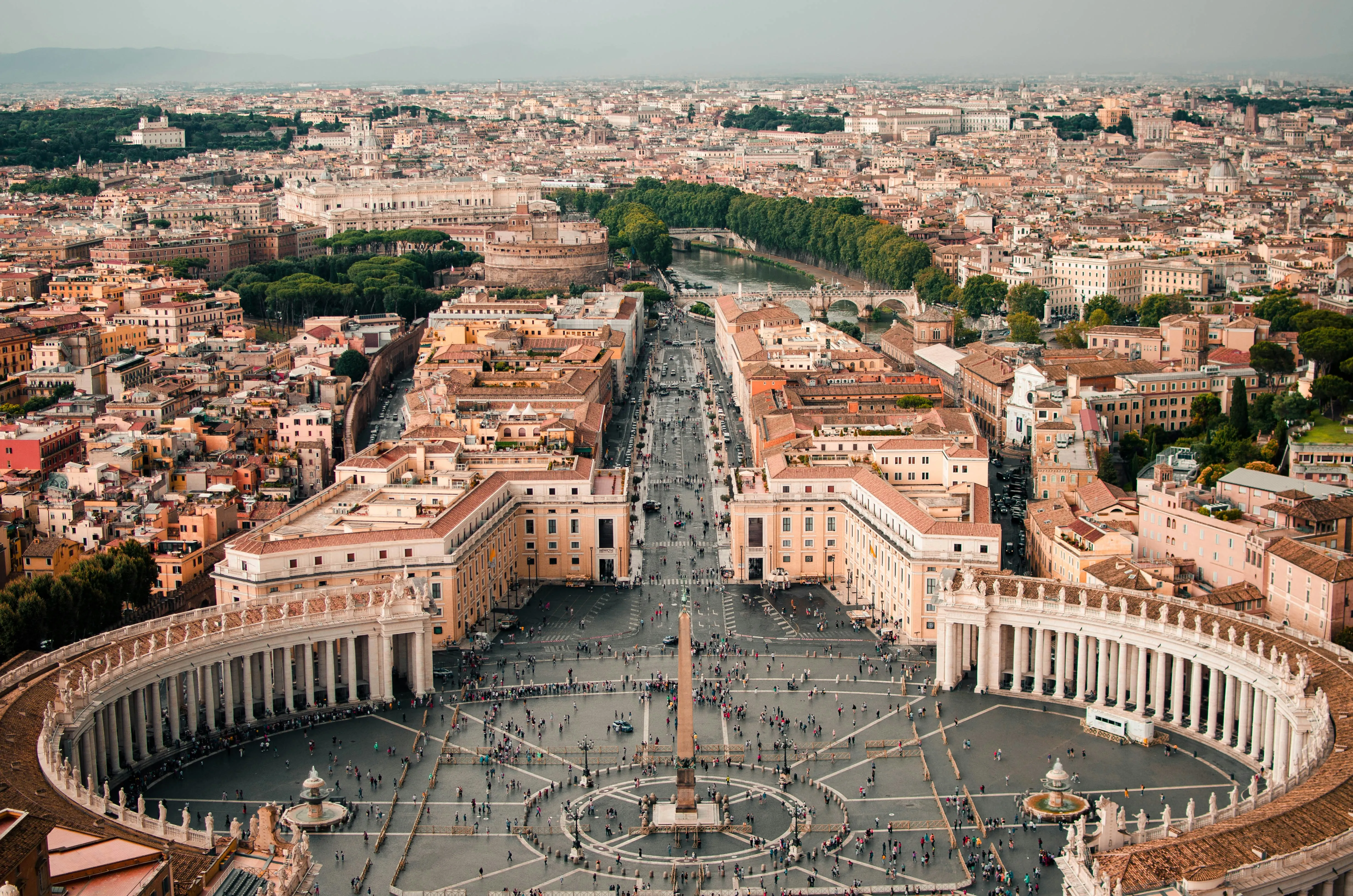
Vatican City, despite its small geographical extension, constitutes one of the densest historical and artistic centers in the world. Its urban configuration is mainly articulated around St. Peter’s Square, a vast esplanade designed by Bernini that acts as a threshold of welcome for people of all origins. This space is delimited by an imposing semicircular colonnade symbolizing a gesture of welcome and is crowned by numerous statues of historical figures. In the center, the Egyptian obelisk serves as a visual reference point, connecting the square with the large avenues that lead into it.
The most emblematic building of this sovereign state is St. Peter’s Basilica, a masterpiece of Renaissance and Baroque architecture on which artists of the stature of Bramante, Michelangelo, and Maderno worked. The interior of the temple stands out for its monumental scale and for housing priceless pieces, such as Michelangelo’s Pietà sculpture or the bronze Baldachin located over the main altar. Visitors also usually access the Dome, from which a complete panoramic view of the city and the limits separating the Vatican from the surrounding Italian territory is obtained.
The Vatican Museums represent another of the fundamental areas for any traveler interested in culture. This museum complex, formed by various galleries and rooms, guards one of the most important art collections in humanity. The tour passes through such significant places as the Gallery of Maps, the Raphael Rooms, and the Pio-Clementine Museum, which exhibits classical sculptures of great historical relevance. The itinerary through the museums usually leads to the Sistine Chapel, internationally recognized for Michelangelo’s frescoes that decorate its vault and the Last Judgment altar wall.
For those seeking a more peaceful environment, the Vatican Gardens occupy a large part of the state’s surface and offer a natural contrast to the stone and marble of the buildings. This green space is characterized by a careful combination of paths, fountains, grottoes, and monuments reflecting different landscaping styles over the centuries. It is an area that allows for observing the quieter side of the city, where vegetation and small administrative buildings coexist in harmony within the walls surrounding the enclosure.
In addition to surface tours, there are underground areas of great archaeological interest, such as the Vatican Necropolis, located under the current basilica, where remains of ancient funerary structures are preserved. In the cultural sphere, temporary exhibitions and the state libraries keep unique documents and manuscripts that are part of the global documentary heritage. Activities in these areas usually focus on artistic observation, historical study, and attendance at institutional acts that take place periodically in public spaces and audience halls.
Tip: You cannot miss St. Peter’s Basilica, the most emblematic place in the country.
✈️ Best time to travel
Vatican City has a Mediterranean climate characterized by hot summers and mild winters. As it is primarily a cultural and religious destination, the visiting experience varies significantly depending on the time of year. The months of spring and autumn usually offer a pleasant balance between moderate temperatures and ideal light to appreciate the architecture of St. Peter’s Square and the Vatican Museums.
It is important to keep in mind that the liturgical calendar deeply marks the pace of this enclave. During noted festivities, the influx of visitors increases considerably, regardless of weather conditions. Therefore, choosing the time of the trip depends on whether one prefers to enjoy institutional events or if one seeks a quieter stay focused on artistic observation.
| Season | Months | Typical climate | What to expect | Influx of tourists |
|---|---|---|---|---|
| Spring | Mar – May | Mild temperatures (15°C - 22°C) and clear days. | Flowery environment and important Holy Week celebrations. | ⭐⭐⭐ (Medium-High) |
| Summer | Jun – Aug | Intense heat, low humidity, and constant sun. | Days with lots of light and more movement in the surroundings. | ⭐⭐⭐⭐ (Very High) |
| Autumn | Sep – Nov | Pleasant temperatures that drop towards November. | A cooler atmosphere and ochre colors in the gardens. | ⭐⭐⭐ (Medium) |
| Winter | Dec – Feb | Cool weather, with occasional rain and little snow. | Christmas decorations and shorter wait times at entrances. | ⭐⭐ (Low) |
🗣️ Basic vocabulary
Although Latin is the official language of Vatican City, in daily life and for any interaction with staff, the Swiss Guard, or at information points, the language used is Italian. Knowing some basic expressions will allow you to move more easily and show courtesy during your visits to the Vatican Museums or St. Peter’s Basilica.
It is not necessary to master the language, but these words and phrases will be very useful for everyday situations, such as greeting when entering a premises or asking for directions politely.
- Buongiorno: Good morning.
- Grazie: Thank you.
- Per favore: Please.
- Scusi: Excuse me (ideal for asking to pass or getting an assistant’s attention).
- Dov’è…?: Where is…? (useful for locating services or entrances).
- Sì / No: Yes / No.
- Quanto costa?: How much does it cost? (for souvenir shops or bookstores).
- Arrivederci: Goodbye / See you later.