


Ethiopia
Discover the cradle of humanity, fascinating volcanic landscapes, rock-hewn churches, and a vibrant ancient culture that captivates every adventurous traveler.
Quick Facts
- Capital
- Addis Ababa
- Language
- Amharic
- Oromo, Tigrinya, Somali, English
- Currency
- Ethiopian Birr (ETB)
- Best time to visit
- From October to March, coinciding with the dry season and cultural festivals
- Budget per day
- $30 - $90 per day
- Climate
- Varied climate depending on the altitude, with temperate highlands and very hot and arid lowlands.
- Connectivity
- low
- Available at airports and official stores through registration with a passport
- Electricity
- Type C, E, F, L (230V)
- Local transport
- limited
- Card usage
- cash is used more
- Tipping
- optional
🌎 Introduction
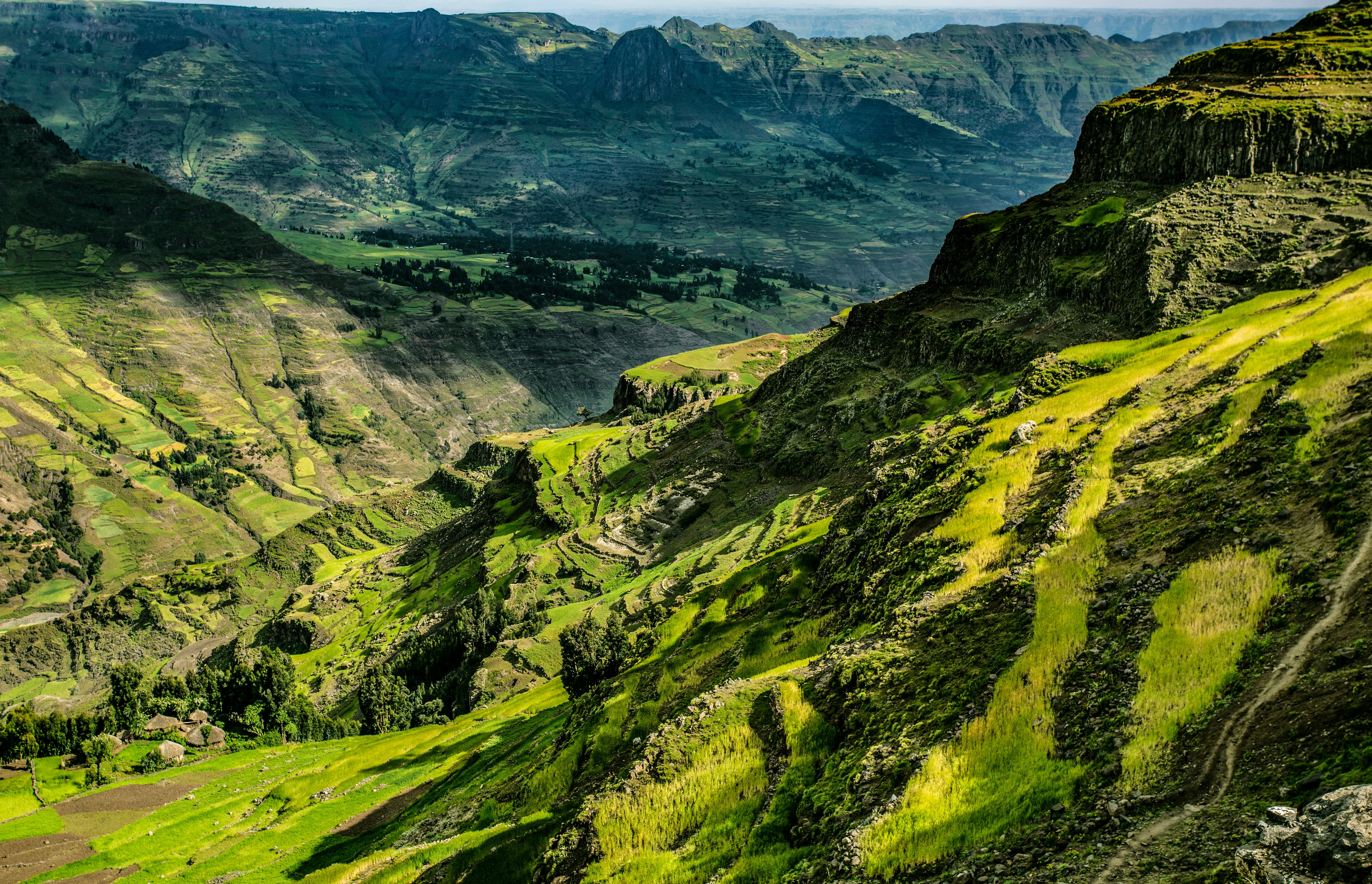
Traveling through Ethiopia is like stepping into a corner of the Horn of Africa where time seems to follow its own rhythm. Marked by a geography of contrasts, the landscape unfolds between the cool peaks of the Simien Mountains and the arid depressions that open toward the Great Rift Valley. This altitude not only defines its climate, often milder than one might expect, but has also shaped a singular identity, sheltered for centuries by its imposing natural walls of rock and vegetation.
In daily life, the Ethiopian essence is perceived in simple gestures, such as the aroma of freshly roasted coffee that permeates homes in a slow and everyday ceremony. Life is organized around ancient traditions, from the colorful festivities like Timkat to the shared taste of injera at a common table. It is a place where native languages, a unique calendar, and an architecture that springs directly from the earth—like the rock-hewn churches that silently tell stories of other times—coexist.
This diversity is also reflected in its people, who change drastically as one descends from the highlands to the southern plains. Between vibrant markets and horizons that seem to have no end, the environment offers a blend of spirituality and raw nature that invites quiet observation. It is a mosaic of cultures that have managed to preserve their roots while the cycles of the seasons continue to mark the pace of a life intimately linked to the land.
🛡️ General Safety
Ethiopia is a country with an immense cultural and historical richness that welcomes thousands of travelers every year. Generally speaking, the country offers a hospitable experience, although the security situation can be variable and complex depending on the region visited.
- General safety level: It is considered a medium-risk destination, where most visits occur without incident, especially on the main tourist routes.
- Guidance comparison: Compared to other countries in its surroundings, Ethiopia is usually safer for tourists in terms of violent crime, but it requires constant vigilance due to possible internal political tensions.
- Context for the traveler: It is essential to stay informed about the current situation in the specific regions you plan to visit (such as Tigray, Amhara, or Oromia), as the landscape can change rapidly. The Northern Historical Circuit area is usually better prepared for tourism, while border areas require greater caution.
Crime and common risks
Crime in Ethiopia is not usually violent against foreigners, but petty crimes are a reality in crowded areas.
- Pickpocketing and theft by distraction: These are common in markets, bus stations, and high-traffic areas. It is recommended not to display valuables, expensive cameras, or large amounts of cash.
- Frequent scams: It is common to find people offering themselves as “spontaneous guides” or inviting tourists to private coffee ceremonies that end with excessive charges. It is advised to always hire services through official agencies.
- Caution zones: In Addis Ababa, the Mercato market is known for being a critical point for pickpockets. It is recommended to visit it with a guide and with only the bare essentials.
- Infrequent risks: Although kidnapping is not a common risk for conventional tourists, traveling at night on remote roads or near the borders with Somalia, South Sudan, or Eritrea should be avoided.
Safety in cities and tourist areas
Urban centers and points of historical interest have a visible police presence that contributes to the traveler’s peace of mind.
- Addis Ababa: The capital is relatively safe during the day. At night, it is preferable to move by private transport and avoid walking on poorly lit or sparsely populated streets.
- Tourist centers: Places like Lalibela, Gondar, or Aksum usually have a very quiet and visitor-oriented atmosphere. Residents are generally very respectful of tourists, as tourism is a vital source of income.
- Practical recommendations: Always carry a photocopy of your passport and visa, leaving the originals in the hotel safe. Keep a low profile and respect local customs, especially in religious areas.
Transportation safety
Transportation in Ethiopia presents logistical and infrastructure challenges that the traveler should be aware of.
- Driving: In Ethiopia, you drive on the right. The condition of the roads is very uneven; while the main roads are paved, secondary ones can be difficult-to-navigate dirt tracks.
- Public transport: Buses and “minibuses” are inexpensive but are usually very full and do not always meet optimal maintenance standards.
- Taxis and apps: In the capital, using official taxis (yellow) or private transport applications (such as Ride) is the safest and most reliable option. It is advisable to agree on the price before starting the journey if there is no meter.
- Domestic flights: Due to the large distances and mountainous geography, using Ethiopian Airlines for domestic flights is the safest and most efficient way to move between major tourist cities.
Natural and climatic risks
Ethiopia has a diverse geography ranging from high mountains to deserts below sea level, which implies specific risks.
- Extreme heat: In areas like the Danakil Depression, temperatures can exceed 50°C. These visits must be conducted with organized expeditions that have water supplies and first aid equipment.
- Rainy season: This occurs mainly between June and September. During this period, localized flooding and landslides can occur, blocking roads in rural areas.
- Seismic activity: The country sits on the Rift Valley, so there are risks of minor earthquakes and volcanic activity in specific areas, although serious incidents are rare.
Legislation and local norms
Ethiopia is a deeply religious (mostly Orthodox Christian and Islamic) and conservative country.
- Photography: It is strictly forbidden to photograph military installations, government buildings, bridges, and airports. Doing so can lead to detention and the confiscation of equipment.
- Prohibited substances: Laws against drug trafficking and consumption are extremely severe. The consumption of khat is legal and common among the local population, but tourists should be cautious with its use.
- Religious respect: When visiting churches and monasteries, it is mandatory to dress modestly (shoulders and legs covered) and, in many cases, to remove your shoes.
Safety for specific groups
- Female travelers: Ethiopia is generally safe for women traveling alone, although they may receive unwanted attention or persistent comments. It is recommended to dress conservatively to avoid calling unnecessary attention.
- LGTBIQ+ travelers: Homosexuality is illegal in Ethiopia and is socially stigmatized. Absolute discretion is recommended, as public displays of affection can lead to legal problems or aggression.
- Children and the elderly: The main challenge is the altitude (Addis Ababa is at 2,300 meters) and limited sanitary conditions outside the capital. Health insurance with air evacuation coverage is recommended.
Emergencies and assistance
Emergency services can be slow and their coverage is limited outside of large cities.
- Emergency numbers:
- Police: 991
- Ambulances (Red Cross): 907
- General emergencies (in Addis Ababa): 911
- Medical services: In Addis Ababa, there are high-quality private hospitals, but in rural areas, medical care is very basic.
- Protocol in case of an incident: In case of theft or incident, go to the nearest police station to file a report (“police report”), which is necessary for any insurance claim. Always maintain contact with your embassy or consulate.
Tip: Always avoid road travel after the sun goes down, due to the lack of lighting, the presence of animals on the road, and the risk of assaults in isolated areas.
📝 Entry Requirements
To plan a trip to Ethiopia, the first fundamental step is to review the necessary personal documentation. International travelers usually require a passport with a minimum validity, frequently six months from the date of arrival in the territory. In addition, most visitors need to manage a tourist visa, which in many cases can be processed electronically before starting the journey or, under certain circumstances, upon landing at the main points of entry. The duration of the stay for recreational purposes is usually limited to periods of 30 or 90 days, depending on the choice made during the application process.
Upon reaching immigration controls, especially at international airports, authorities may request information to support the purpose of the trip. It is common to be asked to show a return ticket or a ticket for onward travel to another destination, as well as proof of having sufficient funds to cover expenses during the stay in the country. Regarding customs controls, there are common regulations on the import and export of currency, where large amounts usually require a formal declaration. Standard restrictions also apply to the entry of certain medications, so it is advisable to carry the corresponding medical prescriptions to avoid inconveniences.
In the health field, entry conditions may include the presentation of vaccination certificates. It is common for proof of the yellow fever vaccine to be requested from travelers coming from areas with a risk of transmission. In addition to legal requirements, a consultation with specialized medicine centers is usually recommended to receive advice on other vaccines or general preventive measures. Having travel insurance with broad coverage is a common and advisable practice to ensure a peaceful stay in the face of any health eventuality.
Below are some relevant aspects for border control and the stay:
- Passport validity: It is recommended that the document has at least two blank pages for entry and exit stamps.
- Visa procedures: The electronic format is the most common for tourism, facilitating inspection at border posts.
- Baggage and customs: There are limits on the entry of products such as tobacco or perfumes, and the use of drones is usually subject to prior special permits.
- Currency and money: It is important to keep currency exchange receipts if you wish to perform the reverse operation when leaving the country.
- Prohibited items: Rigorous restrictions apply to the exit of ancient objects, animal skins, or any item considered cultural heritage without proper authorization.
- Preventive health: It is suggested to pay attention to food hygiene standards and the consumption of bottled water throughout the visit.
🏥 Basic Health Considerations
When you plan your trip, you will discover that the health system in Ethiopia presents very marked contrasts. In the capital, Addis Ababa, you will find high-quality private clinics where the staff usually speaks English and is accustomed to dealing with foreigners. However, in rural or remote areas, medical assistance is much more limited and basic. It is important to know that private healthcare for tourists has a moderate cost, but they will generally ask for payment in advance, even if you have insurance, so you will have to manage reimbursements later.
Hiring travel medical insurance is not mandatory to enter the country, but it is totally essential for your peace of mind. Your policy should include broad coverage for hospitalization, surgical expenses and, especially, medical repatriation by air ambulance. In case of a serious emergency outside the capital, you may need to be moved to another country with more advanced infrastructure, and that cost is extremely high if you do not have insurance.
Regarding vaccines, the yellow fever vaccine is mandatory if you are traveling from a country where this disease is endemic, so they will ask for the international vaccination certificate when you arrive at the airport. Beyond this, it is highly recommended that you have your routine vaccination schedule up to date. Other vaccines you might consider, depending on the areas you are going to visit, are hepatitis A and B, typhoid fever, and tetanus-diphtheria. The most sensible thing is to make an appointment at an international health center at least one month before your departure.
If you need to carry personal medication, it is fundamental that you transport it in its original packaging and accompanied by the official medical prescription, preferably translated into English. You will not have legal problems for carrying your basic medicines, but if you use very specific or psychotropic drugs, the medical certificate is vital to avoid misunderstandings at customs. In local pharmacies in large cities, you can buy basic products, but you will not always find international brands or exact doses.
Regarding risks according to the environment, you will notice that altitude is a key factor, as a large part of the country and its capital are located more than 2,000 meters above sea level. This can cause fatigue, headache, or dizziness during the first few days while you acclimatize. On the other hand, the risk of malaria is practically nil in the highlands, but if you are going to descend to low-lying areas or river valleys, you should use repellents and long-sleeved clothing. The sun is very strong due to the proximity to the equator, so sun protection and constant hydration will be your best allies.
In the area of food and water, caution must be maximum to avoid gastric problems. Never drink tap water; you will find bottled water easily and you should always check that the seal is intact. Avoid ice in drinks and vegetables that have not been cooked or peeled by yourself. Traditional food is usually served very hot, which is a point in favor of food safety, but it is always wise to be prudent with street stalls that do not maintain visible hygiene.
For any medical emergency, the telephone number you should dial is 912 for general emergencies or 907 to contact the Red Cross. You should bear in mind that the ambulance service can be slow due to heavy traffic, especially in Addis Ababa, so in situations of extreme need, it is usually faster to move by your own means or taxi to the nearest private hospital indicated by your insurance.
As final practical tips, always carry a small kit with painkillers, hand sanitizer, and oral rehydration salts. If you are going to go hiking in nature, make sure to use closed footwear to avoid bites or wounds that could become infected with dust and heat. Maintaining good hand hygiene before every meal will save you most of the health inconveniences you could encounter during your stay.
🚌 Transportation Within the Country
Moving around the country requires taking into account the large distances and the mountainous geography that characterizes the region. The airplane is the most widely used means of transport by travelers to move between the main urban centers and points of historical interest, as it allows for overcoming terrain difficulties and saving a considerable amount of time compared to road trips.
For land travel, the bus is the most common option for connecting different provinces. There are long-distance services that link the main cities, while for shorter or rural journeys, minibuses or shared vans are usually used. In the capital, visitors also have a light rail network that crosses the nerve centers, although it usually has high occupancy during peak hours.
In cities, taxis and three-wheeled motorized vehicles are fundamental for short transfers. In more developed urban centers, the use of mobile applications to request transport services is common, which simplifies communication regarding the destination. In contrast, in rural areas, transportation is more basic and relies heavily on vehicles adapted to less-traveled roads, where the frequency of service can be less predictable.
The ease of use of public transport presents contrasts. Although staff at airports and hotels usually communicate in English, signage at bus stations and in local services can be confusing. Ticket purchasing is usually done in person at station windows or directly from the vehicle staff, as advance booking through digital means is not generally available for all types of transport.
The sense of comfort and punctuality varies depending on the chosen medium. While internal air connections are usually reliable and regular, road transport tends to be slower due to road conditions in certain areas. It is common in the rural environment for vehicles not to have a fixed departure time, but rather to depart once the available seats have been filled, which requires some flexibility on the part of the traveler.
Tip: It is advisable to confirm the exact location of departure stations in advance and travel to them with sufficient time, especially in large cities where traffic can influence the duration of the journey.
🤵 Culture and Etiquette
Ethiopian society places great importance on interpersonal relationships and mutual respect, which is reflected in its daily interactions through a slow-paced courtesy. Greetings are usually fundamental and should not be rushed; the most common practice is to shake the right hand gently. In meetings between people of the same gender who already have some level of trust, the exchange of light shoulder touches or kisses on the cheek is common. Likewise, showing deference toward elderly people or those with higher social hierarchy is an essential practice, often manifested through a slight bow of the head or the use of both hands when giving or receiving an object.
In public spaces, an atmosphere of discretion and composure prevails. Voice volume tends to be moderate, as speaking in too high a tone can be interpreted as a sign of aggression or lack of manners. Regarding physical contact, while displays of affection and closeness between friends of the same sex are natural and frequent, romantic expressions by couples in public are usually kept very private. Regarding punctuality, there is a more flexible perception of time in social contexts, where human interaction is prioritized over the rigidity of the clock, so it is common for meetings to begin with a certain margin of delay.
Hospitality is a pillar of local culture, especially around the table and the emblematic coffee ceremony, which represents a rite of welcome and friendship. When sharing food, which is usually served on a common tray, the etiquette rule is to use exclusively the right hand to bring food to the mouth. On occasion, the host may offer a bite directly to the guest, a gesture known as gursha that symbolizes appreciation and is recommended to be accepted with pleasure. In the field of services, tips are well-received and valued, especially in the tourism sector, although they should always be given discreetly.
Respect for religious traditions and places of worship is of utmost importance. When visiting sacred sites, it is necessary to dress modestly, covering shoulders and legs, and it is mandatory to remove your shoes before entering. In these spaces, behavior should be silent and contemplative. Similarly, before capturing images of people, rites, or everyday scenes, it is considered fundamental to ask for permission politely, always respecting the privacy and will of the local inhabitants.
Tip: The concept of time in Ethiopia coexists with a local time system that counts the twelve hours of the day starting from dawn; therefore, when agreeing on a time for a visit or activity, it is very important to confirm whether it is international time or Ethiopian time to avoid misunderstandings.
🍛 Typical Gastronomy
The gastronomy of Ethiopia stands out as one of the most unique on the African continent, based on a deeply collective and social experience. The central element of any table is the injera, a flat, thin, spongy-textured bread made from teff flour, a nutritious local cereal. The injera not only serves as the base for the food but also acts as both plate and cutlery, as it is torn by hand to scoop up the different stews or preparations served on top.
Ethiopian flavors are usually intense and aromatic thanks to the frequent use of berbere, a spice blend that includes chili, ginger, garlic, and cloves, among other ingredients. This combination provides a spicy touch and a characteristic reddish color to many of its dishes. Additionally, niter kibbeh, a clarified butter flavored with herbs, provides an essential depth of flavor in both meat and legume preparations. Due to religious traditions, it is very common to find a wide variety of vegan options, especially on Wednesdays and Fridays, known as fasting days.
The act of eating is a ritual of hospitality in which diners usually share a large circular tray called a gebeta. One of the most striking customs for the visitor is the gursha, a gesture of affection and respect that consists of placing a bite of food directly into another person’s mouth. Regarding drinks, coffee holds a sacred place; its preparation is part of a slow traditional ceremony that is a pillar of social life. It is also common to accompany meals with tej, a fermented drink based on honey.
| Dish | Description | Main Ingredients | Where to try it | Tip |
|---|---|---|---|---|
| Doro Wat | Spicy chicken stew considered the national dish, usually served at celebrations. | Chicken, hard-boiled eggs, berbere, and clarified butter. | Traditional restaurants in Addis Ababa and inland areas. | It is an intense dish; it is best accompanied by plenty of injera to balance the heat. |
| Beyaynetu | Vegetarian combination featuring various portions of stews on an injera. | Lentils, chickpeas, cabbage, beets, and carrots. | Eateries and restaurants throughout the country, ideal on fasting days. | It is the best option to try many different flavors in a single meal. |
| Kitfo | Finely minced beef, served raw or very lightly cooked. | Beef, niter kibbeh, and mitmita (a very spicy spice blend). | Restaurants specialized in meat in the Gurage region and the capital. | You can order it “leb leb” if you prefer the meat to be slightly seared over fire. |
| Tibs | Meat sautéed over high heat, served simply or with vegetables. | Lamb or beef, onion, garlic, and rosemary. | Local food stalls and traditional grills in any city. | It is an excellent alternative if you prefer to avoid stews with heavy and highly spiced sauces. |
| Shiro | Thick and comforting stew, very popular in everyday Ethiopian life. | Chickpea or lentil flour, onion, and berbere. | Any home-style food place or budget-friendly stalls. | It is usually the safest and tastiest option if you are looking for something light yet nutritious. |
📷 Zones and Places to Visit
Ethiopia is a territory of profound contrasts where ancient history and the most untamed nature are naturally intertwined. The usual starting point is Addis Ababa, a vibrant capital that blends the modernity of its international headquarters with the slow pace of its traditional neighborhoods. Strolling through its streets allows you to discover the National Museum of Ethiopia, where fundamental archaeological remains for understanding human evolution are kept, or to get lost in the Mercato, one of the most extensive open-air markets on the continent, where the trade of spices, fabrics, and local crafts offers a unique sensory experience.
To the north lies the historical route, a journey that transports the visitor through ancient empires. Lalibela is, without a doubt, one of the most significant points in the country due to its eleven medieval rock-hewn churches. These temples, carved directly into the volcanic rock floor, remain active pilgrimage centers where the sound of chanting and the color of white robes create an atmosphere of great spirituality. Not far away, the city of Gondar surprises with its medieval architecture, highlighting the royal enclosure of Fasil Ghebbi, a walled citadel housing castles and palaces with an aesthetic reminiscent of the chivalric era.
Ethiopian nature reaches its maximum expression in the Simien Mountains National Park. This mountain massif, crisscrossed by deep ravines and peaks exceeding four thousand meters, is the ideal setting for hiking. In these highlands, it is possible to observe endemic species in their natural habitat while contemplating a landscape of overwhelming vastness. For its part, the Aksum region offers a return to classical antiquity through its enormous monolithic stelae and obelisks, which are silent witnesses to the power of an empire that dominated trade routes between Africa and Asia.
In the eastern part of the country, the walled city of Harar offers a radically different atmosphere. With its labyrinthine alleys of bright colors and numerous mosques, this city is famous for its hospitality and for the ancient tradition of feeding hyenas outside the wall at nightfall. The coexistence of secular traditions and the bustle of its coffee and khat markets makes this town a cultural enclave of great value. Nearby, the surroundings of Lake Tana and the Blue Nile Falls allow for enjoying trips in traditional boats to visit isolated monasteries on small islands.
Toward the south, the landscape changes drastically to give way to the Omo Valley, one of the regions with the greatest cultural diversity in the world. This territory is home to numerous ethnic groups that maintain ways of life closely linked to the land and livestock. Visiting local markets in towns like Turmi or Jinka allows for understanding the complexity of social structures and the rich ornamental traditions of its inhabitants. It is an area of plains and savannas that contrasts with the rugged terrain of the north, offering a complete view of the country’s geographical variety.
For travelers looking for experiences in extreme environments, the Danakil Depression represents one of the most unique places on the planet. Located below sea level, this volcanic zone features landscapes that seem to be from another world, with salt plains, active lava lakes like that of the Erta Ale volcano, and hydrothermal formations of yellow and green colors in Dallol. The contrast between these arid lands and the fertile valleys of the interior summarizes the essence of a country that never ceases to surprise with its ability to reinvent itself in every region.
“Tip”: You cannot miss visiting Lalibela, the most emblematic place in the country.
✈️ Best Time to Travel
Ethiopia is a destination with a climate marked by its varied altitude, which generates significant contrasts between the northern highlands and the southern lowlands. Generally, the most balanced time to visit the country coincides with the months when rainfall is scarce, which facilitates road travel and allows for enjoying natural landscapes and historical sites in more comfortable conditions.
The choice of date is also often influenced by the cultural and festive calendar, as the country has ancient traditions that transform the travel experience. While the period following the rains offers an especially green and fertile environment, the drier months are ideal for hiking routes in national parks or for exploring desert depressions, where temperatures are more moderate during the northern winter.
| Season | Months | Typical Climate | What to Expect | Tourist Influx |
|---|---|---|---|---|
| Spring | Mar – May | Temperate temperatures with brief and occasional rains (Belg season). | Intense agricultural activity, blooming of local flora, and good conditions for bird watching. | Medium (⭐⭐⭐) |
| Summer | Jun – Aug | Frequent and heavy rainfall in the highlands; cooler weather. | Deep green landscapes and powerful waterfalls, though some mountain routes may be more complex. | Low (⭐) |
| Autumn | Sep – Nov | Clear skies and pleasant temperatures after the end of the rains. | Celebration of the Meskel festival, lush landscapes, and optimal conditions for hiking. | High (⭐⭐⭐⭐) |
| Winter | Dec – Feb | Dry climate, sunny days, and cool nights in the highlands. | Major religious festivities (Timkat and Genna) and the best time to visit the Omo Valley and Danakil. | Very high (⭐⭐⭐⭐⭐) |
🗣️ Basic Vocabulary
Learning a few words in Amharic, the official language of Ethiopia, can significantly improve your experience in the country. Although it is possible to communicate in English in hotels and tourist areas, Ethiopians greatly appreciate visitors trying to use their language, which usually facilitates a warmer and friendlier welcome in everyday life.
Knowing these expressions will be useful for greeting, moving through markets, or showing courtesy in daily situations. It is not necessary to master the grammar; it is enough to have these basic tools to manage with a bit more ease during your stay.
- Selam: Hello (general greeting).
- Ameseguenallo: Thank you.
- Ebakish (to a woman) / Ebakih (to a man): Please.
- Ow / Ay: Yes / No.
- Sintno?: How much does it cost?
- Ishee: Okay / Fine (used very frequently to show agreement).
- Yikirta: Sorry / Excuse me.