


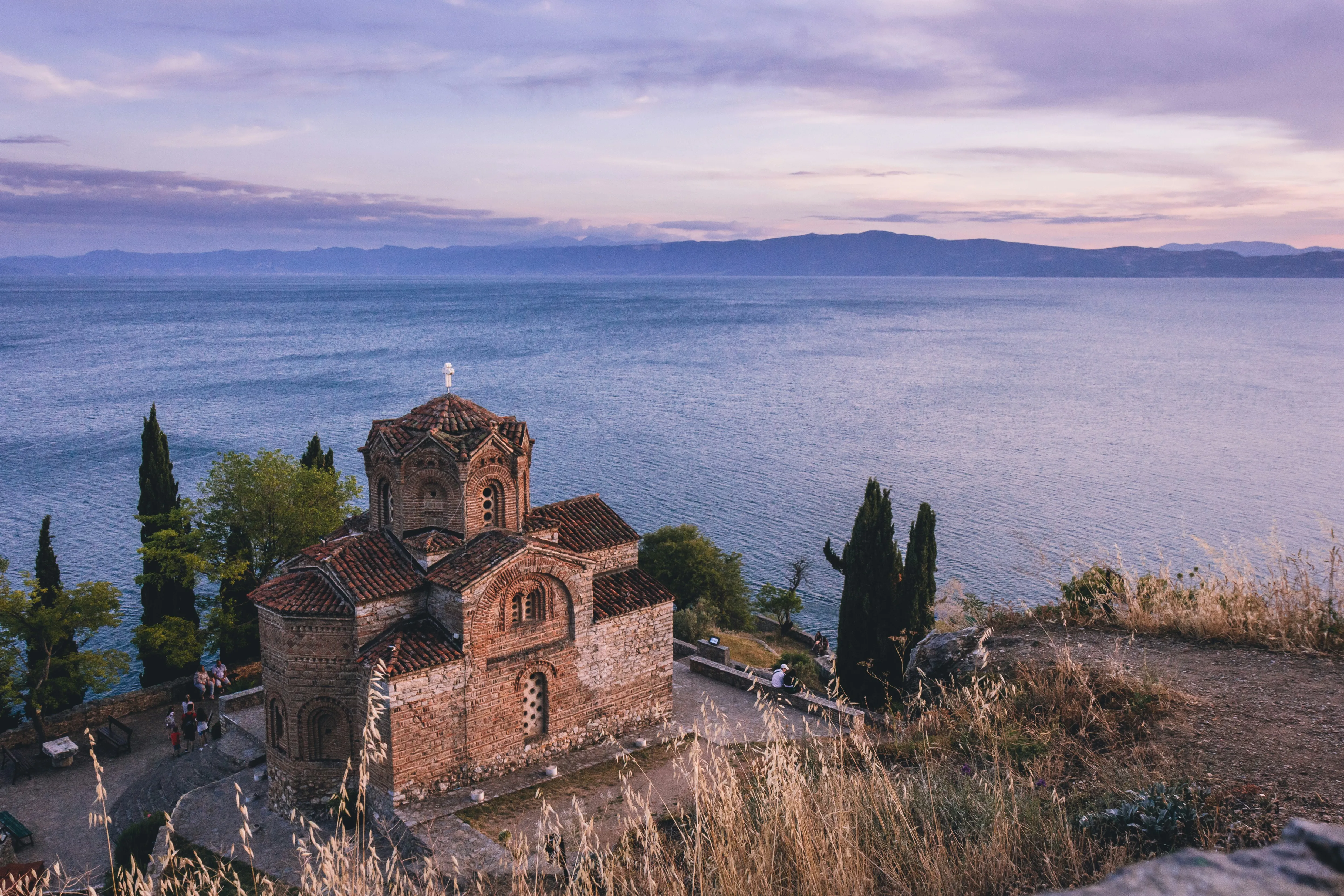
North Macedonia
A Balkan treasure to be discovered, featuring the mystical Lake Ohrid, ancient monasteries, wild mountains, and a vibrant culture that blends Byzantine, Roman, and Ottoman influences.
Quick Facts
- Capital
- Skopje
- Language
- Macedonian
- Albanian, Turkish, Serbian
- Currency
- Macedonian Denar (MKD)
- Best time to visit
- From May to September to enjoy nature and the lake.
- Budget per day
- $30 - $80 per day
- Climate
- Continental climate with hot, dry summers and cold winters with frequent snowfall in the mountainous areas of the country.
- Connectivity
- good
- Very easy to obtain at airports and telecommunications stores.
- Electricity
- Type C / F (230V)
- Local transport
- acceptable
- Card usage
- acceptable
- Tipping
- optional
🌎 Introduction
In the heart of the Balkans, where the trade routes of old left a deep mark, a territory of soft contrasts and a slow pace unfolds. Here, daily life seems to be set to the murmur of the water in its great lakes and the aroma of coffee that floods the squares at sunset. It is a place where Ottoman architecture coexists with ancient monasteries, creating a cultural mosaic that is perceived in both the bustle of local markets and the simple hospitality of its people.
The landscape transforms with the passing of the seasons, offering everything from snowy peaks that invite reflection to fertile valleys where peppers and grapes ripen under a generous sun. The local gastronomy, honest and rooted in the land, reflects a mixture of Mediterranean and continental influences; a plate of homemade ajvar or a glass of young wine are natural ways here to share time and celebrate the heritage received.
Walking through its cities or traveling the trails that wind between mountains is a glimpse into an identity patiently forged over centuries. In traditional festivities or in the simple gesture of chatting on a terrace, one breathes a mixture of serenity and vitality that defines the character of the region. It is a corner of southeastern Europe that shows itself as it is, without artifice, allowing the environment itself to narrate its story.
🛡️ General safety
North Macedonia is considered a destination with a high level of safety and, in general terms, it is a very peaceful country for the international traveler. Compared to other European destinations, crime rates are notably low, allowing for the enjoyment of its landscapes and cities with a constant sense of calm.
The context for the traveler is that of a hospitable country that seeks to increasingly integrate into international tourist circuits. Although it is not necessary to take exceptional measures, as with any trip, common sense and prevention are the best tools to guarantee a trouble-free experience.
Crime and common risks
Most visits to North Macedonia pass without incident. However, there are minor risks that are worth knowing:
- Petty theft: Pickpockets usually operate in crowded areas. It is advisable to watch your belongings in markets, transport stations, and busy pedestrian zones.
- Minor scams: Some tourists have reported overcharging in unregulated services. It is important to agree on prices before consuming services that do not have posted rates.
- Begging: In some urban areas, the presence of people asking for money is common, sometimes insistently, especially near monuments or terraces. The ideal approach is to politely decline and continue on your way.
Safety in cities and tourist areas
Macedonian cities, including the capital, Skopje, and the tourist destination Ohrid, are generally safe both day and night.
- Urban centers: Central areas and tourist neighborhoods have good lighting and a preventive police presence. The Old Bazaar of Skopje is very safe, although it is advisable to be mindful of belongings due to the density of people.
- Public transport: It is safe to use, although during peak hours urban buses can be very full, a time that pickpockets take advantage of.
- Practical recommendation: Avoid showing high-value objects or large amounts of cash in public unnecessarily. It is preferable to leave the original passport in the hotel safe and carry a photocopy.
Transport safety
Moving around the country is simple, but requires attention to certain logistical and road safety details:
- Public transport and buses: The intercity bus network is the most common medium and is completely safe. Stations are usually busy places but without major risks.
- Taxis: It is recommended to exclusively use official taxis (with a visible license and identification number). Always ensure that the driver activates the taximeter at the start of the journey or agree on a fixed price beforehand if the trip is long-distance.
- Driving: In North Macedonia, driving is on the right. The condition of main roads is acceptable, but in rural or mountain areas, they can be narrow and less illuminated. Special attention should be paid to local driving, which can be somewhat unpredictable, and the potential presence of animals on rural roads.
- Rental vehicles: This is a safe and popular option. It is recommended not to leave valuables in sight inside the car when parked in isolated or poorly guarded areas.
Natural and climatic risks
The country presents some geographical particularities that the traveler should keep in mind depending on the time of year:
- Seismic activity: North Macedonia is located in an area with seismic activity. Although perceptible earthquakes are infrequent, it is useful to know basic self-protection rules (stay calm, stay away from objects that could fall).
- Extreme heat: During the months of July and August, temperatures can exceed 40°C. It is essential to stay hydrated and avoid direct sun exposure during the central hours of the day.
- Mountain climate: If you go hiking or engage in winter sports, the weather can change abruptly. Always inform your accommodation about your route and check the weather forecast.
- Forest fires: In summer, due to the heat and dryness, the risk of fires in forested areas is real. Respect bans on making fires.
Local legislation and norms
Compliance with local regulations is essential to avoid misunderstandings with the authorities:
- Identification: It is mandatory to carry a valid identification document at all times. The police have the right to request it to identify you.
- Photography: It is strictly forbidden to photograph military installations, government buildings, border posts, or security personnel. There are usually warning signs; when in doubt, it is better not to use the camera.
- Prohibited substances: Laws related to the possession and consumption of drugs are very strict and carry prison sentences, with no distinction between personal consumption or trafficking.
- Stay registration: Tourists must register at the local police station within 24 hours of their arrival. If you stay in a hotel or regulated establishment, they usually carry out this procedure automatically, but it does not hurt to confirm it.
Safety for specific groups
- Female travelers: North Macedonia is a safe destination for women traveling alone. There are no specific cultural restrictions regarding clothing, although discretion and respect are recommended when visiting Orthodox churches or mosques (covering shoulders and knees).
- LGTBIQ+ travelers: Although homosexuality is legal, Macedonian society is mostly conservative. Public displays of affection may attract uncomfortable looks or comments, so discretion in public spaces outside the more modern circles of the capital is generally recommended.
- Traveling with children and the elderly: The country is very family-oriented and welcoming to the elderly. The main difficulties may be architectural barriers (cobblestone streets in old towns) that complicate the use of strollers or wheelchairs.
Emergencies and assistance
In case of needing urgent help, these are the basic protocols and contact numbers:
- 112: General emergency number (equivalent to the European standard).
- 192: Police.
- 193: Fire department.
- 194: Ambulance / Medical emergencies.
Emergency personnel in major cities usually have some knowledge of English, although in rural areas communication may be more limited. In the event of an incident, such as the theft of documentation, you should go to the nearest police station to file a report (“prijava”), an essential document for subsequent consular procedures.
Tip: Always keep the proof of police registration given to you at the hotel (or the white registration card) until you leave the country, as border authorities may request it.
📝 Entry requirements
To organize a trip to North Macedonia, the first fundamental step is to ensure you have a valid travel document. Generally, a passport is required with validity extending at least a few months beyond the planned date of departure from the territory. Depending on current international agreements, some visitors may enter with their national identity document, although a passport remains the most recommended option to avoid delays at border posts.
Regarding entry authorization, a large portion of international tourists can enjoy short stays without needing to arrange a visa in advance at consulates or embassies. The usual period allowed for leisure activities is a maximum of 90 days within a six-month interval. It is common for border authorities to request additional information during the entry process, such as confirmation of a return ticket or departure to a third destination, as well as proof of possessing sufficient financial means to cover expenses during the planned stay.
When crossing borders, whether through international airports or by land, routine security and customs checks are carried out. Travelers should keep in mind standard customs regulations, which usually limit the import of products such as tobacco, alcohol, or certain luxury items above the quantities allowed for personal use. Likewise, the entry of fresh food or products of animal origin may be subject to strict restrictions for biosecurity reasons. In the case of transporting regular medications, it is advisable that these travel in their original packaging and be accompanied by a descriptive medical prescription.
From a health point of view, mandatory vaccinations are not usually required generically to enter the country, unless coming from areas with specific epidemiological risks. However, it is strongly recommended that travelers keep their basic vaccination schedule up to date and consider purchasing travel medical insurance with international coverage, which guarantees peaceful assistance in the event of any health contingency during the stay.
Below is a summary of the key aspects for access and stay in the territory:
- The passport must be in perfect condition and have enough space for control stamps.
- It is convenient to verify that the document’s validity covers the entire planned stay period to avoid administrative complications when leaving.
- Authorities may request the accommodation address, so it is recommended to have the hotel reservation or host information handy.
- There is a standard foreigner registration procedure that hotel establishments normally perform automatically upon check-in.
- The transport of valuables or large amounts of cash should be consulted beforehand to comply with customs declaration limits.
- Baggage checks are standard, seeking to ensure that the items introduced are exclusively for tourist or personal purposes.
🏥 Basic health considerations
When preparing your trip to North Macedonia, you will see that it is generally a safe destination from a health perspective. The health system has a network of public centers and private clinics, especially in the capital, Skopje. Although public healthcare covers the basics, as a tourist you will likely prefer to go to private medicine, as it offers more modern facilities and much shorter waiting times. The cost of private consultations is reasonable, but complex treatments can quickly increase in price. You will find that much of the medical staff in private centers speaks English, which will greatly facilitate communication.
It is highly recommended, although not legally mandatory for entering the country, that you take out travel medical insurance with broad coverage. I suggest that this insurance includes hospitalization and, above all, medical repatriation. Having this protection will give you peace of mind if you need to be transferred to a specialized center or back to your place of residence.
Regarding vaccinations, there are none mandatory for entering Macedonian territory. The most important thing is that you have your regular vaccination schedule up to date, including common vaccines such as hepatitis or tetanus. For most travelers, this is more than enough. If you plan on doing a lot of hiking or spending time in rural areas, you might consult a doctor about the tick-borne encephalitis vaccine, but for standard tourism, it is usually not necessary.
If you take regular medication, I advise you to bring it from home in its original packaging. You will find well-equipped pharmacies in the main cities, but it is always better to have what you already know with you. If your medication is specific, don’t forget to bring the medical prescription or a report from your doctor translated into English in case it is requested at customs or you need an urgent refill.
The most common health risks depend on the time you travel. In summer, the heat can be intense in areas like the Vardar valley, so you should stay well-hydrated and protect yourself from the sun. In winter, especially in Skopje, air quality can be affected by coal heating and the city’s geographical situation, something to keep in mind if you have prior respiratory problems. In mountain and forest areas, it is advisable to check your skin after a walk to avoid tick bites.
Regarding water and food, you will see that tap water is potable in most large cities, although many people prefer to buy bottled water for its taste or to avoid minor stomach upsets if their system is very sensitive. Food hygiene in restaurants is good, so you can try the delicious local gastronomy without fear. Just take basic precautions with street food, such as observing that the place is clean and busy.
In case of a serious medical emergency, the phone number you should dial is 194. This service manages ambulances, although you should know that sometimes traffic in the cities can slow down their arrival. If the situation permits, it is sometimes faster to go directly by your own means to the emergency department of a prestigious private hospital.
As final tips, remember to always carry a small first-aid kit with pain relievers, bandages, and disinfectant for minor wounds. Don’t forget your sunscreen and stay hydrated during your routes through the lakes or mountains. With these basic precautions, you will enjoy a peaceful and healthy stay in this corner of the Balkans.
🚌 Transport within the country
To move around North Macedonia, the bus is the most widely used means of transport by travelers. This system connects the main cities and tourist destinations regularly and frequently. Although there is a railway network that links some key points, the journeys tend to be slower and the frequencies lower, so the train is considered a more leisurely option for observing the landscape. Due to the country’s size, there are no domestic flights, and car rental is a common alternative for those who prefer to explore less accessible areas.
The use of public transport is functional, although it requires some attention from the visitor. Signage at major stations is usually available in Cyrillic and, occasionally, in Latin script as well. Ticket purchases are generally made at station ticket offices or directly from the staff on board on some rural routes. While in the most touristy areas it is possible to communicate in English, at transport points in more remote areas, interaction may be more limited.
There is a notable difference between large cities and rural areas. In urban centers like the capital, the local bus network is extensive and allows for easy movement between different districts. However, in mountain areas or small towns, the frequency of transport decreases considerably and travelers often depend on local van services or less formal transport services that connect small communities with the nearest cities.
Taxis are a very common resource and are present in almost all urban centers and points of interest. They are a convenient option for short trips or to reach places where public transport does not have a fixed stop. In general terms, the reliability of schedules is acceptable on main routes, although vehicle comfort can vary. It is convenient to keep in mind that the country’s topography, with numerous mountains, causes road trips to sometimes be longer than the distance on the map suggests.
Tip: Always check return schedules directly at the destination station, as transport frequency may vary depending on the day of the week or the season.
🤵 Culture and etiquette
Society in North Macedonia is characterized by a warm and hospitable treatment of visitors. Upon first contact, the most common gesture is a firm handshake while maintaining eye contact, which is interpreted as a sign of sincerity and respect. As trust grows, it is common for greetings to include hugs or kisses on the cheeks, reflecting a culture where physical contact is common in interpersonal and social relationships.
The pace of daily life is usually relaxed, especially regarding social encounters. Although punctuality is appreciated in official or professional contexts, there is greater temporal flexibility in informal meetings. Conversations in public spaces, such as cafes and markets, tend to be animated and vibrant; the volume of the voice may naturally rise due to the enthusiasm of the talk, without this signifying a lack of courtesy or a confrontation.
Coffee culture is a central element of coexistence, and meeting to share a drink is the preferred way to socialize, potentially lasting for hours. In restaurants, it is customary to leave a tip of approximately ten percent of the bill or to round up the amount as a gesture of gratitude for the service. If one has the opportunity to be invited to a private home, it is considered a polite detail to bring a small gift, such as sweets or flowers, and it is common for hosts to suggest removing shoes upon entering the home.
Respect for traditions and religious spaces is fundamental for harmonious coexistence. When visiting Orthodox churches or mosques, it is important to dress discreetly, covering shoulders and knees, and to maintain a low tone of voice. Given the country’s rich ethnic diversity, it is positively valued that the traveler shows an attitude of openness and sensitivity toward different cultural sensibilities, avoiding simplifications about local identity and showing interest in the customs unique to each community.
“Tip”: When making a toast, it is a fundamental rule of courtesy to maintain eye contact with the people present while pronouncing the word “Nazdravje”, as this gesture symbolizes trust and goodwill among the diners.
🍛 Typical gastronomy
The cuisine of North Macedonia is a reflection of a rich blend of Mediterranean, Balkan, and Oriental influences. The country’s climate, with abundant hours of sunshine, allows for the cultivation of high-quality vegetables and fruits that form the basis of most of its dishes. Fresh products, especially tomatoes and peppers, are fundamental to its daily diet, providing intense and natural flavors to all preparations.
The pace of meals in this region is usually slow, as the act of eating is understood as a social event. It is very common for lunches or dinners to begin with a selection of small dishes or appetizers called meze, intended to be shared quietly while conversing. The use of clay pots for slow cooking is a widespread traditional technique, giving stews a very characteristic texture and depth of flavor.
Regarding drinks, rakija (a fruit brandy) is the preferred option to accompany appetizers, while local wines enjoy an excellent reputation thanks to the winemaking tradition of the central valleys. To close meals, Turkish-style coffee, strong and aromatic, is a constant in the daily life of its inhabitants. In hospitality establishments, the treatment is usually close and the atmosphere relaxed, without excessively strict etiquette.
Dairy products also play a leading role, highlighting white brine cheese, similar to feta but with nuances specific to the area, which is grated or crumbled over almost any salad or main dish. Bread is an essential accompaniment that is never missing from the table, often used to soak up the sauces and juices from stews and roasts.
| Dish | Description | Main Ingredients | Where to try it | Tip |
|---|---|---|---|---|
| Tavče Gravče | The national dish, consisting of traditionally baked white beans. | Beans, onion, paprika, and spices. | Traditional food restaurants or kafanas. | Always order it in a clay pot to keep the heat. |
| Ajvar | A very versatile vegetable preserve with a sweet and slightly smoky flavor. | Roasted red peppers, eggplant, and oil. | Local markets and as an accompaniment to any meal. | Try it on a slice of bread with grated white cheese. |
| Pastrmajlija | A kind of oval bread dough topped with pieces of seasoned meat. | Flour dough, pork or lamb, and lard. | Typical of the cities of Veles and Štip, but common throughout the country. | It is a hearty dish ideal for sharing as a main course. |
| Šopska Salata | A refreshing salad usually served as a starter or side dish. | Tomato, cucumber, onion, and plenty of grated white cheese. | In virtually all restaurants in the country. | It is the perfect accompaniment for rakija at the start of dinner. |
| Sarma | Vegetable leaf rolls filled with a savory mixture and slow-cooked. | Fermented cabbage or vine leaves, minced meat, and rice. | Very common in winter menus and family festivities. | Look for homemade versions offered in guest houses. |
📷 Areas and places to visit
North Macedonia is a destination that surprises with its ability to interweave remnants of ancient civilizations with a constantly evolving modernity. Exploration of the country usually begins in its capital, Skopje, a city marked by architectural contrasts. Walking through its streets, it is possible to transition from the medieval atmosphere of the Old Bazaar, one of the largest and best-preserved in the Balkans, to the monumentality of the new area. In the heart of the city stands the Stone Bridge, which connects Ottoman history with wide contemporary squares. Other points of cultural interest include the Kale Fortress, from which panoramic views of the surroundings are obtained, and the Mother Teresa Memorial House, dedicated to one of the most universal figures born in this region.
To the southwest lies the jewel of Macedonian heritage: the Ohrid region. This enclave, declared a World Heritage Site, combines the beauty of one of the oldest and deepest lakes in Europe with an exceptional historic center. Strolling through its cobblestone streets allows for the discovery of gems such as the Church of St. John at Kaneo, situated on a cliff over the water, or Samuel’s Fortress, which dominates the horizon. Lake Ohrid is not just a visual attraction, but also a center for activities where boat trips can be taken or the Monastery of Saint Naum can be visited, located near the border in an area of natural springs of great ecological value.
In the southern area, the city of Bitola offers a different atmosphere, known for its diplomatic heritage and architectural elegance. The pedestrian street Shirok Sokak is the nerve center of social life, flanked by neoclassical style buildings and traditional cafes. On the outskirts of the city, archaeology lovers can explore the ruins of Heraclea Lyncestis, an ancient city founded by Philip II of Macedon, where its detailed Byzantine mosaics stand out. This region also serves as a gateway to Pelister National Park, ideal for those seeking hiking routes among pine forests and glacial lakes.
Macedonian nature presents very varied settings that invite active tourism and contemplation. Matka Canyon, located a short distance from the capital, is a frequent destination for kayaking and visiting deep caves like Vrelo. On the other hand, Mavrovo National Park houses the highest peaks in the country and is famous for its iconic submerged church in the artificial lake. These natural environments are perfect for observing local flora and fauna, in addition to visiting small mountain villages where artisanal crafts and gastronomic traditions linked to the land are still maintained.
To understand the diversity of the country, it is recommended to visit wine regions like Tikveš, where the landscape transforms into rolling hills covered with vineyards. Here, wine culture is an essential part of the local identity. Similarly, the east of the country offers a more rural and authentic vision, with monasteries hidden in the hills and local markets where the exchange of fresh products remains the center of the community. The contrasts between the urban life of Skopje and the serenity of its natural and rural spaces allow the visitor to obtain a balanced and complete vision of what this territory has to offer.
Tip: You cannot miss visiting Lake Ohrid, the most emblematic place in the country.
✈️ Best time to travel
North Macedonia has a transitional climate between Mediterranean and continental, which allows for very different experiences depending on the time of year. The choice of the ideal time depends on the traveler’s priorities: those looking for hiking and nature will find their best ally in the temperate months, while fans of snow sports or the summer atmosphere of the lakes will prefer the extreme seasons.
In general terms, the period between May and September offers the most stable conditions for touring the country comprehensively. During these months, the days are long and most points of cultural interest and national parks are fully accessible, allowing for a combination of urban visits with the exploration of its mountainous landscapes and rural areas.
| Season | Months | Typical climate | What to expect | Tourist influx |
|---|---|---|---|---|
| Spring | Mar – May | Mild temperatures (10°C - 20°C) and occasional rain. | Green landscapes, blooming in national parks, and snowmelt in the mountains. | ⭐⭐ Medium - Low |
| Summer | Jun – Aug | Hot and dry, with maximums that can exceed 30°C. | Swimming season at Lake Ohrid, outdoor cultural festivals, and high mountain routes. | ⭐⭐⭐⭐ High |
| Autumn | Sep – Nov | Cool and pleasant, with a gradual decrease in temperatures. | Ochre colors in the forests, harvest season in wine regions, and a quiet atmosphere. | ⭐⭐ Medium |
| Winter | Dec – Feb | Cold, with frequent frosts and snow in high areas. | Skiing in resorts like Mavrovo, snowy landscapes, and traditional January celebrations. | ⭐ Low |
🗣️ Basic vocabulary
Learning some basic notions of the local language will help you navigate with greater ease during your stay in North Macedonia. Although English is quite widespread in hotels and more touristy areas, local inhabitants usually appreciate travelers knowing some courtesy terms, especially in markets, small towns, or when using public transport.
Having these simple expressions will allow you to manage daily situations in a more fluid and friendly way. Here is a selection of practical words for your trip:
- Zdravo: Hello.
- Blagodaram: Thank you.
- Molam: Please (also used to respond “you’re welcome”).
- Da: Yes.
- Ne: No.
- Izvinete: Excuse me or sorry.
- Kolku chini?: How much does it cost?
- Prijatno: Goodbye or have a nice day.