


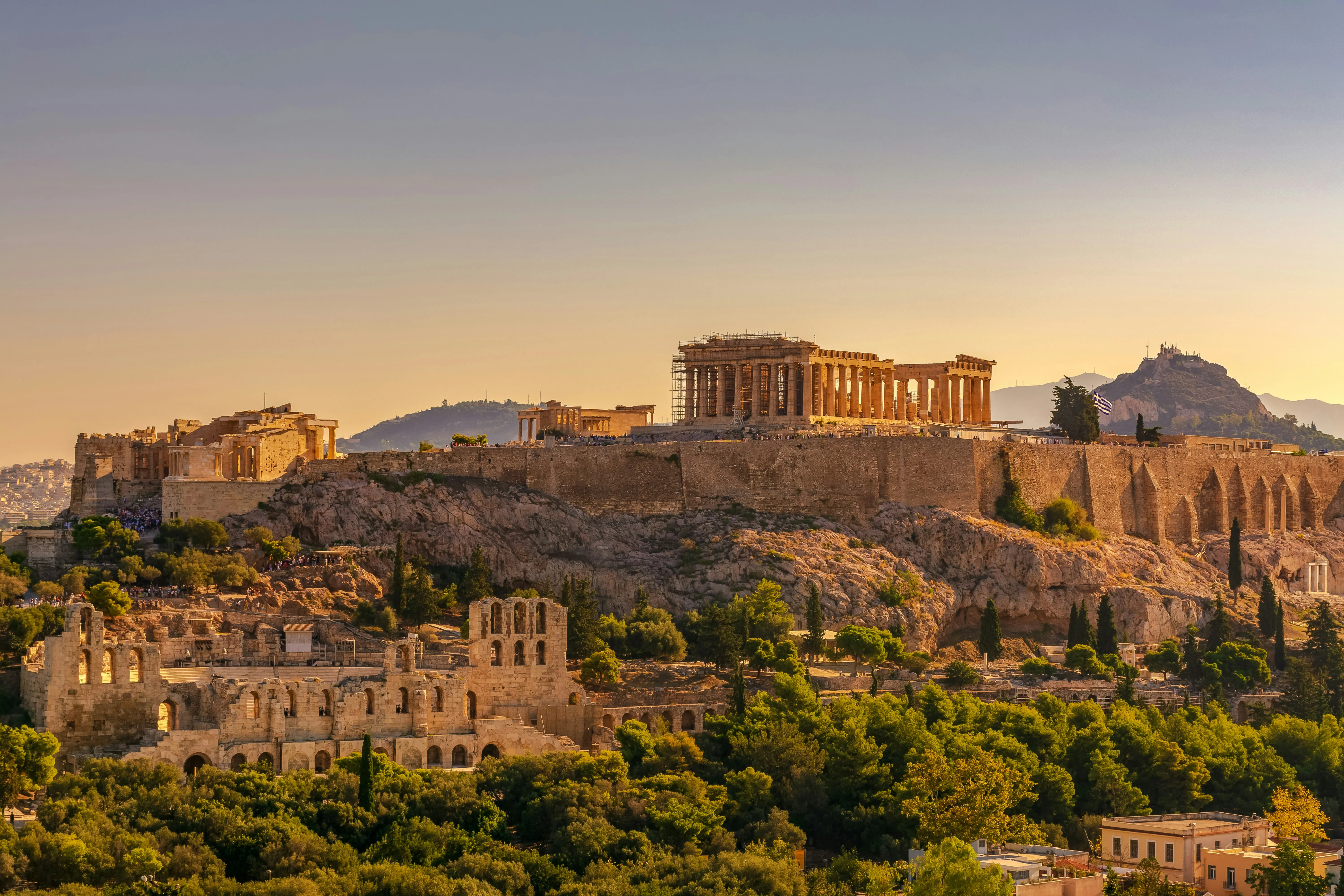
Greece
Cradle of Western civilization, Greece captivates with its millenary temples, crystal-clear water beaches, picturesque islands, and a truly unforgettable and healthy Mediterranean gastronomy.
Quick Facts
- Capital
- Athens
- Language
- Greek
- English (very widespread)
- Currency
- Euro (€)
- Best time to visit
- From April to June and from September to October to avoid extreme heat and crowds.
- Budget per day
- $60 - $180 per day
- Climate
- Typical Mediterranean climate, with dry, hot summers and mild, rainy winters, especially sunny in coastal areas.
- Connectivity
- good
- Very easy to obtain at airports and local shops; wide availability of SIM cards and eSIMs.
- Electricity
- Type C / F (230V)
- Local transport
- acceptable
- Card usage
- very widespread
- Tipping
- optional
🌎 Introduction
In the corner where the blue of the sea merges with a mountainous and rugged terrain, a territory unfolds that seems to have been sculpted by the passage of time and light. It is not just a collection of islands and sun-drenched coasts; it is a space where life flows at a different rhythm, marked by the simplicity of a conversation in a square and the aroma of wild oregano. The landscape changes naturally from the peaks of the interior to the small churches that dot the coastline, offering a diversity that goes far beyond the best-known images.
The identity of these lands is perceived in their daily customs and in their respect for their roots. Walking through its towns allows you to encounter the sound of leisurely chats, tables shared with local products, and a welcome that feels close. Each season brings a different nuance: the rebirth of nature in spring, the atmosphere of popular celebrations in summer, or the serenity of the cooler months. It is an environment where history is not limited to monuments, but spontaneously coexists with the present.
🛡️ General safety
Greece is considered, in general terms, a very safe destination for international travelers. Its safety level is high, standing in line with most European Union countries. The atmosphere is usually hospitable and relaxed, allowing tourists to enjoy their holidays with a constant sense of tranquility, both in mainland areas and on the islands.
Although the country has gone through periods of social unrest in the past, these usually manifest locally and do not typically target tourists. The general context for the traveler is that of a country that values and takes care of tourism, with a robust security infrastructure and a population accustomed to receiving visitors of all nationalities.
Crime and common risks
Violent crime is extremely rare in Greece, especially that directed at visitors. However, as in any mass destination, there are minor risks that are worth knowing:
- Theft and pickpocketing: They are the most frequent problem, especially in places with large crowds, historical monuments, and transport stations.
- Scams in establishments: In very busy areas, some places might try to charge excessive prices or not show the price list. It is always recommended to verify prices before consuming.
- Street scams: Situations may occur where people offer “gifts” (such as bracelets or flowers) and then insistently demand payment.
Safety in cities and tourist areas
Safety in urban centers such as Athens or Thessaloniki is good, although it requires the normal attention of any large city.
- Specific neighborhoods: In Athens, areas like Syntagma Square, Monastiraki, and Omonia are very safe during the day, but it is advisable to be more attentive at night in less-lit streets or peripheral areas.
- Public transport: The Athens metro is efficient and modern, but it is the main point of operation for pickpockets. It is recommended to carry your backpack or bag in front and not neglect valuables at busy stops.
- Greek islands: On the islands, the safety level is even higher than in the cities. In many cases, crime rates are practically non-existent, allowing full mobility at any time of the day or night.
Safety in transportation
Moving around Greece is simple, but there are particularities that the traveler should take into account to guarantee their safety:
- Public transport and ferries: They are safe and reliable means of transport. Ferries comply with strict maritime safety regulations.
- Taxis: It is recommended to use official taxis and ensure that the meter is turned on or agree on a fixed price before starting the journey for long trips. There are popular mobile applications that offer greater traceability.
- Driving: In Greece, people drive on the right. Driving can be somewhat aggressive compared to other countries, so extreme caution is recommended on secondary or mountain roads, where the pavement can be irregular.
- Rental vehicles: When renting motorcycles or quads (very common on the islands), the use of a helmet is mandatory. Many accidents occur due to a lack of experience with these vehicles or the condition of rural tracks.
Natural and climatic risks
Greece presents some risks derived from its geography and climate that the tourist must manage preventively:
- Extreme heat: During the months of July and August, temperatures can exceed 40 °C. It is essential to stay hydrated and avoid direct sun exposure during the central hours of the day to prevent heat stroke.
- Forest fires: Due to high temperatures and dryness, the risk of fires is high in summer. Local authorities’ instructions must be strictly followed, and lighting fires in forested areas must be avoided.
- Seismic activity: Greece is located in an area of seismic activity. Although perceptible earthquakes are not daily, the country has very strict construction protocols, and emergency services are well prepared.
- Strong winds (Meltemi): In the Cyclades islands, during the summer, the Meltemi wind can be very intense, affecting the navigation of small boats and beach conditions.
Legislation and local norms
It is important to respect local laws to avoid legal inconveniences or fines:
- Military facilities: It is strictly forbidden to take photographs of military facilities, navy ships, military airports, or defense personnel. Non-compliance can lead to arrests and espionage charges.
- Prohibited substances: Greece has very strict laws against the possession, consumption, or trafficking of drugs (including cannabis). Prison sentences can be severe.
- Antiquities: It is illegal to take antiquities (stones from archaeological sites, pottery fragments, etc.) out of the country without proper permits. The export of cultural goods is heavily regulated.
- Behavior in sacred places: When visiting churches or monasteries (especially in places like Meteora), one must dress respectfully, covering shoulders and knees.
Safety for specific groups
Greece is an inclusive and welcoming country, with specific considerations for different types of travelers:
- Female travelers: Greece is a very safe country for women traveling alone. Respect is the general rule, and it is unusual to suffer street harassment.
- LGTBIQ+ travelers: In large cities and on cosmopolitan islands like Mykonos or Santorini, there is great acceptance and a vibrant social life. In very deep rural or religious areas, society can be more conservative, so discretion is recommended in those specific areas.
- Travel with children and the elderly: The country is ideal for families. Greeks have a deep respect for the elderly and children, who usually receive preferential and affectionate treatment in shops and restaurants.
Emergencies and assistance
In case of needing immediate help, the traveler has several assistance channels:
- Single emergency number: 112 is the free number to contact police, ambulances, or firefighters. They answer in several languages, including English.
- Tourist Police: There is a specific division called the Tourist Police (dialing 171), designed to help visitors in case of lost documents, reports of theft, or conflicts with establishments.
- Healthcare: The public health system is competent, although on small islands resources may be limited, with serious cases being referred to Athens or Crete. It is always recommended to travel with private medical insurance to speed up any care procedures.
Tip: Before using a taxi or booking an excursion in very touristy areas, always confirm that the final price includes all taxes and supplements to avoid surprises at the time of payment.
📝 Entry requirements to the country
To plan a trip to Greece, it is essential to keep in mind that most international travelers must have a valid passport whose validity usually extends at least three months beyond the planned date of departure. The document must be in good condition to avoid inconveniences at border control points. Depending on the place of origin, many people can enter for tourism purposes without the need for a prior visa, provided that the stay does not exceed a certain period, which is usually established at a maximum of 90 days within a six-month interval.
Upon arrival at airports or ports, authorities may request additional documentation that supports the tourist nature of the trip. This may include the presentation of a return ticket or departure to a third destination, as well as proof of having sufficient financial means to cover expenses during the stay in the territory. It is recommended to have the accommodation reservation or a letter of invitation handy if applicable, as controls can be random but detailed.
Regarding customs regulations, standard regulations for the transport of personal goods apply. Travelers can carry medications for their own use, preferably accompanied by their corresponding medical prescription translated if possible. There are limitations regarding the amount of tobacco, alcohol, and certain food products that can be introduced without declaring. It is essential to avoid transporting objects of archaeological value or antiquities without proper permits, as local laws are especially protective of their historical heritage.
From a health point of view, mandatory vaccines are not usually required to enter the country, although it is always advisable to have the standard vaccination schedule up to date. It is highly recommended to have travel insurance with broad medical coverage to cover any eventuality, given that access to healthcare can entail costs for foreign visitors. In general, the entry process is agile and designed to facilitate the flow of tourists in an orderly and safe manner.
🏛️ Tourist information of interest
Greece is a destination that combines unmatched historical wealth with natural landscapes of great beauty. Below are some key aspects to understand its tourist offer:
- Athens: The capital is the heart of classical civilization, where the Acropolis and the Parthenon stand out as universal symbols of ancient history.
- Cyclades Islands: An archipelago famous for its white houses and blue domes, with iconic destinations such as Santorini and Mykonos.
- Crete: The largest island in the country, known for its Minoan heritage, the palace of Knossos, and its crystal-clear water beaches.
- Peloponnese: A peninsula rich in archaeological sites such as Olympia, Mycenae, and the theater of Epidaurus.
- Delphi: Formerly considered the center of the world, it is a mystical place located on the slopes of Mount Parnassus.
🍽️ Gastronomy and culture
Greek cuisine is a fundamental pillar of the Mediterranean diet, standing out for the use of fresh and local ingredients:
- Olive oil: Considered the liquid gold of the region, it is the base of almost all traditional dishes.
- Moussaka: A baked layered cake of eggplant, minced meat, and béchamel that represents one of the most iconic dishes.
- Feta Cheese: Generally made with sheep and goat milk, it is an essential ingredient in salads and various appetizers.
- Souvlaki: Grilled meat skewers served as high-quality fast food throughout the country.
- Hospitality: The concept of Philoxenia (love of strangers) is an intrinsic part of the local culture, ensuring kind and welcoming treatment towards the visitor.
💡 Practical data for the traveler
To better organize the stay, the following points should be considered:
- Climate: The Mediterranean climate predominates, with hot, dry summers and mild winters, with spring and autumn being the most balanced times for tourism.
- Language: The official language is Modern Greek, although in tourist areas the use of international languages is very widespread.
- Currency: The common European currency is used, and the use of credit cards is widely accepted, although it is always useful to have some cash in rural areas or small islands.
- Transportation: The ferry network is essential for movement between islands, while on the mainland there are train and bus options that connect the main cities.
- Schedules: Shops usually have long hours in tourist areas, but it is common for local businesses to close during the central hours of the afternoon for rest.
🏥 Basic health considerations
The healthcare system in Greece has a generally quite good level, especially in large urban centers like Athens or Thessaloniki. You will find both public hospitals and private medical centers with modern equipment. You should keep in mind that in rural areas or on smaller islands the infrastructure may be more limited, although they always have basic primary care services. Medical staff usually have a high level of English, so you can communicate with them without major difficulties if you need to explain a symptom or ailment.
Having travel medical insurance is totally recommended, as it will allow you to access private healthcare quickly and avoid unnecessary waits. Your policy should include broad coverage for hospitalization, medical transfers, and repatriation, ensuring that any serious unforeseen event is financially covered. Although the cost of medical care is not among the highest in Europe, the expenses of a surgical intervention or an emergency transfer from an island can represent a significant outlay if you do not have insurance to support you.
Regarding vaccines, there are none that are mandatory to enter the country. It is enough to have your usual vaccination schedule updated, including common booster doses. You will not have to go through special procedures at international vaccination centers, as the epidemiological profile of the country is similar to that of any other Mediterranean European destination.
If you need to travel with your own medication, it is essential to carry it in its original container and, preferably, accompanied by a medical prescription or a report from your doctor specifying the treatment. This will avoid problems at customs controls and make things easier if you need to buy more units at a local pharmacy. You will find pharmacies easily in almost any town, identifiable by a green cross, where you can purchase basic health products with total safety.
The main health risks you might encounter are related to the weather. During the summer months, the intense heat can cause dehydration or sunstroke, so you should protect yourself properly. In some coastal areas, you might find sea urchins or jellyfish, so appropriate footwear for the water will be very useful. There is no presence of tropical diseases, so the risk of insect bites is limited to the usual nuisance of mosquitoes in humid or rural areas.
Regarding the consumption of water and food, tap water is potable and safe in cities like Athens or Thessaloniki. However, on many of the islands and in some rural areas, it is recommended to drink bottled water, as the local water may have a high mineral content or a taste that you do not find pleasant. Food hygiene standards are high, so you can try street food and typical dishes in taverns with total confidence.
If you find yourself in a health emergency situation, the phone number you should dial is 112, which is the single emergency contact, or 166 to directly contact the ambulance service. The emergency care system works efficiently, although on the islands the logistics can be somewhat more complex and slow due to the country’s geography.
As final practical advice, always remember to carry high-factor sunscreen and stay well-hydrated during your tourist routes. It is also a good idea to include a small basic first-aid kit in your luggage with pain relievers, disinfectant, and bandages for small scrapes that may arise when walking through archaeological sites. If you follow these simple guidelines, your experience in the country will be totally pleasant and safe.
🚌 Transportation within the country
Moving through Greek territory requires combining different means of transport due to its geography, which mixes mountainous areas with a large number of islands. The ferry is the most common mean to move between archipelagos, with regular connections departing mainly from the ports near the capital. For long-distance journeys on the peninsula, the bus is the option that reaches almost every corner, while the train connects the main cities in a more limited way. The plane is also frequent to save time on trips to more distant islands or between large urban centers.
The experience for the visitor is usually simple, as signage in stations and ports is usually available in both Greek and English. Ticket purchasing is usually done at ticket offices or authorized points of sale. In large cities, the use of the metro and tram greatly facilitates internal movements, while in rural areas or small islands the frequency is lower and transport depends more on specific bus schedules.
The use of taxis is a widespread practice throughout the country, proving useful for short journeys or to reach specific accommodations where public transport does not stop. Generally, the transport system is reliable, although in the case of boats it is worth considering that the state of the sea can influence punctuality. Car rental is also a common alternative for those seeking greater autonomy, especially for exploring the interior of the islands or less connected continental regions.
“Tip”: It is advisable to check schedules with some anticipation, especially outside of peak season, as the frequencies of boats and buses can vary according to the time of year.
🤵 Culture and etiquette
Social interaction in Greece is based on a deep-rooted tradition of hospitality, where close treatment and kindness towards the visitor are essential pillars of coexistence. In initial encounters, it is usual to perform a firm handshake maintaining eye contact. As trust develops, displays of affection such as hugs or kisses on the cheeks become common, reflecting a culture that values physical proximity and warmth in interpersonal treatment.
In public spaces and during meetings, it is frequent for conversations to take place with a high volume of voice and very active gestures. This behavior is usually a sign of enthusiasm and participation in the dialogue, rather than an indicator of tension or conflict. Regarding punctuality, there is a marked difference between the professional sphere, where rigor is expected, and the social environment, where schedules are usually more flexible and relaxed, allowing appointments to extend naturally.
The table is the center of social life, and meals are understood as moments to share without haste. When visiting restaurants, although service is usually included, it is a widespread custom to leave an additional tip or round up the bill as a gesture of gratitude if the treatment has been satisfactory. If you have the opportunity to be invited to a private home, it is considered a detail of courtesy to offer a small gift, such as sweets, flowers, or a bottle of drink, for the hosts.
It is fundamental to show an attitude of maximum respect towards traditions and the Orthodox Church, which plays a relevant role in the country’s identity. When entering monasteries or churches, one must dress discreetly, generally covering shoulders and knees, and maintain a low tone of voice. Likewise, it is important to observe the indications regarding photography inside the temples so as not to interfere with the atmosphere of recollection or in religious ceremonies that may be taking place.
Tip: When making hand gestures to indicate numbers or greet, try to keep your fingers together and do not extend your open palm towards others, as this gesture can be interpreted equivocally in certain local contexts.
🍛 Typical gastronomy
Greek gastronomy is one of the highest expressions of the Mediterranean diet, based on the use of fresh, seasonal, and local products. Virgin olive oil is the backbone of almost all its preparations, providing an unmistakable aroma and flavor. It is a cuisine that stands out for its simplicity and honesty, where the goal is to highlight the quality of the raw material without resorting to excessively complex preparations.
Among the flavors that define the local palate, aromatic herbs such as oregano, thyme, and mint stand out, as well as the recurrent use of lemon to season both meat and fish. Vegetables occupy a central place at the table, with eggplant, tomato, and zucchini present in many stews and salads. Likewise, dairy products, especially feta cheese and yogurt, are essential elements that accompany much of the daily meals.
Eating in Greece is, above all, a social and slow act. It is very common to start the meeting with mezedes, a selection of various small dishes shared in the center of the table to encourage conversation. Regarding schedules, lunch and dinner are usually eaten later than in other countries, with dinner being the moment of greatest social importance. In restaurants and taverns, the atmosphere is relaxed, and it is customary for water to be served as a courtesy when sitting at the table.
As for drinks, coffee plays a fundamental role in daily life, enjoyed during long breaks throughout the day. To accompany the dishes, local wine and traditional liquors like ouzo are the most frequent options. It is important to keep in mind that, although service is usually included, it is common to leave a small gratuity if the attention has been satisfactory. Bread is usually served automatically and is considered an indispensable accompaniment to take advantage of the sauces in the dishes.
| Dish | Description | Main ingredients | Where to try it | Tip |
|---|---|---|---|---|
| Moussaka | Baked layered dish similar to a lasagna but without pasta. | Eggplant, minced lamb or beef, and béchamel. | Traditional taverns in Athens or Crete. | It is a hearty dish; it is advisable to let it rest for a few minutes so the flavors settle. |
| Souvlaki | Roasted meat skewers served on a plate or inside a pita bread. | Marinated pork or chicken, spices, and lemon. | Street food stalls and grills throughout the country. | Order it with a little tzatziki sauce to bring freshness to the meat. |
| Horiatiki Salad | The classic Greek salad, refreshing and simple. | Tomato, cucumber, red onion, Kalamata olives, and a block of feta cheese. | Coastal restaurants and rural areas. | Feta cheese is usually served in one piece over the vegetables; break it up yourself before eating. |
| Spanakopita | Savory pie with crunchy dough, very popular as a snack. | Filo pastry, fresh spinach, feta cheese, and spring onion. | Local bakeries (fournos) and markets. | It is ideal for a light lunch while walking through the city. |
| Tzatziki | Very versatile cold sauce or cream that accompanies almost any meal. | Greek yogurt, grated cucumber, garlic, olive oil, and dill. | Any restaurant or tavern as part of the appetizers. | Try it spread on warm pita bread before the main dishes arrive. |
📷 Areas and places to visit
Greece is a destination where ancient history and contemporary life naturally intertwine in every corner. The starting point is usually Athens, a capital that combines the bustle of a modern metropolis with the constant presence of millenary monuments. Walking through the neighborhoods of Plaka and Monastiraki allows you to discover narrow streets, traditional markets, and squares full of life. In the heart of the city lies the complex of the Acropolis, where the Parthenon presides over the horizon, accompanied by the Acropolis Museum, a fundamental space for understanding the archaeological importance of the region.
Towards the south extends the Peloponnese, a peninsula rich in historical sites and coastal landscapes. In this area, Mycenae, linked to the Homeric civilization, and the Theater of Epidaurus, recognized for its acoustics, stand out. It is also possible to visit Olympia, the place where the ancient games originated, and cities with medieval influence like Monemvasia, built on a rock facing the sea. The contrast between the olive groves of the interior and the small bays with crystal-clear water defines the character of this rural and authentic region.
In the center of the country, the landscape becomes more mountainous and spiritual. Delphi, located on the slopes of Mount Parnassus, was considered in antiquity the center of the world and today offers a journey through temples and stadiums with views of the olive valley. Further north, the region of Thessaly houses the monasteries of Meteora, built on impressive sandstone rock pillars that rise towards the sky, creating a unique setting for hiking and contemplation.
Insular Greece offers an astonishing diversity spread across several archipelagos. In the Cyclades Islands, destinations like Santorini are recognized for their architecture of white houses and blue domes on a volcanic relief, while Mykonos stands out for its windmills and its traditional urban design. Other islands like Naxos or Paros allow you to enjoy a more leisurely atmosphere, with extensive beaches and routes that cross mountain villages dedicated to crafts and agriculture.
Crete, the largest island in the country, is a destination in itself that requires time to explore its contrasts. From the Palace of Knossos, the epicenter of Minoan culture, to the natural landscapes of the Samaria Gorge, ideal for hiking enthusiasts. In the archipelago of the Ionian Islands, Corfu stands out for its clear Venetian influence and its lush vegetation, offering an aesthetic different from the rest of the Greek islands.
The northern cities, like Thessaloniki, show a multicultural face with Roman, Byzantine, and Ottoman vestiges. It is a vibrant cultural center where food markets, contemporary art exhibitions, and film festivals mark the daily rhythm. This area is also the gateway to explore Mount Olympus, a protected area of great ecological value where mountain routes allow you to get to know the local flora and fauna in an environment surrounded by mythology.
Visiting Greece also involves participating in its leisurely lifestyle. Boat trips between islands, visits to local wineries in regions like Santorini or Nemea, and attending theater and music festivals during the summer months are common activities. Archaeological museums spread throughout the territory, as well as the small Byzantine churches of rural villages, complete an offer that satisfies both those seeking culture and those who prefer direct contact with nature and the sea.
Tip: You cannot miss visiting the Acropolis of Athens, the most emblematic place in the country.
✈️ Best time to travel
Choosing the right time to visit Greece depends largely on the type of experience being sought. Generally, the months between late spring and early autumn offer the most balanced conditions for most travelers. During this period, the Mediterranean climate guarantees bright days and temperatures that allow for the enjoyment of both the archaeological sites of the interior and the extensive coasts and islands.
Beyond the meteorology, the season significantly influences the pace of the trip. While summer is the time of greatest activity and vitality in the archipelagos, intermediate seasons like spring and autumn invite a more leisurely exploration. In these months, nature shows its greenest or golden face, and temperatures are ideal for hiking and cultural visits without the intensity of the summer sun.
| Season | Months | Typical climate | What to expect | Tourist influx |
|---|---|---|---|---|
| Spring | Mar – May | Mild and pleasant temperatures. Green landscapes and lengthening days. | Flora in bloom, ideal conditions for hiking and visits to monuments. | Medium ⭐⭐ |
| Summer | Jun – Aug | Dry heat and high temperatures. Clear skies and constant sun. | Coastal life in full swing, summer festivals, and a wide range of sailing options. | Very high ⭐⭐⭐⭐ |
| Autumn | Sep – Nov | Warm temperatures at the beginning, cooling towards November. Sea still warm. | Grape and olive harvest season. Quieter atmosphere on islands and in cities. | Medium - Low ⭐⭐ |
| Winter | Dec – Feb | Cool in the south and cold in the north. Possibility of snow in mountainous regions. | Urban cultural tourism, museums without waits, and snowy landscapes in the interior. | Low ⭐ |
🗣️ Basic vocabulary
Although in most tourist areas of Greece you will be able to communicate in English without problems, knowing some basic expressions in Greek will help you move more easily and connect better with the local people. It is a gesture of courtesy that is usually very well received in shops, restaurants, and hotels.
It is not necessary to master the Greek alphabet to get by; it is enough to memorize a few key words phonetically to facilitate daily interactions during your stay.
- Yassas: Hello or goodbye (polite form or addressed to several people).
- Efjaristó: Thank you.
- Parakaló: Please or you’re welcome.
- Né: Yes (it’s worth paying attention, as it is often confused with ‘no’ in Spanish by sound).
- Oji: No.
- Signomi: Sorry or excuse me.
- Logariasmós: The bill.
- Kalimera: Good morning.