


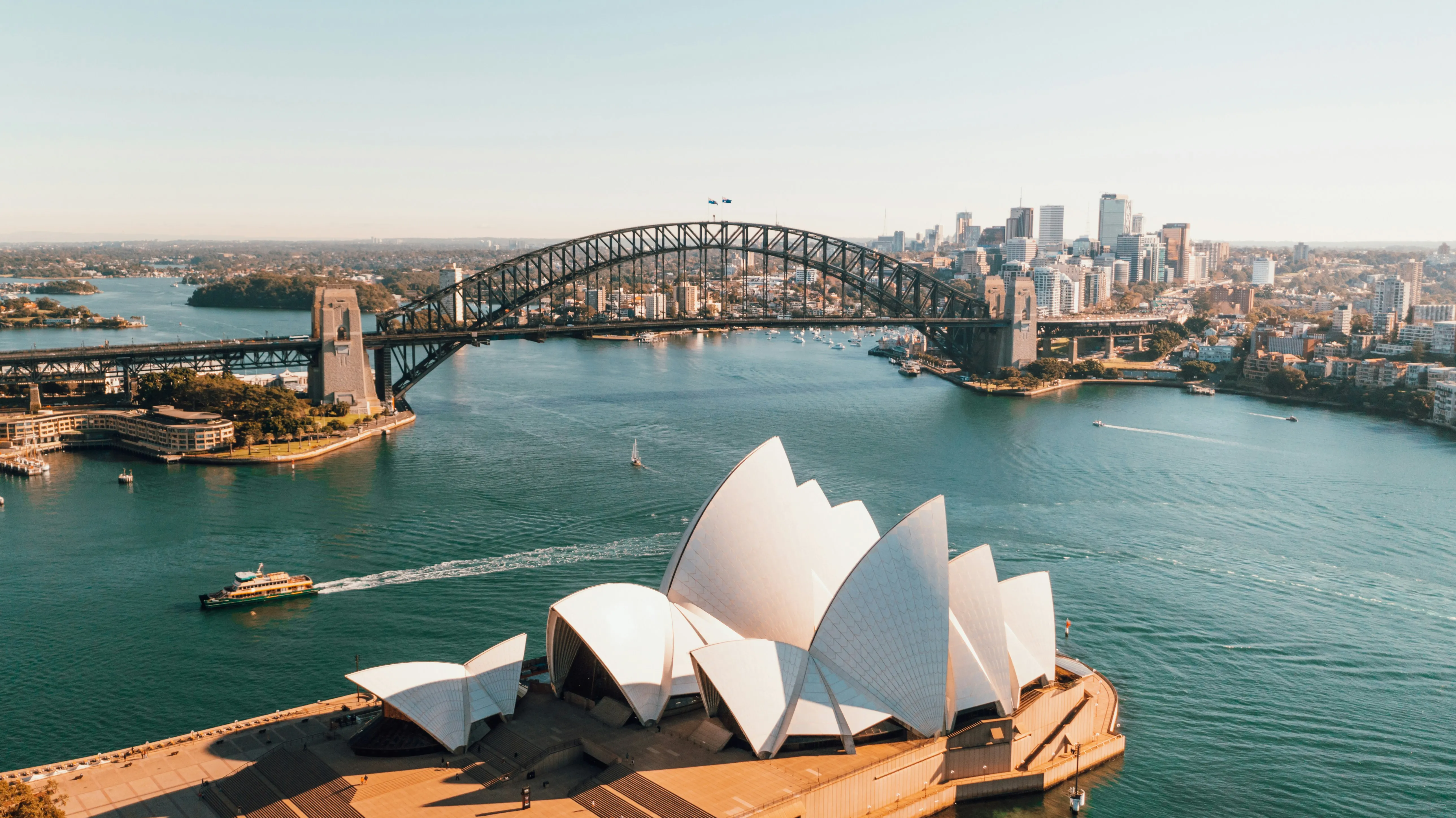
Australia
Australia captivates with its infinite landscapes, white sand beaches, and modern cities, offering a unique adventure among coral reefs and unforgettable wild nature.
Quick Facts
- Capital
- Canberra
- Language
- English
- None
- Currency
- Australian Dollar (AUD)
- Best time to visit
- From September to November and from March to May to enjoy pleasant temperatures in almost the entire country.
- Budget per day
- $100 - $250 per day
- Climate
- Varies from tropical in the north to temperate in the south, with warm summers and mild winters in most of the territory.
- Connectivity
- good
- Very easy to obtain at airports and local stores, with wide availability of prepaid cards and eSIM options.
- Electricity
- Type I (230V)
- Local transport
- good
- Card usage
- widespread
- Tipping
- optional
🌎 Introduction
Thinking of these lands is to imagine a horizon where the light seems to behave differently. Crossing the equator means finding a territory where the seasons are reversed, allowing traditions like Christmas to be experienced among warm sands and long sunsets. It is a space of marked contrasts, where vibrant cities, always overlooking the sea, coexist with the serenity of an unreachable interior tinged with ochre and reddish tones.
Daily life flows at its own pace, marked by a culture that values outdoor life and respect for a unique natural environment. Walking through its streets is usually accompanied by the aroma of freshly roasted coffee, a local hallmark, while fauna and flora integrate naturally into the everyday landscape. From the tropical forests of the north to the vineyard valleys of the south, the country’s identity is built on a millenary heritage that today dialogues with an open and diverse society.
Beyond the usual postcards, this corner of the world offers a different scale of distances and time. Its geography invites contemplation of clear skies and rock formations that have remained almost unchanged for centuries. It is, in essence, a destination that unfolds calmly, showing its variety through simple scenes, local markets, and a nature that claims its prominence in every corner.
🛡️ General safety
Australia is consistently considered one of the safest destinations in the world for travelers. The country enjoys great political and social stability, which translates into a peaceful environment where tourism can develop without major upsets.
In general terms, the safety level is very high. When compared to other top-tier international destinations, Australia presents extremely low rates of violent crime. International travelers can feel comfortable exploring both large metropolises and rural areas, always applying common sense and the basic precautions one would take anywhere in the world.
Crime and common risks
Although Australia is a very safe country, it is not exempt from minor incidents that can affect tourists. Most problems tend to be related to carelessness rather than acts of directed violence.
- Minor theft: Thefts of wallets or mobile phones can occur in high-traffic areas, such as main train stations, busy beaches (like Bondi Beach in Sydney), or nightlife areas.
- Thefts from vehicles: It is common for thefts to occur if valuables are left in sight inside rental cars or campervans, especially in national park parking lots or isolated viewpoints.
- Minor scams: Although rare, there may be cases of overcharging in unregulated services or internet scams related to temporary accommodation. It is recommended to always use official platforms.
- Infrequent risks: Violent crimes are rare, but it is advisable to avoid walking alone through poorly lit areas on the outskirts of large cities during the early hours of the morning.
Safety in cities and tourist areas
Australia’s urban centers, such as Sydney, Melbourne, Brisbane, or Perth, are very safe environments for the visitor. Surveillance is constant and the infrastructure is designed to facilitate the protected movement of people.
- Public transport: It is extremely safe and has surveillance cameras and security personnel. In cities like Sydney, there are “safe waiting zones” on train platforms for night hours.
- Entertainment areas: Bar and club areas (such as Fortitude Valley in Brisbane or Surfers Paradise on the Gold Coast) can become somewhat noisy or chaotic on weekends due to alcohol consumption. In these situations, it is best to stay clear of any altercations.
- Practical recommendations: It is advised not to carry large amounts of cash, as card payment is widespread in practically the entire country, even for small amounts.
Transportation safety
Transportation in Australia meets high-quality international standards, but the country presents unique geographical challenges that the tourist must know.
- Driving: It is fundamental to remember that in Australia people drive on the left. This requires special attention, especially at intersections and roundabouts, for drivers accustomed to the right.
- Rental vehicles and taxis: The use of taxis and private transport services (like Uber) is completely safe and regulated. Rental vehicles are usually in excellent condition.
- Roads and distances: Distances in Australia are immense. Outside the cities, it is vital to plan refueling and carry enough water.
- Wildlife on the road: It is recommended to avoid driving in rural areas during dawn or dusk, as this is when animals like kangaroos are most active and can cross the road unexpectedly, causing serious accidents.
Natural and climatic risks
This is perhaps the section where the tourist should pay the most attention, as the Australian natural environment can be hostile if local warnings are not respected.
- UV Radiation: The sun in Australia is extremely strong. The risk of severe sunburn is very high even on cloudy days. The use of high-factor sunscreen, a hat, and sunglasses is mandatory.
- Bushfires: During the Australian summer (December to February), the risk of fires is real in many rural and forested areas. It is essential to follow local news and emergency service applications.
- Extreme heat: In the center of the country (Outback), temperatures can exceed 40 °C. Dehydration is a serious risk for inexperienced hikers.
- Water safety: At beaches, it is vital to swim only between the red and yellow flags, which indicate that the area is patrolled by lifeguards. Additionally, in northern Australia (Queensland and Northern Territory), there is a risk of marine crocodiles and dangerous jellyfish (stingers) depending on the season.
Local legislation and regulations
Australia has strict laws whose compliance is closely monitored by the authorities. Ignorance of the rule does not exempt one from the penalty.
- Biosecurity: Australia has very strict customs rules to protect its ecosystem. It is forbidden to bring in fresh food, plants, seeds, or wood products without declaring them. Fines at the airport are immediate and high.
- Alcohol and tobacco consumption: Smoking is prohibited in almost all enclosed public spaces, transport stops, and near building entrances. Alcohol consumption in the street is restricted in many urban areas (alcohol-free zones).
- Zero tolerance: Laws against driving under the influence of alcohol or drugs are very severe, with frequent checks and fines of thousands of dollars or prison sentences.
Safety for specific groups
Australia is an inclusive and respectful country, which makes it an ideal destination for all types of travelers.
- Solo female travelers: It is a very safe destination for women traveling alone. There are no cultural restrictions on clothing and general respect is the norm.
- LGTBIQ+ travelers: The country is a pioneer in rights and acceptance. Areas like Darlinghurst in Sydney are world references for diversity and safety for the collective.
- Children and the elderly: Infrastructure (hospitals, parks, access) is perfectly adapted. The health system is first-class, although it is essential to travel with private medical insurance with broad coverage, as healthcare for tourists is very expensive.
Emergencies and assistance
In case of needing help, Australian services are fast and very efficient.
- Emergency number: The single number for police, ambulance, and fire services is 000 (Triple Zero).
- Police attention: The police are professional, helpful, and trustworthy. If you suffer a theft or incident, you must go to the nearest police station to obtain a report necessary for insurance.
- Consular assistance: It is recommended to always have the contact details of the consulate or embassy of your country of origin written down for cases of lost passports or serious emergencies.
”> Tip: Download the official emergency app for each state you visit (such as ‘Fires Near Me’ for New South Wales) to receive real-time alerts about weather conditions or bushfires.”
📝 Entry requirements
To plan a trip to this destination, the first fundamental step is to have a valid passport with sufficient validity, usually recommended to be at least six months from the planned date of arrival. This document is the basic piece of identification and is essential for any entry procedure at border control posts.
In the vast majority of cases, international visitors require prior obtaining of an electronic travel authorization or a tourist visa. These permits usually allow a maximum stay of up to ninety days for recreational purposes or personal visits. It is advisable to manage this permit sufficiently in advance of the start of the journey to ensure that all documentation is in order before boarding.
Upon arrival at land or airport entry points, authorities usually perform routine checks where they may request the presentation of an exit ticket from the country or proof that sufficient financial funds are available to cover expenses during the planned stay period. Inspection processes are thorough and seek to guarantee compliance with coexistence and safety rules.
An aspect of special relevance is the biosecurity and customs regulations. There is very strict surveillance on the introduction of food, plant products, or animal derivatives, as the goal is to protect the local ecosystem from possible pests or diseases. In the case of carrying medications for personal use, it is recommended to carry the medical prescription or a descriptive letter to facilitate verification by customs agents.
Regarding public health, specific vaccines are not usually required in a generalized manner to enter the territory, unless the traveler comes from areas with a risk of certain diseases. Nevertheless, it is a common practice recommended by experienced travelers to keep the standard vaccination schedule up to date and to have health assistance support for any eventuality during the tour.
Below is a summary of some of the elements that are usually subject to inspection or declaration at control points:
- Identity documentation and electronic travel permits linked to the passport.
- Fresh food products, packaged food, or seeds that may affect biosecurity.
- Camping or sports equipment that may contain traces of soil or organic matter.
- Amounts of currency exceeding the limits established for entry without prior declaration.
- Prescription medications which must be duly justified before the authority.
🏥 Basic health considerations
Australia has a first-class health system, with modern facilities and highly qualified professionals who will offer you excellent care. As a tourist, you will have access to both public and private healthcare, although you must take into account that the costs are high for foreign visitors. The main language in which the healthcare staff will assist you is English, so if you do not master the language, it will be useful to carry a translation app or verify if your insurance offers an interpreter service.
Contracting travel medical insurance is not usually a mandatory requirement to obtain a tourist visa, but it is something completely recommended. Any small mishap or medical consultation can result in a very high bill that you will have to pay out of your own pocket. When choosing your policy, make sure it covers hospitalization, diagnostic tests, ambulance transfer, and repatriation if necessary.
Regarding vaccines, you will not find any that are mandatory to enter Australian territory, unless you come from a country with a risk of yellow fever transmission, in which case they will request the international vaccination certificate. The most sensible thing is to have your usual vaccination schedule up to date, but you will not need additional specific treatments to move around the tourist areas of the country.
If you need to travel with your own personal medication, you should know that Australia is very strict with the entry of drugs. You will find that it is mandatory to carry medications in their original packaging and always accompanied by a medical prescription or a certificate signed by your doctor, preferably in English. It is fundamental that you declare these medications upon arrival at customs control to avoid sanctions.
The most common health risk to which you will be exposed is solar radiation, which is extremely strong in this part of the world. You will notice that it is very easy to get burned even on cloudy days, so the use of high-factor sunscreen, a hat, and glasses is essential. In northern regions, during the warmer months, you should pay attention to the presence of jellyfish on beaches and always follow the directions on local signs. Although Australian fauna has a reputation for being dangerous, encounters with poisonous snakes or spiders are unusual in urban areas and frequented tourist routes.
Regarding the consumption of water and food, you can be totally calm. Tap water is potable throughout the entire country and hygiene standards in restaurants and food stalls are very rigorous. You will not need to take special precautions beyond those you would have in your own place of residence.
If you find yourself in a medical emergency situation, the telephone number you should dial is 000. It is the centralized contact for emergencies and from there they will coordinate the dispatch of an ambulance if necessary. Keep in mind that this emergency transport service has an additional cost for tourists that is not usually covered by the public system.
As final recommendations for your stay, we advise you to maintain good hydration constantly, especially if you are going to visit desert areas or the Outback. If you plan to go hiking, always use closed footwear and notify someone of your route. Following these basic tips, you will enjoy a safe trip without health complications.
🚌 Transport within the country
Australia is a country of vast dimensions, so the plane is the most common means of transport to cover the large distances between the main cities. Within urban centers, travelers have a varied network that includes trains, buses, metros and, in cities with a port or river, an efficient ferry service. Additionally, rental cars are a frequent option for those seeking to explore coastal routes or the interior autonomously.
The use of public transport is simple for visitors, as the signage is clear and the language facilitates orientation at all times. Systems for obtaining access to different means are usually intuitive and are adapted so that anyone, regardless of their origin, can use them without difficulty from the first day. The integration of different services in metropolitan areas allows for easy transfers.
There is a marked distinction between mobility in large cities and in rural areas. While in urban centers the frequency is high and the coverage is broad, in more remote or less populated areas, public transport is limited. In these rural environments, movement usually depends on private vehicles or long-distance road transport services that connect specific populations.
Taxi services and ride-sharing vehicles through mobile applications are usually available throughout the territory. They are a safe and regulated alternative, ideal for short journeys or for moving at times when mass transport is less frequent. The service is usually professional and offers good availability in the most busy areas.
The traveler’s general feeling is one of great comfort and reliability. Vehicles and facilities are usually kept in good condition and punctuality is a common characteristic in most services. This organization allows travel to be part of a relaxed trip experience, where it is possible to predict arrival and departure times with considerable accuracy.
“Tip”: It is convenient to always check the distances and travel times before leaving, as the size of the territory can mean that journeys that seem short on the map require several hours of travel.
🤵 Culture and etiquette
Australian society is characterized by an informal, relaxed, and welcoming treatment, based on the idea of equality between people. In daily encounters, a firm handshake and direct eye contact are the most widespread and appreciated forms of greeting. It is common for conversations to quickly adopt a close tone, where the use of first names is frequent even in contexts that might initially seem formal, favoring fluid communication without excessive barriers.
In public spaces, behavior is governed by respect for privacy and personal space. Maintaining a moderate voice volume on transport or in restaurants and scrupulously respecting order in queues are basic habits that facilitate coexistence. Punctuality is a relevant value in the local culture; arriving at the agreed time for a social appointment, a professional meeting, or a reservation in an establishment is considered a sign of courtesy and respect for others’ time.
Regarding dining etiquette, the atmosphere is usually relaxed and practical. If an invitation to visit a private home is received, it is a common gesture of courtesy to bring a drink or a small gift for the hosts. Regarding tipping, there is no social norm that obligates giving them, although rounding up the bill or leaving a small extra after receiving exceptional service is gratefully accepted. It is very common to find establishments with the BYO (Bring Your Own) label, which allows customers to bring their own drinks to the venue.
It is of utmost importance to show special sensitivity and respect towards Australia’s indigenous cultures, recognizing the deep connection of Aboriginal and Torres Strait Islander peoples to their land. This implies observing signs at sacred sites and following local recommendations regarding access or taking photographs. This attitude of respect also extends to the natural environment, where there is a deep-rooted collective awareness regarding the preservation of biodiversity and maintaining cleanliness in parks and beaches.
“Tip”: It is recommended to maintain an attitude of modesty and simplicity in social interactions, avoiding boasting about personal achievements or status, as authenticity and a sense of humor are valued positively over hierarchies.
🍛 Typical gastronomy
Australia’s culinary proposal is a reflection of its cultural diversity and its vast natural environment. It is characterized by being a fusion cuisine where fresh local products are combined with international techniques, especially influenced by British traditions and Mediterranean and Asian migratory currents. The emphasis always falls on the quality of the raw material, highlighting especially its meats, fish, and a great variety of tropical fruits.
A central element of Australian social life is the barbecue or “barbie”. This practice goes beyond the simple act of cooking; it is a common form of gathering in parks and private gardens. In daily life, breakfasts and brunch have gained vital importance, turning cafes into favorite meeting points during the early hours of the day. The ingredients are usually simple, but presented with care and always seeking nutritional balance.
Regarding habits and etiquette, it is important to keep in mind that meal times are usually earlier than in other parts of the world. Many restaurants close their kitchens earlier than usual, so it is recommended to move dinner time forward. A very widespread custom is the BYO (Bring Your Own) system, where some venues allow the customer to bring their own alcoholic beverage by paying a small surcharge for the service. Generally, the atmosphere in establishments is relaxed and friendly, without excessively rigid protocols.
| Dish | Description | Main Ingredients | Where to try it | Tip |
|---|---|---|---|---|
| Meat Pie | Small shortcrust pastry pie filled with meat and gravy. | Minced beef, gravy, and puff pastry. | Bakeries, sporting events, and gas stations across the country. | It is usually served with a generous portion of cold tomato sauce on top. |
| Barramundi | White freshwater or saltwater fish highly valued for its texture. | Barramundi fish fillet, often grilled or steamed. | Coastal restaurants and establishments in the Northern Territory. | Order it simply grilled to appreciate its mild flavor and firm texture. |
| Pavlova | Meringue-based dessert with a soft interior and crisp exterior. | Egg whites, sugar, whipped cream, and fresh fruits. | Pastry shops and as a dessert at family meals. | Try it with passion fruit or kiwi to contrast with the sweetness of the meringue. |
| Lamingtons | Small square sponge cakes covered in chocolate and coconut. | Fluffy sponge cake, chocolate coating, and shredded coconut. | Traditional cafes and local bakeries. | They are the perfect accompaniment for mid-morning coffee or tea. |
| Fish and Chips | Battered fish accompanied by thick-cut fries. | Local white fish (such as Snapper), flour, and potatoes. | Kiosks and stalls next to beaches and harbors. | Enjoy it outdoors, preferably sitting near the sea at sunset. |
📷 Areas and places to visit
Australia is a country of continental dimensions that offers a variety of landscapes and experiences difficult to match in other regions of the world. From vibrant metropolises with cutting-edge architecture to remote deserts of reddish color and protected marine ecosystems, the territory invites exploration of marked contrasts between the modernity of its urban centers and the millenary heritage of its natural sites. The distribution of its points of interest is wide, spanning from fertile coasts to the arid heart of the interior.
On the east coast, Sydney positions itself as one of the most recognized urban centers. The harbor environment is the city’s nerve center, where the Sydney Opera House, with its iconic design, and the Harbor Bridge coexist. Walking through the historical neighborhood of The Rocks allows one to learn about the origins of the modern settlement, while the beaches of Bondi and Manly are fundamental meeting points for understanding the local lifestyle linked to the sea. A short distance from the city, the Blue Mountains National Park offers hiking trails among eucalyptus forests and unique rock formations.
To the south, the city of Melbourne stands out for its cultural atmosphere, its alleys decorated with urban art, and its varied offer of markets and galleries. It is an important center for fashion and gastronomy, with an atmosphere that combines Victorian buildings and modern skyscrapers. From here, one usually travels the Great Ocean Road, an emblematic coastal route that allows for the viewing of the Twelve Apostles, limestone formations emerging from the ocean, as well as small fishing villages and forest areas where native fauna resides.
The state of Queensland, in the northeast, is the main destination for those seeking contact with tropical nature. The Great Barrier Reef is an ecosystem of enormous global relevance, ideal for observing marine life through different sailing modalities. In this region, the Daintree National Park is also found, one of the oldest tropical rainforests on the planet, where vegetation reaches the edge of the coast. Localities like Cairns or the Gold Coast serve as bases for exploring these environments and enjoying outdoor activities during much of the year.
The interior of the country, known as the Red Centre, offers a completely different experience in the Northern Territory. The landscape transforms into a plain of ochre and reddish tones where the Uluru-Kata Tjuta National Park stands out. This place possesses a fundamental geological and spiritual value for local cultures. Further north, near the city of Darwin, the Kakadu National Park combines extensive wetlands, waterfalls, and one of the world’s largest collections of rock art, which allows for an understanding of the long history of human occupation on the continent.
The west coast, with Perth as a reference, is known for its geographical isolation and its peaceful pace of life. In this area, one can visit the beaches of Rottnest Island or travel north to the Ningaloo Reef, where it is possible to closely observe large marine species in a less crowded environment. In the southern area, the city of Adelaide is famous for its cultural festivals and its proximity to Kangaroo Island, a natural refuge where species such as koalas and kangaroos can be seen in their original habitat.
Finally, the island of Tasmania offers mountainous terrain and a cooler climate, with dense forests and glacial lakes that form part of highly beautiful protected areas. In the institutional sphere, the national capital, Canberra, houses important buildings such as the Parliament of Australia, the War Memorial, and the National Gallery, which offer a deep insight into the country’s history, politics, and art in a setting of precisely designed parks and gardens.
“Tip”: You cannot miss visiting Uluru, the country’s most emblematic place.
✈️ Best season to travel
Australia is a destination of continental dimensions where the climate varies significantly from one region to another. Being in the southern hemisphere, the seasons are the reverse of those in the northern hemisphere, which allows for favorable conditions to be found somewhere in the country during any month of the year. Generally, transition periods, such as spring and autumn, are usually the most recommended for touring the territory comprehensively, as they offer moderate temperatures and clear skies in most states.
The travel experience depends on the visitor’s main objective. While the south enjoys a temperate climate with well-differentiated seasons, the north presents a tropical climate with two marked stages: the dry and the wet. Planning the journey according to local geography allows for enjoying both urban life and coastal beaches as well as the wild nature of the interior in its best conditions of visibility and thermal comfort.
| Season | Months | Typical Climate | What to Expect | Tourist Influx |
|---|---|---|---|---|
| Spring | Sep – Nov | Mild temperatures and sunny days in almost the entire country. | Jacaranda blooming, whale watching, and hiking in national parks. | Medium (⭐⭐) |
| Summer | Dec – Feb | Intense heat, long days, and high humidity with rains in the tropical north. | Nautical activities, outdoor festivals, and major international sporting events. | Very High (⭐⭐⭐) |
| Autumn | Mar – May | Stable climate, cool nights, and pleasant temperatures for walking. | Deciduous foliage landscapes in the south, grape harvest in wine regions, and clear skies in the Outback. | Medium (⭐⭐) |
| Winter | Jun – Aug | Cool in the south and dry, warm, and sunny season in the north. | Skiing in the Australian Alps and ideal conditions for visiting the Great Barrier Reef. | Low / Medium in the north (⭐) |
🗣️ Basic vocabulary
Although the official language of Australia is English, Australians frequently use a series of their own colloquial terms and expressions that are part of their identity. Knowing these words will help you integrate better, understand local directions, and show courtesy in your daily interactions during your trip across the country.
It is not necessary to master local slang completely, but handling some basic expressions will facilitate common situations in cafes, shops, or when asking for directions. These small vocabulary differences are useful for avoiding confusion and for making communication with residents more fluid and natural.
- G’day: Informal greeting equivalent to “hello” or “good day”.
- No worries: Expression meaning “you’re welcome”, “no problem”, or “it’s okay”.
- Arvo: Term used to refer to the afternoon.
- Thongs: Name given to flip-flops or sandals.
- Brekkie: Common and abbreviated way to refer to breakfast.
- Ta: A very short and informal way of saying “thanks”.
- Barbie: Word used to refer to a barbecue.
- Maccas: Popular name that Australians give to the fast-food chain McDonald’s.