


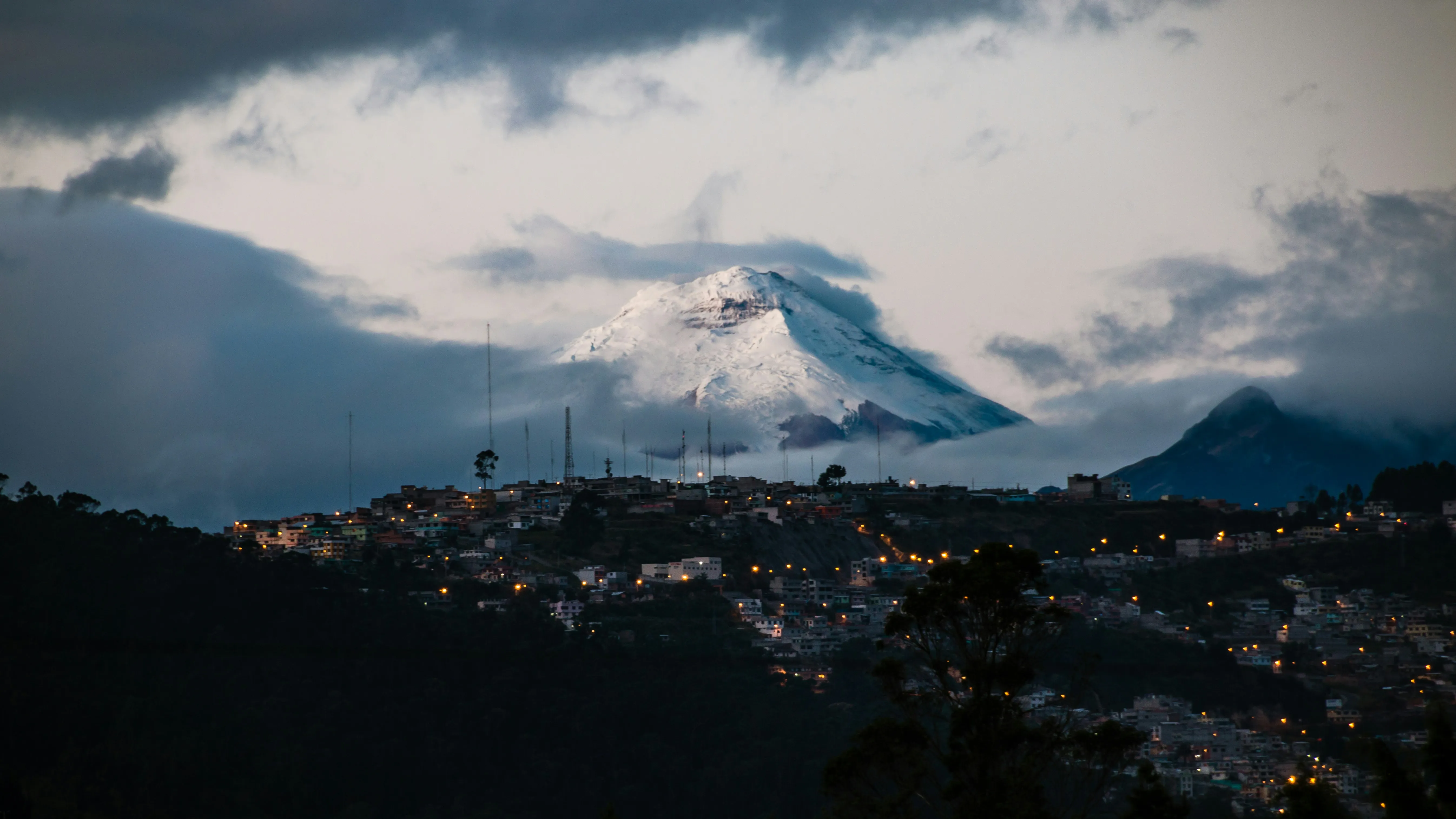
Ecuador
Discover a biodiverse country that unites the Andes, the Amazon, and the Galápagos, offering vibrant colonial culture and unique natural landscapes on the equatorial line.
Quick Facts
- Capital
- Quito
- Language
- Spanish
- Quechua, Shuar
- Currency
- United States Dollar (USD)
- Best time to visit
- From June to September in the highlands and year-round to visit the Galápagos Islands.
- Budget per day
- $35 - $120 per day
- Climate
- Tropical and humid climate on the coast and in the Amazon, while in the highlands it is temperate with variations depending on altitude.
- Connectivity
- medium
- It is easy to get SIM cards or eSIMs at airports and shopping centers in major cities.
- Electricity
- Type A/B (120V)
- Local transport
- acceptable
- Card usage
- acceptable
- Tipping
- optional
🌎 Introduction
Crossing the imaginary line that divides the globe, a territory unfolds where geography seems to compress, allowing one to go from the Andean peaks to the Pacific coast in just a few hours. In this corner of the world, snow-capped volcanoes coexist with the lushness of the jungle and the particular character of its islands, creating a mosaic of landscapes that change according to altitude. The climate, marked by the absence of traditional seasons, is defined instead by the alternation of sun and rain, dictating a pace of life that is slow and closely linked to the cycles of the earth.
The country’s identity is perceived in daily details: the color of the local markets, the aroma of cocoa, and the corn stews that provide comfort as evening falls. Its cities and towns retain an air of another era, with cobbled squares and traditions that hold centuries of history and heritage. It is a place of soft contrasts, where ancestral heritage is naturally interwoven with modern life, offering a serene atmosphere to those seeking to understand the essence of the Andean region and its natural diversity.
🛡️ General Safety
General safety level
Ecuador is a country that offers a fascinating experience for the traveler, although it requires maintaining a moderate level of precaution. In general terms, the country presents a medium level of safety, similar to other destinations in the Andean region. Most visits take place without incident, provided that basic recommendations are followed and one acts with common sense.
The context for the traveler is that of a country with a developed tourist infrastructure, where the authorities make constant efforts to protect the main attraction hubs. However, it is important to stay informed about the local situation at the time of travel, as the perception of safety can vary between rural areas, the coast, and large cities.
Crime and common risks
Most incidents affecting tourists are non-violent. The most common risks include:
- Pickpocketing and bag snatching: These are common in places with large crowds, such as markets, bus stations, and main squares.
- Minor scams: These can occur when hiring unofficial tourist services or when exchanging currency on the street.
- Substance use: Isolated cases of the use of scopolamine to incapacitate victims have been reported, generally in nightlife environments. It is recommended not to accept drinks or cigarettes from strangers.
- Theft on beaches: Leaving belongings unattended on the sand is a frequent risk in coastal areas.
Safety in cities and tourist areas
Safety varies significantly depending on the city and the neighborhood:
- Historic centers: In cities like Quito or Cuenca, historic centers are heavily guarded during the day, but caution is recommended at sunset, when the flow of people decreases.
- Guayaquil: Requires special attention. It is advisable to move mainly through regenerated areas such as the Malecón 2000 or the Las Peñas neighborhood, avoiding peripheral areas without a local guide.
- Urban public transport: Bus and metrovía systems are often crowded, which facilitates the work of pickpockets. It is preferable to wear your backpack in front.
- Practical recommendation: Avoid showing valuables, such as expensive jewelry or high-end cameras, ostentatiously in non-tourist public places.
Safety in transportation
Moving around Ecuador is simple, but it is advisable to follow certain safety guidelines:
- Taxis: It is strongly recommended to use mobile application taxis or request them from the hotel or restaurant. If taking a taxi on the street, make sure it has orange license plates, a visible unit number, and that it uses the taximeter.
- Interprovincial buses: They are economical and cover the entire country. During journeys, always keep your carry-on luggage with you and do not place it in the overhead compartments, as thefts occur during intermediate stops.
- Rental vehicles: A good option for exploring rural areas. Keep in mind that in Ecuador, driving is on the right.
- Road conditions: Due to the mountainous terrain, roads can suffer closures due to landslides, especially during the rainy season. Avoid driving at night on unknown routes due to poor lighting and the possible presence of animals or pedestrians on the road.
Natural and climatic risks
Ecuador is located in an area of high geological and climatic activity that the traveler should be aware of:
- Volcanic activity: The country has several active volcanoes (such as Cotopaxi or Sangay). Authorities constantly monitor their status and issue alerts if necessary.
- Earthquakes: Being on the Pacific Ring of Fire, seismic movements are possible. It is important to know the “drop, cover, and hold on” protocols.
- Climatic phenomena: During the rainy season (generally from December to May), floods or landslides can occur in the coastal and highland areas.
- Solar radiation: Due to the location on the equinoctial line, radiation is extremely high. It is essential to use broad-spectrum sunscreen, even on cloudy days.
Legislation and local regulations
Compliance with local laws is essential to avoid serious problems:
- Prohibited substances: Ecuador has extremely strict laws against drug trafficking and consumption. Prison sentences are severe and prison conditions are difficult.
- Identification: It is mandatory to always carry identification. It is recommended to carry a color photocopy of your passport and the entry stamp page, leaving the original document in the hotel safe.
- Respect for heritage: It is strictly forbidden to attempt to take protected species of flora or fauna (especially from Galápagos) or archaeological pieces out of the country.
Safety for specific groups
- Women travelers: Ecuador is a safe destination for women traveling alone, although “catcalling” or unwanted comments may be experienced. It is recommended to avoid walking in poorly lit or lonely areas during the night.
- LGTBIQ+ travelers: Homosexuality is legal and there is growing acceptance in large cities. However, in rural or more conservative areas, public displays of affection may attract stares or comments.
- Children and elderly: The main challenge is the altitude (soroche) in cities like Quito. It is vital to acclimate slowly, hydrate well, and consult a doctor before traveling if you have heart or respiratory problems.
Emergencies and assistance
In case of needing help, the response system is centralized:
- Single emergency number: 911 is the toll-free number to contact the National Police, Firefighters, and ambulance services throughout the territory.
- Tourist Police: In the most visited areas of Quito and other cities, there is a Tourist Police unit that usually speaks English and is trained to specifically assist foreigners.
- Procedure in case of incident: If you are a victim of theft, you must go to the nearest Prosecutor’s Office (Fiscalía) to file a report (“denuncia de robo o pérdida de documentos”), which will be necessary for insurance procedures or passport replacement.
Tip: Before leaving your accommodation, always consult with the local staff about which streets or neighborhoods are safe to walk in that day, as city dynamics can change quickly.
📝 Entry Requirements
To organize a trip to this South American destination, it is essential to have a valid passport in good condition. Generally, immigration authorities suggest that the document have a minimum validity of six months at the time of entry to avoid inconveniences during identity control at the border.
In most cases, international visitors traveling for leisure or tourism purposes do not usually require a prior visa for short-term stays. The usual period of stay granted to travelers is up to 90 days, although this time may be subject to the assessment of the officers at the point of entry and the regulations in force at each moment.
It is common that, upon arriving at the airport or land checkpoint, the presentation of an exit ticket from the country is requested, either back to the place of origin or to a third destination, to confirm the intention to end the visit within the permitted period. Likewise, it is advisable to have documents that allow for the proof of sufficient financial solvency to cover the expenses planned during the stay.
Regarding customs controls, travelers can bring in their personal items tax-free, provided they are not for commercial purposes. It is recommended to pay special attention to the transport of specific medications, which should be accompanied by their corresponding medical prescription, and to avoid bringing in fresh products of animal or vegetable origin to protect local biodiversity.
Regarding sanitary conditions, there are usually no strict requirements for all traveler profiles, although it is advisable to have the general vaccination schedule up to date. In certain circumstances, depending on the geographical areas planned to be visited or the origin of the flight, the yellow fever vaccine could be recommended.
- Identity document: Passport with validity exceeding six months.
- Tourist visa: Generally not required for short leisure stays.
- Length of stay: Usually a maximum of 90 days is allowed.
- Proof of exit: Return ticket or onward travel ticket.
- Financial resources: Possible request for proof of sufficient funds.
- Customs: Restriction on organic products, fresh foods, and commercial goods.
- Health: Recommendation of general vaccines and precautions according to the destination area.
🏥 Basic Health Considerations
In Ecuador, you will find a health system divided between the public and private sectors. If you need medical attention during your stay, it is most advisable to go to private clinics in large cities like Quito, Guayaquil, or Cuenca, as they offer higher quality standards and much shorter waiting times than public hospitals. Prices in these private centers are usually moderate compared to other countries, but for a tourist they can be high, so paying out of pocket for a serious intervention will be costly. Healthcare staff speak mainly Spanish, although in prestigious clinics in urban areas it is common to find doctors who communicate correctly in English.
Although they will not always ask for the document compulsorily to enter the country, having travel medical insurance is fundamental for moving with peace of mind. You should hire a policy that includes hospitalization, emergency medical transfers, and repatriation. Think that if you find yourself in remote areas or decide to visit the Galápagos Islands, an emergency transfer to the mainland can have an astronomical cost if you do not have adequate coverage.
Regarding vaccines, no mandatory vaccines are required to enter Ecuadorian territory in a general way. However, it is very sensible to have your usual vaccination schedule updated. If your itinerary includes visits to the Amazon region or lowland jungle areas, the yellow fever vaccine is highly recommended, as are those for hepatitis A and B or typhoid fever to avoid setbacks related to food.
You will be able to carry your personal medications without major inconveniences, but it is always preferable to transport them in their original packaging and within your carry-on luggage. If you follow a specific treatment or need drugs containing controlled substances, make sure to bring a copy of the medical prescription signed by your doctor. You will not find severe legal restrictions for common medications, but having the documentation will make things easier for you at any routine control.
The most common health risk you could experience is altitude sickness or soroche, because many cities in the highlands are located at more than 2500 meters above sea level. You will notice that you are short of breath or that you tire faster than usual when walking. Additionally, being right on the equatorial line, solar radiation is extremely strong, so skin burns can occur very quickly even on cloudy days. In coastal areas and in the Amazon, the main factor to watch out for are mosquitoes, which in rainy seasons can transmit diseases such as dengue or zika, although the risk is minimized with a good repellent.
Regarding water and food consumption, you should know that tap water is not suitable for human consumption in most of the country. You should always drink bottled, boiled, or filtered water. You will find incredible gastronomy in street stalls, but I advise you to choose places where you see that the food turnover is high and basic hygiene is maintained. It is preferable to avoid consuming salads or unpeeled fruits in places where you do not have the certainty that they have been washed with purified water.
If you find yourself in an emergency situation, the number you should dial is 911. This service coordinates the attention of ambulances, police, and firefighters throughout the national territory. Keep in mind that in rural or difficult-to-access areas, the arrival of emergency services may take longer than expected due to the country’s complex geography.
As practical tips for you to enjoy your trip, I suggest that you dedicate the first two days to acclimating to the altitude without doing great physical efforts. Drink plenty of water to combat dehydration from height and heat, and always use a high-factor sunscreen, even if you feel the weather is cool. If you plan to move through different climatic levels, wear versatile clothing that allows you to protect yourself from both the intense sun and the sudden cold of the moors (páramos).
🚌 Transportation Within the Country
Moving through the national territory is relatively simple thanks to an extensive network of interprovincial buses that connects most cities and towns. For long-distance journeys, such as travel between the capital, the coast, or the gateways to the Amazon, the airplane is a frequent alternative that significantly reduces travel times. On the other hand, in the Galápagos archipelago, the main means of transport to move between islands is the ferry or coastal boats.
The use of public transport is usually accessible for tourists, as the bus terminals in large cities are well-organized and have information counters. Signage is clear and, as Spanish is the predominant language, communication for purchasing tickets or checking routes does not usually present difficulties. In the most important urban centers, the transport system is more structured, allowing for fluid mobility between points of interest.
There is a clear distinction between transport in metropolitan areas and in rural areas. While cities like Quito have modern systems such as the metro and exclusive bus lanes, in mountain or jungle areas travel can be slower due to the terrain. In these less populated areas, the use of adapted pickup trucks or simpler local transport that reaches places where large buses do not have access is common.
Taxis are a very common and widespread option throughout the country. In main cities, these vehicles usually use devices to measure the journey, ensuring standardized management of the trip. Additionally, in larger urban centers, it is common to use mobile applications to request private transport services, providing a comfortable and predictable alternative for the international visitor.
In general terms, the transport network is functional and allows for efficient exploration of the country’s diversity. Although road journeys can be affected by weather conditions specific to the region, the departure frequency of buses and the connectivity of internal flights facilitate itinerary planning. Comfort standards are adequate for the traveler, especially in long-haul bus services that connect provinces.
Tip: When taking long road trips, it is advisable to always carry something warm in your carry-on luggage, as changes in altitude and the use of air conditioning can vary the temperature inside the vehicle.
🤵 Culture and Etiquette
Ecuadorian society is characterized by cordial and friendly treatment, where courtesy is a fundamental pillar in daily interactions. When starting any conversation, whether in a shop, a hotel, or with a stranger on the street, it is customary to greet with a “buenos días” (good morning), “buenas tardes” (good afternoon), or “buenas noches” (good evening/night). The use of “usted” (formal “you”) is frequent when interacting with elderly people, authority figures, or in situations of some formality, reflecting deep respect for hierarchy and experience. In social encounters, greetings usually include a firm handshake and, among women or in mixed groups with some familiarity, a kiss on the right cheek is common.
Regarding communication, the volume of voice is usually moderate and slow, diplomatic language is appreciated. Ecuadorians usually avoid direct confrontation, preferring friendly and, at times, somewhat indirect forms of expression so as not to be impolite. Regarding punctuality, there is a difference between contexts: while in the professional sphere and in transport services or tours strict punctuality is expected, in social events and informal meetings there is usually greater time flexibility, with it being common for meetings to start a bit later than agreed.
Customs related to the table are an essential part of coexistence. When entering a place where people are eating, or when finishing one’s own meal, it is a gesture of courtesy to say “buen provecho” (enjoy your meal). In restaurants, although some establishments include a percentage for service on the bill, it is customary to leave an additional tip of approximately ten percent if the service has been satisfactory. If one has the opportunity to be invited to a private home, it is considered a detail of good manners to bring a small gift, such as chocolates or flowers, and to wait for the host to take the initiative to start eating or drinking.
Respect for the environment and local traditions is fundamental to integrating naturally. Ecuador possesses a diverse cultural identity and a very present religious heritage, so when visiting temples or participating in religious festivities, it is recommended to maintain a silent and discreet attitude, avoiding clothing that may be considered inappropriate for the place. Likewise, given the richness of indigenous communities, it is essential to show an attitude of openness and sensitivity toward their rites and ways of life. It is considered a basic sign of respect to ask permission before taking photographs of people, especially children or traditional ceremonies, to respect their privacy and beliefs.
“Tip”: When addressing people you do not know, using titles like “señor” or “señora” before the last name, or simply as a formula of courtesy, helps to create a climate of trust and mutual respect from the first moment.
🍛 Typical Gastronomy
The gastronomy of Ecuador is the result of a great geographical and cultural diversity that is mainly divided into four regions: the Coast, the Andean Highlands (Sierra), the Amazon, and the Galápagos Islands. This variety allows the country to have a very rich natural pantry, where products such as plantain, corn, potato, and a wide range of tropical fruits and fresh seafood are the undisputed protagonists of the daily table.
In the daily life of Ecuadorians, the most important meal is lunch, which is usually served between 12:00 and 14:00. It is very common for this menu to consist of two dishes: a soup (a fundamental element in the local diet, especially in mountain areas) and a main dish called segundo, which usually includes rice, a protein, and salad. Dinner is usually lighter and takes place from 19:00 onwards, although in urban areas hours can be more flexible.
Regarding table manners, the atmosphere is usually close and informal, although respectful treatment toward service staff is maintained. It is customary to accompany meals with freshly squeezed natural fruit juices, such as tree tomato, blackberry, or lulo. Coffee also holds a relevant place, frequently consumed both at breakfast and at the end of the afternoon. In most establishments, tipping is not mandatory, although it is common to leave a small percentage if the service has been satisfactory.
Ecuadorian flavors are not usually excessively spicy by definition, but there is almost always a homemade ají (chili sauce) in the center of the table so that each diner can add it to their liking. In the coastal area, the use of coconut and peanut (maní) adds a characteristic creaminess to fish stews, while in the Andean area, more earthy flavors linked to various types of grains and tubers predominate.
| Dish | Description | Main Ingredients | Where to try it | Tip |
|---|---|---|---|---|
| Ceviche de camarón | Cold marinated seafood soup, unlike other regional versions it is quite brothy. | Shrimp, lemon, orange, red onion, and cilantro. | Coastal restaurants and specialized markets. | It is usually accompanied by chulpi (toasted corn) or popcorn. |
| Locro de papa | Creamy soup of Andean origin, very comforting and smooth in texture. | Potatoes, fresh cheese, milk, and achiote. | Traditional restaurants in the Highlands and Quito. | It is essential to add a few slices of fresh avocado just before eating it. |
| Encebollado | Intense fish broth considered by many as the national dish par excellence. | Albacore (tuna), yuca, pickled red onion, and tomato. | Local stalls and “encebolladerías” throughout the country. | Squeeze plenty of lemon over the broth to enhance all the flavors. |
| Fritada | Pork dish slowly cooked until it is golden and crispy. | Pork, cooked corn (mote), fried plantain, and toasted corn. | Markets and traditional stops in the inter-Andean region. | Ask for some tree tomato ají to accompany the meat. |
| Bolón de verde | Fried and mashed green plantain dough in the shape of a sphere, very popular for breakfast. | Green plantain, fresh cheese or pork rinds (chicharrón). | Cafeterias and breakfast stalls on the Coast and in Guayaquil. | Enjoy it accompanied by a cup of freshly brewed black coffee. |
📷 Areas and Places to Visit
Ecuador is a country that stands out for its geographical diversity, condensing into a manageable territory landscapes ranging from high mountains to tropical jungle. The capital, Quito, is usually the starting point for many travelers. Its historic center, declared a World Heritage Site, is one of the best-preserved on the continent. Walking through its squares, such as the Plaza Grande, and visiting temples of baroque architecture like the Church of the Company of Jesus allows one to understand the region’s colonial past. Additionally, in the surroundings is the Middle of the World City, a place where you can cross the equatorial line and visit interactive museums about the history and science of the site.
Towards the south, the city of Cuenca offers a different atmosphere, marked by its cobbled streets, its flower markets, and the imposing Cathedral of the Immaculate Conception, with its characteristic blue domes. This area is known for its artisanal tradition, especially in the making of toquilla straw hats. Nearby is the Ingapirca archaeological complex, which preserves the most important Inca ruins in the territory, showing the fusion between the Cañari and Inca cultures.
The Highlands (Sierra) region is crossed by the so-called Avenue of the Volcanoes. The Cotopaxi National Park is one of the preferred destinations for those seeking hiking trails and views of snow-capped peaks. Another point of great interest is the Quilotoa Lagoon, a turquoise water lake located inside a volcanic crater. For those who prefer an environment more oriented toward rest and outdoor activities, the town of Baños de Agua Santa serves as a transition between the Andes and the Amazon, standing out for its waterfalls and its thermal water spas.
The Ecuadorian Amazon occupies a large part of the east of the country and is home to a biodiversity difficult to find elsewhere. Areas such as the Yasuní National Park or the Cuyabeno Wildlife Reserve allow for incursions through rivers and jungle trails. Activities here focus on local fauna observation, learning about medicinal plants, and contact with communities that maintain their ancestral traditions. It is an experience that contrasts strongly with urban life in the highland cities.
In the coastal strip, the city of Guayaquil acts as the economic engine and offers modern spaces like the Malecón 2000, next to the Guayas River, and the picturesque Las Peñas neighborhood, with its colorful houses and panoramic views. Along the coast, there is a succession of beaches and fishing villages that attract surfing enthusiasts and those seeking to enjoy seafood gastronomy. Finally, the Galápagos Islands constitute a protected natural space of world relevance. On islands like Santa Cruz, San Cristóbal, or Isabela, guided visits can be made to observe unique species and learn about the conservation work of the Charles Darwin Research Station.
Tip: You cannot miss visiting the Galápagos Islands, the most emblematic place in the country.
✈️ Best Season to Travel
Ecuador is a destination that can be visited throughout the year due to its geographical location on the equinoctial line, which gives it notable thermal stability. However, the travel experience varies according to the region—the Coast, the Andean Highlands, the Amazon, or the Galápagos Islands—and the rainfall regime. The choice of the ideal moment depends mainly on the activities to be performed, whether hiking in the mountains, fauna sighting, or resting on the coast.
Generally, two climatic periods are distinguished, conditioned by altitude and marine currents. The period with lower rainfall in the Andean zone usually coincides with the months of June to September, facilitating walking routes and views of the volcanoes. On the other hand, between December and May, the coastal region and the Galápagos experience a warmer and more humid climate, which favors water temperature and the observation of various marine species.
| Season | Months | Typical Climate | What to Expect | Tourist Influx |
|---|---|---|---|---|
| Spring | Mar – May | Frequent rains in the Highlands; warm and humid climate on the Coast. | Green and lush landscapes. Flowering in the Andes and optimal climate for swimming in the Pacific. | Medium ⭐⭐ |
| Summer | Jun – Aug | Dry and sunny in the Highlands; clear skies and cool winds. | Ideal for trekking and volcano photography. Humpback whale watching on the coast. | High ⭐⭐⭐ |
| Autumn | Sep – Nov | Transition with moderate rains and temperate temperatures. | Harvest season and local festivities. Fewer crowds in national parks. | Low ⭐ |
| Winter | Dic – Feb | Intermittent rains in the Andes; hot days and sun on the coast. | Traditional year-end festivities. Excellent visibility for diving in the Galápagos Islands. | High ⭐⭐⭐ |
🗣️ Basic Vocabulary
Knowing some words and expressions typical of Ecuador will be very useful for you to navigate better in the day-to-day of the trip. Although the official language is Spanish, the use of certain local idioms facilitates contact with people and helps to better understand directions or exchanges in shops and markets.
You do not need deep knowledge of the local dialect, but integrating these terms into your daily conversations will make your stay more comfortable and allow you to move with greater confidence through the different regions of the country.
- ¿Mande?: It is the common and polite way to say “pardon?” or “what did you say?” when you haven’t understood something or to respond when someone calls you.
- La yapa: Refers to a small extra or free addition that sellers usually give upon finishing a purchase, especially in food markets.
- Chévere: A widespread adjective used to say that something is good, pleasant, or that you like it.
- Guagua: A word of Quichua origin used to refer to a baby or a young child.
- Veci / Vecino: The common and friendly way to address small shop owners, food stalls, or local people.
- Aquisito: Expression used to indicate that a place is “right here” or very close, although it’s advisable to confirm the actual distance.
- Achachay: Exclamation used spontaneously when feeling cold.
- Chulla: Term referring to something that is unique or alone, such as a single shoe or a single person.