


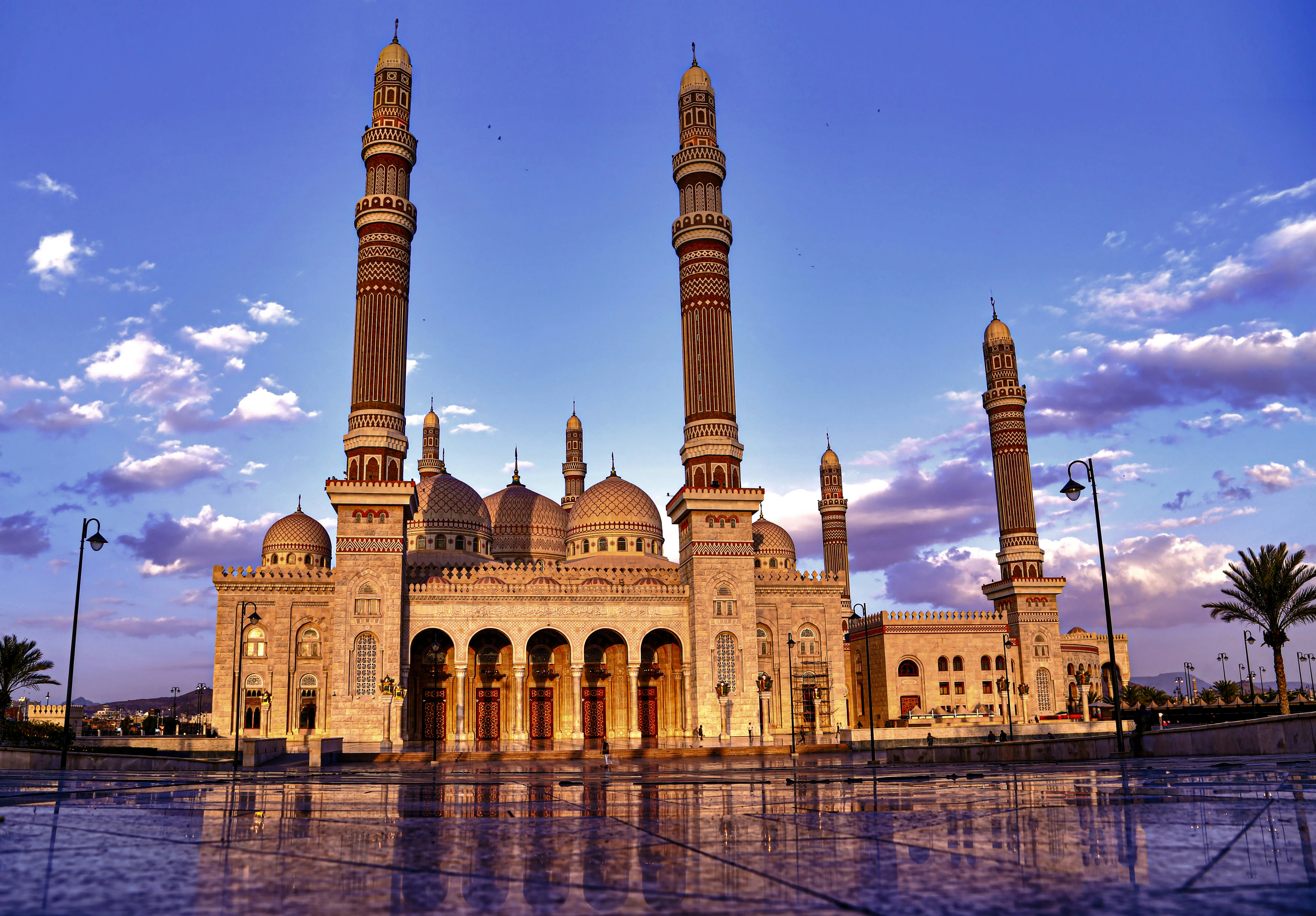
Yemen
Explore a nation of unique ancestral architecture, fascinating desert landscapes, and a millenary culture that stands out for its authenticity and history in the Arabian Peninsula.
Quick Facts
- Capital
- Sanaa
- Language
- Arabic
- English, South Arabian languages
- Currency
- Yemeni Rial (YER)
- Best time to visit
- From October to April, when temperatures are more moderate and the weather is more pleasant for the traveler.
- Budget per day
- $30 - $100 per day
- Climate
- Mostly desert and arid climate, with moderate temperatures in the western highlands and a humid tropical environment in coastal areas.
- Connectivity
- low
- Available mainly in urban centers, although the registration process can be complex for foreign visitors.
- Electricity
- Type A/C/G (230V)
- Local transport
- limited
- Card usage
- cash is used more
- Tipping
- optional
🌎 Introduction
At the southern tip of the Arabian Peninsula, where the waters of the Red Sea meet the Indian Ocean, a corner of the world emerges with an identity forged between arid mountains and infinite coasts. It is a place where time seems to be measured by the slow pace of its markets and the scent of frankincense that travels through the stone streets. Its architecture, with decorated facades reminiscent of intricate embroidery, speaks of an ancient heritage that remains present in the daily lives of its inhabitants, integrating naturally into the landscape.
Yemeni geography is a constant contrast ranging from green peaks and gravity-defying cultivation terraces to the deep silence of the desert. In these lands, uniquely shaped trees and legends of sailors coexist, while the aroma of freshly roasted coffee serves as a reminder that this region was, for centuries, an essential bridge between different cultures. It is a land of nuances, where the sunset light tints the valleys and villages perched on rocks with ochre tones, creating a serene and evocative atmosphere.
Daily life flows with a hospitable simplicity, marked by chats around a table and quiet exchanges in the souks. Traditions are kept alive in the smallest details, from the preparation of traditional dishes passed down through generations to the use of clothing that tells its own stories. Approaching its reality allows one to sense a way of understanding the world where history and everyday life intertwine organically, offering a balanced vision of its rich diversity.
🛡️ General Safety
The security situation in Yemen is complex and requires extremely detailed planning before undertaking any trip. It is considered a destination with a high risk level compared to other countries in the region, due to the political and social instability that has marked its recent history. The current context requires the traveler to stay constantly informed through official and local sources.
- The general security assessment is maximum caution. It is not a destination for improvised or backpacking tourism.
- Most current tourist visits are concentrated in very specific areas, such as Socotra Island, which maintains a different and much calmer security dynamic than the mainland territory.
- The context for the traveler is that of a country with limited tourist infrastructure, where the accompaniment of authorized local guides is essential to guarantee safety and compliance with security regulations.
Crime and Common Risks
Despite the general context, common crime specifically directed at tourists is not the most widespread risk, although it is advisable to be alert to everyday situations.
- Minor theft and snatching can occur in busy markets (Souks) or crowded areas in cities. It is recommended not to display valuables or large sums of money in public.
- Scams directed at travelers are usually related to inflated prices for transport services or unofficial guides. It is always preferable to agree on prices beforehand.
- As an infrequent but relevant risk, there are areas where roadblocks or demonstrations can occur. The best way to avoid them is to have the advice of a local tour operator.
Safety in Cities and Tourist Areas
Safety varies significantly depending on the region and city where the visitor is located.
- In urban centers, such as Sanaa (when access is possible) or Aden, the presence of checkpoints is common. It is fundamental to cooperate with authorities and always carry original documentation.
- Tourist neighborhoods and historical areas are usually safe during the day, provided that the instructions of local guides are followed. It is recommended to avoid nighttime travel through poorly lit or unknown areas.
- Regarding urban public transport, its use by foreigners is not common. The use of private transport managed by trusted travel agencies is recommended.
Transport Safety
Moving around the country requires specialized logistics and knowledge of local traffic rules.
- Long-distance public transport is limited and does not always meet international safety standards.
- You drive on the right, as in most of Europe and America. However, driving can be erratic and the condition of roads in rural areas is often poor.
- The use of taxis is common, but it is recommended to request services recommended by the accommodation or use trusted drivers. For travel between provinces, it is mandatory to have travel permits issued by local authorities, which are usually managed by tourism agencies.
Natural and Climatic Risks
Yemen has a diverse geography that presents specific climatic risks depending on the area and time of year.
- Extreme heat is the most common risk, especially in coastal and desert areas during the summer months (June to September), with temperatures that can exceed 40 degrees Celsius.
- Flash floods can occur after intense rains in mountain areas and dry riverbeds (wadis). These are seasonal and occur mainly in spring and summer.
- On Socotra Island, the monsoon season (from June to September) brings very strong winds and dangerous waves, which usually paralyzes sea and air transport to the island.
Legislation and Local Norms
Yemen is a country with deep-rooted traditions and laws largely based on Islamic regulations, so respect for local customs is mandatory to avoid legal problems.
- The consumption and import of alcohol are strictly prohibited for foreigners in almost the entire territory. Non-compliance can lead to severe fines or arrests.
- There are strict laws regarding photography: it is forbidden to photograph government buildings, military installations, airports, or bridges. It is also courteous to ask for permission before photographing local people, especially women.
- The use of drones is highly restricted, and bringing them into the country without special permits can result in equipment confiscation and trouble with authorities.
Safety for Specific Groups
There are important considerations for certain traveler profiles due to the country’s culture and legislation.
- Female travelers: It is recommended to dress modestly, covering shoulders and legs. In many areas, the use of a headscarf to cover the hair is advisable. Traveling alone is possible but uncommon; being accompanied by a guide greatly facilitates social interaction and safety.
- LGTBIQ+ travelers: Homosexuality is illegal in Yemen and is socially and legally penalized. Maximum discretion is recommended, avoiding any public display of affection to prevent legal risks or aggression.
- Children and the elderly: The country does not have infrastructure adapted for people with reduced mobility. Trips with children require rigorous medical preparation due to the limited availability of advanced health services in certain regions.
Emergencies and Assistance
In case of requiring help, it is vital to know the basic assistance channels, although communication can be difficult if Arabic is not spoken.
- General emergency numbers are 191 for police and 199 for ambulances, although their effectiveness and response time can vary notably depending on the location.
- Emergency services and the police often have limited resources. In case of an incident, the first measure should be to contact the tour operator or the local contact coordinating the trip.
- It is essential to have comprehensive travel insurance that includes emergency medical evacuation, as high-complexity health centers are scarce outside the main cities.
Tip: Always keep several physical copies of your passport and visa, as they will be requested frequently at the multiple security checkpoints on the roads.
📝 Entry Requirements
To begin a trip to Yemen, the first indispensable requirement is to have a passport with sufficient validity, which is usually recommended to be at least six months from the planned date of arrival. It is not common for entry to be allowed without a valid travel document and available space for the corresponding stamps. Regarding the stay authorization, the vast majority of visitors require the prior processing of a tourist visa, as granting permits directly at borders or airports is not a common practice for most international travelers.
The maximum duration of stay allowed under the tourist category is usually determined by what is specifically indicated on the granted visa, with periods of thirty days, extendable under certain circumstances, being frequent. Upon arrival at checkpoints, it is very likely that authorities will request the presentation of an exit ticket confirming the return to the country of origin or continuation to a new destination. Similarly, proof of having sufficient financial funds to cover all planned expenses during the stay in the territory may be required.
Controls at airports and other entry points are usually exhaustive for security reasons, so waiting times can be somewhat higher than average. In the field of customs restrictions, there are clear rules regarding the prohibition of introducing alcoholic beverages, pork products, or any material considered to offend local cultural values. Regarding the entry of medicines, it is advisable that they travel in their original packaging and accompanied by a descriptive medical prescription to facilitate inspections.
In the section on health requirements, it is important to check if any specific vaccine is required depending on the traveler’s previous itinerary, especially regarding yellow fever if they have traveled through endemic areas. It is recommended to keep the general vaccination schedule up to date and have travel insurance with broad health coverage, given that access to medical services may be limited in certain regions.
📌 Summary of Practical Information for the Traveler
- Main documentation: Passport with a minimum validity of six months and a previously processed tourist visa.
- Additional proof: Confirmed return ticket and proof of financial solvency for the period of stay.
- Baggage restrictions: Prohibition of alcohol, pork products, and sensitive materials; strict control of prescription medicines.
- Health and prevention: Recommendation of basic vaccines and the need for comprehensive international medical insurance.
- Border security: Meticulous inspections of belongings and possible brief interviews regarding the reason for the trip.
- Allowed stay: Generally limited to thirty days, subject to the validity of the visa obtained.
- Conduct recommendation: Maintain a respectful and collaborative attitude with officials at immigration checkpoints.
🏥 Basic Health Considerations
When planning your trip to Yemen, it is essential to understand that the country’s infrastructure has gone through difficult times. You will find that the public health system is very limited and lacks basic resources in many regions. If you need medical attention, it is most recommended to go to private clinics in main cities like Sanaa or Aden, where standards are higher, although the cost can be high by local standards. Medical personnel in these private centers usually speak English, which will greatly facilitate communication if you do not master Arabic.
Hiring comprehensive travel health insurance is not just a recommendation, but an absolute necessity before landing in the country. You must ensure that your policy includes not only medical assistance and hospitalization but also medical repatriation and, if possible, transfer by air ambulance to neighboring countries in case of serious illness. Without insurance covering these costs in advance, you could face very high medical bills that you must pay in cash.
Regarding vaccines, if you are traveling from an area where yellow fever is endemic, an obligatory vaccination certificate will be required to enter. For all other travelers, it is highly advisable to have the official schedule up to date, including tetanus-diphtheria, polio, and MMR. Additionally, you should consult with a travel medicine professional about vaccines for hepatitis A, hepatitis B, and typhoid fever. In certain times and areas, the cholera vaccine might also be recommended, as outbreaks have been recorded in the past.
If you are undergoing specific medical treatment, it is vital to bring all necessary personal medication for the total duration of your stay, as you might not find the same brands or compounds in local pharmacies. Remember to carry medications in their original packaging and always accompany them with a medical prescription or report in English justifying their use, to avoid inconveniences at customs controls. Avoid traveling with medications containing narcotic substances without very clear official documentation.
The most common health risks are related to climatic conditions and hygiene. Extreme heat in coastal areas can cause dehydration or heatstroke, while in mountain areas you might notice the effects of altitude. Insects are also a factor to consider, as there is a risk of diseases like malaria, dengue, or chikungunya in low-lying areas. The use of strong repellents and clothing that covers extremities at dawn and dusk will be your best ally.
Regarding water and food, you must take extreme precautions. Tap water is not potable at all, so you should always consume bottled water and ensure the seal is intact. Avoid ice cubes and salads or fruits that you have not peeled yourself. As for street food, although very tempting, ensure that the food is well-cooked and served hot to reduce the risk of intestinal infections.
In case of a medical emergency, you can try to contact the number 191, which is the standard for medical emergencies, although ambulance response can be slow or non-existent depending on your location. In critical situations, the most effective course of action is usually to organize your own transfer to the nearest private clinic or immediately contact the assistance number of your travel insurance so they can manage the logistics.
As final practical recommendations, I suggest you carry a basic first-aid kit with pain relievers, antihistamines, hand sanitizer, and oral rehydration salts. Always maintain rigorous hand hygiene and, at any symptom of fever or persistent stomach discomfort, do not wait to return home and seek professional medical advice immediately. Your health comes first so you can enjoy the experience this destination offers.
🚌 Transport Within the Country
Moving around Yemen requires slow planning, as current infrastructure conditions travel times. The main means for travelers are private vehicles with drivers and internal flights, which connect the most important cities in a limited way. There are no train or metro networks, so the road is the fundamental axis for any journey, with the use of a car being the most common option for covering distances between regions.
Conventional public transport can be inaccessible for those visiting the country for the first time. Signage on roads and in urban centers is mostly in Arabic, and the purchase of tickets for long-distance bus services is done in person at stations. The language can be a barrier at these points, as staff do not always speak other languages, which usually requires the support of local guides to manage tickets and understand departure points.
There are notable differences between urban areas and the rural environment. In large cities, the use of taxis is very common and easy to manage, functioning as the main resource for short journeys. However, in rural and mountainous areas, the terrain becomes more demanding and the quality of the road surface decreases. In these areas, the use of all-terrain vehicles is almost essential to ensure adequate transit through paths that are not always paved.
The sense of comfort and punctuality is variable and usually subject to external factors. Road journeys can take longer than expected due to the terrain’s orography and the presence of frequent security checkpoints on main routes. It is a transport system oriented toward functionality, where traveler flexibility is necessary to adapt to local rhythms and changing environmental conditions.
“Tip”: It is convenient to coordinate travel in advance through drivers who know the routes well and the location of checkpoints to facilitate transit.
🤵 Culture and Etiquette
Hospitality is a fundamental pillar in Yemeni society, where receiving a visitor is considered an honor and a shared responsibility. When meeting someone, it is common to perform slow greetings that include cordial questions about personal well-being. Physical contact, such as a handshake, is usually reserved for people of the same sex, while between different genders, the most common gesture is a courtesy without contact, such as a slight nod or placing a hand on the heart as a sign of respect.
The concept of time and punctuality tends to be flexible, prioritizing human interactions and conversation over the rigidity of the clock. In public spaces, discretion and maintaining a moderate voice volume are valued to preserve the harmony of the environment. Likewise, effusive public displays of affection are not part of the usual social norm, with restrained behavior that respects the privacy and personal space of others being preferred.
In the context of meals and visits, it is important to remember the preferred use of the right hand for both eating and handing or receiving objects, as the left hand is traditionally reserved for personal hygiene. If an invitation to a home is received or tea or coffee is offered, it is a courtesy to accept at least a small amount, as the exchange of food and drink is a symbol of goodwill. Regarding tipping, although not mandatory, it is considered a well-received gesture of gratitude in hospitality and guiding services.
Respect for the elderly and authority figures is a key element in the social structure. When passing near religious sites or participating in traditional festivities, it is recommended to maintain an attitude of observation and deference, adapting to the rhythm and tone of the local community. Dress is usually conservative, and following this pattern is interpreted as a gesture of consideration for the customs and cultural sensitivity of the environment.
“Tip”: Before taking photographs of local people, especially in rural areas or family settings, it is fundamental to request permission to ensure that their privacy and will are respected.
🍛 Typical Gastronomy
Yemeni gastronomy is a reflection of its historical position as a focal point on the spice route. Its cuisine is rich in nuances, aromatic, and based on fresh, local ingredients. Unlike other nearby regions, Yemeni flavors are usually deep and spiced without being excessively hot, highlighting the use of blends like hawaij, which combines cumin, black pepper, cardamom, and turmeric.
Eating habits in the country are deeply linked to hospitality and a sense of community. It is common for meals to be served on large shared trays and for diners to sit on the floor on rugs or cushions. The use of cutlery is less frequent than in the West; instead, traditional flatbread (khubz), freshly baked in clay ovens, is used to scoop food directly from the common dishes.
The rhythm of meals is usually marked by sunlight, with lunch being the main meal of the day. In local restaurants, it is common to find separate areas for families and for single men. When eating, cultural etiquette dictates the exclusive use of the right hand. Regarding drinks, alcohol consumption is practically non-existent due to religious norms, replaced by a wide variety of spiced teas and qishr, a traditional infusion made from coffee bean husks, ginger, and cinnamon.
The use of carved stone pots is another hallmark of its cuisine. These vessels retain heat for a long time, allowing stews to arrive at the table bubbling. Lamb, chicken, and fish in coastal areas are the most common proteins, always accompanied by grains like rice or wheat, and a constant presence of legumes and fresh vegetables.
| Dish | Description | Main Ingredients | Where to Try It | Tip |
|---|---|---|---|---|
| Saltah | Considered the national dish, it is a bubbling stew served in a stone pot. | Meat base, vegetables, and a topping of fenugreek foam (hilba). | Traditional restaurants in Sanaa and the north of the country. | Try it very hot and always accompany it with freshly made bread. |
| Mandi | Meat slowly cooked in an underground oven, giving it a smoky flavor. | Lamb or chicken, basmati rice, spices, and charcoal for smoking. | Specialized restaurants in the Hadramaut region. | It is a hearty dish, ideal for sharing among several people. |
| Fahsa | A very tender meat stew that falls apart upon contact with bread. | Beef or lamb meat and spiced broth with fenugreek. | Food houses and local markets in urban areas. | It is usually served as a main course for lunch, the most important meal. |
| Bint al-Sahn | A dessert or side dish consisting of multiple layers of thin dough. | Flour, eggs, clarified butter, local honey, and black sesame seeds. | In family celebrations or home-style restaurants. | Enjoy it while the honey is warm to better appreciate its texture. |
| Aseed | A dense and soft dough consumed hot, typical of family gatherings. | Wheat flour, water, and salt, served with meat broth or honey. | Homes and traditional places in mountainous areas. | Use your fingers to form a small ball and dip it into the central broth. |
📷 Areas and Places to Visit
Yemen presents itself as a destination of exceptional cultural and landscape richness, where history seems to have stopped on its adobe and stone facades. The Old City of Sanaa is, undoubtedly, one of the most striking starting points for any traveler. This urban core is famous for its unique architecture of tower-houses decorated with intricate white plaster motifs and colored glass windows, known as qamariyas. Strolling through its streets allows you to discover the Souk al-Milh, a traditional market where spices, metal crafts, and textiles are exchanged, maintaining an atmosphere that evokes trade routes from centuries ago.
In the Wadi Hadramaut region, one of the most surprising landscapes in the country can be found. There stands Shibam, popularly known as the “Manhattan of the Desert.” This city stands out for its mud skyscrapers, multi-story buildings built entirely with adobe bricks that have defied the passage of time in an arid environment. Near this area, the valley offers green oases that contrast with the sobriety of the desert, dotted with small villages and mosques of great historical value.
Nature reaches its maximum expression in the Socotra Archipelago, a place that seems to belong to another world due to its geographic isolation. This group of islands is home to unique plant species, such as the dragon’s blood tree, with its characteristic umbrella shape. Visitors can explore white sand beaches and crystal-clear waters, such as those of the Qalansiya lagoon, or venture into the mountainous areas of the interior to discover deep caves and biodiversity found nowhere else on the planet.
In the surroundings of the capital, the Dhar Valley houses one of the most photographed monuments in the region: the Dar al-Hajar or Rock Palace. This building, erected on an imposing rock formation, served as a royal residence and is a masterly example of how architecture and natural relief can integrate harmoniously. The rural environment of this area allows for walking routes among cultivation terraces and ancient irrigation systems that are still in use.
Towards the south coast, the city of Aden offers an interesting contrast with its natural port located in the crater of an ancient volcano. It is an area with a different historical heritage, where you can visit the Tawila Cisterns, an impressive work of ancient engineering designed to store rainwater. The city combines colonial elements with its maritime past, offering a different perspective on urban life and trade in the Gulf of Aden.
For those looking to immerse themselves in academic and religious history, the city of Zabid is a fundamental stopping point. Former capital of Yemen and seat of a prestigious Islamic university for centuries, its streets preserve a sober architecture and mosques that narrate the region’s intellectual past. The contrasts between high mountain areas, with fortified towns like Thula or Hababa, and the coastal plains of the Tihama, show the enormous diversity of traditions, clothing, and ways of life that coexist in this territory.
Tip: You cannot miss visiting the Old City of Sanaa, the most emblematic place in the country.
✈️ Best Season to Travel
Yemen has a diverse geography that conditions the climate according to the region visited. Generally, the months between October and March are considered the most suitable for touring the country, as temperatures are more moderate in both the interior mountainous areas and the coastal plains. During this period, the environment is drier and allows for urban exploration and hiking activities with greater comfort.
However, the choice of date also depends on the specific destination within the territory. While the highlands enjoy a temperate climate for much of the year, the coastal and desert areas can reach very high temperatures during the central months. Observing the rain cycles is equally relevant, especially for those who wish to see the greenest landscapes in rural areas and traditional agricultural terraces.
| Season | Months | Typical Climate | What to Expect | Tourist Influx |
|---|---|---|---|---|
| Spring | Mar – May | Temperate in the interior and warm on the coast. Moderate rains. | Landscapes beginning to turn green and flowering in the highland valleys. | ⭐⭐ Medium |
| Summer | Jun – Aug | Intense heat in coastal and desert areas. Monsoons in the south. | High humidity on the coast. In the mountains, the weather is cooler but with frequent rains. | ⭐ Low |
| Autumn | Sep – Nov | Gradual drop in temperatures. Dry and clear environment. | Harvest time on agricultural terraces and optimal conditions for hiking. | ⭐⭐⭐ Medium-High |
| Winter | Dec – Feb | Sunny days and cool nights in the mountains; warm on the coast. | Clear skies. It is the most balanced period to visit historic cities and the desert. | ⭐⭐⭐⭐ High |
🗣️ Basic Vocabulary
Although in many tourist contexts basic communication is possible, learning some expressions in local Arabic greatly facilitates daily life in Yemen. Knowing simple words allows you to show respect for the local culture and speed up everyday situations in markets, transport, or when interacting with residents.
It is not about mastering the language, but about having practical tools to greet, thank, or ask for help simply. These small tokens of courtesy are usually very well received and help establish more fluid and friendly communication during the journey through the country.
- As-salam alaykum: Formal welcome greeting (literally, “peace be upon you”).
- Shukran: Thank you.
- Afwan: You’re welcome or excuse me.
- Na’am: Yes.
- La: No.
- Min fadlak: Please.
- Kam?: How much does it cost?
- Wayn…?: Where is…?
- Maa as-salama: Goodbye or stay with peace.