


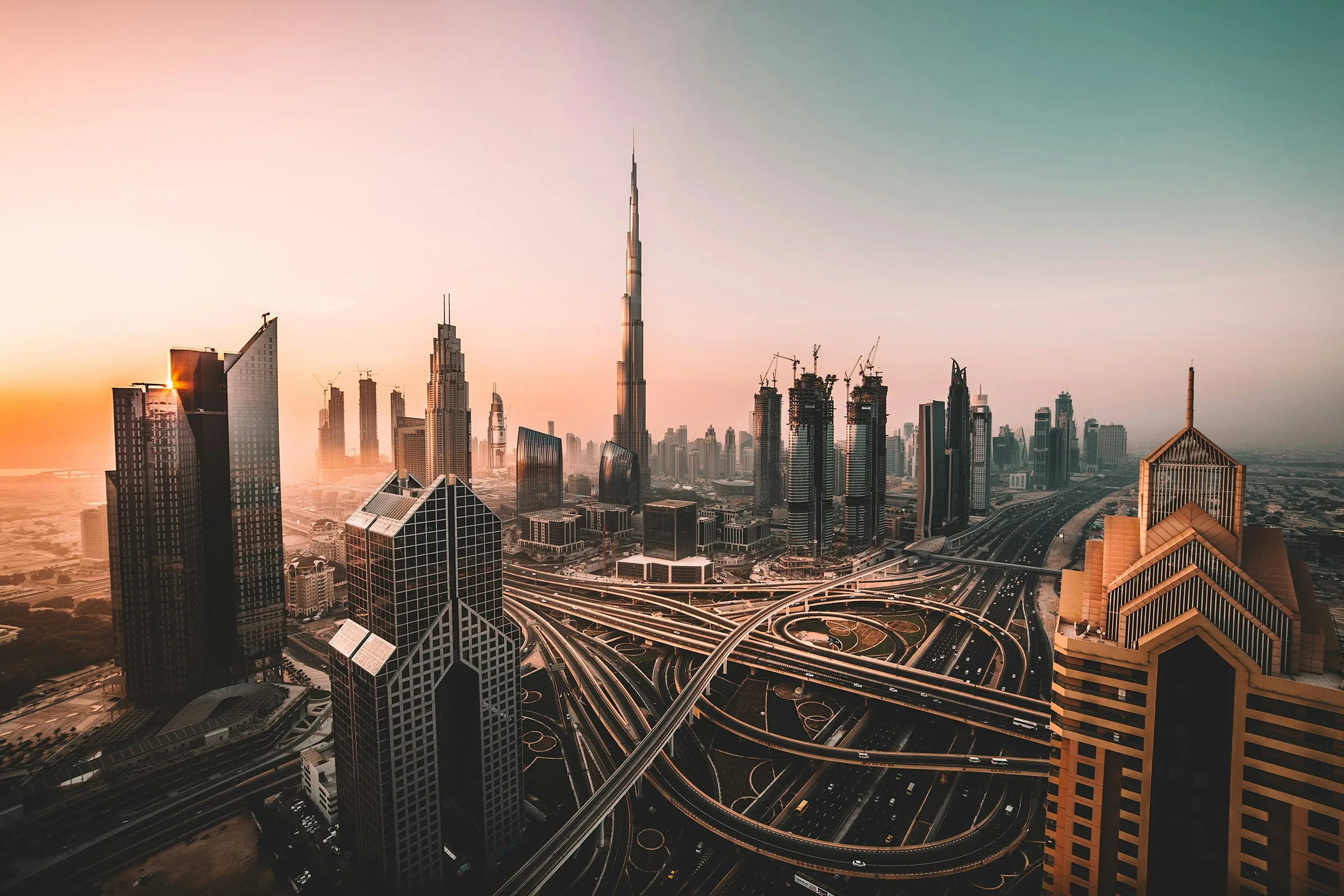
United Arab Emirates
Discover a country where cutting-edge architecture blends with the infinite desert, offering luxury, traditional culture, and unforgettable experiences under the Arabian sun.
Quick Facts
- Capital
- Abu Dhabi
- Language
- Arabic
- English
- Currency
- Dirham (AED)
- Best time to visit
- From November to March, when temperatures are more pleasant for tourism.
- Budget per day
- $80 - $400 per day
- Climate
- Desert with extremely hot summers and mild, sunny winters; rainfall is very scarce throughout the year.
- Connectivity
- good
- Very easy to obtain both physical SIM cards and eSIMs at airports and shops.
- Electricity
- Type G (230V)
- Local transport
- good
- Card usage
- widespread
- Tipping
- optional
🌎 Introduction
In the corner where the Arabian Peninsula overlooks the sea, the landscape is drawn between the constant movement of the dunes and the serenity of the coast. When the cooler months arrive, life moves entirely outdoors, allowing the gentle sun to illuminate the mangroves and the reddish mountains that shelter the interior. It is an environment where time seems to have two rhythms: the silent calm of the desert and the energy of urban centers that transform under an always intense light.
Strolling through its neighborhoods allows one to perceive a mixture of incense and cardamom coffee aromas, a reflection of a hospitality that remains alive in daily gestures. Between the murmur of traditional markets and the lines of contemporary architecture, Bedouin-rooted customs coexist with a markedly cosmopolitan atmosphere. This identity, forged between sand and saltpeter, offers a balanced vision of a territory that has managed to preserve its essence while becoming a meeting point for people from all over the planet.
🛡️ General Safety
The United Arab Emirates (UAE) are unanimously considered one of the safest destinations in the world for tourists. The country stands out for its political stability and an extremely monitored and regulated social environment, which translates into exceptionally low crime levels compared to other global urban centers.
- The general safety level is rated as very high. Travelers can walk through most tourist areas at any time of the day or night with an uncommon sense of tranquility.
- The country’s context is based on a combination of strict laws, an efficient (though often discreet) police presence, and a modern infrastructure designed for the protection of both residents and visitors.
- Despite this safety, it is fundamental to remember that the country is governed by very specific cultural and legal norms that the traveler must know to avoid misunderstandings with local authorities.
Crime and common risks
Violent crime is practically non-existent against tourists. However, as in any international destination that receives millions of visitors, there are certain minor risks that should be taken into account.
- Petty theft: Although very rare, lapses in attention can occur in crowded areas such as traditional souks or during mass events. It is recommended to keep basic belongings in sight.
- Commercial scams: In some traditional markets (souks), vendors may be persistent or attempt to sell counterfeit products (watches, bags). It is advised to always buy in official establishments.
- Cybersecurity: When using public Wi-Fi networks in airports or shopping malls, it is advisable to avoid accessing sensitive banking information, a common practice for any international destination.
- Infrequent risks: Credit card fraud is minimal, but it is always a good idea to check bank statements after the trip.
Safety in cities and tourist areas
Major cities, such as Dubai and Abu Dhabi, are designed to be controlled and safe environments. Camera surveillance is ubiquitous, which deters any attempt at criminal activity.
- Urban centers and tourist neighborhoods: Areas such as Downtown Dubai, Dubai Marina, or the Abu Dhabi Corniche are extremely safe and have constant security patrols.
- Public transport: The metro and buses are modern, clean, and have security personnel and surveillance systems. There are exclusive carriages for women and children, which must be strictly respected to avoid fines.
- Differences between areas: There are no “dangerous neighborhoods” in the conventional sense. Even in older or industrial areas, the risk of suffering a physical mishap is minimal.
- Practical recommendation: Respect for local rules of coexistence is the best security tool. Avoid heated arguments in public or offensive gestures, as they can be reported to the police.
Transportation Safety
Moving around the United Arab Emirates is easy and safe, thanks to top-tier road infrastructure and regulated transportation services.
- Taxis and private transport: Official taxis (which use meters) are very safe and reliable. Private transport applications like Uber or Careem operate normally and provide a record of the journey and the driver.
- Rental vehicles: This is a common option for traveling between emirates. Roads are in excellent condition, although speeds on highways are usually high.
- Driving: In the United Arab Emirates, you drive on the right. It is vital to respect speed limits, as there are radars almost every kilometer and fines are very high.
- Relevant rules: There is zero tolerance for drinking and driving. Even a minimal amount can lead to prison sentences and deportation.
Natural and climatic risks
The main challenge for the physical safety of the traveler in this country is not crime, but the desert climate.
- Extreme heat: Between the months of May and September, temperatures can easily exceed 45°C with very high humidity. There is a real risk of heat stroke and dehydration if one remains outdoors for prolonged periods.
- Sandstorms: These occur occasionally and can drastically reduce visibility on roads, as well as cause respiratory discomfort.
- Torrential rains: Although rare, when they occur they can cause flash flooding in urban areas because the ground does not absorb water quickly.
- Prevention: It is essential to drink water constantly, use high sun protection, and avoid intense physical activities outdoors during the central hours of the day in summer.
Local legislation and norms
This is the point where tourists must pay the most attention, as behaviors accepted in other countries may be illegal here.
- Alcohol consumption: Only permitted in licensed venues (hotels, bars, and specific restaurants). Drinking in public or being visibly intoxicated on the street is an offense.
- Displays of affection: Public displays of affection (kisses or intense hugs) can be considered offensive and are grounds for a fine or arrest, especially near mosques or family areas.
- Dress code: It is recommended to dress modestly in public places (shopping malls, markets). Shoulders and knees should preferably be covered, although in hotel beaches and private clubs, the use of standard swimsuits and bikinis is permitted.
- Photography: It is strictly forbidden to photograph government buildings, military installations, or embassies. It is also illegal and very offensive to photograph local people (especially women) without their express consent.
- Social media: Posting comments critical of the government, religion, or images that could be considered offensive can have serious legal consequences under cybercrime laws.
Safety for specific groups
- Female travelers: The UAE is one of the safest destinations for women traveling alone. Street harassment is almost non-existent due to severe laws. It is recommended to follow the local dress code to avoid unwanted stares.
- LGTBIQ+ travelers: Same-sex relationships are prohibited by law. Although there is usually tolerance in large Dubai hotels, it is recommended to maintain absolute discretion in public and avoid any manifestation of affection to prevent legal problems.
- Traveling with children and the elderly: The country is perfectly adapted for families and people with reduced mobility. There are high-quality health services and public spaces are very accessible and safe.
Emergencies and assistance
The emergency system in the Emirates is highly efficient and features English-speaking operators.
- Emergency numbers:
- 999 for Police (general emergencies).
- 998 for Ambulance.
- 997 for Fire Department.
- Police assistance: There is a specific unit called the Tourist Police in Dubai and Abu Dhabi, designed to help visitors with minor problems, lost documents, or information.
- Recommendation in case of an incident: If involved in an altercation or accident, stay calm and wait for the authorities to arrive. Do not attempt to negotiate on your own and cooperate with the police at all times. It is essential to have comprehensive health insurance, as private healthcare is excellent but extremely expensive.
”> Tip: Download the official police app for the emirate you are visiting (such as Dubai Police) to have quick access to emergency services and incident reporting from your mobile.
📝 Entry Requirements
To undertake a trip to the United Arab Emirates, the fundamental requirement is to have a passport with sufficient validity. Generally, it is suggested that the document has a minimum validity of six months from the moment of entry into the territory. It is advisable for the passport to be in perfect physical condition to facilitate scanning processes at international airport migration controls.
Regarding access for leisure stays, the country usually offers facilities to a wide variety of international travelers. In many cases, a free entry permit is granted upon arrival at the border post, which allows for a stay that typically ranges between 30 and 90 days, depending on specific mobility agreements. However, it is a prudent practice to verify entry conditions before starting the journey, as some visitor profiles might require prior management of their documentation.
During the border inspection process, authorities may request additional documents to validate the tourist nature of the visit. It is common to be asked to show an exit ticket from the country or a continuation of the trip, as well as a confirmation of accommodation for the stay. Likewise, at certain times, proof of financial solvency or financial means may be required to ensure that the traveler can cover their personal expenses during their stay at the destination.
Customs regulations are a relevant aspect to consider due to local regulation. There is special surveillance over the introduction of medicines, so it is recommended that, if specific treatments are needed, one travels with the original medical prescription and, preferably, a translation of it. Similarly, there are common restrictions on certain foods, objects that may be considered offensive to local culture, or products that exceed the permitted personal quantities of tobacco or liquids.
Regarding public health, there are usually no mandatory vaccination requirements for general tourist entry, except in specific cases of origin from areas with determined health risks. It is considered a highly recommended practice to have comprehensive travel insurance that includes medical assistance, as health costs can be high for foreign visitors. Keeping the standard vaccination schedule up to date is the usual recommendation for any international traveler.
- Identity document: Valid passport with a recommended validity of at least six months.
- Stay permits: Tourist authorizations that usually cover periods of between one and three months.
- Drug regulation: Need for a medical prescription for medications containing substances controlled under local regulations.
- Supporting documentation: It is advisable to have hotel reservations and return tickets printed or in digital format.
- Health security: General recommendation to have medical insurance with international coverage throughout the stay.
🏥 Basic Health Considerations
The United Arab Emirates has one of the most advanced medical infrastructures in the world, so you can be very calm in that regard. In cities like Dubai or Abu Dhabi, you will find top-tier hospitals and clinics with state-of-the-art technology. Most medical services you will use as a visitor belong to the private sector, as the public system is mainly focused on local citizens. You should keep in mind that medical care costs are very high, so any small setback can lead to a considerable bill. A point in your favor is that health personnel are international and English is the usual language in all consultations, which greatly facilitates communication.
Contracting travel medical insurance is not just a recommendation; it is almost a logical necessity before landing there. Although entry regulations may vary, the ideal is to have a policy that offers very broad coverage, including hospitalization, emergency surgery, and, of course, medical repatriation. Being a destination where private medicine prices are high, having this support will allow you to enjoy the trip without financial worries in case you need to see a doctor.
Regarding vaccinations, you will not find any that are mandatory to enter the country, unless you are coming from an area with a risk of yellow fever transmission. The most practical thing is to have your usual vaccination schedule up to date. There are no unusual risks of tropical or endemic diseases, so with the basic vaccines we all usually have, it is more than enough to move around there safely.
A fundamental aspect you must check is the transport of medication. Emirati authorities are extremely strict with substances entering the country. Some drugs that are common in other places, such as certain strong painkillers, anxiolytics, or syrups, may be prohibited or highly controlled. If you need to carry your personal medication, always make sure to carry it in its original packaging and accompanied by a detailed medical prescription signed by your doctor, preferably translated into English. If they are very specific medications, it is advisable to consult the country’s Ministry of Health official portal before traveling.
The main health risk you will face is the climate. The heat in this part of the world can be extreme, especially during the summer months. It is very easy to suffer episodes of dehydration or heat stroke if you are not careful. Additionally, you will notice a very strong contrast between the outdoor heat and the intense air conditioning in shopping malls, hotels, and transport, which can sometimes cause slight colds or throat discomfort. There are no significant risks from insects or altitude, so the sun and temperature will be your main factors to watch.
Hygiene in the country is excellent. You can try local food with total confidence, as food safety controls are very rigorous, both in luxury hotels and small neighborhood spots. Regarding water, although tap water is potable and safe for washing or brushing teeth, you will see that most people prefer bottled water for drinking due to the mineralized taste of the desalinated water from the grid.
If you find yourself in an emergency situation, the number you must dial to request an ambulance is 998. Care is fast and emergency services are very well equipped to assist you at any point in the main cities.
As final practical tips, remember to drink water constantly even if you don’t feel thirsty, always use high-factor sunscreen, and try to carry a light jacket to protect yourself from sudden temperature changes when entering buildings. If you follow these guidelines, your stay in the United Arab Emirates will be most pleasant and safe.
🚌 Transport Within the Country
Moving around this country is primarily based on a modern infrastructure where road transport and urban rail play a leading role. In large cities, the metro and tram allow you to reach the most interesting points efficiently and easily. For longer journeys between different points of the territory, the bus is a frequent option, although the use of a car remains the most common way to move globally.
The ease of use for the visitor is notable, as all signage is usually available in several languages and is very intuitive for those arriving for the first time. Payment systems for journeys are organized to simplify the traveler’s experience, allowing for seamless travel management through electronic payment methods used across various public transport modes.
There is a clear difference between large urban centers and more remote areas. While in cities the deployment of means is constant and varied, in more rural or natural areas, public transport options are considerably reduced. In these environments, a private vehicle or arranged transport services become essential to explore the surroundings with greater freedom.
Taxi services and other vehicles with drivers are very frequent and reliable, operating in a regulated manner and with wide availability in almost any part of the cities. These vehicles offer a comfortable and direct alternative, standing out for their cleanliness and punctuality. In general, the transport network stands out for offering a climate-controlled and comfortable environment, something the traveler appreciates during their travels.
“Tip”: It is recommended to always verify the exact location of stops and stations before starting a journey, as walking distances can be longer than they appear on a map due to the urban structure.
🤵 Culture and Etiquette
Hospitality is a fundamental pillar in the society of the United Arab Emirates and is manifested through an always attentive and cordial treatment of the visitor. Social encounters usually begin with slow greetings that prioritize courtesy, so it is common to dedicate a few minutes to introductions and generic questions about well-being before getting down to business. In this context, it is positively valued that the traveler maintains a patient and receptive attitude, adapting to a pace of interaction where kindness and manners are essential to generate a climate of mutual trust.
In public spaces, general behavior tends to be discreet and moderate. It is recommended to maintain a soft volume of voice and avoid excessively effusive gestures that may be intrusive to others. Regarding physical contact, greetings are usually limited to a handshake; however, it is a common practice of courtesy to wait for the other person to initiate the gesture, especially in interactions between men and women, as a show of respect for privacy and the personal space of each individual.
Gastronomic culture and the act of sharing are very significant. It is frequent to receive offers of Arabic coffee or dates in various environments, gestures that are considered a sign of welcome and that are usually accepted with pleasure. A widespread rule of etiquette is to preferably use the right hand for eating, drinking, or giving and receiving objects. Regarding tipping, although not mandatory, it has become a standard practice in hospitality and transport services as a way to recognize the good service received.
Respect for religious traditions and places of worship is of utmost importance for harmonious coexistence. When visiting mosques or participating in cultural events, an attitude of reverence and decorum is expected, always observing local indications on appropriate behavior. Similarly, showing deference to authority figures and national symbols reflects a positive consideration of the country’s history and social structure. In the professional sphere, punctuality is highly appreciated, while in social events, schedules can be more flexible and relaxed.
“Tip”: Before taking photographs of local people, especially in traditional settings, it is a basic rule of courtesy to ask permission verbally to ensure that the privacy and comfort of others are respected.
🍛 Typical Gastronomy
The cuisine of the United Arab Emirates is a reflection of its nomadic history and its strategic position as a commercial link between East and West. Its flavors are based on a combination of desert ingredients, such as dates and camel meat, along with products that arrived through maritime routes. The use of spices such as saffron, cardamom, turmeric, and thyme is fundamental, providing intense but balanced aromas to dishes where rice, lamb, and fresh fish from the Gulf are the usual protagonists.
Hospitality is the central axis of the Emirati table. It is frequent for meals to be planned as a social event for sharing, where the host offers generous amounts of food to their guests. The ritual usually begins with Arabic coffee or gahwa, traditionally served in a coffee pot called a dallah and distributed in small handleless cups. This coffee, which is usually flavored with cardamom, is almost always accompanied by dates, serving as a gesture of welcome in homes and establishments.
Regarding habits and etiquette, it is important to remember that the right hand is what should be used both for eating and for accepting food or drinks, following local customs. Although in urban areas the use of cutlery is the norm, in more traditional contexts one can eat sitting on rugs, sharing large central trays. Regarding restrictions, as it is a country of Islamic culture, pork is not part of the traditional diet and alcohol consumption is regulated and limited to specifically licensed places, such as hotels.
Meal times tend to be flexible in large cities, although lunch is usually the main moment of the day. To accompany the dishes, in addition to coffee, karak tea is very common, a mixture of black tea, evaporated milk, and spices that has become a much-appreciated daily drink. The gastronomic offer is extremely diverse, allowing one to find everything from ancient recipes cooked over low heat to international proposals adapted to regional products.
| Dish | Description | Main Ingredients | Where to try it | Tip |
|---|---|---|---|---|
| Al Machboos | Considered one of the national dishes, it is a very aromatic spiced rice stew. | Basmati rice, meat (lamb, chicken, or fish), and Arabic spice mix. | Traditional food restaurants in Dubai or Abu Dhabi. | Try it with a little daqus, a spicy tomato sauce that usually accompanies it. |
| Al Harees | An ancient and simple recipe, with a texture similar to a thick porridge, very common at festivities. | Ground wheat, meat (usually lamb or chicken), and a pinch of salt. | Traditional markets or during cultural celebrations. | It is a mild-flavored dish; it is enjoyed more when served very hot with a touch of local fat. |
| Luqaimat | Small spheres of fried dough, crunchy on the outside and fluffy on the inside. | Flour, yeast, cardamom, saffron, and date syrup. | Street food stalls and traditional cafes. | They are the ideal dessert to accompany a cup of hot Arabic coffee. |
| Saloona | A classic and comforting stew that allows for many variations depending on the season. | Meat, a wide variety of fresh vegetables, and a spiced broth base. | Family restaurants and less touristy areas of the interior. | It is usually accompanied by white rice or local flatbread to soak up the broth. |
| Balaleet | A curious dish that combines sweet and salty flavors, typical of breakfast. | Fine noodles (vermicelli), sugar, cardamom, saffron, and an omelet on top. | Local cafes serving traditional Emirati breakfasts. | Don’t be surprised by the contrast; the mixture of sweet pasta with the egg is very characteristic. |
📷 Zones and Places to Visit
The United Arab Emirates offers a fascinating combination of contemporary architecture and traditions rooted in the desert environment. Dubai is usually the main entry point for travelers, featuring districts such as Marina, known for its maritime urban profile, or the Downtown area, which concentrates high-rise structures and leisure centers. However, to understand the city’s origins, it is essential to explore the historical neighborhood of Al Fahidi, with its adobe houses and wind towers, and cross the Dubai Creek in a traditional boat to visit the spice and gold souks.
Abu Dhabi, the country’s capital, presents a somewhat more relaxed but equally sophisticated atmosphere. The city’s cultural interest centers on the Sheikh Zayed Grand Mosque, a standout work of Islamic design, and the cultural district of Saadiyat Island, which houses the Louvre Abu Dhabi Museum. In addition to the urban environment, the capital has protected natural spaces, such as its extensive mangroves, which can be explored peacefully, and the Qasr Al Watan palace complex, which allows visitors to learn about the region’s craftsmanship and governance.
The emirate of Sharjah is recognized as the nation’s cultural center. Its numerous museums and art centers are intertwined with restored heritage areas where one can delve into the history of local navigation and trade. It is an ideal place for those looking for an experience more oriented toward knowledge and the arts, away from the dynamism of neighboring metropolises. Its traditional souks offer an authentic vision of daily life and commercial exchange in the area.
Moving inland, the city of Al Ain, belonging to the emirate of Abu Dhabi and declared a World Heritage Site, shows a different face of the territory. Its oasis, with millenary irrigation systems, and its historical mud forts offer a green refuge and a direct connection with the region’s agricultural and defensive past. On the other hand, the north of the Emirates, especially the emirate of Ras Al Khaimah, stands out for its mountainous geography. The Al Hajar mountain range and the Jebel Jais peak are key points for those who prefer outdoor activities and contact with rocky and steep landscapes.
The east coast, washed by the waters of the Gulf of Oman in the emirate of Fujairah, offers a different environment with natural beaches and areas suitable for marine life observation. Between the mountains and the sea, there are small historical mosques and ancient castles that watch the horizon. Finally, the immensity of the Liwa Desert in the south represents the essence of Emirati territory, with its extensive sand formations that invite contemplation of the serenity of this ecosystem.
“Tip”: You cannot miss the Sheikh Zayed Grand Mosque, the most iconic place in the country.
✈️ Best Time to Travel
Planning a trip to the United Arab Emirates fundamentally depends on climatic conditions, as the country has a desert climate with significant thermal variations throughout the year. Most visitors choose the months between November and March, when moderate temperatures allow for outdoor activities and exploring both urban environments and desert dunes comfortably.
During the rest of the year, the increase in heat marks the pace of the visit. While winter invites you to enjoy festivals, markets, and beaches, summer concentrates activity in closed and climate-controlled spaces, which are very developed in this destination. Each season offers a different perspective of the region, from the effervescence of the high season to the tranquility and slow pace of the hottest months.
| Season | Months | Typical Climate | What to Expect | Tourist Inflow |
|---|---|---|---|---|
| Spring | Mar – May | Rising temperatures (25°C – 35°C) and clear skies. | Beach activities, promenades, and urban parks before the intense heat. | ⭐⭐⭐ (Medium/High) |
| Summer | Jun – Aug | Intense heat (frequently above 40°C) and high humidity. | Indoor social life, shopping malls, museums, and climate-controlled theme parks. | ⭐ (Low) |
| Autumn | Sep – Nov | Gradual decrease in heat; nights begin to feel cool. | Return of water sports and outdoor dining as the sun goes down. | ⭐⭐⭐ (Medium/High) |
| Winter | Dec – Feb | Mild and pleasant weather (15°C – 25°C); scarce rain. | Cultural events, desert safaris, and exploration of souks and historical areas. | ⭐⭐⭐⭐⭐ (Very high) |
🗣️ Basic Vocabulary
Although English is the most widely used language in daily life and in the tourism sector of the United Arab Emirates, knowing some basic Arabic words will allow you to interact with greater proximity. It is a simple way to show respect for the local culture and usually facilitates interaction in daily situations such as shopping, transfers, or courtesy greetings.
It is not necessary to master grammar to communicate effectively; it is enough to memorize a few practical terms that will help you move through souks, restaurants, and hotels with more confidence.
- Marhaba: Hello. It is the most common and neutral greeting to start a conversation.
- Shukran: Thank you. An essential word to show gratitude in any situation.
- Afwan: You’re welcome or excuse me. Used as a response to thanks or to get someone’s attention politely.
- Salam Alaikum: Peace be upon you. It is the traditional formal greeting, widely used when entering an establishment or meeting someone.
- Na’am / La: Yes / No. Basic concepts for responding quickly to direct questions.
- Min fadlak: Please. Essential for asking for directions or requesting a service with courtesy.
- Kam?: How much? Very useful when you are in traditional markets or souks and want to check the price of an item.
- Inshallah: If God wills. It is heard very frequently and is used to talk about future plans or to express hope that something will happen.