


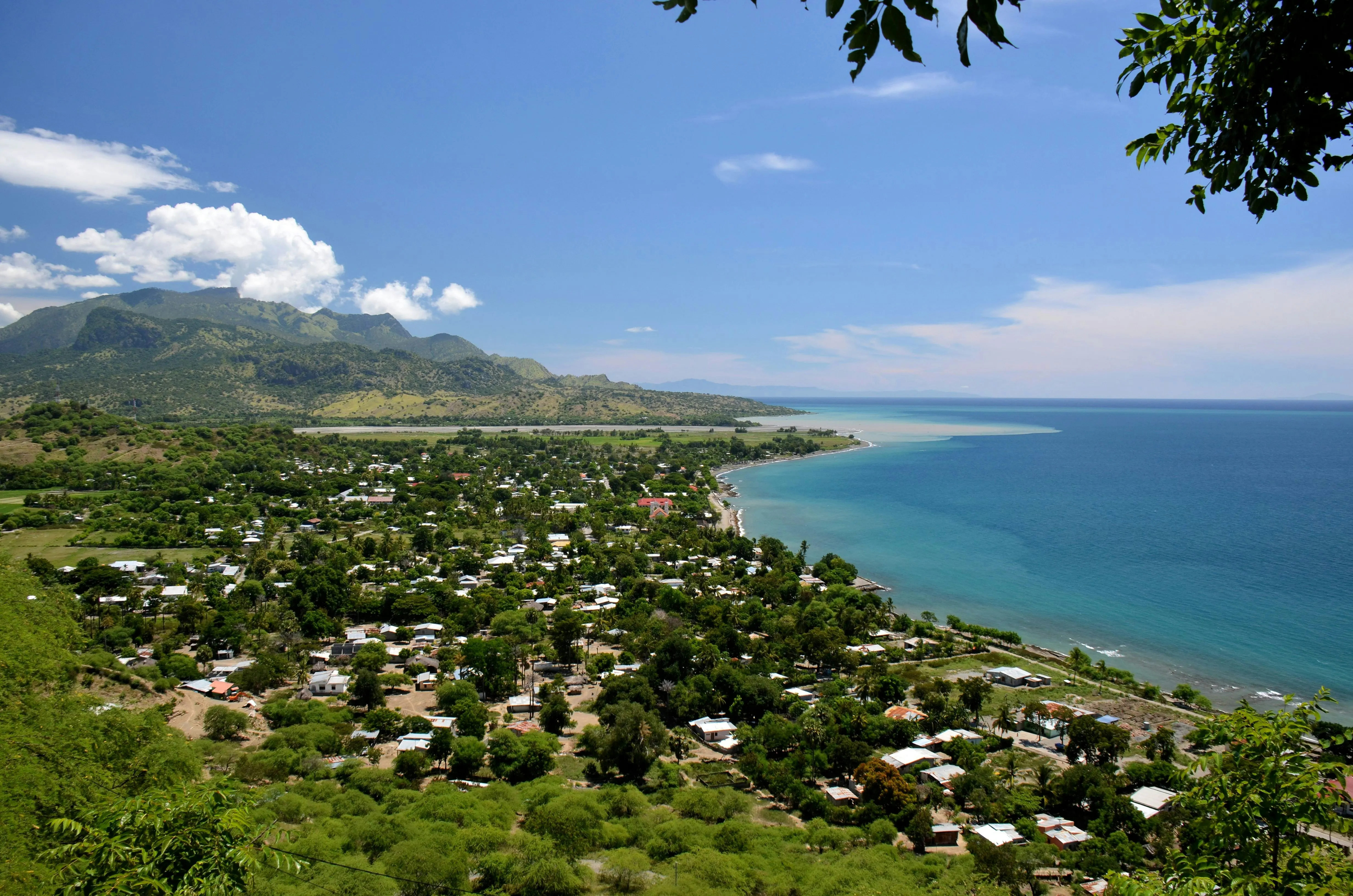
Timor-Leste
A pristine destination in Southeast Asia that captivates with its crystal-clear beaches, untouched coral reefs, rugged mountains, and fascinating cultural history.
Quick Facts
- Capital
- Dili
- Language
- Tetun
- Portuguese, Indonesian, and English
- Currency
- US Dollar (USD)
- Best time to visit
- From May to October, during the dry season, ideal for diving and hiking.
- Budget per day
- $35 - $110 per day
- Climate
- Warm and humid tropical climate, with a marked dry season and another of intense monsoon rains.
- Connectivity
- low
- Easy to obtain at Dili airport or in local shops of major operators.
- Electricity
- Type C, E, F, I (220V)
- Local transport
- limited
- Card usage
- cash is used more
- Tipping
- optional
🌎 Introduction
Looking at the map of Southeast Asia, exactly where the Indonesian archipelago meets the waters of the Pacific, appears a land of contrasts marked by its mountainous geography and its coral coast. In this corner of the world, the rhythm is set by the seasons: the dry months, which tint the landscape in shades of ochre and gold, give way to a rainy season that awakens the intense green of the coffee plantations in the highlands of Ermera or Maubisse. It is a place where the rugged interior relief descends calmly until meeting a tranquil sea, offering a natural setting that preserves an uncommon simplicity.
The identity of this young state is perceived in daily details, such as the colorful tais —traditional fabrics that narrate the history of its families— or the aroma of freshly roasted coffee floating in local markets. The heritage of centuries of diverse influences is organically intertwined in the architecture of coastal towns and in celebrations that unite ancestral rites with traditions brought from other continents. Traveling through its villages allows one to experience a slow-paced hospitality and a life that passes by indifferent to haste, centered on respect for the land and the community.
🛡️ General Safety
Timor-Leste is a country that, after years of institutional consolidation, offers a generally safe environment for the international traveler. The safety level can be described as medium, similar to other Southeast Asian countries that are in the process of tourism development. Although it is not a high-risk destination, it requires the tourist to maintain an attitude of observation and common sense, as the security infrastructure is still maturing and conditions can vary outside the capital.
General safety level
- The political and social situation is stable, allowing for travel through most of the territory without major setbacks.
- The country is in a growth phase, so the traveler should expect a quiet environment but with limited services compared to its regional neighbors.
- It is essential to stay informed about the local situation before traveling to very remote rural areas, although most points of interest are accessible and safe.
Crime and common risks
- The most common crimes are petty theft and bag snatching, especially in crowded places like markets, popular beaches in Dili, or during public events.
- Isolated cases of nighttime incidents related to disputes between local groups have been reported, though these rarely involve foreign tourists.
- Tourist scams are not widespread, but it is advisable to always agree on prices for services or transport in advance to avoid misunderstandings.
- It is recommended to avoid walking in poorly lit or isolated areas of Dili after the sun has set.
Safety in cities and tourist areas
- In Dili, the capital, the atmosphere is vibrant during the day. Neighborhoods like Pantai Kelapa or Lecidere are safe for walking, always keeping an eye on personal belongings.
- In coastal tourist areas, such as Atauro Island or the Baucau area, the safety level is high and interactions with the local population are usually very hospitable and respectful.
- It is important to be discreet with valuables, cameras, and large amounts of cash in urban centers.
Transport safety
- In Timor-Leste, traffic drives on the left, a legacy of its history and proximity to other countries in the region.
- The condition of the roads can be poor, with potholes and unpaved sections, especially in mountain areas, which increases the risk of accidents.
- Microlets (local minibuses) are the most common transport; they are economical but usually very crowded and do not meet international safety standards.
- For intercity travel, the use of 4x4 vehicles with a professional driver or private transport services recommended by hotels is advised.
- Taxis in Dili do not usually use meters; it is essential to negotiate the fare before starting the journey. It is recommended to use transport apps if available or request taxis by phone.
Natural and climatic risks
- Timor-Leste has a pronounced rainy season (from November to May) which can cause flash floods and landslides that cut off main roads.
- The country is located in a zone of seismic activity, so low-intensity earthquakes are possible, although large-magnitude ones are rare.
- Extreme heat and high humidity can be a health risk; constant hydration and adequate sun protection are vital.
- A specific natural risk is the presence of crocodiles in many coastal areas and rivers. It is fundamental to respect warning signs and ask locals before swimming at beaches that are not strictly tourist-oriented.
Legislation and local norms
- Laws related to drug use and trafficking are extremely strict and carry very severe prison sentences.
- Timor-Leste is a predominantly Catholic country with deep-rooted traditional values. It is recommended to dress modestly and respectfully, especially when visiting churches or rural communities.
- Failure to comply with social norms or lack of respect for authorities can result in fines or administrative problems.
Safety for specific groups
- Solo female travelers: In general, the country is safe, but it is common to receive unwanted attention or comments on the street. It is recommended to avoid traveling alone at night and to dress discreetly to minimize risks.
- LGTBIQ+ travelers: Although there are no laws criminalizing homosexuality, society is conservative. It is recommended to avoid public displays of affection to prevent uncomfortable situations or social rejection.
- Traveling with children and the elderly: The main challenge is the limited health infrastructure and the difficulty of transport. It is essential to travel with medical insurance that includes aerial evacuation.
Emergencies and assistance
- The general emergency number to contact the National Police (PNTL) is 112.
- Ambulance and fire services have limited capabilities, especially outside the capital.
- In case of an incident, one should go to the nearest police station to file a formal report, which is necessary for any subsequent insurance claim.
- Quality medical assistance is scarce in the country; for serious problems, transfer to hospital centers in Darwin (Australia) or Bali (Indonesia) is standard.
Tip: Always check with local residents before entering the water at remote beaches due to the real risk of crocodile presence, a natural hazard that tourists often underestimate.
📝 Entry Requirements
To plan a trip to Timor-Leste, it is essential to have a valid passport with a minimum validity, usually at least six months from the time of arrival in the territory. This document is the essential requirement for access and must be in good condition to facilitate procedures at immigration checkpoints.
In most situations, international travelers can obtain a stay permit or tourist visa directly upon arrival at major entry points, such as the international airport or certain border crossings. This authorization usually allows a maximum stay of 30 days, a period that is typically sufficient to explore the country’s attractions, although in many cases it is possible to request an extension of the permit from local authorities.
Immigration authorities usually require visitors to demonstrate their intention to leave the country at the end of their tourism period. To do this, it is common to be asked for a confirmed onward ticket to a third destination or back to the point of origin. Likewise, it may be necessary to prove sufficient financial solvency to cover all accommodation and maintenance expenses during the planned stay.
In the customs area, regular luggage inspections are carried out to ensure compliance with local regulations. Travelers should be cautious about bringing in fresh products, food, or plants, as they are usually subject to restrictions to protect the local ecosystem. If transporting prescription medications, it is highly recommended to accompany them with their respective prescription or medical report to avoid misunderstandings during border checks.
Regarding health requirements, there are usually no universally imposed vaccines for all traveler profiles, except in specific cases when coming from areas with a risk of certain diseases. However, it is an advisable practice to keep general vaccinations up to date and consider the usual recommendations for tropical destinations, always prioritizing prevention during the trip.
- Have an official passport with a validity of more than six months.
- Obtain the tourist permit at the point of entry or beforehand as applicable.
- Present proof of onward transport out of the country.
- Have sufficient funds for the total duration of the trip.
- Respect customs regulations regarding medications and perishable products.
- Consult preventive health recommendations for tropical environments.
🏥 Basic Health Considerations
If you have planned a trip to Timor-Leste, you must take into account that the country’s health system is quite limited and simple. In the capital, Dili, you will find the Guido Valadares National Hospital for general cases, but in rural areas, the infrastructure is very basic and health centers have few resources. There are some private clinics oriented towards foreigners where the quality of care is better, although prices can be high for a tourist. Regarding language, staff usually speak Tetum or Portuguese, but in private centers in the capital, it is common to find professionals who communicate in English.
Taking out travel medical insurance is not a legal requirement to enter the country, but it is something absolutely essential for your safety. You must ensure that your policy has very broad coverage that includes aerial medical evacuation to other nearby countries such as Australia or Singapore. In the event of a serious complication, it is very likely that local hospitals will not be able to treat you, and the cost of an emergency transfer on your own would be prohibitive.
Regarding vaccines, there is none that is mandatory for all travelers, unless you come from an area where yellow fever is endemic, in which case they will ask for a vaccination certificate. The most important thing is that you have your official vaccination schedule up to date. Additionally, it is usually highly recommended to be protected against typhoid fever and hepatitis A, especially if you plan to move through less urban areas or try local cuisine frequently.
If you need to bring your own medication, you can do so without problems as long as you transport it in its original packaging with the label visible. It is fundamental that you carry the medical prescription translated into English or a report from your doctor justifying the use of those drugs to avoid misunderstandings at customs. Do not rely on finding specific medications in local pharmacies, so it is best to prepare a complete first-aid kit with painkillers, gastric protectors, and basic wound care material before leaving home.
The main risks to your health in Timor-Leste are related to the tropical climate. The heat and humidity are intense, so you could suffer from dehydration if you do not drink liquids constantly. You will also see that mosquitoes are very common and can transmit diseases such as dengue, zika, or malaria, present in several regions. The use of a good insect repellent and clothing that covers the skin at dawn and dusk will be your best defense. On the other hand, although it is not a common health risk, you should be cautious with crocodiles on some beaches and river areas, as it is a real danger in the country.
Regarding the consumption of water and food, the golden rule is that you do not drink tap water under any circumstances. You will find bottled water easily and that is what you should use even for brushing your teeth. As for food, you can try delicious dishes at street stalls, but make sure the food is well-cooked and served hot. Avoid raw vegetables or fruits that come already peeled to prevent typical traveler’s intestinal infections.
In case of a medical emergency, the telephone number to call is 115. You should know that the ambulance service is limited and can take quite a while to arrive, especially outside Dili. On many occasions, if you find yourself in an urgent situation, the most effective thing will be to look for private transport to take you directly to the nearest health center or clinic.
As final tips for a peaceful stay, remember to apply sunscreen frequently, as the sun is very strong at these latitudes. Don’t forget to pack some sachets of oral rehydration salts, which will be very useful if the heat takes a toll on you or if you suffer from digestive problems. If you follow these basic prevention guidelines, you will be able to enjoy the country’s wild nature with much more peace of mind.
🚌 Transport within the Country
Getting around Timor-Leste is an experience that requires patience and adaptability. The most common means of transport for short and urban journeys are mikrolets, small vans that run specific routes through the cities. These vehicles do not usually have fixed stops marked in a conventional way, so travelers typically indicate to the driver when they wish to get on or off informally. For longer distances between different districts, larger buses and vans are used, connecting the capital with the main towns of the interior and the coast.
Transport infrastructure varies considerably between the capital and rural areas. While in Dili the main roads allow for fluid traffic, in mountainous regions the roads can be narrow and the surface can be in irregular condition. Due to the topography of the terrain, many visitors opt for renting 4x4 vehicles, which offer greater safety and autonomy to explore remote places where public transport is less frequent or non-existent.
To access specific points such as Atauro Island or the Oecusse enclave, the ferry is the essential means of transport. These maritime journeys depend directly on sea conditions and the availability of vessels at any given time. Likewise, there are domestic flight options that quickly connect the country’s most distant points, although their frequency is usually limited and subject to changes based on demand and weather conditions.
In urban centers, especially in the capital, taxis are a simple alternative for moving from one point to another. Using public transport in general can be somewhat complex at first due to the scarcity of written information or information panels in multiple languages. However, the willingness of drivers and the local population helps compensate for the lack of signage, making it easier for tourists to find their way.
The general feeling of transport in the country is one of flexibility and calm. It is not common to find rigorous punctuality in collective services, as many vehicles usually start their journey once the capacity is full. Journeys can be slow due to the geographical relief, but they offer an authentic way to integrate into the local pace of life and enjoy the natural environment along the way.
Tip: It is recommended to plan journeys with sufficient time margin, especially during the rainy season, to avoid possible delays caused by the state of the roads.
🤵 Culture and Etiquette
Social interaction in Timor-Leste is based on mutual respect and a slow-paced attitude. Greetings constitute a pillar of daily coexistence, the most frequent being the use of a handshake accompanied by a kind gesture. It is common to show special deference towards elderly people or those who hold positions of authority in the community, which translates into more formal and reserved treatment in their presence.
In public spaces, it is positively valued to maintain a moderate volume of voice, as speaking in an excessively high tone can be perceived as a sign of agitation or lack of self-control. Regarding physical contact, this tends to be discreet between people who do not have a close bond. Concerning punctuality, there is a more flexible conception of time than in other contexts, so it is common to find a certain relaxation in the schedules of social meetings or informal activities.
The sense of the sacred and respect for ancestral traditions are very present in daily life. When visiting places of worship or areas that the local population considers special for their symbolic weight, it is recommended to dress discreetly and maintain quiet behavior. It is important to observe local instructions before entering certain natural spaces or traditional constructions, as they may be subject to specific behavioral rules based on their beliefs and the concept of what they consider sacred.
In the realm of meals and hospitality, residents are usually very welcoming to visitors. If an invitation is received to share food or drink in a home, it is considered a gesture of courtesy to accept at least a small portion of what is offered to show gratitude. During time at a table or in general interactions, it is preferable to use the right hand to give or receive objects. Finally, the practice of leaving tips is not a deeply rooted social custom, although it is received with gratitude as voluntary recognition for outstanding service in urban and tourist settings.
Tip: Before photographing people, private homes, or participating in local ceremonies, it is recommended to ask for permission in a kind way to ensure that the gesture is well-received and respectful of the community’s privacy and traditions.
🍛 Typical Gastronomy
The gastronomy of Timor-Leste is the result of a fascinating mix of indigenous traditions, Portuguese heritage, and influences from neighboring Southeast Asian countries. The basis of the daily diet relies on basic local products such as rice, corn, cassava roots, and sweet potato. In coastal areas, fresh fish and seafood are absolute protagonists, while in the interior, the diet is complemented by pork, chicken, and goat meats. Flavors are usually mild but aromatic, using recurring ingredients such as coconut milk, tamarind, and a variety of local spices.
The act of eating in this country has a strong community component. It is common for dishes to be served in the center of the table for sharing, reflecting a deeply rooted culture of hospitality. Regarding habits, lunch and dinner usually take place early, following the rhythm of sunlight. In urban centers, it is common to find restaurants with cutlery, although in more rural or traditional settings, the custom of eating with hands is maintained during certain celebrations. Etiquette is generally informal, with a slow-paced attitude and respect for service times being highly valued.
In the beverage section, Timor coffee stands out notably. It is one of the country’s main products and is consumed daily, usually served very concentrated. It is also common to accompany meals with mineral water or freshly squeezed tropical fruit juices. In social events and festivities, tua mutin (palm wine) is the traditional beverage par excellence, handcrafted from the sap of local palm trees.
| Dish | Description | Main Ingredients | Where to Try It | Tip |
|---|---|---|---|---|
| Ikan Sabuko | Marinated and grilled fish with a sour touch. | Fish (mackerel or snapper), tamarind, chilies, and basil. | Beach restaurants on the coast and in Dili. | Accompany it with steamed rice to balance the flavor of the marinade. |
| Batar Da’an | Nutritious and consistent stew served as a main dish or side. | Corn, mung beans, and pumpkin. | Local food stalls and traditional homes. | It is an ideal choice for travelers looking for a vegetable alternative. |
| Caldeirada de Cabrito | Stew of Portuguese origin adapted with products from the region. | Goat meat, potatoes, tomatoes, and local spices. | Specialized restaurants in the capital. | Try dipping the local bread in the sauce to enjoy all the juices. |
| Tukir | Marinated meat slowly cooked inside bamboo stalks. | Pork or lamb meat, ginger, turmeric, and garlic. | Rural areas and festivities in the interior. | It is a slow-cooked dish, ideal for tasting at local celebrations. |
| Katupa | Rice cooked in coconut milk and presented decoratively. | Rice, coconut milk, and woven palm leaves. | Street markets and roadside stalls. | It is very practical to consume during travels due to its natural wrapping. |
📷 Zones and Places to Visit
Timor-Leste is a destination where recent history and pristine nature are uniquely intertwined. The capital, Dili, serves as the nerve center and starting point for most travelers. In this city, one can perceive a mix of modernity and historical memory. Walking along its waterfront allows for observing daily local life, while visits to the Timorese Resistance Archive and Museum provide a deep perspective on the country’s path to sovereignty. Near the center, the Tais market offers the opportunity to get a close look at traditional weaving, one of the most important cultural expressions of the region.
On the outskirts of the capital, the coastal landscape begins to show its potential. The area surrounding the Cristo Rei statue is one of the most frequented, not only for the monument itself but for the hiking trails that lead to small coves with calm waters. This area represents a meeting point where panoramic views of the bay and the neighboring Atauro Island can be enjoyed. The latter, accessible via a boat trip, is an international reference for its marine biodiversity, making it an ideal place for diving and snorkeling in well-preserved coral reefs.
When moving inland, the geography becomes rugged and mountainous, offering a notable contrast to the coastline. In the town of Maubisse, situated at a higher altitude, the climate is cooler and the environment is defined by coffee plantations and green landscapes. From here, many visitors begin the route to Mount Ramelau, the highest peak in the country. The ascent to this mountain is an activity with a strong spiritual significance for local inhabitants, and from its summit, the profiles of both coasts of the island can be seen on clear days.
The eastern part of the country preserves a more traditional and tranquil air. The city of Baucau, the second largest in the territory, stands out for its Portuguese colonial-influenced architecture, present in public buildings and its old administrative area. The surroundings of Baucau feature extensive beaches and caves with rock art that evidence the antiquity of human settlements in the area. Continuing east, one reaches Jaco Island, an uninhabited space considered sacred by the local population, where white sand and the intense blue of the sea create a natural environment of great purity.
Throughout the rural regions, visitors can find the lulik, or sacred houses, which vary in style depending on the area and are fundamental to understanding the social organization and beliefs of the communities. The Nino Konis Santana National Park, the country’s first, encompasses much of this cultural and natural wealth of the eastern tip, protecting both archaeological sites and terrestrial ecosystems. The diversity of Timor-Leste is thus manifested in the balance between its developing urban centers and its vast stretches of nature and tradition.
Tip: You cannot miss visiting the Cristo Rei of Dili, the most emblematic place in the country.
✈️ Best Season to Travel
Timor-Leste has a tropical climate characterized by warm temperatures year-round and a clear distinction between the dry season and the rainy season. The choice of the ideal time to visit the country depends on the type of experience sought, as the landscape and accessibility of infrastructure vary significantly according to rainfall.
In general terms, the period of lower humidity facilitates road travel and outdoor activities, such as hiking or diving, thanks to greater underwater visibility. However, the rainy season offers a much more exuberant and green environment, ideal for those who prefer to observe nature in its full splendor, provided there is some flexibility in travel plans.
| Season | Months | Typical Climate | What to Expect | Tourist Influx |
|---|---|---|---|---|
| Spring | Mar – May | Transition from wet to dry. Mild temperatures and decreasing humidity. | Very green landscapes after the rains, Independence Day celebrations (May), and favorable conditions for hiking. | ⭐⭐ Medium |
| Summer | Jun – Aug | Dry season. Sunny days, clear skies, and cool winds in the mountains. | Optimal time to travel the country by road and practice diving or snorkeling with excellent visibility on the reefs. | ⭐⭐⭐ High |
| Autumn | Sep – Nov | Hot and dry initially, with occasional rains toward November. | Sighting of whales and dolphins on their migration through the Ombai-Wetar Strait and local cultural festivities. | ⭐⭐ Medium |
| Winter | Dec – Feb | Rainy season. High humidity, frequent rainfall, and hot environment. | Flora in full bloom and high-flow rivers. Travel is slower due to the state of routes in rural areas. | ⭐ Low |
🗣️ Basic Vocabulary
Although Portuguese is an official language in Timor-Leste, Tetum is the language most used in daily life by the majority of the population. Knowing some basic words in this language will allow you to communicate more easily in common situations, such as when shopping in local markets, using transport, or simply greeting those you meet along the way.
Deep knowledge of grammar is not necessary to get by; remembering a few essential polite expressions is enough. Local inhabitants usually appreciate a visitor trying to address them in their language, which facilitates a more fluid and natural interaction during your stay in the country.
- Bondia: Good morning.
- Botarde: Good afternoon.
- Bonoite: Good night.
- Obrigadu / Obrigada: Thank you (use the “u” ending if the speaker is male and “a” if female).
- Favor ida: Please.
- Deskulpa: Sorry or excuse me.
- Di’ak ka lae?: How are you?
- Di’ak: Well / Everything’s good.