


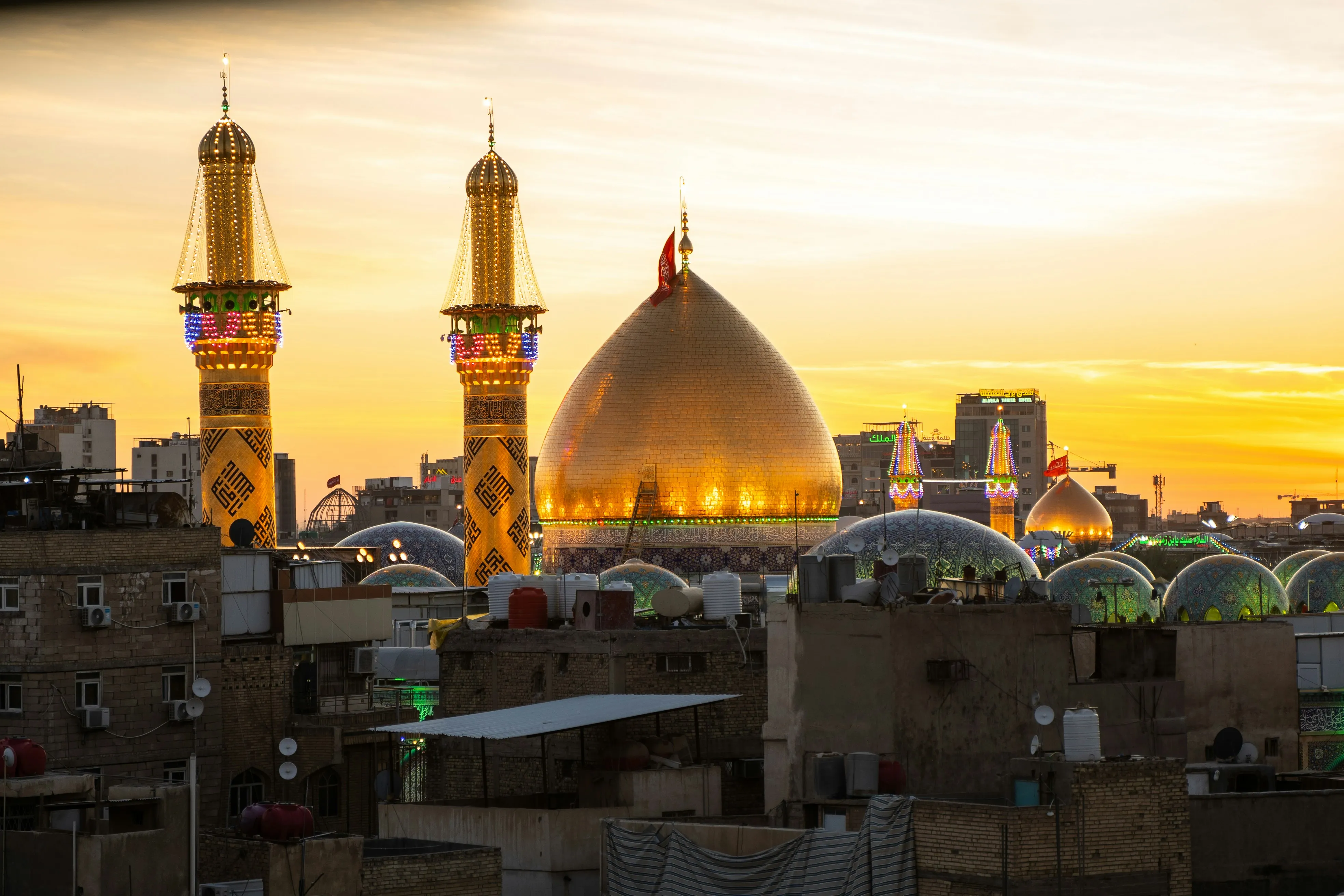
Iraq
Cradle of civilizations, Iraq offers a unique historical journey between the Tigris and Euphrates rivers, discovering fascinating archaeological treasures under ancient skies.
Quick Facts
- Capital
- Baghdad
- Language
- Arabic
- Kurdish
- Currency
- Iraqi Dinar (IQD)
- Best time to visit
- From October to April, avoiding the extreme summer heat.
- Budget per day
- $40 - $120 per day
- Climate
- Mostly desert climate with extremely hot summers and mild winters, being more temperate in the northern mountains.
- Connectivity
- medium
- Easy to obtain at airports and authorized kiosks in major cities.
- Electricity
- Type C, D, and G (230V)
- Local transport
- limited
- Card usage
- more cash is used
- Tipping
- optional
🌎 Introduction
Between the constant flow of the Tigris and the Euphrates lies a territory where the sunset light often tints the palm groves and city silhouettes in ochre. Beyond the desert stretches, the terrain becomes rugged in the northern mountains, which even see snow during the coldest months, while in the south, the wetlands offer a landscape of canals and reeds that seems untouched by the passage of time. It is a place defined by its geographical contrasts, where the climate dictates the rhythm of harvests and life in the squares.
The local culture manifests in simple gestures, such as the ritual of sharing cardamom tea even on hot days, or in the aroma of freshly baked bread that floods the souks at dawn. The gastronomy, which grants a privileged place to ingredients such as pomegranate, lamb, and fresh dates from its oases, reflects a heritage that has managed to preserve its essence through the years. Between rooted traditions and an urban life that maintains its own pulse, the country shows a polyhedral identity, forged as much by its historical weight as by the discreet hospitality of those who inhabit its shores.
🛡️ General Safety
Traveling to Iraq is an experience that has transformed its nature in recent years, going from being a practically inaccessible destination to one that arouses growing interest. However, the country presents a moderate-complex security level that requires meticulous planning and a vigilant attitude. The situation varies significantly between the Iraqi Kurdistan region (in the north), which is usually considered more stable and open to tourism, and Federal Iraq, where security measures are more visible and strict.
For the traveler, the current context is one of progressive stabilization, although challenges stemming from the country’s recent history persist. The presence of checkpoints is a constant on roads and city entrances, something that should be understood as a protective measure and not necessarily as a sign of imminent danger.
Crime and common risks
Compared to other international destinations, indices of common crime (such as violent robbery) are relatively low in Iraq, due in part to the strong police presence and cultural values of hospitality. However, there are certain risks that should be monitored:
- Petty theft and pickpocketing: Can occur in crowded markets or areas with high foot traffic, although it is not common.
- Minor scams: Especially when using taxis without a meter or in shops where prices are not marked; it is recommended to always agree on the price beforehand.
- Sensitive areas: It is essential to avoid border areas or zones where active security operations are being carried out, which are usually clearly delimited.
Safety in cities and tourist areas
Safety in urban centers has improved notably, especially in cities like Baghdad, Erbil, Najaf, or Basra. Tourist neighborhoods and areas where international hotels are located have their own security perimeters.
- Regional differences: Iraqi Kurdistan functions almost autonomously and is usually perceived as a more relaxed environment for tourists. In Federal Iraq, controls are more frequent.
- Urban mobility: It is recommended to move through crowded areas and avoid unknown peripheral neighborhoods, especially at night if you do not have a local guide.
- Checkpoints: It is mandatory to always carry your original passport at hand, as identity checks are common when changing neighborhoods or entering areas of interest.
Transportation safety
Transportation in Iraq is marked by the state of infrastructure and the dynamics of security checkpoints.
- Driving: In Iraq, people drive on the right. Traffic in cities like Baghdad can be chaotic and road rules are not always strictly respected.
- Taxi use: The use of transport applications (such as Careem) or taxis recommended by the hotel is recommended. Shared taxis are common, but for greater safety, private transport is preferable.
- Rental vehicles: Renting vehicles without a driver is not usually recommended for foreign tourists due to the complexity of the roads and the need to manage multiple security checkpoints in local languages.
- Public transport: Buses and vans are economical, but can be confusing for those who do not master the language or know the routes.
Natural and climatic risks
The climate is one of the most important safety factors to consider before undertaking a trip.
- Extreme heat: During the summer months (June to September), temperatures can exceed 50°C. This poses a real risk of dehydration and heatstroke.
- Sandstorms: These are frequent in spring and summer, and can paralyze air and land transport, in addition to causing respiratory problems.
- Seismic risk: The north of the country, near the border with Turkey and Iran, is in an area of seismic activity, although high-magnitude earthquakes are not frequent.
Local legislation and norms
Iraq is a country with deep-rooted traditions and legislation that can be very strict compared to Western standards.
- Alcohol consumption: It is not generally prohibited throughout the country, but its consumption is limited to specific places and drinking in public is very poorly regarded. In some holy cities, alcohol is totally prohibited.
- Drugs: Possession, consumption, or trafficking of any type of drug carries very severe prison sentences or even the death penalty.
- Photography: It is strictly forbidden to photograph government buildings, military installations, checkpoints, or critical infrastructure (bridges, airports). Failure to comply can lead to arrests and confiscation of equipment.
- Social behavior: Modest dress is expected, especially in places of worship. Public displays of affection should be avoided out of respect for local social norms.
Safety for specific groups
- Women travelers: It is recommended to dress modestly (covering shoulders and legs). In holy cities, the use of the abaya (black robe) is mandatory for women. Traveling alone is possible, but it is much simpler and more comfortable to do so in a group or with a guide.
- LGTBIQ+ travelers: Homosexuality is not explicitly illegal in all codes, but society is extremely conservative and there is no social acceptance. Maximum discretion is recommended, avoiding any public manifestation of sexual orientation.
- Traveling with children and the elderly: Iraqi culture is very family-oriented and children are usually welcome. The main challenge for these groups will be the extreme weather and long road distances.
Emergencies and assistance
In case of requiring immediate assistance, emergency services are centralized, although the response may vary by location.
- Police: 104
- Ambulance: 122
- Firefighters: 115
In case of any incident, the first thing is to contact local authorities and, subsequently, inform the corresponding consular representation. It is strongly recommended to take out comprehensive travel insurance that includes medical evacuation.
Tip: Always hire an accredited local guide for your movements outside hotel zones; their knowledge of protocols at checkpoints and local customs is the best security tool you will have in Iraq.
📝 Entry requirements
To undertake a trip to Iraq, the first essential requirement is to have a passport with a minimum validity of six months from the date of entry into the territory. It is fundamental that the document is in good condition to avoid inconveniences during the review processes. Regarding entry authorization, most travelers require a tourist visa, which can be managed at the corresponding diplomatic missions or, in certain cases and according to specific entry points, obtained upon arrival through established procedures at the borders.
The maximum duration of stay for tourist purposes is usually limited to a period of thirty days, although there may be variations depending on the nature of the permit granted. At the time of entry, immigration agents may request the presentation of an exit ticket that confirms the return to the country of origin or continuation to another destination. Likewise, it is common to be asked to demonstrate the possession of sufficient funds or financial solvency to cover all expenses derived from the stay in the country.
Security checks at airports and land border posts are usually exhaustive and thorough. Travelers are recommended to maintain a cooperative attitude during the inspection of documents and personal belongings. It is important to consider that verification processes can take longer than usual, so it is suggested to provide for this margin in travel itineraries.
Regarding customs restrictions, there is strict surveillance over the entry and exit of certain goods. It is strictly forbidden to transport any object that may be considered an antiquity or cultural heritage without the relevant permits. Regarding medications, it is advisable to carry the original medical prescription translated, especially if it involves specific treatments. Rules also apply to the import of certain foods, professional-use electronic products, or large amounts of currency, which must be declared if they exceed established limits.
In the field of health, it is recommended to verify the requirements regarding vaccines before starting the journey. Although an international vaccination certificate is not always required universally, it may be necessary for people coming from regions where certain diseases are endemic. It is suggested to have travel insurance with broad coverage that includes medical assistance and transfers, thus guaranteeing greater peace of mind against any health unforeseen during the stay.
The key points for entering the country are summarized below:
- Identity document: Passport with a validity of at least six months.
- Entry authorization: Visa usually required, manageable at embassies or enabled points.
- Length of stay: Generally up to thirty days for tourist activities.
- Additional documentation: Return ticket and proof of financial means.
- Health: Recommendation of vaccines according to origin and possession of medical insurance.
- Customs: Strict prohibition on the export of antiquities and control of prescription medications.
🏥 Basic health considerations
On your trip through Iraq, you will see that the healthcare system has gone through various stages and is currently in a process of reconstruction. You will find that in major cities like Baghdad or Erbil, there are modern private clinics and well-equipped hospitals that are the best option for any tourist. The public system, although accessible, is usually more crowded and has fewer resources. Prices for private medicine are moderate, but for a serious intervention, costs can rise considerably. A point in your favor is that much of the medical staff in private centers has studied abroad and speaks English fluently, so you will be able to explain what is happening to you without major difficulties.
Taking out travel medical insurance is not a mandatory procedure for obtaining a visa in all cases, but you should consider it essential in your planning. It is fundamental that your policy has broad coverage that includes hospitalization and medical repatriation. Due to the country’s logistics, in case of a serious health problem, you might need a transfer to specialized centers in other nearby countries, and having this support will save you from astronomical expenses that you could hardly afford on your own.
Regarding vaccines, you will not find mandatory requirements to enter the country, unless you come from an area with a risk of yellow fever transmission. The most recommended thing is to have your official vaccination schedule up to date. Complementarily, to travel with total peace of mind, protection against Hepatitis A and B is usually advised, in addition to vaccines against typhoid fever. It is always a good idea to visit a specialist doctor in travel medicine a few weeks before your departure to review your particular situation.
If you need to carry personal medication, make sure to always transport it in its original packaging and accompanied by the official medical prescription, preferably translated into English. Iraq is quite strict about the entry of certain drugs, especially those containing psychotropic substances or very potent painkillers. If you are on a chronic treatment, take enough for all the days you are away, as although you will find many pharmacies in urban areas, commercial brands and the availability of certain compounds may vary from what you usually use.
The most common health risk you will encounter is extreme heat, especially if you decide to travel during the summer months. Temperatures can easily exceed 45 degrees, which increases the risk of dehydration or heatstroke if you do not take precautions. It is also possible that you suffer some respiratory discomfort if you happen to encounter a sandstorm, which is common at certain times. Otherwise, there are no serious endemic diseases to worry about excessively, beyond logical precautions with environmental hygiene.
Regarding water and food, the golden rule is that tap water is not potable for visitors. You will find bottled water everywhere and it is what you should use even for brushing your teeth. At street food stalls, you can try incredible local dishes, but always make sure the food is freshly cooked and very hot. Avoid raw vegetables, fruits you cannot peel yourself, and ice cubes in drinks. Hygiene in tourist establishments in cities is generally good, but using a hand sanitizer gel before eating is a habit that will save you stomach upsets.
If you find yourself in an emergency situation, the telephone number for medical emergencies is 122. You should keep in mind that traffic in large cities can be very dense, which sometimes delays the arrival of ambulances. In non-life-threatening situations, you will often arrive sooner at a private hospital if you move by your own means in a taxi or private transport.
As final tips for your stay, it will be very useful to carry a small first-aid kit with basic painkillers, gastric protectors, and oral rehydration salts. Locate the referral hospitals near your accommodation as soon as you arrive and always carry a copy of your medical insurance on your phone or printed. Keeping yourself constantly hydrated, even if you don’t feel thirsty, will be your best strategy to enjoy the country with energy and health.
🚌 Transport within the country
Moving around Iraq involves mainly the use of the road network, which connects the most important urban centers of the territory. Travelers usually opt for medium and long-distance buses or by plane to cover extensive journeys between main cities, which allows for optimizing travel times. Although there is a railway line connecting some specific points of the country, its use is more limited compared to road transport, which remains the predominant option.
The public transport system can present certain challenges for the visitor, as signage is not always available in multiple languages and information about routes is not usually centralized. Ticket purchases are usually managed in person at stations or terminals, where direct interaction with staff is the standard way to confirm destinations and departure points.
In large cities, the transport offer is constant and varied, facilitating movement between different districts. However, in rural areas, options are scarcer and services are usually less frequent, which makes the traveler depend on vehicles that only start their journey once the number of passengers is complete. This dynamic requires the tourist to maintain a flexible attitude regarding their time estimates.
The use of taxis is one of the most common and practical ways to move in urban environments, being a very widespread service and easy to locate at any point. Regarding comfort and reliability, it is relevant to consider that dense traffic in metropolitan areas can influence the duration of journeys, so punctuality may vary according to road conditions and the time of day.
Advice: When using road transport services, it is recommended to go to the main terminals during the early hours of the morning, which is when there is a higher frequency of departures to other points in the country.
🤵 Culture and etiquette
Iraqi society is distinguished by deep hospitality and a sense of generosity that permeates daily life. Dealing with visitors is usually warm and close, as receiving someone from outside is considered an honor for the host. In social interactions, kindness and patience are enormously valued, dedicating time to greetings and courtesy questions before addressing any specific topic. This slow approach allows for establishing a bond of trust that is fundamental in any exchange, whether personal or commercial.
In the area of communication and physical contact, greetings are usually formal and are generally performed via a handshake between people of the same gender. It is common for the volume of voice to be high during a conversation or for gestures to be made with emphasis, which is usually a reflection of enthusiasm or passion in the speech and not necessarily a confrontational attitude. Regarding punctuality, there is a flexible conception of time, where human relationships and present conversations are usually prioritized over strict adherence to a schedule.
In gastronomic and visiting contexts, the exchange of food and drinks plays a central role. It is very common to receive invitations to drink tea, a gesture that should be accepted as a sign of gratitude and respect. When eating or when giving and receiving objects, social norms suggest using preferably the right hand. As for tips, although there is no rigid rule, they are a common and well-received practice in hospitality and transport services as recognition for good service, always within a framework of discretion.
Respect for traditions and religious spaces is a fundamental aspect for moving naturally. When visiting places of worship, such as mosques or shrines, silence and a collected attitude are essential, as is following instructions on clothing that covers shoulders and legs. During celebrations or significant periods in the local calendar, showing consideration for community practices, such as fasting or prayer times, facilitates a harmonious integration. Likewise, respect for the elderly and family hierarchies is an unwritten rule that structures much of the social behavior in the country.
Advice: Before photographing people in their daily environment or in private situations, it is fundamental to request prior permission, as this gesture of courtesy is valued as a sign of great respect for the individual’s privacy and dignity.
🍛 Typical gastronomy
The cuisine of Iraq has its roots in the ancient civilizations of Mesopotamia, making it one of the richest and most historical culinary traditions in the world. It is characterized by a balanced use of ingredients such as lamb, rice, legumes, and a wide variety of vegetables, especially eggplant. Flavors are not usually excessively spicy, but rather aromatic, thanks to the use of spices such as saffron, cardamom, turmeric, and the characteristic dried lemon or noomi basra, which adds a deep acidity to stews.
Eating habits in the country are deeply marked by hospitality and a sense of community. Meals are usually hearty and shared in a group, usually with various dishes placed in the center of the table so that each diner serves themselves. Flatbread or khubz, traditionally baked in clay ovens, is an omnipresent element used not only as an accompaniment but often as a utensil to pick up food.
Regarding customs in establishments, lunch is the main meal of the day and usually extends through the afternoon. In restaurants, it is common for small complimentary dishes or appetizers to be served before the main course. Regarding drinks, black tea is the pillar of social life; it is consumed at any time of the day, served in small glasses and usually with a fair amount of sugar. Due to local traditions, alcohol consumption is limited and not found in all establishments, while pork consumption is practically non-existent.
| Dish | Description | Main ingredients | Where to try it | Advice |
|---|---|---|---|---|
| Masgouf | Considered the national dish, it consists of grilled fish. | River carp, salt, and mild spices. | Restaurants on the banks of the Tigris River in Baghdad. | It is cooked slowly next to a wood fire; the wait is worth it. |
| Dolma | Variety of stuffed vegetables cooked over low heat. | Chard or vine leaves, onions, zucchini, meat, and rice. | Traditional cuisine restaurants throughout the country. | It is a very complete dish where the flavors of the vegetables blend together. |
| Quzi | Roasted lamb served on a generous base of rice. | Lamb meat, rice, nuts, and raisins. | Banquet halls and family restaurants. | It is the star dish at celebrations and guest meals. |
| Tashreeb | A traditional stew served over layers of flatbread. | Chickpeas, meat (lamb or chicken), and khubz bread. | Local eateries and markets. | The bread at the bottom absorbs all the broth, being the tastiest part. |
| Kleicha | The most emblematic sweet, especially during festivities. | Flour, dates, walnuts, and cardamom. | Local bakeries and street stalls. | It is the perfect accompaniment for a glass of hot black tea. |
📷 Areas and places to visit
Iraq is a destination that offers a deep journey through human history, where the legacy of ancient civilizations intertwines with contemporary life. The central axis of the country is marked by the Tigris and Euphrates rivers, whose banks have been the stage for the most remote settlements. Traveling through its territory, one perceives a fascinating contrast between extensive desert plains, southern wetlands, and the imposing northern mountains, offering a landscape diversity that surprises those seeking more than just archaeology.
The capital, Baghdad, is the beating heart of the country and an unavoidable cultural reference point. Walking through the historic Al-Mutanabbi Street, the center of the book trade and intellectual life, allows one to feel the pulse of the city. The National Museum of Iraq houses one of the most important collections in the world on Mesopotamia, while the Abbasid Palace and the ancient madrasas show the architectural sophistication of past eras. It is a city of large avenues and traditional markets where daily life flows with constant energy.
To the south, ancient history comes to life in the archaeological complexes of Babylon. Walking among its reconstructions and vestiges allows one to imagine the magnitude of what was one of the centers of the ancient world. Not far away, near Nasiriyah, stands the Ziggurat of Ur, a Sumerian structure that dominates the desert horizon and stands out for its excellent state of preservation. This southern area also houses the Mesopotamian Marshes, a unique ecosystem where one can navigate in traditional boats among reed houses, observing a way of life that has remained almost unchanged for millennia.
The cities of Najaf and Karbala represent the spiritual center for a large part of the population. Their impressive mosques with golden domes and the constant movement of people create an atmosphere of great solemnity and respect. These urban centers contrast with the tranquility of the surrounding rural areas, where agriculture remains the main driver. In the center of the country, Samarra also stands out, known worldwide for the Malwiya spiral minaret, a jewel of Islamic architecture that offers an iconic silhouette over the river valley.
In the northern region of Iraqi Kurdistan, the landscape transforms radically into green valleys and snowy peaks. Erbil, with its millennia-old Citadel situated atop a hill, is one of the oldest inhabited cities in the world and an example of coexistence between the modern and the ancient. This area is ideal for nature excursions, visiting the Gali Ali Bag waterfalls, or exploring the monasteries carved into the rock near Duhok, where the influence of various cultures and religions has left a deep mark on the character of its people.
Advice: You cannot miss visiting Babylon, the most emblematic place in the country.
✈️ Best time to travel
Iraq presents a predominantly continental and desert climate, which clearly marks the conditions for tourism. In general, transition periods, such as spring and autumn, are the most advisable for traveling through the country. In these stages, moderate temperatures allow for visiting both the extensive archaeological sites of the south and the mountainous areas of the north with greater comfort and clear skies.
During the temperate months, the Iraqi landscape offers its most notable contrasts, from the greenery of the hills in Kurdistan to the clarity of the Mesopotamian plain. In contrast, months of extreme temperatures—whether due to the intense summer heat or the cold of the high areas in winter—require more detailed planning and a greater adaptation to local rhythms of life, which usually pause during the central hours of the day.
| Season | Months | Typical climate | What to expect | Tourist influx |
|---|---|---|---|---|
| Spring | Mar – May | Mild and pleasant temperatures, with fresh breezes. | Green landscapes in the north and cultural festivals like Newroz (equinox). | ⭐⭐⭐ (High) |
| Summer | Jun – Aug | Extreme heat and very dry atmosphere, often exceeding 45 °C. | Urban activity concentrated at dawn and dusk; slow-paced days. | ⭐ (Low) |
| Autumn | Sep – Nov | Gradual decrease in heat and clear atmosphere. | Optimal conditions for photography and exploration of outdoor historical ruins. | ⭐⭐⭐ (High) |
| Winter | Dec – Feb | Cool in the center and cold in the north, with occasional rain. | Possibility of snow in the Kurdistan mountains and quiet atmosphere in cities. | ⭐⭐ (Medium) |
🗣️ Basic vocabulary
Although in hotels and busier areas of Iraq you could communicate in English, knowing some words in local Arabic is very useful for daily life. Iraqis are known for their hospitality and usually value positively that visitors make the effort to use basic terms, which greatly facilitates interaction in markets, transport, or restaurants.
These expressions will help you manage in daily situations and show courtesy during your travels through the country, allowing you to resolve quick doubts or make purchases more easily.
- Salam Alaykum: Formal greeting (literally, “peace be upon you”).
- Shukran: Thank you.
- Min fadlak: Please.
- Na’am / La: Yes / No.
- Wayn…?: Where is…?.
- Bikam?: How much does it cost?.
- Afwan: You’re welcome or excuse me (useful for asking to pass or apologizing).
- Mashi: Okay or alright.