


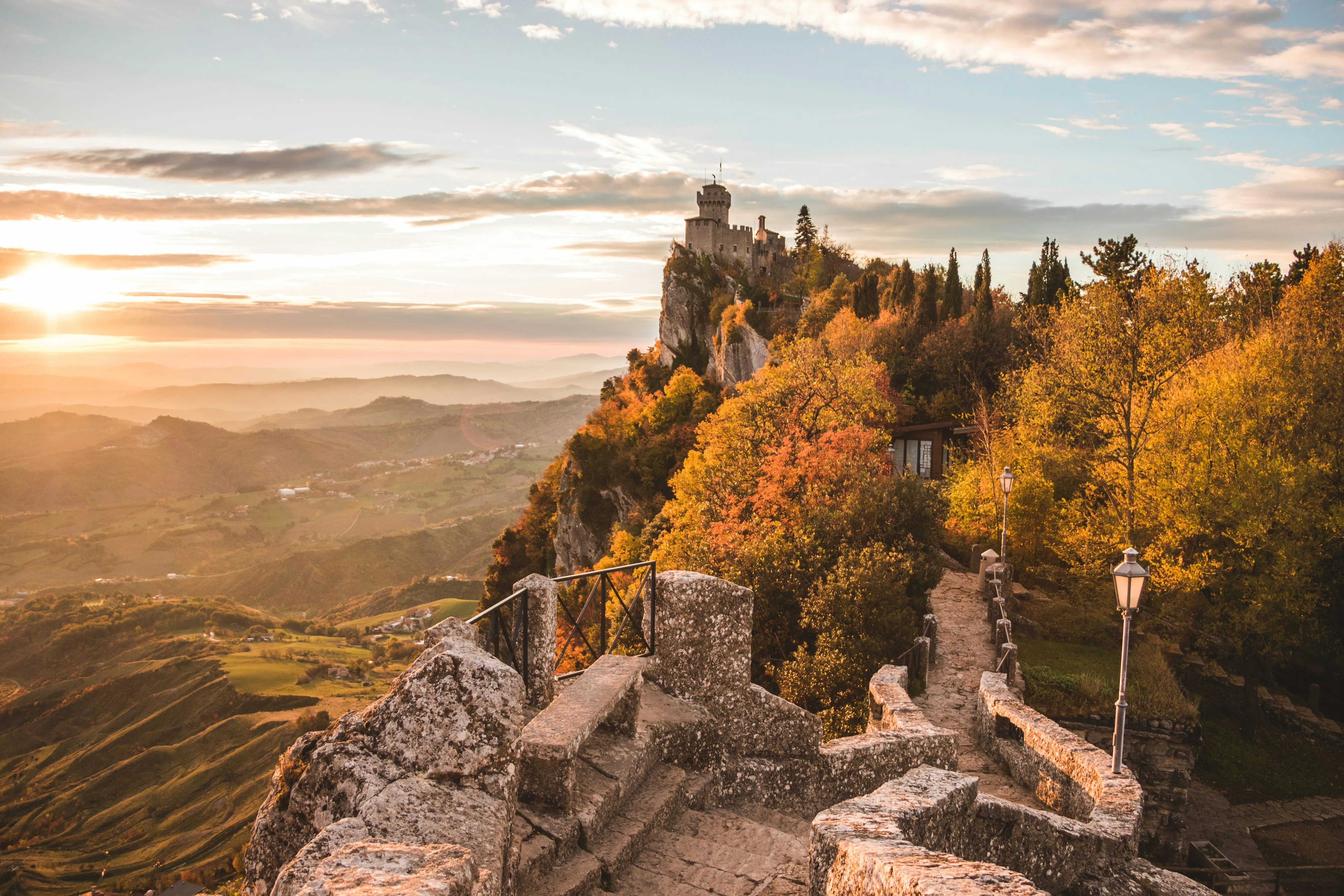
San Marino
Discover the oldest republic in the world, located in Italy, with medieval fortresses, stunning panoramic views, and a unique and captivating historical charm.
Quick Facts
- Capital
- City of San Marino
- Language
- Italian
- Emilian-Romagnol
- Currency
- Euro (EUR)
- Best time to visit
- From April to June and from September to October for mild weather
- Budget per day
- $80 - $180 per day
- Climate
- Inland Mediterranean with hot summers and cool winters, conditioned by its altitude on Mount Titano.
- Connectivity
- good
- Very easy to obtain through Italian operators or eSIM cards
- Electricity
- Type C / F / L (230V)
- Local transport
- acceptable
- Card usage
- very widespread
- Tipping
- optional
🌎 Introduction
Rising above the ridges of Mount Titano, this corner of the Italian peninsula preserves a serene atmosphere where history is felt in every corner. Its stone profiles, crowned by ancient towers overlooking the Adriatic Sea, offer a landscape that transforms as the months pass. On clear days, the horizon seems infinite, while the arrival of the cold usually wraps the cobblestone streets in a melancholy and cozy air that invites one to seek shelter in its small taverns.
The identity of this enclave is manifested in its daily customs and in a calendar marked by festivities that honor its medieval legacy. It is not uncommon to find scenes where the flavors of its gastronomy, such as local cheeses or traditional pastries, mix with the echo of ancient traditions and crafts. It is a place that balances its century-old heritage with a leisurely life, allowing a connection with a different rhythm, far from the usual rush.
🛡️ General safety
San Marino is considered one of the safest countries in the world for tourists. Due to its small size, high standard of living, and a very cohesive community, crime rates are extremely low. The feeling of tranquility is constant, allowing travelers to enjoy its historical heritage without the usual concerns of large metropolises.
In comparative terms, the security level is very high. The context for the traveler is that of a small sovereign republic where public order works with great efficiency and where respect for rules is the basis of daily coexistence.
Common crime and risks
Despite being an exceptionally safe destination, no place is totally free from minor incidents, especially during the high season.
- Petty theft: Pickpockets are uncommon, but they can appear in crowded areas, such as the towers or during large events. It is advisable to watch belongings in the historic center of the City of San Marino.
- Scams: No recurring scams aimed at tourists are reported. However, as in any commercial area, it is advisable to check prices before consuming in establishments located in high-traffic zones.
- Rare risks: Violent crime is practically nonexistent in the Republic, allowing for total freedom to walk at any time of the day or night.
Safety in cities and tourist areas
Safety in urban centers and points of interest in San Marino is excellent. The historic center, declared a World Heritage Site, is largely pedestrian and is constantly monitored by local security forces.
- Urban centers: In both the capital (San Marino) and Borgo Maggiore, the streets are safe and well-lit.
- Public transport: The bus service connecting with Italy and the cable car are safe environments where the main recommendation is simply to keep belongings in sight.
- Peripheral areas: There are no neighborhoods or areas classified as “dangerous” or that should be avoided for personal safety reasons.
Transport safety
Transport in the Republic is orderly and governed by strict road safety regulations.
- Driving: In San Marino, driving is on the right, just as in the rest of continental Europe.
- Road conditions: Roads are well-maintained, although steep slopes, sharp turns, and narrow sections are frequent due to the topography of Mount Titano.
- Parking: It is essential to respect marked parking zones. Checks are frequent and fines are processed quickly.
- Rental vehicles and taxis: Services are reliable and professional. There is no risk of meter manipulation or fraudulent services.
Natural and climatic risks
San Marino presents a controlled natural environment, although its geographical location entails certain factors to consider depending on the time of year.
- Winter weather: Between December and February, snowfall and frost are common. This can make driving difficult and cause the cobblestone paths of the historic center to become slippery.
- Summer heat: During the months of July and August, high temperatures can be recorded, so hydration is important when walking the city’s slopes.
- Seismic risk: The area is located in a region with moderate seismic activity, common in the Italian peninsula, although high-magnitude earthquakes are not frequent.
Legislation and local norms
San Marino is one of the oldest republics in the world and takes pride in its sovereignty and traditions.
- Sovereignty: It is important to remember that San Marino is an independent state from Italy. Although there are no physical border controls, its own laws must be strictly respected.
- Respect for heritage: Vandalism or damage to historical monuments carries severe penalties and high economic fines.
- Substance consumption: Drug legislation is strict, and public consumption is not permitted.
- Clothing: Although the atmosphere is relaxed, it is recommended to dress decorously (shoulders and knees covered) to enter churches and places of worship.
Safety for specific groups
San Marino is a welcoming destination for all types of travelers due to its open and peaceful character.
- Women travelers: The country is completely safe for women traveling alone, with practically zero levels of street harassment.
- LGBTQ+ travelers: It is a respectful and safe environment, with no specific risks reported for the community.
- Traveling with children or seniors: The main precaution is physical, due to the steepness of the streets and the presence of stairs, which can pose a mobility challenge.
Emergencies and assistance
The Republic has modern and effective emergency services that collaborate closely with Italian authorities if necessary.
- Emergency numbers:
- General emergencies: 112
- Police (Gendarmerie): 113
- Ambulances and medical emergencies: 118
- Firefighters: 115
- Medical assistance: The State Hospital of San Marino offers high-quality care. Foreign citizens usually require health insurance or the European Health Insurance Card (depending on current agreements) to cover the costs of non-urgent assistance.
- Handling incidents: In case of loss of documents or theft, one must go to the Gendarmerie to file the corresponding report.
Tip: Due to the steep streets and stone pavement, use footwear with good grip to avoid falls, especially if the ground is wet or if you are going up to the Three Towers.
📝 Entry requirements
To access the territory of San Marino, travelers must have a valid passport with sufficient residual validity, usually recommended to be at least three or six months beyond the planned date of departure. As a microstate surrounded by European Union territory, access is free through land borders, so systematic border controls or migration inspection posts are not usually found at the usual road entry points.
In terms of visas, most tourists traveling for short periods do not require prior authorization for stays for recreational purposes. The allowed length of stay usually aligns with international standards for temporary visitors, permitting a stay of up to ninety days in a period of one hundred and eighty days. Although it is not frequent for them to be actively requested at the border, it is advisable for the traveler to have proof of sufficient funds to cover their expenses and a return or onward travel ticket to avoid inconveniences in case of a random inspection.
Regarding customs regulations, general rules apply to the transport of personal goods, medications, and specific products. It is recommended to carry medications for personal use in their original packaging and accompanied by a medical prescription if they contain controlled substances. There are no unusual restrictions for everyday items, although caution is suggested with the entry of fresh food products or products of animal origin, following the general food safety guidelines of the surrounding geographical region.
In the area of health and prevention, mandatory vaccination certificates are not required to enter the country under normal global public health conditions. However, it is advisable to have travel insurance with broad coverage, as medical services for non-residents usually require payment for the costs generated. Keeping official vaccination schedules up to date is the only generic recommendation for any visitor wishing to enjoy a peaceful stay in this destination.
- Primary document: Passport with a recommended minimum validity of three to six months.
- Visa requirement: Generally exempt for short-term tourist stays.
- Stay limit: Up to a maximum of ninety days per semester.
- Entry checks: Possible random request for economic means and an exit ticket.
- Health requirements: No mandatory vaccines, but private medical insurance is recommended.
- Customs regulations: Standard control of medications, tobacco, alcohol, and high-value goods.
- Territorial access: Free entry by land without fixed border controls.
🏥 Basic health considerations
San Marino has a health system of excellent quality and is very efficient, ranked among the best in the world for its management and resources. As such a small state, you will find that services are highly centralized, mainly at the State Hospital. As a tourist, you will have access to both public care and private clinics, but you should know that prices for non-residents are usually high. The medical staff is very well-prepared, and although the primary language is Italian, you will have no trouble communicating in English in most health centers.
Having travel medical insurance is highly recommended for your peace of mind. Although it will not be mandatory to cross the border, it will save you from unexpected bills in case of an accident. It is important that your insurance covers basics such as hospitalization, but also repatriation services and medical transfers if it were necessary to return to your place of origin.
Regarding vaccines, you will not find any that are mandatory to enter the country. The only thing you should check is that your routine vaccination schedule is up to date. There are no risks of tropical diseases or anything out of the ordinary, so you will be safe from major health concerns in this regard.
If you need to bring your own medication, you can do so without problems as long as you carry it in its original packaging. For specific medications or those requiring a prescription, it is very useful to carry the medical prescription or a certificate signed by your doctor. You will find well-equipped pharmacies where you can buy common products, but remember that for certain drugs, they will strictly require a local or international prescription.
Health risks in San Marino are minimal and are usually related to the climate and topography. Being located on Mount Titano, if you travel in summer you will find quite strong sun, so the use of sun protection is essential to avoid burns. In winter, the cold and wind can be intense, so you should dress warmly to avoid colds. As it is a mountain area, it is advisable to wear appropriate footwear to avoid sprains or falls on the cobblestone streets, which is the most common physical risk for visitors.
You can drink tap water with total safety anywhere in the country, as it is of magnificent quality. Regarding food, hygiene standards in restaurants and establishments are very high, so you can try all the local delicacies without fear of poisoning. No special precautions are necessary with raw foods or food from street stalls.
In case you have a medical emergency, the number to dial is 118, although you can also use 112, which is the generic emergency number. The ambulance service is very fast and professional, and given the small surface area of the territory, attention usually arrives in a matter of very few minutes.
As final tips, I would tell you to always carry a copy of your insurance with you and not to forget a small first-aid kit with painkillers or band-aids for the walks. San Marino is a very safe and clean destination where your only concern will likely be enjoying the impressive views from its towers.
🚌 Transport within the country
Due to its small territorial size, mobility in San Marino is primarily based on road transport. As there is no internal railway network or airports within its borders, visitors usually move around using the bus or a private vehicle. A very common means of connecting the lower area with the historic center located in the upper part is the cable car, which allows for a comfortable ascent.
The use of public transport is simple for international tourists. The signage is clear and departure points are well-indicated, which facilitates orientation despite the terrain’s topography. Ticket management is usually done at authorized points of sale or directly on the transport, maintaining an agile use process without major linguistic complications for the traveler.
There is a difference between the more urban zone and the more peripheral areas of the country. In the historic center, movement is fundamentally pedestrian due to the configuration of its streets, while moving between the different castles or municipalities relies more on a vehicle. The public transport service is generally punctual and reliable, offering a sense of order and safety during transfers.
Taxis are available and are a useful alternative for specific journeys or for those seeking greater schedule flexibility. Although they are not as numerous as in large metropolises, they well cover the needs for direct travel between points where collective transport has less presence. The road network is in good condition, which contributes to short and fluid journeys.
“Tip”: It is recommended to check the transport schedules for less central areas to organize visits in advance.
🤵 Culture and etiquette
Social interaction in San Marino is characterized by a balance between cordiality and formal respect, reflecting the pride of one of the oldest republics in the world. When addressing local inhabitants, it is customary to use formal greetings such as buongiorno or buonasera, reserving familiar treatment for closer circles. Hospitality is a fundamental value, and residents usually appreciate visitors showing interest in their unique national identity and their institutional history, which they care for with dedication.
In public spaces, discreet and calm behavior is valued. The volume of the voice is usually moderate, and maintaining an appropriate personal distance during conversations is appreciated, especially with strangers. Punctuality is a sign of courtesy in social appointments and commitments, so arriving at the agreed time is considered a gesture of consideration toward others. Physical greetings usually begin with a firm handshake, evolving into closer gestures only when a consolidated prior relationship exists.
Regarding gastronomy and visits, meals are moments of social gathering enjoyed without haste, respecting the “sobremesa” (after-meal conversation) times. Although there is no strict rule regarding tipping, leaving a small percentage of the total or rounding up the bill is a well-received gesture if the service has been satisfactory, although in many cases the service charge is already included. When visiting establishments or homes, it is common to wait for the host to indicate the protocol to follow. Likewise, care in dress is relevant in certain contexts, opting for somewhat more formal clothing when going to high-end restaurants or official events.
Respect for traditions and shared spaces is essential for harmonious coexistence. In places of worship and government buildings, it is recommended to maintain a low voice tone and dress decorously, covering shoulders and knees as a show of deference toward the character of the site. Similarly, during institutional celebrations or historical parades, the public is expected to observe the acts with an attitude of respectful listening and observation, valuing the deep meaning these events have for the Sanmarinese community.
“Tip”: It is fundamental to recognize and respect the sovereignty and identity of San Marino as an independent State, avoiding referring to the country as if it were an extension or a region of the surrounding territories.
🍛 Typical gastronomy
The gastronomy of San Marino is closely linked to its geographical location, sharing deep roots with the surrounding Italian regions, especially Emilia-Romagna and Marche. The base of its cuisine is purely Mediterranean, with a strong presence of fresh local products, cereals, meats, and legumes. The artisanal preparation of fresh pasta and the use of locally produced olive oil are fundamental pillars that define the flavor of its tables.
Among the most common eating habits, the importance of lunch and dinner as moments of social gathering stands out. Schedules are usually regular, with the midday meal between 12:30 and 14:30, and dinner starting from 19:30. It is common to start meals with a pasta or soup dish, followed by a protein accompanied by seasonal vegetables. Bread is always present on the table, serving as an indispensable accompaniment for most traditional recipes.
Characteristic ingredients include varieties of local cheeses, cured meats, and aromatic herbs that grow on the slopes of Mount Titano. In the beverage section, San Marino has its own winemaking tradition, producing white and red wines that usually accompany the main meals. Coffee also plays an essential role in the daily routine, generally consumed after eating in a leisurely manner on the terraces and cafes of the urban centers.
In restaurants, etiquette is generally relaxed and hospitable, prioritizing attentive service without excessive formalities. A strict dress code is not required in most establishments, although correctness is valued. It is common for establishments to maintain a focus on local cuisine, highlighting the authentic flavors of the region without unnecessary artifice, which allows the visitor to know the country’s cultural identity through the palate.
| Dish | Description | Main ingredients | Where to try it | Tip |
|---|---|---|---|---|
| Torta Tre Monti | A cake made of layers of crispy wafer with filling. | Wafers, hazelnut cream, cocoa, and chocolate. | Bakeries and cafes in the City of San Marino. | It is ideal to accompany afternoon coffee. |
| Nidi di rondine | Fresh pasta rolled in the shape of a “swallow’s nest” and baked. | Egg pasta, cooked ham, melted cheese, and béchamel. | Traditional restaurants and local taverns. | It is recommended to try it fresh from the oven to appreciate its texture. |
| Piadina | A thin flatbread served folded and filled. | Wheat flour, lard or olive oil, water, and salt. | Fast food stalls and kiosks throughout the country. | It is perfect as a light meal while walking through the old town. |
| Cappelletti in brodo | Small filled pasta served in a clear broth. | Egg pasta, minced meat, parmesan cheese, and meat broth. | Home-cooking restaurants and family establishments. | It is a very comforting dish, especially during the winter months. |
| Bustrengo | A dense and traditional cake with a rustic texture. | Corn flour, breadcrumbs, dried fruits, honey, and apples. | Bakeries and local festivities. | Being a substantial dessert, a small portion is enough to appreciate its flavor. |
📷 Areas and places to visit
The City of San Marino, located at the top of Mount Titano, constitutes the historic core and the main point of interest for those visiting the country. When walking through its cobblestone and pedestrian streets, one perceives a very well-preserved medieval environment that has been recognized as a World Heritage Site. Much of the cultural and administrative activity is concentrated in this area, allowing the visitor to observe closely the institutional structure of one of the oldest republics in the world.
The country’s profile is defined by the Three Towers, located on the mountain peaks. The first of them, Guaita, is the oldest and served as a refuge for the inhabitants; the second, Cesta, is located at the highest point and houses a collection of ancient weapons; while the third, Montale, stands out for its more isolated location and its original defensive function. These structures are connected by paths, such as the well-known Witches’ Path, which offers panoramic views toward the surrounding valleys and the Adriatic coast.
In the heart of the capital is the Piazza della Libertà, where the Palazzo Pubblico is located, the seat of government and the city hall. This neo-Gothic style building is an example of the country’s institutional architecture, and the changing of the guard can usually be observed outside. A few steps away is the Basilica of San Marino, a neoclassical style temple dedicated to the founder of the community, which preserves relics of great historical importance.
For those seeking a different perspective, Borgo Maggiore represents the link between the upper area and the rest of the territory. Located at the foot of Mount Titano, this urban center is known for its traditional atmosphere and its historical market square. The connection between this area and the historic center is easily made via the cable car, a journey that allows one to appreciate the contrast between the stone constructions and the natural landscape surrounding the mountain.
The cultural offer is complemented by various institutions such as the State Museum, located in the Palazzo Pergami Belluzzi, which displays archaeological finds and artistic pieces related to local history. Other relevant spaces include the Museum of Curiosities or the St. Francis Art Gallery, where religious and civil works of art are exhibited. These visits allow for an understanding of the region’s social and political evolution over the centuries.
Beyond the historic center, the territory is divided into different municipalities called castelli. Areas like Serravalle or Domagnano offer a more residential and modern atmosphere, where sports and commercial activities are developed. In these rural areas, it is possible to enjoy hiking trails and paths that cross cultivated fields and wooded areas, showing a quieter and more natural side of the country, away from the main tourist flow.
“Tip”: You cannot miss visiting the Three Towers of Mount Titano, the most emblematic place in the country.
✈️ Best time to travel
The choice of date to visit San Marino depends largely on personal preferences regarding the climate and the type of experience sought. Being located on Mount Titano, this small State enjoys a transitional climate between Mediterranean and continental. This allows for well-defined seasons: summers are warm and lively, while winters are usually cool and quiet, offering very different perspectives of its landscapes and fortresses depending on the month of the year.
Generally, the periods between the end of spring and the beginning of autumn are considered the most balanced for outdoor activities and enjoying the panoramic views toward the Adriatic. During these months, the days are longer and the temperatures allow for walking the cobblestone streets comfortably. However, those who prefer a more serene atmosphere or to enjoy the winter aesthetic will find the colder months to be a less crowded destination with a particular atmosphere.
| Season | Months | Typical weather | What to expect | Tourist influx |
|---|---|---|---|---|
| Spring | Mar – May | Mild temperatures and progressively clearer days. | The awakening of vegetation on Mount Titano and the investiture ceremony of the Captains Regent in April. | Medium ⭐⭐ |
| Summer | Jun – Aug | Warm and dry climate, with frequent breezes due to the altitude. | Sunny days, medieval-themed festivals, and a wide range of outdoor cultural events. | High ⭐⭐⭐ |
| Autumn | Sep – Nov | Cool and pleasant temperatures, with a gradual increase in rain. | Landscapes with ochre tones, seasonal local gastronomy, and the second investiture of the Captains Regent in October. | Medium ⭐⭐ |
| Winter | Dec – Feb | Cold weather, with occasional presence of fog and snow in high areas. | Christmas markets, a very quiet atmosphere, and views of the castles surrounded by winter calm. | Low ⭐ |
🗣️ Basic vocabulary
Learning some basic words and phrases in Italian will help you move around more easily during your stay in San Marino. Although many local inhabitants are used to tourism and can understand other languages, using simple expressions to greet or say thank you is a practical way to facilitate communication in shops, restaurants, and points of interest.
It is not necessary to delve deep into grammatical rules; knowing the most common terms for daily interactions is enough. These small formulas of courtesy usually make dealing with residents smoother and more pleasant while you explore the historic center or use local services.
- Buongiorno: Good morning (generally used until after midday).
- Buonasera: Good afternoon or good evening (used from mid-afternoon onwards).
- Per favore: Please.
- Grazie: Thank you.
- Prego: You’re welcome (also used as a polite response when someone gives way to you or serves you).
- Scusi: Excuse me or sorry (useful for asking to pass or getting the attention of a waiter or shop assistant).
- Dov’è…?: Where is…? (followed by the place you are looking for, such as a bathroom or a street).
- Il conto, per favore: The bill, please.