


Norway
Discover Norway, a paradise of majestic fjords, northern lights, and modern cities surrounded by pristine nature, ideal for outdoor adventure lovers.
Quick Facts
- Capital
- Oslo
- Language
- Norwegian
- Sami, English
- Currency
- Norwegian Krone (NOK)
- Best time to visit
- From May to September for hiking or from November to March to see the northern lights.
- Budget per day
- $120 - $300 per day
- Climate
- Temperate climate on the coast due to the Gulf Stream and colder in the interior, with snowy winters and cool summers.
- Connectivity
- good
- Very easy to obtain both in physical stores and via eSIM, with excellent national coverage throughout the country.
- Electricity
- Type C / F (230V)
- Local transport
- good
- Card usage
- widespread
- Tipping
- optional
🌎 Introduction
Located in the northernmost part of Europe, Norway unfolds as a mosaic where the sea and mountains coexist in a constant balance. Its jagged coastlines, marked by the presence of fjords and small villages of wooden houses, draw a landscape that changes profoundly with the passing of the seasons. It is a place where time seems dictated by the light and the cycles of nature, whether under the persistent clarity of the midnight sun or in the seclusion of snowy winters.
The Norwegian identity is intimately linked to outdoor life and a genuine respect for the environment. This connection is perceived both in its cities, which naturally integrate contemporary architecture with large green spaces, and in its most deep-rooted traditions. From the aroma of coffee shared after a hike to the freshness of the fish in the ports, the country offers a slow-paced everyday life that invites observing details in a different way.
Throughout its geography, variety manifests in contrasts ranging from the cultural dynamism of urban centers like Oslo or Bergen to the serenity of the Arctic regions. Its local festivals, its gastronomy based on local products, and the folklore that still permeates many of its corners complete the essence of a society that values simplicity. Norway represents, in short, a destination where landscape and culture form an indivisible whole.
🛡️ General safety
Norway is internationally considered one of the safest and most peaceful destinations in the world for travelers. The country enjoys exceptional social and political stability, which translates into a very welcoming environment for tourism.
- General rating: The level of safety is very high. Crime rates are considerably low compared to other international destinations.
- Context for the traveler: Most visits to Norway pass without any type of safety-related incident. Social trust is a pillar of Norwegian culture, so the traveler will feel respected and protected in almost any environment.
Crime and common risks
Despite being an extremely safe country, it is not exempt from small incidents, especially in areas with a high influx of people.
- Minor thefts: Pickpockets usually operate mainly in the key hubs of Oslo, such as the Central Station (Oslo S), the pedestrian street Karl Johans gate, and the most crowded areas during the high cruise season.
- Scams: They are very infrequent, although it is always advisable to be wary of unofficial service offers or people requesting financial help in a suspicious manner in very touristy areas.
- Uncommon risks: Violent crimes are exceptional and rarely affect tourists. Common sense is the best prevention tool.
Safety in cities and tourist areas
Norwegian cities are safe to walk in both day and night. However, it is worth keeping some practical recommendations in mind.
- Urban centers: Cities like Bergen, Stavanger, or Trondheim are very quiet. In Oslo, it is advisable to be a bit more attentive around the train station at night, although it is not a dangerous area by definition.
- Public transport: It is extremely safe and efficient. Incidents on buses, trams, or metros are almost non-existent.
- Recommendation: You can walk peacefully through almost any neighborhood, but it is always advisable to keep your belongings in sight in cafes and places with high people turnover.
Transport safety
Transport in Norway stands out for its punctuality and safety, although the geographical environment requires attention if you decide to drive.
- Driving: In Norway, you drive on the right. The roads are safe but often narrow and winding due to the orography of the fjords.
- Road rules: Fines for speeding are extremely high and limits are strict. The permitted blood alcohol level is practically zero; non-compliance carries severe penalties.
- Taxis and rental vehicles: Taxi services are official and very safe, although expensive. Rental vehicles are usually in excellent condition and equipped for the local climate.
- Winter: If you travel in winter, roads can be covered in ice or snow. The use of winter tires is mandatory, and previous experience in these conditions is recommended.
Natural and climatic risks
This is possibly the point where the tourist should pay the most attention, as Norwegian nature can be unpredictable.
- Changing weather: In the mountains and fjords, the weather can change from radiant sun to an intense storm in a few minutes.
- Hiking and mountains: It is vital to follow marked routes and consult weather forecasts at Yr.no. Do not underestimate the difficulty of famous routes like Preikestolen or Trolltunga.
- Seasonal risks: In winter and spring, there is a risk of avalanches in mountain areas. In summer, although rare, flooding can occur due to snowmelt.
- Prevention: Always wear appropriate clothing (the layering system is fundamental) and notify someone of your route if you are going to hike in isolated areas.
Legislation and local norms
Norway has clear laws that seek to protect common well-being and the natural environment.
- Alcohol consumption: The sale of alcohol is highly regulated. Drinks with an alcohol content higher than 4.7% are only sold in state stores called Vinmonopolet, which have limited hours. It is forbidden to consume alcohol in open public spaces (parks, streets).
- Respect for nature: There is the concept of Allemannsretten (right of public access), which allows camping and walking almost anywhere, as long as private property is respected, no litter is left, and the environment is cared for.
- Drugs: Legislation on narcotic substances is strict, and penalties for possession or consumption can be severe.
Safety for specific groups
- Solo female travelers: Norway is one of the safest countries for women traveling alone. Street harassment is practically non-existent, and gender equality levels are among the highest in the world.
- LGTBIQ+ travelers: The country is a pioneer in diversity rights. It is a very welcoming and safe destination for the LGTBIQ+ community, with an open society and laws that protect against discrimination.
- Children and the elderly: Infrastructure is perfectly adapted for families and people with reduced mobility, guaranteeing a comfortable trip without setbacks.
Emergencies and assistance
In case of needing help, Norwegian emergency services are fast and highly professional.
- Emergency numbers:
- 112: Police.
- 113: Ambulance and medical emergencies.
- 110: Fire department.
- Medical assistance: Healthcare is of excellent quality. Tourists should have adequate travel insurance or, in the case of EU citizens, the European Health Insurance Card to cover medical expenses.
- Police station: If you suffer a theft (uncommon), you must go to the nearest police station (Politistasjon) to file the necessary report for your insurance.
”> Tip: Download the official mountain safety application and always consult the website varsom.no for avalanche or landslide alerts if you plan to do outdoor activities outside the cities.
📝 Entry requirements
To undertake a trip to this Nordic destination, the first fundamental step is to verify personal documentation. The passport is the internationally accepted identification document and must have a residual validity that is generally recommended to be at least three months beyond the planned end date of the trip. Depending on current international mobility agreements, a large portion of foreign visitors do not require a prior tourist visa for short stays, allowing a stay that usually reaches a maximum of ninety days within a period of one hundred and eighty days.
Upon arrival at main access points, such as international airports, border authorities usually perform routine control procedures. In these cases, it is very useful to be able to present a return ticket or departure ticket to a third destination, as well as proof of accommodation reservation or a formal invitation. Similarly, although not always systematically requested, it is advised to have documents or statements that prove the possession of sufficient economic funds to cover all expenses derived from the stay in the territory.
In the customs area, standard regulations apply for the entry of personal goods. There are specific limits for the introduction of products such as alcohol and tobacco, and strict restrictions apply to the transport of fresh food, especially meats and dairy products, to prevent biological risks. If the traveler needs to transport prescription medications, it is highly recommended to carry the original medical prescription translated to facilitate passage through security controls. From a health perspective, mandatory vaccines are not usually required beyond general health recommendations, although having travel insurance with broad medical coverage is a suggested practice to guarantee assistance in the event of any unforeseen circumstances.
- Necessary documentation: Valid passport with a minimum validity of three months after the planned departure.
- Visa regime: Habitual exemption for tourists on stays of less than ninety days.
- Travel proof: Recommended to have a return ticket and accommodation confirmation.
- Demonstration of funds: Possibility of requiring proof of economic solvency for the period of the stay.
- Customs controls: Restrictions on the import of perishable products and regulation of personal pharmaceuticals.
- Health requirements: Absence of mandatory vaccines and recommendation of international medical insurance.
- Type of stay: The permit granted is strictly for tourist activities or family visits.
🏥 Basic health considerations
If you plan to travel to Norway, the first thing you should know is that you are going to one of the countries with the highest quality of life in the world, which is directly reflected in its medical infrastructure. You will find a top-tier healthcare system, with modern facilities and highly qualified professionals. Care is divided into local health centers for minor consultations and hospitals for more serious cases. Although public healthcare is excellent, for foreign visitors the costs can be quite high, so you will see that most tourists prefer to be well covered before landing. Healthcare staff usually speak impeccable English, so you will have no trouble communicating and explaining what is wrong in case of need.
Taking out travel medical insurance is not a mandatory legal requirement to enter the country as a tourist, but it is something you should consider an absolute priority. Expenses for a simple consultation or a minor intervention can quickly disrupt your budget. Your insurance should include broad coverage for hospitalization, ambulance transfers, and, very specially, medical repatriation. Being a country with such rugged geography, if you like hiking or mountain activities, make sure your policy also covers rescues in difficult-to-access areas.
Regarding vaccines, there are no mandatory vaccination requirements to enter Norwegian territory. If you keep your standard vaccination schedule updated, it will be more than enough to move around the country with total peace of mind. There are no tropical diseases or unusual biological risks that require specific preventive treatments before your arrival, so you can focus on preparing your itinerary without worrying about previous visits to the international vaccination center.
If you need to bring your own medication and first-aid kit, it is important to be cautious with local regulations. Norway is quite strict with the entry of certain drugs, especially those containing narcotic or psychotropic substances. It is always recommended that you carry your medicines in their original containers and accompanied by the corresponding medical prescription translated into English. For minor ailments, you will find well-stocked pharmacies in all cities, although keep in mind that many medications that are over-the-counter elsewhere might require a medical prescription here.
Regarding common health risks, the most important factor you should watch out for is the climate. Extreme cold in winter can cause problems with hypothermia or frostbite if you are not well-equipped, while in summer, if you go on routes through the south or forested areas, you might encounter ticks, which in isolated cases transmit diseases like borreliosis. Nothing that a good repellent and a skin check after walking cannot solve. Otherwise, there are no major risks of infectious diseases and the level of health safety is one of the highest you can experience.
Regarding water, food, and hygiene, you can be totally at ease. Tap water in Norway is of exceptional quality, often superior to bottled water, so you can drink directly from any tap without any risk. Hygiene standards in food handling are extremely rigorous, both in luxury restaurants and fast-food stalls. You can try the local gastronomy with total confidence, knowing that health controls are constant and very demanding.
In case you find yourself in a medical emergency, the number you should dial is 113. This phone number will connect you directly with the ambulance service and urgent medical care. The response system is fast and efficient, even in areas somewhat remote from main urban centers. If your situation is not a life-or-death emergency but you need to see a doctor on the same day, you can go to outpatient emergency centers known as Legevakt, present in all cities and large municipalities.
As final practical recommendations, I suggest you always carry your insurance contact with you and that, if you are going to perform risky activities in nature, you inform someone of your route. Don’t forget to protect your skin from the sun even if you feel cold, as the reflection of light on snow or water can be very strong. Norway is a very safe destination for your health, where prevention and common sense will be your best allies to enjoy an unforgettable trip.
🚌 Transport within the country
Traveling through Norway offers various alternatives depending on the region and the distance to be covered. The train is a widely used option to connect large urban centers, allowing you to observe the landscape in a relaxed manner during the journey. For travel to the north or more remote areas, domestic flights are frequent due to the vast extent of the territory. For their part, the bus and the car allow reaching more specific points, while ferries are an essential part of the road network on the coast and in the fjord area.
The use of public transport is simple for the visitor thanks to clear signage and the fact that much of the information is available in several languages. The management of travel is mostly handled technologically, prioritizing the use of digital media for route consultation and ticket acquisition. This allows the traveler to organize their movements independently and without major logistical complications from anywhere.
There is a notable difference between mobility in cities and in the rural environment. While in urban centers the metro, tram, or local buses have high and regular frequencies, in natural areas services are more spread out. In these less populated areas, one’s own vehicle or the long-distance bus are the predominant means, requiring a prior review of connections to avoid prolonged waits.
Taxis and private transport services operate mainly in metropolitan areas and airports, being an alternative for specific and direct transfers. The transport network as a whole stands out for its reliability and comfort, with well-maintained infrastructure and a habitual punctuality that facilitates the fulfillment of the itineraries planned by tourists during their stay.
Tip: It is recommended to check the combination of ferries and roads in advance if planning to travel along the coast, as boat frequency can vary significantly depending on the season.
🤵 Culture and etiquette
Norwegian society is characterized by a deep sense of equality and modesty. In daily interactions, a direct, honest, and pragmatic communication style prevails, where simplicity is valued above demonstrations of status or hierarchy. It is common for treatment to be informal but always respectful, maintaining an attitude of collaboration and civility in shared spaces.
In the public sphere, respect for privacy and personal space is fundamental. Citizens usually appreciate a quiet environment, so it is recommended to maintain a moderate voice volume on public transport, in restaurants, and other enclosed places. Greetings are usually brief, generally consisting of a firm handshake with direct eye contact, leaving gestures of greater physical closeness for the circle of close friends or family.
Punctuality is an essential pillar of coexistence and is considered a sign of respect for the time of others. In both professional meetings and social appointments, arriving at the agreed time is the general norm. If any unforeseen event arises that causes a delay, the most appropriate thing to do is to notify as far in advance as possible to maintain the flow of established plans.
Regarding visits to private homes, there is a widespread custom of taking off shoes upon entering the dwelling, leaving footwear in the hallway. If invited to a meal, it is a polite detail to bring a small gift for the hosts and, upon finishing, thank them for the meal. In dining establishments, although service is usually included, it is common to round up the amount of the bill or leave a small gratuity if the attention has been satisfactory, without this being considered a strict obligation.
The natural environment holds a sacred place in the country’s identity, so respect for nature is a non-negotiable rule of conduct. When visiting places of interest, whether natural landscapes or historical and religious sites, the traveler is expected to maintain an attitude of care and preservation. Compliance with local norms and discretion in places of worship ensure harmonious integration into the daily life of the community.
“Tip”: Respect for silence and the tranquility of others is fundamental, especially in natural settings and residential areas, where not disturbing the environmental calm is positively valued.
🍛 Typical gastronomy
The cuisine of Norway is deeply linked to its geography and the availability of natural resources offered by its coasts and mountains. Due to the country’s climatic conditions, preservation methods such as smoking, salting, and drying have historically been developed—techniques that today continue to provide a distinctive character to its dishes. Simplicity and the quality of the fresh product are the pillars of a table where flavors are natural and preparation processes respect the raw material.
Fish and seafood are the most recognizable elements of their diet, with cod, salmon, and herring as fundamental bases. However, in inland regions, game meats, such as reindeer or elk, and lamb carry significant weight in traditional recipes. It is very common for main dishes to be accompanied by boiled potatoes, root vegetables, and creamy sauces, creating comforting combinations adapted to the environment.
Eating habits in Norway often differ from other places. The main meal of the day, called middag, is generally eaten early, between 4:00 PM and 6:00 PM. Breakfast is usually hearty and varied, while lunch is typically a light and practical meal. In the social sphere, coffee occupies a central place, being one of the most consumed beverages throughout the entire day.
In restaurants, the atmosphere is usually informal and quiet. There is no strict culture of etiquette, although punctuality in reservations is valued. A particularity is that tap water is of excellent quality and is habitually served free of charge. Regarding alcoholic beverages, their sale is regulated and usually has specific hours and points of sale, although in hospitality establishments local beers and other traditional drinks can be enjoyed.
| Dish | Description | Main ingredients | Where to try it | Tip |
|---|---|---|---|---|
| Fårikål | Considered the national dish, it is a simple and traditional slow-cooked stew. | Lamb meat, white cabbage, and black peppercorns. | Traditional cuisine restaurants throughout the country, especially in autumn. | It is served with boiled potatoes and usually gains flavor if reheated the next day. |
| Kjøttkaker | Norwegian version of meatballs, with a firm texture and slightly flattened shape. | Minced beef, onion, flour, and spices. | Local eateries and cafes in any city. | Try them accompanied by pea puree and the classic thick brown sauce. |
| Røkt laks | The famous Norwegian smoked salmon, internationally recognized for its quality. | Fresh salmon, salt, and smoke from selected woods. | Fish markets in Bergen or hotel breakfasts across the country. | It is ideal enjoyed on a slice of whole-grain bread with scrambled eggs. |
| Finnbiff | A creamy and aromatic stew typical of the northern regions and Sami culture. | Reindeer meat shavings, mushrooms, juniper berries, and sour cream. | Restaurants in the Norwegian Lapland region or northern cities like Tromsø. | The sweet contrast of lingonberry jam enhances the flavor of the game meat. |
| Brunost | Brown-colored cheese with a sweet taste reminiscent of caramel, very iconic of the country. | Goat or cow milk whey, cooked until its sugars caramelize. | Available in any breakfast buffet or roadside service areas. | It is best enjoyed sliced very thinly on a waffle or freshly baked bread. |
📷 Areas and places to visit
Norway is a destination that stands out for the harmony between its urban centers of contemporary design and a nature that dominates much of the territory. In the capital, Oslo, the traveler finds a balanced combination of history and modernity. Walking through the center allows discovering iconic buildings like the Oslo Opera House, whose structure allows walking on its roof, or the new Munch Museum, which houses an extensive collection by the famous painter. The Vigeland Park, with its hundreds of human sculptures, and the National Museum are key points for understanding the cultural identity of the region, while the Grünerløkka neighborhood offers a bohemian atmosphere with markets and active social life.
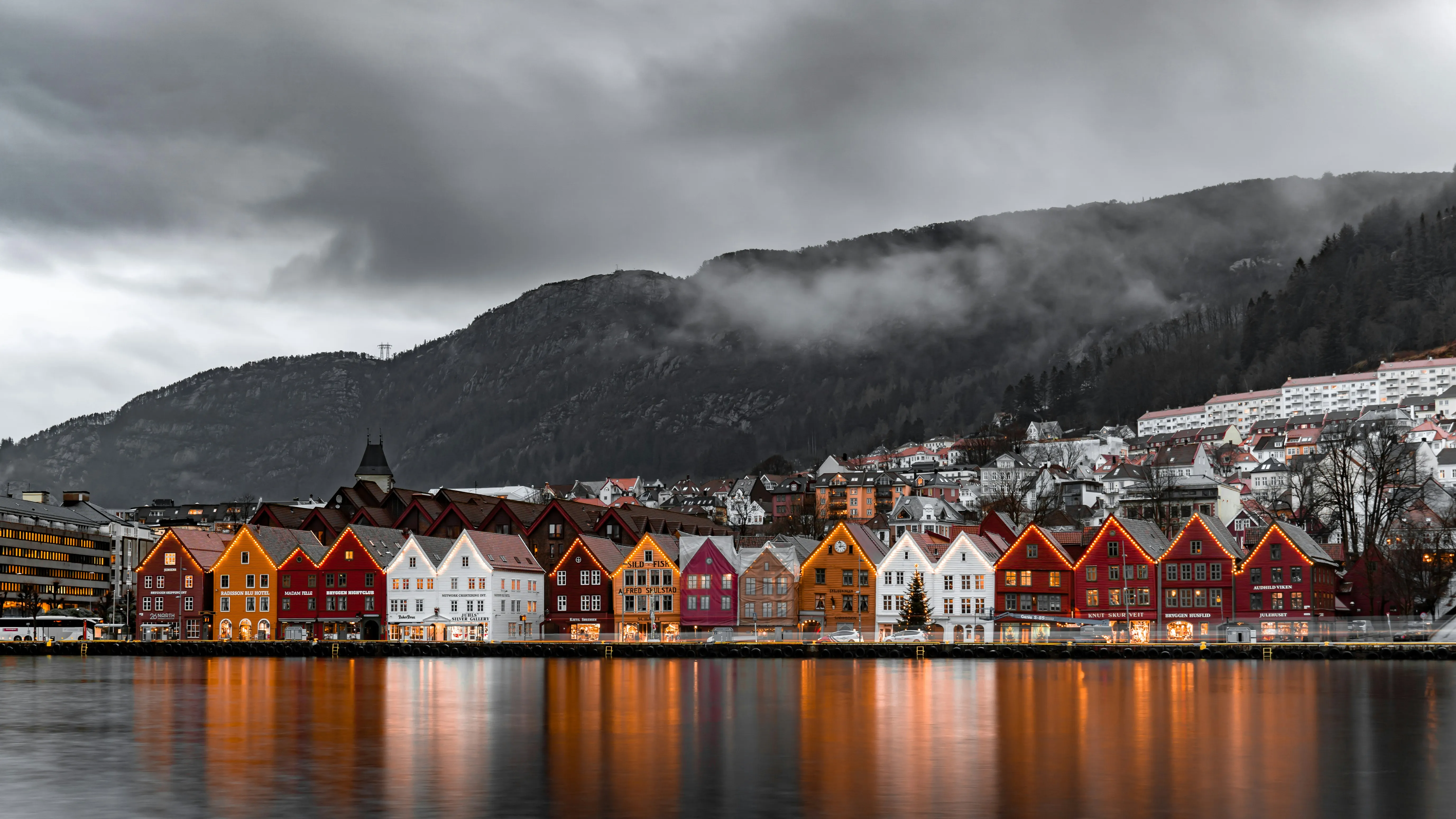
Towards the west coast, the city of Bergen acts as the main gateway to the world of the fjords. Its historic neighborhood, Bryggen, is a collection of wooden houses that recall the commercial past of the Hanseatic League and has been recognized for its historical value. From here, it is common to undertake journeys to the Geirangerfjord or the Nærøyfjord, areas where vertical rock walls and waterfalls define a singular landscape. Activities in this region focus on navigation and hiking, allowing a close observation of the magnitude of these geological formations.
Following the coastline to the south, one finds the city of Stavanger, a frequent starting point for those wishing to hike the route to Preikestolen or The Pulpit, a rocky platform that overlooks the Lysefjord. This area mixes the charm of its old white wooden houses with the energy of its port. On the other hand, in the heart of the country, the city of Trondheim stands out for the Nidaros Cathedral, one of the most important Gothic temples in Northern Europe and a historical place of pilgrimage closely related to the Norwegian monarchy.
Crossing the Arctic Circle, the landscape transforms and the light takes on different nuances depending on the time of year. Tromsø is the main hub of the north, known for its vibrant university life and its Arctic Cathedral with geometric shapes. This area is conducive to observing natural phenomena such as the northern lights in winter or the midnight sun during the summer months. Nearby, the Lofoten Islands present a picture of rugged mountains emerging directly from the sea, dotted by fishing villages with their characteristic red cabins known as rorbuer.
In the interior, national parks offer a different perspective of the country’s geography. The Jotunheimen National Park is home to the highest peaks, ideal for those seeking mountain routes and glaciers. For its part, the central valleys region allows visiting the stavkirke, medieval wooden churches of a very particular architecture, with Borgund being one of the best preserved. The diversity of the territory allows moving from white sand beaches in the north to high mountain plateaus like Hardangervidda, where local fauna and the silence of nature are the protagonists.
Tip: You cannot miss visiting the Norwegian fjords, the most emblematic place in the country.
✈️ Best time to travel
Choosing the ideal time to visit Norway depends largely on the experiences you wish to live, as the country transforms radically with the change of seasons. During the months of prolonged light, the landscape becomes accessible for touring the fjords and mountains, while winter covers the territory in white, offering an atmosphere conducive to snow sports and the observation of celestial phenomena. The weather is variable and can change quickly, so it is important to travel with a flexible mindset and appropriate clothing for various conditions.
Summer is usually the preferred option for those seeking mild temperatures and days that seem to never end, facilitating outdoor activities and access to remote routes. On the other hand, intermediate seasons like spring and autumn offer a quieter perspective of the natural environment, with notable color changes in the vegetation and a more moderate influx of visitors. Each period of the year presents a different balance between daylight hours, weather conditions, and the type of activities available in the different regions of the country.
| Season | Months | Typical weather | What to expect | Tourist influx |
|---|---|---|---|---|
| Spring | Mar – May | Cool temperatures that gradually rise; snowmelt and occasional rains. | Awakening of nature, waterfalls at their maximum flow, and blossoming of fruit trees. | ⭐⭐ Medium/Low |
| Summer | Jun – Aug | Mild and pleasant temperatures, with many hours of light and variable humidity. | Midnight sun in the north, open hiking routes, and fjord navigation. | ⭐⭐⭐⭐ High |
| Autumn | Sep – Nov | Thermal drop, wind, and increased rainfall in coastal areas. | Landscapes in golden and reddish tones, peaceful atmosphere, and possibility of seeing the first auroras. | ⭐⭐ Low |
| Winter | Dec – Feb | Intense cold, frequent snow in almost the whole country, and few hours of sunlight. | Snowy landscapes, winter sports, northern lights, and winter cultural traditions. | ⭐⭐⭐ Medium |
🗣️ Basic vocabulary
Although the vast majority of Norwegians are fluent in English, knowing some basic words in their local language is a gesture of courtesy that is usually very well received. These expressions will help you break the ice and feel a bit more integrated into the local culture during your stay.
Mastering greetings and elementary courtesy formulas facilitates daily interactions, whether in a restaurant, in a shop, or when crossing someone on a trail. It is not about studying complex grammar, but about having practical tools to handle yourself naturally in common situations.
- Hei: Hello. It is the most common greeting and is used at any time of day.
- Takk: Thank you. It is possibly the most important word you should remember.
- Vær så snill: Please. It is used to ask for something in a polite manner.
- Unnskyld: Sorry or excuse me. Useful for getting someone’s attention or asking to pass in crowded places.
- Ja / Nei: Yes / No.
- Hvor er…?: Where is…? Very practical for locating specific places like stations or bathrooms.
- Ha det bra: Goodbye. A standard and friendly way to say goodbye.
- Snakker du engelsk?: Do you speak English? A useful phrase if you need to confirm they can assist you in that language.