


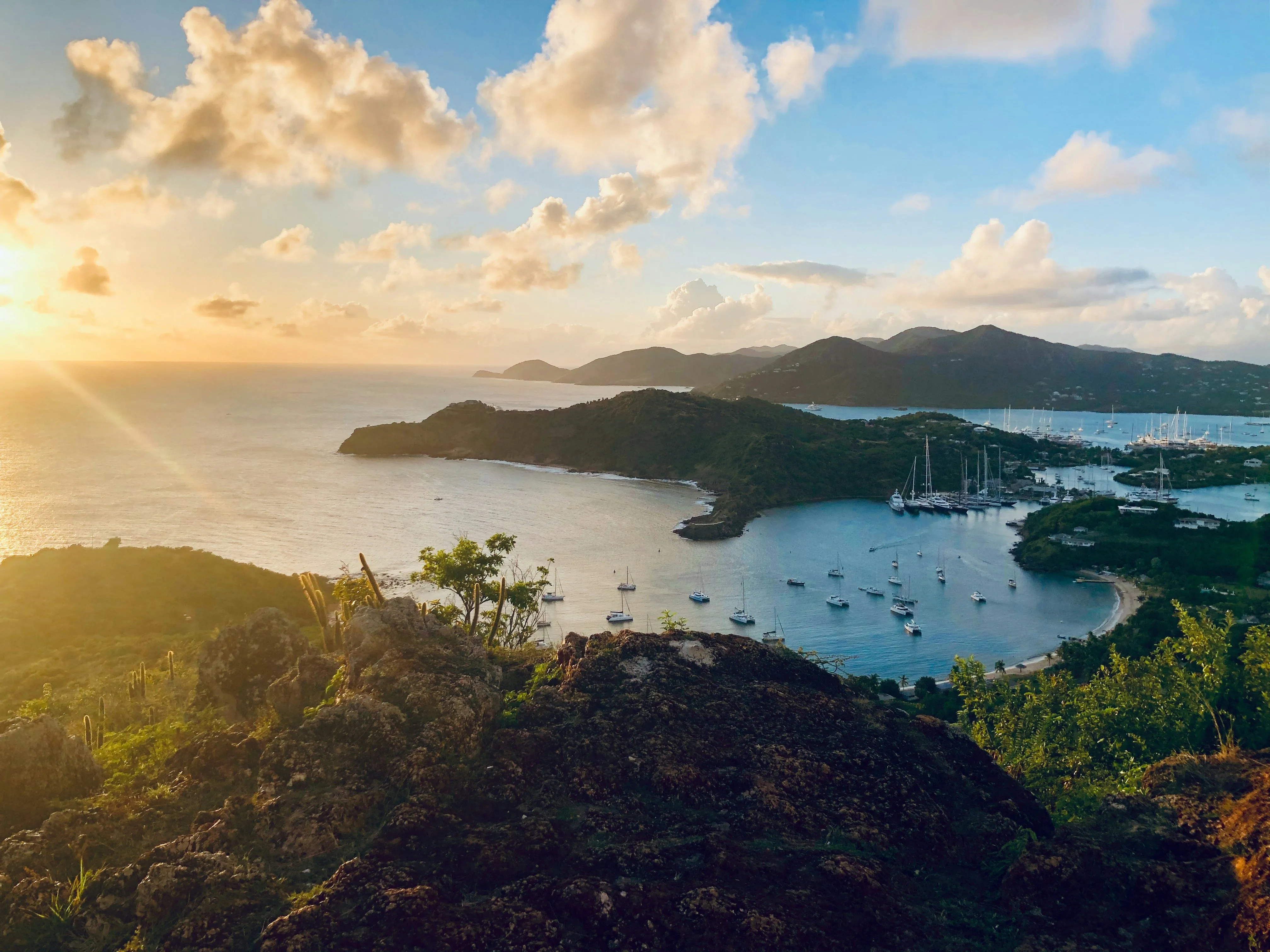
Antigua and Barbuda
A Caribbean archipelago famous for its three hundred and sixty-five white sand beaches, crystal clear waters, and a rich colonial British naval historical legacy.
Quick Facts
- Capital
- Saint John
- Language
- English
- Antiguan Creole
- Currency
- East Caribbean Dollar (XCD)
- Best time to visit
- From December to April, during the dry and cool season.
- Budget per day
- $120 - $450 per day
- Climate
- Tropical maritime climate with warm temperatures all year round and a marked rainy season between June and November.
- Connectivity
- medium
- Easy to obtain at airports and local shops, compatible with eSIM.
- Electricity
- Type A/B (230V)
- Local transport
- limited
- Card usage
- acceptable
- Tipping
- yes
🌎 Introduction
In the heart of the Lesser Antilles, the landscape is drawn between sheltered bays and a sea that alternates between turquoise shades and the deep blue of the Atlantic. These islands maintain a slow pace where the trade winds soften the temperatures for much of the year, creating an environment conducive to life passing between small historic ports and hills of low vegetation. While Antigua unfolds in a jagged coastline full of nuances, Barbuda appears more serene and horizontal, defined by its wide stretches of light sand and the calm of its natural surroundings.
The archipelago’s identity is perceived in everyday details, from the atmosphere surrounding cricket matches to the colorfulness of its local markets. The gastronomy, marked by elements such as the unique black pineapple or fresh fish seasoned with local spices, reflects a heritage where different cultural influences coexist. During the warmest months, the spirit of the islands becomes more vibrant with festivities that commemorate its history through music and shared traditions, showing a natural balance between the legacy of the past and everyday Caribbean life.
🛡️ General safety
Antigua and Barbuda is generally considered a safe and welcoming destination for international travelers. The country enjoys notable political and social stability, which translates into a peaceful environment for those looking to enjoy its famous 365 beaches.
In comparative terms, the risk level is low, especially when compared to other Caribbean destinations or large international metropolises. Although the country is safe, it is not exempt from minor incidents, so common sense and basic precautions are the traveler’s best tools.
Crime and common risks
Most visits to the islands pass without incident. However, it is important to know the most common risks to avoid them:
- Thefts and crimes of opportunity are the most frequent crimes. They usually occur on very crowded beaches or when valuables are left in plain sight inside rental vehicles.
- Snatching or pickpocketing can occur in busy commercial areas of the capital, although it is not systematic.
- Minor scams related to non-agreed prices in informal services can occur, so it is always recommended to confirm costs before accepting a service.
- Violent incidents affecting tourists are extremely rare, but it is recommended to avoid walking in isolated areas or lonely beaches after sunset.
Safety in cities and tourist areas
Safety varies slightly depending on the area where the traveler is located:
- In Saint John’s, the capital, the atmosphere is vibrant and safe during the day, especially in cruise ship areas such as Heritage Quay and Redcliffe Quay. At night, some side streets may be poorly lit, so it is preferable to move by taxi.
- Residential and tourist areas such as Jolly Harbour, English Harbour, and Dickenson Bay usually have their own security services and are considered very low-risk areas.
- On the island of Barbuda, the environment is much more rural and quiet; the crime level there is practically non-existent, although infrastructure is more limited.
Transport safety
Moving around the island is simple, but requires taking certain peculiarities into account:
- Driving is on the left, a legacy of its British past. If you do not have previous experience, extreme caution is recommended at roundabouts.
- Main roads are in good condition, but secondary roads may have considerable potholes and a lack of night lighting.
- Public transport (minibuses) is safe and inexpensive, although it does not have fixed schedules and can be confusing for newcomers.
- Taxis usually do not have meters. Rates are regulated by the government, but it is essential to agree on the price before starting the journey to avoid misunderstandings.
- If you opt for rental vehicles, remember that you will need to obtain a local temporary driving permit, which the rental agency itself usually processes.
Natural and climatic risks
The tropical climate of the islands carries certain risks that must be monitored:
- The hurricane season officially runs from June to November. During these months, it is vital to stay informed through local meteorological services and follow the instructions of the authorities in case of an alert.
- Extreme heat and humidity can cause dehydration. It is recommended to drink bottled water constantly and use high-factor sun protection.
- Although seismic activity is not daily, the region is in an earthquake risk zone, so it is advisable to know the basic “drop, cover, and hold on” rules.
Local legislation and norms
There are specific rules that travelers should know to avoid fines or legal problems:
- It is strictly forbidden to wear camouflage clothing or military prints, even for children. This rule is rigorously applied and the items can be confiscated.
- The consumption and possession of illicit drugs carries severe prison sentences and very high financial fines.
- Nudism and topless sunbathing are not legal and are socially frowned upon on most public beaches.
- It is recommended to ask for permission before photographing local people, especially in non-tourist areas.
Safety for specific groups
- Female travelers: Antigua and Barbuda is a safe destination for women traveling alone. Nevertheless, unwanted attention or comments may occur in nightlife areas; the recommendation is to act with the same prudence as in any other international destination.
- LGTBIQ+ travelers: Although same-sex relationships were decriminalized in 2022, society remains mostly conservative. Discretion in public displays of affection is recommended to avoid uncomfortable situations, especially outside international hotel complexes.
- Traveling with children and the elderly: The country is ideal for families. Health services are correct for minor incidents, although for serious emergencies, transfer to specialized centers outside the island is usually required.
Emergencies and assistance
In case of needing immediate help, these are the protocols to follow:
- The single emergency number (Police, Ambulance, and Fire) is 911 or 999.
- The tourist police usually patrol the most frequented areas and are known for being helpful to visitors.
- It is highly recommended to travel with travel insurance with broad medical coverage that includes medical repatriation, as medical evacuation costs can be extremely high.
Tip: Avoid leaving any objects, even those of little value, inside your rental car when parking near beaches; most minor incidents occur because of objects left in sight that attract unnecessary attention.
📝 Entry requirements
For travelers planning a visit to Antigua and Barbuda, the main document required is a valid passport. It is highly recommended that the passport has a validity of at least six months from the date of arrival in the country to avoid any inconvenience at immigration control points. The document must be in good condition and have free pages for the corresponding entry and exit stamps.
Regarding the stay authorization, the vast majority of international tourists do not require a prior visa for short-term visits for recreational purposes. The maximum stay usually granted generally varies between 30 and 90 days, depending on the assessment of immigration officials at the time of arrival in the archipelago.
It is common for immigration authorities to request the presentation of an exit ticket, either back to the point of origin or to a next destination, as proof of the intention to leave the country within the permitted period. Likewise, visitors may be required to demonstrate that they possess sufficient financial funds to cover all their expenses during the stay, in addition to providing information about their accommodation or hotel reservation.
At entry points, whether airports or ports, routine customs controls are carried out. The entry of standard personal effects is allowed, but there are strict restrictions on the import of fresh food, fruits, plants, and animal products to protect the local ecosystem. If traveling with medication, it is advised to carry the original medical prescription and keep the drugs in their properly labeled containers.
Regarding health requirements, no vaccination is generally required to access the territory. However, an international certificate of vaccination against yellow fever may be requested if the traveler comes from a country where said disease is considered endemic. It is always a recommended practice to have international travel insurance with broad medical coverage to ensure assistance during the holidays.
- Mandatory documentation: Valid passport with a recommended minimum validity of six months.
- Visa regime: Generally exempt for short-term tourist stays.
- Stay period: Usually allowed for a time between 30 and 90 days.
- Exit requirements: Necessity to present an exit transport ticket from the country.
- Financial solvency: Possibility of requiring proof of financial funds for the trip.
- Health regulations: Yellow fever vaccination certificate only in specific cases of origin from risk areas.
- Customs restrictions: Prohibition of entry of agricultural products, plants, and unprocessed fresh food.
🏥 Basic health considerations
You will see that in Antigua and Barbuda the healthcare system is acceptable but somewhat limited compared to the standards of large metropolises. You will find the main hospital, the Mount St. John’s Medical Centre, in the capital, Saint John, although for minor matters there are private clinics that are usually the preferred option for visitors due to their speed. Keep in mind that medical care costs are high, so any consultation or treatment can mean a significant outlay if you are not prepared. The medical staff speaks English, which is the official language, so you will find it easy to communicate if you have a basic level of this language.
It is highly recommended that you take out travel medical insurance before landing on the islands. It is not a mandatory requirement to enter the country, but the lack of free-of-charge agreements for foreigners makes it a necessary safety net. Make sure your policy includes broad coverage for hospitalization and, above all, for medical repatriation, as in cases of extreme gravity you might need an urgent transfer to another country with more complex infrastructure.
As for vaccines, there are none mandatory for traveling to this destination, unless you come from a country where yellow fever is endemic, in which case they will ask for your international vaccination certificate. I advise you to have your usual vaccination schedule up to date. For greater peace of mind, you will see that vaccines against hepatitis A and typhoid fever are usually recommended by travel medicine specialists, although being cautious with what you eat and drink will suffice.
If you take specific medication, it is best to carry the necessary amount for the entire stay in its original containers. You will not have legal problems as long as you accompany the medications with a copy of your medical prescription or a report signed by your doctor in English. You will find pharmacies in urban areas of Antigua, but the availability of certain specific brands may be limited in Barbuda.
The main health risk you will encounter is related to the tropical climate. The sun is very intense throughout the year, so sunburns and heatstroke are the most common problem among tourists. Additionally, as they are islands with areas of vegetation, there are mosquitoes that can transmit diseases such as dengue or chikungunya, especially during the more humid seasons. You will see that there are no altitude risks or serious endemic diseases to worry about excessively if you take basic precautions.
Regarding water and food safety, tap water is usually potable in most hotels and tourist areas of Antigua, although its taste may seem slightly different because it comes from desalination plants. For this reason, you will see that many travelers opt to consume bottled water. As for food, the general level of hygiene is high and you can try local gastronomy at stalls and markets with peace of mind, always applying the common sense of choosing places that look clean and busy.
In case you need immediate assistance for an emergency, the telephone number you should dial is 911 or 999. The ambulance service and urgent care operate normally in Antigua, although you should know that on the island of Barbuda resources are much more limited and any serious complication will require a transfer to the neighboring island.
As final recommendations, I suggest you pack a good insect repellent with DEET and a high-factor sunscreen. Drink plenty of water to stay hydrated under the Caribbean sun and, if you have any health problems, go to the medical centers in tourist areas where they are more accustomed to dealing with international visitors.
🚌 Transport within the country
To move around Antigua and Barbuda, travelers have several options that allow them to explore both the coastal areas and the interior of the islands. Rental cars are one of the most frequent means for those seeking autonomy, although there is also a network of public minibuses that connects the capital with different towns. To travel between the two main islands, the most common way is to use the ferry or small planes that perform short-duration internal flights.
The use of public transport is simple because the official language is English, which facilitates interaction with drivers and other users. However, it is important to keep in mind that these buses do not usually follow fixed schedules, but rather depart when they have reached full capacity, which adds a sense of informality to the service. Road signage is correct on main roads, facilitating orientation for those who decide to drive on their own.
There are notable differences between mobility in the capital, Saint John’s, and rural areas. While in the urban center the transport offer is constant and varied, in less populated areas or for access to certain secluded beaches, public transport is less frequent. In these cases, depending on your own vehicle or private transport services is much more convenient to avoid long waits.
Taxis are a widespread resource and are considered a safe and reliable means for moving around the country. They are especially useful for direct journeys or when traveling with luggage, as drivers are usually present at the points of greatest tourist interest and at arrival terminals. It is relevant to remember that driving is on the left side of the road, a fundamental aspect for the comfort and safety of international drivers.
Tip: It is convenient to check the location of the departure terminals in the capital, as most bus routes operate radially from the main points of Saint John’s to the rest of the island.
🤵 Culture and etiquette
In Antigua and Barbuda, social interactions are governed by a code of courtesy and mutual respect that is fundamental for daily coexistence. The greeting is a key piece in communication; it is considered a basic rule of politeness to address others with a “good morning,” “good afternoon,” or “good evening” before starting any inquiry or transaction. This gesture of recognition towards the other person greatly facilitates understanding. In formal contexts or when dealing with older people, it is common to use courtesy titles (Mr. or Mrs.) followed by the surname, reflecting a social structure that values respect for hierarchies and experience.
Behavior in public spaces is usually calm and moderate. Although the general atmosphere of the islands is relaxed, it is appreciated when visitors maintain an appropriate voice volume and a discreet attitude on collective transport and in urban areas. Regarding physical contact, the standard greeting is a firm but brief handshake. A very relevant aspect of local etiquette is the distinction between leisure environments and population centers; swimwear is expected to be limited exclusively to beaches and pools, and it is necessary to cover up properly when entering shops, restaurants, or public buildings.
In the realm of gastronomy and services, customs are similar to those of other international destinations. It is common to leave a tip of between 10% and 15% in restaurants, provided this charge has not been included beforehand on the bill. When participating in social activities or visiting local markets, discretion is highly valued; therefore, it is important to always ask for permission before photographing residents or their belongings. Regarding time, although there is some flexibility in informal social meetings, punctuality is considered a sign of professionalism in the service sector and for scheduled appointments.
Society maintains a deep connection with its traditions and religious beliefs, so temples and places of worship must be visited with an attitude of maximum solemnity. It is recommended to dress modestly and soberly when accessing these spaces, avoiding excessively informal clothing. During cultural celebrations or local festivities, showing an attitude of respectful observation and following the instructions of the hosts allows you to enjoy the country’s traditions in a harmonious and balanced way for all parties.
Tip: The initial greeting is the pillar of communication in the country; starting any interaction with a cordial greeting before asking for information or help is essential for establishing a friendly and fluid relationship with residents.
🍛 Typical gastronomy
The cuisine of Antigua and Barbuda is a reflection of its history and its geographical location, merging African and Caribbean influences with fresh local products. The use of tubers, legumes, and fish caught on its coasts defines the basis of its daily diet. Flavors are usually balanced, with a moderate use of spices that enhance the main product without masking it. It is common to find dishes where the contrast between sweet and savory plays a fundamental role, using tropical fruits in preparations that would traditionally be considered savory.
Regarding eating habits, breakfast is one of the most important meals of the day, often hearty and rich in protein. Lunch and dinner follow schedules similar to international standards, although the pace is usually more relaxed and slow, inviting people to enjoy after-dinner conversation. In restaurants, etiquette is generally informal, especially in establishments near the coast, although correctness in treatment and respect for local rules of coexistence are valued. Tips, although sometimes included in the bill, are a common gesture of appreciation for the service received.
The drinking culture on the islands revolves around natural products. Tropical fruit juices, such as tamarind or mango, are common to accompany meals. In addition, infusions and fermented drinks based on roots and barks are part of the local tradition. In the social sphere, meetings are usually accompanied by drinks made with products derived from sugar cane, which have been produced in the region for centuries.
| Dish | Description | Main ingredients | Where to try it | Tip |
|---|---|---|---|---|
| Fungee and Pepperpot | Considered the national dish, it is a thick stew accompanied by cornmeal balls. | Cornmeal, okra, salted meat, spinach, and pumpkin. | Traditional restaurants in Saint John’s. | Try it hot to appreciate the soft texture of the fungee. |
| Saltfish and Chop-up | A classic breakfast that combines dried fish with scrambled vegetables. | Salted cod, eggplant, spinach, and zucchini. | Local cafes and breakfast stalls. | It is usually accompanied by coconut bread or boiled dumplings. |
| Ducana | A kind of sweet-flavored tamale served as a garnish for savory dishes. | Grated sweet potato, coconut, flour, sugar, and spices. | Local markets and street food stalls. | It is the ideal accompaniment for fish with tomato. |
| Barbuda Lobster | Fresh seafood prepared simply to highlight its natural flavor. | Local lobster, garlic butter, and lemon. | Beach restaurants on the island of Barbuda. | Always ask for the catch of the day to ensure freshness. |
| Goat Water | A very tasty and slightly spicy goat soup or stew. | Goat meat, aromatic herbs, onion, and flour for thickening. | Popular festivals and Creole food restaurants. | It is a hearty dish, ideal as a single meal at midday. |
📷 Areas and places to visit
Exploring Antigua and Barbuda means immersing yourself in a combination of naval history, unspoiled nature, and a vibrant local life that is spread across its two main islands. Antigua, the larger of the two, is the heart of tourist and cultural activity, while Barbuda offers a slower environment focused on the preservation of its ecosystems. Both islands maintain a balance between the colonial past and a present that looks to the sea, offering options for those seeking both historical knowledge and rest in natural settings.
On the northwest coast of Antigua lies St. John’s, the capital and the country’s commercial center. Walking through its streets allows you to observe the contrast between modern cruise terminals and traditional brightly colored wooden buildings. One of its most prominent points is St. John’s Cathedral, whose twin towers dominate the city’s skyline. To learn about the evolution of the archipelago from its geological origins to its independence, the Museum of Antigua and Barbuda, located in a former 18th-century courthouse, offers a didactic and pleasant perspective. Additionally, the city’s public market is a key place to observe daily life and discover local products.
To the south of the island is the English Harbour area, which constitutes the historical heart of the nation. This natural harbor houses Nelson’s Dockyard, a British colonial-era shipyard that has been restored and declared a World Heritage Site. It is possible to walk among stone buildings that today function as museums, shops, and hotels, maintaining their original architecture. Nearby, the hills of Shirley Heights offer one of the most representative views of the coast, also being a regular meeting point to enjoy local music and social traditions outdoors in a fortified environment.
The diversity of landscapes in Antigua is manifested in places like Devil’s Bridge, a limestone geological formation sculpted by the Atlantic waves that creates natural bridges and sea water geysers. For those who prefer to delve into the island’s agricultural past, the Betty’s Hope plantation preserves its old sugar mills, allowing for an understanding of this industry’s importance in past centuries. Along the entire coastline, the island’s so-called 365 beaches offer everything from protected bays with calm waters to more open areas where a constant breeze is characteristic.
For its part, the island of Barbuda offers a much flatter and wilder landscape, generally accessed by sea or short flights. The main settlement is Codrington, a small village where life passes simply. The greatest natural attraction of this island is the Frigate Bird Sanctuary, located in the Codrington Lagoon, where one of the largest colonies of these birds in the world can be observed. Barbuda’s beaches are known for their coral tones, highlighting the Pink Sand Beach area, where the accumulation of small shell fragments gives the sand a characteristic pink color at certain times of the year.
Activities in these areas are usually linked to the marine environment and local culture. While in Antigua it is common to find sailing festivals and international regattas, Barbuda invites a quieter exploration, focused on bird watching and hiking along little-traveled routes. The coexistence between the urban areas of the capital and the serenity of the national parks allows visitors to get a complete vision of the country’s identity, marked by its close relationship with the Caribbean Sea.
Tip: You cannot miss visiting Nelson’s Dockyard, the most emblematic place in the country.
✈️ Best time to travel
Antigua and Barbuda enjoys a warm tropical climate all year round, making this archipelago an attractive destination in any season. The choice of the ideal time for the visit usually depends on the balance the traveler seeks between weather conditions and the volume of visitors. Generally, the period between December and May is the busiest, as it coincides with the dry season, offering sunny days and a constant breeze that moderates temperatures.
On the other hand, the remaining months of the year present a more humid and quiet atmosphere. During this time, the landscape becomes more exuberant and green due to rainfall, which is usually intense but brief. It is a favorable time for those who prefer to explore local culture and nature with fewer people, always taking into account the climatic variations typical of the Caribbean region.
| Season | Months | Typical weather | What to expect | Tourist influx |
|---|---|---|---|---|
| Spring | Mar – May | Warm and mostly dry; mild temperatures. | Optimal conditions for sailing and yachting events. | Medium ⭐⭐⭐ |
| Summer | Jun – Aug | High temperatures and increased humidity. | Green landscapes and cultural festivities like Carnival. | Low ⭐⭐ |
| Autumn | Sep – Nov | Higher probability of rain and high humidity. | Very quiet atmosphere, ideal for rest and flora observation. | Very low ⭐ |
| Winter | Dec – Feb | Dry climate, clear skies, and cool breezes. | High beach season and great activity in coastal areas. | High ⭐⭐⭐⭐⭐ |
🗣️ Basic vocabulary
In Antigua and Barbuda, the official language is English, so communication in hotels and tourist areas is simple. However, in daily life, it is very common to hear Antiguan Creole, a local dialect that combines African roots with English. Knowing some expressions of this everyday use will allow you to navigate with greater fluency and closeness in informal situations, such as when visiting local markets or moving on public transport.
Using these words or phrases is not strictly necessary, but it is a gesture of courtesy that usually facilitates interaction with the islands’ inhabitants. Below are some terms and greeting formulas that will be practical during your stay.
- Good night: Used as a greeting when arriving at a place from sunset onwards, not just for saying goodbye.
- How it go?: A common and informal way to ask “How is it going?” or “How are you?”.
- Me de yah: Means “I am fine” or “here I am,” and is commonly used as a response to the previous greeting.
- Aite: An expression derived from “all right” used to confirm that something is okay or that there is agreement.
- Bless: Frequently used when saying goodbye, as a way to wish the other person the best.
- Please: Please (essential for asking for any directions, food, or service).
- Thank you: Thank you