


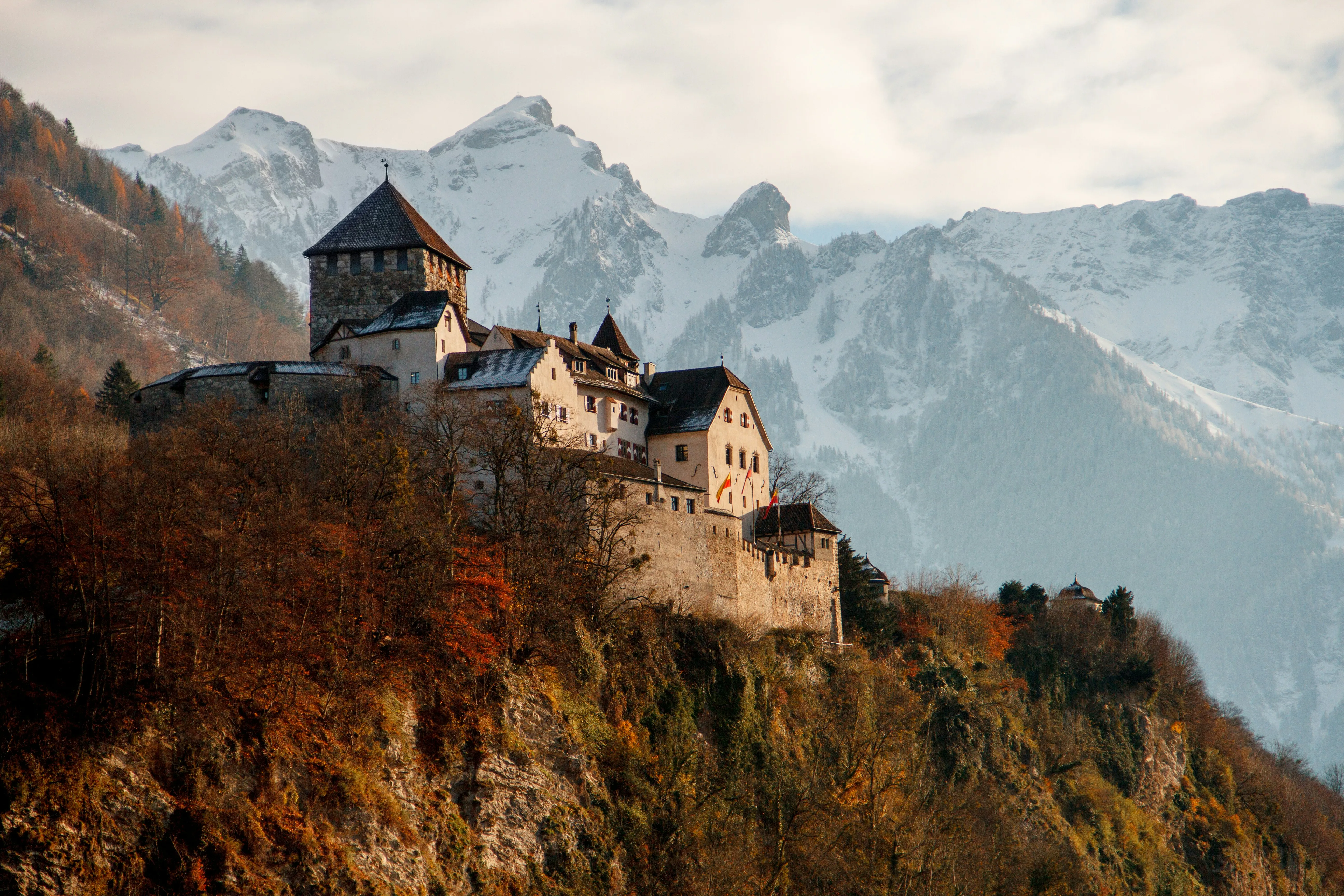
Liechtenstein
A small Alpine principality surrounded by towering mountains, historic castles, and nature trails that offer a quiet and sophisticated experience in the heart of Europe.
Quick Facts
- Capital
- Vaduz
- Language
- German
- Alemannic dialect
- Currency
- Swiss franc (CHF)
- Best time to visit
- From May to September for hiking and from December to March for winter sports.
- Budget per day
- $120 - $300 per day
- Climate
- Alpine continental climate with mild summers, cold and snowy winters, and green landscapes that vary according to the altitude of the mountains.
- Connectivity
- good
- Very easy through local shops or eSIM, although many travelers take advantage of Swiss or Austrian networks.
- Electricity
- Type J / Type C (230V)
- Local transport
- good
- Card usage
- widespread
- Tipping
- optional
🌎 Introduction
Nestled between the peaks of the Alps and the banks of the Rhine, this corner of the heart of Europe unfolds like a mosaic of green valleys and summits that transform their appearance with the passing of the seasons. Its small scale allows nature and daily life to intertwine with simplicity, where vineyards climbing the slopes coexist with the silhouette of castles watching the horizon from above. It is an environment where the rhythm passes slowly, marked by the fresh air descending from the mountains and the sound of cowbells in the high pastures.
The identity of these lands is perceived in the deep roots of its customs, from the aroma of cheese in Käsknöpfle dishes to the serenity of its villages when winter arrives. Traveling along its routes, a constant harmony is appreciated between the modernity of its urban centers and the heritage of its rural communities. Whether during the long sunny days that invite walking along panoramic trails or under the blanket of snow covering the valleys, the landscape maintains a balance that defines the character of this Alpine territory.
🛡️ General safety
Liechtenstein is considered one of the safest countries in the world. Due to its small size, its high standard of living, and very strong social cohesion, crime rates are exceptionally low. For the traveler, this translates into a quiet and relaxed visit experience, where usual safety concerns take a back seat.
General safety level
- The level of safety in Liechtenstein is very high. It is consistently among the destinations with the lowest crime rates globally.
- Compared to other European destinations, the risk is significantly lower than in large capitals or mass tourism areas.
- The context for the traveler is one of absolute normality; there are no exclusion zones or troubled neighborhoods, allowing for the exploration of the entire territory with complete freedom.
Crime and common risks
- Violent crimes are practically non-existent in the principality.
- Minor thefts, such as pickpocketing or phone snatching, are extremely rare, although it is always advisable to maintain basic vigilance of belongings in crowded spots, such as the pedestrian area of Vaduz during the high season.
- There are no records of common scams specifically targeting tourists. Commerce and services are usually honest and transparent.
- An infrequent but real risk is the neglect of personal items in hiking areas or ski resorts due to a false sense of absolute security.
Safety in cities and tourist areas
- Safety in urban centers, such as Vaduz or Schaan, is excellent both day and night.
- Public transport (LIEmobil network buses) is completely safe and reliable for any type of traveler.
- There are no safety differences between urban and rural areas; tranquility is a constant throughout the country.
- It is recommended to walk calmly through any area, as lighting and surveillance are adequate, although the police presence is usually discreet.
Transport safety
- The bus system is punctual and very safe. It is the main means of transport and poses no risks to the user.
- The use of taxis is safe, although their price is high. Rental vehicles are in perfect condition, and companies operate under high quality standards.
- Regarding driving, in Liechtenstein people drive on the right.
- Mountain roads are in excellent condition, but require caution due to sharp curves and the possibility of finding ice or snow in winter. The use of winter tires is mandatory in extremely cold conditions.
Natural and climatic risks
- The main risk in Liechtenstein is related to its Alpine environment. In winter and spring, there is a risk of avalanches in high mountain areas.
- During the summer, sudden thunderstorms can occur that affect hikers on mountain routes.
- Floods are infrequent, but can occur after periods of heavy rain or rapid snowmelt near the Rhine River.
- It is recommended to always check the weather forecast before performing outdoor activities and to respect trail markings.
Local legislation and norms
- Laws are strict and rigorously applied, especially regarding respect for public order and private property.
- It is important to respect recycling rules and waste management, as urban cleanliness is highly valued.
- Consumption of alcohol in public spaces is not generally prohibited, but disruptive behavior resulting from drunkenness is not well tolerated.
- Failure to comply with traffic rules leads to high fines that are usually processed immediately for foreigners.
Safety for specific groups
- Female travelers: Liechtenstein is an ideal destination for women traveling alone. The risk of harassment or safety incidents is minimal.
- LGTBIQ+ travelers: Society is conservative but very respectful. There are no specific safety risks for this group, and tolerance is the norm.
- Traveling with children and the elderly: The country is extremely friendly to families and the elderly, with safe, accessible infrastructure and a very controlled environment.
Emergencies and assistance
- 112: General emergency number (valid for police, ambulance, and fire department).
- 117: Specific number for the National Police.
- 144: Health emergencies and ambulances.
- 118: Fire department.
- Emergency services are extremely efficient and have highly trained staff, many of whom speak English in addition to German.
- In case of a minor incident or loss of documents, one should go to the National Police office in Vaduz, where the treatment is professional and efficient.
”> Tip: Even though you feel you are in a place where no one steals, avoid leaving valuables in sight inside your car when parking on isolated hiking routes to avoid any minimal temptation.”
📝 Entry requirements
To organize a trip to the principality of Liechtenstein, it is essential to have a valid passport with an appropriate validity for the duration of the intended stay. Generally, a tourist visa is not usually required for short visits, thus facilitating access for international travelers coming for leisure or rest. The maximum duration of stay allowed under this modality is usually ninety days, allowing for travel through the country and its surroundings with peace of mind.
When crossing access points, although physical controls may be infrequent due to the close territorial relationship with its neighboring countries, visitors might have to demonstrate that they have a return ticket or an exit ticket to a third destination. Likewise, it is advisable to be prepared to show evidence of sufficient financial funds to cover accommodation and daily activities during the time spent in the territory.
In the realm of customs, there are standard regulations that limit the entry of products such as alcohol, tobacco, or certain foods, so responsible and moderate use of these items is suggested. If the traveler needs to transport personal medication, it is advisable that it be accompanied by its respective medical prescription to avoid any type of misunderstanding during random checks. Regarding public health, there are usually no mandatory vaccinations to enter, although it is always considered good practice to have international medical insurance with broad coverage.
Below are the key points to consider for access to the territory:
- Primary documentation: A valid passport is required and must be current throughout the entire period of the tourist visit.
- Visa management: Generally, no prior management is required for short-term tourist stays.
- Length of stay: The usual stay limit is set at a period of ninety days within the margins permitted by local circulation regulations.
- Solvency and transport: Proof of financial resources and confirmation of a return ticket may be requested at the point of entry.
- Customs controls: Restrictions apply to the introduction of high-value personal items, non-prescription medications, or commercial quantities of certain products.
- Health and well-being: Although specific vaccination requirements are not demanded, it is recommended to always travel with medical assistance insurance that covers any unforeseen event.
🏥 Basic health considerations
When you visit Liechtenstein, you will soon realize that you are in one of the places with the best services in the world, although efficiency comes at a price. You will find a top-tier healthcare system, with modern facilities and very well-trained professionals. Most medical staff communicate in German, but you will see that many master English without problems. You must bear in mind that medical care for visitors is usually private and quite expensive, so any consultation or treatment can represent a significant expense if you are not well prepared.
Although it is not a legal requirement to enter the country, taking out travel medical insurance is something you will appreciate if any unforeseen event arises. You should look for a policy that includes broad coverage for hospitalization and medical repatriation, as transfers from mountain areas can skyrocket the budget. Having this support will allow you to enjoy the Alpine routes with much more peace of mind.
Regarding vaccinations, you will not find any mandatory vaccines to cross the border. The most sensible thing is to have your usual vaccination schedule up to date, the one we all usually follow from childhood. If you plan to spend a lot of time hiking through its forests during mild seasons, you could consult your doctor about the vaccine against tick-borne encephalitis, a common risk in the forested areas of this region of Europe, although it is not something that should worry you excessively if you take basic precautions.
If you need to take any specific medication, the best thing is to bring it with you from home in its original packaging. To avoid trouble at checkpoints or local pharmacies, it will be very helpful to carry a copy of the medical prescription or a certificate signed by your doctor, especially if they are drugs that require special control. In local pharmacies, you can buy basic products, but you will see that the prices are in line with the country’s standard of living.
Risks to your health in this small principality are more related to nature than to rare diseases. Due to its terrain, you will have to pay attention to altitude sickness if you decide to climb quickly to the highest peaks, as well as protect yourself from intense cold in winter. During the summer, the sun in the mountains hits hard, so a good protective cream will be your best ally. As I mentioned before, if you are going to walk through areas of high vegetation, remember to check your skin at the end of the day to rule out the presence of ticks.
You will not have to worry about what you drink or eat, as the tap water is potable and of excellent quality throughout the territory. You can refill your bottle at almost any fountain you find without fear. Hygiene standards in restaurants and food stalls are very high, so you can try the local delicacies with total confidence.
For any medical emergency situation that cannot wait, the number you should dial is 144. This emergency service works quickly and will send you an ambulance or the necessary transport in a short time. If it is a general emergency, the number 112 is also operational and will put you in contact with the corresponding assistance services.
As a final tip, remember that the most important thing is to use common sense. I suggest always carrying a small bottle of water and sun protection in your backpack when you go out to explore, and not forgetting your medical documentation in an accessible place. If you follow these simple guidelines, your only concern will be deciding which landscape to capture first with your camera.
🚌 Transport within the country
Moving around this small territory is a simple and organized experience, where the bus stands out as the main means of transport for visitors. Since there are no internal flights or subway networks, the bus system efficiently connects all municipalities and points of interest. The vehicles are modern and designed to offer a comfortable experience while traveling through the country’s terrain.
The ease of use of public transport is one of the most notable characteristics for tourists. The signage at stops is clear, and the systems for purchasing tickets are intuitive, allowing any traveler to find their way without great difficulty. Furthermore, language does not usually represent a barrier, as essential information is presented in a way that is understandable to an international audience.
Although towns with higher activity have a more constant frequency of service, rural areas and mountain regions are also well integrated into the network. The roads leading to the higher villages are in good condition, which ensures that travel is smooth both in the valley and in higher altitude areas. Punctuality is the general rule in services, allowing for the organization of visit days with confidence.
For more specific trips or private displacements, taxis operate mainly in urban centers. Likewise, some travelers opt for a car to explore the surroundings at their own pace, taking advantage of short distances and the quality of the road infrastructure, which facilitates access to viewpoints and starting points of hiking routes.
“Tip”: Check the frequency of transport services to mountain areas to plan the return in advance.
🤵 Culture and etiquette
Social interaction in Liechtenstein is characterized by formal courtesy and a marked respect for others’ privacy. When greeting, the most common practice is a brief and firm handshake, maintaining eye contact. In initial encounters, polite forms of address and professional titles are usually used if known, reserving the use of first names for relationships of greater trust. In public spaces, maintaining a moderate tone of voice and a discreet attitude is valued, avoiding behaviors that may disturb the tranquility of the environment.
Punctuality is a fundamental pillar in daily organization, both in professional settings and in social gatherings. Arriving at the agreed time is interpreted as a sign of consideration for others. Regarding non-verbal communication, personal space is important, so physical contact is usually limited to initial and farewell greetings. Likewise, there is a deep esteem for the natural environment and order, so visitors are expected to take care of cleanliness and follow the rules of coexistence in open spaces and trails.
In the context of meals and dining, habits are usually unhurried. It is common to wait for all diners to be served before starting to eat and to keep hands visible on the table. Regarding tips, although service is usually included in the final bill price, it is a common practice to round up the amount or leave a small additional gratuity if the service has been satisfactory. If invited to a private home, it is a polite gesture to bring a small decorative or gastronomic gift for the hosts.
Respect for the traditions and history of the country is a very relevant aspect of local life. The figure of the Princely Family enjoys great institutional and social recognition, so it is appropriate to refer to the monarchy with due decorum. Similarly, many festivities and customs are linked to the religious calendar; when visiting temples or participating in traditional events, it is recommended to maintain an observant and silent attitude. It is also advisable to keep rest hours in mind, especially on Sundays and during the midday break, times when intense noise is preferred to be avoided to preserve the collective calm.
“Tip”: Rigorous punctuality is the best way to show respect for others’ time; if an unforeseen event arises that delays arrival by even a few minutes, informing in advance is a highly valued gesture to avoid misunderstandings.
🍛 Typical gastronomy
The cuisine of Liechtenstein is deeply rooted in Alpine tradition, sharing many similarities with the neighboring regions of Switzerland and the Austrian state of Vorarlberg. It is a simple, nutritious, and comforting gastronomy, historically designed to provide energy to those who worked in the fields and mountains. Although the country is small, it has managed to maintain recipes that reflect its agricultural past, where products derived from cereals and dairy are the absolute protagonists.
Eating habits in the principality usually follow a Central European schedule. Lunch is traditionally the main meal, served between 12:00 and 14:00 hours, while dinner is usually lighter and is taken between 18:00 and 20:30. In restaurants, service is usually included in the price, although it is common to round up the bill as a gesture of courtesy. The atmosphere in establishments is usually cozy and familiar, valuing tranquility during the meal.
The most emblematic ingredient is Ribelmais, a type of local corn that has a designation of origin and serves as the basis for various traditional dishes. Along with it, mountain cheese, milk, potatoes, and cured meats form the backbone of the local diet. Regarding drinks, Liechtenstein has a long winemaking tradition thanks to its favorable climate in the Rhine valley, particularly highlighting its red wines of the Pinot Noir variety and whites such as Chardonnay. It is also common to accompany meals with apple cider or local mineral water.
Despite the influence of modern international cuisine, the inhabitants of Liechtenstein maintain a strong link with their national dishes. It is common to find options on restaurant menus that combine homemade pasta with intense cheeses or preparations based on cornflour that recall polenta. Pastries also occupy an important place, with simple desserts based on seasonal fruits or baked doughs that usually accompany afternoon coffee.
| Dish | Description | Main ingredients | Where to try it | Tip |
|---|---|---|---|---|
| Käsknöpfle | Small dough balls of pasta covered with melted cheese and fried onion. | Flour, eggs, local cheeses (Appenzeller type), and onion. | Traditional cuisine restaurants in Vaduz and Triesenberg. | It is usually accompanied by applesauce to contrast flavors. |
| Ribel | Traditional grain dish that is toasted in a pan until it becomes granular. | Cornflour (Ribelmais), milk, water, and butter. | Breakfasts in rural houses or mountain restaurants. | Try it dipped in café au lait or accompanied by elderberry puree. |
| Kratzete | A type of chopped pancake or crepe that can be sweet or savory. | Flour, eggs, milk, and sugar or salt depending on the version. | Picnic areas and mountain huts in the Malbun area. | If you choose the sweet version, accompany it with forest fruit jam. |
| Torkarebl | A rustic dish similar to a thick corn porridge that is then toasted. | Cornflour, milk, and salt. | Traditional inns in the high areas of the country. | It is a very filling dish, ideal after a day of hiking. |
| Hafalaab | Substantial dumplings that are generally served in broths or soups. | Wheat flour, cornflour, and pieces of bacon or ham. | Restaurants specialized in Alpine cuisine throughout the country. | It is excellent as a single dish during the winter months. |
📷 Areas and places to visit
Liechtenstein offers a serene journey through Alpine landscapes and urban centers that combine the harmony of tradition with architectural vanguard. The capital, Vaduz, acts as the country’s nerve center, where you can stroll through the Städtle, a pedestrian zone that concentrates much of the social and cultural life. In this area, the contemporary architecture of government buildings mixes with spaces dedicated to knowledge, highlighting the Kunstmuseum Liechtenstein, which houses an important collection of modern art, and the Postal Museum, a reference point for philately enthusiasts from all over the world.
Rising above the capital is Vaduz Castle, the official residence of the princely family. Although it is not possible to visit its interior as it is a private residence, the trails leading to its surroundings are frequently visited by those seeking a panoramic perspective of the Rhine Valley and nearby peaks. The castle’s surroundings are encircled by forests and vineyards, allowing for gentle hikes while observing the contrast between the city’s administrative area and the natural environment that protects it.
To get to know the most traditional and Alpine facet, the municipality of Triesenberg is an essential stop. This village, situated at a considerable altitude, keeps the heritage of the Walser culture alive, reflected in its wooden constructions and the dialect of its inhabitants. From here, one accesses the Malbun area, the country’s main mountain destination. In winter, this enclave is entirely dedicated to snow sports, while in summer it becomes a starting point for hiking routes of various levels, where one can enjoy Alpine flora and observe birds of prey in their habitat.
At the southern end of the principality lies the town of Balzers, recognizable from a distance by the silhouette of Gutenberg Castle. Unlike the Vaduz residence, this medieval fortification allows access to some of its areas, such as the chapel and rose gardens, offering a detailed view of the region’s defensive history. The surroundings of Balzers are characterized by a rural and quiet atmosphere, with paths that invite the discovery of small chapels and local agricultural farms.
The northern region, known as Unterland, has a gentler relief and is ideal for cycling and nature walks. In this sector, the municipality of Eschen and the Ruggeller Riet nature reserve stand out, a protected space that houses great biodiversity, including rare plant species. This area of the country offers a more peaceful atmosphere, away from the administrative center, where visitors can explore ancient settlements and small churches that preserve the charm of old-time community life.
Towards the center, the town of Schaan stands out for being the industrial engine and an important focus for cultural events. It is a place where the modern and the functional coexist with historical remains, such as the foundations of ancient Roman forts. This diversity of environments, ranging from contemporary art centers to high mountain trails, allows the visitor to obtain a balanced and complete vision of what this small state in the heart of the Alps represents.
Tip: You cannot miss a visit to Vaduz Castle, the most emblematic place in the country.
✈️ Best time to travel
Liechtenstein is a destination that can be visited throughout the year, as its tourist offer adapts easily to the change of seasons. The choice of the ideal moment depends mainly on whether one seeks to enjoy hiking routes in the high mountains or if, conversely, one prefers winter sports and the cozy atmosphere of snowy landscapes. Given its Alpine relief, the climate is temperate continental, with mild summers and cold winters that completely transform the appearance of the small principality.
During the warm months, the Rhine valleys and the peaks of Malbun fill with vegetation, allowing for travel through the extensive network of trails that connects the country from north to south. With the arrival of the cold, activity moves to the ski resorts and urban centers, where local culture and traditions take center stage. It is convenient to bear in mind that, being a mountain environment, the weather can be changeable, so it is always recommended to have appropriate equipment for rain or wind at any time.
| Season | Months | Typical weather | What to expect | Tourist influx |
|---|---|---|---|---|
| Spring | Mar – May | Cool temperatures (5°C to 15°C) and snowmelt on the peaks. | Flowering in the valleys, clear low-altitude routes, and longer days. | Medium - Low (⭐) |
| Summer | Jun – Aug | Mild and pleasant (18°C to 25°C) with occasional rains. | Main hiking season, outdoor festivals, and sunny days. | High (⭐⭐⭐) |
| Autumn | Sep – Nov | Gradual decline in temperatures and dry winds (Föhn). | Ocher-colored landscapes, harvest season in the vineyards, and a quiet atmosphere. | Medium (⭐⭐) |
| Winter | Dec – Feb | Intense cold (-2°C to 4°C) with frequent snowfalls. | Snow sports in Malbun, Christmas markets, and snowy Alpine landscapes. | High in ski areas (⭐⭐⭐) |
🗣️ Basic vocabulary
Although most people working in the tourism sector in Liechtenstein speak English, knowing some expressions in German —the official language— and in the local Alemannic dialect facilitates daily interaction. Learning these words will help you move more naturally in restaurants, shops, or when greeting local inhabitants during your travels.
It is not necessary to master the grammar, but using these basic courtesy formulas is usually well received and proves very practical for handling common situations, such as ordering something in a shop or saying goodbye after a visit.
- Grüezi: Hello (formal greeting commonly used during the day).
- Sali: Hello (informal greeting).
- Merci: Thank you (frequently used due to Swiss-German influence).
- En Guata: Enjoy your meal (said before starting to eat).
- Uf Wiederluaga: Goodbye or see you later.
- Bitte: Please (also used to say “you’re welcome”).
- Entschuldigung: Excuse me or sorry (useful for asking to pass or getting a waiter’s attention).
- Jo / Naa: Yes / No