


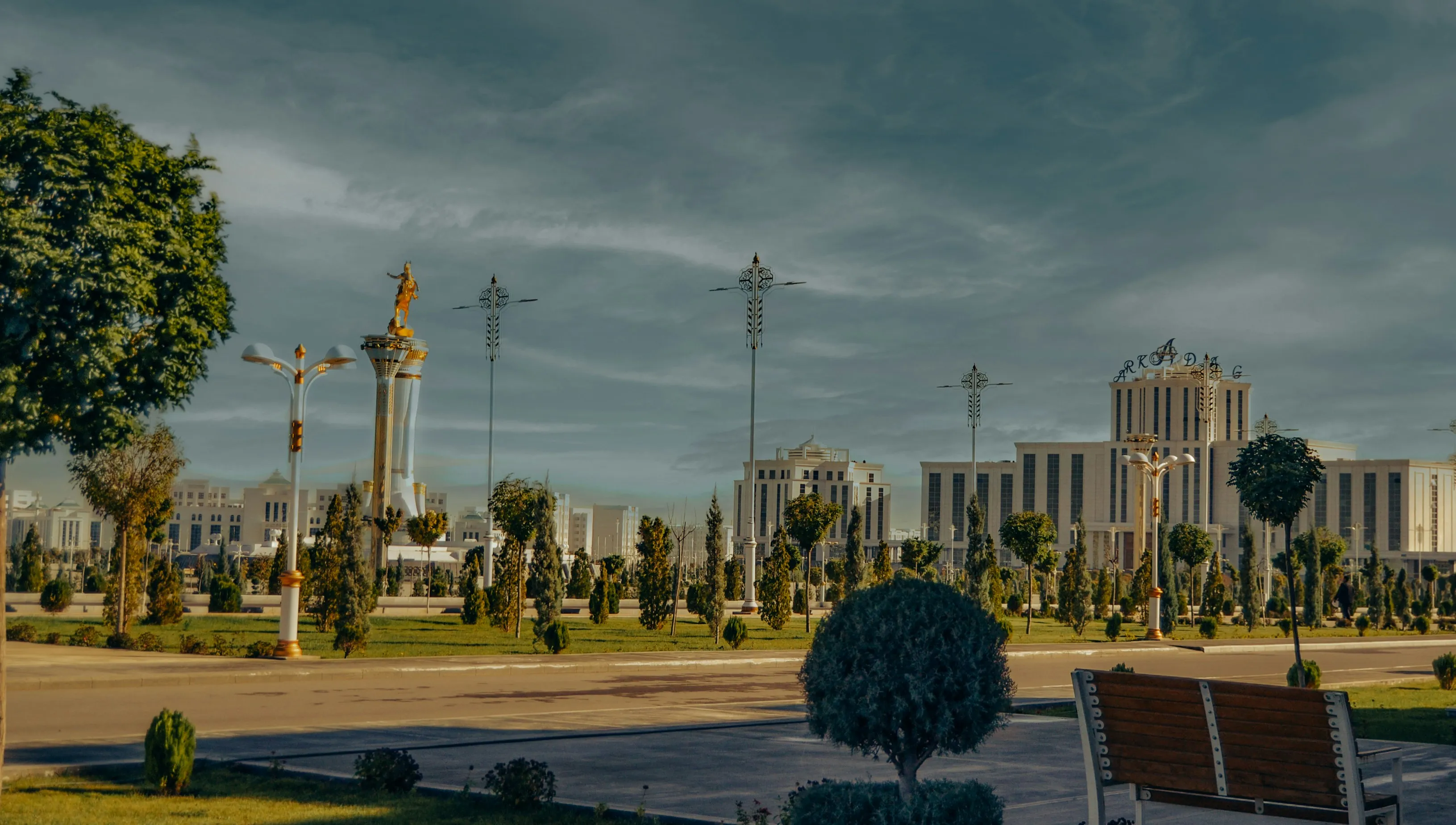
Turkmenistan
Explore a land of contrasts where white marble modernity meets ancient Silk Road cities and endless deserts.
Quick Facts
- Capital
- Ashgabat
- Language
- Turkmen
- Russian
- Currency
- Turkmenistani Manat (TMT)
- Best time to visit
- Between March and May or from September to November to avoid the extreme heat of the desert.
- Budget per day
- $60 - $200 per day
- Climate
- Continental desert climate with extremely hot summers and very cold winters, with sparse rainfall throughout the year.
- Connectivity
- low
- High difficulty; requires bureaucratic procedures and the offer for tourists is very limited and strictly controlled.
- Electricity
- Type C/F (220V)
- Local transport
- limited
- Card usage
- more cash is used
- Tipping
- optional
🌎 Introduction
Under the watchful eye of the Karakum Desert and the constant breeze of the Caspian Sea, the Turkmen territory unfolds like a mosaic of open horizons where the memory of the Silk Road remains present. It is a place of slow nuances, where the character of its people has been forged between the immensity of the dunes and the elegance of the Akhal-Teke horses. In daily life, the aroma of freshly baked bread in clay ovens and the murmur of traditional markets tell the story of a people who value hospitality as a fundamental pillar of their coexistence.
The passing of the seasons transforms the landscape, from winters of crisp air to the golden light that bathes the squares during autumn. Between the white marble facades of its modern cities and the vestiges that hold echoes of millenary civilizations, a solid identity coexists, expressed both in the fineness of its hand-woven carpets and in the comforting taste of shared tea. It is an environment of contrasts, where the serenity of the desert invites a close observation of the traditions that still define its daily essence today.
🛡️ General Safety
Turkmenistan is a destination that stands out for offering a very safe environment for the traveler regarding physical integrity and common crime. Due to tight government control and the constant police presence on the streets, violent incidents against tourists are extremely unusual.
- The general safety level is considered high, especially compared to other international destinations.
- The country is perceived as one of the most stable and controlled in Central Asia, which drastically reduces the possibility of suffering street altercations.
- The context for the traveler is that of a country with strict social discipline, where respect for local rules is the key to a trouble-free stay.
Crime and common risks
Although the risk of being a victim of a serious crime is very low, as in any part of the world, it is advisable to maintain basic common sense to avoid small incidents.
- Petty theft or minor robberies, such as bag or wallet snatching, are very infrequent but can occur in isolation in crowded markets or bazaars.
- Scams against tourists are not common, although occasionally there may be attempts to overcharge for unregulated services. It is advisable to agree on prices beforehand.
- A rare but noteworthy risk is the possibility of facing exhaustive bureaucratic controls or requests for documentation by authorities in border areas or internal checkpoints.
Safety in cities and tourist areas
Turkmen cities, and especially its capital, Ashgabat, are characterized by extreme cleanliness and constant surveillance, allowing for very peaceful walks.
- Urban centers and residential neighborhoods are safe both day and night. Lighting in the main areas of the capital is excellent.
- Public transport is safe and reliable, although the language can be a barrier. Tourists usually move easily through designated areas.
- There are no significant safety differences between the various cities open to tourism, although outside the capital, infrastructure may be simpler.
- It is recommended to avoid photographing government buildings, presidential palaces, or military facilities, as this may attract the attention of security forces and lead to the retention of photographic equipment.
Safety in transportation
Transportation in Turkmenistan is generally safe, although road conditions outside the main routes can vary considerably.
- Public transport (buses) is an economical and safe option, although most tourists prefer private vehicles with a guide.
- In Turkmenistan, you drive on the right. Main roads are in good condition, but in desert or rural areas, potholes or unpaved sections are common.
- Official taxis are the most recommended option. Private taxis exist (private cars acting as taxis), but the use of official services is advised for greater security and price transparency.
- A curious and relevant fact is that in the capital, Ashgabat, there is an unwritten but frequently applied rule about vehicle cleanliness: driving an excessively dirty car can be grounds for a fine.
Natural and climatic risks
Turkmenistan’s geographical environment presents some challenges that the traveler should be aware of to be well prepared.
- The country is located in a seismic activity zone. Although large-magnitude earthquakes are not frequent, the risk exists, and it is advisable to know basic protection measures.
- Extreme heat is the most relevant climatic risk. During the summer (especially from June to August), temperatures in the Karakum Desert can easily exceed 45 °C.
- Sandstorms can occur occasionally in desert regions, reducing visibility and making transportation difficult.
- It is recommended to hydrate constantly, use high-factor sunscreen, and avoid desert expeditions without a professional guide and proper equipment during the months of maximum temperature.
Legislation and local norms
Turkmenistan has very strict laws that visitors must respect scrupulously to avoid legal problems or expulsion from the country.
- It is strictly forbidden to smoke on the street or in outdoor public spaces. There are very specific and limited areas for smokers; non-compliance carries severe fines.
- Alcohol consumption is permitted in some restaurants and hotels, but public drunkenness is very poorly regarded and can be sanctioned.
- It is mandatory to always carry your original passport and migration registration card, as authorities may request them at any time.
- There is an unofficial night curfew in some areas (generally from 11:00 PM), at which time street activity decreases drastically and it is advisable to remain in your accommodation.
Safety for specific groups
- Female travelers: Turkmenistan is a safe country for women traveling alone. However, it is recommended to dress discreetly, covering shoulders and knees, especially in rural areas or places of worship, to respect conservative local customs.
- LGTBIQ+ travelers: Same-sex relationships are illegal in Turkmenistan and are punishable by law. Maximum discretion is recommended, and any public display of affection should be avoided, as society is very conservative in this regard.
- Traveling with children or the elderly: There are no specific risks for these groups, beyond the need to manage hydration and fatigue well due to the extreme climate and long road distances.
Emergencies and assistance
The emergency system is centralized, although the language barrier can be an obstacle if you do not have a local guide.
- 101: Fire Department.
- 102: Police.
- 103: Ambulance and medical emergencies.
- The police are usually helpful to tourists, but their function is primarily control. In case of an incident, it is essential to immediately contact your local travel agency or guide, who will facilitate communication with the authorities.
- It is highly recommended to have comprehensive travel insurance that includes medical evacuation, as health services outside the capital can be limited.
”> Tip: Always carry a physical copy of your passport and visa with you, and keep the originals in a safe place at the hotel, unless you are traveling between cities or near borders, where you will need the original documents for official checks.”
📝 Entry requirements
To plan a visit to Turkmenistan, the first fundamental aspect is to have a passport with sufficient validity, which generally must extend at least six months beyond the planned date of entry into the territory. Most international travelers require a tourist visa before the start of the trip, a process that is usually linked to the presentation of a letter of invitation managed in advance. This document is an essential part of the administrative process to allow access through any of its borders.
The duration of the stay permitted for tourist purposes is usually limited and normally fits the days specified in the granted permit. At checkpoints, whether airports or land crossings, it is common for authorities to request the presentation of a departure ticket from the country or for the continuation of the journey. Likewise, proof of sufficient economic funds to cover the expenses derived from the stay at the destination may be required.
Customs controls are characterized by being detailed and thorough for all visitors. There is a very strict regulation on the entry of certain medications, so it is advisable to travel only with basic drugs accompanied by their corresponding translated medical prescription. Similarly, the transport of products of plant or animal origin, as well as certain objects with cultural or archaeological value, is usually subject to quantitative restrictions or the need for specific declarations.
In the field of health, there is usually no general requirement for specific vaccines for entry into the country, except in specific situations of arrival from risk areas. However, it is considered a recommended practice to have the standard vaccination schedule up to date and to follow the usual prevention guidelines for international travelers in the Central Asian region, paying special attention to hygiene in food and water consumption.
- Identity document: Valid passport with a minimum validity of six months.
- Access permit: Tourist visa linked to a letter of invitation.
- Proof of transport: Usual presentation of a round-trip ticket.
- Financial solvency: Possible requirement of proof of economic means.
- Drug regulation: Strict control of prescription medicines.
- Luggage and customs: Restrictions on tobacco, food, and goods of historical value.
- Health recommendations: Updated general vaccination status for the traveler.
🏥 Basic health considerations
You will find a health system that has undergone a modernization process in recent years, although it still presents marked differences depending on the area you are in. In the capital, Ashgabat, you will see that there are modern clinics and specialized centers with advanced equipment, but in more rural regions, assistance can be much more limited and basic. Tourists’ access to healthcare is mainly through private centers or international clinics, as public healthcare does not usually meet the standards you may be used to. Prices for foreigners are often notably high, so any consultation or treatment will involve a significant expense. Additionally, you should keep in mind that medical personnel usually communicate in Turkmen or Russian, and it is quite difficult to find professionals who speak other languages outside the international centers in the capital.
Taking out comprehensive travel medical insurance is not just a recommendation, but practically a necessity, as in many cases it will be required for visa processing. It is essential that your policy includes medical repatriation and emergency medical evacuation coverage to other countries. This is vital because, in the event of a surgical complication or a serious illness, you will most likely need to be transferred to a medical center with better resources outside the borders of Turkmenistan.
Regarding vaccines, there are none that are mandatory for entering the country in general. However, it will be very useful to have your basic vaccination schedule up to date. As an additional recommendation, you can discuss vaccination against Hepatitis A and B, as well as typhoid fever, with your doctor, especially if you plan to visit remote areas or spend a lot of time in rural areas where hygiene conditions are different. Being up to date with the tetanus-diphtheria vaccine is always a good idea before any trip of this type.
You must pay close attention to the issue of medication. Turkmenistan has extremely strict regulations regarding the entry of pharmaceuticals into the country. It is forbidden to introduce medications containing substances considered psychotropic or narcotic, which includes some common painkillers in other places that contain codeine or tramadol. If you need to take personal medication for chronic treatment, it is mandatory to carry the original medical prescription, preferably translated, and the medication must be in its original packaging with the leaflet. If you do not follow these rules, you could face significant legal problems at customs.
The most frequent health risks you might experience are related to the climate. Extreme heat is a dominant factor, especially if you travel in summer and visit desert areas like the Karakum, where temperatures rise drastically and the risk of dehydration or heat stroke is high. In certain mountain areas or during winter, the cold can also be intense. It is not a country where serious tropical diseases abound, but airborne dust in the driest areas can cause respiratory discomfort or eye irritation if you are sensitive.
Regarding hygiene and food, the golden rule is that tap water is not potable. You will find bottled water easily in shops and hotels, and it is what you should use even for brushing your teeth if you want to avoid stomach upsets. As for food, you can try delicious local dishes, but always ensure the food is well-cooked and served hot. Avoid ice cubes in drinks and be cautious with salads or fruits that come already peeled at street stalls, as hygiene in the handling of raw food may not always be ideal.
In case you experience a health emergency, the phone number you should know is 103, which corresponds to the ambulance service. You should know that response times can be slow and that ambulances do not always have the necessary equipment for complex cases. If you are in the capital and the situation allows it, it is usually faster and more efficient to move by your own means directly to one of the international clinics or reference medical centers.
As final tips to make your stay as peaceful as possible, I suggest you carry a small first-aid kit with hand sanitizer, oral rehydration salts, and bandages for blisters. Do not forget to use high-factor sunscreen constantly and drink liquids frequently even if you don’t feel thirsty, to combat the effects of the dry and hot climate. Maintaining basic hygiene patterns, such as washing your hands frequently, will be your best ally for enjoying the trip without health setbacks.
🚌 Transportation within the country
Moving around Turkmenistan requires some planning due to the great distances and the country’s geographical characteristics. Internal flights are one of the most used means for traveling between the main regions, saving time on longer journeys. On the other hand, the train represents a functional option for connecting urban centers, offering a slower travel experience. On the ground, buses and minibuses are essential for shorter distances and access to smaller towns.
The ease of use of public transport varies by area. At the main departure points, ticket purchases are usually made at the window, and it is advisable to manage the procedures with sufficient time. Signage and written information are not always available in international languages, which can pose a communicative challenge. Nevertheless, the system’s operation is generally predictable, and services usually maintain a constant regularity in their departures.
The transportation experience changes notably between large cities and the rural environment. In the capital, the transport network is modern and has extensive infrastructure that facilitates mobility. In contrast, when entering rural areas or desert regions, roads can be in a more basic state and regular transport services are less frequent, requiring a greater capacity for adaptation from the traveler.
The use of taxis and shared vehicles is a widespread practice for moving quickly both within urban centers and between provinces. It is common for these services to function collectively, sharing space with other passengers heading to the same destination. Generally speaking, transport in the country stands out for its punctuality in rail and air services, while road transport is more flexible.
Tip: It is convenient to carry the names of destinations or addresses written down to facilitate interaction at stations and with drivers.
🤵 Culture and etiquette
Social interaction in the country is based on deep respect for hierarchy and the figure of elders, who usually hold a place of honor in any meeting or conversation. When greeting, it is customary to use a calm tone and, in the case of men, a handshake that is often performed with both hands as a gesture of deference. Discretion marks behavior in public spaces, where it is valued to maintain a moderate voice volume and avoid excessive displays of affection or close physical contact between people who do not have a direct family bond.
In the realm of hospitality, local inhabitants are known for their generosity towards visitors. If invited into a home, it is a common practice for tea to be offered constantly; accepting at least one cup is considered a gesture of basic courtesy. Bread holds a sacred place on the table and in daily culture, so it must be treated with great care, always avoiding placing it upside down or putting it on the ground, actions that could be perceived as a lack of consideration for the food.
Regarding interpersonal treatment, kindness and patience are key tools for navigating naturally. Although punctuality is appreciated in formal or professional settings, in social gatherings there is greater flexibility, prioritizing the quality of interaction over strictly following the clock. As for tipping, while it is not a mandatory norm in local culture, it is well received in tourism-oriented establishments as an optional recognition of quality service.
Respect for traditions and places of worship is fundamental for harmonious coexistence. When visiting mosques or spaces considered sacred, it is essential to dress modestly, covering shoulders and knees, and to remove shoes before entering if indicated. During traditional festivities or ceremonies, observing in silence and following the hosts’ instructions allows for respectful integration into the cultural environment without altering the development of local customs.
“Tip”: It is recommended to wait for the eldest person or the host to begin eating or give the signal to start before tasting the food, as a show of respect for the social structure and hierarchy at the table.
🍛 Typical gastronomy
The gastronomy of Turkmenistan is a reflection of its nomadic heritage and its strategic location on the Silk Road. It is characterized by being simple, nutritious, and based mainly on products from the land and livestock. Bread and meat, especially lamb, constitute the basis of the daily diet, complemented by a wide variety of dairy products and grains. The flavors are natural and balanced, avoiding excessively hot spices and prioritizing the aroma of fresh raw materials and slow cooking techniques.
Chorek, the traditional bread baked in clay ovens called tamdyr, holds a central place at the table and in the local culture. For Turkmen, bread is sacred; it is considered disrespectful to waste it or place it upside down on the table. Regarding eating habits, a meal is usually a social and leisurely act. In homes and some traditional establishments, it is common to sit on carpets around a low table called a dastarkhan, where dishes are shared communally.
The quintessential drink throughout the country is tea, both green and black, which accompanies all meals and is offered as a constant gesture of welcome. In desert regions, chal is traditional, a fermented camel milk drink highly valued for its refreshing and nutritional properties. Additionally, the Turkmen table stands out for its melons, famous throughout the Central Asian region for their sweetness and variety, which are usually served as a natural dessert at the end of gatherings.
When visiting restaurants in cities like Ashgabat, the traveler will find attentive service. Meal times are usually regular, with lunch served at noon and dinner starting from seven in the evening. Although cutlery is commonly used, in rural or more traditional settings, some dishes are enjoyed shared from a central platter. It is a common custom to show respect towards older diners, waiting for them to begin the meal.
| Dish | Description | Main Ingredients | Where to try it | Tip |
|---|---|---|---|---|
| Palow | The national dish par excellence, cooked slowly in a large cauldron. | Rice, lamb meat, yellow carrots, and onion. | Traditional restaurants and family celebrations. | Accompany it with a tomato and onion salad to balance its flavor. |
| Manty | Steamed dumplings of oriental influence, soft and juicy. | Wheat dough, minced lamb or beef, and onions. | Local cafes and bazaar stalls. | Try them with a spoonful of plain yogurt or sour cream on top. |
| Ichlekli | Known as “shepherd’s pie,” it was traditionally baked under hot sand. | Two layers of dough filled with minced meat and basic spices. | Regional cuisine restaurants and rural areas. | It is served very hot, so it is ideal for cooler days. |
| Shurpa | A clear and comforting soup that serves as a main course or starter. | Meat broth, pieces of lamb, potatoes, carrots, and herbs. | Eateries and markets in any city. | Ask for a piece of freshly made chorek bread to dip in the broth. |
| Dogroma | A ritual and ancient dish consisting of torn bread mixed with meat. | Hand-torn tamdyr chorek bread, boiled lamb meat, and onion. | Local festivities and Turkmen homes. | It is a dish with a unique texture that is usually served with a bowl of hot broth. |
📷 Areas and places to visit
Turkmenistan is a destination that offers a unique combination of architectural modernity and vestiges of millenary civilizations. The usual starting point is its capital, Ashgabat, a city that stands out for its urban planning and the extensive use of white marble in its buildings. When walking its avenues, one can appreciate large-scale monuments such as the Independence Monument or the Neutrality Arch, which reflect the country’s contemporary identity. History lovers find a fundamental space in the National Museum of History, where pieces narrating the past of Turkmen tribes and the ancient empires that passed through these lands are preserved. Additionally, the Tolkuchka Bazaar offers an immersion into local life, allowing a close look at the craft of Turkmen carpets and the commercial dynamism of the region.
Beyond the capital, the landscape is dominated by the imposing Karakum Desert, which occupies most of the national territory. In the heart of this arid expanse is located one of the best-known spots for travelers, the Darvaza gas crater. This phenomenon, originated by an old prospecting site, remains in continuous combustion, creating a very characteristic image in the middle of the desert plain. The experience of exploring the desert allows one to understand the adaptation of rural life and the importance this ecosystem has for the nation, offering routes that connect small traditional towns with the immensity of the natural landscape.
The country’s historical wealth is manifested with special force in the ancient city of Merv, located near present-day Mary. This enclave was one of the most important metropolises on the Silk Road, and today its archaeological ruins allow one to contemplate structures such as the Mausoleum of Sultan Sanjar. The site’s extent and the variety of its remains reflect the passage of different cultures over the centuries. Similarly, in the north of the country, the Kunya-Urgench area preserves testimonies of the Khwarazmian Empire, highlighting the Kutlug Timur Minaret, which remains one of the tallest historical structures in Central Asia, surrounded by mausoleums and ancient centers of learning.
For those seeking geographical contrasts, the area near the border with Iran houses the Kopet Dag mountains, which offer a different relief and a cooler climate. In this region lies the fortress of Nisa, which was the capital of the ancient Parthians and is a place of great value for world archaeology. On the other hand, the western side of the country opens onto the Caspian Sea, with the port city of Turkmenbashi as the main hub. Nearby is the Awaza zone, an area developed for coastal relaxation with modern infrastructure facing the sea. Another point of natural interest near the capital is the Kow Ata cave, which houses an underground lake of thermal waters where it is possible to bathe in a unique natural setting.
“Tip”: You cannot miss the Darvaza Gas Crater, the most emblematic place in the country.
✈️ Best time to travel
Planning a trip to Turkmenistan depends largely on weather conditions, as much of its territory is dominated by the Karakum Desert. Generally, the transitional seasons are the most recommended for exploring the country, as they allow for avoiding both the intense heat of the middle months of the year and the rigorous cold of the continental winter.
During these intermediate periods, the weather facilitates road travel and stays in natural areas. Spring offers an unusual landscape with the blooming of the steppe, while autumn stands out for its clear skies and pleasant temperatures, ideal for visiting the archaeological sites of the Silk Road or contemplating the white marble monuments of Ashgabat.
| Season | Months | Typical weather | What to expect | Tourist influx |
|---|---|---|---|---|
| Spring | Mar – May | Mild and pleasant, with some brief rains that turn the environment green. | Desert bloom, Nowruz (Persian New Year) celebrations, and temperate days. | ⭐⭐⭐ (Medium) |
| Summer | Jun – Aug | Extreme and dry heat, frequently exceeding 40 °C in desert areas. | Very long and clear days; activities usually take place at dawn or dusk. | ⭐ (Low) |
| Autumn | Sep – Nov | Temperate and very dry, with temperatures gradually dropping from warm to cool. | Melon harvest, Akhal-Teke horse equestrian festivals, and excellent visibility. | ⭐⭐⭐⭐ (High) |
| Winter | Dec – Feb | Intense cold and wind, with temperatures often falling below zero. | Clear urban landscapes, possible snowfall in the mountains, and a very quiet atmosphere. | ⭐ (Low) |
🗣️ Basic vocabulary
Although Russian is understood in much of the country, Turkmen is the official language and the one most used in daily life. Learning a few basic expressions will allow you to interact more fluently and closely with the local inhabitants, whether in an Ashgabat market or visiting a small town on the way to the desert.
It is not necessary to master the grammar for these words to be useful. Simple gestures like greeting correctly or saying thank you in the local language are usually very well received and facilitate daily situations such as buying basic products, asking for simple directions, or showing courtesy during encounters with the local population.
- Salam: Hello.
- Sag boluň: Thank you (also commonly used to say goodbye).
- Hawa: Yes.
- Ýok: No.
- Haýyş edýärin: Please.
- Bagyşlaň: Excuse me or sorry.
- Bu näçe?: How much does this cost?
- Hoş galuň: Goodbye (more formal form of farewell).