


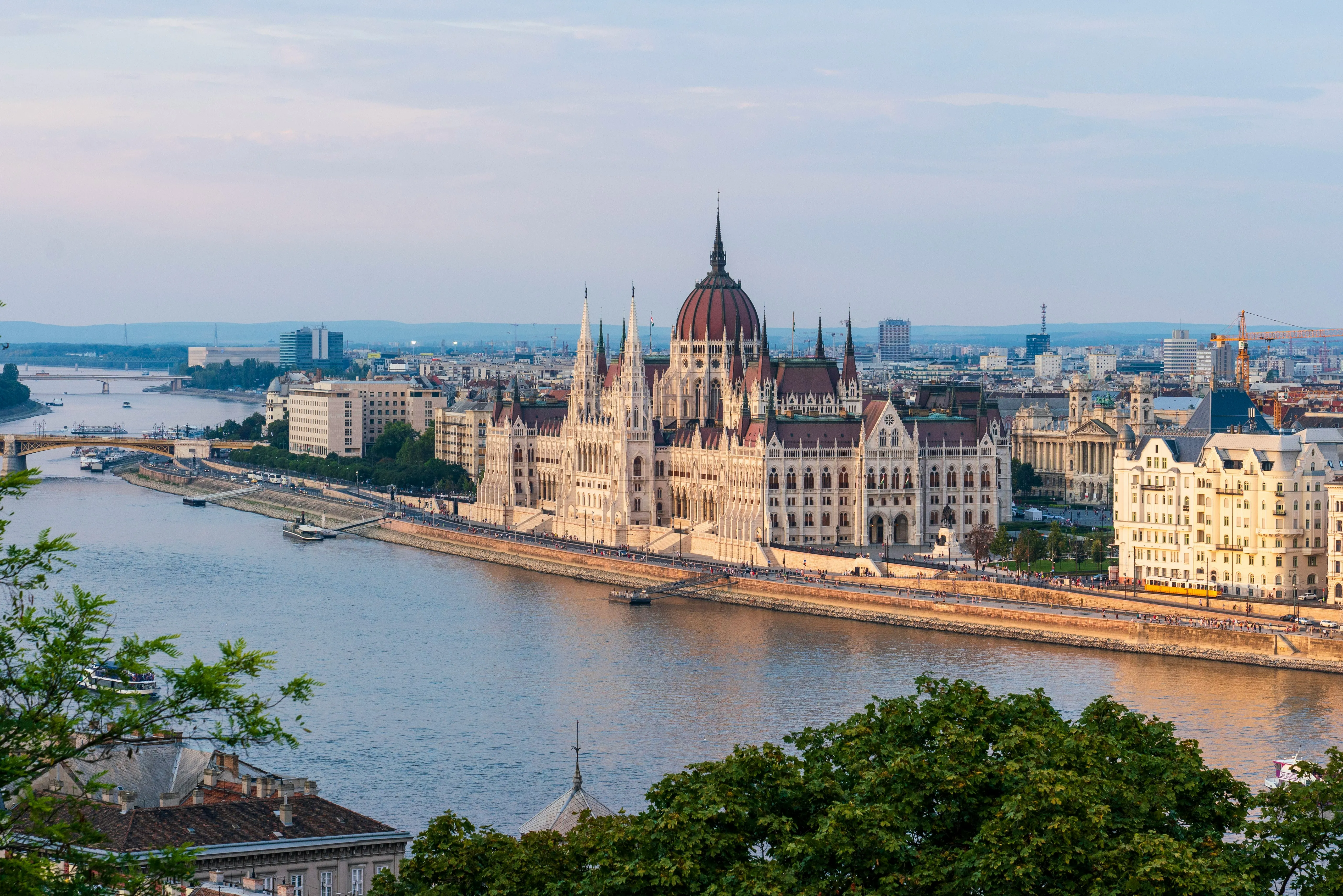
Hungary
Hungary captivates with its historic spas, the imperial elegance of Budapest, and Lake Balaton, offering a rich cultural tradition in the heart of Europe.
Quick Facts
- Capital
- Budapest
- Language
- Hungarian
- German, English
- Currency
- Hungarian Forint (HUF)
- Best time to visit
- Spring (May to June) and autumn (September to October).
- Budget per day
- $45 - $120 per day
- Climate
- Continental climate with hot summers and cold, dry winters; rainfall is moderately distributed throughout the year.
- Connectivity
- good
- Very easy to obtain at airports, official stores, and kiosks, with wide availability of eSIM cards.
- Electricity
- Type C / F (230V)
- Local transport
- good
- Card usage
- widespread
- Tipping
- yes
🌎 Introduction
In the heart of the continent, where the Danube draws a silhouette that divides hills and plains, a landscape unfolds that changes profoundly with the passing of the seasons. From winters of gray skies and steaming spas to bright summers on the shores of Lake Balaton, life moves at its own pace. It is not just the architecture of its cities that tells stories of other times, but also that calm breathed in its fields and vineyards, where local traditions continue to mark the calendar of the villages.
Hungarian identity is tasted in the aroma of paprika coming from its kitchens and heard in a singular language, which resonates with a cadence different from that of its neighbors. It is a place of soft contrasts, where historic cafes coexist with lively markets and where the legacy of centuries merges with the daily life of a dynamic present. Traveling through its corners allows one to appreciate a cultural richness manifested in both its folk music and the elegance of its bridges and the serenity of the great plain.
🛡️ General safety
Hungary is considered, in general terms, a very safe country for tourists. The crime rate is low compared to other European destinations, allowing visitors to enjoy the country with a constant sense of tranquility.
- The overall safety rating is high, ranking as one of the most stable destinations in Central Europe.
- The context for the traveler is one of absolute normality, where serious incidents are infrequent and most visits pass without any mishap.
Crime and common risks
Although Hungary is safe, as in any destination with a large influx of visitors, there are certain minor risks, mainly linked to petty scams and crimes of opportunity.
- Pickpocketing and purse snatching are the most common problems, especially in crowded areas of Budapest, such as Váci utca, the surroundings of the Parliament, or the viewpoint bastions.
- Scams in nightclubs and restaurants have been reported occasionally. These consist of charging exorbitant prices for drinks or dishes that were not clearly listed on the menu. It is recommended to always check prices before ordering.
- Exchanging currency on the street is a practice that should always be avoided, as it usually leads to scams or the delivery of out-of-circulation bills. It is better to use official exchange houses or ATMs.
Safety in cities and tourist areas
Hungarian cities, led by Budapest, maintain a monitored and well-lit urban environment.
- In urban centers, the police presence is discreet but effective, contributing to a relaxed atmosphere even during the night.
- Public transport (metro, tram, and bus) is safe, although it is the preferred place for pickpockets during peak hours. It is advised to wear backpacks on the front in crowded carriages.
- There are no “no-go zones” or extremely dangerous neighborhoods for tourists, although in the capital it is advisable to transit with more attention through some areas of District VIII (Józsefváros) during the early morning hours if you do not know the streets well.
Safety in transport
The transport system in Hungary is efficient and has high safety standards.
- In Hungary, driving is on the right. Road infrastructure is modern, especially the motorways connecting Budapest with the borders.
- The use of taxis requires caution: it is strongly recommended not to take taxis that are stationary on the street or that offer services out loud. It is preferable to use recognized mobile applications (such as Bolt) or ask the hotel or restaurant to call an official company. Official taxis must be yellow and display their rates on the doors.
- For those renting a vehicle, it is fundamental to know that there is zero tolerance for alcohol. The permitted limit behind the wheel is 0.0 mg/l, and penalties are immediate and severe.
Natural and climatic risks
Hungary is not a country with extreme geological risks, but its continental climate dictates certain prevention guidelines.
- Seasonal flooding of the Danube River can occur during the spring or after heavy rains in summer. Although they rarely affect the physical safety of tourists, they can alter river cruise schedules or close some walking paths near the riverbank.
- Heatwaves are frequent in July and August, with temperatures that can exceed 35°C. Constant hydration and avoiding the central hours of the day in open spaces are recommended.
- Winters are harsh, with frequent presence of snow and ice patches on sidewalks, which increases the risk of falls if appropriate footwear is not used.
Legislation and local norms
Compliance with local regulations is essential to avoid administrative fines or major legal problems.
- It is mandatory to always carry a valid identity document (ID card or passport).
- Illicit drugs are strictly prohibited. Hungarian legislation is severe and does not distinguish between personal consumption and trafficking in many of its penal sections.
- In public transport, inspectors are very strict. It is imperative to validate the ticket before starting the trip; the mere fact of possessing it without having marked it carries an immediate fine that must be paid on the spot or at the police station.
Safety for specific groups
- Women travelers: Hungary is a safe destination for women traveling alone. There are no specific dress codes and general respect is the norm. Standard precautions that one would take in any international city at night apply.
- LGTBIQ+ travelers: Although society is generally respectful in tourist areas and Budapest has a diverse scene, the country maintains a conservative political climate. Very evident public displays of affection may attract uncomfortable looks or comments, especially in rural or less cosmopolitan areas.
- Traveling with children and the elderly: The country is very well adapted. Parks are safe and cities have a good network of health centers and well-equipped pharmacies.
Emergencies and assistance
In case of needing immediate help, the emergency system is centralized and efficient.
- 112 is the single emergency number and has operators who usually speak English and, occasionally, other European languages.
- The police (Rendőrség) are usually professional. If you need to file a report for loss or theft for insurance purposes, you must go to a police station; in Budapest, there are specific tourist assistance offices.
- Healthcare assistance is of good quality. It is recommended to always travel with private medical insurance or, in the case of European Union citizens, with a valid European Health Insurance Card.
Tip: Always use official applications to request taxis and avoid vehicles that do not carry the badge of a recognized company, even if the driver seems friendly.
📝 Entry requirements
To organize a trip to Hungary, the first aspect to consider is identity documentation. Travelers usually need a valid passport or, depending on international agreements between countries, a valid national identity document. It is recommended that the document has a remaining validity of at least three or six months from the planned date of departure from Hungarian territory to avoid complications at border control points.
In most cases related to short-term tourism, a prior visa is not usually required for stays not exceeding 90 days. However, this condition depends on the visitor’s region of origin, so it is common for some travelers to have to manage an electronic authorization or a specific permit before starting their journey. The maximum stay permitted as a tourist is generally governed by six-month periods in which the total days of stay are calculated.
Upon arrival at airports or land entry points, customs agents may randomly request complementary documentation. It is frequent for them to ask to see a return ticket or an exit ticket to a third country, as well as proof of sufficient financial resources to cover the expenses planned during the visit. It is also usually recommended to have a confirmed accommodation reservation for the first nights of the stay.
Regarding customs regulations, there are standard limits on the amount of alcohol, tobacco, and perfume that can be brought in without declaring. If the traveler needs to carry specific medications, it is advisable that these are accompanied by their corresponding original medical prescription. For phytosanitary safety reasons, the entry of certain fresh foods of animal or vegetable origin may be restricted or subject to specific controls at the border.
Regarding health, there are usually no mandatory vaccinations to enter the country, unless coming from areas with very specific and temporary epidemiological risks. It is suggested that the tourist has their usual vaccination schedule up to date and carries travel insurance with broad medical coverage, as this facilitates any necessary assistance during the tour of Hungarian cities.
Below are the key points for entering the territory:
- Travel document: A passport or official identity document with sufficient validity is required.
- Period of stay: The usual maximum time for tourist visits is 90 days.
- Justification of means: You may be asked to prove financial funds for the trip.
- Exit from the country: Agents may request the presentation of a return transport ticket.
- Health controls: There are no special vaccination requirements, but medical insurance is recommended.
- Baggage restrictions: There are caps for products such as tobacco and alcoholic beverages.
- Personal medications: You must travel with a medical prescription if they are specific treatments.
🏥 Basic health considerations
When planning a trip to Hungary, it is normal to wonder how health matters work there. In general, you will find a good quality healthcare system, especially in Budapest and the larger cities. The country has a network of public hospitals and very well-equipped private clinics. If you need care, you will see that private healthcare is the fastest and most comfortable option for a tourist, as the staff usually speaks fluent English and waits are minimal. Regarding prices, although it is not an excessively expensive country compared to other European destinations, a medical consultation or emergency treatment can represent a significant unforeseen expense if you are not well prepared.
Although it is not mandatory to enter the country, taking out travel medical insurance is something you will appreciate if any inconvenience arises. Ideally, your policy should include broad coverage for hospitalization, medical transfers, and, above all, repatriation to your home country if necessary. Having this support allows you to enjoy the thermal baths and Hungarian landscapes with the peace of mind that, in the face of any stumble, you will not have to pay large sums of money out of pocket.
In the section on vaccines, you will not find any that are mandatory to enter Hungary. The most important thing is that you have your usual vaccination schedule up to date, with the standard doses we all usually have. If you plan to do a lot of hiking or spend time in rural areas and forests, some travelers choose to protect themselves against tick-borne encephalitis, but for a conventional tourist visit, it is not usually necessary. It is always a good idea to consult with a professional before leaving, but in principle, you will not have to go through complicated vaccination processes.
If you take specific medication, it is best to bring it from home in its original packaging and accompanied by a copy of your medical prescription or a report from your doctor. This is useful both to avoid problems at customs and so that local pharmacists know what to give you if you need a replacement. In Hungary, you will find pharmacies easily, identified with the name Patika, where you can buy hygiene items and basic medications without problems.
Regarding health risks, Hungary is a very safe country. The climate is continental, so in summer you can find waves of intense heat and in winter temperatures below zero, so you should dress appropriately. As mentioned before, in nature areas such as Lake Balaton or the northern mountains, it is advisable to use repellent and check your skin at the end of the day for ticks. There are no tropical diseases or serious risks you should worry about while walking through its streets.
Regarding water and food, you can be totally calm because tap water is drinkable and of good quality in practically the entire territory. You can refill your bottle without fear and save money on plastic. Hygiene in restaurants and street food stalls is quite strict, so you can try all the local delicacies like goulash or lángos without fear of them making you feel bad. The general level of cleanliness in establishments is equivalent to that of any other modern European country.
If you find yourself in an emergency situation, the number you should dial is 112, which is the European standard for emergency services. Through this number, you can request an ambulance or immediate medical assistance. The ambulance service works effectively and they are prepared to act quickly in urban areas.
As final tips, always remember to carry a copy of your documentation and your medical insurance. If you visit the famous Hungarian thermal baths, do not forget to stay well hydrated and respect the recommended times inside the hot water to avoid drops in blood pressure. With these basic precautions, you will find that your stay in Hungary will be as safe as it is pleasant.
🚌 Transport within the country
The transport network in Hungary is quite efficient and allows for easy travel throughout the territory. The train constitutes the main axis for long-distance travel, connecting the capital with the most important cities regularly. To reach smaller towns or rural areas where the railway does not reach, intercity buses offer very complete coverage and reach almost every corner of the country. In large cities, visitors have a wide variety of options including the metro, tram, and trolleybus, making urban journeys much easier.
The user experience for the tourist is usually simple because signage in the main stations and transport hubs is usually available in several languages. Buying tickets is an accessible process that can be done at automatic machines, many of them with translated menus, or at customer service windows. While in urban areas transport is constant and very frequent, in rural areas schedules may be more limited, so it is advisable to organize trips in advance if you plan to visit more remote regions.
Regarding road travel, car rental is a common alternative for those seeking greater autonomy, as the main roads and motorways are in good condition. Taxis are a common resource in urban centers and operate under established regulations, with the use of mobile applications to request these services quickly being frequent. In general, the transport system stands out for its punctuality and reliability, allowing the traveler to move with a sense of order and comfort during their stay.
Tip: It is essential to always validate the ticket when boarding transport or before entering controlled access zones to ensure a trip without setbacks.
🤵 Culture and etiquette
In Hungary, social interactions are usually marked by a tone of formal courtesy and a notable respect for personal space. When greeting, the most common way is a firm handshake while maintaining eye contact, both when arriving and when saying goodbye. Although the initial treatment may seem reserved, this attitude reflects a norm of discretion and decoro rather than a lack of friendliness. It is common for people to use surnames and formal titles in first meetings, moving to the use of first names only when a relationship of greater trust has been established.
Behavior in public spaces is governed by moderation. Maintaining a low voice volume in public transport, restaurants, and museums is valued so as not to interfere with the peace of others. Punctuality is considered a fundamental sign of respect for other people’s time, so it is recommended to arrive at the exact time for any appointment, whether social or professional. When entering and leaving small commercial establishments, it is customary to greet and say goodbye in a general way, acknowledging the presence of the staff.
Regarding the table and meals, Hungarian customs emphasize hospitality. It is common to wait for the host to begin or for all diners to be served before starting to eat. Regarding tipping, the standard practice in restaurants is to leave approximately 10% or 15% of the total bill if the service is not included. A relevant detail of local etiquette is that the tip is usually communicated verbally to the waiter at the time of payment, indicating the total figure one wishes to pay, instead of leaving coins on the table upon leaving.
Respect for historical and religious heritage is essential when visiting the country. When entering churches or synagogues, one should dress modestly and remain silent. Hungary has a deeply rooted cultural identity, so showing genuine interest in its history, music, and traditions is usually very well valued by local residents. In the context of visiting private homes, it is a common gesture of courtesy to take off one’s shoes upon entering, following the host’s indication, to maintain the cleanliness of the domestic space.
“Tip”: When making a toast, especially with beer, it is common for some Hungarians to avoid clinking glasses or mugs due to an old historical tradition; to follow local etiquette, simply raise the glass, establish eye contact, and say the word “egészségedre”.
🍛 Typical gastronomy
The cuisine of Hungary is recognized for being comforting, spiced, and with a great personality. Its roots are found in the nomadic history of the ancient Magyars, combined with influences from the Austro-Hungarian Empire and neighboring regions of Central Europe. The central element that defines its flavor is, without a doubt, paprika, an ingredient that adds color and depth to most of its preparations, appearing in both sweet and spicy versions.
In daily life, Hungarians usually give great importance to lunch, which traditionally consists of three courses: a soup, a meat-based main dish, and a dessert. The use of tejföl (a thick sour cream) is almost constant, used to soften stews or as a final garnish. In addition to pork and beef, seasonal vegetables and flour play a fundamental role in the preparation of doughs and homemade pastas that accompany abundant sauces.
From a cultural point of view, the experience of eating in Hungary is slow-paced. In restaurants, commonly known as étterem or the more traditional csárda (rustic-style inns), service is usually attentive. Regarding drinks, it is very common to start meals with a small sip of pálinka, a local fruit brandy, or to accompany main dishes with the prestigious wines from Tokaj or the Eger region. Mineral water and infusions are also common on local tables.
When visiting markets or traditional establishments, one perceives that food is not just sustenance, but a social act. It is not uncommon to find street food stalls serving fried doughs or steaming sweets, ideal for consuming while walking. Etiquette in establishments is simple, although courtesy is valued and it is common to leave a tip of around ten percent if the service was to the diner’s liking.
| Dish | Description | Main ingredients | Where to try it | Tip |
|---|---|---|---|---|
| Gulyás | Thick and nutritious soup, the national dish par excellence. | Beef, potatoes, carrots, and plenty of paprika. | In any traditional restaurant or csárda in the country. | Do not confuse it with a dry stew; the authentic version is always a soup. |
| Pörkölt | Slow-cooked meat stew with a dense and tasty sauce. | Meat (pork or beef), onion, paprika, and lard. | Very common in midday menus in Budapest and rural areas. | Always accompany it with nokedli, small flour pastas similar to dumplings. |
| Halászlé | Intense red river fish soup with a spicy flavor. | Freshwater fish (carp or catfish) and spicy paprika. | Restaurants on the banks of the Danube or the Tisza River. | Use caution with the small bones that are usually present in the broth. |
| Lángos | Fried bread dough served as fast food or a snack. | Flour, yeast, water, and toppings like garlic and sour cream. | Market stalls and recreational areas like Lake Balaton. | The classic is eaten with garlic oil, tejföl, and grated cheese on top. |
| Kürtőskalács | Cylindrical sweet roasted over fire with a crunchy outer layer. | Yeast dough, sugar, cinnamon, or chopped nuts. | Street stalls and markets in major cities. | Buy it when it is freshly made to enjoy its tender texture and caramelized sugar. |
📷 Zones and places to visit
The capital, Budapest, is usually the starting point for most travelers and is naturally divided by the course of the Danube River. On the west bank is Buda, an area characterized by its rugged terrain and historical atmosphere. Here, the Buda Castle complex stands out, housing the Hungarian National Gallery and the Budapest History Museum. Walking through its cobblestone streets leads to the Fisherman’s Bastion, a viewpoint with panoramic views toward the other bank, and the Matthias Church, recognized for its colorful tiled roofs. This part of the city offers a slower pace, ideal for exploring the country’s medieval and baroque heritage.
On the other side of the river stretches Pest, the nerve, administrative, and commercial center. It is a flat and vibrant area where the Hungarian Parliament, one of the largest legislative buildings in the world, is located. In this area, it is essential to walk along Andrássy Avenue, which connects the center with Heroes’ Square and the City Park. Pest is also home to the Jewish Quarter, where the Great Synagogue and numerous rehabilitated cultural spaces are found. In addition to its architecture, this part of the capital is famous for its historic spas, such as Széchenyi or Gellért, where the culture of thermalism is experienced as a daily social activity.
Following the course of the river northward, you reach the Danube Bend, a region where the natural landscape blends with small towns of great historical importance. Szentendre is one of the most visited due to its artistic atmosphere, its art galleries, and its narrow Mediterranean-style streets. A bit further away is Visegrád, known for its citadel located on top of a hill, and Esztergom, which houses the largest basilica in the country and marks the natural border with neighboring territory. This area is ideal for day trips and enjoying gentle hiking routes with views of the river valley.
In the west of the country lies Lake Balaton, colloquially known as the Hungarian sea. It is the largest freshwater lake in Central Europe and a fundamental holiday destination. The northern shore is famous for its volcanic hills and vineyards, especially in the Badacsony area. The Tihany peninsula stands out for its Benedictine abbey and its lavender fields, while towns like Balatonfüred maintain an elegant air with their promenades and historic villas. Very close to the lake is Hévíz, which features a unique natural thermal lake where it is possible to bathe outdoors all year round.
To the south, the city of Pécs offers a fascinating contrast thanks to its mild microclimate and rich multicultural heritage. It is known for its remains from the Roman era, such as the Early Christian Necropolis, and for its buildings from the Ottoman period, such as the Mosque of Pasha Qasim. It is also the center of Zsolnay ceramics, whose factory and cultural quarter are mandatory stops for lovers of design and industrial history. Southern Hungary shows a more relaxed side, with a landscape of gentle hills and a deeply rooted wine tradition.
In the northeast, the city of Eger stands out for its imposing castle and well-preserved baroque architecture. It is an area of great historical relevance for its resistance against ancient invasions and a key point for understanding national identity. Near there, the Tokaj region is world-renowned for its protected cultural landscapes and its wine-making tradition. Nature lovers also find in the north the Aggtelek National Park, famous for its impressive stalactite cave systems, which offer spectacular underground tours.
Finally, the Great Plain or Alföld covers a large part of the east of the country, offering a landscape of infinite horizons very different from the rest of the regions. The Hortobágy National Park is the clearest exponent of this area, where the culture of traditional shepherds is preserved and indigenous fauna species can be observed in the wild. In this region, you also find Debrecen, the second largest city in Hungary, which stands out for its imposing Great Reformed Church and its university atmosphere, being a top-tier cultural center away from the more conventional tourist circuits.
Tip: You cannot miss visiting the Budapest Parliament, the most emblematic place in the country.
✈️ Best season to travel
Hungary is a destination that offers very different experiences depending on the time of year it is visited. Generally, the months of spring and the beginning of autumn are considered the most balanced periods, as temperatures are moderate and allow for comfortable walking tours, both in urban areas and in natural environments.
During the hot months, the country experiences a vibrant atmosphere with numerous outdoor events, while winter, although cold, transforms the landscape and allows for a cozy atmosphere, especially linked to the culture of historic spas. The choice of travel time will depend on whether one seeks the dynamism of the summer season or the tranquility of the intermediate seasons.
| Season | Months | Typical climate | What to expect | Tourist influx |
|---|---|---|---|---|
| Spring | Mar – May | Mild temperatures (10°C - 20°C) and occasional rain. | Blooming parks, art festivals, and traditional Easter markets. | Medium ⭐⭐ |
| Summer | Jun – Aug | Hot and mostly sunny weather, with long days. | Music festivals, nautical activities on Lake Balaton, and lively terraces. | High ⭐⭐⭐ |
| Autumn | Sep – Nov | Gradual drop in temperature and clear skies. | Harvest season in wine regions and wooded landscapes with ochre tones. | Medium ⭐⭐ |
| Winter | Dec – Feb | Intense cold, frequent frost, and possibility of snow. | Christmas markets, ice skating, and thermal baths with thermal contrast. | Low (High in December) ⭐ |
🗣️ Basic vocabulary
Learning some basic notions of Hungarian can be of great help during your stay in the country. Although in the more touristy areas of cities like Budapest it is common to be able to communicate in English, knowing a few key words facilitates interaction in shops, restaurants, or transport.
Hungarian is a language with very different roots from Spanish or English, so locals usually value the effort of visitors to use simple expressions in their language. These words will allow you to navigate everyday situations of your trip with greater fluidity and respect.
- Szia: Hello or goodbye (informally).
- Jó napot: Good day.
- Köszönöm: Thank you.
- Kérem: Please.
- Igen / Nem: Yes / No.
- Bocsánat: Sorry or excuse me.
- Mennyibe kerül?: How much does it cost?
- Egészségedre: Cheers! (used for toasting)