


Slovenia
A fascinating destination that combines the Julian Alps with crystal-clear lakes and charming cities, offering pristine nature, great tranquility, and unforgettable experiences in Central Europe.
Quick Facts
- Capital
- Ljubljana
- Language
- Slovenian
- English, Italian, Hungarian
- Currency
- Euro (EUR)
- Best time to visit
- From May to September to enjoy nature and from December to March for winter sports.
- Budget per day
- $60 - $160 per day
- Climate
- Varied climate with alpine influence in the north, Mediterranean on the coast, and continental in the center, with cold winters and mild summers.
- Connectivity
- good
- Very easy to acquire at kiosks, post offices, supermarkets, and mobile phone shops in major cities.
- Electricity
- Type C/F (230V)
- Local transport
- good
- Card usage
- very widespread
- Tipping
- optional
🌎 Introduction
In the heart of the continent, where the last foothills of the Alps soften before reaching the Adriatic Sea, there is a territory defined by the diversity of its contrasts. It is a place where it is possible to start the day facing the sea breeze and end it under the shadow of snowy peaks, crossing green-carpeted valleys and forests that seem never-ending along the way. This geographical variety has shaped a peaceful character and an identity perceived in the harmony of its landscapes and the human scale of its settlements.
Life here moves at a slow pace, closely linked to the cycles of the land and traditions that are effortlessly kept alive. This is evident in the deep roots of beekeeping, present in the colorful panels of the beehives, and in the wine culture that defines the eastern hills. The seasons transform the environment in obvious ways: from the white silence of winter, which invites retreat in the mountains, to the burst of color in spring, when local markets fill with fresh produce and the squares regain their daily pulse.
This blend of Slavic, Germanic, and Latin influences is reflected in both the architecture of its small towns and its varied and honest gastronomy. Walking along its trails or exploring its urban centers allows one to appreciate a natural balance that is preserved with pride. It is, in essence, a space where nature and culture coexist in an integrated way, offering a calm experience for those seeking to understand the essence of this European region.
🛡️ General Safety
Slovenia is considered one of the safest destinations in the world for travelers. Its peaceful atmosphere, low population density, and a culture based on respect and civil order mean that the country enjoys a very high level of safety. Compared to other European destinations, Slovenia stands out as a place where serious incidents are extremely unusual, allowing tourists to enjoy a relaxed stay in both natural and urban environments.
The context for the traveler is one of great trust. It is common to see locals and tourists walking calmly at any time of day. However, as in any international destination, common sense and prevention are the best tools to guarantee a trouble-free trip.
Crime and Common Risks
Although the crime rate is very low, there are certain minor risks worth knowing:
- Pickpockets and theft: These occur sporadically in crowded places, such as the main train and bus stations in Ljubljana, or at the most touristy spots like Ljubljana Castle and the shores of Lake Bled.
- Theft from vehicles: In hiking areas or parking lots of natural parks, it is advisable not to leave valuables in sight inside the car, as they can attract opportunists.
- Minor scams: These are rare, but it is recommended to always check prices on menus in restaurants in the busiest areas and confirm taxi fares before starting the journey.
Safety in Cities and Tourist Areas
Slovenian urban centers, including the capital, Ljubljana, and cities like Maribor or Piran, offer a very safe environment.
- Nightlife: It is safe to walk through the cities at night. Neighborhoods are usually well-lit, and the atmosphere is mostly family-oriented and peaceful.
- Public transport: Urban buses are safe and clean. There are no common reports of insecurity in their daily use.
- Practical recommendation: Keep your belongings supervised while resting on café terraces or in public parks, especially in the capital.
Safety in Transportation
Transportation in Slovenia is efficient and safe, complying with the most demanding European standards.
- Driving: In Slovenia, people drive on the right. Roads and highways are in excellent condition, although mountain routes can be winding and narrow.
- Mandatory vignette: To drive on motorways and expressways, it is mandatory to purchase an e-vinjeta (electronic vignette). Not having one results in high fines that are collected immediately.
- Taxis and transfers: It is recommended to use official taxi apps or clearly identified licensed vehicles. Prices are reasonable, but it is better to agree on the estimated cost beforehand if the vehicle does not use a visible taximeter.
- Trains and intercity buses: These are very safe and reliable means for moving around the country, with stations generally well-monitored.
Natural and Climatic Risks
Slovenia’s geography, marked by the Alps and karst systems, presents some factors to keep in mind:
- Mountain environment: The weather in the Julian Alps can change suddenly. It is essential to check the weather forecast before hiking and carry appropriate equipment.
- Floods: During periods of heavy rain (especially in autumn), some areas near rivers may suffer localized flooding.
- Seismic activity: Slovenia is located in an area with some tectonic activity, so minor earthquakes can occur occasionally, although they rarely affect modern infrastructure.
- Ticks: In forested areas and meadows during the summer, there is a risk of tick bites that can transmit diseases such as Lyme disease or encephalitis. It is recommended to use repellent and wear long clothing.
Local Legislation and Norms
Slovenia is a country that respects rules, and visitors are expected to act the same way:
- Identification: It is mandatory to always carry a valid identity document (passport or national identity card, depending on origin).
- Alcohol and tobacco consumption: Smoking is prohibited in closed public spaces. Alcohol consumption on the street may be restricted in certain municipal areas or specific events.
- Drugs: Legislation is strict regarding the possession and consumption of narcotic substances; penalties can include severe fines or detention.
- Respect for the environment: There are very strict laws regarding wild camping (it is prohibited outside designated areas) and waste management in national parks. Non-compliance leads to immediate fines.
Safety for Specific Groups
- Female travelers: Slovenia is a highly recommended country for women traveling alone. Respect for women is the norm, and street harassment problems are not commonly reported.
- LGTBIQ+ travelers: The country is progressive and legally protective of the community. In Ljubljana and tourist areas, acceptance is high, although in more remote rural areas, the population may be more conservative, while always maintaining courtesy.
- Children and the elderly: The infrastructure is very accessible, and the environment is extremely safe and welcoming for families and senior travelers.
Emergencies and Assistance
In case of an incident, Slovenian emergency services are fast and efficient:
- Single emergency number: 112 (for ambulances, firefighters, and general emergencies).
- Police: 113.
- Roadside assistance: 1987 (AMZS).
- Medical care: The health system is of high quality. It is recommended to travel with medical insurance that covers any eventuality to facilitate assistance procedures.
Tip: If you are going to drive on their motorways, make sure to buy the e-vinjeta online before entering the country or at the first gas station after crossing the border to avoid automatic fines captured by camera.
📝 Entry Requirements
When planning a trip to Slovenia, it is essential to keep in mind that most international visitors require a valid passport with a validity that preferably extends several months beyond the planned end date of the trip. Depending on nationality and current international agreements, many tourists can access the territory without needing to obtain a prior visa for short stays, allowing them to enjoy the country’s attractions for a maximum period that usually hovers around ninety days within a six-month window.
At entry points, whether through airports or land borders, authorities may conduct routine checks where information about the reason for the trip is requested. It is advisable to have an outbound ticket from the country or for continuation to another destination, as well as documents proving that the traveler has sufficient financial means to cover their expenses during the stay. Likewise, having a confirmed accommodation reservation for the first nights can facilitate a smooth entry process.
Regarding customs restrictions, there are standard regulations on the import of certain products. It is recommended to pay attention to the permitted amounts of tobacco and alcohol, as well as limitations on the transport of meat or dairy products to avoid inconveniences at checkpoints. In the case of traveling with prescription medications, it is very useful to carry a copy of the medical prescription or a descriptive report. Regarding health, there are usually no mandatory vaccination requirements for entry, although it is always a recommended practice to have travel insurance with broad health coverage for the traveler’s peace of mind.
Below are the key points to consider for access to Slovenian territory:
- Travel documentation: Use of a valid passport or identity document according to the agreements applicable to each region.
- Stay period: Usual authorization of up to ninety days for strictly tourist activities.
- Proof of resources: Possibility of requiring proof of financial funds and return transport tickets.
- Customs rules: Control over the entry of fresh food, plants, and commercial quantities of certain personal items.
- Health and prevention: Recommendation to have international medical insurance and keep the vaccination schedule up to date.
- Border procedures: Habitual luggage inspections and verification of the traveler’s basic documentation.
🏥 Basic Health Considerations
If you plan to visit Slovenia, you will be pleased to know that you are heading to one of the countries with the best standards of quality of life and safety in Europe. You will find a modern, efficient, and well-distributed healthcare system throughout the territory, with top-tier hospitals especially in the capital, Ljubljana, and in major cities. Assistance is both public and private, but you should keep in mind that for tourists, costs can be high if you do not have adequate coverage. Medical staff are usually very well-trained, and it is common that you can communicate in English without major difficulties, as most professionals are fluent.
Although it is not a strictly mandatory legal requirement to enter the country as a tourist for short stays, taking out travel medical insurance is highly recommended. Ideally, your policy should include broad coverage for hospitalization, surgical interventions, and, above all, medical repatriation in case of a serious accident. Having this support will allow you to move with total peace of mind through its mountains and lakes knowing that any unforeseen event will be covered without affecting your pocket.
Regarding vaccines, there are no mandatory ones to enter Slovenia. Most likely, you only need to have your usual vaccination schedule up to date. However, if you plan to spend a lot of time hiking in forested or rural areas during the spring and summer, you might consider the vaccine against tick-borne encephalitis, something common among nature lovers in this region of Central Europe.
If you take specific medication, it is best to bring the necessary amount for your entire trip in its original packaging. You will find pharmacies easily, but for certain drugs, they will ask for a medical prescription translated into English or an official certificate from your doctor. There are no strange restrictions on common medications, but it is always preferable to travel with a small first-aid kit for minor ailments such as headaches or minor digestive problems.
Health risks in Slovenia are truly low. The climate is continental, so in summer you should protect yourself from the sun and in winter dress warmly to avoid extreme cold. The main real risk you will find in nature is tick bites if you walk through forests or high meadows, so using repellent and checking your skin at the end of the day is a very advisable practice. There are no tropical diseases or significant altitude risks, as its mountains are accessible and safe if you follow marked routes.
Regarding water and food, you can be completely at ease. Tap water is potable and of excellent quality throughout the country; in fact, you will be surprised by how good it tastes even from public fountains in the cities. Food hygiene standards are very strict, so you can try local gastronomy in both restaurants and markets with total confidence. The level of cleanliness in establishments is generally impeccable.
In case you suffer a medical emergency during your stay, the number you should dial is 112, which is the unified emergency telephone number. The ambulance system is fast, and they will attend to you with great professionalism. You will see that response times are short and that coordination between rescue services, especially in mountain areas, works excellently.
As final tips for a perfect trip, I suggest wearing comfortable shoes for walking, using sunscreen if you are going to be near the lakes, and drinking plenty of water from its natural springs. Slovenia is a very safe country for the traveler, where the biggest concern is usually simply deciding which landscape to enjoy next. If you follow these basic guidelines, your experience will be as healthy as it is pleasant.
🚌 Transport within the Country
Moving around Slovenia is a simple task thanks to its manageable size and well-organized infrastructure. Travelers usually opt for the bus and the train to travel between the main points of interest. Since the territory is not very extensive, there are no domestic flights, making land transport the main option for touring the country. Many visitors also decide to rent a vehicle, as it allows for greater flexibility to explore natural settings with total freedom.
The use of public transport is quite intuitive for visitors. Stations and stops are usually well-signed, and the staff is accustomed to managing fluently in different languages, which greatly facilitates communication and orientation. Buying tickets is a direct process that can be done in person at station ticket offices or at authorized points of sale before starting the journey.
There is a difference between urban areas and the rural environment. In the cities, the transport network is frequent, while in mountain regions or more remote villages, schedules may be more limited. For this reason, to reach certain valleys or natural parks that are difficult to access, it is advisable to plan trips in advance to adjust visiting times.
Taxis and other private transport services are present mostly in urban centers and near the main places of interest. They are considered a reliable and comfortable option, ideal for short trips or to quickly reach specific points where regular transport does not have a nearby stop. Generally speaking, the transport system stands out for its punctuality and the good maintenance condition of its vehicles.
Tip: It is recommended to check travel schedules in advance, especially during weekends, as the frequency may be lower than on business days.
🤵 Culture and Etiquette
In Slovenia, interpersonal treatment is usually characterized by discreet courtesy and a moderate tone. When greeting, the most common way is a firm handshake while maintaining direct eye contact, in both formal and informal contexts. It is common to use courtesy titles followed by the surname until greater trust is established between the parties. In public spaces, maintaining a low voice volume and calm behavior that does not interfere with the tranquility of others is valued, reflecting a coexistence based on respect for others’ space.
Punctuality is a fundamental value in daily and social Slovenian life. Arriving at the agreed time is considered a basic sign of consideration for others’ time, whether for a professional appointment, a restaurant reservation, or a private invitation. Regarding physical contact, the general tendency is to respect personal space, avoiding excessively effusive gestures with strangers or in first meetings, preferring a prudent physical distance.
When invited to a Slovenian home, it is a widespread custom to remove your shoes upon entering the house; normally, hosts will offer a pair of house slippers to their guests for their comfort. It is common to bring a small gift as a gesture of gratitude, such as flowers, chocolates, or a bottle of wine. During meals, it is customary to wait for the host to make a small toast or formally invite everyone to start before beginning to eat or drink.
In the catering sector, tips are not mandatory, as service is usually included in the final price, but it is a common and appreciated practice to round up the bill or leave approximately 10% of the total if the service received has been satisfactory. Service in establishments tends to be efficient and professional, with polite and direct treatment always being valued. Likewise, there is a deep link with nature, so maintaining the cleanliness of outdoor spaces and respecting the natural environment is an essential rule of conduct for the local population.
When visiting churches, monasteries, or places of worship, it is recommended to dress modestly, covering shoulders and knees, and to maintain absolute silence, especially if a religious service is being held. Slovenia has strong roots in its local traditions and historical heritage; showing genuine interest and an attitude of listening to these cultural manifestations facilitates a harmonious integration of the traveler into the country’s pace of life.
Tip: Before entering a private house, check if there are shoes by the door; taking off your shoes is the most common and expected gesture of courtesy to maintain the cleanliness and comfort of the home.
🍛 Typical Gastronomy
Slovenia’s gastronomy is defined by its enormous diversity, a result of its geographical location at the crossroads of Alpine, Mediterranean, and Central European cultures. This blend of influences has resulted in an honest cuisine, based on local products and traditional recipes that vary significantly from one region to another. In the interior, hearty and comforting dishes predominate, while on the coast, there is a clear Italian heritage with a greater presence of fish and olive oils.
Among the country’s most characteristic ingredients are the use of buckwheat, potatoes, legumes, and a wide variety of mushrooms gathered from its dense forests. A distinctive element of the Slovenian table, especially in the east, is pumpkin seed oil, a dark-colored condiment with an intense flavor used to dress salads and even desserts. Additionally, the country has a solid tradition of cured meats and smoked meats, as well as a wide range of artisanal dairy products.
Regarding eating habits, lunch is usually the main meal of the day and typically begins with a hot soup, even in summer. Schedules tend to be European, with dinners served relatively early. In restaurants, etiquette is simple but respectful; it is common to find so-called gostilnas, which are traditional eating houses where hospitality and family recipes are prioritized. Bread culture is fundamental, as it is an element that is rarely missing from the center of the table.
Regarding drinks, Slovenia has a very deep-rooted wine culture, with three main regions producing high-quality local wines, both white and red. Tap water is potable and of great purity in almost the entire territory, something the inhabitants are proud of. It is also common to end meals with some type of fruit brandy or herbal liqueurs, and local beer consumption is very widespread in social settings.
| Dish | Description | Main Ingredients | Where to try it | Tip |
|---|---|---|---|---|
| Kranjska klobasa | Smoked sausage with designation of origin, very representative of the Alpine region. | Pork, bacon, salt, pepper, and garlic. | In almost any traditional inn or market stalls. | It is usually accompanied by mustard, horseradish, and a piece of fresh bread. |
| Potica | The national dessert par excellence, a thin dough roll with various fillings. | Flour, yeast, and fillings of walnuts, poppy seeds, or tarragon. | Bakeries and homes during festivities throughout the country. | The walnut version is the most classic; it is ideal to accompany afternoon coffee. |
| Štruklji | Dough rolls, boiled or baked, which can be sweet or savory. | Flour dough with fillings of cottage cheese, tarragon, or apple. | Very common in mountain huts and regional cuisine restaurants. | Try them as a side dish for meat or as a light main course. |
| Jota | A thick and nutritious stew, very popular in cold months and in the western zone. | Sauerkraut (or fermented turnips), beans, potatoes, and smoked meat. | Typical of the Primorska region and inland areas. | It is a very complete dish that works perfectly as a single meal after a hike. |
| Kremna rezina | Cream and custard cake with layers of puff pastry, originating from the Lake Bled area. | Puff pastry, vanilla pastry cream, whipped cream, and icing sugar. | Cafes around Lake Bled and hotels in the area. | Enjoy it on a terrace with views of the lake to complete the experience. |
📷 Areas and Places to Visit
Ljubljana, the country’s capital, is usually the starting point for most travelers. It is a human-scale city, largely designed by the architect Jože Plečnik, where the Old Town and its relaxed atmosphere on the banks of the Ljubljanica River stand out. Walking through its streets, it is essential to cross the Dragon Bridge and the Triple Bridge, which connect the modern area with the historical center. At the top of a hill, Ljubljana Castle offers a full perspective of the city and the Alpine peaks seen in the distance. In addition to its architecture, the capital has a varied cultural offering in spaces such as the Kino Šiška Centre for Urban Culture or the numerous museums of contemporary art and national history.
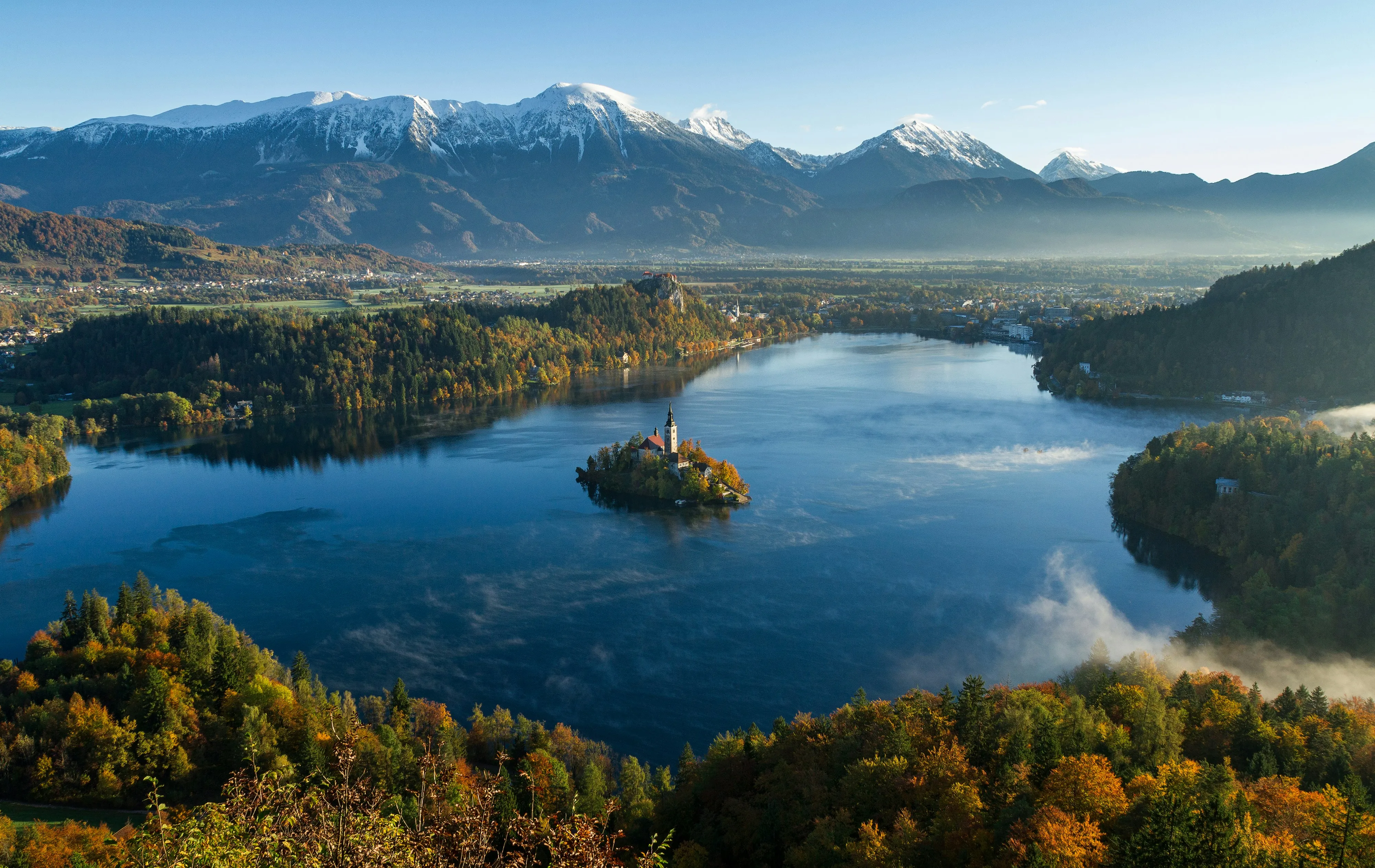
To the northwest, the Julian Alps present some of the most recognized landscapes in the region. Lake Bled is a fundamental site, characterized by its small island with the Church of the Assumption and the imposing castle situated on a cliff. Very close by, Lake Bohinj offers a quieter and more pristine environment, ideal for those looking for hiking trails or activities in direct contact with nature. This area is the heart of the Triglav National Park, where you can go on mountain excursions, visit the Vintgar Gorge, or contemplate the waterfalls that dot the Alpine valleys.
Following the course of the water, the Soča Valley is famous for the emerald color of its river. This territory not only attracts adventure sports fans such as kayaking or rafting, but also those interested in history. During World War I, these mountains were the scene of important battles, whose memory is preserved today in the Kobarid Museum and on the various trails that run through ancient fortifications. The contrast between the harshness of history and the serenity of the river landscape defines the identity of this western area.
In the south of the country, the terrain changes radically to give way to the Karst Region, an underground landscape of great geological importance. The Postojna Caves allow you to explore impressive formations of stalactites and stalagmites through an electric train tour. A short distance away is Predjama Castle, a unique construction built inside the mouth of a cave halfway up a rock wall. Also in this area, the Škocjan Caves, declared a World Heritage Site, offer enormous underground canyons that can be explored on foot.
The small coastal strip of Slovenia shows a clear Mediterranean influence. The city of Piran is the clearest exponent of this style, with its Venetian-influenced architecture, its narrow streets, and the Tartini Square open to the sea. It is an ideal place to enjoy seafood gastronomy or visit the Sečovlje Salt Pans, where salt is still collected following traditional methods. In contrast, nearby towns offer infrastructure more oriented towards rest and maritime leisure, maintaining a balance between fishing tradition and modernity.
Finally, towards the east, the landscape softens with hills dedicated to vineyard cultivation. Maribor, the second city of the country, is home to the oldest vine in the world and is a relevant cultural center with annual festivals and a cozy historical center on the banks of the Drava River. Very close by is Ptuj, considered the oldest city in the country, whose castle and medieval streets transport the visitor to past centuries. This region is ideal for getting to know the more rural Slovenia, where spas and vineyard routes offer a more leisurely travel experience focused on local heritage.
“Tip”: You cannot miss Lake Bled, the most emblematic place in the country.
✈️ Best Season to Travel
Slovenia is a destination that offers very diverse experiences depending on the time of year, thanks to a geography that combines the Alps, the Mediterranean coast, and extensive plains. The choice of the ideal date depends largely on the activities you wish to perform, as the climate varies significantly from one region to another. Generally, the months between late spring and early autumn are favorable for those looking to enjoy nature at its peak.
During the warmer months, the country lends itself to exploring its lakes and mountains with pleasant temperatures, while winter transforms the landscape into an ideal setting for snow fans. Intermediate seasons, such as spring and autumn, allow you to experience the natural environment and the cities with a quieter atmosphere, facilitating a more leisurely contact with local culture.
| Season | Months | Typical Climate | What to Expect | Tourist Influx |
|---|---|---|---|---|
| Spring | Mar – May | Cool and variable, with a gradual increase in temperatures. | Flowering in parks, snowmelt in mountains, and hiking trails in valleys. | ⭐⭐ (Medium - Low) |
| Summer | Jun – Aug | Warm and sunny, with the possibility of brief storms. | Activities in lakes and on the coast, cultural festivals, and mountain sports. | ⭐⭐⭐ (High) |
| Autumn | Sep – Nov | Mild at the beginning and cooler and rainier towards November. | Forest landscapes with reddish tones, gastronomic fairs, and grape harvesting in wine areas. | ⭐⭐ (Medium - Low) |
| Winter | Dic – Feb | Cold, with frequent frosts and snow in high areas. | Winter sports in the Alps, Christmas markets, and Alpine lakes with snowy landscapes. | ⭐⭐ (Medium / High in ski resorts) |
🗣️ Basic Vocabulary
Although in most tourist areas of Slovenia you will be able to communicate in English without problems, knowing some expressions in the local language is a great help to connect better with the people and show courtesy. Slovenians usually appreciate it when visitors make the small effort to use basic words in their daily interactions.
Mastering these terms will allow you to move more easily in common situations, such as entering a cafe, buying something in a local market, or simply greeting the staff at your accommodation. Perfect pronunciation is not necessary; what matters is the intention to facilitate communication.
- Dober dan: Hello / Good morning.
- Hvala: Thank you.
- Prosim: Please / You’re welcome.
- Oprostite: Excuse me / Sorry.
- Nasvidenje: Goodbye.
- Da / Ne: Yes / No