


Sudan
Explore the cradle of ancient Nubian civilizations, where the Nile unites under an eternal sun, revealing forgotten pyramids and a deeply captivating cultural hospitality.
Quick Facts
- Capital
- Khartoum
- Language
- Arabic
- English
- Currency
- Sudanese Pound (SDG)
- Best time to visit
- From November to February, when temperatures are more moderate and the desert heat is less intense.
- Budget per day
- $30 - $80 per day
- Climate
- Mostly desert and arid climate in the north with extreme heat, becoming more tropical and rainy as you move south.
- Connectivity
- low
- They can be easily acquired at airports and urban centers by presenting a passport for mandatory registration.
- Electricity
- Type C, D (230V)
- Local transport
- limited
- Card usage
- more cash is used
- Tipping
- optional
🌎 Introduction
Bathed by the course of a Nile that takes on its own personality here, this corner of Northeast Africa stretches between the serenity of the desert and the liveliness of its coasts. The country’s geography is marked by the slow rhythm of the river, which dictates the pulse of agriculture and village life, while the horizon is dotted with archaeological remains that speak of a millennial past without the need for artifice. It is a land of wide horizons, where the dry climate and constant sun define a character that is equally resilient and welcoming.
The essence of its culture manifests in daily scenes, such as the shared ritual of jebana or spiced coffee, and in a gastronomy that makes the most of simple ingredients to create comforting dishes. Among bustling markets and the calm of rural areas, a mix of influences is perceived that coexist naturally. Walking through its towns allows a glimpse into an identity rich in nuances, where Nubian traditions and Arabic heritage merge under a light that, in many moments, seems to stop time.
🛡️ General Safety
Sudan is a country with immense historical and cultural richness, traditionally known for the legendary hospitality of its inhabitants. However, for the international traveler, safety in the country is closely linked to its political and social context, which can experience periods of significant instability.
General safety level
- The safety level in Sudan is currently considered complex and variable. Historically, the country has maintained a low common crime rate compared to other destinations, but political stability is the determining factor for the tourist.
- Compared to other African destinations, Sudan is placed on a medium-high risk scale, primarily due to internal tensions rather than crime directed at foreigners.
- It is essential for the traveler to stay informed through official sources and local news before and during their stay, as conditions can change rapidly depending on the region.
Common crime and risks
- Violent crime against tourists is very rare. Respect for the visitor is a cultural pillar in Sudanese society, creating an environment of generalized courtesy.
- Petty theft or crimes of opportunity can occur in crowded places, such as traditional markets (souqs) in Khartoum or Omdurman. It is recommended not to flaunt valuables.
- Scams are not common, but as in any destination, it is advisable to agree on service prices (especially transportation) in advance to avoid misunderstandings.
Safety in cities and tourist areas
- In urban centers and archaeological zones (such as the Pyramids of Meroë), safety is usually acceptable. Tourists generally move with peace of mind in areas designated for cultural interest.
- Peripheral zones and border regions (especially towards the west and south) present much higher risks and often require special travel permits. Travel through areas not authorized by the government is strongly discouraged.
- During periods of protests or demonstrations, city centers can become unsafe. The main recommendation is to avoid any type of gathering of a political nature.
Safety in transportation
- Public transportation consists mainly of long-distance buses and shared vans. Although they are economical, vehicle maintenance and driving styles may not meet international standards.
- The use of taxis and transport applications is common and generally safe. It is preferable to use private transport services recommended by hotels.
- In Sudan, people drive on the right. However, self-driving for tourists is not very advisable due to the irregular state of the roads, lack of signage, and the frequent presence of animals on the road.
- Roadblocks by security forces are common. It is mandatory to always carry the original passport and pertinent travel permits.
Natural and climatic risks
- Extreme heat is the primary environmental risk. For much of the year, temperatures can exceed 45°C, which implies a real risk of dehydration and heatstroke.
- Sandstorms, known locally as haboobs, can reduce visibility to zero in a matter of minutes and affect the respiratory system. They occur mainly between May and July.
- During the rainy season (from July to September), flash floods can occur, even in desert areas, cutting off roads and making transportation difficult.
Local legislation and norms
- Sudan is a country with legislation based on conservative Islamic principles. The consumption, possession, or importation of alcohol is strictly prohibited, and penalties can be severe.
- The dress code is important: both men and women are expected to dress modestly and discreetly, covering shoulders and legs in public to avoid drawing negative attention.
- Photography is a sensitive issue. It is necessary to obtain an official photography permit from the Ministry of Tourism, and it is strictly forbidden to photograph government buildings, bridges, military installations, or security personnel.
Safety for specific groups
- Female travelers: Sudan is generally respectful, but women traveling alone may attract curiosity. It is recommended to dress very conservatively and avoid walking alone in isolated areas at night.
- LGTBIQ+ travelers: Homosexuality is illegal and socially taboo. It is recommended to maintain absolute discretion regarding sexual orientation and avoid any public displays of affection to avoid legal or social problems.
- Children and the elderly: The main challenge for these groups is the extreme climate and limited healthcare infrastructure outside the capital. It is recommended to plan trips with private logistics and air conditioning.
Emergencies and assistance
- The general emergency number for the police is 999.
- Emergency services and ambulances can be slow or non-existent in rural areas. In Khartoum, there are private clinics that offer superior care to public hospitals.
- In case of an incident, contact the nearest consular representation immediately and remain calm. The police are usually collaborative with tourists, although bureaucratic processes can be slow.
> Tip: Always obtain your travel and photography permit as soon as you arrive in Khartoum; having these documents in order will save you the vast majority of inconveniences with local authorities during your travels.
📝 Entry Requirements
To plan a trip to Sudan, the first fundamental step is to review personal documentation. Most international travelers require a passport with a minimum validity of six months from the planned date of arrival in the territory. It is common to be required to obtain a tourist visa, which is usually processed beforehand through the corresponding diplomatic representations. The permitted stay for tourism purposes usually extends for an initial period of thirty days, although it is possible to manage extensions once at the destination if the traveler wishes to prolong their stay.
Upon arrival at entry points, whether airports or land borders, authorities frequently request to check the exit ticket from the country or a transport reservation confirming the intention to leave the territory at the end of the visit. Likewise, a demonstration of economic solvency or proof of sufficient funds to cover planned expenses during the stay may be required. Security and immigration checks are often thorough, so a collaborative attitude is recommended during identity verification and document review processes.
Regarding customs regulations, there are important restrictions that visitors must know to avoid setbacks. The entry of alcoholic beverages and certain food products that do not comply with local regulations is generally prohibited. Regarding medications for personal use, it is advisable that they be accompanied by their respective medical prescription and in their original packaging to facilitate inspection. It is also common for the entry of professional photography, video equipment, or drones to be supervised, which usually require specific permits granted by the competent authorities before the start of the trip.
From a health point of view, it is highly recommended to have travel insurance with broad international coverage. Regarding vaccinations, it is common to be requested for the international certificate of vaccination against yellow fever, especially if the traveler has transited through or resides in areas where said disease is endemic. Other health recommendations usually include prevention against insect-borne diseases and care with the consumption of water and fresh food in certain regions of the country.
Key aspects to take into account for access to the territory are detailed below:
- Identity document: Passport valid for more than six months and with sufficient space for entry and exit stamps.
- Visa management: Mandatory document for the vast majority of visitors, the processing of which must begin well in advance of the trip.
- Mandatory registration: Once in the country, it is usually necessary to register with the foreign authorities within the first hours after arrival.
- Travel vouchers: It is convenient to carry printed accommodation reservations and the planned itinerary within the country.
- Customs limitations: Absolute restriction on alcohol and control over high-precision electronic equipment or professional recording gear.
- Health certifications: Presentation of the international vaccination card if authorities require it based on the flight’s origin.
- Currency: There may be an obligation to declare high amounts of foreign currency when entering or leaving the country.
🏥 Basic Health Considerations
When preparing for your trip to Sudan, it is important to keep in mind that the country’s healthcare system is quite limited. In the capital, Khartoum, you will find private clinics that offer acceptable care for minor problems, but in rural areas, resources are very scarce. Private healthcare is the option you should choose if you need assistance, as public hospitals often lack basic supplies. Keep in mind that prices for foreigners can be high and it is common for medical staff in large centers to speak English in addition to Arabic, which will facilitate your communication.
Taking out travel medical insurance is not optional for this destination; it is an absolute necessity. You must ensure that your policy includes very broad coverage for hospitalization and medical repatriation by air ambulance. In the event of a serious emergency, it is very likely that you will need to be transferred to another nearby country with better infrastructure, and without insurance to back it up, the costs would be astronomical.
Regarding vaccines, the yellow fever vaccine is mandatory if you arrive from a country where this disease is endemic, so you must carry your international vaccination certificate. Generally, it is highly recommended to have your regular vaccination schedule up to date, including tetanus, diphtheria, and hepatitis A and B. Depending on the area you visit and how long you stay, you might also consider the vaccine against typhoid fever and meningococcal meningitis, something you should consult at a travel medicine center before departing.
For your peace of mind, I recommend carrying a well-equipped personal first-aid kit. It is essential to include your regular medications in their original packaging and accompanied by a copy of the medical prescription translated into English to avoid problems at customs. Do not forget pain relievers, gastric protectors, hand sanitizer and, above all, oral rehydration salts. Finding specific drugs in local pharmacies can be a complicated task.
The most common health risks in Sudan are related to the extreme climate. The heat can be suffocating, so you will have to hydrate continuously to avoid heatstroke. On the other hand, the country is a malaria risk zone, so you should use potent repellents and, if your doctor advises, take prophylactic medication. It is also important to avoid swimming in fresh water, such as canals or stagnant areas of the Nile, to prevent parasitic diseases like schistosomiasis.
Water and food hygiene is the key to not ruining your stay. Always drink bottled water and make sure the seal is intact when buying it. Avoid ice in drinks and raw vegetables that may have been washed with tap water. Regarding food, you can try local delicacies at street stalls, but always look for those places where you see the food being cooked over high heat and on the spot, and that have a high turnover of customers.
In case of a medical emergency, the general telephone number is 999, although you should know that the ambulance service is not always fast or available. In most situations, it is most practical to move by your own means or by taxi directly to the nearest private clinic recommended by your insurance or your accommodation staff.
As final tips, always remember to wash your hands frequently and carry a small bottle of hand sanitizer with you. If you are going to travel to desert areas, protect yourself well from the sun with hats and high-protection cream. Staying calm and following these basic guidelines will allow you to enjoy the incredible history and hospitality of this country with much more safety.
🚌 Transport Within the Country
Travel through the territory is mainly done by road, with the long-distance bus being the most common means to connect different urban centers. To cover long distances, there are domestic flights that link the capital with strategic points in the country, which allows for reduced travel times. Although the train has been historically important, its current use for passengers is limited and less frequent compared to motorized transport.
In large cities, mobility relies on a dense network of taxis and small three-wheeled vehicles that facilitate short journeys agilely. The use of public transport can be somewhat complex for the visitor because signage and information are usually primarily in Arabic. For this reason, it is common for international travelers to need to consult the local population for orientation at terminals and to confirm departure points or routes.
The travel experience varies significantly between urban environments and rural areas. While major cities have paved streets, dirt routes predominate in the interior of the country, where four-wheel drive vehicles are necessary to travel safely. In these cases, the reliability of journeys depends heavily on weather conditions and the state of the road surface, so travel times are usually long and require patience.
Punctuality is not always rigorous, as many collective transports start their journey only when the passenger quota is filled. In terms of comfort, standards are usually simple, although there are more modern bus services that offer a higher level of comfort for routes connecting the country’s most important cities.
Tip: It is advisable to plan transfers with a sufficient time margin and always verify the status of local communications before starting a long trip between regions.
🤵 Culture and Etiquette
Sudanese society is characterized by deep hospitality and a deeply rooted sense of community. Greetings are an essential part of daily interaction; they are usually slow and extensive, as it is common to ask about health and general well-being before starting any conversation. In interpersonal dealings, physical contact is common between people of the same sex as a show of affection and trust, while between men and women, a courteous distance is maintained, generally opting for a verbal greeting or a slight nod of the head unless the other person initiates contact.
Behavior in public spaces is governed by discretion and respect for local sensitivity. It is valued to maintain a moderate volume of voice and avoid excessively effusive gestures or public displays of affection between couples. Regarding dress, a code of modesty predominates that usually covers shoulders and knees in both sexes, which facilitates natural integration into the environment. Punctuality in Sudan tends to be flexible, understanding time in a less rigid way than in other cultures, so it is common for meetings or social gatherings to begin with a certain margin over the agreed time.
In the context of meals and visits, generosity towards the guest is the norm. It is common for food or drink, such as tea or coffee, to be offered insistently; accepting these attentions is considered a gesture of good manners. When eating from shared dishes, it is essential to always use the right hand, reserving the left for personal hygiene. If invited into a home, it is customary to remove one’s shoes before entering. Regarding tipping, it is well-received in tourist establishments and restaurants, although there is no strict rule on the percentage, being valued more as a gesture of gratitude for the service.
Respect for traditions and religion is a central pillar of daily life. During prayer hours, the rhythm of cities can change, and it is important to show a calm and respectful attitude towards these practices. When visiting places of worship, one must follow the protocol of removing shoes and dressing especially soberly. Likewise, there is great consideration for family and social hierarchies, always granting a place of honor and preference to elderly people in any type of interaction or conversation.
Tip: Before capturing photographs of people or daily scenes, it is essential to ask for permission in a friendly manner, as privacy and respect for the image of others are highly valued.
🍛 Typical Gastronomy
The gastronomy of Sudan is a reflection of its geographical position, where influences from Arab countries and traditions from sub-Saharan Africa merge. It is a cuisine based on simple and nutritious ingredients, making use of the resources of the fertile Nile Valley and the arid zones surrounding it. Dishes usually have a base of legumes, grains, and meats, highlighting the recurrent use of onion, garlic, and local spices that provide deep but balanced flavors.
The heart of the Sudanese table are the breads and grain pastes, essential for accompanying any meal. Sorghum and millet are the most used grains to make thin fermented doughs or thicker breads. The use of peanut, whether in oil or crushed into a paste, is another distinctive feature that gives a texture and a creamy flavor to many of its stews and salads. Although the consumption of lamb and beef is common, legumes like fava beans play a leading role in the daily diet.
The experience of eating in this country has a strong social and communal component. It is common for food to be served on a large shared tray in the center, from which all diners serve themselves directly using their right hand. In local restaurants, the atmosphere is relaxed and there are no meal times as rigid as in other regions, although breakfast and dinner are usually the times of greatest social activity. Table etiquette dictates that one should wait for the host or the eldest person to begin before starting to eat.
Regarding drinks, the culture of tea and coffee is deeply rooted. Coffee, known locally as Jabana, is prepared with a specific ritual and is usually flavored with ginger or cinnamon. Due to local regulations, no alcoholic beverages are served, so hot infusions and natural fruit juices, such as hibiscus or baobab, are the main options for accompanying dishes or for enjoying during rest periods.
| Dish | Description | Main ingredients | Where to try it | Tip |
|---|---|---|---|---|
| Ful Medames | National dish consisting of a slow-cooked fava bean stew. | Fava beans, vegetable oil, garlic, onion, and optionally cheese. | In almost any cafe or street stall at breakfast time. | Add a drizzle of sesame oil for a more authentic flavor. |
| Kisra | A very thin flatbread with a slightly elastic texture and fermented flavor. | Sorghum or wheat flour and water. | Accompanying stews in homes and traditional restaurants. | It is used as a spoon to scoop up the rest of the food. |
| Agashe | Seasoned and grilled meat, very popular as a snack. | Beef, lamb, or fish, peanut flour, and spices. | Street food stalls, especially at sunset in cities like Khartoum. | Order it with raw onion slices and lime to highlight the flavor. |
| Gorasa | A circular, thick, and spongy bread served with various stews on top. | Wheat flour, water, and yeast. | Regional cuisine restaurants in the north and center of the country. | Try it with meat stews (mulah) so the bread absorbs the sauce. |
| Shaiya | Pan-fried pieces of meat until they are crispy on the outside. | Lamb or beef, garlic, black pepper, and salt. | Restaurants specializing in meats and family celebrations. | It is a hearty dish ideal for sharing among several people. |
📷 Areas and Places to Visit
Sudan is a land of great contrasts where ancient history and contemporary life intertwine on the banks of the Nile River. In the capital, Khartoum, the traveler finds the geographical point where the White Nile and the Blue Nile converge to form the main channel that flows north. This metropolis combines the activity of its government centers with spaces of great cultural value, such as the National Museum of Sudan, which houses important temples rescued from the flooding of Nubia and a notable collection of Christian frescoes from the medieval period.
Crossing the river to the west lies Omdurman, considered the traditional and spiritual center of the country. Its streets house one of the largest markets in the region, where it is possible to find everything from local leather crafts to spices and agricultural products. One of the most significant cultural events in this area occurs at sunset near the Hamed al-Nil mosque, where the ceremonies of the Whirling Dervishes take place, a ritual expression of music and dance that reflects the depth of local traditions.
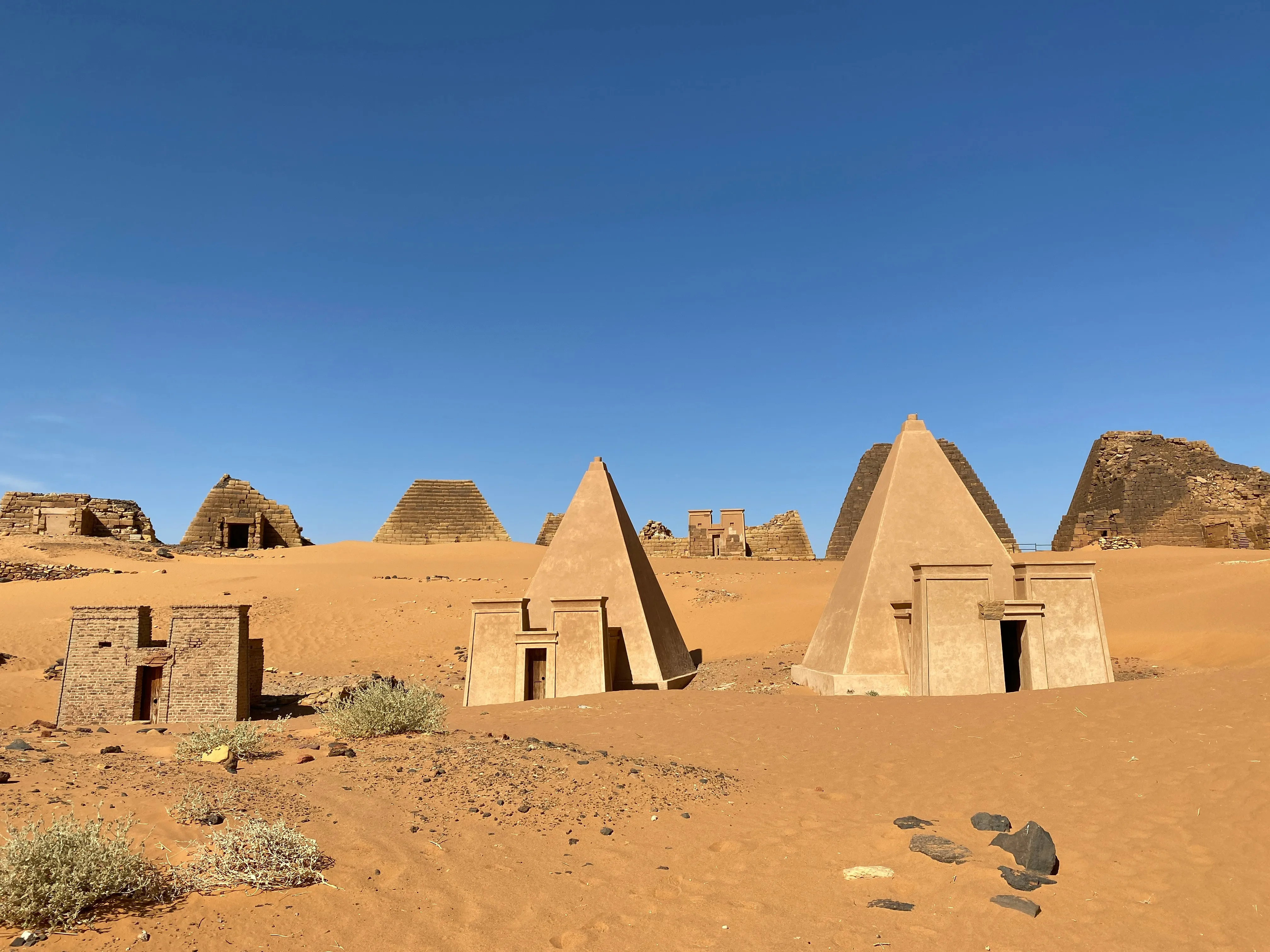
The north of the country is the region that concentrates the greatest archaeological legacy of the ancient Kushite civilization. The Pyramids of Meroë constitute the most iconic landscape of the area, with dozens of funerary structures emerging among the reddish sand dunes. Unlike other similar constructions in the region, these pyramids are characterized by their narrow angles and their relative isolation, allowing for a peaceful and reflective visit experience regarding the history of the ancient Kingdom of Kush.
Following the course of the Nile northwards, you reach the town of Karima, located at the foot of the sacred mountain Jebel Barkal. This sandstone promontory, declared a World Heritage Site, houses at its base remains of temples dedicated to the god Amun and royal necropolises such as El Kurru. The area offers a serene rural environment, where palm groves and villages of adobe houses painted with bright colors show the hospitality and daily life of current Nubian communities.
To the east, the landscape changes drastically upon reaching the Red Sea coast. The city of Port Sudan serves as a base for exploring some of the most preserved marine ecosystems in the world, highlighting areas like the Sanganeb reef. Nearby is the ancient island of Suakin, a historic port built with coral stone that, although currently mostly in ruins, preserves a unique architecture that narrates centuries of maritime trade between Africa and the Arabian Peninsula.
In the eastern interior, near the border, the city of Kassala surprises with the formations of the Taka Mountains, rounded granite peaks that dominate the horizon. This region is known for its fertile orchards and its ethnic diversity, offering a different atmosphere from the desert plains of the center. Visits to local markets and contact with the traditions of the nomadic peoples of the area allow for an understanding of another facet of the cultural plurality that defines this country.
“Tip”: You cannot miss visiting the Pyramids of Meroë, the most emblematic place in the country.
✈️ Best Season to Travel
Sudan has a predominantly desert climate, which causes temperatures and weather conditions to vary significantly throughout the year. For those who wish to comfortably explore the archaeological sites of the Kushite culture or navigate the Nile, the choice of date is a fundamental factor. In general terms, the months with more moderate temperatures facilitate travel and allow for a more pleasant stay in areas of historical and natural interest.
Throughout the year, thermal contrast defines the traveler’s experience. While the central months are characterized by intense heat and the arrival of the rainy season in the center and south of the country, the winter period offers clear days and cool nights. This variability influences both the visibility of desert landscapes and the possibility of conducting outdoor activities, from diving on the Red Sea coasts to routes through the Pyramids of Meroë.
| Season | Months | Typical climate | What to expect | Tourist influx |
|---|---|---|---|---|
| Spring | Mar – May | Rising temperatures and very dry environment. | Sunny days and possibility of witnessing occasional sandstorms. | ⭐⭐ Medium |
| Summer | Jun – Aug | Intense heat; rainy season in the center and south. | Greener landscapes in certain areas and increased Nile flow. | ⭐ Low |
| Autumn | Sep – Nov | Progressive decrease in heat and clear skies. | Ideal transition for landscape photography after the rains. | ⭐⭐⭐ Medium-High |
| Winter | Dec – Feb | Mild days and cool or cold nights in the desert. | Optimal time for archaeological visits and desert crossings. | ⭐⭐⭐⭐ High |
🗣️ Basic Vocabulary
Although it is possible to communicate in English in hotels and tourist areas of Sudan, knowing some basic words in Sudanese Arabic greatly facilitates daily interaction. The use of local expressions is usually very well received by the population, as it shows respect for their culture and helps break the ice in markets, transport, or everyday situations.
These phrases and words will be useful for you to move more easily, make basic purchases, or simply greet the people you meet during your stay in the country.
- Salam or As-salamu alaykum: Hello / Universal greeting.
- Shukran: Thank you.
- Aiwa: Yes.
- Laa: No.
- Min fadlak: Please.
- Bekam?: How much does it cost?
- Afwan: You’re welcome / Excuse me.
- Ma’asalama: Goodbye