


Belarus
Discover pristine forests, medieval castles, and Soviet architecture in an authentic, peaceful European destination full of a history that is fascinating.
Quick Facts
- Capital
- Minsk
- Language
- Belarusian
- Russian
- Currency
- Belarusian ruble (BYN)
- Best time to visit
- From May to September for mild weather and outdoor festivities.
- Budget per day
- $35 - $85 per day
- Climate
- Humid continental climate with mild summers and long, cold winters with heavy snowfall.
- Connectivity
- good
- Very easy to obtain at airports and local mobile phone shops.
- Electricity
- Type C / F (230V)
- Local transport
- good
- Card usage
- acceptable
- Tipping
- optional
🌎 Introduction
Belarus unfolds as a corner of Europe where the pace of life seems to have preserved a natural pause. Between the plains of the east of the continent, the landscape is profoundly transformed by the passing seasons, shifting from winters covered by a white blanket to summers where the intense green of the forests and wetlands floods everything. It is a territory of water and wood, marked by a history that appears both in its monumental architecture and in the simplicity of its rural villages.
Daily life in these lands is closely linked to traditions that still breathe strongly. Celebrations such as Kupala Night, during the summer solstice, keep popular roots alive among bonfires and crowns of wild flowers. In the kitchens, the aroma of rye bread and dishes prepared with potatoes offer a comforting constant, reflecting an honest identity that values hospitality and the link with the land.
Strolling through its cities or along its riverbanks allows for the observation of a unique balance between the legacy of past decades and a serene present. The stork, the national symbol, usually nests on the roofs of wooden houses, watching over a country that, without needing to resort to great artifice, offers an authentic and leisurely atmosphere for those seeking direct contact with a culture that has managed to preserve its essence over time.
🛡️ General safety
Belarus is characterized by being a country with a high level of citizen safety, especially regarding the physical integrity of visitors. In general terms, the feeling of safety is higher than in many Western European capitals, largely due to a constant police presence and active surveillance on the streets.
The country presents a low risk of violent crime against tourists. However, it is important for the traveler to understand that this safety comes with a strict regulatory environment. As long as the tourist remains within the margins of the law and respects local rules, their stay usually passes without notable incidents.
General safety level
- The safety level in Belarus is considered high for the conventional tourist.
- Compared to other international destinations, rates of violent robbery are notably low.
- The context for the traveler is one of tranquility and order; the streets of the main cities are usually very clean, well-lit, and monitored.
Common crime and risks
- Petty theft (such as the theft of wallets or phones) is the most common risk, although it remains less frequent than in other major capitals. These usually occur in crowded places like train stations or markets.
- Minor scams can occasionally occur in nightlife establishments or with informal taxi drivers. It is recommended to use official applications to request transportation.
- A rare risk but one worth mentioning is fraud related to currency exchange on the street. It is essential to always carry out these operations in official banks or exchange houses (obmen valyut).
Safety in cities and tourist areas
- The urban centers of cities such as Minsk, Brest, or Grodno are very safe to walk in, even during the night.
- Public transport (metro, buses, and trams) is safe and well-monitored, with no prohibited areas or “dangerous neighborhoods” that the tourist should systematically avoid.
- It is advisable to maintain a discreet attitude and not participate in crowds or demonstrations of a political nature, as government control over these activities is extremely rigorous.
Transport safety
- Public transport is extremely punctual, affordable, and safe. In the Minsk metro, there are security checks at the entrances (luggage scanners).
- For the use of taxis, it is ideal to use mobile applications (such as Yandex Go), which allow you to know the price in advance and record the journey. Avoid accepting rides from unofficial drivers at airports or stations.
- Regarding driving, traffic moves on the right. Main roads are in good condition, but secondary ones may be deficient.
- There is a zero-tolerance policy for alcohol while driving (0.0%). Fines are severe and can lead to arrest.
Natural and climatic risks
- Belarus does not suffer from risks of natural disasters such as earthquakes, hurricanes, or volcanic eruptions.
- The main risk is climatic: winters can be extremely cold, with temperatures frequently dropping below -15 °C. This entails risks of frostbite or slips on ice if you do not have the proper equipment.
- In summer, although the weather is moderate, intense thunderstorms can occur.
- There is a restricted zone in the south of the country (near the border with Ukraine) due to radiation derived from the Chernobyl accident. This zone is clearly marked and access is prohibited or strictly regulated.
Local legislation and norms
- Belarusian legislation is very strict. It is mandatory to always carry your original passport (or a certified copy, although the original is recommended) and proof of mandatory medical insurance.
- It is strictly forbidden to photograph government buildings, train stations, military facilities, or police officers. Failure to comply can result in the traveler’s detention and the deletion of images.
- Laws related to the consumption and possession of drugs are extremely severe, including long prison sentences even for minimal amounts of any substance.
- Consumption of alcohol in public places is prohibited outside authorized terraces.
Safety for specific groups
- Women travelers: Belarus is a very safe destination for women traveling alone. Street harassment is almost non-existent, although standard precautions at night are always recommended.
- LGTBIQ+ travelers: Although homosexuality is not illegal, society is conservative. It is recommended to avoid public displays of affection to prevent situations of hostility or unwanted attention.
- Traveling with children and the elderly: The country is very suitable for family travel. Parks are well-maintained and cities are accessible, although the language barrier (predominance of Russian and Belarusian) can be a challenge for the elderly if they are unaccompanied.
Emergencies and assistance
- 102: Police.
- 103: Ambulance / Medical emergencies.
- 101 / 112: Firefighters and general emergencies.
- Emergency services are efficient, although staff do not always speak English. In case of a serious incident, it is essential to contact your country’s consular representation as soon as possible.
- It is recommended to always have the hotel address written in Cyrillic script to facilitate assistance in case of getting lost.
Tip: Always maintain a neutral behavior and avoid taking photographs of any structure that looks official or related to security; in Belarus, discretion is your best ally for enjoying a trip without setbacks.
📝 Entry requirements
To plan a trip to Belarus, the first fundamental step consists of ensuring that your passport has sufficient validity, which usually must extend at least three months after the planned date of departure. It is recommended that the document be in good condition and have free pages for border control stamps. Depending on the route of entry into the territory, many international visitors can benefit from visa waiver programs for short stays, provided that entry is made through specific points such as the main international airport.
The maximum permitted stay under tourism modalities is usually set at a period of thirty days. During the border control process, agents may request documentation proving the reason for the trip, which includes the presentation of a confirmed return ticket and proof of financial resources sufficient to cover the stay. This proof of funds is normally calculated based on a daily amount per person.
Regarding customs regulations, there are controls on the import of certain goods. It is essential to pay attention to medications, as those containing psychotropic or narcotic substances must be accompanied by a detailed medical prescription. Likewise, the entry of food of animal origin is usually restricted or limited to small quantities for personal consumption. At airports, procedures are usually fluid, although it is recommended to declare any amount of cash that exceeds standard international limits to avoid administrative difficulties when leaving the country.
From a health point of view, specific vaccines are not usually required for travelers, beyond general public health recommendations. However, it is a common requirement to possess travel medical insurance with specific coverage in Belarusian territory. This document may be requested at the time of arrival and must cover medical expenses and repatriation during the entire duration of the stay.
The following are key aspects for access to the territory:
- Identity document: Passport with validity exceeding ninety days after departure.
- Entry authorization: Possibility of visa waiver for brief tourist stays depending on the entry point.
- Length of stay: Generally limited to a maximum of one month.
- Additional documentation: Return ticket and proof of accommodation.
- Economic solvency: Proof of available funds for the period of the stay.
- Health insurance: Medical insurance policy valid in the country for the total duration of the trip.
- Customs declaration: Registration of currency and items of value if established thresholds are exceeded.
- Medication: Mandatory to carry prescriptions for specific treatments.
🏥 Basic health considerations
When you prepare your trip to Belarus, you will discover that the health system combines an extensive network of public centers with modern private clinics, especially in the capital, Minsk. You will see that public facilities may have a somewhat old appearance, but the level of professionals is generally good. If you need assistance, we recommend going to private clinics, where the equipment is more current and you are more likely to find staff who speak some English, as it is usual in public centers that only Russian or Belarusian is spoken. Costs for tourists are not excessively high, but any medical care will have a price that you must pay if you do not have the proper documentation.
You must keep in mind that taking out travel medical insurance is not just a recommendation, but a mandatory requirement to enter the country. Authorities will ask for proof when processing the visa or crossing the border. Ensure that your policy has a minimum coverage of 10,000 euros and specifically includes medical assistance in Belarus, hospitalization, and medical repatriation. If your regular insurance is not valid there, you will have to buy one from Belarusian state companies at the border points themselves or at the airport upon landing.
Regarding vaccines, you will not find any legal obligation to get vaccinated to enter the territory. The most sensible thing is to keep your official vaccination schedule up to date, with special attention to tetanus and hepatitis. If you plan to get lost in the country’s dense forests or visit national parks during the spring and summer seasons, you should consider the vaccine against tick-borne encephalitis, a risk present in rural areas with heavy vegetation. For a purely urban trip, you will not need additional measures.
If you travel with your own medication, you will have to be careful with customs regulations. It is essential to carry your medicines in their original packaging and accompanied by the medical prescription or a report from your doctor, preferably translated. Belarus is very strict with the entry of psychotropic substances or strong painkillers containing codeine or similar components. For a basic travel first-aid kit, it will be enough to include common painkillers, some gastric protector, and disinfectant for small wounds you might suffer during your walks.
The most common health risks are mainly related to the climate. During the winter months, you will notice that the cold can be extreme, so you will have to be well-equipped to avoid problems of frostbite or hypothermia. In the warmer months, the risk shifts to insects in the countryside. On the other hand, although the region’s nuclear past is sometimes mentioned, you will see that for a conventional tourist the risk is non-existent, as long as you do not enter the exclusion zone near the southern border without authorization, which is clearly marked and restricted.
Regarding the consumption of water and food, you will notice that in large cities tap water is usually potable, although its high mineral content may give it a somewhat strange taste. Therefore, the most convenient thing is to choose to drink bottled water, which you will find easily in any shop. Hygiene in food establishments is, in general, very good. You will be able to try typical dishes like “draniki” in stalls and restaurants with total confidence, although it is always a good idea to wash fruits and vegetables you buy on your own in local markets well.
If you find yourself in a medical emergency situation, the phone number you will have to dial is 103. This ambulance service works quickly in the cities. When calling, try to stay calm and, if you do not speak the language, look for someone nearby who can help you with the translation to indicate your exact location. Remember that initial emergency care is usually covered, but the hospital will ask for your insurance details for any subsequent treatment or admission.
As final practical recommendations, we advise you to always carry a physical or digital copy of your medical insurance and your passport. You will see that having a translation app on your phone will get you out of more than one tight spot if you have to explain basic symptoms in a pharmacy or health center. If you follow these simple guidelines and act with common sense, you will enjoy your stay in this destination with complete peace of mind and safety for your health.
🚌 Transport within the country
Getting around Belarusian territory is simple thanks to a communication network that links the main population centers. The train is the preferred means of transport for covering long distances, as it connects the capital with regional cities regularly and constantly. Within urban environments, the metro is the fastest option in the capital, while buses, trams, and trolleybuses cover the rest of the routes in the various towns of the country.
For the visitor, using public transport requires some attention to signage, which is mostly in the Cyrillic alphabet. However, in major stations, it is increasingly common to find translated indications, which helps with basic navigation. Buying tickets is managed simply at station ticket offices or through automatic terminals, although it is advisable to be clear about the names of the destinations, as the fluency in other languages by the ticket office staff may be limited.
The mobility experience changes significantly when leaving large cities to enter rural areas. In urban centers, the frequency of service is high and coverage is broad, but in less populated areas, intercity bus schedules are more spaced out, requiring more leisurely time management. In general terms, the transport system stands out for its punctuality and the reliability of its railway services, which usually strictly adhere to their scheduled times.
The use of taxis and private transport services is a very widespread and functional alternative for moving quickly. These services are common for journeys where public transport does not reach directly or for trips during the night. Their management is usually carried out through digital tools that allow setting the route in advance, which facilitates interaction and ensures that the trip is carried out smoothly without needing to master the local language.
Tip: Having the name of the final destination written in the Cyrillic alphabet is very useful for confirming routes with drivers or station staff in areas with less international signage.
🤵 Culture and etiquette
Belarusian society is usually characterized by a reserved courtesy and a leisurely behavior in the public sphere. When interacting with citizens, a firm handshake accompanied by direct eye contact is common, especially in formal contexts or between men. In the streets and on public transport, an atmosphere of tranquility and order prevails, so it is recommended to maintain a moderate volume of voice to integrate naturally into the environment.
Respect for shared space is fundamental, reflected in an attitude of civic-mindedness and care for urban furniture and monuments. Regarding punctuality, it is considered an important show of consideration for others, so arriving at the agreed time is the general rule in both social commitments and professional appointments. In interpersonal treatment, there is a tendency toward discretion, avoiding excessive physical contact or effusive displays of affection with people with whom there is no prior bond of trust.
If an invitation is received to visit a private home, it is a very widespread custom to take off your shoes immediately upon entering; hosts usually provide slippers for the guest’s comfort. It is common to bring a small gift as a gesture of gratitude, with sweets, chocolate, or flowers being highly appreciated options. In the context of dining, tips are well-received and usually range around ten percent of the total bill if the service was satisfactory.
Visiting religious buildings, mostly Orthodox churches, requires special attention to dress and decorum. Visitors are expected to maintain a respectful silence and follow local norms: traditionally, women cover their hair with a scarf and men uncover their heads upon entering. Likewise, it is important to show a solemn attitude toward commemorative monuments, which carry great weight in the collective memory and identity of the country.
“Tip”: When giving flowers, make sure the bouquet is composed of an odd number, as even numbers are traditionally reserved exclusively for funerals and acts of mourning.
🍛 Typical gastronomy
The gastronomy of Belarus is characterized by being comforting, simple, and deeply linked to the land. Throughout history, it has managed to take advantage of the resources of its forests and fields, giving rise to a cuisine where mild but satiating flavors predominate. The undisputed star ingredient is the potato, which is prepared in dozens of different ways and constitutes the base of the national diet. Alongside it, the use of wild mushrooms, pork or beef, and a great variety of cereals defines the character of its main dishes.
An element that is rarely missing from the Belarusian table is smetana or sour cream, which is generously added to soups, stews, and doughs to provide a creamy texture and an acidic touch. Rye bread, dark in color, with an intense aroma and dense crumb, is also a fundamental pillar in every meal, traditionally being a symbol of hospitality toward the visitor. Soups, both hot in winter and cold during the summer months, are essential to begin the menu, standing out for the use of root vegetables such as beetroot.
Regarding social habits, citizens usually eat three main meals a day. Lunch is traditionally the most important moment of the day, often consisting of a first liquid course, a second course of meat or fish with a side dish, and a drink. In restaurants, service is usually slow and formal. Regarding drinks, it is very common to accompany meals with kvass, a fermented drink with a low alcohol content made from bread, or with infusions of berries and herbs collected in rural areas.
| Dish | Description | Main ingredients | Where to try it | Tip |
|---|---|---|---|---|
| Draniki | Grated potato pancakes fried until crispy. | Potato, onion, egg, and flour. | Traditional cuisine restaurants in any city. | Always accompany them with a generous dollop of smetana. |
| Machanka | A thick meat stew usually served with crepes. | Pork, sausages, flour, and cream. | Rural taverns and restaurants specializing in regional food. | Use the blini (pancakes) to dip directly into the stew sauce. |
| Khaladnik | Vibrantly colored cold soup, very refreshing for the summer season. | Beetroot, kefir, cucumber, boiled egg, and dill. | Cafeterias and bistros throughout the country during the summer. | It is the ideal dish for hot days due to its temperature and lightness. |
| Kletski | Boiled dough balls that can be filled or plain. | Flour or potato, often filled with minced meat. | Eateries and family-style restaurants. | Order them with a touch of fried onion on top to enhance their flavor. |
| Babka | Grated potato cake baked slowly in a casserole dish. | Potato, bacon, onion, and eggs. | Agrotourism and home-cooking restaurants. | It is usually served very hot in the same clay pot in which it is cooked. |
📷 Areas and places to visit
Belarus is a destination that surprises with the balance between its Soviet past, its medieval roots, and a nature of infinite plains. The capital, Minsk, serves as an ideal starting point to understand the country’s identity. Walking along Independence Avenue, one appreciates the monumental architecture of socialist realism, with its wide squares and symmetrical buildings. However, the contrast emerges when visiting the Trinity Suburb, a reconstruction of the old town on the banks of the Svislach River that allows one to imagine what the city was like before the transformations of the 20th century. In this area, the Island of Tears is also found, a space dedicated to historical memory surrounded by a serene environment.
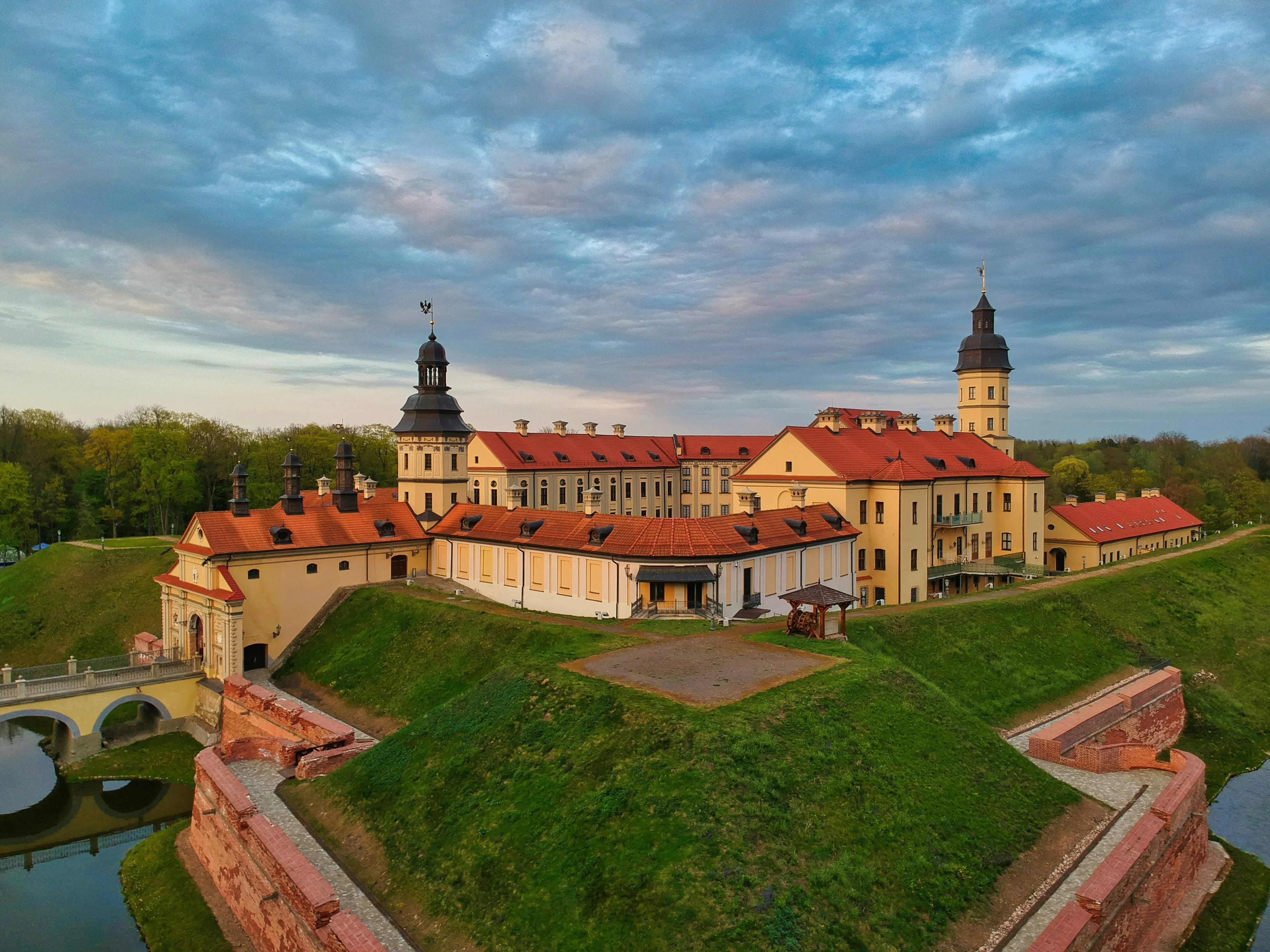
A short distance from the capital are two of the country’s most relevant historical treasures, both recognized by UNESCO. Mir Castle stands out for its impressive blend of Gothic, Renaissance, and Baroque styles, with its characteristic red brick towers reflected in the adjacent pond. On the other hand, Nesvizh Palace, the former residence of the Radziwill family, offers a glimpse into noble luxury through its halls, galleries, and extensive landscaped gardens. Both complexes allow for tours of their interiors to learn about the evolution of the nobility in Eastern Europe.
To the west, the city of Brest offers an experience marked by military history and proximity to the European border. The Brest Fortress is a place of great symbolic weight, where visitors can observe colossal monuments and remains of the old fortifications. In addition to historical interest, the city has lively pedestrian streets and unique museums such as the Berestye Archaeological Museum, which protects a 13th-century wooden archaeological site. Nearby, Belovezhskaya Pushcha National Park protects one of the last primary forests in Europe, where it is possible to observe the European bison in its natural habitat while walking or cycling.
In the northern region, the landscape transforms into a labyrinth of water and vegetation in the Braslav Lakes. This area is ideal for those seeking tranquility, offering activities related to sailing and bird watching in an environment of gentle hills and crystal-clear lakes. Meanwhile, the city of Vitebsk is known internationally for being the birthplace of the painter Marc Chagall. There, you can visit his childhood home and an art center dedicated to his work, as well as enjoy the cultural atmosphere surrounding its music and traditional art festivals.
The city of Grodno retains a more Central European air, having kept much of its original historical layout. Its two castles, the Old Castle and the New Castle, located on a hill overlooking the Neman River, are must-visit spots, along with the Kalozha Church, one of the oldest Orthodox structures in the region that still preserves its walls decorated with colored stones. This diversity between the capital’s wide avenues, medieval castles, and the leisurely life of the rural regions allows the traveler to obtain a complete and balanced view of the Belarusian reality.
For those interested in ethnography and rural life, there are open-air museums such as Dudutki or Strochitsy. In these spaces, old trades, traditional wooden architecture, and popular customs are recreated, allowing participation in craft workshops or tasting local products. It is a direct way to connect with the folklore and roots of the country, away from the hustle and bustle of modern urban centers.
Tip: You cannot miss visiting Mir Castle, the most emblematic place in the country.
✈️ Best time to travel
Belarus has a moderate continental climate that clearly defines the four seasons of the year, offering very different experiences depending on the time of visit. Generally, the months covering the end of spring and summer are usually the most recommended for those seeking pleasant temperatures and long days, ideal for exploring both national parks and the historical centers of its cities.
During the rest of the year, the landscape transforms drastically. Autumn stands out for its golden tones in the country’s dense forests, while winter offers a scene of snowy landscapes and cultural traditions linked to the cold. The choice of date will depend on whether one prefers to enjoy nature in its full glory or the quiet, icy atmosphere of the winter months.
| Season | Months | Typical climate | What to expect | Tourist influx |
|---|---|---|---|---|
| Spring | Mar – May | Transition from cold to mild (5°C to 15°C). Initial thaw and moderate rains. | Awakening of nature, flowering in parks, and increase in daylight hours. | Medium ⭐⭐ |
| Summer | Jun – Aug | Warm and mild (18°C to 25°C). Long days with occasional rains and storms. | Outdoor festivals, activities on lakes, and hiking in natural reserves. | High ⭐⭐⭐ |
| Autumn | Sep – Nov | Cool and progressively cold (12°C to 2°C). Increased cloudiness and humidity. | Landscapes of ochre colors, mushroom season, and cultural atmosphere in the cities. | Medium - Low ⭐⭐ |
| Winter | Dec – Feb | Intense and dry cold (-4°C to -10°C). Usual presence of snow and frost. | Snowy landscapes, winter sports, and traditional year-end celebrations. | Low ⭐ |
🗣️ Basic vocabulary
Learning a few words in the local language can make your day-to-day life much easier during a trip through Belarus. Although in the most touristy spots in Minsk it is possible to find people who speak some English, in most everyday situations, such as using public transport or shopping in markets, Russian and Belarusian are the predominant languages.
Knowing how to say hello or thank you in a simple way will not only help you manage with greater ease, but it is also a gesture of courtesy that local residents usually value positively. Below are some basic and practical terms that will be useful during your stay.
- Privet: Hello (informal form).
- Spasibo: Thank you.
- Pozhaluysta: Please (also used to say “you’re welcome”).
- Do svidaniya: Goodbye.
- Izvinite: I’m sorry or excuse me (useful for asking to pass or getting a waiter’s attention).
- Da / Net: Yes / No.
- Gde…?: Where is…? (followed by the place you wish to go).
- Schet, pozhaluysta: The bill, please.