


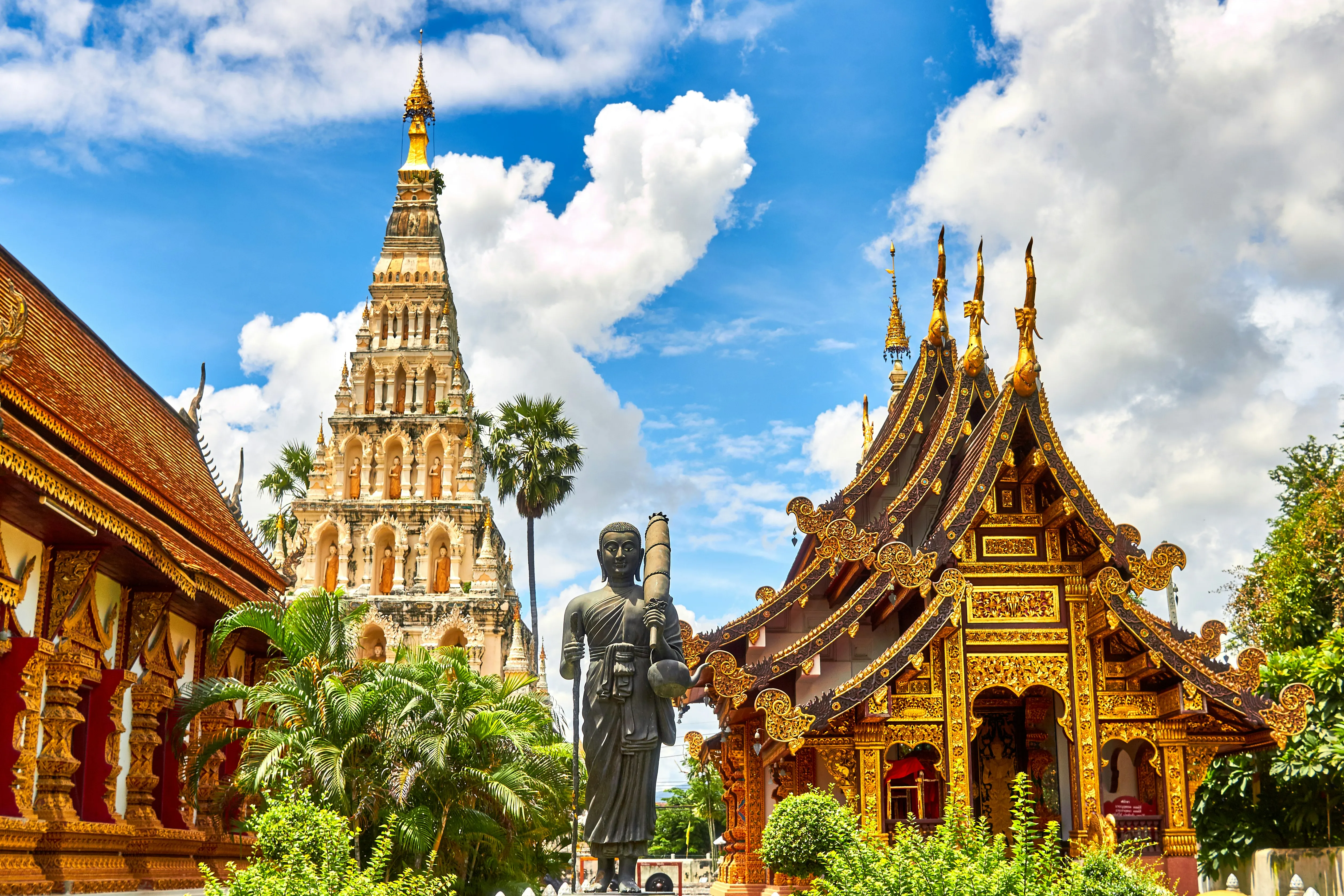
Thailand
Discover a kingdom of golden temples, paradisiacal beaches, and exquisite gastronomy that combines tradition and modernity in a unique natural and cultural setting.
Quick Facts
- Capital
- Bangkok
- Language
- Thai
- English
- Currency
- Thai Baht (THB)
- Best time to visit
- From November to February, when the weather is cooler and drier.
- Budget per day
- $25 - $150 per day
- Climate
- Tropical, with warm temperatures throughout the year and a monsoon rainy season between May and October.
- Connectivity
- good
- Very easy to obtain at airports and convenience stores.
- Electricity
- Type A / B / C (220V)
- Local transport
- good
- Card usage
- acceptable
- Tipping
- optional
🌎 Introduction
Thailand has the ability to envelop visitors through a constant blend of contrasts. The vibrant rhythm of the streets of Bangkok, where the aroma of spices mixes with the constant movement of markets, coexists naturally with the silence of the northern mountains or the serenity of its coasts. It is a place where the ancient and the contemporary meet at every corner, offering its own identity that goes far beyond the best-known images, integrating spirituality into daily life in a simple and authentic way.
Life in this corner of Southeast Asia flows to the beat of its seasons and traditions. Whether during the arrival of the rains that transform the landscape into an intense green tapestry or in the festivities where rivers are illuminated with small floating offerings, a deep respect for hospitality and balance is perceived. Its temples and local markets are not just transit points, but the heart of a slow routine where gastronomy, with its characteristic interplay of sweet, sour, and spicy flavors, acts as the true thread of the experience.
🛡️ General Safety
Thailand is generally considered a very safe destination for tourists. The country enjoys a high safety rating, ranking above the average of many international destinations thanks to a hospitable culture and an infrastructure very much oriented towards the visitor.
The context for the traveler is one of tranquility; the vast majority of visits pass without serious incidents. Although minor risks exist, as in any mass destination, mutual respect is the basis of coexistence in the country, making it easy for tourists to feel welcome and protected in almost any corner of Thai territory.
Crime and common risks
Violent crime against tourists is extremely unusual in Thailand. However, petty theft and small scams are the most common problems that can be found.
- Pickpockets usually operate in crowded places such as night markets, transport stations, and massive party areas.
- Tourist scams are common around major monuments. A typical example is a stranger informing the traveler that the temple they wish to visit is “closed for a ceremony” to offer an alternative tuk-tuk tour to shops with commissions.
- In beach areas, caution is advised with jet ski or motorcycle rentals, as sometimes there are attempts to charge for pre-existing damage to the vehicle.
Safety in cities and tourist areas
Safety in urban centers like Bangkok, Chiang Mai, or Phuket is notable, even during the night. Tourist neighborhoods are usually heavily patrolled and well-lit.
- In large cities, public transport is very safe, although at peak times it is advisable to watch personal belongings due to crowds.
- There is a difference between the bustle of nightlife zones and residential neighborhoods; in the former, excessive alcohol consumption by some visitors can generate minor tense situations.
- It is recommended to walk along main streets and avoid poorly lit or deserted areas at dawn, although Thailand does not present “no-go zones” as such on its main tourist routes.
Transport safety
Transport in Thailand is varied and efficient, although it requires specific attention regarding road safety, which is one of the points where the traveler should exercise the most caution.
- Driving is on the left.
- Taxis and app-based vehicles (like Grab) are safe. It is always recommended to demand the use of the taximeter (meter) or agree on the price previously through the official application.
- The use of rental motorcycles is very popular but risky. The use of a helmet and having the appropriate international driving license is mandatory. Motorcycle accidents are the most real safety risk for tourists.
- Long-distance trains and buses are reliable, but it is always advisable to keep valuables with you and not leave them in the luggage hold.
Natural and climatic risks
Thailand has a tropical climate that defines certain seasonal risks that the traveler should know to plan their stay.
- The monsoon is the most relevant phenomenon, bringing heavy rains that can cause local flooding and transport disruptions, especially between May and October (though it varies by coast).
- Extreme heat is a health risk factor, especially between March and May. Constant hydration and sun protection are recommended to avoid heatstroke.
- Although the risk of earthquakes is low, some coastal areas have tsunami warning systems, which are properly signaled on beaches with evacuation routes.
Legislation and local regulations
Thailand has very specific and strict laws that differ significantly from Western ones, and ignorance of them does not exempt one from sanctions, which can be severe.
- The Lèse-majesté Law protects the monarchy. Any criticism, insult, or gesture of contempt towards the King or the royal family (including images on banknotes or coins) is a serious crime punishable by imprisonment.
- Drug laws remain strict for unregulated substances, despite recent changes in cannabis regulations. Drug trafficking can carry the death penalty.
- The use of electronic cigarettes or vapes is illegal in Thailand and can result in high fines or even detention.
- Smoking on many public beaches is prohibited to protect the environment, with direct financial penalties.
Safety for specific groups
Thailand is an inclusive destination that stands out for its tolerance, although it is always good to follow some guidelines of cultural respect.
- Women travelers: Thailand is a very safe country for women traveling alone. However, it is recommended to dress respectfully in temples (shoulders and knees covered) and maintain common-sense precautions at night.
- LGTBIQ+ travelers: The country is one of the most open and tolerant in Asia towards sexual diversity. Social acceptance is very high, especially in urban and tourist areas.
- Travel with children or the elderly: Thai society loves children and deeply respects the elderly, so these groups usually receive exceptional attention and help from locals.
Emergencies and assistance
In the event of any incident, Thailand has specific services to help foreign visitors efficiently.
- Tourist Police: The number is 1155. They have English-speaking staff and specialize in assisting foreigners.
- General emergencies: The number 191 is the standard contact for the national police.
- In case of a medical emergency, private hospitals in major cities offer international quality standards, although costs are high, so traveling with medical insurance is indispensable.
Tip: Always use the Grab app to move around by car or motorcycle in cities; you will have a fixed price, the journey monitored by GPS, and the driver’s details recorded.
📝 Entry Requirements
To enter Thai territory for recreational purposes, the traveler must have a valid passport with a minimum residual validity, often set at six months from the moment of entry. It is essential that the document is in good condition and has enough free pages for the corresponding stamps that authorities will apply upon arrival and departure. In most cases of leisure visits, there is a visa exemption regime or the possibility of processing a visa on arrival, which allows a stay for tourism purposes for a specific period that usually ranges between thirty and sixty days.
Upon arrival at immigration controls at airports or land borders, staff may request the presentation of an exit ticket from the country confirming that the visitor will not prolong their stay beyond the time allowed by their permit. Likewise, it is common to be randomly required to demonstrate possession of sufficient financial means to cover planned travel expenses, either by showing cash or equivalent financial documents. Controls at international entry points are usually efficient, although visitors should be prepared to answer routine questions about their planned itinerary or the place of accommodation where they will stay.
Regarding customs regulations, there are strict limits on the amount of tobacco and alcohol that can be brought in personal luggage without declaring it to the authorities. Special monitoring is applied to the entry of certain electronic devices and accessories, such as electronic cigarettes or vaporizers, whose use or possession may be subject to local restrictions. Regarding health, specific vaccines are not generally required for entry, except in situations where the traveler comes from areas with a risk of transmission of certain tropical diseases. It is recommended to keep the international vaccination schedule up to date and to have insurance that offers broad coverage throughout the entire stay abroad.
🌏 Main Destinations and Attractions
Thailand offers a diversity of landscapes and experiences ranging from urban bustle to the serenity of its natural environments. The following points represent some of the most common options for visitors:
- Bangkok: The capital stands out for its blend of modernity and tradition, where historical temples of great architectural relevance can be visited and a wide range of leisure and street markets can be enjoyed.
- Chiang Mai: Located in the mountainous northern region, this city is valued for its quiet atmosphere, its handicraft centers, and its proximity to natural parks and wildlife reserves.
- Southern islands and beaches: Coastal areas, both in the Andaman Sea and the Gulf of Thailand, are famous for their limestone rock formations, crystal-clear waters, and options for water sports such as diving or snorkeling.
- Ruins of Ayutthaya and Sukhothai: These historical parks allow visitors to learn about the country’s past through the remains of its ancient capitals, declared World Heritage Sites.
🍜 Gastronomy and Culture
Local culture is known for its hospitality and deep respect for traditions. Some highlights for the traveler include:
- Local gastronomy: Thai cuisine is internationally recognized for the balance of its sweet, salty, sour, and spicy flavors. Dishes such as Pad Thai, Green Curry, or soups flavored with fresh herbs are essential elements of the culinary experience.
- Behavioral norms: Respect for the monarchy and religious figures is fundamental. When visiting temples or places of worship, it is recommended to dress modestly, covering shoulders and knees, and to remove shoes before entering sacred buildings.
- Markets and commerce: Night and floating markets are traditional spaces where local products can be purchased and different types of food can be tasted in a dynamic atmosphere.
💡 Practical Travel Information
- Climate: The country has a mostly tropical climate, with warm temperatures during much of the year. Three seasons are generally distinguished, and it is advisable to check meteorological conditions according to the area planned for visit.
- Clothing: Due to high temperatures, it is preferable to use light clothing made of natural fabrics such as cotton, in addition to having adequate sun protection and comfortable walking shoes.
- Currency and payments: The legal tender is the Baht. Although the use of credit cards is widespread in large cities, it is advisable to have cash for purchases in small markets or more remote areas.
- Connectivity: It is easy to obtain local phone SIM cards to have mobile data, which facilitates navigation and communication during the tour of the country.
🏥 Basic Health Considerations
Thailand has a high-quality health system, especially in urban areas and tourist centers such as Bangkok, Phuket, or Chiang Mai. You will find that private hospitals offer international standards, with cutting-edge technology and very fast care. However, you should keep in mind that public healthcare is usually quite saturated and waiting times are long. The cost of private medical care is high by local standards, so any consultation or treatment can involve a significant expense if you are not well prepared. In these private centers, medical staff usually speak English fluently, greatly facilitating communication.
Taking out travel medical insurance is absolutely fundamental for your peace of mind. Although it is not always a mandatory requirement to cross the border, traveling without it is a risk you won’t want to take due to the high prices of private medicine. Make sure your policy includes broad coverage for hospitalization, surgical expenses, and, very importantly, medical repatriation to your home country if necessary. It is also recommended that it covers adventure activities if you plan to go diving or similar sports.
Regarding vaccines, there are no mandatory vaccination requirements for most international travelers, unless you come from an area with a risk of transmission of yellow fever, in which case they will ask for the official certificate. Generally, it is highly advisable to have the basic vaccination schedule up to date, which includes tetanus, diphtheria, and hepatitis B. For a conventional tourism trip, many specialists also recommend vaccines against hepatitis A and typhoid fever, as these are diseases that can be contracted through water or food.
If you need to bring your own medication, it is vital to transport it in its original container accompanied by a medical prescription translated into English. Thailand has very strict laws regarding narcotic and psychotropic substances, so certain pain or sleep medications may be regulated. For minor ailments, you will find well-stocked pharmacies on almost every corner of tourist areas, where you can buy basic first-aid items or stomach protectants.
The main health risks are related to the tropical climate. Intense heat and humidity can cause dehydration or heatstroke if you don’t take care, so drinking fluids constantly is key. Insects are another factor to consider, as in some areas and times of the year there is a risk of mosquito-borne diseases, such as dengue. Don’t be alarmed, simply use a good repellent and wear light clothing that covers the skin at dawn and dusk. In cities and common tourist areas, the risk of contracting serious diseases is truly low.
Regarding hygiene and food, the golden rule is never to drink tap water; you will find low-cost bottled water everywhere. As for the famous street food, you can try delicious dishes with total safety if you follow your instinct and choose stalls where you see that the food is cooked to order and has a high turnover of customers. The level of hygiene in tourist restaurants is usually good, but it is always prudent to avoid ice if you are not sure it has been made with purified water.
In case of a serious medical emergency, the telephone number you should dial for an ambulance is 1669, which corresponds to the medical emergency center. You can also contact the Tourist Police at 1155, where they usually speak several languages and can guide you on what to do or which hospital to go to. Ambulances in large cities work well, although heavy traffic in places like Bangkok can slow down their arrival.
As final recommendations for your daily life, remember to protect yourself from the sun with high-factor creams even if it is cloudy and wash your hands frequently or use disinfectant gel before eating. If you follow these basic common-sense guidelines, you will enjoy your stay in the land of smiles without major health setbacks.
🚌 Transport Within the Country
Moving around Thailand is a varied experience due to its diverse geography. To cover long distances, the plane is a common option that connects the main regions of the country quickly. By land, the train and the bus are the most used means to travel between provinces, offering different levels of comfort depending on the type of journey chosen. In coastal and island areas, the ferry and local boats are fundamental for transit between different ports and archipelagos.
The transport system is, in general terms, accessible to the traveler. At the most important communication hubs and main stations, signage is usually available in English, which significantly facilitates orientation for visitors. Buying tickets is a simple process that can be done directly at station counters or through authorized points of sale. Staff serving the public on the most frequented routes usually have basic language skills to assist tourists.
In large cities, there are modern transport systems, including elevated and underground train networks that allow for efficiently avoiding heavy traffic. Conversely, in rural areas, transport is slower and usually relies on simpler local vehicles or shared transport services. Taxis and other private transport services are very common throughout the territory, functioning as a comfortable and direct alternative for door-to-door journeys at any time of the day.
The sense of comfort is good and is usually adapted to the standards of a pleasure trip. Although punctuality on long-distance trains can be somewhat flexible, bus services and domestic flights usually meet their scheduled times regularly. Overall, the country’s transport infrastructure allows for a smooth, safe, and adapted flow through its different regions at various travel paces.
Tip: it is recommended to plan transfers somewhat in advance if traveling during high-demand periods to ensure availability on the most requested routes.
🤵 Culture and Etiquette
In Thailand, social interaction is governed by courtesy and mutual respect, elements that facilitate coexistence in all areas of daily life. The traditional greeting, known as the Wai, consists of placing the palms of the hands together at chest or face level while slightly bowing the head. It is fundamental to consider the symbolic importance of body parts: the head is considered the most sacred area and should not be touched, while the feet are perceived as the least noble part, so it is inappropriate to point them at people, objects, or religious representations.
Social harmony is a fundamental pillar, so maintaining a calm tone of voice and avoiding public displays of anger or heated arguments is highly valued. The concept of maintaining composure is essential to avoid discomforting others and to preserve mutual respect. Regarding physical contact, effusive displays of affection in public spaces are not common, with discretion being preferred. Punctuality tends to be flexible in informal social contexts, although in transport services and professional settings, it is recommended to follow established schedules.
Respect for institutions and religious figures is of utmost importance throughout the country. When visiting temples or sacred places, it is necessary to dress modestly, ensuring shoulders and knees are covered. It is a widespread custom to remove shoes before entering homes, in some small businesses, and always in places of worship. Likewise, monks occupy a prominent place in the social hierarchy; out of respect for their vows, women should avoid direct physical contact with them or their belongings.
In the gastronomic field, food is usually a shared experience where several dishes are served in the center of the table for all diners. The main utensil is usually the spoon, which is used to bring food to the mouth, while the fork acts as support to push the food. Regarding tipping, although not a contractual obligation, it is considered a well-received gesture of gratitude in restaurants in tourist areas or after receiving personalized services. In any interaction, the use of a smile is a universal communication tool that helps soften situations and show kindness.
“Tip”: It is highly recommended to always observe if there is footwear accumulated at the entrance of an establishment, shop, or home, as removing shoes is one of the simplest and most appreciated courtesy gestures to integrate into the local rhythm.
🍛 Typical Gastronomy
Thai cuisine is based on a precise balance between basic flavors: sweet, spicy, sour, salty, and, occasionally, bitter. It is not just a combination of ingredients, but an art where the aromas of fresh herbs, such as lemongrass, galangal, and kaffir lime, play a fundamental role. Rice is the central axis of almost any meal, serving as a fundamental base to accompany a wide variety of curries, stir-fries, and soups that define the country’s culinary identity.
In Thailand, the act of eating has a strong social component and dishes are usually served simultaneously so that diners can share them in the center of the table. Unlike other neighboring Asian destinations, the use of chopsticks is reserved mainly for noodle soups of Chinese influence; for the rest of the dishes, it is common to use a spoon and a fork, using the latter only to push food onto the spoon. Additionally, the street food culture is essential, allowing for gastronomic options at almost any time of day in markets or on sidewalks.
Regarding drinks, it is common to accompany dishes with Thai iced tea, natural fruit juices, or bottled water. Meals are not usually structured in a rigid order of courses, and it is common for dessert, often based on tropical fruits or coconut milk, to arrive at the table fluidly. It is important to note that the spice level is usually high by international standards, so it is common for the intensity to be adjusted according to the visitor’s preference.
| Dish | Description | Main ingredients | Where to try it | Tip |
|---|---|---|---|---|
| Pad Thai | Rice noodles sautéed in a wok with a sweet and sour touch. | Rice noodles, bean sprouts, egg, tofu, and peanuts. | Street stalls and restaurants across the country. | Add a few drops of fresh lime before eating to enhance the flavors. |
| Tom Yum Goong | Aromatic, spicy, and sour soup, usually served with shrimp. | Shrimp, lemongrass, galangal, lime, and fresh chilies. | Family restaurants in coastal areas or Bangkok. | It is usually served with whole aromatic herbs; remember these are not eaten. |
| Som Tum | Refreshing and spicy green papaya salad. | Green papaya, tomato, green beans, chili, lime, and peanuts. | Local markets and street food stalls. | If you have no spice tolerance, specifically ask for it to be prepared without chilies. |
| Massaman Curry | Persian-influenced curry, with a rich texture and a mild, spiced flavor. | Meat (chicken or beef), potatoes, coconut milk, and cinnamon. | Restaurants in southern Thailand and Bangkok. | It is ideal for those looking for a complex flavor but with a very low spice level. |
| Mango Sticky Rice | Traditional dessert combining fresh fruit with sweet rice. | Ripe mango, rice glutinous, and coconut milk cream. | Night markets and dessert stalls. | Try it during mango season to enjoy the best quality fruit. |
📷 Areas and Places to Visit
Thailand offers a journey that balances the energy of large cities with the serenity of rural and coastal environments. At the heart of the country is Bangkok, a metropolis where cutting-edge skyscrapers coexist with traditional neighborhoods that keep their essence intact. Here, the Grand Palace complex and the Temple of the Emerald Buddha, known as Wat Phra Kaew, represent the historical legacy of the Thai monarchy. Traveling the Chao Phraya River by boat or getting lost in the busy streets of Chinatown allows for observing the daily life of the capital, while cultural centers like the Jim Thompson House or the National Museum offer a deep perspective on Southeast Asian art and history.
To the north, the landscape transforms into a succession of jungle-covered mountains and fertile valleys that invite exploration. Chiang Mai stands out as the cultural heart of this region, home to hundreds of ancient temples like Wat Phra That Doi Suthep, located atop a hill overlooking the city. This area is conducive to learning about local community traditions and enjoying night markets, where handicrafts and regional gastronomy are the main attractions. Nearby, in Chiang Rai province, temples with contemporary architecture can be found that reinterpret religious symbolism with unique artistic styles.
The country’s ancient history is exceptionally preserved in the archaeological parks of Ayutthaya and Sukhothai. These cities, which were capitals of ancient kingdoms, house ruins of brick temples, imposing stupas, and large Buddha statues that narrate centuries of cultural and political evolution. Walking through these spaces, declared World Heritage Sites, allows for understanding classical Thai architecture in a quiet environment surrounded by nature, offering a notable contrast to the dynamism and traffic of more urbanized areas.
In the southern zone, interest shifts to the coasts and their diverse marine ecosystems. The Andaman Sea and the Gulf of Thailand host internationally known islands such as Phuket, Koh Samui, or the Phi Phi Islands. In these areas, the imposing limestone cliffs of Krabi province rise above turquoise waters, creating natural landscapes of great aesthetic value. In addition to days of rest on the coast, it is common to take excursions in traditional boats to discover hidden bays, sea caves, or practice diving in protected coral reefs.
For those seeking a pristine nature experience, the country’s interior offers reserves like Khao Sok National Park, considered one of the oldest tropical forests in the world. This environment features lakes surrounded by rock formations and biodiversity that includes unique flora and fauna species. Throughout the territory, activities diversify between visiting floating markets, participating in traditional light and color festivals, and hiking through mountain routes, forming an offer that balances cultural richness with the natural environment.
Tip: You cannot miss visiting the Grand Palace in Bangkok, the most emblematic place in the country.
✈️ Best Season to Travel
Choosing the right time to visit Thailand depends largely on the activities one wishes to perform and the tolerance for heat or humidity. Being a tropical country, temperatures usually stay warm throughout the year, although the monsoon regime marks notable differences between northern, central, and coastal regions.
In general terms, months with a more stable and dry climate allow for full enjoyment of beaches and mountain routes. However, transition periods are also attractive for those seeking greener landscapes, powerful waterfalls, and a travel experience with a slower pace at the main points of cultural interest.
| Season | Months | Typical weather | What to expect | Tourist influx |
|---|---|---|---|---|
| Spring | Mar – May | Intense heat and high humidity, with mostly clear skies. | Cultural celebrations like Songkran and optimal conditions for diving. | ⭐⭐⭐ (High) |
| Summer | Jun – Aug | Warm temperatures with intermittent showers, generally brief. | Very exuberant jungle landscapes and good visibility in the Gulf of Thailand. | ⭐⭐ (Medium) |
| Autumn | Sep – Nov | Higher frequency of rain at the beginning, cooling towards the end of the period. | Traditional lantern festivals and nature at its maximum splendor. | ⭐⭐ (Medium/Low) |
| Winter | Dec – Feb | Dry, sunny weather and very pleasant moderate temperatures. | Ideal time for hiking in the north and outdoor activities throughout the country. | ⭐⭐⭐⭐ (Very high) |
🗣️ Basic Vocabulary
Learning a few words in Thai not only facilitates daily life during the trip but is also a gesture of courtesy that local inhabitants usually appreciate. Although it is common for some English to be spoken in the main tourist areas, knowing basic greetings and some simple formulas will help you move with more confidence in markets, food stalls, or public transport.
In the Thai language, politeness is a fundamental pillar. A practical detail you should consider is that men usually end their sentences with the particle khrap and women with kha. Adding this ending to your words will allow you to show respect and communicate more naturally with the people you meet during your stay.
- Sawasdee: Hello or goodbye.
- Khop khun: Thank you.
- Khor thot: Sorry or excuse me.
- Chai / Mai chai: Yes / No.
- Tao rai?: How much does it cost?
- Mai phet: Not spicy.
- Check bin: The bill, please.
- Aroy: Delicious or tasty.