


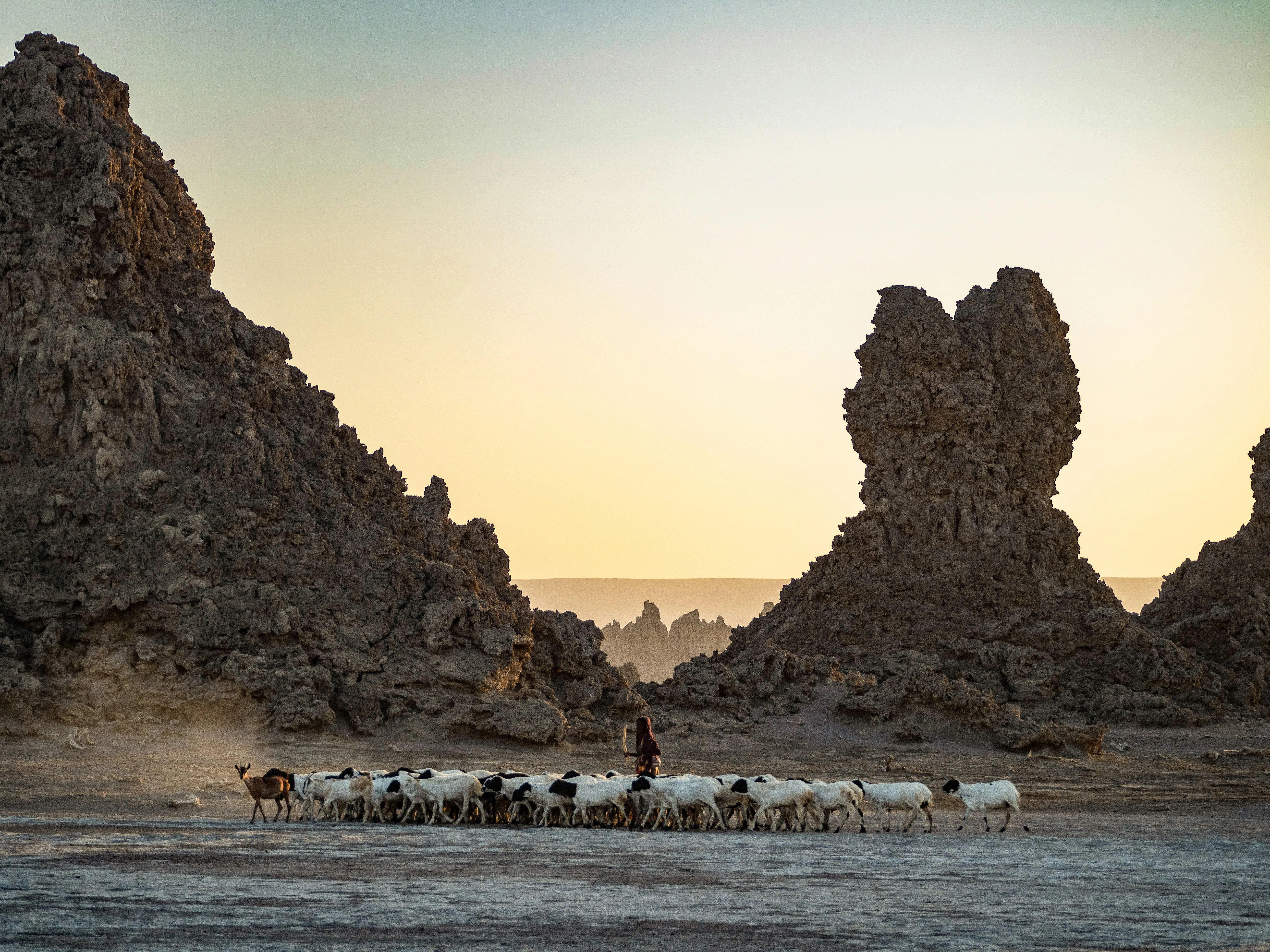
Djibouti
Discover a unique enclave in the Horn of Africa, where volcanic landscapes, saline lakes, and crystal-clear waters offer an unforgettable adventure in a wild environment.
Quick Facts
- Capital
- Djibouti
- Language
- French
- Arabic, Afar, Somali
- Currency
- Djiboutian franc (DJF)
- Best time to visit
- From November to March, when the heat is less intense and the weather is more pleasant for traveling.
- Budget per day
- $70 - $220 per day
- Climate
- Tropical desert climate, characterized by very high temperatures throughout the year and an almost total lack of precipitation.
- Connectivity
- medium
- It is possible to purchase local prepaid SIM cards mainly in the capital and at the international airport.
- Electricity
- Type C / E (220V)
- Local transport
- limited
- Card usage
- more cash is used
- Tipping
- optional
🌎 Introduction
At the point where the Red Sea meets the Indian Ocean, there is a corner where geography seems to tell stories from other times. Away from the most traveled routes, the landscape constantly transforms between volcanic plains and salt lakes that shine intensely under the African sun. It is a territory where the rhythm is set by the tides and the wind that sweeps across the plateaus, offering a serenity that invites calm observation of the force of a nature that remains almost intact.
The identity of this place is woven in its markets and in the slow conversations around a spiced tea. Here, the traditions of the Afar and Somali peoples coexist naturally with the bustle of the ports and the aroma of fresh grilled fish. During the cooler months, daily life unfolds with a welcoming simplicity, showing a mosaic of cultures that have made the desert and the coast their home, creating a unique balance between the aridity of the terrain and the hospitality of its people.
🛡️ General safety
Djibouti is generally considered one of the most stable and safe countries in its region. Its strategic international importance has fostered an environment of relative calm and a constant presence of security forces. Although it is a destination that requires logical precautions, it does not present the levels of insecurity of some of its immediate neighbors.
General safety level
- The safety level for tourists in Djibouti can be rated as medium-high, provided that basic travel recommendations are followed.
- Unlike other countries in the area, the country enjoys notable political stability, which allows travelers to move through main routes and tourist areas with peace of mind.
- It is important for the traveler to understand that, although the country is safe, it is located in a geopolitically sensitive region, which translates into a strong military presence (both local and international), something that should be interpreted as a factor of deterrence and control rather than a sign of imminent danger.
Crime and common risks
- Violent crime against tourists is very rare. The main risk focuses on petty crime, such as opportunistic theft or bag snatching.
- Pickpockets usually operate in crowded places, especially in traditional markets (souks) and in areas near the port.
- Scams are not common, although sometimes prices for foreigners for informal services may be inflated. It is recommended to always agree on prices in advance.
- It is advised to avoid walking through poorly lit or peripheral areas of the capital during the night, always maintaining a low profile and not flaunting valuables such as jewelry or professional cameras.
Safety in cities and tourist areas
- In Djibouti City, the capital, most central neighborhoods are safe during the day. Areas like the “Plateau” or the residential embassy zones are especially quiet.
- In natural tourist areas, such as Lake Assal or Lake Abbe, the risk of crime is practically non-existent due to their isolation, although it is recommended to always go with authorized local guides.
- Urban public transport (minibuses) is safe in terms of physical integrity, but it can be chaotic and is prone to small thefts if the vehicle is very full.
- It is recommended to keep belongings always in sight and use hotel safes to store original documents and large sums of cash.
Safety in transport
- In Djibouti, you drive on the right, just as in most of continental Europe and America.
- The use of taxis is the most recommended option for tourists. They do not have meters, so it is essential to negotiate the price before starting the journey. It is preferable to request taxis from trusted hotels or restaurants.
- If opting for car rental, a 4x4 is strongly recommended, as roads outside the main axes can be in poor condition or be dirt tracks.
- Night driving outside the capital should be avoided due to the lack of lighting, the possible presence of animals on the road, and the unpredictable state of some road sections.
- Police checkpoints on the roads are common; always keep your documentation handy and act with courtesy.
Natural and climatic risks
- The most relevant natural risk in Djibouti is extreme heat. During the summer months (June to August), temperatures can easily exceed 45°C, which poses a real risk of heatstroke and dehydration.
- The country is located in a zone of seismic activity (the East African Rift), so minor tremors may occur occasionally, although they rarely affect tourist infrastructure.
- During occasional rainy seasons, flash floods can occur in dry riverbeds (wadis). If it rains, avoid camping or parking vehicles in these areas.
Legislation and local norms
- Djibouti is a predominantly Muslim country with conservative customs. It is essential to dress modestly, especially in public areas and urban centers, covering shoulders and knees.
- It is strictly forbidden to photograph government buildings, military installations, ports, airports, or critical infrastructure (bridges, communication towers). Failure to comply can lead to equipment confiscation or arrests.
- Alcohol consumption is allowed in licensed hotels and restaurants, but public drunkenness is socially unacceptable and can lead to legal problems.
- Possession and consumption of drugs are severely punished with prison sentences.
Safety for specific groups
- Female travelers: Djibouti is relatively safe for women, but it is recommended to avoid walking alone at night in sparsely populated areas. Respecting local dress codes significantly minimizes unwanted attention.
- LGTBIQ+ travelers: Homosexuality is not explicitly illegal according to the penal code, but it is a deep social taboo and there is no legal recognition or protection. Maximum discretion is recommended, and public displays of affection should be avoided to prevent incidents or social rejection.
- Children and the elderly: The main risk for these groups is the climate. It is vital to ensure constant hydration and avoid sun exposure during the central hours of the day. Highly complex medical services are limited outside the capital.
Emergencies and assistance
- In case of emergency, the main numbers are 17 for the Police and 18 for the Fire Department.
- Quality medical care is concentrated in the capital. For serious problems, medical evacuation is usually necessary, so it is essential to have travel insurance with broad coverage.
- In case of loss of passport or legal incidents, you should contact the consular representation of your reference country (some countries do not have a physical embassy in the country and manage affairs from Ethiopia or France).
Tip: Always carry a photocopy of your passport and visa with you, leaving the originals in your accommodation’s safe; identity checks by authorities are frequent and routine.
📝 Entry requirements
To plan a trip to Djibouti, the fundamental document is the passport, which must generally have a minimum validity of six months from the planned date of arrival. It is recommended that the document has enough blank pages for immigration control stamps. Most visitors require a tourist visa to enter the territory, a process that can usually be managed electronically before departure or, in certain cases, at main entry points such as the international airport.
The duration of stay permitted for tourist purposes is usually a maximum of 30 days, although this period may vary according to the authorization obtained. Upon arriving at border controls, it is common for authorities to request the presentation of an exit ticket from the country or a return ticket to the place of origin, as well as proof of sufficient financial funds to cover the stay in the nation. Likewise, having a confirmed accommodation reservation facilitates entry procedures.
Regarding health aspects, it is advised to verify the need to present an international vaccination certificate, especially regarding yellow fever, particularly if you have recently traveled through countries where this disease is endemic. Other common recommendations include preventive measures against insect-borne diseases and the consumption of bottled water, given the climatic conditions of the region.
As for customs regulations, the country maintains standard restrictions on the import of products. Personal effects are allowed in reasonable quantities, but there are strict limitations on the transport of specific medications, which should be accompanied by their corresponding medical prescription. Similarly, the entry of fresh food products or products of animal origin may be subject to inspections and prohibitions for biosecurity reasons. It is important to keep in mind that, due to local customs, the transport of material that may be considered offensive to the country’s culture could be detained at customs.
The key points for trip preparation are summarized below:
- Identity documentation: Valid passport with an expiration margin of more than six months.
- Stay authorization: Prior management of the tourist visa or corresponding entry permit.
- Exit logistics: Possession of a transport ticket confirming exit from the national territory.
- Preventive health: Consultation of international vaccination recommendations and possession of travel insurance with broad coverage.
- Currency: Declaration of large amounts of foreign currency if requested at checkpoints.
- Baggage and customs: Control of pharmaceutical products and avoidance of items restricted or prohibited by local regulations.
🏥 Basic health considerations
When preparing your trip to Djibouti, you will see that quality medical care is concentrated almost exclusively in the capital. You will find that the public system is limited and often lacks modern resources, so if you need assistance, you will most likely end up going to private clinics or centers linked to the international presence in the country. Costs for tourists are usually high, and it is common for payment to be required in advance. Regarding language, healthcare personnel communicate mainly in French, although in higher-level private centers you might find staff who speak English.
Taking out travel medical insurance is a measure that, although not mandatory by law for entry, is totally essential for your peace of mind. It is vital that your policy includes very broad coverage for medical repatriation and transfer by medicalized aircraft. In serious situations, the standard practice is evacuation to countries with more advanced infrastructure or to Europe, a procedure that without insurance would have a prohibitive cost. Ensure that your coverage covers hospitalization and high-amount emergency medical expenses.
Regarding vaccines, the only one that will be mandatory is yellow fever if you are coming from a country where this disease is endemic. For any traveler, the first step is to have the standard vaccination schedule of your place of origin up to date. Additionally, protection against hepatitis A and B, typhoid fever, and, in some cases depending on the duration of the trip, meningitis is usually recommended. Since the country is in a malaria risk zone, you should consult a specialist doctor before leaving to assess the need for preventive medication.
If you need to take your own medication, it is very important to transport it in its original packaging and accompanied by the corresponding medical prescription, preferably translated. In the capital, you will find pharmacies, but the supply of certain specific medications can be unstable or non-existent in rural areas. It will be very helpful to carry a basic first-aid kit that includes painkillers, dressings, wound disinfectant and, very especially, oral rehydration salts, which will help if you suffer from any digestive upset or heat-related issues.
The main health risks are closely linked to the arid and extremely hot climate of the region. Sunstroke and heatstroke are frequent, so you must manage your sun exposure well. In addition to malaria, there are other insect-borne diseases such as dengue, so the use of high-efficacy repellents and long-sleeved clothing at sunset will be your best defense. There are no altitude risks, but you should be careful with marine fauna if you go diving or snorkeling, avoiding touching unknown species.
Hygiene with water and food is the point where you should take the most precautions. You will always drink bottled water and ensure that the container is opened in your presence. Avoid ice in drinks and the consumption of natural juices that you haven’t prepared yourself. Regarding food, you can try the local gastronomy more safely if you opt for dishes that are well-cooked and served hot. Avoid raw vegetables or fruits that you cannot peel yourself, and be cautious with street stalls if they do not have a clear hygienic appearance.
For medical emergencies, the general telephone number is 18 for ambulances or fire departments and 17 for the police. However, you must keep in mind that the public ambulance service may not meet the standards of speed you expect. In case of a real emergency in the capital, the most practical thing is usually to contact your medical insurance directly so they can tell you which private clinic to go to or ask to be transferred to the Peltier Hospital or reference private centers.
As final practical recommendations, you should hydrate constantly even if you don’t feel thirsty, as the dry environment evaporates sweat very quickly. Avoid bathing in freshwater lakes or rivers to prevent parasitic diseases and always use hand sanitizer before eating if you don’t have clean water and soap at hand. With these basic cares, your experience in this fascinating destination will be much safer and more pleasant.
🚌 Transport within the country
To get around Djibouti, travelers have limited but functional options that connect the points of greatest interest. The train is one of the most modern means, although its route is mainly oriented towards international connection, leaving the weight of internal road transport to minibuses and small-sized buses. These vehicles usually cover the routes between the capital and the main regional towns, generally operating without fixed schedules and departing once the passenger capacity is full.
For those wishing to cross the gulf and head towards the northern towns, the ferry represents a practical and frequent alternative that avoids long detours by land. Regarding mobility within Djibouti City, the use of taxis is the most common option for visitors. These vehicles are easily recognizable, and although they do not always have automatic metering systems, they allow for agile movement through the urban core, with it being recommended to confirm the destination clearly before starting the journey.
The ease of use of public transport is acceptable for the tourist, as signage and communication are usually in French, which facilitates orientation. However, there is a marked difference between the capital and rural areas. While in the city the supply is constant, in the interior of the country infrastructures are simpler and the frequency of transport decreases considerably. To access certain remote natural spots, it is common to resort to the rental of four-wheel-drive vehicles due to the characteristics of the terrain.
The reliability of journeys is often linked to weather conditions and the state of the roads. It is common for travel around the country to be conducted at a slow pace, so comfort and punctuality may vary depending on the type of vehicle and the chosen route. In general, the transport system requires some flexibility on the part of the traveler, especially in shared services that depend on daily demand to start their routes.
Tip: For long-distance journeys or ferry use, it is recommended to go to the departure points well in advance to secure a space and confirm any possible variation in the frequency of the transport.
🤵 Culture and etiquette
In Djibouti, interpersonal treatment begins with a slow and cordial greeting, which is fundamental for establishing a relationship of mutual trust. It is common to use the Arabic expression As-salamu alaykum and dedicate a short time to inquiring about general well-being before dealing with any practical or commercial matter. Handshakes are the norm between people of the same sex, while in interactions between men and women, a verbal courtesy gesture or a slight nod of the head is usually chosen, avoiding physical contact unless the local person takes the initiative.
Communication in public spaces is characterized by a moderate voice volume and a discreet attitude. Patience is an essential virtue when interacting with the local population, as there is a flexible view of time and punctuality; social interactions usually take priority over strict adherence to schedules. Maintaining a calm tone of voice, even in the face of possible misunderstandings, is perceived as a show of education and personal control, greatly facilitating the resolution of any situation.
Hospitality is a pillar of society, and receiving an invitation to share a tea or a meal is a common gesture of generosity. In these contexts, it is important to remember the use of the right hand for eating, greeting, or giving and receiving objects, as the left hand is traditionally reserved for personal hygiene. Regarding tipping, although it is not a strict social obligation, it is appreciated as recognition for good service in restaurants and hotels, being an increasingly widespread practice in urban areas.
Respect for religious beliefs and places of worship is fundamental for harmonious coexistence. During the period of Ramadan or at prayer times, it is advisable to show an especially reserved and empathetic attitude towards local customs. Likewise, before capturing images of people, homes, or daily activities, the most appropriate thing is to ask for permission kindly, always respecting the privacy and social hierarchies of the community being visited.
Tip: Before entering a private home or carpeted spaces, observe if there are shoes at the entrance; removing your shoes is a highly valued gesture of respect and courtesy that facilitates closeness with your hosts.
🍛 Typical gastronomy
The cuisine of Djibouti is the result of a historical encounter between diverse cultures, merging Afar, Somali, Yemeni, and French influences. This mixture results in an aromatic but balanced culinary identity, where the use of spices seeks to enhance the flavor of fresh products from the Red Sea and the grazing areas of the interior. Fundamental ingredients include grains like millet and sorghum, legumes, lamb or goat meat, and a wide variety of local fish.
In daily life, flatbread is the essential accompaniment to any meal, often serving as a base for stews and braises. The local diet is characterized by simple and nutritious dishes that reflect the climate and resources of the environment. Spiced flavors are present but are not usually excessively hot, commonly using cumin, cardamom, cinnamon, and cloves to flavor meats and rices.
Eating customs maintain a strong social and hospitality component. It is common to find places where food is eaten communally and, in traditional settings, the right hand is used to serve oneself directly from the trays. After the meal, the ritual of spiced tea or aromatic coffee is a very widespread practice. Being a predominantly Muslim country, alcohol consumption is limited and is mainly found in establishments oriented towards the international public, with fruit juices and infusions being the most common drinks.
Meal times usually adapt to the country’s temperatures, with an early breakfast that often includes fermented breads and a main meal at midday. In coastal areas, grilled fish is the undisputed protagonist of dinners, cooked simply to highlight its freshness. Restaurant etiquette is generally relaxed, although discretion and respect for local dress standards are valued.
| Dish | Description | Main ingredients | Where to try it | Tip |
|---|---|---|---|---|
| Skoudehkaris | Considered the national dish, it is a very aromatic meat and rice stew. | Rice, lamb, tomato, cumin, cardamom, and cloves. | Traditional restaurants in the capital. | Try it with a bit of local hot sauce on the side to adjust the flavor. |
| Fah-fah | A nutritious and comforting soup that is usually served as a main dish. | Goat or beef meat, assorted vegetables, and green chilies. | Eating houses and local markets. | It is ideal for a light but complete dinner after a day of excursion. |
| Sambuusa | Local version of the fried pastry, crispy on the outside and savory on the inside. | Minced meat or lentils, onion, and a mixture of spices. | Street stalls and city markets. | Consume them freshly made to enjoy their crispy texture. |
| Mukbaza | Fish opened in half and cooked at high temperature in clay ovens. | Fresh fish (such as yellowfin tuna), spices, and sometimes a touch of honey. | Specialized restaurants on the coast and ports. | It is recommended to eat it accompanied by traditional bread to soak up the fish juices. |
| Lahooh | Flat and spongy bread, similar in texture to a fermented crepe. | Sorghum or wheat flour, water, and yeast. | Cafeterias and breakfast stalls. | It can be enjoyed both with honey and butter or with savory stews. |
📷 Areas and places to visit
The country’s capital, Djibouti City, is the natural starting point for any traveler and offers an interesting contrast between colonial heritage and the energy of a modern port city. Walking through its streets, one perceives a blend of Arabic, African, and European influences reflected in its architecture and daily life. The European Quarter stands out for its French-style buildings and wide plazas, while the African Quarter buzzes with the constant movement of the Central Market, where the aromas of spices and the bustle of the stalls offer an authentic insight into local culture. Near the coast, the marina and promenades allow for observing the strategic importance of this city in the Horn of Africa.
Towards the interior, the landscape transforms into a unique geological setting where Lake Assal presents itself as one of the most striking points in the region. Located in a depression below sea level, this saline lake is surrounded by dormant volcanoes and stretches of black lava that contrast with the intense whiteness of its salt-covered shore. It is a place where one can observe the traditional extraction of this mineral, an activity that has shaped the economy of nomadic populations for centuries. Not far away, Lake Abbe, on the border with Ethiopia, offers an almost surreal scene with its limestone chimneys that vent steam, creating an ecosystem where it is common to see flamingos at dawn.
The coast of the Gulf of Tadjoura is another fundamental area for those seeking marine wealth and peaceful landscapes. The city of Tadjoura, known as the white city due to the color of its houses and its numerous mosques, retains a historical and slow-paced air. From here, it is easy to access the Moucha and Maskali Islands, small paradises of fine sand and transparent waters surrounded by coral reefs. These areas are highly valued for diving and snorkeling, especially during the seasons when it is possible to spot the whale shark, which comes to these nutrient-rich waters.
For those who prefer hiking and contact with vegetation, the north of the country houses the Day Forest National Park. Located in the Goda Mountains massif, this enclave represents one of the few forested redoubts in the territory, offering a cooler climate and a unique biodiversity that includes endemic species such as the Djibouti francolin. Routes through this area allow for meeting small villages and enjoying panoramic views that break with the predominant aridity of the rest of the country. Additionally, the Mabla Mountains offer another environment of great ecological value where local flora adapts to the altitude.
Historical interest also has its place in towns like Obock, which was the first capital of the territory under French administration and still retains vestiges of that era. On the other hand, archaeology lovers find a treasure in Abourma, a site that houses impressive rock carvings thousands of years old, which represent the fauna and customs of the civilizations that inhabited the area long before the modern era. These contrasts between port modernity, nomadic traditions, and virgin natural spots define the experience of visiting this nation.
Tip: You cannot miss visiting Lake Assal, the most emblematic place in the country.
✈️ Best season to travel
Djibouti is characterized by an arid and semi-desert climate, which significantly marks the travel experience depending on the time chosen. Most visitors opt for the months of more moderate temperatures, which allow for exploring unique natural landscapes like Lake Assal or the steam chimneys of Lake Abbe with greater comfort. During this period, the environment is more conducive to outdoor activities and the observation of local fauna.
Conversely, the central months of the year record high temperatures that can condition travel and staying in outdoor areas. This seasonal variation influences both the influx of people and the availability of certain experiences, especially those related to the marine environment and the sighting of migratory species on the coasts of the Gulf of Tadjoura.
| Season | Months | Typical weather | What to expect | Tourist influx |
|---|---|---|---|---|
| Spring | Mar – May | Rising temperatures, between 28°C and 34°C. | Transition towards heat; good visibility for diving and last views of migratory fauna. | ⭐⭐ Medium |
| Summer | Jun – Aug | Intense heat, often exceeding 40°C, with dry winds. | Low activity period; desert landscapes under intense light and reduction of outdoor tourist services. | ⭐ Low |
| Autumn | Sep – Nov | Gradual drop in heat; more pleasant atmosphere towards November. | Start of the whale shark sighting season and better conditions for hiking. | ⭐⭐⭐ Medium |
| Winter | Dec – Feb | Mild and pleasant weather, with averages of 20°C to 25°C. | Optimal period for geological excursions, local festivals, and marine life observation in ideal conditions. | ⭐⭐⭐⭐ High |
🗣️ Basic vocabulary
Although French and Arabic are the official languages of Djibouti, Somali and Afar also coexist in daily life. Knowing some basic expressions will help you move with greater ease in everyday situations, whether in markets, transport, or when interacting with the local population, who usually positively value interest in their culture.
Having this small repertoire of words will allow you to establish closer and more respectful contact during your stay. It is not necessary to master the grammar, as for most tourist matters these courtesy formulas are usually enough to facilitate communication.
- Salaam: Universal greeting (Hello).
- Merci: Thank you (French is widely used in shops and services).
- Shukran: Thank you (Arabic term widely used throughout the country).
- S’il vous plaît: Please.
- Insha’Allah: If God wills (used constantly when talking about future plans).
- Pardon: Pardon or excuse me.
- Au revoir: Goodbye