


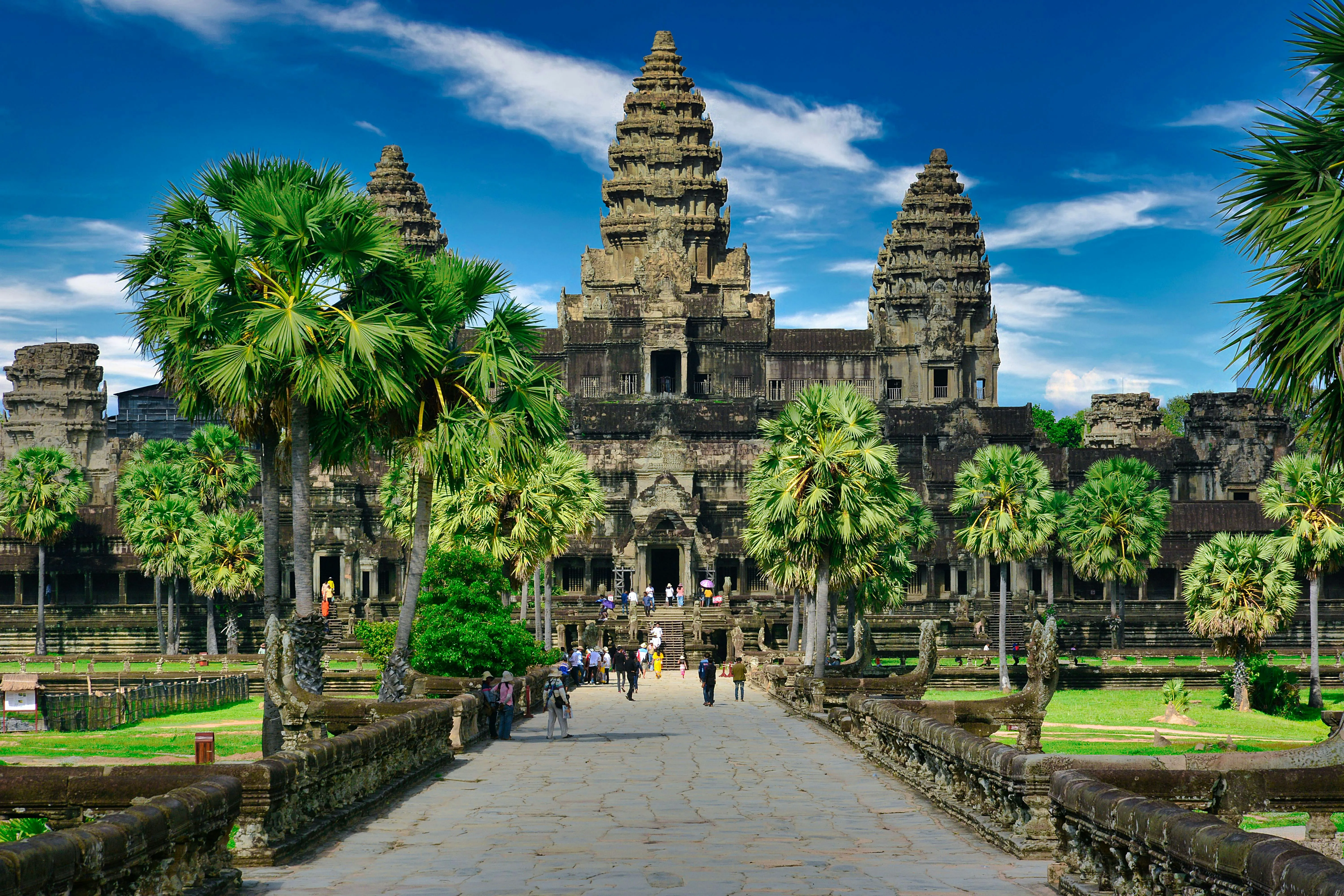
Cambodia
A kingdom of ancient temples, tropical jungles, and the Mekong River, where the history of Angkor intertwines with a resilient and welcoming culture.
Quick Facts
- Capital
- Phnom Penh
- Language
- Khmer
- French, English
- Currency
- Cambodian Riel (KHR) and United States Dollar (USD)
- Best time to visit
- From November to February, during the dry and cool season.
- Budget per day
- $25 - $80 per day
- Climate
- Tropical monsoon climate with a dry and cool season from November to April and a rainy season from May to October.
- Connectivity
- medium
- Very easy to obtain at airports and local shops.
- Electricity
- Type A / C / G (230V)
- Local transport
- acceptable
- Card usage
- cash is used more
- Tipping
- optional
🌎 Introduction
Cambodia unfolds following the leisurely course of the Mekong River and the extension of its rice fields, which change color according to the whim of the monsoons. In this corner of Southeast Asia, time seems to be governed by other rhythms, marked by tropical humidity and the constant murmur of a nature that embraces every corner. It is a place where the warm light of sunset often meets the profile of pagodas and the silhouette of fishermen who, generation after generation, continue to work on the waters of Lake Tonlé Sap.
Beyond the ancient stone peeking through the jungle, the country’s identity resides in daily gestures: the aroma of ginger and lemongrass emanating from the markets, the vibrant orange of the monks’ robes, and the slow-paced hospitality of its inhabitants. From the bustle of its cities to the quiet of rural villages, one perceives a balanced mix between a heavy historical legacy and a young society that beats with simplicity, keeping its traditions alive while observing the present with serenity.
🛡️ General safety
Cambodia is considered, in general terms, a safe and welcoming country for international travelers. Most visits pass without incident, as the Cambodian people are known for their kindness and respect toward visitors. In a global comparison, the risk level is in a medium-low range, similar to other Southeast Asian countries.
The current context of the country is one of stability, although the traveler should be aware that Cambodia remains a developing country with infrastructure that can vary significantly between urban and rural areas. The key to a peaceful trip is common sense and respect for local customs.
Crime and common risks
Violent crime against tourists is extremely rare. However, it is necessary to be alert to petty crimes motivated by carelessness.
- Bag snatching: This is the most common incident, especially in large cities like Phnom Penh. They usually occur from moving motorcycles, targeting bags, mobile phones, or cameras hanging from the tourist’s shoulder.
- Pickpocketing: In crowded markets, bus stations, or popular beaches (such as those in Sihanoukville), cases of pickpocketing can occur.
- Minor scams: Some transport drivers or unofficial guides may try to charge excessive fees. There are also scams related to “donations” in temples or supposed aid to orphanages that are not always legitimate.
- Landmines: Although tourist areas such as the temples of Angkor and main cities are completely clear and safe, in very remote rural areas away from the usual circuits, there is still a risk of unexploded mines. It is vital to never stray from marked trails in countryside or deep forest areas.
Safety in cities and tourist areas
The safety experience varies slightly depending on the location:
- Siem Reap: It is probably the safest area in the country due to its heavy focus on tourism (Angkor Wat). There is a constant police presence, and the atmosphere is very relaxed, even at night in areas like Pub Street.
- Phnom Penh: As the capital, it requires slightly higher vigilance. It is recommended to avoid walking through poorly lit streets in the early hours of the morning and to keep belongings close to the body when walking along the Riverside.
- Coastal areas: In areas like Sihanoukville, rapid development has brought an increase in nighttime activity; it is advised to move in groups and use official transport at night.
Safety in transport
Transport is one of the points where the traveler must pay more attention due to the state of the roads and driving habits.
- Driving rules: In Cambodia, driving is on the right. However, traffic rules are often not strictly respected, and traffic can be chaotic at intersections.
- Taxis and Tuk-tuks: These are safe means of transport. It is recommended to use transport applications (such as Grab or PassApp) to ensure a fair price and that the journey is recorded.
- Rental vehicles: Renting cars without a driver is not recommended due to the complexity of traffic. Renting motorcycles or scooters is common but requires prior experience and the mandatory use of a helmet; motorcycle accidents are the leading cause of injuries to tourists.
- Night transport: Traveling by road between cities at night is discouraged due to the lack of road lighting and the presence of heavy vehicles.
Natural and climatic risks
Cambodia has a tropical climate conditioned by monsoons, which creates specific risks depending on the time of year.
- Flooding: During the rainy season (from May to October), heavy rainfall can cause flash floods that affect road transport, especially in rural areas.
- Extreme heat: During the months of March to May, temperatures can exceed 40°C. Heatstroke and dehydration are real risks for tourists visiting extensive temple complexes.
- Storms: Thunderstorms are frequent and very intense during the monsoon, although they are usually short-lived.
Legislation and local rules
Compliance with local laws is fundamental to avoid serious problems with the authorities.
- Drugs: Cambodia has extremely strict laws against the possession, consumption, or trafficking of narcotic substances. Penalties include long prison sentences and severe fines.
- Respect for the monarchy and religion: It is essential to show respect toward images of the King and in Buddhist temples. In temples, it is mandatory to dress modestly (shoulders and knees covered).
- Photography: Photographs of military installations, government buildings, or uniformed personnel should not be taken without permission.
- Behavior: Excessive public displays of affection are frowned upon by the local culture, which is conservative.
Safety for specific groups
- Women travelers: Cambodia is a safe destination for women traveling alone. Nevertheless, it is recommended to dress discreetly to avoid unwanted attention and to use closed transport or travel applications during the night.
- LGTBIQ+ travelers: Homosexuality is legal and Cambodian society is generally tolerant. However, being a conservative culture, discretion in public displays of affection is recommended to avoid discomfort, especially in non-tourist areas.
- Children and the elderly: The country is very welcoming to families. The main challenge is the heat and humidity, as well as the irregular state of some sidewalks and access to temples, which can hinder mobility.
Emergencies and assistance
In case help is required, these are the key points:
- Emergency numbers: The number for the Police is 117, Firefighters is 118, and Ambulances is 119.
- Medical care: For minor incidents, there are private clinics in the main cities. In case of serious emergencies, most travel insurance providers opt for medical evacuation to neighboring countries with more advanced healthcare infrastructure.
- Reporting: If you are a victim of theft, you should go to the “Tourist Police,” which usually has offices in the areas of greatest interest and is more accustomed to dealing with foreigners.
Tip: Always use transport applications for your trips within the city; this guarantees that the driver knows the exact destination, the price is fixed beforehand, and your route is monitored by GPS.
📝 Entry requirements
To plan a trip to the heart of Southeast Asia, it is essential to know the access conditions that govern this destination. The main document is the passport, which must have a residual validity of at least six months from the moment the border is crossed. In most situations, international travelers require a tourist visa, a process that usually grants a stay period of up to thirty days. This permit is usually managed through various channels, allowing organized entry by both air and land.
During the entry process at immigration controls in airports or borders, authorities may request the presentation of proof of departure, such as a flight ticket or a transport reservation to a neighboring country that demonstrates the intention to leave the territory. Similarly, although not checked exhaustively in all cases, it is advisable to have means that demonstrate the financial solvency necessary for the total duration of the visit. These procedures are part of the standard routine and aim to ensure that the tourist has the resources for their stay and return.
Passing through customs involves compliance with certain restrictions on personal belongings and merchandise. It is possible to bring in items for personal consumption, but there are quantitative limits for products such as alcohol or tobacco that should not be exceeded. Regarding health, it is advisable to carry regular medications in their original containers and, preferably, with a copy of the medical prescription to facilitate their identification by agents. Likewise, the entry of certain fresh food products is usually restricted to preserve the biosecurity of the national territory.
Regarding health recommendations, the situation is stable and does not usually present massive vaccination requirements for general access. However, a yellow fever vaccination certificate may be required for those who have recently traveled through countries where this disease is considered endemic. For greater peace of mind during the journey, it is a widespread practice among travelers to consult recommended vaccinations of a general nature, such as those linked to protection against hepatic conditions, always adapting medical advice to the specific itinerary and areas to be visited.
- Main documentation: Passport with validity exceeding six months.
- Visa management: Standard tourist permit that usually covers one month of stay.
- Proof of transport: Possible request for a ticket confirming departure from the country.
- Sanitary control: Yellow fever certificate required depending on the traveler’s origin.
- Drug regulation: Recommendation to carry prescriptions for specific medical treatments.
- Restricted goods: Common limitations on the import of tobacco, alcohol, and fresh food.
- Demonstration of funds: Possibility of requiring proof of financial capacity for the trip.
🏥 Basic health considerations
When preparing for your trip, it is essential that you know how the health environment in Cambodia works so that you can move with total peace of mind. You will find a healthcare system that presents large differences between rural areas and major cities. In urban centers like Phnom Penh or Siem Reap, you will have access to private clinics of international standards that have modern equipment and qualified professionals. However, in more remote areas, resources are very limited and basic. Medical personnel in private centers usually speak English fluently, which will greatly facilitate communication if you need to explain what is happening to you. You should take into account that private healthcare for foreigners has a high cost, so any consultation or treatment will require a significant outlay if you do not have support.
Taking out travel medical insurance is not a mandatory requirement to enter the country, but it is something totally essential for your safety. We recommend that your policy include broad coverage of medical expenses, hospitalization and, above all, medical repatriation. It is vital that the insurance also covers medical transfer to neighboring countries like Thailand, as for complex surgical interventions or very specific treatments, it is common to prefer referral to hospitals in Bangkok. Traveling with this protection will allow you to enjoy the temples and landscapes without worrying about possible financial setbacks.
Regarding vaccines, there is no legal obligation for vaccination to enter Cambodian territory, unless you come from an area with a risk of yellow fever transmission. However, to make your stay safer, it is ideal that you are up to date with your regular vaccination schedule, including tetanus and diphtheria. Protection against Hepatitis A and typhoid fever, which are related to the intake of water or food, is also commonly recommended. If you plan to take a long-duration tour or visit very remote areas, you might consider other options, always consulting a specialized international medicine center weeks before your departure.
If you need to carry personal medication, you can do so without issues as long as you transport it in its original container. It is highly advisable that you carry with you a copy of the medical prescription or a report in English justifying the use of those drugs to avoid delays at customs controls. Although you will find pharmacies in the cities, the quality and authenticity of medicines can vary, so it will be very useful to carry a basic first-aid kit with analgesics, anti-inflammatories, some antihistamine and, very importantly, oral rehydration salts.
The most common health risks you might experience are related to the tropical climate. The intense heat and humidity can cause dehydration or exhaustion if you do not rest enough. On the other hand, the presence of mosquitoes is constant, especially at sunrise and sunset. In some areas, there is a risk of diseases transmitted by bites, such as dengue, so the use of a good insect repellent and clothing that covers the limbs will be your best defense. You should not be alarmed by serious diseases if you follow basic prevention measures and stay protected in vegetation zones.
Hygiene with water and food is the point where you should pay the most attention. Never drink tap water and make sure that the bottled water you buy is well sealed. You will find delicious and very tempting street food, but it is advisable to choose stalls where you see that the food is cooked to order and at high temperatures. Avoid consuming raw vegetables, fruits that you cannot peel yourself, or ice cubes of doubtful origin in informal places. By following these small hygiene tips, you will drastically reduce the chances of suffering the classic traveler’s stomach upset.
In case you find yourself in a health emergency, the general telephone number is 119, although the public ambulance service can be slow due to dense traffic in cities like the capital. If you find yourself in an urgent situation, the most practical thing is usually to go directly by your own means in a taxi or private transport to one of the international referral hospitals. Always have the contact number of your medical insurance at hand, as they can immediately indicate which clinic to go to for the best possible care.
Finally, remember that prevention is your best ally in this destination. Use sunscreen with a high factor, stay well hydrated with bottled water, and don’t forget to apply repellent constantly. With these basic guidelines and good travel insurance, you can concentrate solely on discovering the wonders that this country has to offer.
🚌 Transport within the country
To move around Cambodia, the most widespread and used means of transport by travelers are buses and shared vans, which connect the most relevant destinations of the national geography. There are also internal flights that quickly link the main urban centers, as well as ferries and fast boats intended for transfers to the islands or river routes. Although a railway network exists, its reach is more limited and the journeys are considerably slower.
Using public transport is relatively simple for the visitor. In the most crowded points, signage and ticket management are usually carried out fluidly, with a common presence of signs in several languages to facilitate understanding. Seat reservations are usually managed easily through the accommodations themselves or at specific information points located in the stations.
In the urban environment, the tuk-tuk is the most characteristic and practical vehicle for moving short distances, allowing agile mobility through the streets. In large cities, taxi services and mobile transport applications also operate, offering a standardized experience. Conversely, in rural areas, options are scarcer and travel depends largely on the passage of local vehicles or the hiring of private transport.
The sense of comfort and the reliability of the journeys can vary depending on the infrastructure of the area. While the main routes linking the most important cities have paved roads, in the interior of the country it is common to find dirt roads that can slow down progress. Punctuality is usually flexible, as traffic and road conditions directly influence the duration of road trips.
“Tip”: It is advisable to plan trips with sufficient time margin, as the real duration of road journeys is usually longer than what the distances on the map suggest.
🤵 Culture and etiquette
Social interaction in Cambodia is deeply influenced by mutual respect and recognition of social hierarchy and age. The traditional greeting, known as Sampeah, consists of joining the palms of the hands at chest height while performing a slight bow of the head. Although the use of the handshake has spread in urban or professional contexts, performing this gesture shows an appreciation for local customs. In daily dealings, it is highly valued to maintain a calm attitude; raising the voice or showing anger in public is perceived as a loss of composure that can make interlocutors uncomfortable.
Regarding non-verbal communication, there are certain conventions about the body that should be observed. The head is considered the most sacred part of the body, so it is not common to touch another person’s head, not even affectionately with children. Conversely, the feet are considered the least noble part; therefore, one tries not to point at people or religious objects with them and they are usually tucked away when sitting on the floor. Likewise, it is common to remove shoes when entering private homes and practically all religious buildings.
Buddhism permeates much of daily life and norms of conduct. When visiting temples or sacred places, behavior must be especially sober, maintaining a low volume of voice and dressing in a way that covers shoulders and knees. It is important to show deference toward monks, avoiding physical contact with them and allowing them to occupy preferred places in transport or waiting rooms. In the realm of courtesy, punctuality is usually valued in formal meetings, although in social life a more flexible and relaxed rhythm prevails.
In the context of meals and services, hospitality is a fundamental pillar. If invited to a home, it is common to wait for the oldest person or the host to begin eating. Regarding tips, they are not a mandatory practice nor are they traditionally integrated into the local culture, but they are well received in the tourism sector as a gesture of gratitude for satisfactory service. In markets and shops, interaction is usually friendly and slow-paced, where a smile facilitates any type of negotiation or inquiry.
“Tip”: It is advisable to always use the right hand or both hands when giving or receiving objects, money, or food, as the exclusive use of the left hand is considered informal in social interactions.
🍛 Typical gastronomy
The gastronomy of Cambodia, also known as Khmer cuisine, is characterized by a subtle balance between sweet, sour, salty and, to a lesser extent, spicy flavors. Unlike the cuisines of some of its neighboring countries, spice is not usually the absolute protagonist; instead, the use of fresh herbs and complex spice pastes called kroeung is preferred, providing depth and aroma to the dishes. Rice is the fundamental pillar of the daily diet and is served at practically every meal, whether boiled, fried, or in the form of noodles.
One of the most distinctive ingredients of this cuisine is prahok, a fermented fish paste used as a base to season a multitude of preparations and which gives a unique and potent flavor to stews. Freshwater fish, coming from rivers like the Mekong or from the great Lake Tonlé Sap, occupies a central place in the diet, along with the frequent use of coconut milk to soften the textures of curries and soups.
Regarding social customs, eating in Cambodia is understood as an act for sharing. It is common for several dishes to be served at the same time in the center of the table so that each diner serves themselves small portions to accompany their individual bowl of rice. Meal times are generally early: lunch usually takes place between 11:00 and 13:00, while dinner is customarily served around 18:00 or 19:00. In local establishments, it is most common to use a spoon and fork for rice dishes, using the fork only to push the food toward the spoon, while chopsticks are reserved mainly for noodle soups.
To accompany the dishes, it is very common for jasmine tea to be served free of charge in many local restaurants. Also notable are the freshly squeezed tropical fruit juices and coffee with condensed milk, which is very popular during the morning. The atmosphere in restaurants is usually relaxed and friendly, reflecting the characteristic hospitality of the country.
| Dish | Description | Main ingredients | Where to try it | Tip |
|---|---|---|---|---|
| Fish Amok | Steamed fish curry with a texture similar to a flan or mousse. | Fish, coconut milk, kroeung paste, and lime leaves. | Traditional restaurants in Siem Reap and Phnom Penh. | It is the national dish; it is best enjoyed if served in a banana leaf. |
| Bai Sach Chrouk | Simple and popular dish consisting of marinated pork over a bed of rice. | Pork, garlic, coconut milk, rice, and cucumber. | Street stalls in local markets during the morning. | It is mainly consumed as breakfast, so it is advisable to look for it early. |
| Lap Khmer | Khmer-style marinated beef salad, served warm or cold. | Beef slices, lemongrass, shallots, mint, and lime. | Local cuisine restaurants and night markets. | It is ideal for those who prefer citrusy and very refreshing flavors. |
| Nom Banh Chok | Thin rice noodles with a fish curry sauce and fresh vegetables. | Rice noodles, green fish curry, bean sprouts, and edible flowers. | Local markets and street vendors in the morning. | Mix everything well with the fresh herbs that usually accompany the dish. |
| Lok Lak | Tender beef stir-fry served on a bed of lettuce, tomato, and onion. | Beef, soy sauce, Kampot pepper, and lime juice. | Khmer cuisine restaurants in any city in the country. | Its most characteristic feature is its pepper and lime dipping sauce; be sure to use it. |
📷 Areas and places to visit
Cambodia is a destination that naturally balances a deep historical past with serene daily life and diverse natural landscapes. The journey through the country usually has its central axis in the Siem Reap region, where the Angkor Archaeological Park is located. This complex is not just a set of ruins, but the remains of an advanced civilization. Walking through temples like Bayon, known for its faces carved in stone, or Ta Prohm, where vegetation integrates into the structures, allows one to understand the magnitude of the ancient Khmer Empire. In addition to the temples, this area offers the opportunity to explore Lake Tonlé Sap, where life is organized in floating communities that change location according to the season.
The capital, Phnom Penh, represents the administrative heart and a meeting point between tradition and modern development. Located at the confluence of the Mekong and Tonlé Sap rivers, the city preserves colonial architecture buildings and architectural gems such as the Royal Palace and the Silver Pagoda. It is also a fundamental place to understand the contemporary history of the country through its historical memory spaces, such as the Tuol Sleng Genocide Museum, which offers a necessary insight into the most complex periods of its recent chronology. Local markets, such as the Art Deco-style Central Market, are key points to observe the dynamism of urban life.
To the northwest is Battambang, a city that stands out for its relaxed atmosphere and well-preserved architecture. It is a predominantly agricultural area where the traveler can learn about rural life up close. One of the common activities is the journey on the bamboo train, an ingenious form of local transport that runs along the region’s railway tracks. In addition, the city’s surroundings house natural caves and less crowded temples that allow for a slower experience closer to the daily life of its inhabitants.
For those looking for a different natural environment, southern Cambodia offers a coastline and archipelagos with a leisurely pace. Towns like Kampot and Kep are famous for their tranquility and their pepper plantations, as well as their historical link to the colonial era. From the coast, it is easy to access islands like Koh Rong and Koh Rong Samloem, known for their white sand beaches and calm waters, ideal for relaxation and water activities. These environments contrast with the jungle areas of the northeast, such as Mondulkiri or Ratanakiri, mountainous regions where the landscape transforms into dense forests and waterfalls, offering hiking routes and the possibility of learning about the culture of various ethnic minorities.
Finally, the passage of the Mekong River through towns like Kratie provides the opportunity to observe unique river ecosystems. This stretch of the river is home to a small population of Irrawaddy dolphins, an endangered species that has become a symbol of natural conservation in the area. Sunsets over the river and the possibility of exploring riverside villages by bicycle complete a diverse vision of the country, which goes far beyond its best-known monuments and shows a multifaceted identity.
Tip: You cannot miss visiting Angkor Wat, the most emblematic place in the country.
✈️ Best season to travel
Cambodia has a tropical climate that divides the year mainly into two periods: the dry season and the rainy season. The choice of when to visit the country usually depends on whether the traveler prefers to avoid rainfall or if, on the contrary, they seek to contemplate the landscapes in their maximum splendor of greenery, with fewer people at the points of interest.
During the cooler and drier months, exploration of archaeological complexes and rural areas is more comfortable due to the absence of extreme humidity. However, the rainy season transforms the environment, filling the moats of the temples and the rice fields, which offers a very different photographic and natural perspective of the Khmer heritage without the usual crowds of the high season.
| Season | Months | Typical weather | What to expect | Tourist influx |
|---|---|---|---|---|
| Spring | Mar – May | High temperatures and dry environment; increasing humidity toward May. | Days are hot, ideal for visiting the southern islands before the rains arrive. | Medium ⭐⭐⭐ |
| Summer | Jun – Aug | Rainy season with intense but brief showers, generally in the afternoon. | Very green landscapes, lush jungles, and less waiting time to visit temples. | Low ⭐⭐ |
| Autumn | Sep – Nov | Transition from the end of the rains to a cooler and clearer climate. | Celebration of cultural festivals linked to water and maximum levels in Lake Tonlé Sap. | Medium-High ⭐⭐⭐⭐ |
| Winter | Dec – Feb | Dry, sunny weather and moderate temperatures, the coolest of the year. | Optimal conditions for hiking and extensive tours of archaeological parks. | High ⭐⭐⭐⭐⭐ |
🗣️ Basic vocabulary
Learning a few words in Khmer, the official language of Cambodia, is very useful for facilitating communication with the local population. Although English is quite widespread in the more touristy areas, showing interest in the country’s own language helps to create a climate of trust in everyday situations, such as when visiting a market or using public transport.
It is not necessary to delve into grammatical rules; it is enough to memorize a few basic expressions that allow you to greet, thank, or ask for information simply. These small gestures are usually very well received and improve the travel experience.
- Choum reap sour: Hello (formal and respectful form).
- Orkun: Thank you.
- Som tos: Sorry or excuse me.
- Ba (said by men) / Chas (said by women): Yes.
- Ort teh: No.
- Tlay punman?: How much does it cost?
- Lea hay: Goodbye (informal).
- Chum reap lea: Goodbye (formal form)