


Georgia
Discover the cradle of wine nestled between the Caucasus Mountains and ancient monasteries, where legendary hospitality blends with alpine landscapes and a vibrant history.
Quick Facts
- Capital
- Tbilisi
- Language
- Georgian
- Russian, English
- Currency
- Georgian Lari (GEL)
- Best time to visit
- From May to June and from September to October for its temperate climate.
- Budget per day
- $35 - $100 per day
- Climate
- Varied climate with hot summers, cold winters in mountainous areas, and more humid, subtropical conditions on the Black Sea coast.
- Connectivity
- good
- Very easy to obtain at airports and major cities, with a wide range of SIM and eSIM cards available.
- Electricity
- Type C / F (220V)
- Local transport
- acceptable
- Card usage
- acceptable
- Tipping
- optional
🌎 Introduction
Located where the Caucasus Mountains meet the breezes of the Black Sea, Georgia presents itself as a territory of contrasts that has managed to preserve its own identity throughout the centuries. It is a place where the pace of life seems to be set by the land itself; from the vineyards that turn the valleys golden during autumn to the stone villages awaiting the thaw in the high altitudes. The passage of time is perceived naturally in the relief of its ancient churches and in the uniqueness of an alphabet that resembles no other.
Hospitality in this corner of the world is a way of understanding coexistence that manifests especially around a table. The tradition of the supra, those gatherings where wine is still made in buried clay jars, reflects a leisurely and generous character. The gastronomy, with its freshly baked breads and aromas of walnuts and spices, accompanies both popular festivities and daily life in cities where contemporary architecture coexists with carved wooden balconies and the everyday atmosphere of its markets.
🛡️ General Safety
Georgia is currently considered one of the safest and most welcoming destinations for international tourism in the Caucasus region. The country has made significant efforts in recent decades to reduce crime and professionalize its security forces, resulting in a peaceful travel experience for the visitor.
- The general safety level is high, comparable to that of many Western European countries.
- Violent crime rates are extremely low and rarely affect tourists.
- There is a deeply rooted culture of hospitality, where the guest is considered a “gift from God,” creating an environment of respect toward the traveler.
Crime and Common Risks
Although Georgia is a very safe country, as in any tourist destination, there are certain minor risks related to large crowds and neglect of belongings.
- Petty theft or pickpocketing is infrequent but can occur in crowded areas of the capital, such as open-air markets or metro stations.
- Isolated cases of scams in bars or nightclubs have been reported (especially in tourist areas of Tbilisi), where excessively high bills are presented for non-detailed consumption. It is recommended to check prices before ordering.
- Lapses in cafes or leaving valuables in plain sight inside parked vehicles are the most common risk situations.
- Political demonstrations are common in central Tbilisi (Rustaveli Avenue). Although they are usually peaceful, it is recommended to avoid crowds as a precaution.
Safety in Cities and Tourist Zones
Major cities like Tbilisi, Batumi, or Kutaisi are safe to walk around at any time, even during the night, thanks to good lighting and a preventive police presence.
- Tourist neighborhoods are very well monitored and have security cameras at strategic points.
- Public transport (metro and buses) is safe, although it is advisable to watch backpacks during peak hours to avoid pickpockets.
- In rural and mountain areas, the main risk is not public safety but the lack of signage on some trails or encounters with shepherd dogs, which can be territorial if one gets too close to the livestock.
Transport Safety
This is perhaps the aspect that requires the most attention from the traveler, due to the particularities of local driving and the state of some infrastructure.
- In Georgia, driving is on the right, although it is very common to find right-hand drive vehicles imported from other markets, which can be confusing during overtaking maneuvers.
- Local driving tends to be aggressive and fast; risky overtaking is common on secondary roads.
- The use of taxis is very economical. It is strongly recommended to use transport applications (such as Bolt or Yandex) instead of hailing taxis on the street to ensure a fair price and trip traceability.
- Marshrutkas (shared minibuses) are the main means of transport between cities. They are cheap and generally safe, although drivers tend to drive at high speeds.
Natural and Climatic Risks
Georgia’s mountainous geography means that certain natural factors must be taken into account, depending on the season.
- There is a risk of avalanches and landslides in high mountain regions (such as Svaneti or Kazbegi) during winter and the spring thaw.
- Earthquakes are a technical possibility, as the country is in a zone of seismic activity, although perceptible tremors are not frequent.
- During the summer, temperatures in Tbilisi and the plains can exceed 35-40 degrees Celsius, requiring precautions against heatstroke.
- In coastal areas like Batumi, heavy storms can cause momentary localized flooding.
Legislation and Local Norms
It is essential to respect Georgian laws, as some regulations can be stricter than in other countries.
- Georgia has a zero-tolerance policy on drugs. Possession of even minimal amounts, including substances considered “soft” elsewhere, can lead to severe prison sentences.
- Certain medications containing codeine or psychotropic substances (common in painkillers or anxiolytics) may be prohibited or require a sworn translation of the medical prescription.
- It is prohibited to enter Georgia from Russia through the regions of Abkhazia or South Ossetia. Doing so is considered illegal entry into the country and can lead to heavy fines or detention.
- Respect for religious sites is important: women should cover their heads and wear long skirts (usually available at the entrance), and men should avoid wearing shorts inside Orthodox churches.
Safety for Specific Groups
Georgia is a country of contrasts between the modernity of its cities and the conservatism of its rural areas.
- Female travelers: It is a safe country for women traveling alone. Street harassment is minimal, although in rural areas, one may receive curious but generally respectful attention.
- LGTBIQ+ travelers: Georgian society is mostly conservative, and the Orthodox Church has great influence. Discretion with public displays of affection is recommended, especially outside the modern environments of the capital, to avoid uncomfortable situations.
- Traveling with children and the elderly: Georgia is very family-oriented. Children are welcome everywhere, and seats are systematically given up for the elderly on public transport.
Emergencies and Assistance
The emergency response system is centralized and quite efficient in urban areas.
- The single emergency number in Georgia is 112. This number integrates police, fire, and ambulance services and has operators who usually speak English and Russian.
- The patrol police are easily recognizable by their modern uniforms and vehicles with blue lights. They are generally helpful to tourists.
- In case of an incident, it is advisable to go to the nearest police station to file a report (“protocol”), an essential document for any subsequent travel insurance claim.
Tip: Download a private transport app like Bolt as soon as you arrive; you will avoid unnecessary price negotiations and move around cities much more safely and economically.
📝 Entry Requirements
To organize a trip to Georgia, the primary document any traveler must present is a passport. This document must be in good condition and have a remaining validity that covers at least the entire planned stay in the territory. It is recommended practice that the passport does not expire on dates very close to departure from the country to avoid potential inconveniences in border control procedures.
Regarding visas, the country’s regulations are usually very favorable for international visitors for tourism purposes. A large number of nationalities can access the territory without needing to manage a prior visa for stays that do not exceed a certain duration, which is usually quite generous compared to other destinations. This allows travelers to enjoy a flexible extended stay, facilitating the exploration of various regions of the country without complex administrative procedures before arrival.
At entry points, whether airports or land borders, authorities may carry out routine checks. During these procedures, the tourist may be asked to show a return ticket or departure ticket to a third destination, as well as documents proving the availability of sufficient financial funds to cover expenses during the stay in the country. Likewise, it is usually advisable to have travel insurance with international medical coverage for any eventuality that may arise.
Customs restrictions follow standard international guidelines, although with special attention to certain items. In the case of medications, it is essential to travel with the original medical prescription, especially if the treatment includes substances that may be locally regulated. On the other hand, there are generic limitations on the introduction of fresh food products or products of animal origin to preserve phytosanitary safety. Objects of excessive personal value or specific professional equipment might require a declaration at the time of entry.
Regarding health requirements, there is usually no obligation to present specific vaccination certificates for the entry of general tourists. However, it is recommended to keep the standard vaccination schedule up to date and consult with a specialized center before starting the journey. Having insurance that covers medical assistance is an element that, although not always strictly verified, provides necessary peace of mind for the average traveler wishing to tour the country safely.
Below is a summary of the key points to consider for accessing the territory:
- Personal documentation: A valid passport in good condition is required for all travelers.
- Stay permits: Many international visitors enjoy a visa exemption for long-term tourism periods.
- Additional proof: It is convenient to carry proof of departure from the country and evidence of financial solvency.
- Health and prevention: It is suggested to have international medical insurance and review general vaccination recommendations.
- Customs control: It is necessary to pay attention to regulations regarding prescription medications and food products.
- Border procedures: Controls are usually fast, but it is essential to cooperate with authorities during luggage checks and document verification.
🏥 Basic Health Considerations
Georgia is a country that has modernized its services in recent years, although you will still notice significant differences between large cities and rural areas. You will find a mixed health system where public hospitals coexist with modern private clinics. As a tourist, it is most common to visit private health centers, especially in cities like Tbilisi or Batumi, as they have better facilities and equipment. The cost of medical care for foreigners is not excessively high, but a consultation or emergency treatment can disrupt your budget if you are not prepared. Regarding language, in most private clinics in the capital, you will be able to communicate in English or Russian with the medical staff.
Having travel medical insurance is something you should consider essential. Although it is not a strictly mandatory legal requirement to cross the border in all cases, authorities may request it, and most importantly, it will provide the necessary peace of mind in case of any unforeseen event. It is fundamental that your policy includes broad hospitalization coverage and, above all, medical repatriation. If you plan to engage in adventure activities or hiking in the Caucasus Mountains, make sure the insurance covers rescues in difficult-to-access areas.
Regarding vaccinations, you will be glad to know that there are no mandatory vaccinations to enter Georgia. It is most recommended to have your official vaccination schedule up to date, including the usual doses against tetanus, diphtheria, and hepatitis. If you plan to spend a lot of time in rural environments or in direct contact with nature, you might discuss the hepatitis A or rabies vaccine with your doctor, although for a standard tourist trip, it is usually not necessary.
A very important point to review before packing is the subject of medication. Georgia has very strict legislation regarding the entry of certain drugs. You will find that substances common in other places, such as some painkillers containing codeine or certain tranquilizers, are totally prohibited or highly regulated. If you need to carry personal medication, make sure to always carry the original medical prescription, preferably translated into English, and take only the amount necessary for the days of your stay.
Regarding health risks according to the environment, in high mountain areas, you should pay attention to altitude sickness if you are going to perform significant climbs, as well as protect yourself properly from the sun and extreme cold. During the summer, in low-lying areas, the heat can be suffocating, so constant hydration will be your best ally. In forested areas during spring and summer, you might find ticks, so it is a good idea to use repellent and long clothing if you are walking through the countryside. You will also see many stray dogs; most are controlled and vaccinated by the government (you will see this by a tag on their ear), but it is better to avoid excessive contact to prevent any unnecessary risk.
Regarding water and food, in cities like Tbilisi, tap water is usually drinkable, but you will find that most travelers prefer to consume bottled water, which is inexpensive and of excellent quality throughout the country. Hygiene in food establishments is generally quite good. You can try the delicious local gastronomy at street stalls and restaurants with total confidence, always applying the common sense of choosing places that look busy and clean.
If you find yourself in a medical emergency, the phone number you should dial is 112. This is a centralized emergency service that includes police, fire, and ambulance. Operators usually assist in several languages, including English. In major cities, the ambulance service is fast and efficient, although in remote mountain areas, assistance may be considerably delayed due to the topography of the terrain.
As final tips to make your trip perfect, I recommend carrying a small first-aid kit with basic items like band-aids, disinfectant, some anti-diarrheal medication, and sunscreen. Don’t forget to check the official list of restricted medications before leaving home to avoid problems at customs. With these basic precautions, you can enjoy Georgian hospitality and its landscapes with total safety and well-being.
🚌 Transport within the country
Moving around Georgia offers various alternatives that adapt to different types of journeys. The train is a comfortable option for connecting the main cities, offering a reliable service that links the center with the coast. For travel to mountain areas or smaller towns, the most widespread medium is shared vans, which reach almost every corner of the territory. In the capital, the metro facilitates quick movements, and there is also the possibility of taking internal flights to cover long distances to the northern regions in a short time.
The use of public transport is accessible for visitors, as signage in stations and airports is usually available in both the local alphabet and Latin characters. In large cities, payment and organization systems are more modernized, while in rural areas, operation is more informal and based on traditional departure points. Although language can be a barrier in remote areas, the willingness to help the traveler facilitates orientation in most cases.
Taxis and chauffeur-driven transport services are very common and are a practical alternative for urban travel or for reaching specific points of interest directly. The use of mobile applications is recommended to manage these trips more easily. Regarding comfort and reliability, railway services stand out for their punctuality, while road journeys can be slower due to the topography of the terrain, especially on routes that cross high mountain areas.
Tip: It is advisable to confirm the exact departure point for road transport, as in large cities there are often different stations depending on the region you wish to travel to.
1. 🤵 Culture and Etiquette
Georgian society is characterized by an amiable and hospitable treatment toward visitors, based on a tradition that considers the guest a figure of great relevance. In initial encounters, the usual greeting consists of a firm handshake while maintaining eye contact, while among people with a higher degree of trust, an exchange of kisses on the cheek is common. In public spaces, behavior is usually discreet and respectful. Deference toward elderly people is especially valued, to whom seats are usually given on public transport or priority given in any everyday circumstance.
Religion plays a fundamental role in the identity and daily life of the country, so visits to churches and monasteries require special attention to the dress code. To enter these places, it is recommended to dress modestly, covering shoulders and knees. In the case of women, the use of a veil or headscarf to cover the head and long skirts is frequent, items that are often provided at the entrance of the temples themselves for those who do not have them. During stays in religious spaces, a low tone of voice should be maintained, and interrupting ceremonies or the moments of prayer of the faithful should be avoided.
The table is one of the pillars of social coexistence, manifesting most fully in the supra, the traditional banquet. In these celebrations, the figure of the tamada or toastmaster is essential, as they are the person in charge of directing the meal and the order of the toasts. It is a gesture of courtesy to wait for the tamada to make the corresponding toast before drinking. Regarding punctuality, there is some flexibility in informal social encounters, although precision is valued in professional spheres and tourist services. Regarding tipping, it is customary in restaurants to leave between 10% and 15% of the total, although it is worth checking the bill, as in some establishments this concept already appears broken down as a service charge.
Physical contact and voice volume in conversations are usually kept at moderate levels in public. Although the population may appear somewhat reserved in a first contact, the general attitude is one of collaboration and courtesy toward any inquiry from the traveler. In daily interactions, the use of basic expressions of gratitude and a measured manner facilitate communication and reflect respect for local customs, allowing the travel experience to develop with naturalness and fluidity.
Tip: When participating in a traditional meal, it is essential to show attention to the tamada’s toasts and avoid drinking from your glass before they have finished their intervention, as this ritual is the central axis of hospitality and social interaction at the table.
🍛 Typical Gastronomy
The cuisine of Georgia is a reflection of its strategic location between Europe and Asia, offering a combination of flavors that is original and balanced. It is mainly based on the use of products from the land, where fresh vegetables, legumes, and meats are complemented by a wide variety of aromatic herbs such as cilantro, dill, and tarragon. It is a gastronomy that avoids the artificial to focus on the quality of the raw material and traditional preparation processes that have remained intact for generations.
A fundamental element on the Georgian table is the use of walnuts, which are crushed to form thick pastes or sauces that accompany both meats and vegetables. The use of ingredients with acidic and fruity touches, such as pomegranate or tkemali (a wild plum sauce), which bring freshness to more substantial dishes, is also very characteristic. Doughs, usually baked in stone ovens, are the indispensable accompaniment to any meal, whether in the form of simple breads or preparations filled with local cheese.
The act of eating in this country has a deeply social and hospitable dimension. The most representative structure is the supra, a traditional banquet where the table is completely covered with various dishes intended to be shared. In these events, the figure of the tamada or toastmaster, who guides the evening, is of great importance. In restaurants, the atmosphere is usually relaxed, and it is not uncommon for dishes to be served as they come out of the kitchen, without a strict order of first or second courses, fostering the idea of a communal meal.
Regarding drinks, Georgia is considered one of the birthplaces of viticulture. Its method of production in qvevri (large buried clay jars) produces wines with very particular profiles. In daily life, it is common to accompany meals with natural mineral waters of great local renown or traditional herbal soft drinks. Meal times are similar to the rest of the region, with a light lunch and a dinner that is usually the main meeting time, often extending for several hours.
| Dish | Description | Main Ingredients | Where to try it | Tip |
|---|---|---|---|---|
| Khinkali | Large dough dumplings containing a savory broth inside. | Flour, minced meat (beef or pork), spices, and broth. | Traditional taverns and restaurants nationwide. | Hold the dough knot with your hand, bite one side, and drink the broth before eating the rest. |
| Khachapuri Adjaruli | Boat-shaped bread dough filled with melted cheese and finished with a raw ingredient. | Flour, sulguni cheese, egg, and butter. | Adjara region and specialized restaurants in Tbilisi. | Mix the egg and butter with the hot cheese and dip the edges of the bread into the mixture. |
| Badrijani Nigvzit | Fried eggplant rolls filled with a thick, spiced paste. | Eggplant, walnuts, garlic, spices, and pomegranate seeds. | Appetizers in any local cuisine restaurant. | Try them as a cold appetizer to appreciate the contrast between the vegetable and the walnut. |
| Chakapuli | Aromatic and light stew usually prepared for spring celebrations. | Meat (veal or lamb), fresh tarragon, green plums, and white wine. | Regional cuisine restaurants and family celebrations. | Ideal for those seeking herbal flavors and a touch of natural acidity. |
| Churchkhela | Candle-shaped traditional sweet often seen hanging at stalls. | Walnuts or hazelnuts, thickened grape must, and flour. | Local markets, roadside stops, and food shops. | Remove the central thread before eating; it is a perfect energy snack for excursions. |
📷 Zones and Places to Visit
Tbilisi, the country’s capital, represents the natural starting point for any visitor. This city stands out for the harmonious contrast between its Old Town, characterized by cobblestone streets and carved wooden balconies, and the avant-garde architecture that has emerged in recent decades. In the Abanotubani neighborhood, the historic sulfur baths with their brick domes can be found, while the Narikala Fortress watches over the city from the heights, offering a complete view of the valley. Walking along Rustaveli Avenue allows access to important institutions such as the Georgian National Museum, where archaeological treasures of great value are kept.
A few kilometers from the capital lies Mtskheta, considered the spiritual center of the nation and its ancient capital. This place is fundamental to understanding Georgian history, housing the Svetitskhoveli Cathedral and the Jvari Monastery, both recognized as World Heritage Sites. The surroundings, marked by the confluence of the Aragvi and Mtkvari rivers, offer a serene landscape where medieval religious architecture integrates perfectly into nature. It is a very popular area for one-day cultural visits to learn about the origin of local traditions.
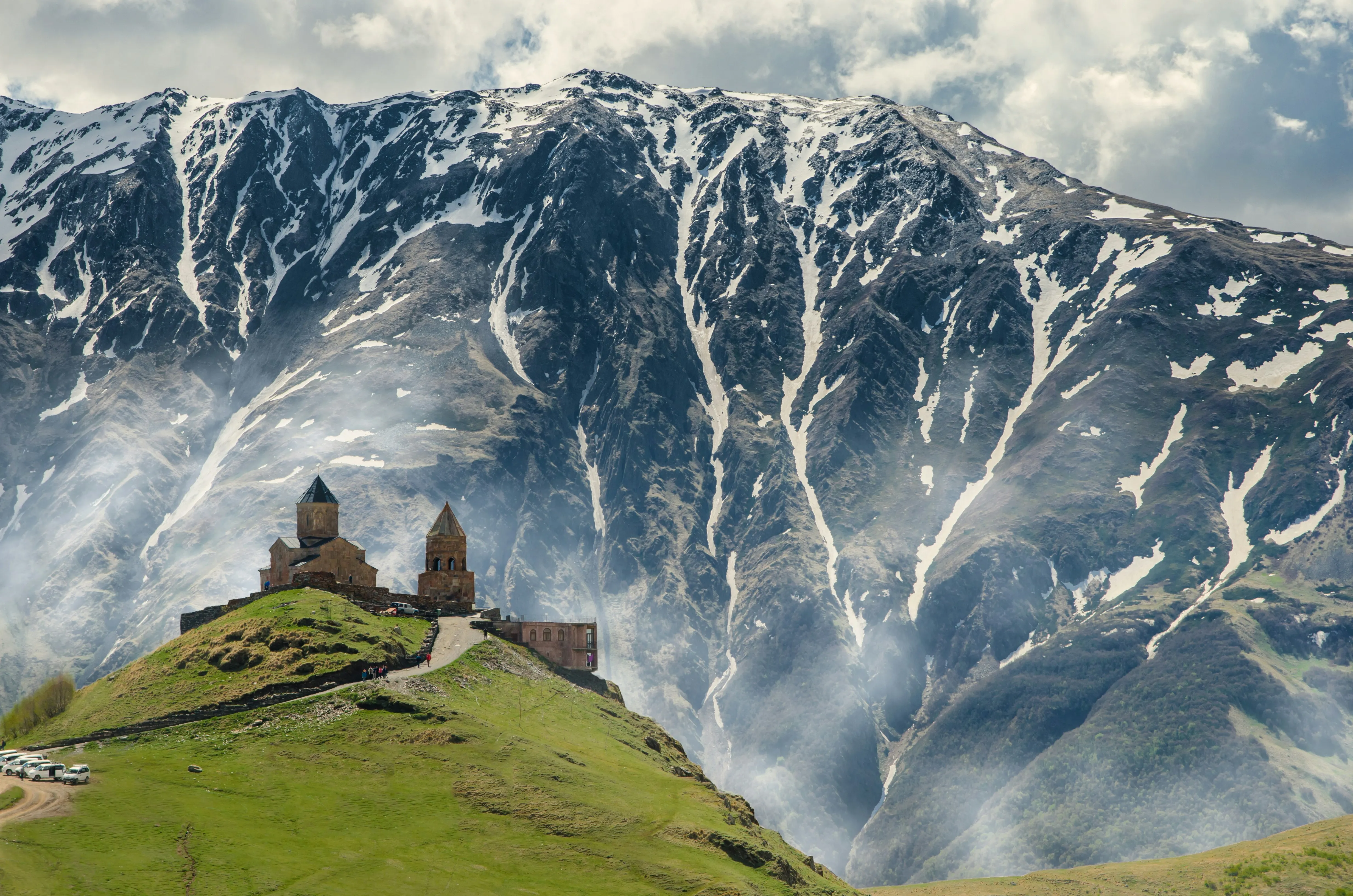
To the north, the mountains of the Greater Caucasus define the country’s geography. The Stepantsminda region is one of the most sought-after destinations due to the Gergeti Trinity Church, which stands solitary against the imposing Mount Kazbek. This area is ideal for those who enjoy outdoor activities, with hiking routes that cross alpine valleys and waterfalls. Further northwest is Svaneti, a remote and mountainous region famous for its medieval defense towers in settlements like Mestia and Ushguli, which have maintained their customs and visual aesthetics for centuries.
In the eastern part, the Kakheti region unfolds as an extensive tapestry of vineyards and valleys. The walled city of Sighnaghi is one of the most picturesque spots, with its red roofs and clear views of the Alazani Valley. This area is internationally recognized for its link to wine culture, where the traditional method of fermentation in clay jars called qvevri is still used. Visitors often tour its local markets and participate in activities related to regional gastronomy and crafts.
The Black Sea coastal strip offers a completely different atmosphere, led by the city of Batumi. This urban center is known for its modernity, its contemporary design buildings, and an extensive seaside boulevard ideal for strolling. In addition to its beaches, the Batumi Botanical Garden is a relevant stop for its diversity of species from various ecosystems of the world. The atmosphere in this area is more relaxed and cosmopolitan, especially during the summer months when various cultural festivals are held.
Finally, historical heritage is powerfully manifested in the rock-cut cities. Complexes like Vardzia, a cave monastery carved into a mountainside, or Uplistsikhe, one of the oldest urban settlements in the Caucasus, show ingenious human adaptation to the terrain. Near the city of Kutaisi, travelers can explore the Gelati Monastery, another relevant historical landmark, or venture into geological formations like the Prometheus Cave, which stands out for its impressive halls of stalactites and underground rivers.
“Tip”: You cannot miss visiting Mtskheta, the most emblematic place in the country.
✈️ Best Time to Travel
Georgia is a destination that offers different experiences depending on the time of year, thanks to its varied geography ranging from the high peaks of the Caucasus to the shores of the Black Sea. Generally, the periods of late spring and early autumn are considered the most balanced for touring the country, as temperatures are moderate and allow for both cultural visits in cities and nature excursions.
The climate varies significantly between mountainous regions and valleys. While summer is the ideal time for those seeking high mountain hiking routes, winter transforms the landscape into a suitable setting for snow sports. For their part, the shoulder seasons stand out for the awakening of flora or the color of the vineyards, offering a quieter atmosphere to explore Georgia’s historical heritage.
| Season | Months | Typical Climate | What to Expect | Tourist Influx |
|---|---|---|---|---|
| Spring | Mar – May | Mild temperatures gradually rising and occasional rains. | Blossoming valleys, green landscapes, and Orthodox Easter celebrations. | Medium ⭐⭐ |
| Summer | Jun – Aug | Intense heat in the lowlands and cool temperatures in the mountains. | Hiking in the Greater Caucasus, outdoor festivals, and beach season on the Black Sea. | High ⭐⭐⭐ |
| Autumn | Sep – Nov | Fresh and dry atmosphere, with sunny days and colder nights as the season progresses. | Grape harvest season (Rtveli), intensely colored foliage, and collection of local products. | Medium-High ⭐⭐⭐ |
| Winter | Dec – Feb | Cold and frequent snow in high areas; cool and humid climate in the capital. | Skiing and winter sports, Christmas atmosphere, and visits to thermal baths. | Low ⭐ |
🗣️ Basic Vocabulary
Although Georgian has its own unique alphabet, knowing some basic expressions greatly facilitates daily interaction during the trip. Using simple words to greet or say thank you is not only useful in shops and restaurants but is also usually well-received by the local population, who value the visitor’s interest in their language.
These are some of the most practical words and phrases for communicating in everyday situations in Georgia:
- Gamarjoba: Hello.
- Madloba: Thank you.
- Ki / Ara: Yes / No.
- Tu sheidzleba: Please.
- Nakhvamdis: Goodbye.
- Gakvt…?: Do you have…? (Very useful for asking for products in shops or markets).
- Ver mivkhvdi: I don’t understand.