


Mauritius
Discover this paradise in the Indian Ocean with crystal-clear lagoons, white beaches, exuberant nature, and a vibrant culture that blends various unique traditions.
Quick Facts
- Capital
- Port Louis
- Language
- English
- French, Mauritian Creole
- Currency
- Mauritian Rupee (MUR)
- Best time to visit
- From May to December, coinciding with the driest and coolest season.
- Budget per day
- $60 - $250 per day
- Climate
- Tropical maritime climate with pleasant temperatures all year round; hot and humid summers and mild and dry winters.
- Connectivity
- good
- It is very easy to purchase physical SIM cards or eSIMs at the airport and local stores.
- Electricity
- Type C / G (230V)
- Local transport
- acceptable
- Card usage
- acceptable
- Tipping
- optional
🌎 Introduction
In the middle of the Indian Ocean, far from the large continental masses, Mauritius unfolds as a corner of contrasts where volcanic relief meets the serenity of turquoise lagoons. Life on the island moves at a slow pace, marked by the southern hemisphere sun and a nature that manifests itself both in the dense tea plantations of the interior and in the reefs that protect its coast. It is a place where the landscape shifts gently from green mountains to sugarcane fields, offering a serene and balanced image.
The true essence of the island lies in its plural identity, the result of centuries of coexistence between cultures from different continents. Traveling through its villages, it is common to find richly decorated Hindu temples alongside colonial churches or mosques, while the aroma of spices and fresh vanilla fills the local markets. This mixture is also reflected at the table, where Creole gastronomy combines local ingredients with millenary traditions, and in the sound of sega, a music that narrates the history and feelings of its people.
Throughout the year, the country transforms its colors according to the season, from the intense red of the flamboyant trees in the warmest months to the soft light of the mild winters, ideal for walking the trails of its national parks. Far from being just a destination for rest, the everyday life of its fishing villages and the natural hospitality of its inhabitants invite you to discover a diverse reality, where the harmony between the natural environment and the human legacy defines the unique character of this oceanic enclave.
🛡️ General safety
Mauritius is internationally known as one of the safest and most welcoming destinations in Africa and the world. The country enjoys notable political and social stability, which translates into a very peaceful atmosphere for the visitor.
General safety level
- The general safety rating for tourists is very high. Mauritius is perceived as a safe environment where serious incidents are extremely rare.
- Compared to other international destinations, the risk is low. The country relies heavily on tourism, so there is a constant institutional effort to protect the traveler.
- The context for the traveler is that of a hospitable island, where the greatest risk is usually related to environmental factors or small oversights rather than personal physical integrity.
Crime and common risks
- The most common crime is petty theft or theft by neglect. This mainly occurs on busy public beaches, markets, or high-traffic commercial areas.
- Isolated cases of minor scams have been reported in the hiring of unofficial tourist services or beach excursions. It is always advisable to hire through accredited operators.
- An infrequent risk, but one worth mentioning, is theft in vacation rental accommodations that do not have basic security measures. In large hotels and resorts, this risk is virtually non-existent.
- It is recommended to avoid leaving valuables in sight inside rented vehicles or unattended on the sand while swimming.
Safety in cities and tourist areas
- Urban centers such as Port Louis, Curepipe, or Quatre Bornes are safe during the day. However, after dark, some areas of the capital can become very lonely, so it is recommended to travel by taxi instead of walking through poorly lit streets.
- Tourist areas like Grand Baie, Flic en Flac, or Le Morne have adequate surveillance and are very safe for walking at any time, always maintaining common sense.
- In popular markets, such as the Port Louis Central Market, it is important to watch backpacks and wallets due to crowds, which are the ideal setting for pickpockets.
Safety in transport
- Public transport (buses) is safe and widely used by the local population, although it can be somewhat slow and does not always have air conditioning.
- Taxis are a very common means of transport. It is recommended to agree on the price before starting the journey or ensure they use the taximeter to avoid overcharging.
- In Mauritius, people drive on the left, a British heritage that may require a period of adaptation for many drivers. Main roads are in good condition, but secondary ones can be narrow, poorly lit, and have pedestrians or animals on the roadway.
- If you opt for vehicle rental, extreme caution is recommended during night driving due to reduced visibility in rural areas.
Natural and climatic risks
- The most relevant natural risk is tropical cyclones, which can occur mainly during the austral summer season, between the months of November and April.
- The country has a very efficient cyclone warning system (divided into classes from 1 to 4). Hotels and local authorities inform in advance and have clear protocols to ensure everyone’s safety.
- Flash floods can occur after heavy rains, especially in low-lying areas or near riverbeds.
- Regarding the sea, caution should be exercised with strong currents at certain points outside the lagoons protected by the coral reef. It is always preferable to swim in marked areas or ask locals.
- The sun is extremely strong due to the latitude, so the risk of sunburn and dehydration is real if proper preventive measures are not taken.
Legislation and local norms
- Mauritius is extremely strict with laws related to drug use and trafficking. Penalties are severe and authorities maintain a zero-tolerance policy.
- It is strictly prohibited and penalized to collect or damage coral, as well as to buy or attempt to export turtle shells or protected species.
- Although clothing is informal in beach areas, respectful behavior and appropriate clothing (covering shoulders and knees) are expected when visiting religious temples (Hindu, mosques, or churches).
- Nudism is not allowed on public beaches; toplessness is accepted in some private resorts, but it is advisable to check the rules of each establishment.
Safety for specific groups
- Female travelers: Mauritius is a safe destination for women traveling alone. Harassment is not common, although it is recommended to follow the usual precautions of not walking alone in isolated areas or deserted beaches at night.
- LGTBIQ+ travelers: Although Mauritian society is traditional and conservative in some aspects, laws have evolved and same-sex relationships are no longer criminalized. Very obvious public displays of affection are not common among the general population, so discretion is recommended outside of international resort environments.
- Traveling with children or the elderly: It is an excellent destination for families and seniors due to the quality of private medical services, ease of transport, and the peaceful nature of tourist activities.
Emergencies and assistance
- The main emergency numbers are: 999 or 112 for Police and 114 for medical emergencies and ambulances.
- There is a special unit called the Police du Tourisme (Tourist Police) that patrols areas of major interest and is specifically trained to help visitors.
- In case of an incident, such as a robbery, it is necessary to go to the nearest police station to make an official report (Statement), which is essential if you intend to claim from travel insurance later.
- Mauritius has good public hospitals, but for tourists, the use of private clinics, which offer international standards of care, is strongly recommended.
Tip: Always keep a digital copy of your passport and medical insurance in the cloud, and use your hotel safe for original documents and large amounts of cash while enjoying the beach.
📝 Entry requirements
To organize a trip to this island destination, the first step usually consists of verifying the necessary personal documentation. Generally, a passport with sufficient validity to cover the entire intended stay is required. It is common for local authorities to request that the document be in good condition to facilitate identification processes at entry points.
In most cases, visitors traveling for leisure do not usually need to manage a visa beforehand, as one is typically issued easily upon arrival at the airport for a large number of nationalities. The maximum permitted stay as a tourist is usually limited to a period of a few months, a time that is generally sufficient to explore the island’s main attractions and enjoy its natural environment.
During the entry process, immigration staff may request the presentation of a confirmed onward ticket demonstrating the intention to leave the country at the end of the vacation. Likewise, proof of sufficient financial funds to cover travel expenses or confirmation of booked accommodation for the first days of the stay may sometimes be required.
Regarding customs controls, there are standard regulations concerning the import of certain goods. The entry of personal use items is usually allowed, although there are clear limitations on the amount of tobacco or alcoholic beverages permitted. It is essential to pay attention to restrictions on the introduction of plant products, seeds, or certain foods to protect the local ecosystem. Transporting specific medications usually requires a prescription or medical report justifying their personal use.
From a health point of view, there is usually no generalized requirement for vaccines for all travelers, although it is recommended to keep the standard vaccination schedule updated. In very specific situations, such as when coming from areas where certain diseases are endemic, a specific vaccination certificate might be requested. It is advised to maintain a collaborative attitude during routine health checks that may be carried out randomly upon arrival at the airport.
Below are the fundamental aspects for trip preparation:
- Main document: Valid passport in good physical condition.
- Visa management: Process usually carried out at the point of arrival for tourist purposes.
- Visiting period: The standard permit usually authorizes a stay for a maximum time of ninety days.
- Travel proof: Possession of a return ticket and details of intended accommodation.
- Solvency: Ability to demonstrate financial resources for the stay if required.
- Health: Recommendation to consult international health guides months before departure.
- Luggage: Strict control over prohibited substances, plants, and excess taxable products.
🏥 Basic health considerations
You will find that Mauritius has a fairly acceptable health infrastructure, especially in the more touristy areas and urban centers. The country has public hospitals where care is free for residents, but as a visitor, you will find that the most functional option is to go to private clinics. These private centers offer a very high level of care, with modern technology and reduced waiting times. The health staff is usually highly qualified, and you will find it easy to communicate with them, as they perfectly master both English and French. You should keep in mind that costs in private healthcare can be high, so it is a factor to consider in your planning.
Taking out travel medical insurance is something we totally recommend, even if it is not a mandatory requirement to cross the border. It is fundamental that your policy has as broad a coverage as possible including hospitalization, surgical interventions, and, very specially, medical repatriation. Having this support will allow you to receive the best possible care in private clinics without having to pay large sums of money out of your pocket for any unforeseen event.
Regarding vaccines, there are no mandatory vaccination requirements to enter Mauritius, unless you come from an area where yellow fever is endemic, in which case they will request the corresponding certificate. The most appropriate thing is to verify that you have your standard vaccination schedule updated. In some cases, depending on the type of trip you are going to take, they might recommend protection against hepatitis A or tetanus, but the ideal is to consult with a preventive medicine professional before leaving to go with total peace of mind.
If you travel with specific medication, you will find it very important to carry your drugs in their original containers and accompanied by a medical prescription or a report signed by your doctor, preferably in English. This will avoid complications at customs controls, as local authorities are strict about the entry of certain substances. For minor problems, you will see that there are well-stocked pharmacies in the cities and near hotel complexes where you can buy basic first-aid products.
The most common health risks are related to the island’s tropical environment. The sun is very intense throughout the year, so sunburns and heatstroke are frequent if you do not take precautions. You will also find mosquitoes, which although they do not usually transmit serious diseases habitually, can be annoying; using a good repellent will help you avoid their bites. In the sea, we advise you to use appropriate footwear in coral areas to avoid pricks from sea urchins or accidental encounters with stonefish.
In the food section, you will see that the levels of hygiene in restaurants and establishments are generally good. Although tap water is treated, the most prudent thing to avoid stomach upset is to always drink bottled water. You can try the varied local gastronomy with peace of mind, even at street food stalls, provided you observe that the place looks clean and that the food is cooked to order.
For any medical emergency situation that requires a rapid response, the telephone number you should dial is 114. This service manages the dispatch of ambulances and initial urgent care. Many large hotels also have agreements with private doctors who can come to your room if you suffer from a minor ailment that does not require going to the hospital.
As final recommendations for your trip, we suggest you pack a small first-aid kit with the basics: disinfectant, bandages, painkillers, and some stomach protector. Don’t forget to apply high-factor sunscreen several times a day and stay well hydrated. Following these tips, you will enjoy all the beauty of Mauritius with the security that you are taking good care of your health.
🚌 Transportation within the country
Moving around the island is a simple task due to its manageable dimensions. The bus is the most widespread means of public transport and reaches almost every corner of the territory, being a very popular option for integrating into local life. In recent years, a light rail system has been incorporated, connecting the capital with various inland towns, offering a modern and fluid alternative for crossing the most populated areas. For those who prefer greater independence, car rental is a common option, always keeping in mind that driving on the left is the rule throughout the country.
The use of public transport is accessible for visitors thanks to the fact that signage and directions are usually in languages understandable to the international traveler. In the case of buses, the operation is simple and the staff in charge helps identify the corresponding stops. However, there is a notable difference between urban areas, where frequency is high, and rural areas or more remote coastal zones, where services are more limited and the pace is slower.
Taxis represent another fundamental pillar for tourist transport. They are easily found at strategic points and hotel areas, frequently used for direct trips or for exploring different points of interest in a single day. Although the main road network is efficient and in good condition, it is common to find heavy traffic during peak hours near administrative centers, so the sense of fluidity can vary depending on the time of day and location.
“Tip”: It is very useful to confirm with residents or at information points the transport schedules when planning to visit areas far from the main urban centers.
🤵 Culture and etiquette
Mauritian society is characterized by a harmonious coexistence of various cultures and traditions, making mutual respect the basis of any social interaction. When addressing residents, it is common to start with a formal greeting, such as “bonjour” or “hello”, always maintaining a kind and calm manner. Courtesy is a highly valued trait in daily life, and visitors are expected to behave with an open and considerate attitude toward the plurality of customs that coexist on the island.
In the realm of interpersonal relationships, discretion and a moderate voice volume are the norm in public spaces. Although the general atmosphere is welcoming and friendly, maintaining adequate personal space is valued. Regarding punctuality, there is usually some flexibility in informal contexts, although in professional environments or organized tourist services, adherence to established schedules is recommended to facilitate the smooth running of activities. Initial physical contact is usually limited to a handshake, allowing familiarity to grow organically.
Respect for religious diversity is fundamental when exploring the country. When visiting sacred spaces, it is essential to observe the specific rules of each place, which usually include covering shoulders and knees and, in the vast majority of cases, removing footwear before entering. Likewise, before taking photographs of people or during ritual acts, it is a sign of good manners to ask for permission, ensuring that the solemnity of the moment and the privacy of the individuals participating are not interfered with.
Regarding gastronomy and social gatherings, the act of sharing a table is a relevant cultural pillar. If an invitation to a private home is received, it is a polite gesture to bring a small gift for the hosts. Regarding tipping, while not mandatory, it is considered a well-received gesture of gratitude for good service in hospitality establishments. Outside of strict beach areas, it is recommended to use appropriate clothing that fits the environment, showing consideration for the sensitivity of local communities.
“Tip”: When visiting places of worship or private homes, it is advisable to observe if there is footwear at the entrance, as taking off your shoes is a simple gesture that symbolizes respect for the environment and local traditions.
🍛 Typical gastronomy
The cuisine of Mauritius is a reflection of its history, a melting pot of influences from Africa, India, Europe, and China that have blended over the centuries. The result is a varied gastronomy where spices play a fundamental role, but without necessarily being excessively spicy. Rice and noodles are usually the base of most meals, accompanied by sauces rich in aroma and fresh products from both the sea and local gardens.
The flavors are characterized by the constant use of ingredients such as ginger, turmeric, cilantro, and curry, which bring intense nuances to the stews. It is common to find slow-cooked dishes, such as curries or tomato stews known as rougaille. Additionally, the consumption of fresh tropical fruits and salty or spicy pickles, which serve to balance the flavors, is a common practice at any Mauritian table.
Regarding customs, street food is an essential part of the country’s daily and cultural life. Mobile stalls offering quick snacks at any time of the day are frequently found. In restaurants, the atmosphere is usually relaxed and dinner times tend to be earlier than in some Western countries, with kitchen service usually ending around ten at night. Sharing several dishes in the center of the table is a widespread custom, especially at social meals.
To accompany the dishes, vanilla tea is one of the island’s most emblematic drinks, served both hot and cold. Lemongrass infusions and preparations based on milk and basil seeds are also popular. Although bottled water is the frequent choice for visitors, natural fruit juices and fresh coconut water are easy to find in markets and coastal areas.
| Dish | Description | Main Ingredients | Where to try it | Tip |
|---|---|---|---|---|
| Dholl Puri | A thin legume pancake filled with various accompaniments. | Yellow lentils, flour, bean curry, and chutney. | Port Louis markets and street stalls. | Order it freshly made to appreciate its soft texture. |
| Bol Renversé | Asian-influenced dish served upside down on the plate. | Rice, fried egg, chicken or seafood, and sautéed vegetables. | Family restaurants and local cafes. | Break the egg yolk so it mixes with the sauce. |
| Rougaille | A classic tomato stew of Mauritian Creole cuisine. | Tomato, onion, garlic, thyme, and meat or fish. | Traditional cuisine restaurants. | Accompany it with white rice to balance the tomato flavor. |
| Mine Frit | Local-style stir-fried egg noodles with a smoky touch. | Noodles, fresh vegetables, egg, and meat or prawns. | Food stalls on beaches and markets. | Add a few drops of garlic or chili sauce to taste. |
| Gateau Piment | Small fried balls consumed as an appetizer. | Crushed yellow lentils, chili, cilantro, and cumin. | Bakeries and fast food stalls. | They are ideal to eat hot as a mid-morning snack. |
📷 Areas and places to visit
The island of Mauritius presents itself as a destination of great geographical and cultural contrasts, where volcanic heritage and the influence of various civilizations have shaped a diverse landscape. To understand the essence of the country, it is fundamental to travel through its different regions, which transition from the urban effervescence of the capital to the serenity of its national parks and its calm water coasts.
In the heart of the island lies Port Louis, the capital, a core where the modernity of business centers coexists with colonial history. Walking through its streets allows you to discover the Central Market, a daily meeting point for inhabitants where local products and spices are exchanged. Nearby, the Aapravasi Ghat, declared a World Heritage Site, offers a profound insight into the history of immigration on the island. The contrast is provided by the Caudan Waterfront, a port area that combines leisure and views of the Indian Ocean.
Toward the north, the landscape becomes gentler and the atmosphere more dynamic. The town of Grand Baie stands out as one of the most important centers of activity, offering a wide variety of maritime excursions and dining options. In this same area is located Cap Malheureux, recognizable by its red-roofed church that contrasts with the blue of the sea. A bit further inland, the Pamplemousses Botanical Garden constitutes an essential visit to learn about tropical flora, being world-famous for its giant water lilies and its extensive collection of palm trees.
The east coast is characterized by its extensive white sand beaches and a more relaxed atmosphere. It is the usual starting point for visiting Deer Island (Île aux Cerfs), an islet that allows for water activities and postcard-perfect landscapes. In this region, the pace of life is slow, ideal for those looking to observe coastal life without the crowds of more urbanized centers.
The south and southwest of Mauritius house some of the most unique natural landscapes in the Indian Ocean. In the area of Chamarel, you can observe the geological phenomenon of the Seven Coloured Earth, where sand dunes present shades ranging from red to violet, alongside an impressive high waterfall. Not far away, the Black River Gorges National Park protects the island’s last indigenous forests, offering hiking trails that allow for the observation of endemic species and panoramic views of the mountains.
In the central highlands, the climate is cooler and the vegetation denser. Here lies Grand Bassin or Ganga Talao, a sacred lake situated in the crater of an extinct volcano that has become the most important place of worship for the island’s Hindu community, presided over by monumental statues. Nearby, the city of Curepipe offers a different perspective with its colonial architecture and the Trou aux Cerfs crater, from which a circular view of much of the island is obtained.
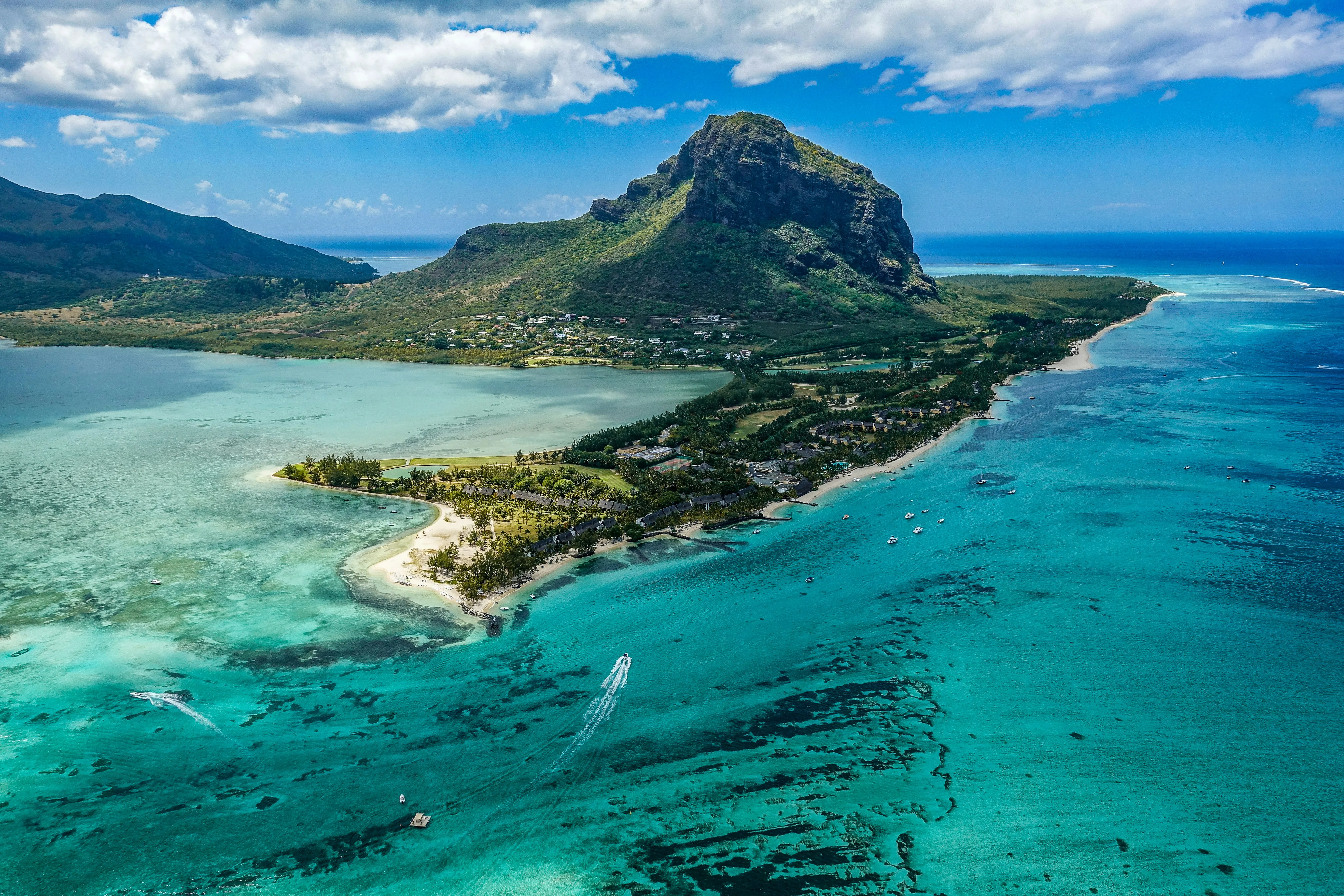
Finally, the area of Le Morne, at the southwestern tip, stands out for its imposing mountain that juts into the sea. This place not only possesses exceptional scenic value for its lagoons but also a deep historical meaning related to resistance and freedom. The beaches of this peninsula are very popular with those who practice wind sports, integrating sport, history, and nature in the same environment.
“Tip”: You cannot miss visiting Le Morne Brabant, the most emblematic place in the country.
✈️ Best time to travel
Mauritius is a tropical climate destination that offers pleasant temperatures throughout much of the year, allowing for a visit to be planned in almost any month. However, the experience varies according to the balance sought between humid heat and the coolness of the trade winds. Generally, transition periods offer a balanced climate, ideal for enjoying both the white sand beaches and the lush vegetation of the island’s interior.
The choice of date will depend on the traveler’s preferred activities. While the warmer months are ideal for diving and water sports due to the clarity and temperature of the water, the cooler months are especially comfortable for hiking trails in national parks or visiting botanical gardens. It is important to keep in mind that, being in the southern hemisphere, the seasons work inversely to those in the northern hemisphere, providing a sunny refuge all year round.
| Season | Months | Typical climate | What to expect | Tourist influx |
|---|---|---|---|---|
| Autumn | Mar – May | Warm temperatures and progressive decrease in humidity. | Very green landscapes after the rains, calm waters, and good visibility for diving. | Medium (⭐⭐⭐) |
| Winter | Jun – Aug | Cool and dry climate, with mild temperatures and wind on the east coast. | Ideal for surfing, hiking, and whale watching in a relaxed atmosphere. | Medium / Low (⭐⭐) |
| Spring | Sep – Nov | Sunny days, dry climate, and moderately rising temperatures. | Flowering of exotic species, clear skies, and optimal conditions for snorkeling. | Medium / High (⭐⭐⭐) |
| Summer | Dec – Feb | Hot and humid environment with brief and intense tropical rainfall. | Long days, abundance of tropical fruits, and a festive and vibrant atmosphere. | High (⭐⭐⭐⭐) |
🗣️ Basic vocabulary
Although English is the official language in Mauritius and French is spoken fluently across most of the island, the language that unites its inhabitants in daily life is Mauritian Creole (kreol). Learning a few basic expressions in this local language will help you connect better with the population and move with more ease in markets, shops, or public transport.
It is not necessary to delve into grammatical rules, as Mauritians greatly value the gesture of using their native tongue in simple interactions. Knowing these fundamental words will allow you to show courtesy and facilitate communication during your stay:
- Bonzour: Hello or good morning.
- Ki manyer?: How are you? or how is everything going?
- Mersi: Thank you.
- Silvouple: Please.
- Komié sa?: How much does it cost?
- Wi / Non: Yes / No.
- Orevwar: Goodbye