


Pakistan
Discover the majestic peaks of the Karakoram, vibrant historical cities, and the unique hospitality of a people who treasure an ancient and striking cultural heritage.
Quick Facts
- Capital
- Islamabad
- Language
- Urdu
- English, Punjabi, Pashto, and Sindhi
- Currency
- Pakistani Rupee (PKR)
- Best time to visit
- From March to May and from September to October to avoid extreme heat.
- Budget per day
- $20 - $60 per day
- Climate
- Varies from arid in the south to temperate in the center and alpine cold with glaciers in the mountainous far north.
- Connectivity
- medium
- Easily available at airports and official stores by presenting a valid passport and visa.
- Electricity
- Type C / D (230V)
- Local transport
- acceptable
- Card usage
- more cash is used
- Tipping
- optional
🌎 Introduction
Between the imposing peaks of the Karakoram and the fertile banks of the Indus River, a territory of marked contrasts unfolds where geography shapes the character of its people. The landscape changes drastically as you descend from the northern valleys, where apricot trees bloom with the arrival of spring, toward the plains of Punjab and Sindh. It is in this transition that one perceives an identity forged by centuries of history, visible both in the traces of ancient trade routes and in the slow-paced life of mountain villages.
Daily life in this corner of the world is experienced through the senses: the persistent aroma of spiced tea on every corner, the vibrant colors of local markets, and the sound of conversations that stretch out without haste. Hospitality is not just a custom, but a fundamental pillar that defines the warm and simple treatment toward those who arrive from abroad. From the bustle of its historic cities to the silence of its deserts, the country offers a genuine look at a culture that deeply values its roots and the ritual of shared encounters.
🛡️ General Safety
Pakistan is a country that has undergone a notable transformation in terms of stability in recent years, opening up increasingly to international tourism. Generally, safety for travelers is considered moderate, with levels that vary significantly depending on the region visited. While the main urban areas and northern tourist circuits are usually safe, the country requires detailed planning and constant monitoring of local news.
The context for the traveler is that of an extremely hospitable country, where respect for the visitor is a cultural pillar. However, it is fundamental to understand that Pakistan maintains certain political and social particularities that demand a prudent attitude and compliance with the recommendations of local authorities at all times.
Crime and common risks
Violent crime specifically targeted at tourists is infrequent in Pakistan. Most reported incidents are usually of a minor nature. Among the most common risks are:
- Pickpocketing and bag snatching: These can occur in very crowded markets (bazaars) or high-traffic areas in large cities.
- Minor scams: Some informal transport drivers or vendors may try to inflate prices for foreigners, although this is less aggressive than in other regional destinations.
- Cybersecurity: Caution is recommended when using public Wi-Fi networks and protecting personal information on electronic devices.
There are infrequent risks that must be mentioned, such as the possibility of demonstrations or political protests. These are usually localized; the best recommendation is to avoid them entirely, as they can become unpredictable.
Safety in cities and tourist areas
Safety varies considerably by location. Urban centers and areas of interest have different dynamics:
- Islamabad: It is considered the safest and most organized city in the country, with a strong police presence and security checkpoints at entrances that guarantee a peaceful environment for tourists.
- Lahore: It is the cultural heart and is usually safe for travelers, although traffic and population density in the old city require being attentive to personal belongings.
- Karachi: Being a megacity, common crime levels are higher. It is recommended to move with local guides or use trusted transportation, avoiding peripheral areas after dark.
- Northern Areas (Gilgit-Baltistan): These areas are extremely safe for tourists, with very welcoming local communities and virtually non-existent crime levels.
To move around with peace of mind, it is ideal to use private transport services or recognized transport applications instead of walking long distances in unfamiliar cities at night.
Transport safety
Transport in Pakistan is a vibrant experience but requires specific precautions:
- Driving: In Pakistan, driving is on the left. Traffic can be chaotic, and road rules are not always strictly followed by local drivers.
- Public Transport: Long-distance buses from recognized companies are safe and comfortable. In cities, rickshaws (tuk-tuks) are common, but it is necessary to agree on the price before starting the journey.
- Transport applications: The use of mobile applications is highly recommended, as they offer trip traceability and fixed prices.
- Internal flights: They are a safe and efficient option to cover the long distances between the south and north of the country.
Renting vehicles without a driver is discouraged due to the complexity of the traffic and the variable state of the roads in rural areas.
Natural and climatic risks
The country has a diverse geography that entails certain seasonal natural risks:
- Seismic activity: Pakistan is located in a tectonic fault zone, so earthquakes are a possibility, especially in the north and west.
- Monsoons and floods: Between the months of July and September, monsoonal rains can cause flash floods and landslides in mountainous areas, affecting roads.
- Extreme heat: During the summer months (May to June), temperatures in the plains of Punjab and Sindh can exceed 45°C, posing a risk of heatstroke.
It is recommended to always follow weather forecasts and avoid road travel in the north during intense storms.
Legislation and local norms
Pakistan is an Islamic Republic with laws and customs that must be respected to avoid legal or social inconveniences:
- Religion: Blasphemy laws are extremely strict. Any comment or action that could be interpreted as disrespect toward Islam or the Quran must be avoided.
- Alcohol and substances: Alcohol consumption is prohibited for Muslims and is highly restricted for foreigners (only available in some luxury hotels with a permit). Drug consumption carries severe prison sentences.
- Dress: Tourists are expected to dress conservatively. Both men and women must cover their shoulders and knees. For women, the use of loose clothing and carrying a scarf to enter religious sites is recommended.
- Photography: It is forbidden to photograph military installations, government buildings, airports, or bridges.
Failure to comply with these rules can lead to fines, arrests, or immediate deportation.
Safety for specific groups
- Women travelers: Pakistan is a safe country for women if cultural norms are followed. It is preferable to travel in a group or with a guide. On public transport, there are usually sections reserved for women. Walking alone in isolated places at night should be avoided.
- LGTBIQ+ travelers: Homosexuality is not legally recognized and remains a deep social taboo. Maximum discretion is recommended, and public displays of affection should be avoided, as these are also frowned upon even for heterosexual couples.
- Children and the elderly: The country is very welcoming to families. However, infrastructure for people with reduced mobility is very limited, and extreme heat can be especially harsh for these groups.
Emergencies and assistance
It is essential to have local emergency contacts at hand:
- Police (Emergency assistance): 15
- Emergency and Ambulance Services (Rescue): 1122
- Highway Police: 130
In case of an incident, emergency services in large cities usually respond quickly. It is highly recommended to take out comprehensive travel insurance that includes medical evacuation, especially if planning to go trekking or mountaineering in the north. In case of any legal problem, the first step is to contact your country’s consular representation.
Tip: Always keep a digital and physical copy of your passport and visa, and try to register at police checkpoints in rural areas, as this facilitates your location and assistance in case of need.
📝 Country Entry Requirements
Access to Pakistan for tourist activities requires the interested person to have a passport with a validity that, as a general rule, must be at least six months from the moment of crossing the border. It is common for a visa to be required prior to the start of the trip, which is usually managed through electronic systems or at the corresponding consular representations. The permitted stay for those traveling for pleasure is usually limited to a period of thirty days, although there is sometimes the possibility of requesting extensions once in the territory.
At migration control points, whether at airports or land borders, agents usually request the presentation of an exit ticket from the country that confirms the intention to leave the national territory within the planned timeframes. Likewise, it is frequent to be asked to demonstrate the availability of sufficient funds to cover subsistence and accommodation expenses during the visit. It is also advisable to have the reservation for the first establishment where you will stay or a letter of invitation if applicable.
Regarding customs regulations, travelers must be careful with certain items. The introduction of alcoholic beverages and pork products is usually strictly restricted. Regarding medications, it is advised that these travel in their original packaging and be accompanied by a translated medical prescription to avoid inconveniences during inspections. Valuable objects, such as professional photographic equipment or large amounts of cash, may require a formal declaration upon arrival.
From a health perspective, an extensive list of vaccines is not always generalized, but it is common for a vaccination certificate against yellow fever to be requested from people coming from risk zones. It is also frequent to recommend being protected against polio and other endemic diseases. The purchase of international medical insurance that covers transfers and specialized treatments is strongly suggested, given that sanitary conditions can vary considerably between urban areas and more remote rural areas.
Below is a summary of the key aspects to take into account for organizing the trip:
- Passport: Must have a minimum validity of six months and free pages for stamps.
- Tourist Visa: It is the main access document and is usually processed digitally.
- Proof of Exit: Confirmed plane or land transport ticket to another destination.
- Financial Solvency: Documentation proving sufficient financial means for the stay.
- Baggage Restrictions: Strict limitations on alcohol, prohibited products, and medication control.
- Health Certifications: Verification of recommended vaccines and possible yellow fever requirement according to origin.
- Travel Insurance: Broad coverage for medical assistance and possible evacuations in mountain areas.
🏔️ Tourist Attractions and Main Regions
Pakistan is a destination that stands out for its impressive geographical diversity, ranging from the highest peaks in the world to vibrant urban centers with centuries of history. The northern region is world-renowned for housing three of the most imposing mountain ranges: the Himalayas, the Karakoram, and the Hindu Kush. In this area, the Hunza Valley presents itself as an enclave of singular beauty, famous for its glacial landscapes and hospitable culture.
In the urban sphere, the city of Lahore is considered the cultural heart of the country. Its monuments from the Mughal era, such as the Lahore Fort and the Badshahi Mosque, reflect a past of architectural splendor. On the other hand, the capital, Islamabad, offers a more modern and organized structure, standing out for its green environment and the iconic Faisal Mosque. In the south, the metropolis of Karachi acts as the economic engine and offers access to the shores of the Arabian Sea.
For archaeology enthusiasts, the country guards remains of ancient civilizations of great importance. The sites of Mohenjo-Daro and Taxila are outstanding examples that allow for an understanding of the development of societies in the Indus Valley and the influence of Buddhism in the region.
🍽️ Gastronomy and Local Customs
Pakistani cuisine is rich in nuances, spices, and intense flavors. It is characterized by the use of fresh ingredients and slow cooking techniques that enhance the aromas of each dish. Some of the most representative elements of its table include:
- Biryani: An aromatic rice dish cooked with spices, meat, and sometimes legumes.
- Karahi: A meat stew (usually chicken or mutton) prepared in a circular vessel with tomato and ginger.
- Naan and Roti: Essential flatbreads that accompany almost any meal to scoop up sauces and meats.
- Samosas: Fried pastries filled with potato, meat, or vegetables, very popular as a snack.
- Chai: Tea with milk and spices is the social drink par excellence and is offered as a gesture of welcome.
Regarding customs, Pakistani society is known for its deep hospitality. It is common for visitors to be invited to share food or tea. It is recommended to dress conservatively, especially in rural areas and places of worship, covering shoulders and legs. Respect for religious traditions is fundamental for a harmonious coexistence during the tour of the country.
💡 Additional Practical Information
- Local Currency: The monetary unit is the Pakistani Rupee. It is recommended to carry cash in rural areas, as the use of credit cards is usually limited to large hotels and shops in main cities.
- Languages: Urdu is the national language, although English has very widespread use in the administrative, educational, and tourist sectors.
- Climate: Due to its size, the climate varies notably. The best time to visit the north is between May and October, while the south and center are more pleasant during the winter months.
- Connectivity: In main cities, it is easy to purchase local SIM cards for mobile data, although the signal can be unstable in remote mountain valleys.
🏥 Basic Health Considerations
When preparing for your trip to Pakistan, it is important to keep in mind that the quality of medical care varies significantly depending on where you are. In large cities like Islamabad, Karachi, or Lahore, you will find private hospitals and clinics with international standards and modern equipment. Medical staff in these centers usually speak English fluently, so communication will not be a problem for you. However, in rural or high mountain areas, the infrastructure is much more basic and limited. You should know that while the public system exists, for a tourist, the most recommended option is to always go to private healthcare, where prices are moderate compared to other Western countries but can rise quickly if you need complex treatments.
Taking out travel medical insurance is not a legal requirement to enter the country, but it is something absolutely essential for your peace of mind. I advise you to choose a policy with broad coverage that includes hospitalization, surgical interventions, and, above all, medical repatriation. If you plan to go trekking or mountaineering in the north, make sure your insurance specifically covers helicopter rescue, as the costs of this service are extremely high and are usually required in advance.
Regarding vaccines, there are none that are mandatory for all travelers, unless you come from a country with a risk of yellow fever transmission. However, it is very important that you have your routine vaccination schedule up to date. The most recommended vaccinations for moving around the country are protection against hepatitis A, typhoid fever, and tetanus. In some areas and depending on the duration of your stay, they might also advise the hepatitis B or rabies vaccine. I suggest you consult with an international travel medicine center a couple of months before your departure for personalized advice.
If you take regular medication, it is best to bring the entire necessary amount for your stay in its original packaging. It is fundamental to attach a medical prescription or a certificate in English explaining your treatment, especially if you travel with substances that might be considered controlled by local authorities. Although you will find well-stocked pharmacies in large cities, it is always safer to carry your own basic first-aid kit with analgesics, disinfectants, dressings, and something for common stomach discomfort.
The most frequent health risks are related to the environment and the climate. In the summer months, the extreme heat in areas like Punjab or Sindh can be dangerous, so you must hydrate constantly to avoid heatstroke. If you travel to the north, you will have to watch out for altitude sickness and perform a gradual ascent to allow your body to acclimate. Regarding insect-borne diseases, there is a risk of dengue and malaria in certain regions, especially after the rainy seasons. The most effective thing you can do is use powerful repellents and wear clothing that covers the skin at dawn and dusk.
Water and food are the points where you should take the most precaution during your stay. Tap water is not potable, so you should always consume bottled water, ensuring that the seal is intact. Avoid ice in drinks and raw vegetables or fruits that you cannot peel yourself. Regarding street food, although it is delicious and an essential part of the experience, always look for stalls with high customer turnover and where you see food being cooked at the moment at high temperatures. Maintaining good hand hygiene will save you from most digestive problems.
In case of a medical emergency, the telephone number you should dial is 1122, which corresponds to the most efficient emergency and ambulance service in much of the territory. This service works remarkably well in major cities, although in remote areas the response may be delayed. If you have a minor emergency, the fastest thing is usually to ask your accommodation to contact a trusted doctor or point you to the nearest private clinic for immediate care.
As final tips for your day-to-day life, remember to always carry a copy of your insurance policy and assistance contacts with you. Do not self-medicate with local products if you feel unwell; it is preferable to always seek a professional diagnosis at a recommended center. If you follow these basic prevention guidelines and use common sense, you will be able to enjoy the incredible hospitality and landscapes of this country with total safety.
🚌 Transport Within the Country
Moving around Pakistan offers various options that adapt to the large distances of the territory. Long-distance buses are one of the most used means by travelers due to their extensive network, which connects the main cities and provinces with constant frequency. For long-distance journeys, the train is a traditional alternative that allows you to cross the country from north to south, while internal flights are a practical option to save time, especially when traveling toward mountainous regions.
The ease of use of public transport is acceptable for international visitors. In transport terminals and airports, signage usually appears in English in addition to the local language, which facilitates orientation. The purchase of tickets is usually done at the station windows, although management through digital means is increasingly common in more modern services. Language is not usually an insurmountable barrier at major transit points, where it is possible to find staff who understand basic instructions.
There is a clear distinction between urban and rural areas. In large metropolises, the traveler can find Bus Rapid Transit systems and organized transport networks. Conversely, in rural or high mountain areas, transport is more informal and depends on 4x4 vehicles or small vans that circulate on more complex roads. In these areas, travel times are longer, and schedules can be less predictable due to the terrain.
For short and urban transfers, the use of taxis and transport services managed through mobile applications is the most comfortable and common. These services allow for agile movement through cities. Likewise, rickshaws are a constant presence on the streets and are useful for short distances, allowing for effectively bypassing the dense traffic of commercial hubs.
Regarding the general feeling, the comfort in middle and high-end bus services is notable, with vehicles that usually meet expected standards. Punctuality is reasonable in road services, although heavy traffic at city entrances and the state of some secondary roads can cause delays. In general, the transport system is functional and allows for a direct experience of the country’s different realities.
Tip: It is advisable to book long-distance journeys some time in advance to ensure a seat at the most convenient times, especially on significant dates or holiday periods.
🤵 Culture and Etiquette
Society in Pakistan is governed by a deep sense of hospitality, where the visitor is received with notable attention and courtesy. Respect for family structures and social hierarchies is a fundamental pillar in daily coexistence. When interacting with citizens, it is common to observe deferential treatment toward older people, who are usually given the right of way or a seat as a sign of consideration. In the realm of greetings, the most widespread form is verbal, sometimes accompanied by a slight gesture of placing the right hand on the chest. Physical contact between men is common, as it is between women, but it is usually avoided between people of different sexes in public settings, where a respectful distance is preferred.
In public spaces, behavior tends to be discreet and moderate. Maintaining a low voice volume is valued so as not to interfere with others’ space, especially in crowded areas or near residential areas. Regarding the perception of time, punctuality can be more flexible than in other international contexts, with social gatherings or celebrations commonly starting with some delay relative to the agreed time. In this sense, showing a patient and understanding attitude helps to better integrate into the local pace of life, where interpersonal relationships often take precedence over the urgency of the clock.
Customs surrounding the table and visits to private homes are central aspects of social life. It is a very widespread courtesy rule to remove your shoes before entering a house, leaving the footwear at the entrance as a sign of respect and cleanliness. When eating, especially in more traditional settings where cutlery is not used, the right hand is always employed, as the left is reserved for personal hygiene. If invited to a meal, it is considered a gesture of gratitude to taste the food offered, even in small quantities. Regarding tips, they are a common and well-received practice in the catering and transport sectors, functioning as a recognition of the service provided.
Respect for traditions and sacred spaces is essential for harmonious coexistence. When visiting places of worship, such as mosques, it is mandatory to dress modestly, covering shoulders and legs, and women usually cover their hair as well. It is fundamental to remain silent and avoid crossing in front of people who are praying. During festivities or periods of religious observance, daily habits can be significantly modified; at these times, showing a supportive and understanding attitude toward local practices, such as fasting during daylight hours, facilitates a smoother and more respectful travel experience.
Tip: It is fundamental to always use the right hand to greet, hand over money or documents, and for eating, as the use of the left hand in these social interactions is considered inappropriate according to local customs.
🍛 Typical Gastronomy
The cuisine of Pakistan is a reflection of its geographical and cultural diversity, combining influences from Central Asia, the Middle East, and South Asia. The flavors are characterized by the generous use of aromatic spices such as cumin, coriander, ginger, and turmeric, which are balanced to create complex yet comforting dishes. Although spice is present, the base of many stews is slow cooking, which allows the aromas to integrate deeply into each preparation.
Bread and rice are the fundamental accompaniments at any Pakistani table. Varieties of bread such as naan (baked in a tandoor) or roti are often used as a utensil to scoop up food, as it is common to share several dishes in the center of the table. Meat, mainly beef, chicken, and mutton, plays a leading role in the diet, while legumes and seasonal vegetables complete a varied and nutritious culinary offering.
Regarding social customs, Pakistani hospitality places food at the center of gatherings. It is common for dinners to be served quite late, often after nine at night. In many traditional homes and establishments, it is customary to eat using the right hand, maintaining an etiquette that values sharing food. For drinking, tea (chai) is the national drink and is consumed at any time of day, generally with milk and spices. It is important to remember that alcohol consumption is restricted and it is not common to find it in public establishments.
| Dish | Description | Main ingredients | Where to try it | Tip |
|---|---|---|---|---|
| Biryani | Spiced rice cooked in layers with meat. | Basmati rice, chicken or beef, yogurt, and saffron. | Very common in Karachi and celebrations. | Mix the layers well to enjoy all the aromas. |
| Nihari | Thick slow-cooked stew, traditionally served at dawn. | Beef shank, bone marrow, and a spice blend called masala. | Traditional restaurants in Lahore. | Add fresh ginger and lemon just before eating it. |
| Karahi | Meat quickly sautéed in a deep iron wok. | Chicken or mutton, tomatoes, ginger, and green chilies. | At roadside stalls (dhaba) and urban areas. | Order freshly made garlic naan to dip in the sauce. |
| Sajji | Meat slowly roasted around wood embers. | Whole mutton or chicken marinated only with salt and pepper. | Originating from Balochistan, popular in large cities. | It is usually served accompanied by aromatic rice cooked in the meat juices. |
| Halwa Puri | Traditional breakfast that combines sweet and savory flavors. | Fried bread (puri), sweet semolina (halwa), and chickpea curry. | Breakfast markets in any historic center. | It is the typical dish to enjoy during Sunday mornings. |
📷 Zones and Places to Visit
Pakistan is a destination of enormous geographical and cultural diversity, where the traces of ancient civilizations coexist with large-scale mountain landscapes and cities that vibrate at a constant rhythm. The country is divided into regions with very marked identities, offering everything from archaeological remains of the Bronze Age to modern metropolises and alpine valleys that are difficult to access but of great visual beauty.
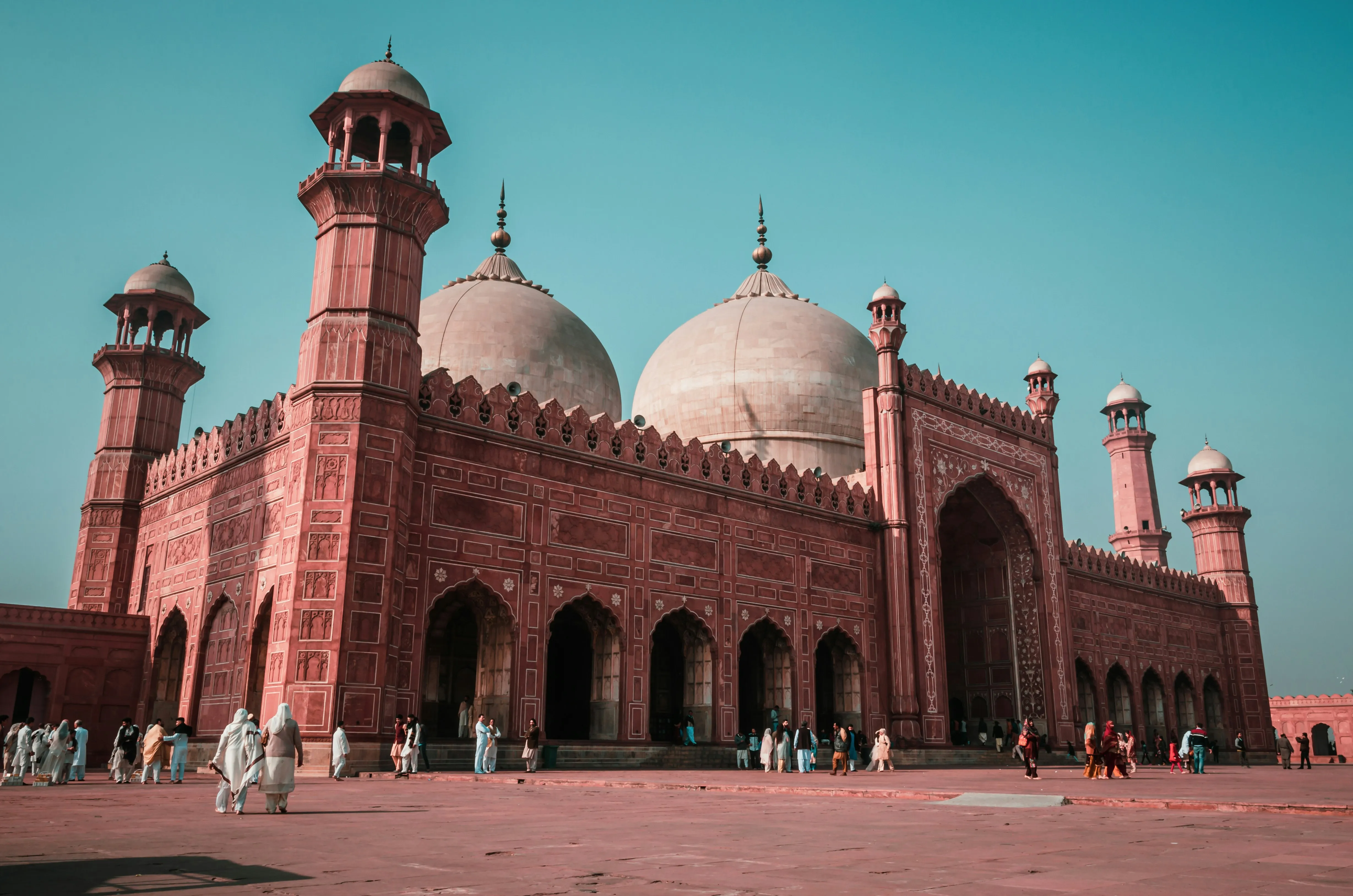
The city of Lahore is usually considered the cultural epicenter of the country. Strolling through its Walled City allows you to observe daily life among narrow alleys and traditional markets. In this area, the Lahore Fort stands out, an imposing structure that showcases the architecture of the Mughal Empire, along with the Badshahi Mosque, recognizable by its white marble domes and red brick. For those seeking to delve deeper into the region’s history, the Lahore Museum houses one of the most relevant collections of art and archaeological remains in South Asia.
In contrast to the historical bustle, Islamabad, the capital, offers a much more planned and serene environment. Situated at the foot of the Margalla Hills, it stands out for its wide avenues and green areas. The best-known landmark here is the Faisal Mosque, a work of contemporary architecture that departs from traditional canons. A short distance from the capital is Taxila, a fundamental archaeological site for understanding the influence of Buddhism and Gandhara culture in the area, with monasteries and stupas dating back centuries.
Toward the north, the landscape changes drastically as you enter the Karakoram Highway, a route that snakes between some of the highest mountains in the world. The Hunza Valley is an outstanding destination for its landscapes of snowy peaks and ancient fortresses such as Altit and Baltit, which watch over the valley from above. This region is ideal for gentle hikes or more demanding routes toward glaciers and mountain lakes, such as Attabad Lake, known for its turquoise waters. In this area, rural life maintains a slow pace, closely linked to nature’s cycles and local traditions.
The south of the country offers a different perspective through Karachi, the most populous city and the main commercial port. It is a cosmopolitan metropolis with access to beaches and a very varied gastronomic offer. Not far from there, history buffs can visit Mohenjo-Daro, the remains of one of the most important cities of the Indus Valley civilization. Additionally, the Sindh region features Sufi shrines and monuments decorated with blue tiles that reflect a very particular artistic style of this southern area.
The regions of Skardu and Gilgit act as gateways for those who wish to observe imposing massifs like Nanga Parbat or K2 up close. These places attract not only for their nature but also for the possibility of experiencing traditional festivals and local craftsmanship in wood and wool. Walks through the Fairy Meadows offer direct views of great ice walls, allowing for an appreciation of the magnitude of the Himalayan range without the need for technically difficult expeditions.
“Tip”: You cannot miss visiting the Badshahi Mosque, the most emblematic place in the country.
✈️ Best Season to Travel
Choosing the right time to visit Pakistan depends largely on the regions you wish to explore. Due to its varied geography, which spans from the peaks of the Karakoram to the Indus plains and the southern coasts, the country offers different experiences throughout the year. Generally, transitional periods such as spring and autumn are considered the most balanced periods for touring most of its points of interest, as temperatures are moderate and landscapes show their greatest color.
For those seeking to venture into the northern mountains, the warmer months allow access to remote valleys and mountain passes that remain closed by snow the rest of the year. Conversely, if the objective is to visit the historic cities and archaeological sites of the center and south, the cooler months are much more comfortable, avoiding the intense heat that characterizes the plains during the summer period.
| Season | Months | Typical weather | What to expect | Tourist influx |
|---|---|---|---|---|
| Spring | Mar – May | Mild and pleasant temperatures in the center; cool in the north. | Flowering of fruit trees in the northern valleys and local festivities welcoming the season. | Medium (⭐⭐) |
| Summer | Jun – Aug | Very hot in the plains; monsoonal rains in the south; dry and cool weather in high mountains. | Ideal time for trekking and mountaineering in the north. The peaks are accessible and pastures are green. | High in the north (⭐⭐⭐) |
| Autumn | Sep – Nov | Dry air, clear skies, and temperatures that gradually drop. | Landscapes with golden and reddish foliage in valleys like Hunza or Skardu. Excellent visibility of the mountains. | Medium / High (⭐⭐) |
| Winter | Dec – Feb | Intense cold and snow in the north; temperate, dry, and sunny weather in the south. | Cultural tourism in cities like Lahore or Karachi and visits to archaeological sites without excessive heat. | Low in the north; Medium in the south (⭐) |
🗣️ Basic Vocabulary
Although English is quite widespread in urban areas and the tourism sector of Pakistan, knowing some basic words in Urdu is very useful for getting by in daily life. Learning these expressions facilitates simple interactions in markets, transport, or everyday situations, and is usually appreciated by the local population during close interactions.
It is not necessary to master grammar to communicate effectively. By managing a small repertoire of greetings and courtesy formulas, you will be able to move with greater confidence and solve basic needs, such as asking for a price or thanking for a service appropriately.
- As-salamu alaykum: Universal greeting meaning “peace be with you” (Hello).
- Shukriya: Thank you.
- Haan / Nahin: Yes / No.
- Kitne ka hai?: How much does it cost?
- Maaf kijiye: Excuse me or sorry.
- Pani: Water.
- Khuda Hafiz: Goodbye