


Jordan
A kingdom of contrasts where the rose city of Petra and the Wadi Rum desert offer an unforgettable historical and natural experience.
Quick Facts
- Capital
- Amman
- Language
- Arabic
- English
- Currency
- Jordanian Dinar (JOD)
- Best time to visit
- Spring (March to May) and autumn (September to November)
- Budget per day
- $50 - $150 per day
- Climate
- Arid and dry climate predominates, with very hot summers and winters that can be cold in the desert and mountains.
- Connectivity
- medium
- Very easy to obtain at airports and local shops, with eSIM options available
- Electricity
- Type C / G (230V)
- Local transport
- acceptable
- Card usage
- acceptable
- Tipping
- yes
🌎 Introduction
Halfway between the desert and the sea, the Jordanian landscape unfolds in a range of ochre and reddish colors that change with the light of day. It is a corner of the world where time seems to flow with a different rhythm, marked by the silence of the stretches of sand and the constant murmur of the markets in cities like Amman. Here, hospitality is not a forced courtesy, but a central element of the local identity that manifests in small gestures, such as the aroma of coffee with cardamom or the pause to share a tea at sunset.
The richness of this territory lies in its contrasts. It is possible to go from the fresh air of the northern mountains, where spring dresses the valleys in green, to the absolute stillness of the desert valleys in the south. Bedouin traditions coexist naturally with contemporary urban life, offering an honest gastronomy where freshly baked bread and spices define the character of every table. The presence of history is perceived in the stone and in the ancient paths, integrating into a daily life that is as familiar as it is suggestive for those who come to know its reality.
🛡️ General safety
Jordan is considered one of the most stable and safe destinations in the Middle East. Despite being in a geographically complex region, the country has maintained solid internal peace and a very welcoming attitude towards international tourism.
General safety level
- The general safety rating for tourists is high. Jordan is distinguished by being a hospitable country where visitors usually feel welcome and protected.
- Compared to other international destinations, the risk level is low. It is not common for tourists to face situations of physical danger, and the country devotes great effort to the protection of its points of historical interest.
- The context for the traveler is that of a kingdom that prioritizes political stability and citizen safety, which allows for visiting most of its attractions with total peace of mind, always maintaining the usual common sense of any trip.
Crime and common risks
- Violent crime against tourists is extremely rare. Jordan has low crime rates compared to many Western capitals.
- Petty theft, such as bag snatching or pickpocketing, can occasionally occur in crowded areas or busy markets (souks), although it is not the norm.
- Tourist scams are the most frequent risk. These usually occur in places like Petra or Wadi Rum and consist of overcharging for transport services (horses, camels), selling fake “antiquities,” or unofficial guides offering “special” routes at high prices.
- It is advisable to be aware of previously agreed prices to avoid misunderstandings at the end of a service.
Safety in cities and tourist areas
- In urban centers like Amman, safety is very good. You can walk through most neighborhoods both day and night without notable problems.
- The most emblematic tourist areas (Petra, Dead Sea, Jerash) have a visible police presence, specifically the Tourist Police, who are there to assist the traveler.
- In more traditional neighborhoods, it is advisable to maintain a discreet profile and respect local customs, which usually guarantees a smooth and safe interaction with residents.
- Public transport in cities (buses and vans) is safe, although it can be confusing for the traveler due to the lack of fixed schedules.
Transport safety
- In Jordan, people drive on the right, just as in most countries in Europe and America.
- The use of taxis is widespread. It is recommended to use vehicles with a meter or agree on the price before getting in. In Amman, private transport apps (such as Uber or Careem) work well and offer an extra layer of safety and price transparency.
- Rental vehicles are a popular option. Main roads, such as the Desert Highway or the King’s Highway, are in good condition, although caution should be exercised with local driving, which can be somewhat erratic, and with the presence of animals (camels or goats) in rural areas.
- Driving at night on secondary roads is discouraged due to the potential lack of lighting and poor signage in some sections.
Natural and climatic risks
- Extreme heat is the main climatic risk, especially between the months of June and September. Temperatures in the Jordan Valley and Wadi Rum can easily exceed 40°C.
- Flash floods are a real and dangerous risk during winter and spring, especially in canyons and wadis (such as the Siq in Petra or Wadi Mujib). If rain is forecast, these areas are usually closed to the public for safety.
- It is recommended to stay constantly hydrated and use adequate sun protection throughout the year.
Legislation and local norms
- Jordan is a predominantly Muslim country and, although it is one of the most liberal in the region, it has laws and customs that should be respected. The consumption of alcohol is allowed in hotels, authorized restaurants, and liquor stores, but drinking or showing signs of intoxication in public is frowned upon and can lead to legal problems.
- Dress should preferably be modest, especially when visiting religious sites or rural areas, covering shoulders and knees to avoid drawing unnecessary attention.
- Excessive public displays of affection are not common and can be offensive to the local population.
- It is strictly forbidden to photograph military installations, government buildings, or critical infrastructure (bridges, borders).
Safety for specific groups
- Female travelers: Jordan is safe for women traveling alone. However, one may experience unwanted attention or persistent stares. Dressing respectfully toward the local culture usually minimizes these incidents.
- LGTBIQ+ travelers: Although homosexuality is not illegal in Jordan, society is conservative and there is no great public acceptance. Total discretion is recommended, and avoiding public displays of affection is advised to prevent uncomfortable situations or problems with local authorities.
- Traveling with children and the elderly: Jordanians have great respect for children and the elderly. They are welcome everywhere and usually receive preferential and kind treatment. However, it must be taken into account that many archaeological sites (such as Petra) require walking long distances over irregular terrain.
Emergencies and assistance
- The universal emergency number in Jordan is 911, which centralizes police, ambulance, and fire services.
- The Tourist Police has offices at all major points of interest, and their agents usually speak English. They are very effective at resolving disputes with merchants or minor safety issues.
- Medical services in major cities (especially Amman) are of excellent quality, with private hospitals that meet international standards. It is essential to travel with comprehensive medical insurance.
Tip: Before entering a canyon or going on a hiking route in a wadi, always check the local weather forecast and confirm with park authorities that there is no risk of flash floods.
📝 Entry requirements to the country
To undertake a trip to Jordan, the first fundamental element to consider is the possession of a passport with a minimum validity that, as a general rule, is usually recommended to be at least six months from the planned date of arrival in the territory. It is convenient to check that the document is in good condition and has sufficient space for the usual border procedures.
In most cases, international travelers require a tourist visa to access the country. This permit is usually managed in various ways, with the possibility of obtaining it directly upon landing at major airports or through digital platforms before starting the journey being common. The maximum duration of stay for recreational purposes is usually thirty days, although there is often the option to request an extension from local authorities if the itinerary requires it.
During the entry process, it is common for immigration personnel to conduct routine inquiries. Among the aspects that may be verified is the provision of an exit ticket from the country or confirmation of the route to a subsequent destination. Likewise, proof of financial funds may occasionally be requested to guarantee that the visitor can cover their stay expenses, so it is useful to have accommodation reservation confirmations or recent bank statements.
Regarding customs regulations, the entry of personal effects and gift items is usually allowed within reasonable limits. It is recommended to pay special attention to the entry of medications, which must be accompanied by their corresponding medical prescription clearly written. Other items, such as certain specialized electronic equipment or drones, could be subject to specific regulations or require prior authorizations for their introduction into the country.
From a health standpoint, it is not common for specific vaccination certificates to be required for the general entry of tourists, unless coming from areas with very localized and specific health risks. Nevertheless, it is considered good practice to keep the standard vaccination calendar up to date and to have travel insurance that covers any medical eventuality during the period of stay at the destination.
Below is a summary of the key points for preparing your arrival at the destination:
- Identity document: The passport is the only internationally accepted document for border crossing.
- Visa management: The procedure can be done in person at designated entry points or through electronic channels in advance.
- Stay period: The stay as a tourist is usually one month, with the possibility of extension under the supervision of the authorities.
- Security controls: It is common to go through detection arches and baggage scanning in a professional and fluid manner.
- Baggage and customs: The entry of tobacco and perfumes in limited quantities for personal use is allowed.
- Health recommendations: It is advisable to consult with travel medicine centers regarding preventive health recommendations before departure.
- Proof of solvency: Keeping proof of hotel reservations at hand facilitates the admission process at the migration control.
🏥 Basic health considerations
You will find that Jordan has one of the most modern and advanced healthcare systems in its region, especially if you are in the capital, Amman. As a tourist, you will have access to both the public health network and private healthcare, the latter being the most recommended option for its speed, equipment, and international quality standards. You must take into account that the costs of private medicine are quite high, so any consultation or treatment will require a significant payout. A very positive point is that the vast majority of doctors and nursing staff have studied abroad and speak fluent English, which will make it easier for you to explain any symptoms or needs.
Although it is not a strict legal requirement to obtain an entry visa in all cases, taking out travel medical insurance is absolutely essential before landing in the country. Your policy should be as comprehensive as possible and must include hospitalization, ambulance transfer, and medical repatriation. Without insurance to back your expenses, it is very likely that private hospitals will request an upfront payment or a financial guarantee before treating you, even in emergency situations.
Regarding vaccines, none are mandatory to enter Jordan, unless you are traveling from a country where yellow fever is endemic. For your peace of mind, it is ideal to have your standard vaccination schedule up to date, which includes polio, tetanus, and diphtheria. Additionally, you could discuss vaccination against Hepatitis A and B or typhoid fever with your doctor, especially if you plan to explore rural areas or spend a lot of time in contact with nature and local food stalls.
If you are following a specific treatment, you can carry your personal medication without problems. It is fundamental that you transport the drugs in their original containers and that you accompany them with the medical prescription or a certificate signed by your doctor, preferably translated into English. This will avoid problems at customs controls, especially if they are medications containing controlled substances or narcotics. In the cities, you will see many well-equipped pharmacies where you can buy basic supplies like painkillers or antiseptics, but it is always better to carry your own small first-aid kit for excursions.
The most frequent health risks in the country are related to the climate. The intense heat and dry environment can cause dehydration or heatstroke if you do not take precautions in places like Petra or the Wadi Rum desert. Conversely, if you travel in winter or sleep in the desert, you will notice that temperatures drop drastically, so you could suffer from colds. There are no serious insect-borne diseases to worry about, although in areas with stagnant water, the use of repellent is never a bad idea to avoid annoying bites.
Regarding hygiene and consumption, you should know that tap water in Jordan is not suitable for drinking. You will find bottled water easily in any shop or hotel, and it is the only one you should consume. You can try the delicious Jordanian gastronomy with confidence, but I recommend avoiding raw vegetables that have not been disinfected and opting for fruits that you can peel yourself. Street food is usually safe if you observe that the establishment has a high customer turnover and the food is cooked to order and at high temperatures.
If you find yourself in a critical situation, the telephone number for medical emergencies is 911. This centralized service works efficiently and will put you in contact with ambulance services. In urban areas, response time is fast, while in desert or mountainous areas, assistance could take a bit longer. Most top-tier hospitals have their own emergency services operating 24 hours.
To make your trip as pleasant as possible, do not forget to drink water constantly even if you do not feel thirsty to combat the dry climate. Use high-factor sunscreen throughout the day and always carry a copy of your insurance policy and your passport, either on paper or on your mobile, in case you have to go to a medical center unexpectedly. Maintaining good hand hygiene before eating will save you from most common traveler stomach problems.
🚌 Transport within the country
To move around Jordanian territory, most travelers opt for car rentals or the use of private cars with a driver, as these options allow for greater freedom to explore points of interest at their own pace. There is also a network of buses that regularly connects the country’s most emblematic destinations. Internal air transport is a possibility to link the capital with the far south, although the road journey remains the most common choice for getting to know the landscape.
The use of public transport, such as local microbuses, is a frequent option for residents, but it can be somewhat more complex for visitors because signage and information about routes are not always available in several languages. While in large cities it is very easy to find means to move around at any time, in rural zones or more remote areas like the desert, options are more limited and require more careful planning.
Taxis are a very widespread resource and represent a practical way to move, especially for short trips within urban centers. In general, comfort in road transfers is acceptable, with main roads that are in good condition and well-connect the northern regions with those of the south. The reliability of services oriented toward the visitor is usually good, allowing for the fulfillment of planned itineraries without major setbacks.
Although the country does not have an operating metro or passenger train network for tourism, the road transport system allows for reaching all corners of historical and natural interest. Road signage on main highways is usually present in several alphabets, which facilitates orientation. In areas with higher influx, services are better adapted to the needs of the international traveler, offering a balanced transport experience.
Tip: it is recommended to organize transfers between cities with some advance notice to ensure the availability of seats, especially on routes connecting the capital with the main sites of interest.
🤵 Culture and etiquette
Hospitality is a fundamental pillar in Jordanian society, where receiving visitors with kindness is considered a sign of generosity and respect. When greeting, the use of prolonged polite formulas and handshakes is common, although it is advisable to observe the other person’s reaction before initiating physical contact, especially between different genders, where sometimes a slight bowing gesture with the hand on the chest replaces direct contact. In social environments, maintaining a calm tone of voice and a patient attitude greatly facilitates interaction, as calmness and politeness are highly valued traits in daily communication.
In public spaces, behavior tends to be reserved, and discretion in displays of affection is valued. The concept of time can be more flexible than in other cultures in social contexts, so an understanding attitude toward possible waits helps in integrating into the local rhythm. However, in the fields of tourism, transport, and professional services, punctuality is usually strictly respected. It is recommended to pay attention to social hierarchies and show special deference toward the elderly, something reflected in the way of addressing them and in the order of greetings at a meeting.
Meetings around the table are moments of great importance for social exchange. If you receive an invitation to eat, it is considered a gesture of politeness to accept at least a small portion of what is offered, as food is a symbol of welcome. It is appropriate to preferentially use the right hand both for eating and for giving or receiving objects, following the local custom of reserving the left for personal hygiene tasks. Regarding tipping, although there is no rigid rule, it is common to reward services in restaurants, hotels, and guides, being a widespread and well-received practice as recognition for the work performed.
Respect for religious traditions is essential, especially when visiting mosques or sacred places. In these spaces, modest dress is required, ensuring shoulders and knees are covered, and it is mandatory to remove shoes before entering. During religious festivities or periods like Ramadan, although travelers are not subject to the same practices as the local population, showing consideration by avoiding eating, drinking, or smoking obviously in public spaces during daylight hours is a highly appreciated gesture that demonstrates sensitivity and respect toward the country’s culture.
“Tip”: If you are offered Arabic coffee as a welcoming gesture, it is customary to accept at least one cup; when you do not want more, slightly shake the cup from side to side before handing it back to politely indicate that you have finished.
🍛 Typical gastronomy
Jordanian cuisine is a reflection of its history and geography, combining influences from Bedouin nomadic traditions with the characteristic flavors of the Mediterranean Levant. The act of eating in Jordan goes beyond simple sustenance; it is a fundamental expression of hospitality and generosity. Meals are usually leisurely social events where dishes are placed in the center of the table to be shared, encouraging interaction among diners.
The aromatic profile of its gastronomy is defined by the use of spices such as cumin, sumac, and za’atar, in addition to a constant presence of high-quality olive oil. Basic ingredients include legumes, fresh vegetables, and meats, mainly lamb and chicken. A distinctive element of the Jordanian table is jameed, a dry and fermented yogurt that provides a unique, intense, and slightly acidic flavor to the country’s most traditional stews.
Mezzes or appetizers are the most common way to start any culinary encounter, consisting of a wide variety of small cold and hot dishes served simultaneously. Regarding customs, it is common to find different types of flatbread, which is often used as a utensil to pick up food directly from the dish. Regarding drinks, mint or sage tea and Arabic coffee, flavored with cardamom, are omnipresent and offered as a welcome gesture in almost any situation.
Meal times are usually flexible, although lunch is traditionally considered the main meal of the day. In dining establishments, service is attentive, and calmness during the after-dinner conversation is valued. Although alcohol consumption is permitted and available in hotels and specific tourist areas, the most popular options to accompany food are water, natural fruit juices, and refreshing yogurt-based drinks.
| Dish | Description | Main ingredients | Where to try it | Tip |
|---|---|---|---|---|
| Mansaf | The national dish par excellence, slow-cooked in a dry yogurt sauce. | Lamb, rice, jameed (fermented yogurt), and pine nuts. | Traditional food restaurants in Amman and local celebrations. | It is the dish of hospitality; traditionally eaten with the right hand. |
| Maqluba | Its name means “upside down,” as the pot is flipped onto the tray before serving. | Meat (chicken or lamb), rice, eggplant, cauliflower, and spices. | Eating houses and family restaurants throughout the country. | Watching the moment they flip the pot is part of the experience. |
| Zarb | Bedouin barbecue style cooked in an oven buried under the desert sand. | Lamb or chicken meat and varied vegetables. | Bedouin camps in the Wadi Rum desert. | Enjoy it freshly taken from the underground oven to appreciate the smoky flavor. |
| Falafel | Fried legume croquettes, very popular as a fast and economical food option. | Ground chickpeas, spices, garlic, and parsley. | Street food stalls and places specialized in breakfast. | Try it inside a freshly baked pita bread with sesame sauce (tahini). |
| Kunafa | Traditional dessert with a crunchy texture on the outside and soft on the inside, soaked in syrup. | Semolina dough or fine noodles, hot cheese, and sweet syrup. | Specialized pastry shops in the historical centers of cities. | It is preferable to taste it while the cheese is still hot and melted. |
📷 Zones and places to visit
The capital, Amman, is usually the starting point for most travelers and represents the balance between past and present. This city spreads over several hills and offers an interesting contrast between the hustle and bustle of its traditional markets in the center and the modernity of its western neighborhoods. In the upper area, the Citadel stands out, an archaeological complex housing remains of Roman temples and Umayyad palaces, providing a panoramic view of the city. At its feet is the Roman Theatre, a construction carved into the hillside that is still used today for cultural events. To delve deeper into the region’s history, the Jordan Museum guards invaluable pieces that span millennia of civilization.
To the north, the landscape becomes greener and more mountainous. The city of Jerash is one of the mandatory stops, as it preserves one of the most complete and best-kept Roman cities in the world. Walking through its colonnaded avenue, visiting its theaters, or crossing its emblematic oval plaza allows one to understand the importance this region had in antiquity. Nearby, Ajloun Castle stands as an example of medieval military architecture, offering a different perspective on the country’s defensive history in an environment of pine and olive forests.
Following the route south along the historic King’s Highway, places of great cultural relevance are reached. Madaba is famous for its Byzantine mosaics, especially for the map of the Holy Land that decorates the floor of the Church of St. George. A short distance away, Mount Nebo offers one of the most representative views of the Jordan Valley. On this same route is Karak Castle, a fortress from the crusader era that stands out for its dimensions and intricate underground passages, dominating the landscape from the top of a hill.
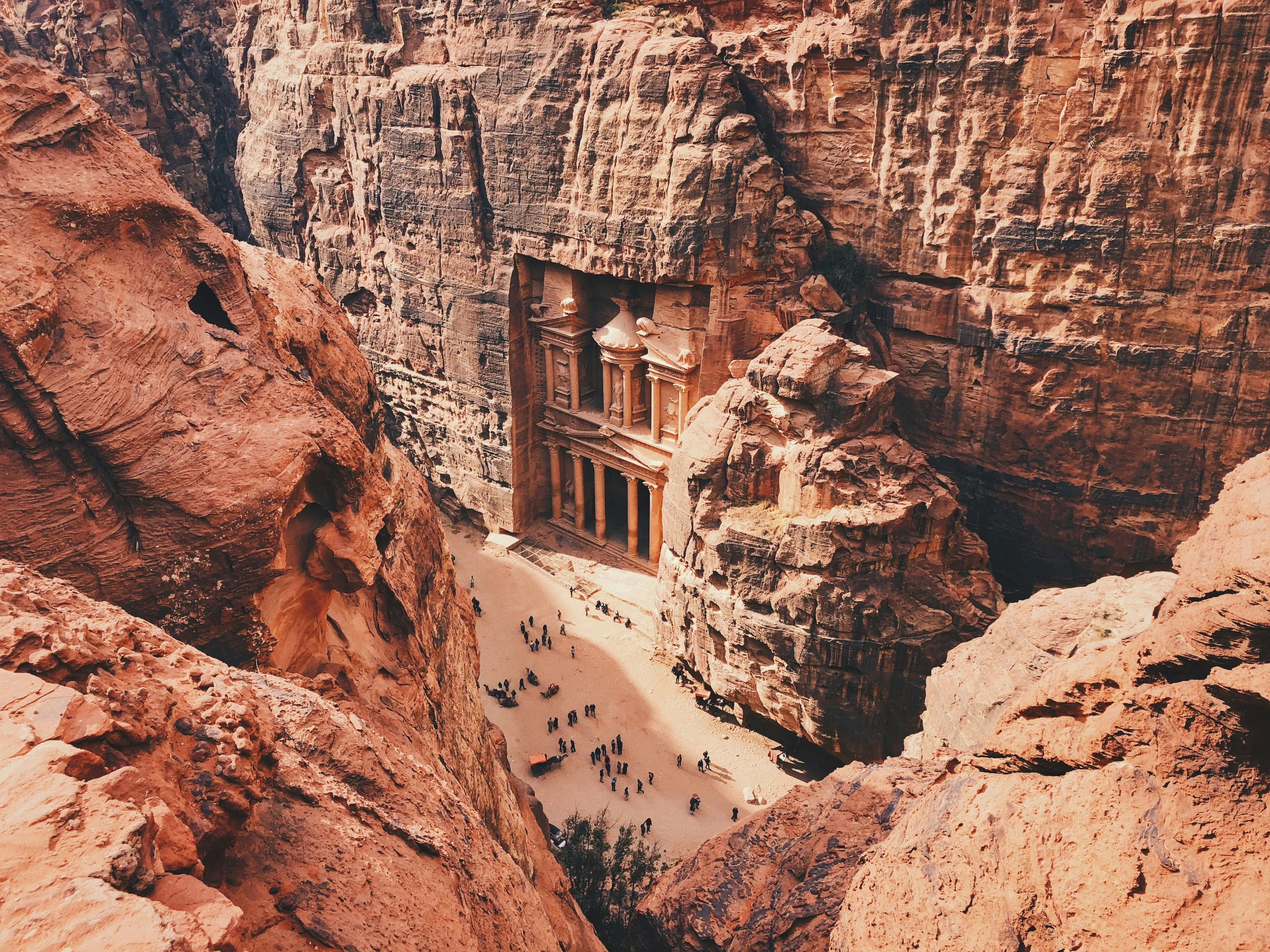
The geographical and emotional center of the country is found in Petra, the city carved directly into the rock by the Nabateans more than two thousand years ago. Access through the Siq, a narrow canyon with high walls, ends at the impressive Treasury, the most iconic facade of the complex. However, the archaeological site is very extensive and allows for spending entire days visiting the Monastery, the royal tombs, or the altars located in the highest areas, where the colors of the stone change according to the sun’s position.
The Wadi Rum desert offers an overwhelming natural experience with its reddish sands and granite formations. It is an ideal place for off-road vehicle excursions or walking among natural stone bridges and hidden canyons. Staying in this area allows one to closely experience the hospitality and customs of local communities, in addition to enjoying clear skies that facilitate stargazing. This environment, which seems to belong to another planet, has been the setting for numerous film productions due to its singular orography.
To finish the journey, the coastal and inland areas offer options for rest and nature. The Dead Sea, located at the lowest point on earth, is famous for the high salinity of its waters, which allows one to float effortlessly, and for the mineral properties of its mud. On the other hand, at the southern tip, the city of Aqaba allows for enjoyment of the Red Sea. Its clear waters are the ideal setting for diving and snorkeling, with coral reefs that host a great marine diversity, thus closing a trip that combines the aridity of the desert with the freshness of the sea.
“Tip”: You cannot miss visiting Petra, the most emblematic place in the country.
✈️ Best season to travel
Jordan offers very different experiences depending on the time of year it is visited. Its climate, predominantly desert, presents marked contrasts between day and night, as well as between different regions of the country, ranging from the mountainous northern zones to the depths of the Jordan Valley and the coasts of the Red Sea.
Choosing the right time depends on the activities you wish to perform, although transitional seasons are usually the most balanced for touring archaeological sites and natural reserves. During these months, moderate temperatures allow for long hikes through Petra or the Wadi Rum desert without the severity of summer heat or the intense cold of winter nights.
| Season | Months | Typical climate | What to expect | Tourist influx |
|---|---|---|---|---|
| Spring | Mar – May | Mild and pleasant temperatures; sunny days with fresh breezes. | Green landscapes in the north, wild flowering, and optimal conditions for hiking and cultural visits. | High (⭐⭐⭐) |
| Summer | Jun – Aug | Dry and intense heat, especially in the desert and the Jordan Valley. | Clear skies and very long days. It is a good time to enjoy water activities in the Red Sea. | Low / Medium (⭐) |
| Autumn | Sep – Nov | Warm and moderate temperatures that gradually drop after summer. | The sea water retains an ideal temperature for swimming, and visibility in the desert is excellent for photography. | High (⭐⭐⭐) |
| Winter | Dec – Feb | Cold climate with the possibility of rain and occasional snow in high areas like Amman or Petra. | A calmer and more leisurely atmosphere, with very cold nights in the desert and unique winter landscapes. | Low (⭐) |
🗣️ Basic vocabulary
Although English is quite widespread in the tourist areas of Jordan, knowing some basic expressions in local Arabic greatly facilitates interaction with its inhabitants. These small gestures are usually highly valued and help in moving with greater fluidity in everyday situations, such as making a purchase, asking for directions, or simply showing courtesy.
It is not necessary to master grammar or have perfect pronunciation; what matters is the intention to communicate in a close manner. Here is a selection of practical terms that will be very helpful during your trip:
- Marhaba: Hello.
- Shukran: Thank you.
- Min fadlak (addressing a man) / Min fadlik (to a woman): Please.
- Afwan: You’re welcome or excuse me.
- Na’am: Yes.
- La: No.
- Kam?: How much does it cost?
- Wayn…?: Where is…?