


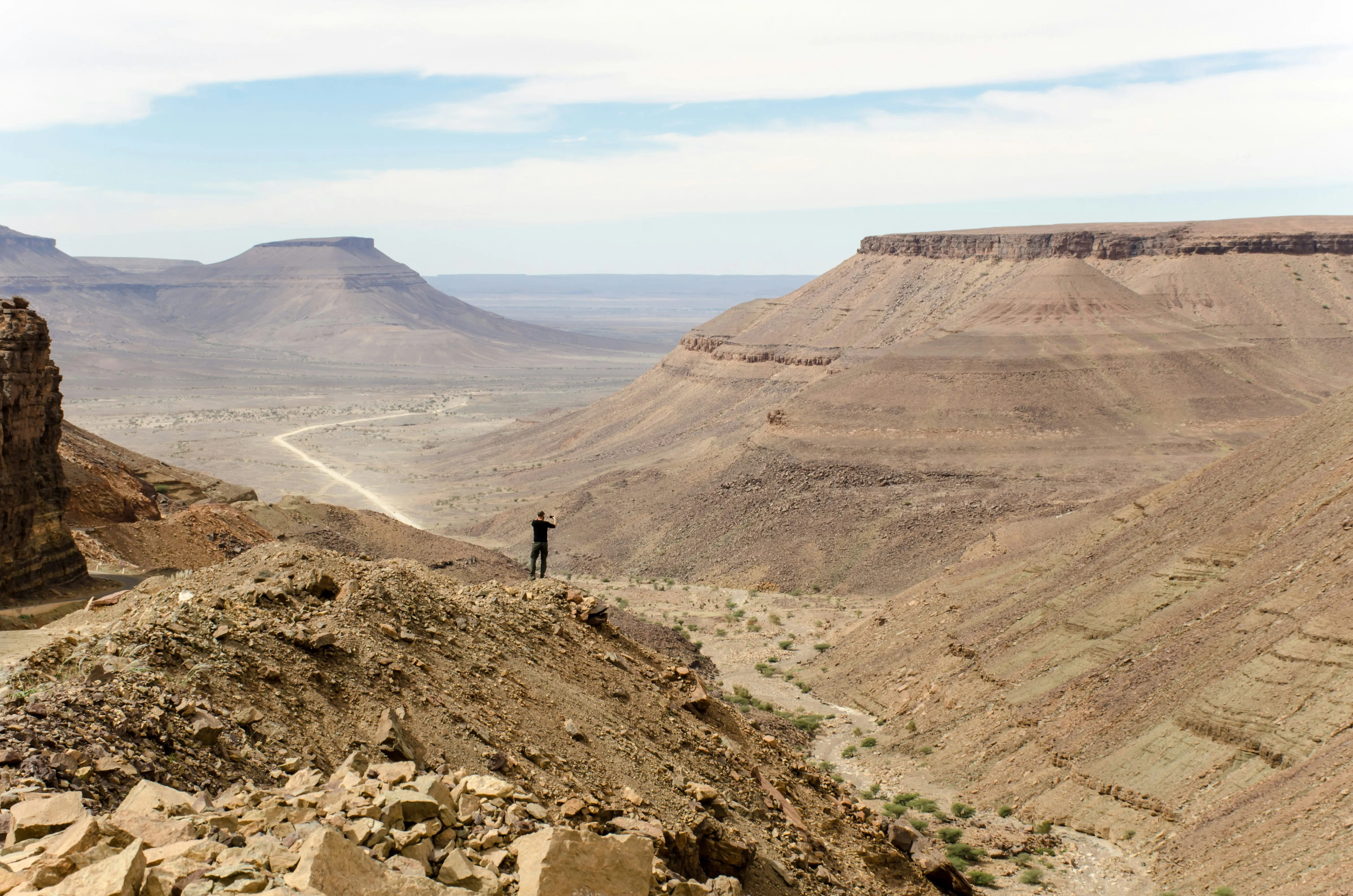
Mauritania
An infinite desert where the dunes meet the Atlantic Ocean, offering raw and ancient beauty for the most adventurous and curious travelers.
Quick Facts
- Capital
- Nouakchott
- Language
- Arabic
- French, Wolof, Soninke, and Fula
- Currency
- Ouguiya (MRU)
- Best time to visit
- From November to March, taking advantage of the milder temperatures outside the months of extreme heat.
- Budget per day
- $30 - $80 per day
- Climate
- Desert climate, characterized by being extremely hot and dry, with more moderate temperature variations on the Atlantic coast.
- Connectivity
- low
- Easy to obtain in main cities through local operators after presenting a passport.
- Electricity
- Type C / F (220V)
- Local transport
- limited
- Card usage
- cash is more common
- Tipping
- optional
🌎 Introduction
Between the waves of the Atlantic and the immensity of the Sahara lies a territory where time seems to follow the rhythm of the wind and the tides. It is a place where the orange of the dunes meets the blue of the ocean, drawing a landscape of contrasts that defines its character. Here, life is organized around oases and fishing ports, maintaining a natural balance between ancient nomadic customs and the slow growth of its urban centers.
Traveling through its plateaus or its markets allows one to understand the importance of hospitality, often symbolized in the tea ritual, which is served calmly and shared among neighbors and newcomers alike. Whether under the intense sun of the dry season or during the cool nights of the desert winter, the daily scene is marked by the movement of robes in the wind and the echo of the caravans that, for centuries, have linked the north of the continent with the sub-Saharan regions.
The identity of this region is perceived as much in the silence of the stone libraries of its ancient commercial cities as in the bustle of the coast when the boats loaded with fish arrive at sunset. It is a geography of wide horizons, where the simplicity of the elements—sand, water, and light—composes a cultural reality that has managed to preserve its essence and traditions over the decades.
🛡️ General Safety
Mauritania is a country that offers a unique and authentic experience for the intrepid traveler, although it requires careful planning and conscious behavior. In general terms, safety for tourists has improved significantly in the last decade, especially on the most visited routes and landmarks.
General safety level
- The safety level in Mauritania is considered medium, with very safe areas for organized tourism and other restricted areas or areas with limited access for border surveillance reasons.
- Compared to other international destinations, the country does not present high rates of violent crime against tourists, but it does require a vigilant attitude and strict following of official recommendations.
- The current context is one of stability, although the traveler must understand that they are in a country with vast stretches of desert where the institutional presence may be limited outside urban centers.
Crime and common risks
- The most common crimes are of a minor nature, mainly pickpocketing and small thefts due to carelessness in crowded areas such as markets or public beaches.
- Scams or cons against tourists are not widespread, but they can occur when hiring informal services or unofficial guides.
- An infrequent but existing risk is the theft of vehicles or belongings on very isolated routes if traveling without the proper equipment or local guides.
Safety in cities and tourist areas
- In cities like Nouakchott (the capital) and Nouadhibou, safety is acceptable during the day. It is recommended to avoid walking through peripheral neighborhoods or poorly lit areas once night falls.
- The tourist areas of the Adrar (Chinguetti, Ouadane, Terjit) are traditionally hospitable and safe for travelers, as the local economy depends largely on tourism.
- It is essential to stay within established tourist circuits and avoid border zones with Mali or areas in the extreme east of the country, which are less traveled and have less security coverage.
Safety in transport
- Public transport consists mostly of shared taxis and intercity buses. Although they are economical, vehicle maintenance standards can be low.
- In Mauritania, people drive on the right. However, driving can be erratic and road rules are not always strictly followed.
- The use of private taxis is recommended in cities, always agreeing on the price beforehand.
- For desert journeys, it is essential to use well-equipped 4x4 vehicles and, preferably, travel in a convoy with guides who know the terrain perfectly. Night driving on the road is strongly discouraged due to the presence of loose animals and vehicles without lights.
Natural and climatic risks
- Extreme heat is the main natural risk. During much of the year, temperatures can exceed 40-45 degrees Celsius, especially in the interior of the country.
- Sandstorms are frequent and can reduce visibility to minimum levels, in addition to causing respiratory problems if proper protection is not used (such as the local turban or cheche).
- Floods are rare, but can occur suddenly during the short rainy season (August-September), blocking tracks and roads.
Local legislation and norms
- Mauritania is an Islamic Republic with laws based on Sharia. It is fundamental to show absolute respect for religious and social customs.
- The consumption, importation, and sale of alcohol are strictly prohibited throughout the country. Possession can lead to prison sentences or severe fines.
- It is forbidden to photograph government buildings, military installations, airports, or bridges. Permission should always be asked before photographing local people.
- Failure to comply with local laws, even through ignorance, can have serious legal consequences, including prolonged detention.
Safety for specific groups
- Female travelers: It is recommended to dress modestly, covering shoulders and knees, to avoid unwanted attention. Although covering the head is not mandatory, carrying a scarf is useful for entering certain places or protecting yourself from the sun. Traveling alone is possible, but it is recommended to do so in organized groups for greater comfort and safety.
- LGTBIQ+ travelers: Homosexuality is illegal in Mauritania and is penalized. Absolute discretion is recommended, and any public display of affection should be avoided, as social acceptance is non-existent in this area.
- Traveling with children or the elderly: The country can be physically demanding due to the climate and limited health infrastructure. It is essential to travel with comprehensive medical insurance and basic health supplies.
Emergencies and assistance
- The main emergency numbers are: 17 for the Police and 116 for the Gendarmerie (outside the cities).
- Emergency services and quality medical care are concentrated almost exclusively in Nouakchott. In case of a serious accident in remote areas, evacuation can be slow and expensive.
- In the event of any incident, it is recommended to stay calm, cooperate with local authorities, and contact your corresponding consular representation or embassy as soon as possible.
Tip: Always register at Gendarmerie checkpoints when traveling by road by carrying printed copies of your passport (known locally as “fiches”) to speed up procedures and make it easier for authorities to know your location.
📝 Entry requirements
To plan a trip to Mauritania, it is essential to ensure that the passport has a minimum validity of six months from the date of arrival in the territory. It is recommended that the document has at least a couple of blank pages to facilitate the stamping of immigration control seals and the placement of corresponding residence permit stickers.
Most international visitors require a visa to enter the country for tourism purposes. This procedure is usually carried out in person at the main entry points, such as Nouakchott airport or land borders, where the traveler’s biometric data is collected. The usual duration of stay permitted for tourist activities is typically thirty days, although it is possible to manage extensions at security offices once inside the country.
During the entry control, authorities may request the presentation of an exit ticket from the country or proof of onward travel to verify the intention not to exceed the permitted time. Likewise, it is common to be asked to demonstrate possession of sufficient funds to cover maintenance and accommodation expenses during the stay in Mauritanian territory, and it is useful to have a confirmed hotel reservation for the first few days.
Regarding customs, there are important restrictions that travelers should know to avoid setbacks. Since it is a nation with specific cultural regulations, the importation of alcoholic beverages is strictly controlled and, generally, prohibited for public consumption. Regarding medications, it is advised to always carry the original medical prescription, especially for specialized treatments, to facilitate passage through security controls.
From a health point of view, it is strongly recommended to travel with comprehensive medical insurance that includes repatriation. It is common for an international vaccination certificate against yellow fever to be required, especially if the traveler comes from areas where this disease is endemic. It is advisable to consult with a travel medicine center before departure for recommendations on other vaccines and preventive measures related to the geographical environment.
- Passport validity: Minimum of six months.
- Visa processing: Usually available at airports and main borders.
- Stay period: Thirty days, extendable.
- Additional documentation: Return ticket and proof of financial funds.
- Customs restrictions: Prohibition of alcohol and strict control of prohibited products.
- Health: Vaccination certificate depending on origin and recommended travel insurance.
🏜️ Places of interest and tourist attractions
Mauritania offers a wealth of landscape and culture centered mainly on the Sahara Desert and its historic cities. Travelers seeking an authentic experience away from mass circuits will find destinations that seem frozen in time.
- Chinguetti: Considered the seventh holy city of Islam, it stands out for its ancient libraries housing medieval manuscripts and its dry stone architecture.
- Banc d’Arguin National Park: A natural sanctuary on the Atlantic coast home to thousands of migratory birds and where it is possible to observe local fishermen using traditional techniques.
- Ouadane: A caravan city declared a World Heritage Site, located on the edge of the Adrar massif, ideal for understanding the history of trans-Saharan trade.
- Nouakchott: The capital of the country, where the fish market on the beach offers a vibrant view of the economic and daily life of the population.
- Terjit: A paradisiacal oasis among dunes and rock formations, known for its thermal springs and dense palm groves that offer refuge from the desert heat.
💡 Recommendations for the traveler
The Mauritanian environment requires proper preparation to enjoy the experience safely and respectfully. The climate and local customs are determining factors when organizing the itinerary.
- Clothing: The use of discreet clothing that covers shoulders and legs is recommended, respecting the country’s cultural sensitivities.
- Climate: The use of high solar protection, hats, and constant hydration is vital due to the extreme temperatures in desert areas.
- Currency and payments: The use of cash in local currency is predominant, so it is advisable to exchange money in the main cities, as the use of credit cards is very limited.
- Transport: For travel into the interior, it is preferable to use all-terrain vehicles and, where possible, travel in organized groups through known areas.
- Language: Although Arabic is the official language, knowledge of basic French can be very useful for communicating in tourist and urban environments.
🏥 Basic health considerations
When preparing for your trip to Mauritania, you will see that health planning is fundamental to enjoying the experience with peace of mind. Being a country with a geography marked by the desert and extensive rural areas, medical infrastructure is not always at the level you might find in more urbanized destinations. In main cities like Nouakchott or Nouadhibou, you will find private clinics that offer acceptable care for minor problems or basic diagnoses, but in the rest of the territory, resources are quite limited.
Access to public health care is often precarious, and tourists usually always turn to private healthcare. You should keep in mind that the costs of these services for foreigners can be high, as immediate payment is expected for any consultation or treatment. An important point is language, as most healthcare personnel communicate in French or Arabic, so if you do not speak these languages, you might have some difficulty explaining your symptoms.
Taking out travel medical insurance is not just a recommendation, but an absolute necessity before landing in the country. It is vital that your policy includes very broad coverage for medical repatriation, as in the event of any serious mishap, you will most likely need to be transferred to another country with better hospitals. Make sure the insurance also covers hospitalization costs and advance payment of services, so you do not have to pay large sums of money out of your own pocket.
Regarding vaccines, the yellow fever vaccine is mandatory for all travelers entering the country. Additionally, it is highly advisable to have your official vaccination schedule up to date, including hepatitis A and B, tetanus, and typhoid fever. As recommendations can change depending on the time of year or the specific area you visit, the ideal is to go to an international vaccination center a few weeks in advance to receive personalized advice on malaria prophylaxis, especially if you plan to move around the areas near the Senegal River.
If you take any specific medication, I recommend you take it with you from the start of the trip in sufficient quantities, preferably in its original packaging and accompanied by a medical prescription translated into French. Although there are pharmacies in large cities, it is not always easy to find specific brands or very specific medications. A small first-aid kit with painkillers, disinfectants, basic wound care materials, and stomach protectors will be very useful during your desert routes.
The most common health risks you will encounter are related to the extreme climate. Intense heat can cause rapid dehydration or heat stroke if you do not take precautions. It is also common to suffer insect bites, so the use of strong repellents and clothing that covers the skin at sunset will be your best defense. On the other hand, although the risk of large-scale diseases is low, you should always be attentive to hygiene conditions to avoid gastrointestinal problems.
Regarding water and food, the golden rule is to always consume bottled water and ensure that the seal is intact when opening it. You should not consume ice cubes or wash fruits with tap water. As for food, you will see that dishes cooked at high temperatures are safe, but you should be more careful with raw vegetables or salads at street stalls where the cold chain or washing is not guaranteed.
In case of a medical emergency, the usual contact numbers are 101 for the Gendarmerie or 118 for Civil Protection, although you should know that the ambulance service does not operate with the speed or equipment you might expect elsewhere. In critical situations, the most effective approach is usually to contact your medical insurance directly or go by your own means to the nearest private clinic if you are in an urban area.
As final tips for your stay, always try to maintain constant hydration even if you don’t feel thirsty and protect your skin with high-factor sunscreen. Avoid walking barefoot in sand or stagnant water areas to prevent skin parasites. If you follow these basic guidelines and maintain a cautious attitude toward hygiene, your time in Mauritania will be a safe and rewarding experience.
🚌 Transport within the country
Moving around Mauritania requires a good dose of adaptability, as infrastructure is heavily conditioned by the territory’s desert geography. The most common way to travel between urban centers is by road, using minibuses or shared vehicles. These transports usually depart from stations located on the outskirts of cities and generally do not have a fixed schedule; instead, they start the journey once all available seats have been filled.
The train has a very limited presence and is practically reduced to a single railway line in the north, used mainly for transporting raw materials, although it allows for the transport of passengers in very basic conditions. To cover the enormous distances between major cities like Nouakchott and Nouadhibou, there are some internal flights, which represent the fastest option, although frequencies are often limited and journeys are subject to last-minute changes.
Within large cities, the most common medium is the taxi. These vehicles operate flexibly, sometimes allowing for shared use to make the trip cheaper. Urban signage is not always clear, and the purchase of tickets for long journeys is done in person at departure points, where knowledge of languages like French can facilitate communication with drivers and managers.
In rural areas or on routes that venture into the Sahara, transport becomes more complex and usually depends on all-terrain vehicles. In these areas, the reliability of journeys is subject to the state of the tracks and weather conditions. In general terms, travel through the country is usually slow and the level of comfort is simple, so it is necessary to understand transport as another part of the local experience, where punctuality is flexible.
Tip: It is recommended to start journeys early in the morning, as this is when shared vehicles usually fill up more quickly and the hottest hours during the journey are avoided.
🤵 Culture and etiquette
In Mauritania, hospitality constitutes a fundamental pillar of social identity, and treatment of visitors is usually slow-paced and welcoming. The greeting is an essential ritual that precedes any interaction; omitting or rushing it can be perceived as a lack of attention. It is common for these introductions to last for a few moments, exchanging wishes for peace and well-being. Regarding physical contact, it is important to always use the right hand to greet, hand over documents, pay, or eat, as the left hand is traditionally associated with personal hygiene tasks.
Behavior in public spaces is governed by discretion and moderation. It is valued to maintain a low voice volume and avoid effusive displays of affection, as privacy and modesty are highly appreciated qualities. Regarding punctuality, there is a flexible conception of time, where the quality of the encounter and conversation is prioritized over the rigidity of schedules. Interactions between men and women are usually formal in public settings, generally limited to a verbal greeting or a slight nod of the head if there is no prior trust.
Social life and home visits usually revolve around the tea ritual, a sign of welcome consisting of three glasses served calmly. If you receive an invitation to eat, it is common for food to be presented in a large common dish for sharing, and it is customary to remove your shoes when entering carpeted rooms in homes. In the service sector, tips are well-received as a gesture of gratitude for good treatment, although they are not considered a strict obligation.
Respect for religious beliefs and social hierarchies is fundamental for harmonious coexistence. During times of prayer or when passing near places of worship, it is recommended to act with silence and prudence. Clothing is usually conservative, covering shoulders and legs, which is interpreted as a sign of respect for local traditions and the social environment. Similarly, treatment of the elderly should always be marked by special deference, recognizing their role within the community.
“Tip”: Before photographing people or scenes of daily life, it is essential to ask politely for permission, as privacy is deeply valued and some people may prefer not to be portrayed.
🍛 Typical gastronomy
The gastronomy of Mauritania is the result of a fascinating mix of nomadic desert traditions and influences from neighboring countries in sub-Saharan Africa and the Maghreb. The diet is fundamentally based on products from the land and livestock, such as rice, couscous, dates, and meats like lamb, goat, or even camel. In coastal areas, the Atlantic Ocean provides an exceptional variety of fresh fish, which becomes the star ingredient in many daily dishes.
The way of eating in this country has a strong social and community component. It is very common for food to be served on a large tray shared by all diners, who sit on carpets or cushions around the dish. Following local customs, it is customary to use the right hand to serve oneself, although in establishments in urban areas, the use of cutlery is completely normalized. Flavors are usually authentic and simple, without an excess of hot spices, allowing the quality of the main product to stand out.
The ritual of drinking is inseparable from the culinary experience. Mauritanian tea (Ataya) is a fundamental pillar of hospitality and is traditionally served in three successive glasses, with different levels of sweetness and concentration. On the other hand, due to predominant religious beliefs, the consumption of alcohol is non-existent in the usual commercial circuit, being replaced by soft drinks, water, or zrig, a refreshing drink made with milk (camel or cow), water, and sugar, highly appreciated for combating the desert heat.
Regarding etiquette and schedules, lunch is usually the main meal of the day and is taken in the early afternoon. In larger cities, such as the capital, there is a varied offer that allows for exploring both traditional cuisine and international adaptations. It is important to keep in mind that during the month of Ramadan, business hours and food availability during the day change significantly, so it is advisable to plan meals in advance if traveling on those dates.
| Dish | Description | Main Ingredients | Where to try it | Tip |
|---|---|---|---|---|
| Thieboudienne | Considered the national dish, it is rice cooked with fish and vegetables. | Fish, rice, tomato, carrot, and spices. | Nouakchott restaurants and coastal areas. | Try it on the coast to ensure the freshness of the fish. |
| Méchoui | Meat roasted slowly until it is tender and juicy. | Lamb or goat and local spices. | Specialized stalls and local festivities. | It is the ideal dish for celebrations and group dinners. |
| Maru we-lhout | Local version of white rice accompanied by fish and an intense sauce. | Rice, white fish, onion, and oil. | Traditional restaurants in Nouadhibou. | Always ask for the “fish of the day” to enjoy the best flavor. |
| Mauritanian Couscous | Steamed wheat semolina served with meat and vegetables. | Wheat semolina, camel or lamb meat, and legumes. | Eating houses and stops on inland routes. | Mix the ingredients well so the semolina absorbs the juices. |
| Bonava | Simple stew of meat and potatoes with a homemade flavor. | Lamb meat, potatoes, onion, and peanut oil. | Small local cuisine restaurants. | Accompany it with traditional local bread (Al-Kessra). |
📷 Zones and places to visit
Mauritania is a destination where the Sahara Desert meets the Atlantic Ocean, offering a geographic and cultural contrast of great serenity. The capital, Nouakchott, is usually the main entry point and allows one to observe the transition between nomadic and urban life. In this city, the Fishermen’s Port stands out as a space full of daily activity, where traditional boats return to the coast at sunset in a spectacle of colors and collective effort. Additionally, the National Museum of Mauritania offers a necessary insight to understand the archaeology and ethnography of the region, housing objects that tell the history of the peoples who have inhabited these arid lands.
Inland, the Adrar Plateau represents the historical and geographical heart of Mauritania. In this area lie the ancient cities of Chinguetti and Ouadane, declared World Heritage Sites. These stone settlements, known as ksour, were vital centers on the trans-Saharan caravan routes. Walking through the narrow streets of Chinguetti is like stepping back in time, especially when visiting its ancient libraries that house medieval manuscripts of incalculable scientific and religious value. The surrounding landscape is dominated by the dunes of Erg Amatlich, which offer one of the most representative images of the deep desert.
For those seeking direct contact with nature, Banc d’Arguin National Park is a mandatory stop on the Atlantic coast. This protected space is one of the most important migratory bird sanctuaries in the world, where the desert gently sinks into the sea, forming sandbanks and shallow waters. It is also home to the Imraguen, a fishing community that maintains traditional techniques in harmony with the ecosystem. The silence of the park and its marine biodiversity provide an experience of absolute calm, far from any urban center.
In contrast to the aridity of the dunes, the Terjit Oasis appears as a refuge of lush vegetation hidden among rocky canyons. This enclave is famous for its natural springs and its dense palm groves, providing a pleasant temperature and an ideal environment for understanding the importance of water points in desert life. On the other hand, in the remote east of the country, the city of Oualata stands out for its unique architecture, where the facades of the houses are decorated with traditional geometric paintings made by local women, giving the place a very particular artistic aesthetic that differs from the rest of the country.
The northern zone of Mauritania offers a more industrial and adventurous vision, marked by the presence of Nouadhibou, the second most important city, located on a peninsula shared with Western Sahara. Near this area, the route of the Iron Ore Train crosses the desert carrying ore, which has become an emblematic route for observing the immensity of the Mauritanian landscape. The contrasts between the rural areas, where time seems to have stopped, and the dynamism of the coastal cities reflect the identity of a country that jealously guards its traditions while timidly peering into modernity.
Tip: You cannot miss visiting Chinguetti, the most emblematic place in the country.
✈️ Best time to travel
The choice of the right time to visit Mauritania depends largely on the region you wish to explore, although generally, the months between October and March offer the most favorable conditions. During this period, the climate is more moderate, which facilitates travel through the desert and visits to the ancient commercial settlements of the interior, where temperatures are usually extreme the rest of the year.
In coastal areas, such as Nouakchott or Nouadhibou, the influence of the Atlantic Ocean helps to soften the atmosphere, maintaining more constant temperatures. However, for those seeking to venture into the dunes of Adrar or visit historic cities like Chinguetti, it is essential to avoid the months of most intense heat to ensure a comfortable and safe travel experience.
| Season | Months | Typical Climate | What to Expect | Tourist Influx |
|---|---|---|---|---|
| Spring | Mar – May | Rising temperatures and dry desert winds. | Possibility of sandstorms; ideal for bird watching on the coast before the heavy heat. | ⭐⭐ Medium |
| Summer | Jun – Aug | Intense heat, especially inland; some rains in the south. | Very dry and hot environment; activity moves to coastal areas with sea breezes. | ⭐ Low |
| Autumn | Sep – Nov | Gradual decrease in heat and clearer skies. | Transition to ideal weather; start of hiking routes and desert caravans. | ⭐⭐ Medium |
| Winter | Dec – Feb | Mild and sunny days; cold nights in desert areas. | Optimal time for dune circuits, starry skies, and local cultural festivals. | ⭐⭐⭐ High |
🗣️ Basic vocabulary
Although French is frequently used in urban centers and the tourism sector of Mauritania, knowing some expressions in Hassaniya (the local Arabic dialect) will greatly facilitate your interaction with the population. Showing interest in communicating in their language is usually very appreciated and helps create an atmosphere of trust in markets, transport, or daily situations.
It is not necessary to delve into grammar to manage fluently during the trip; it is enough to integrate these basic words to greet courteously, thank gestures, or make simple inquiries during your stay.
- Salaam Alaykum: Traditional greeting meaning “peace be upon you.”
- Wa Alaykum Salaam: Standard response to the previous greeting.
- Shukran: Thank you.
- Labass: Used both to ask “how are you?” and to answer “everything is fine.”
- Iye: Yes.
- Laa: No.
- Min fadlak: Please.
- Bikem?: How much does it cost?
- Samaah: Sorry or excuse me.
- Maa: Water