


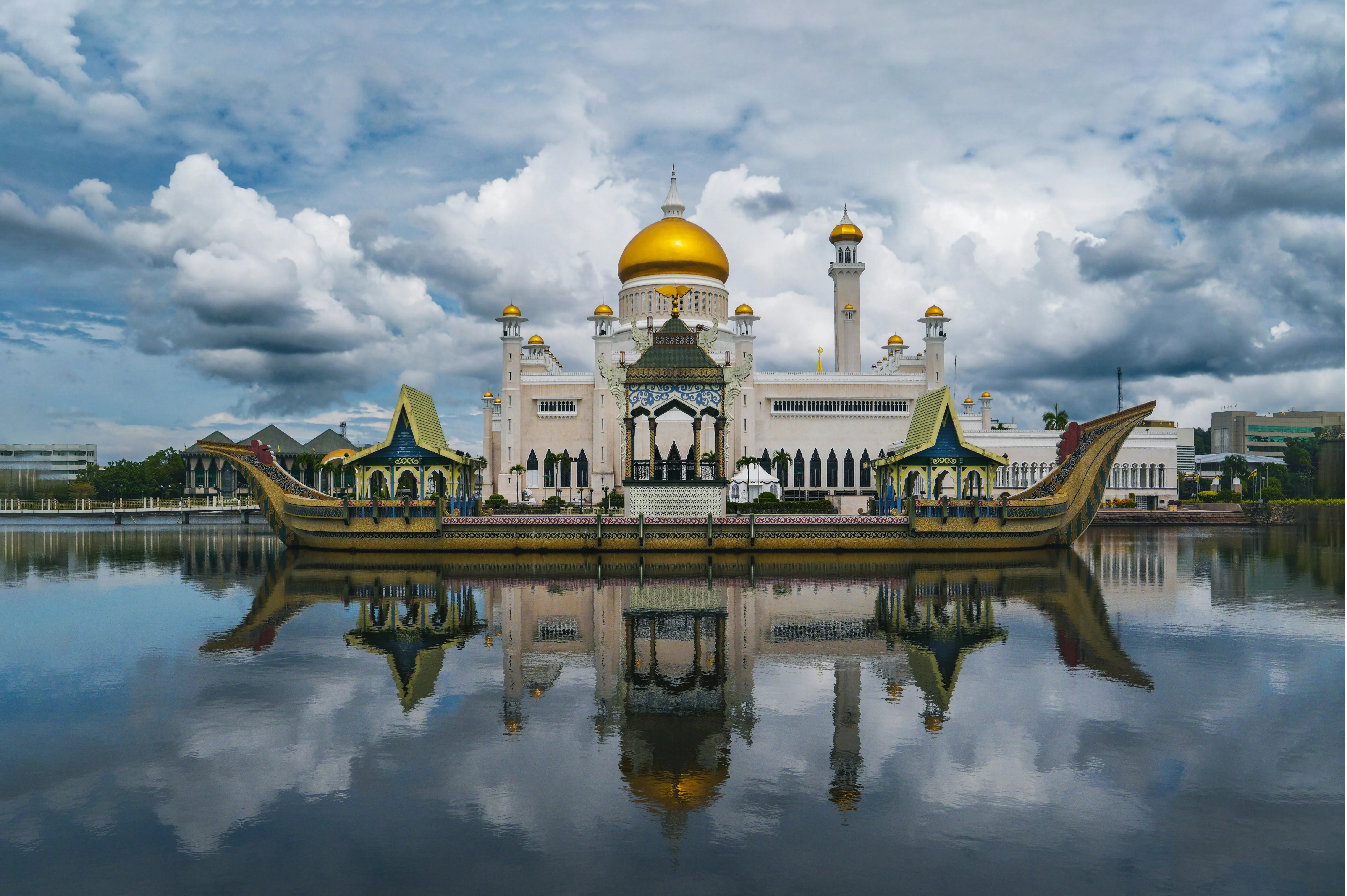
Brunei
Discover a serene sultanate where golden mosques and pristine jungles coexist in harmony, offering an authentic and peaceful cultural experience in the heart of Borneo.
Quick Facts
- Capital
- Bandar Seri Begawan
- Language
- Malay
- English, Chinese
- Currency
- Brunei Dollar (BND)
- Best time to visit
- From January to May, during the driest season.
- Budget per day
- $45 - $130 per day
- Climate
- Tropical climate, hot and humid year-round, with frequent rainfall that maintains its lush jungle.
- Connectivity
- good
- Very easy to obtain at the airport and shopping centers.
- Electricity
- Type G (240V)
- Local transport
- limited
- Card usage
- acceptable
- Tipping
- no
🌎 Introduction
Located in the heart of the island of Borneo, this corner of Southeast Asia unfolds between dense tropical jungles and the waters of the South China Sea. The landscape is marked by a deep green that remains constant throughout the year, thanks to a warm climate where brief afternoon rains often refresh the atmosphere, dictating a slow and peaceful pace of life.
In its cities, architecture featuring domes that reflect the sunlight coexists naturally with the simplicity of floating villages, where wooden houses rise above the water as they have for centuries. At sunset, local markets fill with the aromas of spices and traditional dishes, while daily life passes with a calm that allows for a close observation of a culture that values its roots and the natural environment that surrounds it.
🛡️ General safety
Brunei is known for being one of the most stable and peaceful countries in Southeast Asia. Below is the necessary information to ensure your stay is safe and pleasant.
General safety level
The level of safety for tourists in Brunei is very high. The country is characterized by great political and social stability, which translates into a very welcoming environment for international visitors.
- The overall rating of the country in terms of safety is excellent, placing it significantly above the regional average.
- In an indicative comparison, the risk is considered low, similar to that of the safest cities in Europe or East Asia.
- The context for the traveler is one of absolute tranquility; it is a destination where you can walk the streets at almost any time without a sense of insecurity.
Crime and common risks
Although crime is minimal, as in any destination, it is worth keeping certain aspects in mind:
- The most common crimes, although rare, are petty theft or bag snatching in market areas or crowded events.
- Organized scams against tourists are not usually reported, but it is always advisable to use official services.
- An infrequent risk worth mentioning is theft from vehicles if valuables are left in sight, especially in hiking areas or remote beaches.
Safety in cities and tourist areas
Safety in urban centers, such as the capital Bandar Seri Begawan, is very solid.
- Tourist neighborhoods and the city center are very safe areas, even after sunset.
- Public transport is limited but safe; most tourists get around on foot through the center or use ride-hailing apps with total confidence.
- There are no relevant safety differences between different areas of the country, as both urban and rural areas maintain the same standard of public order.
- As a practical recommendation, it is enough to apply basic common sense: watch your belongings in crowded places and avoid carrying large sums of visible cash.
Transport safety
Moving around Brunei is simple and generally very safe, though with peculiarities specific to the country.
- Public transport (buses) is reliable but has limited routes and schedules.
- The use of taxis is safe, although there are few units. It is highly recommended to download the Dart app (the local equivalent to other private transport apps), which is the most reliable and safe method to get around.
- In Brunei, people drive on the left. Roads are in excellent condition and driving is usually respectful.
- If you decide to rent a vehicle, make sure to strictly respect speed limits and traffic signs, as fines can be high.
Natural and climatic risks
Brunei has a tropical climate that carries certain seasonal risks that should not be ignored.
- Extreme heat and high humidity are constant throughout the year. It is essential to stay hydrated and use sun protection to avoid heatstroke.
- Torrential rains are common, especially during the monsoon season (October to January and May to July), which can cause localized flash flooding.
- Although Brunei is not in a high seismic activity zone, it can occasionally be affected by haze (smoke from forest fires in neighboring regions) between the months of June and September.
- It is recommended to always follow local weather warnings if planning jungle excursions or water activities.
Legislation and local norms
This is the most important section for the tourist in Brunei, as the country is governed by strict laws based on Sharia.
- The consumption and sale of alcohol are prohibited throughout the country. Non-Muslim tourists can import a limited amount for private consumption, but they must never consume it in public.
- Smoking is prohibited in almost all public places and the import of tobacco is subject to very strict taxes from the first unit.
- Visitors are expected to dress modestly (shoulders and knees covered), especially when visiting mosques or government buildings.
- Any criticism or disrespect towards the royal family or the Islamic religion is a serious crime that can lead to prison sentences.
- The trafficking or consumption of drugs is punished with extremely severe penalties, including the death penalty.
Safety for specific groups
- Female travelers: Brunei is a very safe destination for women traveling alone. Respect is the general rule, although it is recommended to dress modestly to avoid unwanted attention and respect the local culture.
- LGTBIQ+ travelers: It is important to know that same-sex relationships are illegal in Brunei. Maximum discretion is recommended, and any public display of affection should be avoided, as failure to comply with these rules can lead to serious legal sanctions.
- Traveling with children or seniors: The country is extremely family-oriented. Infrastructure is good, and respect for the elderly and protection of children are deeply rooted in society.
Emergencies and assistance
The emergency system in Brunei is efficient and services usually speak English.
- Police: 993
- Ambulances: 991
- Firefighters: 995
- Emergency services and hospitals in the capital have modern technology and well-trained staff.
- In case of any incident, stay calm and contact local authorities or your nearest consular representation. It is essential to always travel with comprehensive medical insurance.
Tip: Scrupulously respect rules on alcohol and dress; in Brunei, compliance with local law is the best guarantee for enjoying a trouble-free trip.
📝 Entry requirements
To plan a visit to this destination, it is essential to keep in mind that most international travelers require a passport with a minimum validity of six months from the date of arrival. This is a standard requirement to ensure the document is valid throughout the stay and for any unforeseen events in the itinerary.
Regarding access, many citizens can benefit from a visa exemption for short-term tourist stays. These periods usually vary depending on international agreements, allowing stays in the territory for periods that typically range between fourteen and ninety days. It is advisable to check the current conditions for each particular situation before flying.
During the entry process at airports or border points, authorities may request the presentation of a confirmed onward ticket to a third country or the place of origin. Similarly, proof that the tourist has sufficient financial funds to cover expenses during the planned stay in the country is sometimes required.
Customs regulations are a relevant aspect to consider, as there are strict restrictions on the import of products such as alcohol, tobacco, and certain pork-derived foods, due to local cultural and religious regulations. When traveling with personal medications, it is advised to carry the original medical prescription to facilitate routine security checks.
In terms of health, mandatory vaccinations are not usually required in general, unless the traveler comes from an area with a risk of transmission of specific diseases. However, it is considered highly recommended practice to have travel medical insurance with broad coverage and to keep the standard international travel vaccination schedule up to date.
- Identity document: A passport with at least six months of validity is required.
- Tourist visa: Generally exempt for short stays, subject to the traveler’s origin.
- Proof of exit: It is common to be asked for a return or onward ticket.
- Financial resources: Possible request for proof of economic solvency for the stay.
- Customs controls: Rigorous monitoring of prohibited substances, alcohol, and certain medications.
- Health recommendation: Purchasing health insurance with international coverage.
🏥 Basic health considerations
Brunei has an excellent quality health system, especially in the capital, Bandar Seri Begawan. As a tourist, you will notice that medical services are modern and efficient, although you will most likely need to go to private clinics, as the public system is primarily oriented toward local citizens. Assistance costs for foreigners are usually quite high, so it is essential to keep this in mind before your arrival. A very positive point is that the vast majority of health personnel speak English fluently, which will greatly facilitate communication if you need to explain any symptoms.
Taking out travel medical insurance is a fully recommended measure for visiting the country. Although it is not usually a mandatory requirement to cross the border, having a policy will give you the necessary peace of mind in case of any unforeseen event. It is vital that your insurance includes broad coverage for hospitalization and medical repatriation, as in the case of a serious emergency requiring transfer to another country, costs could be astronomical without this support.
Regarding vaccines, you will not find mandatory requirements to enter the sultanate, unless you come from an area with a risk of yellow fever, in which case they will ask for the international certificate. The most advisable thing is to verify that your regular vaccination schedule is up to date. Some travelers prefer to reinforce their protection against hepatitis A and B if they plan long stays or trips through very rural areas, but for a conventional tourist trip, standard precautions are more than enough.
You should be especially careful with the personal medication you decide to carry in your luggage. Brunei has extremely rigorous laws regarding the entry of controlled substances. If you need prescription medication, make sure to carry the original medical prescription with you and, if possible, a brief report in English justifying its use. Always keep the drugs in their original packaging to avoid any confusion or problems at customs controls.
The main health risk you will encounter is related to the tropical climate. Intense heat and high humidity levels can take a toll if you do not hydrate correctly, causing dizziness or exhaustion. You will see that mosquitoes are present, so the use of an effective repellent is essential to prevent diseases like dengue, which is endemic to the region. Otherwise, you will not have to worry about altitude risks or serious diseases common in other tropical areas, as the country maintains very strict health control.
Food hygiene in Brunei is generally excellent. You can try the delicious food from night markets and street stalls with great confidence, as cleanliness standards are higher than those of other neighboring countries. Regarding water, although it is considered drinkable in urban areas, you will notice that the general recommendation for visitors is to consume bottled water or boiled water, thus avoiding minor stomach discomforts that could ruin a couple of days of excursion.
In case you face a medical emergency, the phone number you should dial is 991. This service centralizes ambulance and emergency care. Care in cities is fast and professional, and the main hospitals are equipped with state-of-the-art technology to handle any critical situation that may arise during your stay.
As final practical tips, remember to protect yourself from the sun with high-factor creams and wear clothes made of natural fabrics that allow for perspiration. Maintaining constant hydration and using insect repellent at dawn and dusk will be your best tools for enjoying Brunei’s exuberant nature without setbacks. With these basic precautions and good insurance in your suitcase, your experience in the country will be comfortable and safe.
🚌 Transport within the country
Travel within Brunei is mainly by road, as the country does not have railway networks or metro systems. In the capital, Bandar Seri Begawan, the most common means for visitors opting for public transport is the city bus. These vehicles travel through the main districts in a circular fashion and connect well-known points of interest, although their frequency can be somewhat slow compared to other international cities.
Ease of use for the tourist is reasonable, given that signage usually appears in both Malay and English, which facilitates orientation. Ticket acquisition is a simple process generally done at the time of boarding. It is important to keep in mind that the system is designed for a quiet pace of life, so waiting times may vary.
A distinctive and necessary element for the traveler is the use of speedboats or water taxis. This medium is essential for moving along the river and accessing traditional settlements built over the water. These are short, constant trips and offer a form of transport very integrated into the daily life of the central area.
Regarding private transport, conventional taxis are not particularly numerous on the streets. For this reason, it is very common among visitors to use mobile transport apps to manage their journeys comfortably and predictably. Roads are in a good state of conservation, allowing for smooth and safe driving if one decides to opt for a rental vehicle to explore the territory.
There are notable differences between the capital and more remote areas. While urban mobility is varied, in rural areas or more jungle-like districts, public transport options are very limited. To reach areas like Temburong, improvements in land infrastructure have greatly facilitated access, although the natural environment continues to set the pace for travel.
Tip: Plan your trips in advance and consider using digital transport apps to ensure greater vehicle availability.
🤵 Culture and etiquette
Bruneian society is characterized by a deep sense of courtesy and discretion in daily interactions. Public behavior is usually slow and calm, with positive value placed on maintaining a moderate voice volume and a serene attitude. Communication tends to be indirect to preserve social harmony, so it is common for local residents to be extremely kind and avoid direct confrontations or gestures of impatience.
Regarding greetings, a soft handshake is common, after which some people briefly bring their hand to their chest as a sign of respect and sincerity. However, in interactions between people of the opposite sex, it is best to wait for the local person to initiate the gesture; if they do not, a verbal greeting accompanied by a slight bow of the head is perfectly correct. Additionally, there is a specific etiquette rule for pointing at objects or directions: instead of using the index finger, the thumb of the right hand is used, resting on the other fingers of the closed hand, a gesture considered much more refined.
Respect for hierarchies and authority figures, especially the royal family, is a fundamental pillar of local culture. This deference also extends to the elderly, who are given priority in treatment and passage. In places of worship, such as mosques, behavior must be especially observant of silence and dress, which must cover shoulders and knees loosely. Likewise, it is a common and necessary practice to remove your shoes when entering both religious buildings and private homes.
In the realm of gastronomy and social gatherings, the use of the right hand is essential, as it is the hand intended for eating and for giving or receiving food. Although the use of cutlery is common in urban settings, if participating in a traditional meal, the use of the left hand for handling food should be avoided. Regarding tipping, it is not a deeply rooted or mandatory custom in the country, although it is accepted in international hotels or restaurants if one wishes to recognize exceptional service.
“Tip”: When giving or receiving any object, such as a business card, money, or a gift, it is recommended to use the right hand (optionally supported by the left at the wrist) or both hands, as this gesture is interpreted as a sign of appreciation and good manners.
🍛 Typical gastronomy
The gastronomy of Brunei is defined by a rich blend of influences from its Southeast Asian neighbors, especially Malaysia and Indonesia, though with its own nuances that make it unique. Rice is the fundamental pillar of the daily diet, serving as an accompaniment for a wide variety of stews, meats, and fish. Flavors are usually intense and aromatic, thanks to the generous use of coconut milk, lemongrass, ginger, galangal, and chili, which provide a balance between creamy and spicy.
As a Muslim-majority country, almost the entire culinary offering is halal. This implies the absence of pork in traditional menus and a total restriction on the public sale and consumption of alcohol. In its place, local inhabitants enjoy a wide range of tropical fruit juices and tea with condensed milk, a very popular drink served both hot and cold. Meal times are usually similar to international standards, although night markets take on special relevance at sunset, becoming the center of social life.
Regarding table etiquette, conventional cutlery is common in most establishments, although in more traditional or family settings, eating with the right hand is common. If choosing this method, the left hand should never be used to touch food. Dishes are usually served in the center of the table to be shared, reflecting the importance of community and family in Bruneian culture.
| Dish | Description | Main Ingredients | Where to try it | Tip |
|---|---|---|---|---|
| Ambuyat | National dish with a viscous texture eaten by rolling it onto bamboo sticks. | Sago palm starch and water. | Traditional food restaurants in the capital. | It should be dipped in sour or spicy sauces without chewing. |
| Nasi Katok | Very popular local fast food consisting of a serving of rice and chicken. | Rice, fried chicken, and sambal (spicy sauce). | Street stalls and night markets. | It is ideal for a light and quick meal at any time. |
| Satay | Marinated meat skewers grilled with a smoky touch. | Meat (beef or chicken), spices, and peanut sauce. | Outdoor food markets. | Make sure to ask for enough peanut sauce for dipping. |
| Ayam Penyet | Fried chicken that is smashed to tenderize the meat before serving. | Chicken, local spices, rice, and chili paste. | Small local restaurants and food courts. | It is usually quite spicy, so it’s good to have a drink nearby. |
| Pulut Panggang | Rice snack wrapped in banana leaves and grilled over charcoal. | Glutinous rice, coconut, and shrimp or meat filling. | Roadside stalls and local markets. | It is the perfect snack to take along during excursions. |
📷 Areas and places to visit
Brunei offers a singular experience in Southeast Asia, where serenity and tradition intertwine with modern and ostentatious architecture. The epicenter of any tour begins in its capital, Bandar Seri Begawan, a city that stands out for its cleanliness and tranquility. In the heart of the city center lies the Sultan Omar Ali Saifuddien Mosque, a building surrounded by an artificial lagoon that projects an image of absolute calm. Not far from there, the Jame’ ‘Asr Hassanil Bolkiah Mosque stands imposing with its golden domes and meticulously cared-for gardens, representing one of the most prominent examples of contemporary religious architecture in the region.
The capital’s most fascinating contrast is found by crossing the river to Kampong Ayer, historically known as the Venice of the East. This stilt settlement constitutes a vast network of houses, schools, and mosques connected by wooden walkways. Touring this area in a traditional boat allows for observing the local way of life, which has endured for centuries while adapting to modern times. It is an environment where authenticity remains intact against the development of the financial and government districts rising just meters from the shore.
For those looking to delve deeper into the history and protocol of this state, the Royal Regalia Museum houses an extensive collection of objects linked to the monarchy, from ceremonial carriages to diplomatic gifts from around the world. Near the capital is also the Istana Nurul Iman Palace, the official residence of the Sultan. Although access is usually restricted to the general public, its imposing facade and dimensions are visible from the river or from neighboring parks, such as Persiaran Damuan, a green space ideal for walking and observing sculptures by regional artists.
Nature is the other great pillar of the country, especially in the Temburong district. This area, physically separated from the rest of the provinces, is accessed by crossing dense mangroves that serve as a refuge for various species of local fauna, such as proboscis monkeys. Ulu Temburong National Park is the main destination for ecotourism, offering hiking trails and observation structures in the treetops that allow one to appreciate the immensity of the primary tropical jungle, an ecosystem that Brunei has preserved with great rigor.
To the west, the districts of Tutong and Belait offer a different perspective, more linked to industry and the coast. In Tutong, one can visit natural lakes and serene beaches like Seri Kenangan, where the river and the sea meet on a narrow strip of sand. For its part, in Belait, the economic importance of the country is perceived, but it is also possible to enjoy recreational areas and museums dedicated to the technological development and natural resources that have defined the recent history of this nation.
Tip: You cannot miss visiting the Sultan Omar Ali Saifuddien Mosque, the most emblematic place in the country.
✈️ Best time to travel
Brunei has a tropical rainforest climate throughout the year, characterized by warm temperatures typically ranging between 24°C and 32°C, along with constant humidity. Being close to the equator, it does not have extreme climatic seasons, although rainfall is a constant that varies in intensity depending on the month. The choice of date will depend on whether one prefers to avoid the heaviest rain periods or if one seeks to participate in any of the country’s cultural festivities.
In general terms, the months of February and March are usually considered favorable for outdoor activities, as statistically they record a lower volume of rainfall. However, the country offers a peaceful travel experience at any time, allowing for the exploration of its mosques, floating villages, and dense tropical vegetation in a leisurely manner and without the large crowds common in other Southeast Asian destinations.
| Season | Months | Typical climate | What to expect | Tourist influx |
|---|---|---|---|---|
| Spring | Mar – May | Warm with moderate rain and high humidity. | Favorable conditions for hiking and wildlife observation in national parks. | ⭐⭐ Medium |
| Summer | Jun – Aug | Hot with occasional afternoon showers. | Celebrations for the Sultan’s birthday (July), with parades and cultural events. | ⭐⭐⭐ High |
| Autumn | Sep – Nov | Increase in rainfall and cloudy days. | Intense green jungle landscapes and fewer visitors at monuments. | ⭐ Low |
| Winter | Dec – Feb | Wettest season due to the northeast monsoon. | Chinese New Year celebration and a relaxed urban atmosphere ideal for cultural visits. | ⭐⭐ Medium |
🗣️ Basic vocabulary
Although English is very widespread in Brunei, especially in shops and tourist areas, knowing some expressions in Malay, the official language, will help you connect better with the local population. Simple gestures such as greeting or saying thank you in their language are usually received with kindness and facilitate communication in daily situations.
In this list, you will find the most practical words and phrases to manage during your stay, whether for making purchases, asking for directions, or simply maintaining basic courtesy in your daily encounters.
- Apa khabar?: How are you?
- Terima kasih: Thank you.
- Sama-sama: You’re welcome.
- Sila: Please (used to invite someone in or when offering something).
- Ya / Tidak: Yes / No.
- Maafkan saya: I’m sorry or excuse me.
- Di mana…?: Where is…?
- Berapa?: How much does it cost? or How much is it?