


Bosnia and Herzegovina
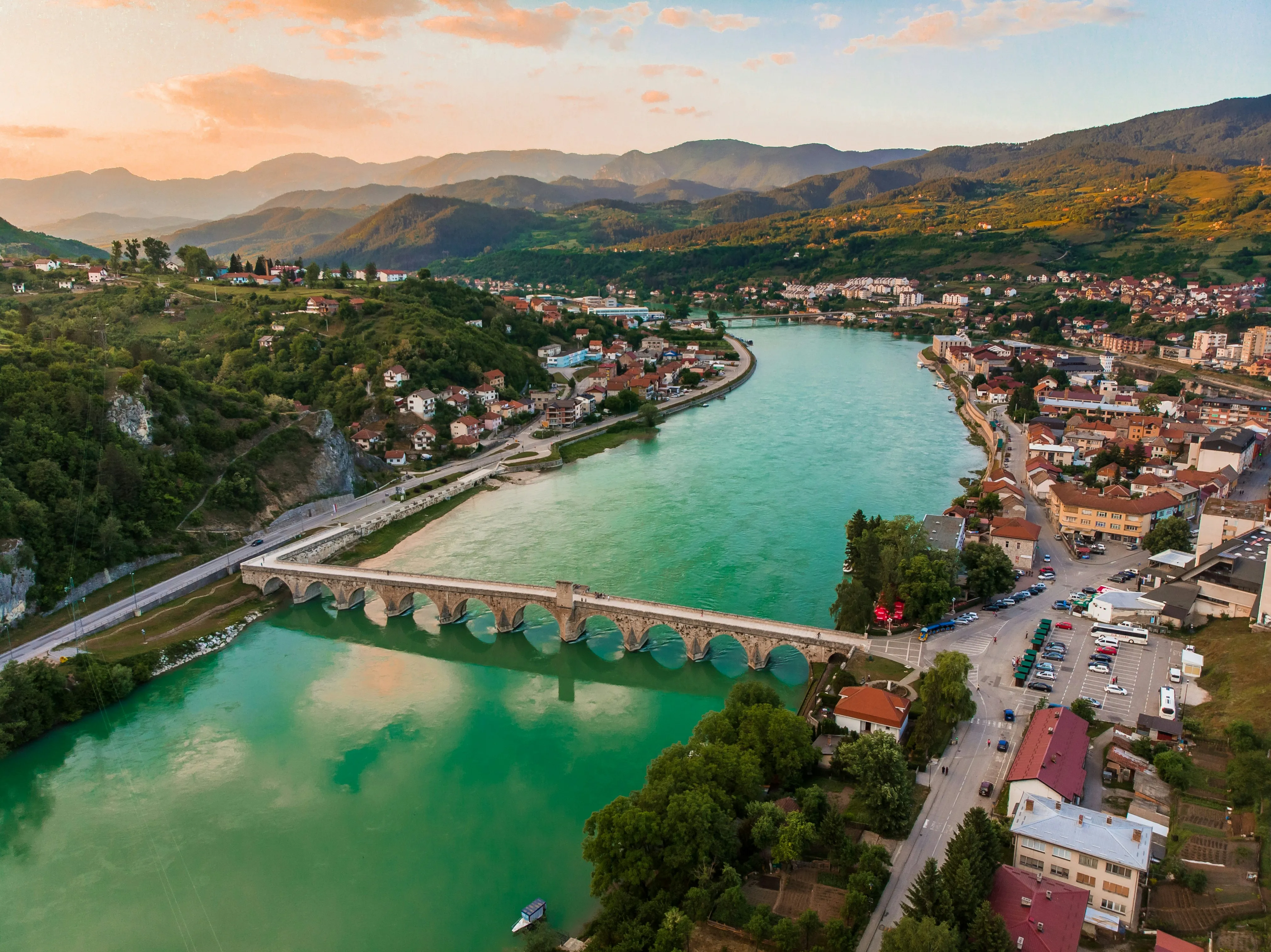
A Balkan corner where East and West converge among emerald mountains, crystalline rivers, and a captivating history that invites you to discover its cultural treasures.
Quick Facts
- Capital
- Sarajevo
- Language
- Bosnian
- Croatian, Serbian
- Currency
- Convertible mark (BAM)
- Best time to visit
- From May to September for hiking and cities; from December to March for ski lovers.
- Budget per day
- $35 - $100 per day
- Climate
- The continental climate prevails with cold winters and hot summers, being much milder and Mediterranean in the southern area.
- Connectivity
- medium
- Very easy to acquire at newsstands, post offices, or official stores of the main mobile operators.
- Electricity
- Type C/F (230V)
- Local transport
- acceptable
- Card usage
- cash is used more
- Tipping
- optional
🌎 Introduction
Walking through this corner of the Balkans means stepping into a landscape where limestone peaks coexist with deep valleys traversed by emerald green rivers. In its cities, the profile of minarets blends with that of bell towers, drawing a horizon that narrates centuries of encounters between diverse traditions and cultures. It is a place where time seems to have a different rhythm, marked by the aroma of coffee served in small copper pots and the slow-paced bustle of markets that preserve the essence of past eras.
The identity of Bosnia and Herzegovina manifests naturally in daily life: in the flavor of a traditional dish shared on a wooden terrace or in the reflection of stone bridges over calm waters. The seasons transform the environment in an evident way, covering the mountains with snow in winter and filling the forests and waterfalls with life when the thaw arrives. This mixture of present nature and an extremely varied cultural heritage gives the territory its own atmosphere, serene and suggestive, allowing each of its nuances to be appreciated calmly.
🛡️ General safety
Bosnia and Herzegovina is, in general terms, a safe country for tourists. After decades of reconstruction and stability, the country has managed to position itself as a welcoming destination where hospitality is a hallmark of identity. Although its recent history may generate doubts for some travelers, the current reality is that of a quiet nation, with very low rates of violent crime that rarely affect foreign visitors.
The safety level can be considered high, similar to that of other countries in the Balkans or Central Europe. However, as in any destination, there are local particularities and basic precautions that should be taken into account to ensure a smooth experience, especially related to the rural environment and small-scale urban crime.
Crime and common risks
Crime affecting tourists is mostly non-violent. The most reported incidents are usually related to taking advantage of carelessness in crowded places.
- Theft and pickpockets: They are common in high-traffic tourist areas, such as the historic center of Sarajevo (Baščaršija) and the area of the Old Bridge in Mostar. It is also recommended to watch belongings on public transport, especially on the capital’s trams.
- Minor scams: Occasionally, some tourists may encounter inflated prices for unregulated services or attempts at overcharging in street markets if the price is not agreed upon in advance.
- Theft from vehicles: Although not massive, leaving valuables in plain sight inside cars with foreign license plates can attract criminals. It is recommended to use guarded parking lots.
- Risk of landmines: This is a specific risk in Bosnia and Herzegovina derived from the conflict of the 90s. Although urban and tourist areas are completely clear, there are still rural and mountainous areas with the presence of mines. It is essential not to leave marked trails or enter abandoned buildings in isolated areas. Dangerous areas are usually marked with a skull and yellow or red bands, but the absence of signs does not guarantee total safety off-trail.
Safety in cities and tourist areas
Bosnian cities are generally safe for walking, even at night. The atmosphere in urban centers is usually family-friendly and lively.
- Urban centers: Walking through Sarajevo, Mostar, Banja Luka, or Tuzla is safe. Pedestrian areas are well-lit and are usually busy until late.
- Peripheral areas: In some cities, less-lit peripheral neighborhoods may require standard precaution, similar to what you would have in any European city, but they are not considered “no-go” zones.
- Social interaction: Citizens are usually very friendly towards foreigners. However, it is recommended to avoid deep discussions on sensitive political or ethnic issues of the past if you do not have confidence with your interlocutor, to always maintain a cordial tone.
Transport safety
Transport in Bosnia and Herzegovina presents certain logistical challenges, more linked to infrastructure than to personal safety.
- Driving: You drive on the right. Main roads are in good condition, but secondary ones are often narrow, winding, and with poor lighting in mountain areas. It is common to find animals on the road or local drivers performing risky overtakes.
- Taxis: It is highly recommended to use only official taxis (which have a roof plate and a meter). In Sarajevo, it is preferable to call a radio-taxi center instead of stopping one on the street to ensure an official fare.
- Public transport: Intercity buses are reliable and safe. In the case of trams and trolleybuses in Sarajevo, the main risk is pickpockets during peak hours.
- Winter: If traveling by car between November and April, winter equipment (special tires or chains) is mandatory, as snowfalls can be heavy and block mountain passes quickly.
Natural and climatic risks
The country’s climate and geography dictate the main natural risks, which vary according to the season.
- Floods: They can occur during the spring due to the thaw and heavy rains, mainly affecting areas near the courses of large rivers.
- Forest fires: During hot and dry summers, especially in the Herzegovina region (southern area), there is a risk of fires in forested areas.
- Seismic activity: Bosnia is in an area with some seismic activity. Although large-magnitude earthquakes are infrequent, minor tremors occur occasionally.
- Air pollution: In winter, cities like Sarajevo or Tuzla often suffer episodes of poor air quality due to the burning of coal and wood for heating, aggravated by the location of the cities in valleys. People with respiratory problems should take this into account.
Legislation and local rules
Compliance with local regulations is essential to avoid administrative sanctions or problems with the authorities.
- Identification: It is mandatory to carry a valid identity document (passport or ID card, depending on current agreements) at all times. Authorities may request it randomly.
- Drugs: The possession, consumption, or trafficking of any type of drug (including cannabis) is strictly prohibited and carries prison sentences and heavy fines.
- Photography: It is prohibited to take photographs of military installations, government buildings, or strategic buildings (such as bridges of national importance or airports). There are normally signs indicating this.
- Religious respect: When visiting mosques, churches, or monasteries, one must dress modestly (shoulders and knees covered). In mosques, it is mandatory to remove shoes before entering.
Safety for specific groups
- Female travelers: Bosnia and Herzegovina is a very safe country for women traveling alone. Respect towards women is the general rule and incidents of street harassment are minimal.
- LGTBIQ+ travelers: Although homosexuality is legal, Bosnian society remains quite conservative and traditional. Public displays of affection may attract stares or negative comments, especially outside the more modern circles of Sarajevo. Discretion is recommended to avoid uncomfortable situations.
- Children and the elderly: The country is very welcoming to families. Parks are safe and locals are usually very attentive to children and the elderly. The main obstacle for people with reduced mobility is the cobbled streets of the historic centers, which can be difficult to navigate.
Emergencies and assistance
In case of any incident, the country has emergency services operational and prepared to assist the traveler.
- Main numbers:
- Police: 122
- Firefighters: 123
- Ambulances / Medical emergencies: 124
- Roadside assistance: 1282 or 1285
- Police attention: If you are a victim of a robbery, you must go to the nearest police station to make a report (“policijski zapisnik”), which is necessary for any insurance claim. Officers are usually professional, although the level of English may vary.
- Healthcare: In major cities, there are good quality private hospitals and clinics. It is highly recommended to have travel insurance that covers medical transfers, as public healthcare may have limitations regarding resources and waiting times.
Tip: If you plan to go hiking or on mountain routes, always hire a certified local guide or ensure you travel only on officially marked routes to avoid any risk related to old landmines.
📝 Country entry requirements
To organize a trip to Bosnia and Herzegovina, the first step usually consists of verifying the necessary documentation. Most international travelers require a passport with sufficient validity, generally recommended to be at least three to six months beyond the planned date of departure. Although access via other identity documents is possible for citizens of certain nearby geographical regions, the passport remains the most accepted and secure reference document for procedures at border crossings.
Regarding entry for exclusively tourist purposes, a large portion of nationalities are exempt from processing a prior visa for short stays. The standard permitted stay period is usually up to 90 days within a 180-day interval. It is important to keep in mind that, when crossing the border, immigration authorities could randomly request the presentation of an exit ticket from the country or proof of possessing sufficient economic means for support during the days of the visit.
Customs controls at airports and land borders usually focus on the transport of commercial goods, cash currencies exceeding certain limits, and products subject to special regulations. For tourists, the entry of personal items is usually allowed, as well as moderate amounts of tobacco and alcohol intended for personal consumption. In case of traveling with prescription medications, it is advised to carry a copy of the medical prescription, preferably written in a widely spoken language, to avoid delays or misunderstandings at customs.
From a health point of view, mandatory vaccinations are not usually required to enter Bosnian territory, beyond the general public health recommendations that apply internationally. However, it is considered a highly recommended practice to have travel medical insurance with broad coverage that includes medical transfers, as access to certain health services could entail costs for the foreign visitor who does not have specific agreements.
Below are the key points for preparing access to the territory summarized in a schematic way:
- Identity document: The passport is the standard document for entry, with a recommended minimum residual validity.
- Stay permits: Many international visitors enjoy visa exemption for stays of a tourist nature.
- Maximum duration: The stay limit is usually set at 90 calendar days.
- Border verifications: Possible request for proof of accommodation, economic funds, or a return ticket.
- Baggage and customs: Standard restrictions on fresh food products and control of prescription drugs.
- Health prevention: Recommendation to travel with habitual vaccinations up to date and protection via private insurance.
🏥 Basic health considerations
To enjoy your trip through Bosnia and Herzegovina with total peace of mind, it is important that you know how its health system works and what precautions you should take. You will find a country with a medical infrastructure that meets basic standards, although you will see that there are differences between public centers and private clinics. In major cities like Sarajevo or Banja Luka, you will have access to well-equipped hospitals, while in rural areas resources may be more limited. Staff in private centers usually speak English, which will greatly facilitate communication if you need to explain what is wrong with you. Regarding costs, although they are not exorbitant, any emergency care or specialized treatment can be expensive if you are not well prepared.
Although it is not a legal requirement to cross the border, taking out travel medical insurance is something you should consider as essential. It will give you the security that, in the event of any setback, you will have the costs of hospitalization covered and, most importantly, medical repatriation. Make sure your policy also includes ambulance transfer and care by specialists, as this will allow you to receive care in the best available centers without having to pay large amounts of money out of your own pocket.
As for vaccines, you will be happy to know that there are no mandatory vaccines to enter the country. Having your usual vaccination schedule up to date, the same one you follow in your place of residence, will be enough to move around the territory without added risks. You will not have to carry out prior health procedures or undergo extra injections before getting on the plane or crossing the border by road.
If you are undergoing any medical treatment, it is essential that you take the necessary medication with you for all the days your stay lasts. We recommend that you keep the drugs in their original containers and that you always carry the medical prescription or a report from your doctor explaining the treatment. This is especially relevant for medications containing controlled substances or psychotropics, as customs authorities can be strict about them. You will find pharmacies easily in cities, but the commercial names of medications may vary, so having the prescription will help the pharmacist identify the active ingredient.
Health risks in Bosnia and Herzegovina are usually related to the natural environment. If you decide to explore its impressive mountains during the summer, you will see that the heat can be very strong, so constant hydration and the use of sunscreen are fundamental to avoid heat stroke. In forested areas, it is a good idea to use repellent to avoid bites from ticks, which are common at certain times of the year. A vital safety tip for this destination is that you never leave the marked trails when hiking in rural areas, as there are still areas with the danger of landmines from past conflicts, although the usual tourist areas are completely clear and safe.
Regarding food and hygiene, you can try local food with great confidence. The level of cleanliness in restaurants and street stalls is, in general, quite high. Tap water is potable in the vast majority of urban centers, so you can drink it and use it to brush your teeth without problems. If you visit very remote areas or have a particularly sensitive stomach, you can choose to buy bottled water, which you will find in any store or gas station at a very affordable price.
In the event that you find yourself in a medical emergency situation, the telephone number you should dial is 124. This service will put you in contact with medical emergencies and the ambulance system. You should keep in mind that while response is fast in cities, in high mountain areas access can be more complicated, so it is always advisable to inform someone of your route if you are going to perform outdoor activities on your own.
As final recommendations for your trip, we advise you to pack a small travel first aid kit with the basics, such as band-ids, some analgesic, and disinfectant for small wounds. Do not forget to always carry a copy of your insurance documents and the international assistance number saved in your phone. With these small precautions, you will only have to worry about enjoying Bosnian hospitality and its incredible landscapes.
🚌 Transport within the country
Moving around Bosnia and Herzegovina is mainly based on the use of the bus, which is the most widespread and practical medium for connecting different populations. Routes cover much of the territory, joining main cities with smaller hubs on a regular basis. Although a railway network exists, its scope is limited and focuses primarily on the route connecting the capital with the south, offering a very visual journey through the mountainous landscape. Internal flights and ferries for domestic travel are not considered due to the geography and dimensions of the country.
Ease of use for the visitor is acceptable, although it requires some planning. Bus stations are the main point for checking routes and purchasing tickets in person. In many areas, signage may appear in both Latin and Cyrillic alphabets, reflecting the reality of the country. Staff at stations in the most important transport hubs usually have basic knowledge to assist international travelers, allowing for functional and direct travel management.
In large cities, such as the capital, public transport is complemented by trams and trolleybuses that facilitate travel through the urban area. However, when heading towards rural areas or natural spots, the frequency of public transport decreases significantly. For this reason, a rental car is a recurring option for those looking to explore the interior with greater flexibility, keeping in mind that roads are usually one lane in each direction and cross winding terrain.
The use of taxis is very common and is a comfortable alternative for short trips or for moving between airports and urban centers. These services are usually available at specific stops and are easy to identify. Generally, they offer a sense of reliability and are a useful tool for the tourist who prefers to avoid waiting for other collective means of transport in the cities.
Regarding the general feeling of the journeys, travel is usually slower than usual due to the orography. Punctuality is reasonable, although traffic or the condition of mountain roads can influence the duration of the trip. Vehicles usually meet basic comfort standards, prioritizing functionality to cover the distances between regions, which may seem short on the map but take time in practice.
Tip: It is advisable to carry some cash when using buses and taxis, as it is not always possible to make payments using other methods on less-traveled routes.
🤵 Culture and etiquette
Society in Bosnia and Herzegovina is characterized by deep hospitality and a close manner towards visitors. In daily life, the most common greeting is a firm handshake accompanied by direct eye contact, which is interpreted as a sign of sincerity and trust. In social settings, it is common for conversations to develop at a slow pace, highly valuing the time dedicated to interacting with others. Verbal courtesy and respect for older people are fundamental pillars of coexistence, both in private spaces and in the public sphere.
Coffee culture occupies a central place in the social life of the country, understood not only as a break, but as an essential rite of connection and hospitality. When invited to a private home, it is a very widespread practice to take off your shoes at the entrance to maintain the cleanliness of the home, a gesture that hosts value positively. In restaurants and cafes, although a tip is not a rigid rule, it is common to round up the bill or leave approximately ten percent of the total as a show of appreciation for good service.
Respect for religious diversity is fundamental when visiting places of worship, whether they are mosques, Orthodox churches, or Catholic churches. It is recommended to dress discreetly and moderately, ensuring that shoulders and knees are covered before entering. In the specific case of mosques, it is mandatory to remove shoes at the entrance and, in some enclosures, women are requested to cover their hair with a scarf. The volume of voice in public spaces is usually moderate, and an attitude of special solemnity is expected at commemorative monuments or sites of historical relevance.
Regarding punctuality, there is a natural flexibility in social encounters, although in formal or professional contexts, adherence to schedules is appreciated. Physical contact between acquaintances is common and warm, but with strangers, it is preferred to maintain a standard interpersonal distance and a formal manner. Communication is usually direct and honest, always prioritizing friendly treatment and avoiding situations that could make the interlocutor uncomfortable in shared spaces.
“Tip”: When participating in a traditional coffee ceremony, it is recommended to enjoy the drink without rushing, as this act is a symbol of respect and coexistence that seeks to strengthen personal bonds over immediacy.
🍛 Typical gastronomy
The gastronomy of Bosnia and Herzegovina is a reflection of its geographical location and its history, fusing Ottoman, Mediterranean, and Central European influences. The result is a comforting cuisine, based on fresh products and traditional techniques where fire and slow cooking are protagonists. Dishes are usually simple but abundant, with a special emphasis on beef and lamb, seasonal vegetables, and artisanal dairy products.
One of the pillars of the Bosnian table is the culture of grilling and stews. It is common to find establishments specialized in a single type of preparation, such as ćevabdžinicas, dedicated to grilled meats, or aščinicas, where homemade spoon dishes are served. The use of spices is moderate, prioritizing the natural flavor of the ingredients, which are usually accompanied by somun, a flat and tender bread that is fundamental in almost any meal.
The preparation of doughs is another of the country’s great traditions. Pitas, thin dough pastries stretched by hand and filled with various ingredients, are omnipresent and consumed at any time of the day. There is an important distinction in terminology: while the generic term is pita, each variant receives a specific name according to its filling. Hospitality is a fundamental value in the service, and it is common to find a relaxed atmosphere where meals are enjoyed without rushing.
As for drinks, Bosnian coffee constitutes an essential social ritual. It is traditionally served in small copper cups and its preparation is slow, marking the rhythm of social encounters. Although in the south of the country there is a notable wine production, non-alcoholic drinks like natural fruit juices and yogurt derivatives are very frequent accompaniments to balance the intense flavors of the meats.
| Dish | Description | Main Ingredients | Where to try it | Tip |
|---|---|---|---|---|
| Ćevapi | Small cylinders of grilled minced meat served inside a flatbread. | Beef (sometimes lamb), somun bread, and raw onion. | Ćevabdžinicas in Sarajevo and Travnik. | Order them with a portion of kajmak (dairy cream) for a complete experience. |
| Burek | Crispy rolled filo pastry pie filled, very popular as fast food. | Seasoned minced meat and layers of thin dough. | Buregdžinicas and bakeries throughout the country. | Accompany it with a liquid yogurt to contrast the crispy texture of the dough. |
| Begova Čorba | Creamy and thick soup, traditionally served on special occasions. | Chicken, okra, carrot, and a sour cream base. | Traditional cuisine restaurants (aščinicas). | It is ideal as a first course to whet the appetite before a hearty meal. |
| Sogan-dolma | Stuffed onions cooked slowly until tender. | Onions, minced meat, rice, and mild spices. | Local cuisine restaurants in Mostar and Sarajevo. | Enjoy it with its own cooking sauce to better appreciate the mix of flavors. |
| Tufahija | Traditional dessert of Ottoman origin, sweet and soft-textured. | Apple cooked in syrup, filled with walnuts and decorated with cream. | Cafes and pastry shops in the historic center of the cities. | It is the perfect accompaniment to a traditional Bosnian coffee in the mid-afternoon. |
📷 Areas and places to visit
Bosnia and Herzegovina presents itself as a destination where history and nature converge harmoniously. The capital, Sarajevo, is the ideal starting point for understanding the essence of the country. Strolling through its old town, known as Baščaršija, allows the traveler to immerse themselves in an environment of cobbled streets, copper craft workshops, and small cafes where an Ottoman atmosphere is breathed. A few steps away, the architectural style changes drastically towards the Austro-Hungarian legacy, reflecting the city’s character as a cultural border. Highlights among its points of interest include the Latin Bridge, linked to key events in modern history, and the Vijećnica or City Hall, an emblematic building that has been carefully restored. For those seeking a deeper historical perspective, the War Childhood Museum and the Tunnel of Hope offer moving accounts of the resilience of its inhabitants.
To the south, the Herzegovina region offers a more Mediterranean and sunny landscape. The city of Mostar is its nerve center, world-famous for its Old Bridge or Stari Most, which joins the two banks of the Neretva River. This enclave stands out for its stone architecture and vibrant markets. Very close by, you can take excursions to the medieval village of Počitelj, built on a rocky hillside, or visit the Blagaj Monastery, a dervish house situated next to the source of the Buna River, where water springs directly from a cave under a cliff. For lovers of natural environments, the Kravica waterfalls offer a wide area of water drops surrounded by vegetation, ideal for enjoying a day of rest outdoors.
In the center of the country, history merges with the mountainous orography. The city of Jajce is unique for housing a large waterfall right in the urban center, just where the Pliva and Vrbas rivers meet. In addition to this natural spectacle, it has a medieval fortress and catacombs that narrate the past of the ancient Bosnian kings. Not far away is Travnik, known in the past as the city of the viziers, where two clock towers and an impressive castle with views over the entire valley are still preserved. It is an excellent place to try local gastronomy and walk its nearby trails.
The northwest of the country is dominated by the course of the Una River, which gives its name to the Una National Park. This area is a paradise for active tourism and the observation of pristine landscapes, especially highlighting the Štrbački buk waterfalls. Visitors usually come here for hiking routes or to enjoy water activities. On the other hand, the city of Banja Luka, located to the north, offers a different side with its wide avenues, tree-lined parks, and the Kastel fortress, which is one of the oldest monuments in the area and a regular space for holding cultural events and summer festivals.
For those looking for the purest contact with the mountain, the Bjelašnica and Jahorina massifs, which were Olympic venues, offer hiking routes and mountain activities throughout the year, connecting with small traditional villages like Lukomir, where time seems to have stood still. In the southeast, the Sutjeska National Park protects one of Europe’s last primary forests, Perućica, and the Tjentište monument, which stands out for its imposing architectural design in the middle of a wild natural environment.
Tip: You cannot miss visiting Mostar, the most emblematic place in the country.
✈️ Best time to travel
Bosnia and Herzegovina is a destination that changes significantly with the passage of the seasons, offering different experiences depending on the time chosen. Generally, the months between May and September are usually the most recommended for touring the country, as the weather is more stable and allows for enjoying both nature and historic cities with a pleasant temperature.
While summer stands out for its long, sunny days, ideal for activities on the rivers and cultural festivals, spring and autumn provide a cooler environment and a very characteristic chromatic landscape. Winter, for its part, transforms the mountainous areas into centers of interest for those seeking contact with snow and mountain sports in a serene and traditional setting.
| Season | Months | Typical Climate | What to Expect | Tourist Influx |
|---|---|---|---|---|
| Spring | Mar – May | Cool temperatures that gradually rise; moderate rains and thaw in the peaks. | Very green landscapes, full rivers, and blooming. It is an ideal time for hiking and urban visits. | Medium ⭐⭐ |
| Summer | Jun – Aug | Hot and dry days, especially in the southern area; cooler nights in the mountain areas. | Film and music festivals, water sports like rafting, and a vibrant social life on city terraces. | High ⭐⭐⭐ |
| Autumn | Sep – Nov | Progressive drop in temperatures; clear atmosphere in September and more humid towards November. | Forests with ochre and golden tones, grape harvest season in the south, and a quiet atmosphere to explore historical heritage. | Medium ⭐⭐ |
| Winter | Dec – Feb | Low temperatures, frequently below zero; usual snowfalls in high areas and inland cities. | Ski season in mountain resorts, winter markets, and a cozy atmosphere in historic centers. | Low - Medium ⭐ |
🗣️ Basic vocabulary
Although it is common to find people who speak English in the more touristy areas of Bosnia and Herzegovina, knowing some basic expressions in the local language greatly facilitates daily interactions. Learning a few words of courtesy helps in navigating shops, transport, or restaurants better, and is usually a gesture appreciated by local residents.
It is not necessary to delve into the complexity of the language to move around the country, but having these simple formulas will allow you to resolve common situations and move with greater confidence during your trip.
- Dobar dan: Good day (the most common greeting during the day).
- Hvala: Thank you.
- Molim: Please (also used to say “you’re welcome”).
- Da / Ne: Yes / No.
- Izvinite: Excuse me or sorry (useful for asking for a way through or getting someone’s attention).
- Račun, molim: The bill, please.
- Gdje je…?: Where is…?
- Zdravo: Hello (informal greeting).