


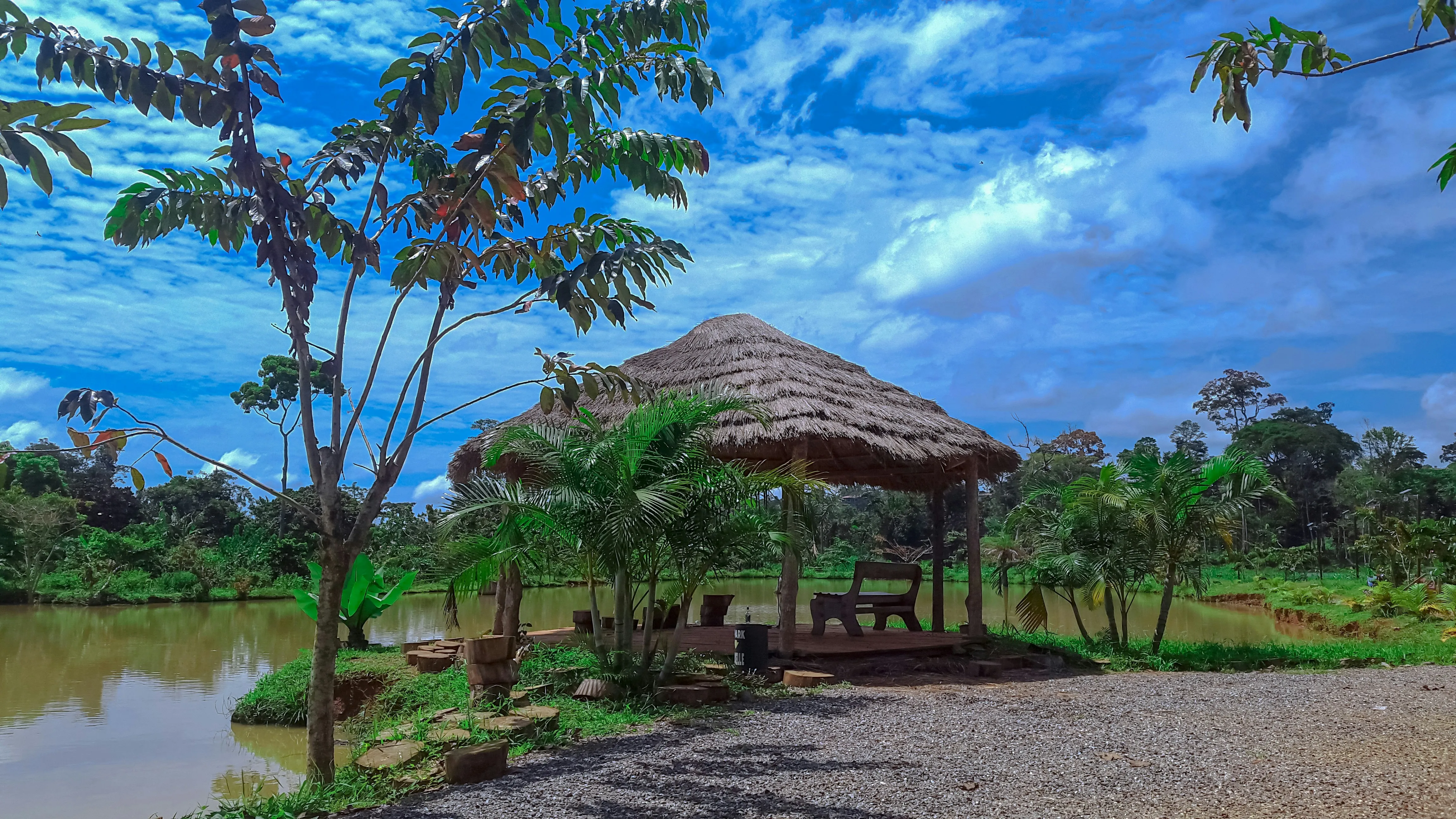
Cameroon
Known as "Africa in miniature," Cameroon offers lush jungles, volcanic mountains, golden beaches, and a fascinating cultural diversity that captivates any traveler.
Quick Facts
- Capital
- Yaoundé
- Language
- French
- English, Bamileke, Fulfulde
- Currency
- Central African CFA franc (XAF)
- Best time to visit
- From November to February, during the main dry season.
- Budget per day
- $30 - $120 per day
- Climate
- Tropical climate, hot and humid in the south, while the north is drier and hotter with Sahelian influence.
- Connectivity
- low
- Easy to obtain at airports and official stores with a passport.
- Electricity
- Type C / E (220V)
- Local transport
- limited
- Card usage
- cash is used more
- Tipping
- optional
🌎 Introduction
Walking through these lands means crossing landscapes that change almost without warning. At the edge of the Gulf of Guinea, the humidity of the ocean merges with the thick jungles of the south, where the rhythm of life seems marked by the constant growth of vegetation. Towards the interior, the terrain rises into volcanic mountain ranges that gradually give way to the plains of the north, where the climate becomes drier and the horizons broaden under a more intense sun.
The country’s identity is perceived in the pause of a shared coffee or in the hustle and bustle of its markets, where the aroma of cocoa and spices naturally permeates the air. It is a territory of sonic and cultural contrasts, where dozens of languages and traditions coexist, manifesting in music, village architecture, and local celebrations. In daily life, hospitality is expressed spontaneously, integrating visitors into a routine that deeply respects its roots.
The passing of the seasons, defined by the alternation between the dust of the dry season and the restorative freshness of the rains, marks the character of its inhabitants and their agricultural cycles. Whether on the slopes of a great mountain or on dark sand beaches, there is a sense of being in a place that has managed to preserve its diversity without fanfare, offering a calm and balanced look at the reality of this African region.
🛡️ General safety
Traveling to Cameroon, known as “Africa in miniature” for its geographical and cultural diversity, requires careful planning and a conscious attitude towards the environment. Although the country offers unique experiences, the security level is considered medium, varying significantly between different regions and cities.
It is fundamental to understand that the country coexists with contrasting realities: while urban centers and tourist areas in the south and coast are generally safe for the attentive traveler, certain border areas or specific regions experience complex socio-political situations. The context for the traveler is one of constant vigilance, without needing to fall into alarmism, but always maintaining a low profile and following local recommendations.
Common crime and risks
Crime in Cameroon is usually motivated by economic factors and mainly affects large urban areas. The most common risks include:
- Pickpocketing and petty theft: These are common in crowded markets, bus stations, and high-traffic areas. It is recommended not to ostentatiously display valuables such as jewelry, expensive watches, or professional cameras.
- Scams: Deception attempts may occur in informal commercial transactions or by people offering tourist services without accreditation. It is always preferable to hire services through hotels or recognized agencies.
- Violent robberies: Although less frequent against tourists, they can occur in outlying neighborhoods or at night. It is advised to avoid walking alone in poorly lit areas after sunset.
- Road checkpoints: It is common to find police or military checkpoints. It is recommended to stay calm, be respectful, and always have documentation at hand.
Safety in cities and tourist areas
Safety varies considerably depending on the location. Generally speaking:
- Yaoundé and Douala: As the political and economic capitals respectively, they have a greater police presence. They are safe during the day in their central hubs but require extra caution in secluded residential neighborhoods or night markets.
- Kribi and Limbe: These coastal areas are popular tourist destinations and are usually quiet, although one should not lower their guard on solitary beaches.
- Areas to avoid: Currently, there are regions with high risks due to internal conflicts or insurgency, such as the Far North (border with Nigeria and Chad) and the Anglophone regions (Northwest and Southwest). It is recommended to limit travel to areas considered stable and touristy in the center and south.
Transport safety
Transport is one of the aspects where the traveler must pay the most attention to personal and road safety:
- Driving: In Cameroon, people drive on the right. Road conditions are highly variable; while main routes between large cities are paved, secondary roads may be in poor condition.
- Taxis: They are the most common means of transport. There are “shared taxis” (where you pay per seat) and “depot” (renting the entire taxi). It is recommended to use the second option or transport apps for greater safety. Never get into a taxi that already has several unknown occupants if you do not feel comfortable.
- Long-distance buses: There are private companies that offer modern and safe services between Yaoundé, Douala, and Kribi. This is the most recommended option for long journeys.
- Night travel: Traveling by road outside cities at night is strongly discouraged due to lack of lighting, road conditions, and the risk of assaults in remote areas.
Natural and climatic risks
Cameroon has a varied geography that entails specific natural risks depending on the time of year:
- Flooding: During the rainy season (generally from May to October), rainfall can be extremely intense, causing road closures and mobility difficulties, especially on the coast and in the south.
- Extreme heat: In the north and during the dry season, temperatures can exceed 40 degrees. Constant hydration and sun protection are vital.
- Volcanic activity: Mount Cameroon is an active volcano. If you plan to hike in the area, it is essential to check the activity status and hire certified local guides.
Local legislation and norms
Respect for local laws is fundamental to avoid legal problems that can be severe:
- Documentation: It is mandatory to always carry the original passport or a certified copy. Authorities may request it at any time.
- Photography: It is strictly forbidden to photograph official buildings, military installations, airports, ports, or bridges. Failure to comply with this rule can lead to equipment confiscation or arrests.
- Prohibited substances: The consumption, possession, or trafficking of drugs carries very high prison sentences and severe fines.
- Social behavior: Cameroon is a traditional society in many aspects. It is recommended to dress modestly, especially in rural or predominantly Muslim areas, and to ask permission before photographing local people.
Safety for specific groups
- Solo female travelers: In general, it is safe, but it is recommended to avoid walking alone at night and to dress modestly to avoid unwanted attention. It is common to receive comments or proposals, which usually stop with a firm and polite refusal.
- LGTBIQ+ travelers: It is important to know that same-sex relationships are criminalized by law in Cameroon. Absolute discretion is recommended, and public displays of affection should be avoided to prevent legal risks or aggression.
- Travel with children and seniors: There are no specific risks beyond health precautions (vaccination and malaria prevention) and the need to plan short journeys, as road trips can be very exhausting.
Emergencies and assistance
The emergency system in Cameroon may not be as fast or efficient as in other countries, so prevention is key:
- Police: The general emergency number is 117 or 112 from mobile phones. For the Gendarmerie (in rural areas or roads), the number is 113.
- Medical services: In case of a medical emergency, it is most recommended to go to private clinics in Douala or Yaoundé, which usually have better facilities. It is essential to have international travel insurance that covers medical evacuation.
- In case of an incident: If you are a victim of a robbery, file a report at the nearest police station (“Commissariat”) for insurance purposes or document replacement, and contact your country’s consular representation.
Tip: Before moving between cities, always check the current status of the routes with hotel staff or local guides, as security conditions can change from one day to the next.
📝 Entry requirements to the country
When planning a trip to Cameroon, it is fundamental to keep in mind that most international travelers typically require a passport with a minimum validity of six months from the planned date of entry into the territory. It is common to request that the document has enough blank pages for immigration control stamps. In most cases, foreign visitors need to arrange a tourist visa in advance, which allows for a stay that generally does not exceed thirty days, although this may vary depending on the permit obtained.
Upon arriving at the main entry points, such as international airports, immigration authorities usually request the presentation of an onward travel ticket or a return ticket confirming the intention to end the visit within the scheduled time. Likewise, it is frequent to be asked to demonstrate the possession of sufficient economic means to cover expenses during the stay. Border controls are standard processes where documentation is verified and entry registration proceeds in a calm and organized manner.
Regarding customs regulations, there are standard restrictions on the importation of certain products. It is recommended that travelers who need to carry specific medications bring the corresponding medical prescription to avoid inconveniences. There are also generic limits for the entry of tobacco, alcohol, and valuable items, which must be for personal use. It is important to keep in mind that the export of certain traditional art objects or products of animal origin is usually subject to special permits to protect cultural heritage and local biodiversity.
From a health perspective, it is a common practice to request the international yellow fever vaccination certificate from all travelers entering the country. Additionally, it is recommended to have a prior medical consultation to assess other generic health recommendations that may be convenient for a trip to this region of Central Africa. Keeping an updated record of basic vaccinations is always a prudent measure for any international traveler.
Below is a summary of the key aspects to consider for access to the country:
- Identity document: Valid passport with extended validity, generally exceeding six months.
- Entry authorization: A tourist visa is usually a frequent requirement for most nationalities.
- Proof of transport: Standard presentation of a return or onward travel ticket to another destination.
- Financial solvency: Possible requirement to prove sufficient funds for maintenance during the visit.
- Health certification: Demand for the document proving the yellow fever vaccine is common.
- Customs regulation: Control over the transport of prescription drugs, large sums of currency, and archaeological or natural value objects.
- Stay period: Standard tourist permits usually allow staying in the country for periods of up to one month.
🏥 Basic health considerations
The healthcare system in the country presents significant contrasts that you should know before landing. In large cities like Yaoundé or Douala, you will find private clinics with acceptable standards and qualified professionals, although infrastructure is much more limited in rural areas. As a tourist, it is common to go to private centers where care is faster, but keep in mind that costs can be high for foreigners and they usually demand payment in advance. Healthcare staff usually communicate in French or English, which are the territory’s official languages.
Taking out travel medical insurance is an essential measure for your peace of mind. Although it is not always strictly required to cross the border, it is absolutely necessary to have one that covers hospitalization, surgical interventions, and medical repatriation by air ambulance. In case of a serious complication, you might need a specialized transfer, something that without insurance would have an unaffordable cost.
Regarding vaccines, the yellow fever vaccine is mandatory for all travelers wishing to enter the country. You must show your international vaccination certificate, the famous yellow card, as soon as you arrive at the airport. In addition to having your standard vaccination schedule updated, it is highly recommended that you consider protecting yourself against hepatitis A and B, typhoid fever, and tetanus. Depending on the area you visit and the length of your stay, the meningitis vaccine is also usually among the standard recommendations of international health centers.
If you need to carry personal medication, make sure to transport it in its original container and always accompanied by a medical prescription or signed report from your doctor, preferably translated into French or English. This will avoid legal inconveniences at customs. Do not rely on finding specific drugs in local pharmacies, so it is better to take everything you anticipate needing with you, including a first-aid kit with disinfectants, dressing materials, and stomach protectors.
The greatest health risk for travelers is malaria, which is endemic throughout the territory. It is fundamental to consult with a doctor before leaving to start the appropriate prophylaxis and to use potent repellents and mosquito nets. Other risks are linked to the climate, such as heatstroke due to high temperatures and humidity, or insect-borne diseases like dengue or Zika. You should also be cautious about the presence of parasites in stagnant water or slow-moving rivers, so bathing in uncontrolled places is discouraged.
Water and food safety is another point where you should pay attention. Tap water is not potable, so you will always find bottled water available, which you should consume ensuring the seal is intact. Avoid ice in drinks and salads or already peeled fruits. You can try the rich local gastronomy without problems as long as the food is well-cooked and served hot, preferring places that have a generally hygienic appearance.
For health emergencies, the generic number you could try to dial from a mobile is 112, although the effectiveness of public ambulance services is very low. The most recommended action is to previously identify the nearest private reference clinic to your accommodation and write down its direct number, as these centers usually manage their own emergency services more efficiently.
As final tips for your trip to be perfect, remember to apply high-factor sunscreen recurrently and maintain constant hydration even if you don’t feel thirsty. If you experience fever or general discomfort during the trip or upon returning, it is vital to inform doctors that you have been in an area with the presence of malaria. With these basic precautions, you can focus on discovering all the cultural and natural richness that this destination has to offer.
🚌 Transport within the country
To move around the territory, the plane is a common option for connecting the main cities, allowing large distances to be covered quickly. The train is also a relevant medium, especially on the axis linking the capital with the coast, offering a leisurely journey that allows for viewing the landscape. For road trips, the use of buses managed by different agencies is the most common way to travel between provinces, generally departing from specific terminals in each locality.
Using public transport requires some adaptation from the visitor. Signage is not always abundant, and the purchase of tickets is usually done in person at stations or departure points. Being a bilingual country, communication takes place mainly in French and English, which facilitates interaction at information points and with drivers.
There is a notable difference between the infrastructures of urban areas and rural areas. While main roads in cities are paved, in rural environments travel usually takes place on dirt roads, where four-wheel drive vehicles or shared transport services are essential. In these cases, the duration of trips can vary considerably depending on the state of the ground and weather conditions.
Within urban centers, the taxi is the most widespread service. It is common to share the vehicle with other passengers taking similar routes, although there is also the possibility of requesting a private service. Alongside them, motorcycles act as an agile resource for short and fast journeys in dense traffic areas, being a medium very much integrated into the daily life of the local population.
Punctuality and comfort can fluctuate, so it is recommended to approach travel with flexibility. Departure times for collective transport usually depend on the vehicle reaching its maximum passenger capacity. Therefore, the reliability of arrival times is approximate, and it is advisable to have an ample margin for any connection or scheduled activity.
Tip: It is recommended to go to the departure stations well in advance and confirm the exact starting point of each journey directly with local staff.
🤵 Culture and etiquette
Social interaction in Cameroon is based on courtesy and the recognition of the interlocutor, giving primary importance to initial greetings. Before making any inquiry, transaction, or starting a conversation, it is essential to dedicate time to greeting in a calm manner. Respect for elders and authority figures is a pillar of daily coexistence; showing an attitude of deference towards older people is a widespread and valued practice throughout the country.
In daily dealings, the use of the right hand is the norm for offering or receiving objects, as well as for eating in traditional contexts, since the left hand is usually associated with personal hygiene. Regarding physical contact, the handshake is the most common form of greeting between adults. Concerning communication in public spaces, a moderate voice volume and a patient attitude are usually preferred, avoiding direct confrontations that could compromise the harmony of the moment.
The perception of punctuality tends to be flexible in social contexts, so it is common for meetings or encounters not to start exactly at the planned time. This time management requires some adaptability from the visitor. In the field of gastronomy and visits, hospitality is a central value. If invited to a home, food or drink is frequently offered as a welcoming gesture; accepting at least a small portion is interpreted as a sign of appreciation towards the host.
It is fundamental to show special respect in environments linked to local traditions and traditional leadership structures, such as chiefdoms. When visiting the palaces of traditional chiefs (known as Fons in the west or Lamidos in the north), it is important to observe indications regarding proper behavior and dress protocol, which usually requires discretion. Likewise, in places of worship and sacred spaces, it is recommended to maintain an observant attitude and follow the example of the local population.
“Tip”: Before taking photographs of people, ceremonies, or institutional buildings, it is an essential rule of courtesy to ask permission directly, as this facilitates interaction and demonstrates respect for privacy and local customs.
🍛 Typical gastronomy
Cameroon’s gastronomy is known for being one of the most diverse in Africa, thanks to the variety of climates and ethnic groups that coexist in its territory. Generally speaking, the cuisine is based on the use of tubers and cereals that serve as an accompaniment to stews and thick sauces. Fundamental ingredients include cassava, yam, corn, and plantain, which are usually transformed into cooked doughs known as fufu to facilitate their consumption alongside main dishes.
The flavors of the region are defined by the generous use of peanuts, palm oil, and a great variety of local green leaves. A taste for spiciness is common, although it is usually served separately so that each diner can adjust the intensity to their preference. In coastal areas, fresh fish plays a leading role, while in the interior and the north, the diet leans more towards the consumption of beef, goat, or chicken, often prepared in slow-cooking methods or grilled.
Regarding social habits, eating is fundamentally a community act. In traditional settings, it is common for dishes to be shared from a central platter and for the right hand to be used for eating, following a strict hygiene protocol. Meal times are usually regular, with a substantial lunch and a dinner served at dusk. In cities, the concept of tourne-dos is very common—small street stalls where locals stop to eat quick dishes informally.
Drinks are also an essential part of local culture. Palm wine, extracted traditionally, is very common in rural areas and is usually present at celebrations. In daily life, inhabitants regularly consume tropical fruit juices, hibiscus or ginger infusions, as well as locally produced beers that enjoy great popularity in establishments across the country.
| Dish | Description | Main Ingredients | Where to try it | Tip |
|---|---|---|---|---|
| Ndolé | Considered the national dish, it is a stew of bitter green leaves. | Ndolé leaves, crushed peanuts, meat or fish. | Local cuisine restaurants in Douala and Yaoundé. | Accompany it with fried plantain or miondo (cassava paste). |
| Poulet DG | A rich and colorful chicken stew originally served to distinguished guests. | Chicken, fried plantain, carrots, and peppers. | Family-style restaurants and celebrations. | It is a complete dish that does not require additional garnishes. |
| Achu | A traditional dish from the northwest regions, with a very characteristic texture. | Taro puree and a yellow sauce spiced with palm oil. | Markets and specialized places in the western regions. | It is usually eaten following the traditional ritual of using the fingers. |
| Poisson braisé | Fresh fish marinated and cooked directly over charcoal embers. | River or sea fish, local spices, and onion. | Street stalls in coastal areas like Kribi or Limbe. | Ask for it to be served with spicy sauce on the side to control the flavor. |
| Koki | A kind of cake or pie with a firm texture steamed in banana leaves. | Crushed black-eyed peas and red palm oil. | Street food stalls and traditional markets. | It is ideal as a mid-morning snack due to its nutritional value. |
📷 Areas and places to visit
Cameroon is often known as the summary of an entire continent due to the great diversity of landscapes and cultures it houses. In the center of the country lies Yaoundé, the political capital, set upon several hills that offer a green and rolling perspective. This city stands out for its administrative and cultural atmosphere, where the National Museum of Yaoundé, located in a former presidential palace, allows for an understanding of the nation’s history and ethnography through its collections of traditional art and historical relics. Walking through its neighborhoods allows one to observe the contrast between institutional architecture and daily life in its markets.
Towards the coast is Douala, the economic engine and most populous city. It is a vibrant and dynamic urban center, marked by its important port and the mouth of the Wouri River. Here, the traveler can explore colonial heritage in some of its old buildings and enjoy a contemporary cultural scene in its art centers and galleries. Life in Douala is intense, reflecting the commercial character of the country, with areas where artisan workshops and venues showing the most modern face of Cameroonian society are concentrated.
The Western Highlands region is one of the most powerful cultural hubs. In this mountainous area are the traditional chiefdoms or Chefferies, where the Bamileke people preserve their ancestral customs and architecture. The city of Foumban is a mandatory stop in this region, notable for the Sultan’s Palace and its museum, which guards thousands of historical objects of Bamoun culture. Additionally, this area is famous for its bronze and wood crafts, and for natural landscapes of great beauty such as the Ekom Nkam Waterfalls, surrounded by dense tropical vegetation.
For those seeking contact with the sea, the town of Kribi offers a relaxed environment with white sand beaches bordered by palm trees. One of the most interesting geographical peculiarities of this area is the Lobe Waterfalls, where the river water falls directly into the sea in the form of a waterfall. Nearby, the Dja Faunal Reserve, declared a World Heritage Site, protects one of the best-preserved tropical jungles, allowing visitors to learn about rainforest biodiversity and the way of life of the communities that inhabit it.
In the far north, the landscape transforms radically into savannah and rock formations. Waza National Park is one of the most prominent protected areas for observing African wildlife in the wild, such as elephants and giraffes. Near the border with Nigeria, the town of Rhumsiki in the Mandara Mountains offers one of the country’s most characteristic images with its volcanic peaks and traditional villages. This region is ideal for hiking and learning about terrace farming systems and local pottery.
Finally, the Limbe area, located at the foot of the country’s imposing volcanic relief, features volcanic black sand beaches and a historical botanical garden. It is a place where a different atmosphere is perceived, with a strong influence from the British colonial era in its layout. Very close by, the city of Buea serves as a starting point for expeditions that traverse the forested slopes and rugged terrains dominating the horizon of this coastal region.
Tip: You cannot miss visiting Mount Cameroon, the most emblematic place in the country.
✈️ Best time to travel
Choosing the right time to visit Cameroon depends largely on the regions one wishes to explore, as the country presents a notable climatic diversity due to its size. Generally, the most favorable time for tourism coincides with the months of least rainfall, which facilitates road travel and wildlife observation in the northern national parks, where animals gather around water points.
During the dry period, landscapes are more accessible and temperatures, although high in certain areas, allow for outdoor activities with greater predictability. Conversely, the rainy season transforms the environment into a garden of dense vegetation and voluminous waterfalls, offering a different perspective for those who prefer to enjoy nature in its most exuberant state and with fewer visitors.
| Season | Months | Typical Climate | What to expect | Tourist influx |
|---|---|---|---|---|
| Spring | Mar – May | Transition to the rainy season. Humid heat in the south and high temperatures in the north. | Beginning of flowering and landscapes starting to turn green. Some isolated rains. | Medium |
| Summer | Jun – Aug | Frequent and intense rainfall, especially in the coastal zone and the south. | Exuberant vegetation, vibrant jungles, and waterfalls at their maximum splendor. | Low |
| Autumn | Sep – Nov | Gradual decrease in rains towards the end of the period. Moderate humidity. | Improved visibility in natural landscapes and return of accessibility to rural roads. | Medium |
| Winter | Dec – Feb | Dry and clear weather. Presence of the Harmattan wind, which can bring haze. | Ideal time for safaris and hiking. Greater ease for observing wildlife. | High (⭐⭐⭐) |
🗣️ Basic vocabulary
Cameroon is a country with great linguistic diversity where French and English coexist as official languages, along with numerous local languages and the popular “Cameroonian Pidgin English.” Learning a few basic words will help you navigate better in markets, transport stations, or when meeting new people, showing respect for the local culture.
In most of the territory, French is the primary language of communication, but the use of certain local expressions or Pidgin can greatly facilitate daily interactions. These are some of the words and phrases you will use most during your stay:
- Bonjour: Hello or good morning.
- Merci: Thank you.
- S’il vous plaît: Please.
- Ça va?: How are you? or is everything okay?
- Abeg: Please (a word from Pidgin English very common for asking a favor or to pass).
- C’est combien?: How much is it?
- Ashia: A very common expression of empathy or encouragement, used to say “I’m sorry,” “keep going,” or “get well.”
- On est ensemble: Literally “we are together,” it is a very common way to say goodbye amicably.
- Pardon: Excuse me or sorry.