


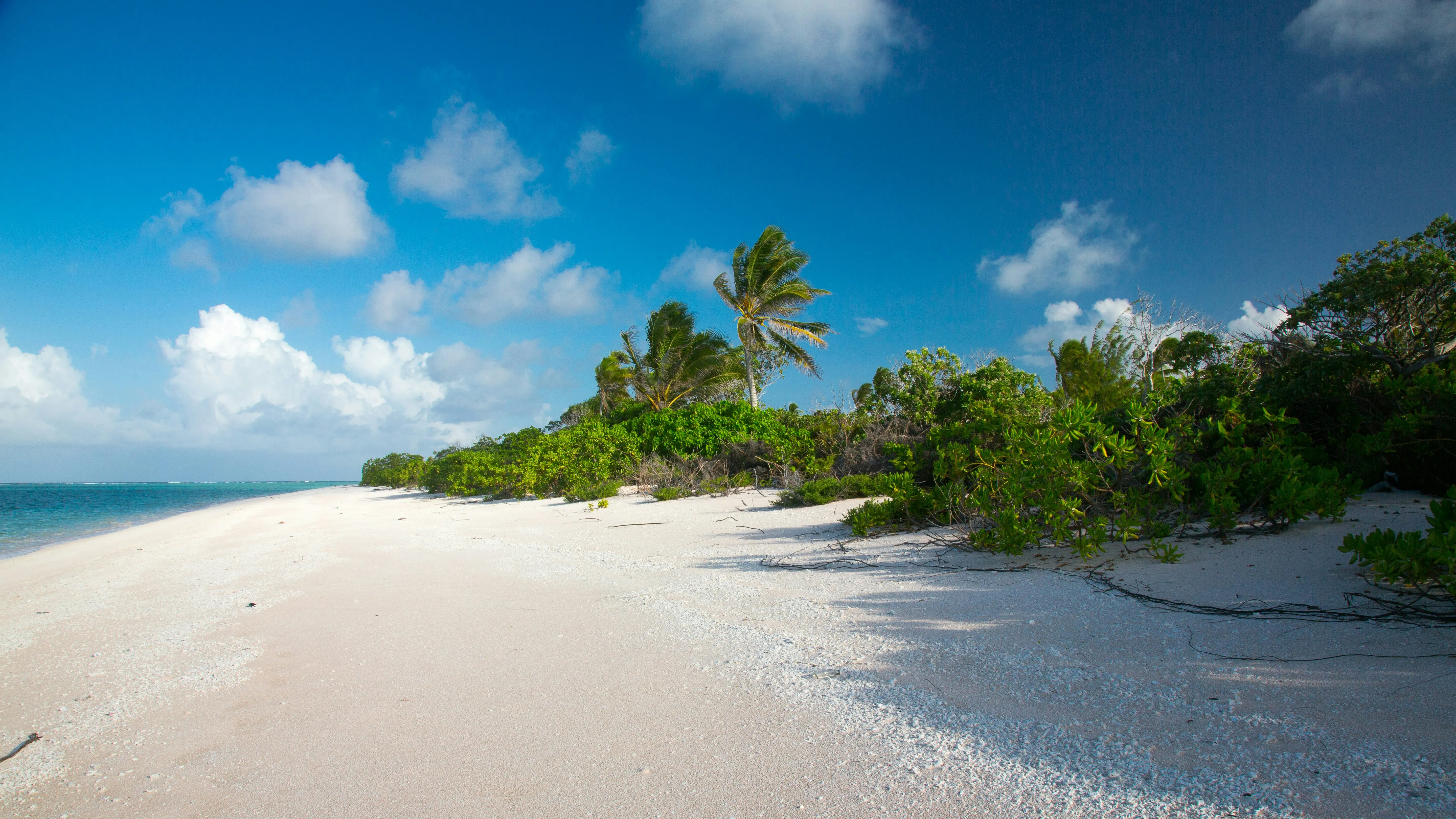
Marshall Islands
A remote archipelago of coral atolls offering crystal-clear lagoons, a rich maritime history, and serene tropical landscapes for travelers seeking authentic peace.
Quick Facts
- Capital
- Majuro
- Language
- Marshallese
- English
- Currency
- United States Dollar (USD)
- Best time to visit
- From December to April, coinciding with the dry season.
- Budget per day
- $130 - $350 per day
- Climate
- Warm and humid tropical climate year-round, with constant temperatures and a well-defined dry season.
- Connectivity
- low
- Available on the main islands, though signal is limited or non-existent in the more remote atolls.
- Electricity
- Type A/B (120V)
- Local transport
- limited
- Card usage
- more cash is used
- Tipping
- optional
🌎 Introduction
In the middle of the vast blue Pacific, a collection of atolls and corals unfolds, barely rising a few meters above sea level. It is a place where the horizon seems infinite and life is organized around lagoons of calm waters, protected from the ocean by thin tongues of white sand. Here, the rhythm of the days is marked by the tides and the wind that shakes the tops of the coconut trees, creating an environment where simplicity defines the landscape and tropical light bathes everything with a particular intensity.
The identity of these islands is deeply linked to a long tradition of navigators who, for centuries, learned to read the currents and stars with astonishing precision. This connection to the sea is reflected today in its gastronomy, based on the catch of the day and the use of coconut or breadfruit, and in a leisurely hospitality that invites one to understand time in a different way. Between small villages and the constant sound of the waves, a subtle balance is perceived between ancestral heritage and a daily life that passes without haste, far from the most traveled circuits.
🛡️ General Safety
The Marshall Islands are, in general, a very safe destination for international travelers. The country is characterized by a peaceful atmosphere and a hospitable culture where serious incidents involving tourists are extremely uncommon.
- The safety level is considered high, especially when compared to other global tourist destinations.
- The social context consists of small and closely-linked communities, which contributes to an environment of low crime.
- For the traveler, this translates into a relaxed experience, although, as in any part of the world, it is always recommended to maintain basic common sense.
Crime and common risks
Although violent crime against visitors is almost non-existent, there are some minor risks worth knowing to avoid setbacks during your stay.
- Minor theft or crimes of opportunity can occur, although they are rare. It is recommended not to leave valuables unattended on public beaches or in vehicles.
- Scams are not a common problem in the country, as the tourist infrastructure is limited and dealings are usually very direct and honest.
- Occasionally, incidents related to excessive alcohol consumption can occur in urban areas during the night, so it is better to avoid rowdy groups in poorly lit areas.
Safety in cities and tourist areas
Most activity is concentrated in Majuro (the capital) and Ebeye. The rest of the atolls are rural or practically pristine areas with even higher safety levels due to low population density.
- In urban centers, it is safe to walk during the day. At night, it is recommended to move along the main roads that have lighting.
- Public transportation in Majuro consists mainly of shared taxis, which are a safe and economical way to get around.
- It is advised to dress respectfully and modestly when leaving hotel resorts or swimming areas, as Marshallese society is conservative.
Safety in transport
Getting around the Marshall Islands is simple, but requires adapting to local infrastructure conditions.
- Driving in the Marshall Islands is on the right.
- The use of shared taxis is the norm in Majuro; they are safe, but it is important to agree on the price or confirm the standard fare before getting in.
- Rental vehicles are available, although roads may have potholes and speeds are usually low due to pedestrian and animal traffic.
- Inter-island transport is conducted via boats or domestic flights. In the case of boats, it is always preferable to verify that they have life jackets and basic communication equipment.
Natural and climatic risks
Given its location and geography (very low-lying atolls), natural risks are mainly linked to the ocean and the tropical climate.
- High tide flooding (known as “king tides”) can occur occasionally, affecting roads near the coast.
- Although the country lies outside the main typhoon belt, strong tropical storms can occur, especially between the months of September and November.
- Extreme heat and solar radiation are constant risks. It is essential to stay hydrated and use high-factor sunscreen.
- There are no significant earthquakes, but sea-level rise is a constant environmental concern in the region.
Legislation and local norms
Compliance with local laws is fundamental to avoiding legal problems, which can be strict in certain areas.
- Drug use is severely punished with prison sentences and heavy fines.
- Alcohol consumption is permitted for those over 21, but there are restrictions on where it can be consumed (generally limited to licensed establishments and private homes).
- It is important to ask for permission before taking photographs of people or private property, as land ownership is a highly respected and traditional concept in the country.
Safety for specific groups
- Female travelers: The country is safe for women traveling alone. However, it is strongly recommended to dress modestly (covering shoulders and knees) to respect local customs and avoid unwanted attention.
- LGTBIQ+ travelers: Although homosexuality is not illegal, society is very conservative and public displays of affection (regardless of sexual orientation) are not well-received and may cause discomfort or rejection. Absolute discretion is recommended.
- Traveling with children and the elderly: It is a safe destination, although limited medical infrastructure may be an inconvenience for people with chronic health conditions requiring specialized care.
Emergencies and assistance
Access to emergency services is functional in urban areas but very limited in the outer atolls.
- The general emergency number in Majuro and Ebeye is 911.
- The main hospital is located in Majuro (Leroj Atama Medical Center), capable of treating basic emergencies, but for serious cases, medical evacuation to other countries is usually necessary.
- It is strongly recommended to take out robust travel insurance that specifically covers emergency air medical evacuation.
Tip: Always carry a small flashlight if you plan to walk at night, as street lighting can be poor in many sections and it will help you be seen by drivers.
📝 Entry requirements
To embark on a trip to the Marshall Islands, it is essential to have a passport with a validity that generally extends at least six months beyond the planned date of departure from the country. It is recommended that the document has enough free pages for the corresponding stamps and is in good condition to avoid inconveniences at identity checkpoints.
Regarding entry for leisure purposes, many visitors can obtain a tourist stay permit upon arrival at the airport, while other profiles might require prior processing depending on current international agreements. The typical duration of these stays usually ranges from thirty to ninety days, a period that allows for exploring the archipelago’s main attractions at a leisurely pace.
It is common for local authorities to request the presentation of a confirmed onward ticket to a third country or to the place of origin, which serves as a guarantee of the intention to leave the territory within the allowed period. Similarly, having evidence of sufficient funds to cover expenses during the stay is a common requirement in the entry processes to the territory.
Controls at access points are usually simple but thorough. In terms of customs, there are clear restrictions on the introduction of fresh food, plants, or animal products, in order to protect the islands’ delicate biodiversity. Regarding medications, it is advisable to carry the original medical prescription and keep the drugs in their properly labeled containers to facilitate the work of the agents.
From a health perspective, it is suggested that travelers have their routine vaccination schedule up to date. Although extensive medical documentation is not required in all cases, in specific situations, a yellow fever vaccination certificate might be requested, especially if the traveler comes from areas where the disease is considered endemic or has made prolonged stopovers in them.
- Main documentation: Passport with a minimum validity of six months from entry.
- Stay permits: General tourist authorizations of 30 to 90 days usually processed upon arrival.
- Proof of departure: Requirement to present a transportation ticket confirming the departure from the country.
- Financial solvency: Possible requirement to demonstrate financial means for the planned stay.
- Customs control: Prohibition of entry for unauthorized agricultural products and regulation of personal medicines.
- Health recommendations: Verification of basic vaccine status and specific certificates depending on the traveler’s origin.
🏥 Basic health considerations
If you plan to travel to this corner of the Pacific, you should know that the health infrastructure in the Marshall Islands is limited and is mainly concentrated in urban centers. You will find the two most important public hospitals in Majuro and Ebeye, while in the atolls and outer islands, care is reduced to medical clinics with very basic resources. Health personnel usually speak English, in addition to the local language, so you will be able to communicate with them without major difficulties if you have basic knowledge of this language. Keep in mind that, although public healthcare exists, as a tourist, foreigner rates will apply to you, which can be expensive if you do not have support.
Taking out comprehensive travel medical insurance is not just advisable; it is something you should consider essential for your peace of mind. It is fundamental that your policy includes emergency air medical evacuation, since, in the event of any serious health problem or emergency surgery, you will most likely need to be transferred to hospitals in Hawaii, Guam, or the Philippines. The costs of these transfers are extremely high, and you will not want to face them without good coverage to back them up.
As for vaccines, there is no legal obligation to enter the country unless you come from a region where yellow fever is endemic, in which case they will ask for the vaccination certificate. The most important thing is to verify that your vaccination schedule is up to date. As a general recommendation for moving through tropical environments, you might consider vaccines against Hepatitis A and typhoid fever, especially if you plan to visit less developed areas or stay in the country for a long time.
If you are undergoing any specific treatment, it is vital to bring all the necessary medication for the total duration of your trip, kept in its original packaging. You will find very few well-stocked pharmacies outside the capital, so depending on local stock is not a good idea. It will be very helpful to carry a medical prescription in English signed by your doctor to avoid any inconvenience at customs and to facilitate the work of local medical staff if you need assistance.
The most frequent health risks are related to the tropical climate. The sun is extremely strong, so you must protect yourself constantly to avoid serious sunburn and dehydration. On the other hand, although there is no malaria on the islands, there are occasional outbreaks of mosquito-borne diseases such as dengue or Zika. You can prevent these situations by using a good insect repellent and wearing clothing that covers most of your body at dawn and dusk.
Regarding the consumption of water and food, you must be cautious. Tap water is not considered safe to drink, so you will always find bottled water or you must boil the water you use. As for food, hygiene is usually acceptable, but it is advisable to avoid consuming large reef fish that may contain ciguatera, a toxin that does not disappear when the food is cooked. If you choose to eat at local stalls, make sure the food is well-cooked and served very hot.
In the event that you suffer a medical emergency in Majuro, the number you should call is 911. You should be aware that the ambulance service can be slow due to the country’s logistical limitations. If the situation permits and you are in an urban area, it is sometimes faster to seek private transport to go directly to the emergency department of the Majuro hospital.
Finally, it will be very useful to carry a basic first-aid kit with hand sanitizer, bandages, painkillers, and some anti-diarrheal medicine. Remember that any small wound or cut caused by coral must be cleaned and disinfected immediately, as the warm and humid environment makes it easy for infections to progress quickly. If you stay well-hydrated and protect yourself adequately from the sun and insects, you can enjoy your stay in total safety.
🚌 Transport within the country
Moving around the Marshall Islands requires understanding its geography of atolls scattered across the ocean. The primary means of traveling between the different islands is the airplane, via domestic flights that connect the capital with other parts of the country. For sea travel, boats and ferries are used, although these are usually slower and their frequency is highly subject to maritime conditions and local logistics.
In the more populated centers, such as Majuro, land transport is fundamentally based on shared taxis. There is no urban bus network or railway systems. The operation of these taxis is simple for the visitor: they circulate constantly along the main road, and a simple hand signal is enough to make them stop. Being a small community, signage is limited, but the ease of communication in English allows journeys to be easily managed.
There is a notable difference between the capital and the outer islands. While in Majuro and Ebeye there are paved roads and a fluid flow of vehicles, in the rest of the atolls, transport is much more rudimentary. In these rural areas, travel is usually done on foot or by small boats to move between the various islets that form the atoll, as road infrastructure is practically non-existent outside the administrative centers.
The reliability and punctuality of long-distance transport, both air and sea, can be affected by weather factors. It is not unusual for schedules to undergo variations, so a patient and flexible attitude is required during the trip. Regarding comfort, rental cars and taxis offer a functional and direct service, suitable for the short distances that characterize the inhabited islands.
Tip: It is advisable to confirm domestic flights some time in advance before departure, as schedule changes are common in regional transport.
🤵 Culture and etiquette
In the Marshall Islands, social behavior is deeply influenced by respect for hierarchy and family ties. The local culture, known as Manit, values courtesy, hospitality, and humility over assertiveness or individual prominence. When interacting with residents, it is fundamental to recognize the authority of elders and traditional leaders, as their position is central to the organization and balance of the community.
Daily interactions are usually quiet and slow-paced. The tone of voice in public spaces tends to be low, and a calm attitude is appreciated, always avoiding boisterousness. Standard greetings include a gentle handshake or a kind nod of the head. It is common for eye contact to be brief, as maintaining a fixed or prolonged gaze can be interpreted in certain contexts as a sign of confrontation rather than attention. Physical contact in public is limited, and intense displays of affection are not frequent, with discretion being preferred at all times.
Modesty in dress is a relevant aspect of social coexistence and a way to show respect for local sensibilities. It is recommended to dress conservatively, keeping shoulders and knees covered, especially when visiting populated centers, villages, or places of worship. This sense of moderation extends to general behavior, where social harmony is valued and any type of public dispute or behavior that might be disruptive to the environment is avoided.
The concept of time on the islands is usually more flexible and relaxed than in other international urban contexts. While punctuality is appreciated in business settings, in social interactions, the rhythm is leisurely and delays are not perceived as a lack of courtesy. On the other hand, Sunday is a sacred day of rest and religious devotion. During this day, commercial and social activity decreases significantly, so it is important to maintain especially quiet and respectful behavior toward the tranquility of the communities.
Regarding customs related to food and hospitality, receiving visitors with generosity is a pillar of Marshallese identity. If you receive an invitation to enter a home, it is a standard rule of courtesy to remove your shoes before entering. Regarding economic gratuities, tipping is not a local custom nor is it considered mandatory, although it may be accepted in establishments with a clear international tourism orientation. At shared meals, it is considered polite to wait for the older people or the hosts to begin dinner or lunch.
“Tip”: Before walking on beaches or land that appears uninhabited, it is essential to ask permission from members of the local community, as almost all land on the islands is privately or communally owned, and unsolicited access may be considered a lack of respect for ancestral property.
🍛 Typical gastronomy
The gastronomy of the Marshall Islands is deeply marked by its geographical environment and its status as a nation surrounded by the ocean. As a collection of coral atolls with limited soil for extensive agriculture, traditional cuisine is based on self-sufficiency and the use of resources provided by the sea and native fruit trees. Fresh fish and seafood are the fundamental pillars of the daily diet, presented in a wide variety of preparations ranging from raw consumption to baking in vegetable leaves.
The predominant ingredients in Marshallese kitchens include coconut, breadfruit, taro, and pandanus. The latter is a fruit very characteristic of the region, from which a sweet and fibrous pulp, highly prized, is extracted. The flavors of local cuisine are usually natural and mild, as it is not customary to use hot spices or excessively complex seasonings, preferring to highlight the freshness of the base product. Rice, introduced through commercial contact, has also become an indispensable accompaniment on today’s table.
Regarding eating habits, food is usually understood as an act of conviviality. It is common for families and communities to share dishes at informal gatherings, where hospitality plays a relevant role. In more urban areas, such as Majuro atoll, restaurant hours are usually conventional, although the general rhythm is slow and relaxed. There is no culture of strict etiquette, with simplicity prevailing in service. To accompany the dishes, the most common drink is natural coconut water, in addition to tropical fruit juices and tea.
| Dish | Description | Main Ingredients | Where to Try It | Tip |
|---|---|---|---|---|
| Fish in leaves | Local fish fillets wrapped and slow-cooked. | White fish, banana or pandanus leaves, and coconut. | Local restaurants in Majuro and Ebeye. | Enjoy it fresh out of the oven to appreciate the aroma of the leaves. |
| Chulu | A traditional fish stew served with a starch base. | Fresh fish, water, and sometimes coconut milk. | Traditional eating houses and community events. | It is a simple dish, ideal for getting to know the natural flavor of the local product. |
| Roasted breadfruit | A staple accompaniment that replaces bread or potatoes. | Ripe breadfruit. | Street stalls and local markets. | Try it when it is well-toasted on the outside for a contrast of textures. |
| Coconut rice | A creamy side dish that accompanies meat or fish dishes. | White rice and fresh coconut milk. | Practically in any restaurant in the country. | Combine it with grilled fish to balance the flavors. |
| Pandanus sweet | A dessert or snack made with the pulp of this tropical fruit. | Pandanus extract and sometimes shredded coconut. | Local product markets in the atolls. | Its texture is fibrous and unique; it is best to chew it well to extract all the juice. |
📷 Areas and places to visit
The Marshall Islands offer a unique experience in the Pacific, where Majuro Atoll acts as the main reference point and gateway for most visitors. This capital is distinguished by its curious geography, as it consists of a narrow strip of land surrounding an immense lagoon of crystal-clear waters. In the urban area, known as the D-U-D (Delap-Uliga-Djarrit) area, the traveler can observe the pulse of local daily life, with its small shops, government headquarters, and social centers. It is a place where modernity mixes with the simplicity of life on the atoll, allowing one to get to know the hospitality of its inhabitants in an environment where the ocean is always present on both sides of the road.
For those seeking to immerse themselves in the history and traditions of the country, the Alele Museum in Majuro is a mandatory stop. This cultural and historical center houses a valuable collection of traditional objects, old photographs, and records of ancestral navigation. It is the ideal place to understand the importance of stick charts, an ingenious system used by ancient navigators to interpret sea currents. Through its exhibitions, it explains how the identity of this people is intrinsically linked to the sea and survival in these small coral ecosystems.
If we move toward the western end of Majuro Atoll, we find the area of Laura, which presents a notable contrast to the bustle of the administrative center. This environment is much more rural and peaceful, characterized by its agricultural plantations and denser vegetation. Here is one of the most popular beaches in the country, with clear sands and a relaxed atmosphere, ideal for enjoying walks or simply observing the landscape. It is an area that allows one to see the more traditional and agricultural side of island life, away from the most intense commercial activity.
Arno Atoll is another prominent area due to its proximity to the capital, but with a completely different atmosphere. Being a more rural atoll, it is known for its fishing techniques and copra production. Visitors usually go there to enjoy the serenity of its lagoons and learn about the famous “love schools,” a peculiar local cultural feature related to the teaching of social traditions. It is an excellent destination for boat excursions, snorkeling, or simply letting oneself be carried away by the slow pace of the local communities that inhabit these small portions of land.
From a historical point of view, Mili Atoll preserves significant heritage related to World War II. In this place, nature has been reclaiming ground over the remains of old bunkers, airstrips, and artillery pieces that are still visible. Exploring this area allows one to reflect on the strategic role these islands played in the global conflict. In addition to its historical weight, Mili stands out for its marine biodiversity and its reefs, making it a point of interest for those who enjoy pristine natural landscapes and the observation of historical remains integrated into the landscape.
Finally, although access is usually more restricted due to its particular history, Bikini Atoll is internationally known for being the site of nuclear tests in the mid-20th century. Today, its importance lies in its declaration as a UNESCO World Heritage Site. It is a place of great relevance for specialized diving, as imposing sunken ships that have been transformed into artificial reefs rest on its seabed. This atoll symbolizes a fundamental part of contemporary history and offers a profound perspective on the relationship between human technology and environmental preservation.
Tip: You cannot miss visiting Majuro Atoll, the most emblematic place in the country.
✈️ Best time to travel
The Marshall Islands have a tropical climate that maintains warm and constant temperatures year-round, usually oscillating between 27°C and 30°C. Being located near the equator, the archipelago does not have marked thermal seasons, so the difference between traveling in one month or another resides mainly in the precipitation patterns and the intensity of the trade winds.
The travel experience is usually more stable during the dry season, which allows for enjoying water activities and life on the atolls with clearer skies. However, marine biodiversity and the warmth of its waters are constant, offering visitors the possibility of exploring its lagoons and coral reefs at any time, always keeping in mind that tropical rains, although frequent in certain months, are usually of short duration.
| Season | Months | Typical Climate | What to Expect | Tourist Inflow |
|---|---|---|---|---|
| Spring | Mar – May | Warm with moderate breezes; transition to the wet season. | Optimal conditions for diving and snorkeling due to water visibility. | Medium ⭐⭐ |
| Summer | Jun – Aug | Increase in humidity and brief but intense rains. | Lush vegetation and very calm waters in the inner lagoons. | Low ⭐ |
| Autumn | Sep – Nov | Rainiest season; constant temperatures and high humidity. | Intense green landscapes and environmental calm; ideal for local culture. | Low ⭐ |
| Winter | Dec – Feb | Dry season; constant trade winds and clear skies. | Ideal season for surfing and sailing; cooler and more pleasant weather. | Medium-High ⭐⭐⭐ |
🗣️ Basic vocabulary
Learning some words and expressions in Marshallese will help you navigate daily life better and show courtesy to the local inhabitants. Although English is widely used in administration and tourism, using the local language in markets, public transport, or small shops facilitates a smoother interaction.
It is not necessary to master grammar for these words to be useful. Having a minimal repertoire of greetings and thanks is enough to improve the travel experience and resolve simple situations with kindness.
- Yokwe: It is the universal greeting and is used to say both hello and goodbye. It also means love.
- Kommol tata: Thank you very much.
- Aet: Yes.
- Jab: No.
- Jolok bwid: I’m sorry or excuse me.
- Emman: Good or well.
- Kwon amōmō: Take care or good luck.
- Etke?: Why?