


Uzbekistan
Discover the mystical Silk Road through its historic cities, blue-tiled mosques, and the warm hospitality of its Central Asian inhabitants.
Quick Facts
- Capital
- Tashkent
- Language
- Uzbek
- Russian, Tajik
- Currency
- Uzbekistani Som (UZS)
- Best time to visit
- Spring (April to June) and autumn (September to November)
- Budget per day
- $30 - $80 per day
- Climate
- Extreme continental climate with very hot summers and cold winters, notable for its great aridity and clear skies throughout most of the year.
- Connectivity
- medium
- Easy to obtain at airports and official stores with a passport
- Electricity
- Type C / F (220V)
- Local transport
- acceptable
- Card usage
- cash is used more
- Tipping
- optional
🌎 Introduction
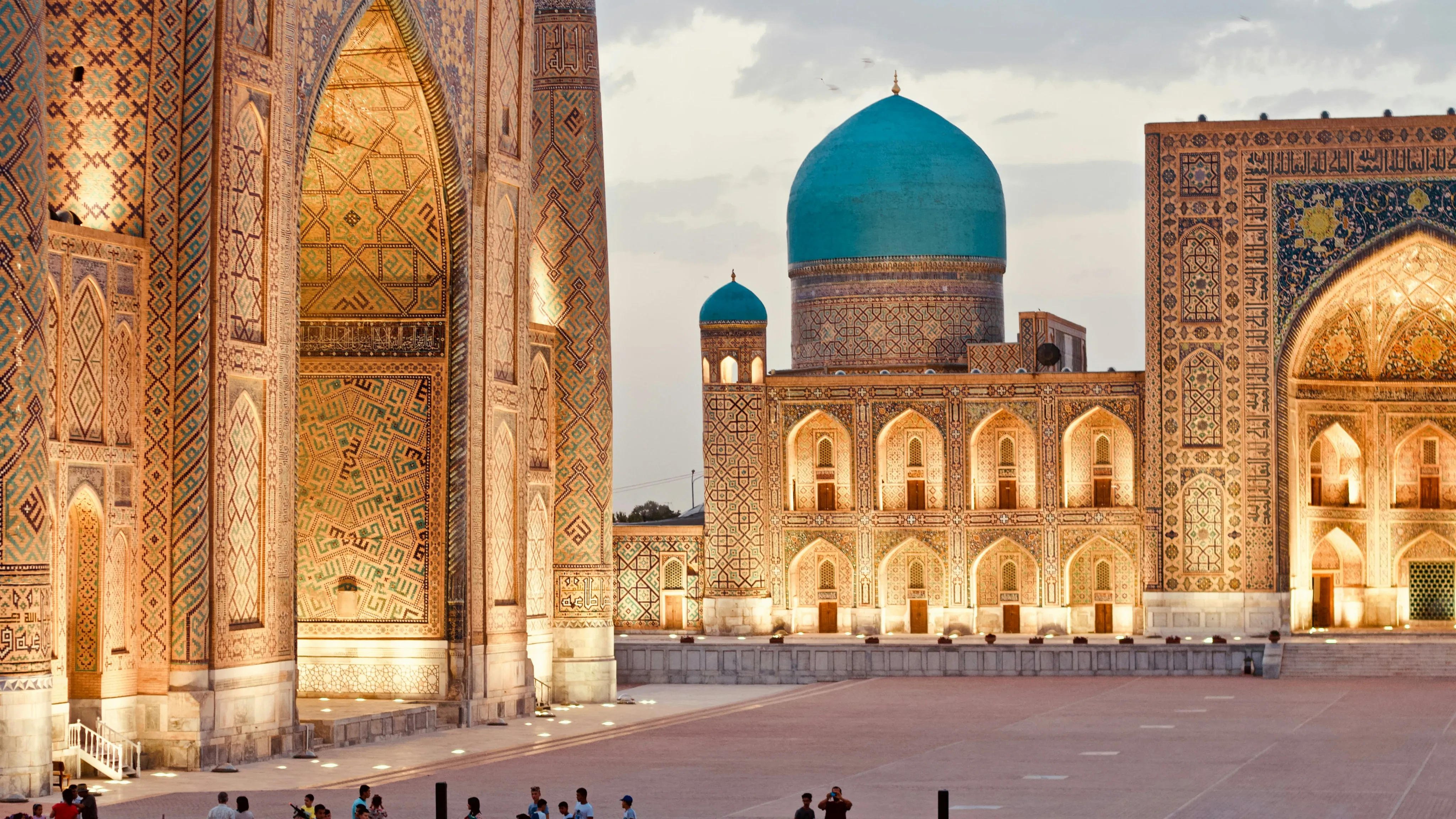
In the heart of Central Asia, the landscapes of Uzbekistan unfold between arid steppes and fertile valleys where time seems to have found its own pace. When walking through its cities, the gaze naturally lingers on the turquoise domes that contrast with the earth tone of the adobe buildings. It is a place where the legacy of the ancient Silk Road is not just a historical reference, but a daily presence felt in the architecture, in the markets filled with spices, and in the murmur of the squares at sunset.
Daily life is organized around simple gestures and shared traditions. It is not uncommon to encounter the aroma of freshly baked bread in clay ovens or the tinkling of teacups in traditional teahouses, where the bustle of the bazaars gives way to moments of pause. The country’s identity is reflected both in the delicacy of its hand-woven silks and in the spontaneous hospitality of its people, who usually receive those who arrive with a contagious calm and a deep respect for their customs.
Depending on the time of year, the environment offers very different nuances. While spring covers the valleys in green, autumn brings golden light and the harvest of sweet fruits that fill the street stalls. This variety of atmospheres allows a glimpse into a complex and balanced culture that has managed to preserve its essence and artisanal crafts while naturally integrating into the contemporary era.
🛡️ General Safety
Uzbekistan is currently considered one of the safest and most welcoming destinations in Central Asia for international tourism. The country has made a notable effort in recent years to open up to the world, resulting in an environment of stability and tranquility for the traveler.
General safety level
- The overall safety rating in Uzbekistan is high. Violent crime rates are extremely low, especially those that could affect foreign visitors.
- Compared to other international destinations, the risk level is in a very low range, similar to or even lower than that of many European capitals.
- The traveler will find a country with a strong police presence, especially in areas of historical interest, which contributes to a sense of constant protection without being invasive.
Crime and common risks
- The most common crimes are minor in nature, mainly pickpocketing or small thefts of wallets in crowded places.
- It is recommended to take extra precautions in traditional bazaars (such as Chorsu in Tashkent) and in transport stations, where crowds can be exploited by pickpockets.
- Scams are not frequent, although cases of overcharging in unofficial taxis or in some shops may occur if the price is not agreed upon beforehand.
- Serious incidents are rare, but it is advisable to avoid walking alone in peripheral or poorly lit areas at night, applying basic common sense.
Safety in cities and tourist areas
- The urban centers of Tashkent, Samarkand, Bukhara, and Khiva are very safe to travel at any time of day.
- There is a specialized unit called the Tourist Police, whose agents usually speak English and are stationed near major monuments to assist travelers with whatever they need.
- There are no significant safety differences between the main cities, as all share a hospitable approach toward tourists.
- To move around with peace of mind, it is enough to follow the usual rules of any city: keep belongings in sight and do not unnecessarily display objects of great value.
Safety in transport
- Public transport, including the Tashkent metro and high-speed trains (Afrosiyob), is modern, punctual, and very safe.
- Regarding taxis, it is strongly recommended to use ride-hailing applications (such as Yandex Go). This guarantees a fair and recorded price, avoiding misunderstandings with independent drivers.
- In Uzbekistan, driving is on the right. If you decide to rent a vehicle, you should know that the condition of the main roads is acceptable, but secondary roads may have potholes or a lack of lighting.
- Local driving can be somewhat erratic; additional caution is recommended at intersections and avoid intercity road travel at night.
Natural and climatic risks
- Uzbekistan is located in a seismic activity zone. Although large-magnitude earthquakes are not frequent, the risk exists and it is advisable to know basic protection protocols in buildings.
- The main climatic risk is extreme heat during the summer months (July and August), where temperatures can exceed 40-45°C. This can cause dehydration or heat stroke if measures are not taken.
- It is recommended to travel with sun protection, drink plenty of bottled water, and avoid outdoor excursions during the central hours of the day during the summer period.
Legislation and local norms
- Uzbekistan has strict laws regarding the possession of medication. Certain drugs containing psychotropic substances or strong painkillers (such as codeine) may be prohibited. It is essential to travel with the original medical prescription and check the list of permitted substances.
- It is mandatory to always carry the original passport or a clear copy of it, as authorities may request it for identification.
- Accommodation registration (regitratsiya) is fundamental. Hotels will issue a receipt for each night of stay; keep them all, as they may be required by customs agents when leaving the country.
- Drug consumption is severely punished with long prison sentences.
Safety for specific groups
- Female travelers: Uzbekistan is a safe destination for women traveling alone. However, it is recommended to dress respectfully (covering shoulders and knees), especially in rural areas or when visiting mosques and sacred sites.
- LGTBIQ+ travelers: Same-sex relationships are illegal under the Uzbek penal code, and the country is socially conservative. Absolute discretion in public behavior is recommended to avoid legal or social problems.
- Children and the elderly: The country is very family-oriented and respectful of the elderly. Infrastructure in tourist areas is adequate, although accessibility in ancient monuments may be limited due to uneven floors.
Emergencies and assistance
- In case of need, the main emergency numbers are:
- 101: Firefighters.
- 102: Police.
- 103: Ambulances and medical emergencies.
- The police are usually helpful to tourists. If you suffer a theft, go to the nearest police station to file a report (“protopol”), which is necessary for any travel insurance claim.
- It is recommended to always have travel insurance with broad medical coverage, as quality private healthcare in major cities can be expensive for a foreigner.
> Tip: Download the Yandex Go taxi app upon arriving in the country; it is the safest, most economical, and transparent way to move around cities without having to constantly negotiate prices.
📝 Entry requirements to the country
To plan a trip to Uzbekistan, the first aspect to consider is identity documentation. It is fundamental that international travelers have a passport with a minimum validity that usually ranges between three and six months from the date of entry into the territory. Depending on the visitor’s origin, access may be subject to a visa exemption regime for short stays or the need to process a prior electronic authorization. These permits usually allow a tourist stay of up to thirty days, a time considered adequate to see the main attractions of the region.
At border control points, whether in international airports or land borders, authorities may request additional information to verify the nature of the trip. It is common to be required to show an exit ticket from the country or proof of travel to a third destination. Likewise, although not always systematically requested, it is convenient to have documents proving the possession of sufficient funds to cover expenses during the stay and accommodation reservations for the first nights on Uzbek soil.
Customs regulations in this destination are a relevant point for the traveler. There is control over the import of certain medications, especially those containing psychotropic substances or derivatives of strong painkillers, so it is advisable to travel with the corresponding medical prescription if following a specific treatment. Regarding the entry of foreign currency, it is usually necessary to declare high amounts of cash if they exceed the limits established by local regulations, thus avoiding possible inconveniences when leaving the country.
Regarding health recommendations, mandatory vaccinations are not usually required for tourists arriving from most international destinations, except for specific cases related to specific risk zones. However, it is considered a good practice to review the general vaccination schedule and have travel medical insurance with broad coverage. It is also advisable to maintain the usual precautions with the consumption of water and food to ensure a healthy and trouble-free stay.
- The passport must be valid and have a sufficient expiration margin.
- Many tourists benefit from visa exemption or the ease of prior digital procedures.
- The maximum stay period for tourism is usually set at 30 days.
- It is recommended to carry the confirmation of the return flight or scheduled departure.
- It is important to find out about restrictions on bringing in certain drugs for personal use.
- The declaration of valuable objects and foreign currency at customs is a common practice at controls.
- Specific health certificates are not generally required, but it is preferable to have private health protection.
🏥 Basic health considerations
Uzbekistan is a fascinating country that is modernizing its services at a good pace, although you will still notice important differences between the main cities and rural areas. The public health system has limitations in terms of equipment and technology, so if you need assistance, you will most likely end up going to private clinics in Tashkent, which is where the best quality standards are concentrated. Prices for tourists in these private centers are usually moderate compared to Western countries, but immediate payment is the norm, so it is better to be prepared. Regarding communication, most doctors speak Uzbek or Russian, and although it is possible to find English-speaking specialists in the capital, it is not guaranteed in the rest of the country.
Having travel medical insurance is not always a mandatory legal requirement for entry, but it is something you should consider essential for your peace of mind. We recommend that your policy include broad coverage for hospitalization and, very specifically, medical repatriation. This is vital because, in the face of a serious complication, you might need a transfer to another destination with more advanced facilities, something that without insurance would have a very high cost for you.
Regarding vaccinations, you will be glad to know that there are no mandatory vaccinations to enter Uzbekistan. Ideally, you should travel with your usual vaccination schedule up to date. As an additional precaution, some travelers consult with their doctor about Hepatitis A and typhoid fever vaccines, especially if you plan to spend a lot of time in rural areas or if you like to explore local markets and try street food frequently.
You must be especially careful with the issue of medication. Uzbekistan maintains very strict laws on the entry of drugs, especially those containing psychotropic substances or codeine, which is common in some syrups or strong painkillers. If you need to carry personal medication, make sure to take it in its original packaging and with the corresponding medical prescription. If possible, having a translation of the prescription into Russian or Uzbek will save you any type of delay or problem at border controls.
Regarding risks according to the environment, the climate will be your biggest challenge. In the summer months, the heat is extremely dry and strong, so you could suffer from dehydration if you do not drink liquids constantly. In mountain areas, the weather changes quickly and the cold can be intense. There are no significant risks of insect-borne diseases in general, but it is common for changes in diet and the use of local cooking oils to cause some mild digestive discomfort during the first days of your stay.
About water and food, the golden rule is that tap water is not potable. You will find bottled water easily anywhere, even in the smallest villages, and it is the one you should use even to brush your teeth if you have a sensitive stomach. In restaurants, you will see that hygiene has improved a lot, but it is always preferable that you consume well-cooked food and that you peel the fruit you buy in the markets yourself.
For any emergency situation, the medical emergency number is 103. Ambulances in large cities like Tashkent or Samarkand usually respond well, although you should keep in mind that the vehicle equipment and the training of first response personnel may be basic. Whenever your condition allows, it will be best to move by your own means to one of the international clinics recommended by your insurance.
As final tips for your route, do not forget to pack a small first-aid kit with rehydration salts, something for heavy digestions, and a hand sanitizer. Maintaining good hand hygiene before each meal is the simplest and most effective gesture to enjoy your trip without health setbacks. Always keep your insurance contact details handy, whether on paper or on your phone, so as not to lose time if you need to use them.
🚌 Transport within the country
Moving around Uzbekistan is an accessible experience thanks to an infrastructure that effectively connects the main urban centers. The train positions itself as the preferred means of transport for travelers, as it has services that connect historic cities efficiently. For long-distance journeys across the territory, domestic flights are a common option that allows for optimizing travel time between the country’s ends.
In the urban environment, the ease of using public transport varies by location. In the capital, the metro is a functional and comfortable system for visitors, while in other cities movement relies more on buses and vans. Although signage may present challenges due to the language, main points are usually indicated so that the tourist can orient themselves with some attention. Ticket purchases are usually managed at stations or authorized points of sale simply.
There is a marked difference between mobility in large cities and rural areas. In urban centers, options are diverse and constant, while in more remote areas transport depends on less regular services or shared vehicles. The use of taxis and transport services with a driver is a very widespread and common practice to cover journeys where mass transport does not reach, offering a flexible alternative for the visitor.
In general terms, transport in the country stands out for its notable punctuality, especially in the railway system. The feeling of comfort is satisfactory on the main routes, allowing the traveler to enjoy the landscape in a relaxed way. Although the condition of some secondary roads can influence the duration of land trips, the transport network offers an adequate reliability for international tourism.
Tip: It is advisable to organize travel between cities with sufficient advance notice to ensure availability on the chosen means of transport.
🤵 Culture and Etiquette
Uzbek society is distinguished by a deep tradition of hospitality and courtesy, where interpersonal treatment is usually slow and respectful. In everyday life, greeting is an important ritual; between men, a handshake is common, often accompanied by placing the right hand over the heart as a sign of sincerity. When addressing women, it is most appropriate to wait for them to initiate the greeting or to perform a slight bow of the head. Respect for elders is a fundamental pillar manifested by giving up seats on transport or allowing them to lead conversations and toasts.
In public spaces, discreet behavior and a moderate voice volume are valued. Although punctuality is appreciated in the professional sphere and in transport services, in social gatherings there is greater temporal flexibility. Regarding physical contact, it is usually limited in initial interactions, always maintaining a personal distance that denotes prudence. Clothing, although it varies by region, tends to be modest, especially in rural areas or those less accustomed to tourism, where covering shoulders and knees is considered a gesture of consideration for local sensitivity.
Gastronomy occupies a central place in social life, and bread (non) is considered an almost sacred element. It is customary never to place bread upside down or leave it on the ground, and it is usual to break it with your hands instead of using a knife. When invited to a home or to participate in a meal, green or black tea is frequently offered constantly as a welcoming gesture. In restaurants in the main cities, it is common to find a service charge already included in the bill, although leaving an additional tip is a well-received gesture if the service has been satisfactory.
When visiting religious sites, such as mosques or mausoleums, it is fundamental to observe a respectful silence and follow directions regarding footwear, which must generally be removed before entering. In these environments, the attitude should be one of contemplation, avoiding interrupting those who are praying. Understanding family and social hierarchies allows the traveler to navigate with greater fluidity, recognizing that local traditions coexist naturally with the modernity of large cities, creating an environment of coexistence based on mutual kindness.
Tip: When giving or receiving objects, documents, money, or food, it is recommended to use the right hand or both hands simultaneously, as this gesture is interpreted as a sign of deference and good manners toward the interlocutor.
🍛 Typical Gastronomy
Uzbekistan’s gastronomy is a reflection of its strategic position in the heart of the Silk Road, which has resulted in a rich, comforting cuisine based on quality local products. The flavors are not excessively spicy, but rather rely on the balanced use of spices such as cumin, coriander, and sesame. Lamb and beef, rice, legumes, and seasonal vegetables constitute the fundamental pillars of the daily diet.
Bread, known locally as non, is a sacred element that is never missing from the table. It is a circular bread with thick edges and a decorated center, traditionally baked in clay ovens called tandir. There is a strong cultural tradition surrounding it: it must never be placed upside down and should not be cut with a knife, but rather broken with the hands as a gesture of respect and fraternity toward the diners.
Eating habits in Uzbekistan are usually marked by hospitality. Meals often begin with a selection of dried fruits, local sweets, and tea, which is the national drink par excellence. Lunch is usually the main meal of the day, and it is frequent for dishes to be shared in the center of the table. In restaurants and choyhonas (teahouses), the atmosphere is slow, inviting travelers to enjoy the food without haste.
Regarding drinks, green tea is consumed throughout the day for its refreshing properties, while black tea is usually reserved for the colder months. It is also common to find ayran, a drink based on yogurt diluted with water and salt, highly appreciated for accompanying hearty dishes. The end of the meal is usually starred by pieces of fresh fruit, such as the famous Uzbek melons, known for their great sweetness.
| Dish | Description | Main Ingredients | Where to try it | Tip |
|---|---|---|---|---|
| Plov (Osh) | National dish par excellence, consisting of mellow rice cooked in large cauldrons. | Rice, lamb or beef, carrots, and cumin. | Specialized plov centers and local restaurants. | It is recommended to try it at noon, when it is served freshly prepared. |
| Shashlik | Skewers of marinated meat grilled over charcoal embers. | Lamb, beef, or chicken meat and raw onion. | Bazaars, street stalls, and grill restaurants. | Accompany it with traditional bread fresh from the oven. |
| Manti | Large stuffed doughs that are steamed. | Wheat dough, minced lamb or beef, and spices. | Traditional cuisine restaurants and teahouses. | Try them with a bit of sour cream or yogurt on top. |
| Lagman | Hand-pulled long noodle dish served with meat and vegetables. | Wheat noodles, meat, pepper, potato, and aromatic broth. | Regional restaurants and market stalls. | There is a sautéed version (without broth) that is also very popular. |
| Shurpa | Clear and nutritious broth soup, very common throughout the country. | Bone-in lamb, potatoes, carrots, and fresh herbs. | Choyhonas (teahouses) and family restaurants. | It is excellent as a first course to whet the appetite before the plov. |
📷 Areas and places to visit
Uzbekistan presents itself as the historical heart of the Silk Road, a destination where Islamic architecture and oasis cities tell centuries of commercial and cultural exchange. The journey through the country usually revolves around its oldest urban centers, which preserve a heritage of brick, adobe, and turquoise tiles. Each region offers a different atmosphere, from the vibrant modern life of the capital to the stillness of walled enclosures that seem frozen in time, allowing the visitor to understand the evolution of Central Asia.
The city of Samarkand is, undoubtedly, the essential point of reference. This enclave stands out for the magnitude of its constructions and the fineness of its mosaics. The epicenter of tourist activity is located in Registan Square, flanked by three madrasas with imposing facades. Other points of great historical relevance are the Shah-i-Zinda necropolis, with its aisles of blue tiles, and the Bibi-Khanym mosque. Walking through these areas allows observing the monumental scale that Tamerlane’s empire reached, combining visits to monuments with stops at small artisanal silk paper workshops.
Moving west, Bukhara offers a more compact and pedestrian experience. Its old town is recognized for the integrity of its urban layout, where the Po-i-Kalyan complex, composed of a 12th-century minaret and a large mosque, stands out. The Ark Fortress and the Samanid Mausoleum are notable examples of the architectural evolution of the area. A common activity here is to wander through the trading domes, ancient covered markets where carpets, spices, and artisanal knives can still be purchased, keeping alive the essence of the old caravanserais.
The city of Khiva represents the third great pillar of Uzbek heritage. Its walled core, known as Itchan Kala, functions as an open-air museum where palaces, mosques, and minarets are concentrated, such as the unfinished Kalta Minor, recognizable by its glazed green color. Unlike other cities, the walled enclosure of Khiva preserves a visual homogeneity that allows one to imagine what the desert city-states were like. It is recommended to climb the walls to watch the sunset over the mud roofs and cyan domes.
In contrast to the historic cities, Tashkent, the capital, shows the most modern and diverse face of the country. After the 1966 earthquake, the city was rebuilt with wide avenues, extensive parks, and Soviet-style buildings. However, it still retains traditional corners like the Chorsu Bazaar, where daily life unfolds under its enormous blue dome. Another of the capital’s highlighted attractions is its metro system, whose stations are decorated with reliefs, chandeliers, and mosaics, turning public transport into an underground art gallery.
For those seeking closer contact with nature and rural traditions, the Fergana Valley offers a different landscape, surrounded by mountains and fertile farmland. It is the ideal area to see silk production in Margilan or traditional ceramics in Rishtan. On the other hand, the region of the Republic of Karakalpakstan houses the Savitsky Museum in the city of Nukus, famous for its collection of forbidden avant-garde art. In this same region, travelers can explore the vestiges of the Aral Sea in Moynaq, where old ships stranded in the sand offer a unique and reflective landscape on environmental changes.
The country’s geography also allows enjoying natural spaces such as the Kyzyl Kum Desert or the Nurata Mountains. In these areas, it is possible to undertake simple hiking routes, stay in traditional yurt camps, and observe the nomadic way of life that still persists in certain areas. Lakes like Aydarkul provide visual relief from the aridity of the desert, offering a conducive environment for bird watching and resting in a serene setting.
Tip: You cannot miss visiting Registan Square in Samarkand, the most emblematic place in the country.
✈️ Best time to travel
Uzbekistan has an extreme continental climate, which translates into very marked seasons with great temperature contrasts. For most travelers, the transition periods are the most recommended, as they allow touring historic cities and natural spaces with a moderate climate, avoiding both the intense cold of winter and the dry, rigorous heat of the summer period.
During the spring and autumn months, the country offers its kindest face. It is the time when the squares of Samarkand, Bukhara, and Khiva can be enjoyed with abundant daylight and temperatures that invite walking. In addition, these times coincide with important cultural festivities and the vitality of local markets, which are filled with fresh products and traditional crafts.
| Season | Months | Typical Climate | What to Expect | Tourist Influx |
|---|---|---|---|---|
| Spring | Mar – May | Mild and pleasant temperatures, with occasional rains. | Green landscapes, flowering in the valleys, and the Navruz celebration. | High (⭐⭐⭐⭐) |
| Summer | Jun – Aug | Dry and intense heat, often reaching 40°C. | Clear skies, long days, and a cooler atmosphere in mountain areas. | Low - Medium (⭐⭐) |
| Autumn | Sep – Nov | Temperate, dry climate with very clear skies. | Harvest season, markets full of fruit, and ideal conditions for photography. | High (⭐⭐⭐⭐) |
| Winter | Dec – Feb | Intense and dry cold, with frequent frosts and snowfalls. | Monuments covered in snow, absolute tranquility in the cities, and winter sports. | Low (⭐) |
🗣️ Basic Vocabulary
Although in the more touristy areas of Uzbekistan it is possible to communicate in English or Russian, knowing some words in Uzbek is very useful for getting around in daily life. Local inhabitants greatly appreciate travelers making the effort to use their language, which usually facilitates a closer and friendlier welcome in markets, shops, or public transport.
Mastering these basic expressions will allow you to resolve common situations, such as greeting correctly, thanking for a service, or asking the price of a product simply. It is not necessary to delve deep into the grammar for this small repertoire to improve your experience and communication during the trip.
- Assalomu alaykum: Formal greeting used to say hello (literally means “peace be upon you”).
- Rahmat: Thank you.
- Iltimos: Please.
- Ha: Yes.
- Yo’q: No.
- Qancha?: How much does it cost?
- Xayr: Goodbye