


Montenegro
Montenegro captivates with its Mediterranean fjords, medieval villages, and rugged mountains, offering a perfect balance between untouched nature and a deep cultural history.
Quick Facts
- Capital
- Podgorica
- Language
- Montenegrin
- Serbian, Bosnian, Croatian, and Albanian
- Currency
- Euro (€)
- Best time to visit
- From May to September to enjoy the sun and the mountains.
- Budget per day
- $45 - $130 per day
- Climate
- Mediterranean on the coast with hot summers and alpine continental in the mountainous interior.
- Connectivity
- good
- It is very easy to buy prepaid cards at kiosks and local shops.
- Electricity
- Type C/F (230V)
- Local transport
- acceptable
- Card usage
- acceptable
- Tipping
- optional
🌎 Introduction
Between the calm waters of the Adriatic and the peaks of the Balkans, lies a territory where the blue of the sea and the green of the forests coexist within a few kilometers. Walking through the stone streets of its coastal towns or observing the reflection of the mountains in freshwater lakes, one perceives a different pause in time. It is a place of soft contrasts, where the sea breeze soon transforms into fresh mountain air, allowing the landscape to change completely in just a couple of hours of travel.
Daily life in this region is savored in the plazas, with the aroma of coffee and the murmur of local markets where artisanal cheeses and olive oil of centuries-old tradition can still be found. Depending on the time of year, the environment transforms its color palette: from luminous summers by the bays that recall the northern fjords, to winters of snow-capped peaks and lit fireplaces in the inland villages. The identity of these lands has been forged between diverse influences, creating a steady character reflected in both its simple gastronomy and the architecture of its ports.
🛡️ General Safety
Montenegro is considered a destination with a high level of safety for international travelers. In general terms, the country offers a very quiet and welcoming environment, placing it in a favorable position compared to other European destinations. The atmosphere is relaxed, and most visitors complete their stay without experiencing any kind of setback related to safety.
The context for the traveler is that of a small and hospitable country that values tourism positively. However, as on any trip, basic prevention and common sense are the best tools to guarantee a trouble-free experience.
Crime and Common Risks
Crime affecting tourists in Montenegro is generally non-violent. The most common incidents are usually limited to:
- Minor theft and pickpocketing: These occur mainly during the high summer season in crowded areas, such as the walls of Kotor, the old town of Budva, or the most popular beaches.
- Service scams: Some tourists may encounter inflated prices in non-official establishments or receive incorrect change in local markets.
- Organized begging: It may be present in some very specific tourist areas, although it is not usually aggressive.
It is rare to face situations of physical violence, as Montenegro maintains a cohesive social structure and a generalized respect toward foreign visitors.
Safety in Cities and Tourist Areas
Montenegro’s urban centers and tourist neighborhoods are very safe, allowing for peaceful walks both day and night.
- Podgorica and inland cities: The pace of life is slow, and crime rates are low. Standard precautions used in any European city are recommended.
- Coastal areas: During the summer, cities like Herceg Novi, Tivat, or Budva increase their population considerably. In this environment, it is advisable not to leave valuables unattended on the beach sand or inside parked vehicles.
- Urban public transport: It is safe and reliable. It is only recommended to pay attention to personal belongings on buses that run very touristy routes or in crowded stations.
Transport Safety
Transportation in Montenegro is generally safe, although it presents important logistical particularities:
- Driving: In Montenegro, you drive on the right. Main roads are in good condition, but the country’s orography is very mountainous. It is common to find narrow roads with many curves and steep slopes, especially in areas like the Tara River Canyon or Durmitor National Park. Extreme caution is recommended regarding local driving, which can sometimes be somewhat impetuous.
- Taxis: To avoid overcharging, it is recommended to use official taxis that have a meter or agree on the price of the journey before starting. There are reliable transport apps and radio-taxi services in the main cities.
- Rental vehicles: This is a very popular and safe option. It is advisable to check the condition of the vehicle when picking it up and to have insurance with broad coverage due to the narrowness of some secondary roads.
Natural and Climatic Risks
Montenegro has a varied geography that involves certain seasonal natural risks:
- Seismic activity: The country is located in a zone of moderate seismic activity. Although large-magnitude earthquakes are rare, there are basic action protocols that are worth knowing.
- Wildfires: During the summer months (July and August), extreme heat and dryness increase the risk of fires, especially in forested areas and on the coast. Lighting fires in unauthorized areas is strictly prohibited.
- Winter weather: In the northern regions and in the mountains, snowfalls can be very intense, causing road closures and dangerous driving conditions due to ice.
- Flooding: Occasional flooding can occur after torrential rains in autumn or spring, mainly affecting low-lying areas near rivers.
Local Legislation and Norms
It is essential to know some regulations to avoid sanctions or misunderstandings:
- Registration of stay: All foreign tourists must register with the local police or at a tourist office within 24 hours of arrival. If you stay in a hotel or official establishment, they will handle the process; if you stay in private homes, make sure the owner does it.
- Substance consumption: Montenegro has strict laws regarding the possession and consumption of drugs, with penalties including heavy fines and periods of detention.
- Photography: It is forbidden to photograph military installations, strategic government buildings, or duly marked security personnel.
- Identification: It is recommended to always carry a copy of your identity document or passport, keeping the original in a safe place.
Safety for Specific Groups
- Female travelers: Montenegro is a very safe country for women traveling alone. Respect for women is the general norm, and street harassment situations do not usually occur. It is recommended to follow standard precautions when going out at night in nightlife areas.
- LGTBIQ+ travelers: Although homosexuality is legal, Montenegrin society remains mostly traditional and conservative. Public displays of affection may attract uncomfortable looks or comments, especially outside the more touristy and modern areas. Discretion is recommended to avoid possible friction.
- Traveling with children and the elderly: It is an excellent destination for families and seniors due to the general tranquility and the good quality of health services in the main urban areas. Infrastructure in historical centers can be difficult for people with reduced mobility due to cobblestone floors and stairs.
Emergencies and Assistance
In case of needing urgent help, these are the main contacts that work throughout the national territory:
- 112: General emergency number (they assist in several languages).
- 122: Police.
- 123: Fire department.
- 124: Ambulance and medical emergencies.
Emergency services personnel are usually professional. In tourist areas, it is likely to find officers who speak basic English. In case of loss of documents, you should go to the nearest police station to process the corresponding report.
Tip: Always keep the receipt for the payment of the tourist tax given to you at your accommodation; occasionally, border authorities may request it when leaving the country to verify your legal registration of stay.
📝 Entry Requirements
To plan a stay in Montenegro, it is essential to have a passport with a minimum validity that is usually between three and six months from the planned date of departure from the territory. It is recommended that the document be in good condition to facilitate procedures at border control posts, both at airports and road access points.
In most cases related to short-term tourism, a prior visa is not required. Travelers are usually allowed to stay in the country for a maximum period of 90 days within a six-month window, which offers enough time to explore the region’s main natural and cultural attractions. However, upon entering the country, authorities might request the presentation of a return ticket or onward travel ticket, as well as proof of sufficient financial funds to cover the planned expenses during the stay.
Regarding formalities at entry points, controls are usually agile but thorough. It is important to take into account standard customs restrictions, which limit the entry of certain products. For example, if you are carrying medications for personal use, it is advisable to bring the corresponding medical prescription. Likewise, there are limits on the introduction of tobacco, alcohol, and certain foods, especially those of plant or animal origin that are not properly processed.
In the field of health, there are usually no mandatory vaccine requirements for the entry of international tourists, beyond general public health recommendations. Even so, it is considered a very positive practice to have travel medical insurance with broad coverage, as this guarantees adequate assistance for any medical eventuality that might arise during the trip through the country.
- Identity document: Passport with a minimum validity of three to six months.
- Visa exemption: Generally applied to tourist stays of less than 90 days.
- Justification of stay: Possible request for accommodation reservation or proof of financial solvency.
- Transport: Recommendation to carry the exit ticket from the country.
- Medicines: Need for a medical prescription for specific treatments.
- Health: Recommendation to have international travel insurance.
- Customs: Limitations on tobacco, alcohol, and fresh food products.
🏥 Basic Health Considerations
When preparing for your trip to Montenegro, you will see that the country has an acceptable health infrastructure, although you will notice important differences between urban and rural areas. In main cities like Podgorica, Budva, or Kotor, you will find modern and well-equipped private clinics, while in the interior, access may be somewhat more limited. Public care is available, but as a tourist, you will very likely prefer to go to private centers for faster and more comfortable attention. Consultation prices and treatments are not exorbitant, but without backup, any setback can upset your budget. Regarding language, you will find it easy to communicate in English with much of the staff in private hospitals, although in public centers you might encounter more difficulties.
Although it is not a mandatory legal requirement to enter the country, taking out travel medical insurance is something you should consider fundamental. Having a policy that includes hospitalization, medical transfers, and repatriation will give you enormous peace of mind while you travel through the mountains or enjoy the Adriatic coast. If you plan to do adventure activities, such as intense hiking through Durmitor or water sports, make sure your insurance covers these specific scenarios, as rescues in remote areas have very high costs.
Regarding vaccines, you will not find any that are mandatory to cross the border. The most sensible thing is to have your usual vaccination schedule up to date, including common doses against tetanus, diphtheria, or hepatitis. If you plan to spend a lot of time in forested areas or doing multi-day mountain routes, you could consult your doctor about the vaccine against tick-borne encephalitis, although it is not a general recommendation for a tourist visiting the country’s best-known spots.
If you need to take personal medication, it is ideal to transport it in its original container and accompanied by a signed medical prescription or report, preferably in English. This is especially important if you travel with specific drugs or chronic treatments. In local pharmacies, which you will recognize by the name Apoteka, you will find basic products for minor ailments, but for very specific medications you might have supply problems or need a prescription from a local doctor.
Health risks in Montenegro are closely linked to nature and climate. During the summer months, temperatures on the coast are usually very high, so you will have to pay attention to constant hydration and the use of sun protection. If you like hiking, the main risk is tick bites in areas of dense vegetation and the presence of some vipers in rocky areas, so it is advisable to walk on marked trails and use closed footwear. Otherwise, there are no serious endemic diseases to worry about.
Regarding the consumption of water and food, you can move with confidence as the general level of hygiene is good. Tap water is considered potable in most of the territory, although in some coastal towns during the summer, the taste may not be the best and you might prefer bottled water. Food in markets and local establishments is safe and follows adequate cleaning standards, so you can try the local gastronomy with total calm.
In case you suffer a serious medical emergency, the phone number you should dial is 124. This service is responsible for coordinating ambulances and first aid care. Keep in mind that in high mountain areas access can be complicated, so it is always recommended to inform your accommodation or acquaintances of your routes.
To finish, it will be useful to follow a couple of simple tips. It is always useful to carry a small first-aid kit with basics like painkillers, band-aids, and some disinfectant. Additionally, if you travel during hot weather, don’t forget a good insect repellent if you plan to visit areas near lakes or rivers. With these minimum precautions, your experience in this destination will be exclusively for enjoying its landscapes.
🚌 Transportation Within the Country
The bus is the most common means of transport for moving around the territory, as it has a network that regularly connects the coastal towns with the capital and the inland regions. Although there is a train service, its route is limited and focuses mainly on the axis connecting the north with the south, being a more restricted option for the tourist looking to cover the entire country. Being a small country, there are no internal flights or metro networks.
For a visitor, public transport is easy to use, as the main stations are usually well-located and have basic information services. The purchase of tickets is generally managed at the ticket offices of the stations themselves or, in the case of roadside stops, directly with the driver. Signage is understandable and, at the most crowded points, it is possible to communicate basic information to resolve doubts about the routes.
There is a clear difference between mobility in the large cities and rural areas. In urban centers and coastal destinations, connections are frequent and fluid. However, to access certain national parks or mountain villages, public transport options decrease considerably, leading many travelers to opt for car rental to explore the country with greater freedom and adapt to the mountainous terrain.
The use of taxis is common and they are easily found in the busiest areas, such as stations and tourist centers. They are a comfortable alternative for short trips or reaching specific accommodations directly. Likewise, in the bay area, the use of small ferries or boats is a common solution for crossing from one point of the coast to another, avoiding road detours.
The general feeling about transport is one of reliability, although travel times can be longer than what the distance on the map indicates due to the orography of the land. Punctuality is usually acceptable, although during the months of highest visitor influx, it is possible to find denser traffic on the main coastal roads that slightly affects the duration of trips.
Tip: It is convenient to check the schedules in advance if you plan to visit less populated areas, as frequencies can be reduced outside the main routes.
🤵 Culture and Etiquette
In Montenegro, interpersonal interaction is characterized by a mix of hospitality and frankness. When greeting, the most common practice is a firm handshake maintaining eye contact, in both formal and informal settings. Among close friends and family, greeting with kisses on the cheeks is frequent, although for the international visitor, a handshake is always the most appropriate and safe option to initiate contact. The tone of voice in conversations is usually animated, reflecting an open communicative culture where honesty in dialogue and closeness in treatment are valued.
Daily life in the country often flows under a concept of tranquility, especially perceptible in the coffee culture, which is the central axis of social life and a fundamental meeting space. Although punctuality is well-received in professional contexts, in social gatherings there is a certain flexibility and a slower pace. In public spaces, respectful and measured behavior is observed; moderate physical contact is common during conversation between acquaintances, reflecting a natural social warmth that is not usually invasive for the traveler.
Table culture is a fundamental pillar and usually involves generosity and abundance. When visiting a Montenegrin home, it is a widespread practice to take off your shoes upon entering, and it is very well seen to give a small gift to the hosts, such as coffee, sweets, or a simple present. In hospitality establishments, tipping is not strictly mandatory, but it is customary to round up the bill or leave approximately ten percent of the total as a gesture of gratitude for good service. Sharing food is considered an important act of hospitality, so it is common for hosts to repeatedly insist on offering food and drink.
Respect for traditions and religious institutions is an essential aspect of coexistence. When visiting Orthodox monasteries, churches, or mosques, it is fundamental to observe a modest dress code, ensuring that shoulders and knees are covered. In some more conservative Orthodox religious centers, women are expected to cover their hair with a scarf and men are expected not to wear shorts. Likewise, it is important to maintain a low tone of voice in these premises and avoid photographs during religious services. Respect for the elderly is also a deeply rooted value, manifesting in the courtesy and priority given to them in public spaces and meetings.
“Tip”: Pay special attention to dress codes in places of worship, as access may be restricted if decorum requirements are not met; it is advisable to always carry a light garment to cover up if you plan to make cultural visits.
🍛 Typical Gastronomy
The cuisine of Montenegro is a reflection of its varied geography, offering a marked contrast between the flavors of the Mediterranean coast and the heartiness of the mountainous areas of the interior. On the coast, the influence of Italian and Greek cuisine is evident, with a predominant use of olive oil, aromatic herbs, and seafood. Conversely, in the north and center of the country, recipes become more caloric and comforting, based on the consumption of meats, dairy, and cereals to cope with the alpine climate.
Local eating habits usually place great importance on lunch, which is typically the main meal of the day. It is common to start with a hot soup or a plate of cold cuts and artisanal cheeses before moving on to the main course. Hospitality is a fundamental pillar in Montenegrin culture; it is common for visitors to be offered something to eat or drink as soon as they arrive at a house or traditional establishment, as a sign of courtesy and welcome.
Regarding customs in establishments, hours are usually broad and flexible. In restaurants, service is slow, as eating is understood as a moment of social coexistence. Drinks also play an important role: Turkish-style coffee or espresso are part of daily life, while rakija, a local fruit brandy, is usually served as both an aperitif and a digestive. The country’s wines, made with local grape varieties, are the usual accompaniment to dinners and lunches.
The use of fresh and seasonal ingredients is the norm, as much of the production remains local and artisanal. Local markets are the ideal place to discover the quality of their products, where cured cheeses in oil, mountain honeys, and traditionally smoked meats stand out. Montenegrin gastronomy, although simple in its preparations, stands out for the intensity of its natural flavors.
| Dish | Description | Main Ingredients | Where to try it | Tip |
|---|---|---|---|---|
| Njeguški pršut | Cured and smoked ham following traditional mountain techniques. | Pork, salt, and beech wood smoke. | Village of Njeguši and any local tavern. | Best enjoyed cut into very thin slices with local cheese. |
| Crni rižot | Black risotto with a characteristic marine flavor. | Rice, squid ink, cuttlefish or squid, garlic, and white wine. | Restaurants and taverns in the coastal area. | It is a light dish ideal for dinner facing the Adriatic Sea. |
| Kačamak | A dense and very energetic dish, typical of cold rural areas. | Corn or wheat flour, boiled potatoes, fresh cheese, and sour milk. | Mountainous areas of the north and national parks. | It is usually very filling, so it is recommended as a single course. |
| Burek | Thin and crispy puff pastry filled with various ingredients. | Phyllo dough, minced meat, cheese, spinach, or potato. | Traditional bakeries or specialized shops (pekara). | Try it freshly baked accompanied by a local liquid yogurt. |
| Ćevapi | Small grilled minced meat rolls, very popular throughout the region. | Mixture of meats (beef and lamb), spices, and pita bread (lepinja). | Traditional grills and informal food stalls. | Order them accompanied by chopped onion and ajvar (pepper cream). |
📷 Areas and Places to Visit
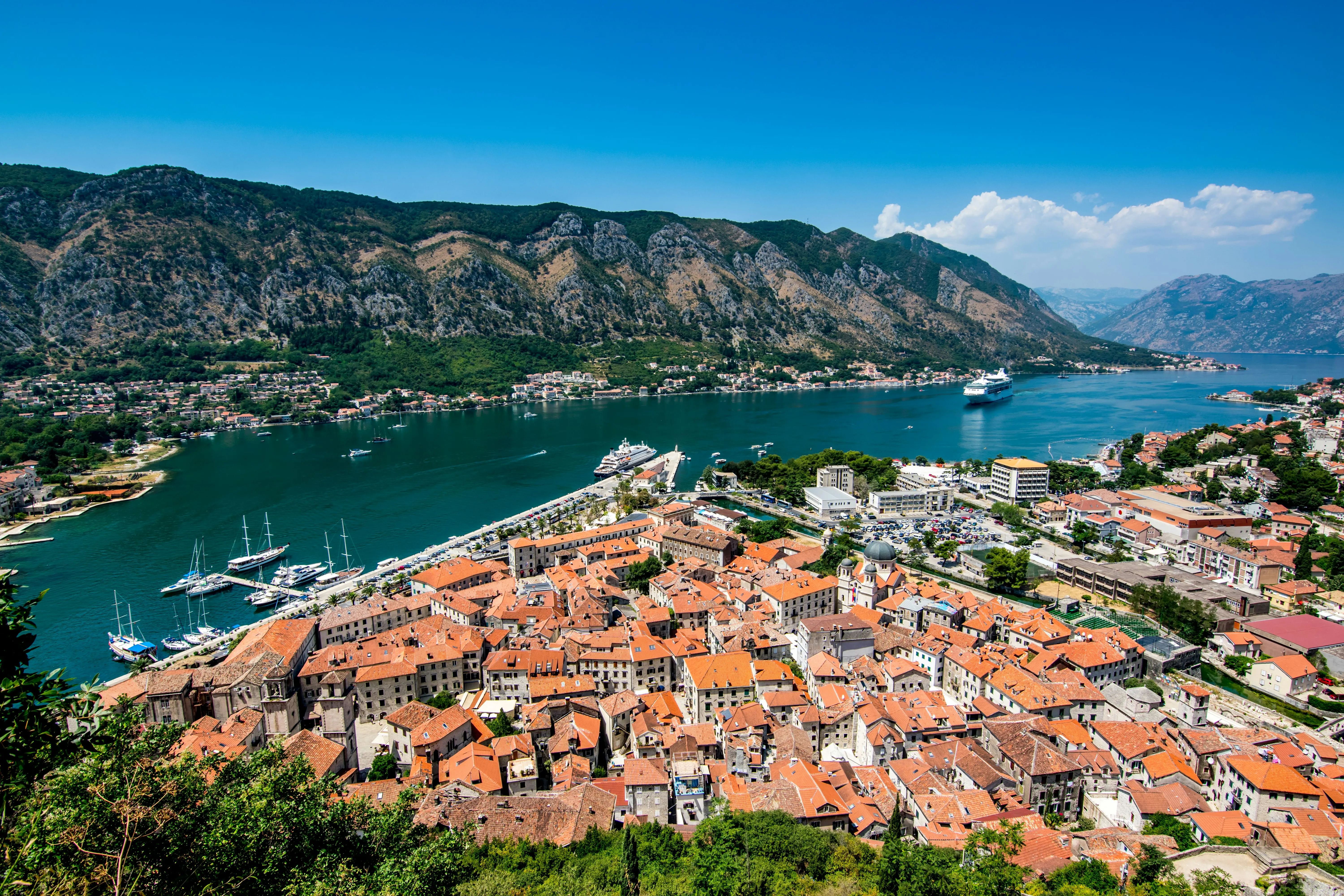
Montenegro offers surprising diversity in a compact territory, where the Adriatic coast and rugged mountains coexist within a few kilometers. The coastal region is, for many, the first contact with the country. Here, the Bay of Kotor presents itself as a natural environment where the sea enters deep into the land, creating a landscape reminiscent of fjord structures. In this area, the city of Kotor stands out for its medieval old town, protected by an extensive wall that climbs the mountainside. Walking through its stone plazas and visiting the Cathedral of Saint Tryphon allows one to understand the region’s deep Venetian heritage.
Nearby, the small town of Perast preserves very well-preserved Baroque architecture in front of two small islets, one of them crowned by the church of Our Lady of the Rocks, which can be visited by small local boats. Following the coastline south, the Budva area offers a contrast between its clear water beaches and a walled historic center located on a small peninsula. It is a region known for its dynamism and seaside promenades, as well as being the access point to contemplate the iconic view of Sveti Stefan, an old fishing village located on an islet connected to the coast by a narrow isthmus.
Inland, the landscape transforms as you enter the historical heart of the country. Cetinje, the former royal capital, is the ideal place to delve into the national identity through its state museums and former embassies that now function as cultural centers. Not far away is the Ostrog Monastery, a white-walled building literally embedded in a vertical cliff. This place represents a point of encounter of great cultural importance and a notable example of architecture integrated into stone, attracting visitors interested in both religious history and architectural curiosity.
Nature takes absolute center stage in Skadar Lake National Park, the largest lake in the Balkans, which serves as a natural border. It is a highly valued destination for bird watching and for touring riverside villages like Virpazar, where you can take excursions through channels surrounded by floating vegetation. In contrast to the serenity of the lake, the north of the country unfolds an imposing and alpine relief. Durmitor National Park is the core of the high mountains, with the Tara River Canyon offering one of the deepest gorges in the region, ideal for those seeking active tourism activities or simply contemplating the magnitude of the bridges that cross it.
In this northern region, the town of Žabljak functions as a base for exploring glacial lakes like Black Lake or doing hiking routes among limestone peaks. Another relevant natural space is Biogradska Gora National Park, which houses one of the last virgin forests in Europe and a central lake with calm waters. Finally, the current capital, Podgorica, shows the country’s most contemporary side, with modern infrastructures like the Millennium Bridge coexisting with vestiges of the Ottoman era in the Stara Varoš neighborhood, offering a balanced vision between the nation’s past and future.
Tip: You cannot miss visiting the Bay of Kotor, the most emblematic place in the country.
✈️ Best Time to Travel
Choosing the right time to visit Montenegro depends largely on the type of activities you wish to perform, as the country has a Mediterranean climate on the coast and a more continental and mountainous one in the interior. This duality allows the territory to offer varied experiences throughout the year, from enjoying its beaches and bays to exploring its national parks and rugged massifs.
For those seeking a balance between pleasant temperatures and the possibility of outdoor activities, the months covering spring and late summer are usually the most recommended. During these periods, nature is at its peak and the weather allows for touring both the historic coastal cities and the hiking routes in the north, without the crowds typical of the middle months of the year.
| Season | Months | Typical Weather | What to Expect | Tourist Influx |
|---|---|---|---|---|
| Spring | Mar – May | Mild temperatures (12°C - 20°C) and longer days. | Thaw in the mountains, very green landscapes, and blooming. Ideal for hiking and cultural visits. | Medium ⭐⭐ |
| Summer | Jun – Aug | Hot and dry on the coast (30°C+); cooler and more pleasant in mountain areas. | Swimming season, outdoor music festivals, and sailing through the bays. | High ⭐⭐⭐ |
| Autumn | Sep – Nov | Falling temperatures (15°C - 22°C) and gradual increase in rain. | Landscapes with autumn colors in national parks and harvesting of local products like grapes and olives. | Medium - Low ⭐⭐ |
| Winter | Dec – Feb | Intense cold and snow in the interior; moderate rain and mild weather on the coast. | Skiing and snow sports in the north. Quiet atmosphere in coastal cities and local festivities. | Low ⭐ |
🗣️ Basic Vocabulary
Although in the main tourist areas of Montenegro it is common for hospitality staff to speak English, knowing some basic words in the local language greatly facilitates interaction with residents. Montenegrins usually appreciate visitors making the effort to use their polite expressions, which can help communication be more fluid and close during the trip.
It is not necessary to delve into complex grammatical rules to manage in daily situations. It is enough to memorize a few practical terms that will serve to greet, thank, or make simple requests in shops, restaurants, and public transport.
- Zdravo: Hello.
- Hvala: Thank you.
- Molim: Please (also used to say “you’re welcome”).
- Dobar dan: Good day / Good morning.
- Doviđenja: Goodbye.
- Da / Ne: Yes / No.
- Izvinite: Excuse me or sorry.
- Račun, molim: The bill, please.