


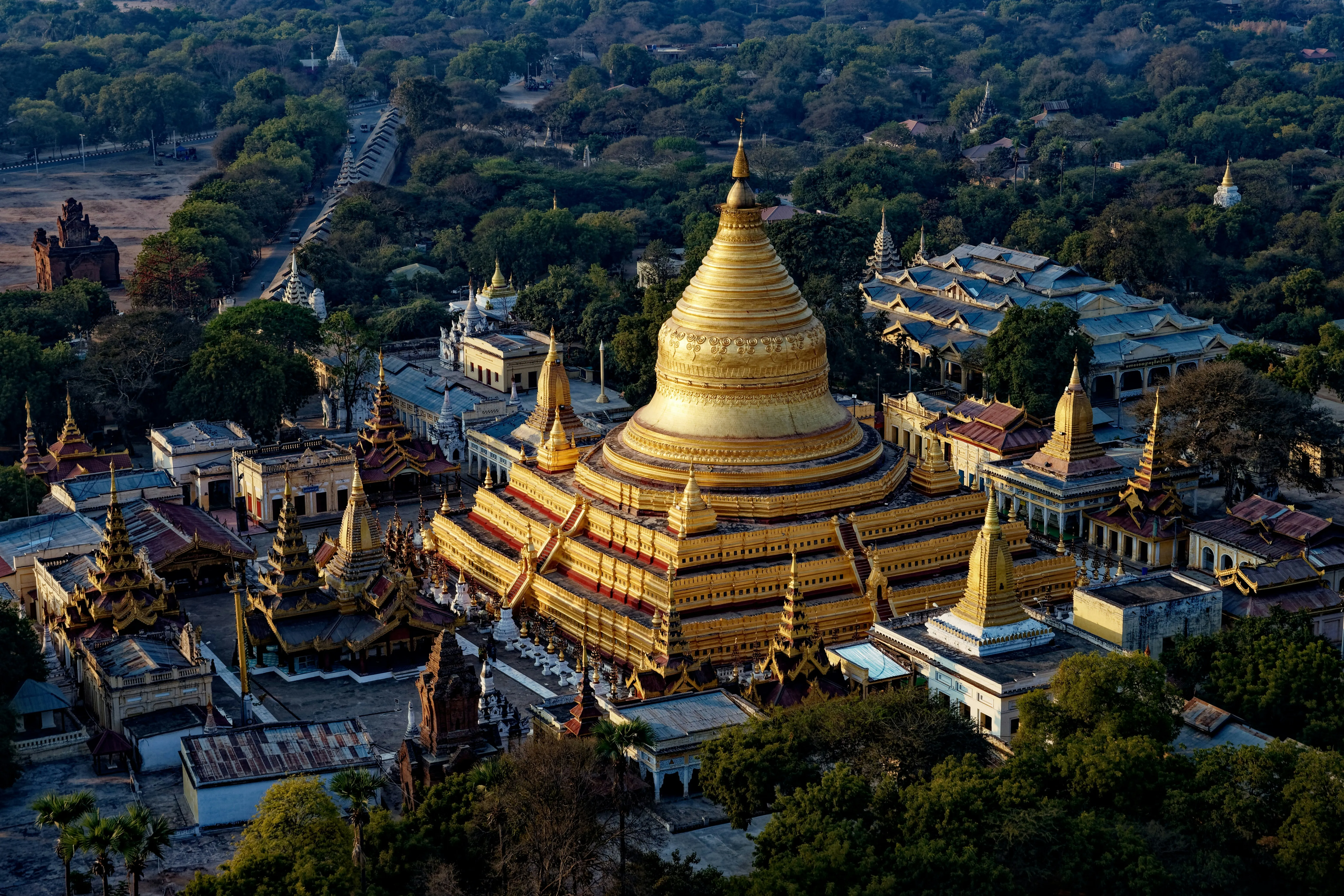
Myanmar
Discover a land of golden pagodas, ancestral traditions, and natural landscapes where Buddhist spirituality permeates every corner of this fascinating Southeast Asian destination.
Quick Facts
- Capital
- Naypyidaw
- Language
- Burmese
- Shan, Karen, Rakhine
- Currency
- Kyat (MMK)
- Best time to visit
- From November to February, coinciding with the dry and cool season.
- Budget per day
- $25 - $80 per day
- Climate
- Tropical monsoon climate with three distinct seasons: a hot one, a rainy one, and a cool and dry one that is very pleasant for the traveler.
- Connectivity
- medium
- Easy to obtain in airports and major cities with a passport.
- Electricity
- Type C, D, F, G (230V)
- Local transport
- limited
- Card usage
- cash is more common
- Tipping
- optional
🌎 Introduction
Myanmar unfolds between the last foothills of the Himalayas and the waters of the Andaman Sea, offering a landscape where the Irrawaddy River sets the rhythm of life. In this corner of Southeast Asia, the silhouette of golden pagodas integrates naturally into the landscape, coexisting with the routine of inhabitants who have managed to preserve their customs despite the passage of time.
As you travel through its towns and cities, everyday scenes stand out, such as the use of thanaka to protect the skin or the coming and going of men wearing the traditional longyi. The aroma of local cuisine, with its tea leaf salads and mild curries, mixes with the atmosphere of the markets, while the cycle of seasons transforms the plains dotted with temples and rice fields into settings of changing and serene light.
The country’s identity is perceived in the diversity of its people and in traditions that remain current, such as artisanal fishing on mountain lakes or festivities that follow the lunar calendar. It is a territory of slow-paced contrasts, where the calm of rural areas and the bustle of urban centers compose a cultural mosaic that invites attentive and curious observation.
🛡️ General Safety
Traveling to Myanmar (formerly Burma) offers a unique cultural experience, although it requires detailed planning and a conscious attitude from the traveler due to its particular political and social context. Generally speaking, the country presents a security situation that can be described as variable, strictly depending on the region visited and the stability situation at any given time.
- The risk level for tourists is usually considered medium-low in areas open to international tourism and high in border zones or areas of internal conflict.
- Most visits pass without incident, provided the traveler stays within authorized tourist circuits (such as Yangon, Bagan, Inle Lake, and Mandalay) and respects local regulations.
- It is fundamental to understand that access to certain parts of the country is restricted by the government and requires special permits or, in many cases, is totally prohibited for foreigners for security reasons.
Crime and Common Risks
Myanmar is traditionally known for being one of the safest countries in Southeast Asia regarding violent crime against foreigners. Nevertheless, it is advisable to keep the following points in mind:
- Small-scale theft and robbery (pickpocketing) are infrequent but can occur in crowded markets, train stations, or high-traffic tourist areas.
- Tourist scams, while not aggressive, often take the form of inflated prices for foreigners or unofficial guides offering services of dubious quality around temples.
- Use of violence against travelers is uncommon; respect for the visitor is a deep pillar of local culture, which creates an atmosphere of tranquility in daily life.
Safety in Cities and Tourist Areas
Urban life in the main cities is generally safe and peaceful for visitors.
- In urban centers such as Yangon or Mandalay, it is safe to walk even after sunset, although it is recommended to do so in well-lit and busy areas.
- Public transport (urban buses) can be confusing and overcrowded, so many tourists prefer to use private transport applications or taxis.
- There is a clear difference between established tourist areas (where the presence of tourist police is common) and remote rural areas, where infrastructure is limited and communication can be difficult.
Transport Safety
Moving around the country is an adventure, but it requires taking certain precautions regarding safety standards.
- In Myanmar, people drive on the right, even though many vehicles still circulate with the steering wheel on the right (a legacy of the colonial past), which can make driving somewhat chaotic and dangerous on interurban roads.
- The use of taxis is highly recommended; they usually do not have meters, so it is necessary to agree on the price before starting the journey. Transport applications are a safe option with fixed prices.
- The railway is picturesque but tends to be old, and journeys are slow and uncomfortable. On the other hand, long-distance buses (VIP) are modern and safe, being the preferred option for travelers.
- Renting cars without a driver is not recommended due to the state of the roads and poor signaling; it is preferable to rent a vehicle with a local driver.
Natural and Climatic Risks
Myanmar’s climate and geography can present seasonal challenges that the traveler should be aware of.
- Monsoons and Floods: Between the months of May and October, the country experiences intense rains that can cause flash floods and road closures, especially in rural and coastal areas.
- Cyclones: Coastal areas can be affected by tropical cyclones during the rainy season.
- Earthquakes: Myanmar is located in a seismically active zone. Although large earthquakes are infrequent, it is a present risk that should be kept in mind when visiting old structures.
- Extreme Heat: During the months of March to May, temperatures can exceed 40°C, posing a risk of dehydration or heatstroke if proper measures are not taken.
Legislation and Local Norms
Myanmar is a country with deep-seated traditions and laws that can be very strict compared to Western standards.
- Respect for Religion: Any lack of respect for the figure of Buddha (including visible tattoos, posing inappropriately with statues, or entering temples with footwear) is a serious crime that can lead to prison sentences or exportation.
- Drugs: Possession, consumption, or trafficking of narcotics is penalized with extremely long prison sentences or even the death penalty. There is zero tolerance.
- Photography: It is strictly forbidden to photograph or record military installations, government buildings, or uniformed personnel.
- Drones: The use of drones is highly regulated and, in most tourist areas (especially in Bagan), it is prohibited without prior government permits which are difficult to obtain. Non-compliance can lead to confiscation of equipment and arrest.
Safety for Specific Groups
- Women Travelers: Myanmar is considered a safe destination for women traveling alone. However, it is recommended to dress modestly (shoulders and knees covered), especially in religious places, to respect the local culture and avoid unwanted attention.
- LGTBIQ+ Travelers: Although society is generally tolerant and friendly, homosexuality remains technically illegal under old laws. There is usually no persecution of tourists, but it is recommended to maintain discretion and avoid public displays of affection to avoid misunderstandings or uncomfortable situations.
- Children and the Elderly: Burmese people adore children and are usually very helpful toward the elderly. The main risk for these groups is the extreme heat and the irregular state of sidewalks and access to temples, which can hinder mobility.
Emergencies and Assistance
Emergency services in Myanmar may not have the speed standards of other countries, so prevention is fundamental.
- Main Numbers:
- Police: 199
- Ambulances: 192
- Firefighters: 191
- High-quality medical assistance is limited outside major cities (Yangon and Mandalay). In case of a serious medical emergency, evacuation to neighboring countries such as Thailand is usually necessary.
- It is essential to always travel with comprehensive medical insurance that includes medical repatriation.
Advice: Always stay informed through official sources about authorized areas for tourism before traveling to remote regions, and scrupulously respect the rules of dress and conduct in temples to avoid legal problems.
📝 Entry Requirements
To organize a trip to this destination, it is fundamental to consider that access usually requires having a valid passport. Most migration authorities suggest that this document maintain a minimum validity of six months from the date of arrival in the territory. It is common for visitors to need to arrange an entry authorization or visa before their departure, a process that is usually done online or through the corresponding consular representations.
The permitted stay for leisure and tourism activities usually has a limited duration, generally set at a period of twenty-eight days. During the entry process at border posts or airports, immigration staff may request the presentation of an exit ticket confirming the intention to leave the country within the authorized period. In certain cases, proof of sufficient financial solvency to cover expenses during the stay may also be required.
Regarding customs controls, travelers must follow the usual rules regarding the importation of goods. It is recommended to pay attention to the entry of medicines, especially those containing controlled substances, for which it is preferable to have a translated medical prescription. Likewise, there are generic restrictions on the entry of certain foods, professional-use electronic products, or materials that may be considered sensitive.
From a health point of view, it is advised that tourists have their basic vaccination schedule up to date. Although it is not always generally required, depending on the traveler’s origin or if a layover was made in risk zones, an international certificate of vaccination against specific diseases could be requested. It is convenient to consult a specialized center before starting the trip to learn about current health recommendations.
Below are the key points for access to the territory:
- Passport: Document with a minimum validity of six months and free space for stamps.
- Tourist Visa: Prior processing necessary for most international visitors.
- Stay Period: Usual maximum period of four consecutive weeks.
- Proof of Transport: Proof of flight or transport out of the country.
- Economic Funds: Ability to demonstrate financial means for the stay if required.
- Customs Declaration: Obligation to declare currency above certain limits and valuables.
- Health: Recommendation to have travel insurance and a review of preventive vaccines.
🏥 Basic Health Considerations
Preparing for your trip to Myanmar involves paying attention to certain health details so that your experience is pleasant and safe. You will see that the country offers incredible landscapes, but medical infrastructure can be limited compared to other destinations, so prevention will be your best ally.
The public health system in Myanmar has quite basic resources and often suffers from a lack of modern equipment. Conversely, in major cities like Yangon or Mandalay, you will find private clinics oriented toward foreigners that offer much more complete care. You should keep in mind that costs in these private centers are high and generally require payment in advance. In these places, most of the medical staff communicates perfectly in English, which will make it easier for you to explain any discomfort you feel.
Hiring comprehensive travel medical insurance is absolutely essential before landing in the country. Even if it is not a strict bureaucratic requirement for entry, it is your greatest guarantee against unforeseen events. Your insurance should mandatorily include medical repatriation and high coverage for emergency evacuation to nearby countries like Thailand or Singapore, where care for serious cases is world-class.
Regarding vaccines, there are no mandatory vaccination requirements to enter the country, unless you come from an area where yellow fever is endemic. The most sensible thing is to have your routine vaccination schedule up to date. Additionally, you could consult a professional about protection against hepatitis A and typhoid fever, as these are frequent recommendations for those visiting Southeast Asia.
If you need to bring your own medication, make sure to transport it in its original packaging and always accompanied by the original medical prescription, preferably translated into English. This is especially important if you travel with drugs containing psychotropic substances or strong painkillers, to avoid any misunderstanding at customs. It will also be useful to prepare a small personal first-aid kit with bandages, disinfectant, and some medicine for mild digestive problems.
The most common health risks you could face are related to the tropical climate. Heat and humidity are usually intense, so dehydration is a real risk if you do not drink liquids constantly. Being an environment with much vegetation in certain areas, you will find mosquitoes that can transmit diseases like dengue. We advise using effective repellents and wearing light clothing that covers arms and legs, especially during sunrise and sunset. On the other hand, you should not worry too much about altitude unless you do very specific trekking in deep mountain areas.
The safety of water and food is a critical point. Never drink tap water; you will find bottled water easily in any store or stall. Even for brushing your teeth, bottled water is the safest option. Regarding food, you can try exquisite local dishes in the markets, but always make sure the food is well cooked and served hot. Avoid ice in drinks and raw vegetables if you want to minimize the risk of suffering from the classic traveler’s diarrhea.
In case of a serious emergency, the phone number for medical emergencies is 192. However, you should know that the public ambulance service is not always fast nor equipped with advanced technology. In most cases, if you are in an urban area, the most practical thing will be to ask your hotel to call a private clinic or use a taxi to travel quickly to the nearest medical center.
As final recommendations for your stay, try to always maintain basic hand hygiene rules, using hydroalcoholic gel before eating. Do not forget to protect yourself from the sun with high-factor creams and hats, as radiation can be very strong even on cloudy days. If you follow these guidelines, you will enjoy the hospitality and culture of Myanmar with total peace of mind.
🚌 Transport within the Country
To travel the distances in Myanmar, travelers usually combine various means depending on the time available. Long-distance buses are one of the most common options for connecting main destinations, while internal flights are the preferred method to save time on more extensive journeys. The train offers a more slow-paced experience and allows for observing the rural landscape, although its speed is limited. On certain river routes, the ferry is used as a peaceful alternative for moving between historic cities.
The ease of use of public transport for visitors presents certain challenges. Although signs can be found in tourist hubs, signage is not always available in other languages outside the local alphabet. Buying tickets is usually managed in person or through intermediaries at accommodations, as digital booking systems are not fully integrated for international users. Communicating with drivers and station staff requires patience and, occasionally, the use of gestures or basic translations.
There are notable differences between large cities and rural areas. In urban centers, traffic can be intense and the use of taxis or private vehicles with a driver is the simplest way to get around, because collective urban transport can be confusing. Conversely, in rural areas or archaeological settings, it is common for travelers to opt for simpler means of transport, such as bicycles or light vehicles, to explore the surroundings with greater freedom.
Regarding comfort and reliability, the experience varies according to the chosen medium. While some road services have improved their fleet, other transport like the railway maintains old infrastructure that can influence punctuality. It is important to understand that journeys are usually longer than expected due to the state of some roads and the topography of the terrain, so it is recommended to approach trips with a flexible attitude.
Advice: It is convenient to confirm departure times directly at the station or at the place of accommodation the day before the trip, as last-minute changes in the schedule of journeys can occur.
🤵 Culture and Etiquette
Burmese society is characterized by a friendly and slow-paced manner in daily interactions. The traditional greeting is usually done with a slight bow of the head, although a handshake is increasingly common in urban environments. It is fundamental to show special respect toward older people or those in positions of authority, always using a soft tone of voice and avoiding excessive displays of affection in public, as discretion is a highly valued virtue in social coexistence and behavior in public spaces.
In shared spaces, maintaining calm and avoiding raising the volume of the voice contributes to harmonious integration with the environment. Regarding physical contact, the head is considered the most sacred part of the body, so touching it should be avoided under any circumstances. Conversely, the feet are perceived as the least noble part; therefore, it is advisable not to point with them, not to use them to move objects, and to avoid pointing them toward people or representations of a sacred nature, always maintaining a tucked-in posture when sitting.
The religious sphere requires special attention to rules of conduct. When visiting temples, pagodas, or monasteries, it is essential to remove footwear completely, removing both shoes and socks before entering the precinct. Clothing must be decorous, covering shoulders and knees as a sign of courtesy toward the sacredness of the place. Likewise, it is common to observe the offering of donations for the maintenance of these spaces, a gesture that is made voluntarily and with both hands as a sign of deference.
During meals, the act of sharing food has a strong social and collective component. It is customary to use the right hand to eat or to give and receive objects, as the left hand is traditionally reserved for personal hygiene tasks. Regarding tipping, it is not mandatory nor part of a strict norm in local culture, but it is well received in the service sector as a gesture of gratitude for good service, especially in establishments oriented toward tourism.
The perception of time in the country is usually flexible, so punctuality is interpreted with some leeway in informal contexts, although adherence to schedules in transport services and official appointments is appreciated. Faced with any misunderstanding or stressful situation, local culture positively values the ability to maintain serenity and patience, avoiding direct confrontation or gestures of anger. This approach facilitates conflict resolution and reinforces bonds of trust with the local population.
“Advice”: When giving or receiving money, business cards, or small gifts, use the right hand while lightly resting the fingers of the left hand on the right forearm, as this gesture is considered a sign of maximum courtesy and respect toward the interlocutor.
🍛 Typical Gastronomy
The cuisine of Myanmar is a reflection of its rich cultural and geographical diversity, situated at the crossroads of great culinary traditions such as those of India, China, and Thailand. Rice is the central element of almost any meal, serving as a base for a wide variety of curries, salads, and side dishes served simultaneously. Unlike other neighboring countries, Burmese dishes tend to be less spicy but possess intense and complex flavors where the use of fermented fish paste (ngapi), peanuts, and sesame oil predominates to highlight the ingredients.
The concept of the table in Myanmar is deeply social and participatory. It is customary for all dishes to be presented at the same time in the center of the table to be shared by the diners. In addition to the main dish, meals are usually accompanied by a light broth, fresh vegetables, and a series of sour or spicy sauces. Although the use of cutlery is widespread in cities, it is still common in many areas to eat with the right hand, forming small balls of rice with the fingers.
A fundamental aspect of daily life are the teahouses, which function as social meeting centers at any time of day. In them, it is common to consume the local black tea mixed with condensed milk, accompanied by various fried snacks or sweets. Regarding schedules, breakfast is one of the most important meals of the day, while dinner is usually eaten early. Hot green tea is the most frequent beverage and is usually found as a courtesy in jars on the tables of most local establishments.
| Dish | Description | Main Ingredients | Where to try it | Advice |
|---|---|---|---|---|
| Mohinga | Considered the national dish, it is a rice noodle soup with fish broth. | Fish, rice noodles, lemongrass, ginger, and chickpea flour. | In street stalls and teahouses throughout the country. | It is the most popular breakfast; it is recommended to try it first thing in the morning. |
| Lahpet Thoke | Fermented tea leaf salad, a unique combination of textures. | Tea leaves, peanuts, fried beans, golden garlic, sesame, and tomato. | Local restaurants and traditional celebrations. | It can be eaten as a main dish or as a digestive dessert at the end of the meal. |
| Shan Noodles | Typical noodles from the Shan region, served with minced meat and broth. | Rice noodles, chicken or pork, tomato paste, and ground peanuts. | Very common in the Inle Lake area and in Mandalay markets. | It can be ordered in a “dry” version with the broth served separately in a bowl. |
| Burmese Curry | A mellow stew that differs from other Asian curries by its oil and onion base. | Protein (meat or fish), plenty of onion, garlic, ginger, and turmeric. | Traditional food restaurants in any city. | It usually comes accompanied by numerous small vegetable dishes and sauces included. |
| Onn No Khow Suey | Wheat noodle soup with a creamy coconut milk and chicken base. | Coconut milk, chicken, wheat noodles, hard-boiled egg, and lime. | Frequent in teahouses and restaurants in Yangon. | Add a squeeze of fresh lime to balance the sweetness of the coconut milk. |
📷 Zones and Places to Visit
Exploring this Southeast Asian country means entering a territory where spirituality and history intertwine in every corner. The diversity of its landscapes allows you to move from plains dotted with ancient temples to mountain lakes and bustling cities where the colonial past is still visible on its facades. The journey usually begins in the former capital, Yangon, a city that stands out for its mixture of British architecture and Buddhist monuments. Walking through its streets allows you to observe the daily life of the local population, visit the National Museum to understand the heritage of the ancient dynasties, or explore the downtown neighborhoods, where commercial activity is constant and markets offer an authentic vision of daily life.
One of the most emblematic points is, without a doubt, the archaeological zone of Bagan. In this vast plain on the banks of the Irrawaddy River, thousands of religious structures dating from the 11th to 13th centuries are preserved. The landscape is a succession of red brick stupas and temples of various dimensions that change hue depending on the position of the sun. It is common to take tours to discover the interior frescoes of the most important constructions or simply observe the immensity of the place from the permitted elevated points. The atmosphere here is different from that of the cities, offering a calm that invites historical and artistic reflection.
In the heart of the country lies Inle Lake, situated in the highlands of Shan State. This natural environment is famous for its villages built on stilts and its floating gardens. The life of the local communities revolves completely around the water, highlighting the peculiar rowing technique of the area’s fishermen. In addition to traditional boat routes, the surroundings offer the opportunity to visit itinerant markets that rotate between the riverside villages, textile craft workshops where lotus fiber is worked, and ancient stupa complexes like those of Indein, which seem to blend into the surrounding vegetation.
The city of Mandalay, the last royal capital, represents the cultural and religious center. It is the ideal place to learn about monastic life and traditional arts, such as wood carving or marble work. In its vicinity are ancient imperial cities like Amarapura, known for its long teak bridge, and Mingun, where a huge unfinished construction and one of the largest bells in the world are located. The contrast between the bustle of its central markets and the serenity of the monasteries located on nearby hills defines the personality of this region.
For those seeking more direct contact with nature and karst geography, the Hpa-An area offers a landscape of limestone mountains and extensive rice fields. This region is famous for its natural caves that house thousands of religious images and reliefs carved into the rock walls. Routes through this area allow you to see a more rural and less traveled side, ideal for those who enjoy hiking and observing unique geological formations.
Finally, the coast offers a different facet with beaches like Ngapali, characterized by its calm waters and palm groves. Unlike other more crowded coastal destinations, a quiet atmosphere is maintained here where the main activity remains artisanal fishing. It is the ideal place to observe how tourism coexists with the traditions of coastal villages, closing a circle of experiences that spans from the historical depth of the central plains to the peace of the maritime shore.
Advice: You cannot miss visiting Bagan, the most emblematic place in the country.
✈️ Best Season to Travel
Planning a trip to Myanmar is mainly conditioned by the monsoon regime, which divides the year into well-differentiated climatic periods. Generally, the most balanced time to visit the country coincides with the months of milder temperatures and absence of rain, which facilitates access to rural areas and the comfortable exploration of archaeological complexes. However, the final choice will depend on whether the traveler prioritizes clear weather or prefers greener landscapes and fewer crowds.
During the months of greatest atmospheric stability, skies are usually clear, favoring activities such as hot air balloon rides or boat trips on Inle Lake. Conversely, the rainy season transforms the environment into a setting of lush vegetation, although it can limit access to certain coastal or mountain areas. Each stage of the year offers a different perspective of daily life and cultural festivities in Southeast Asia.
| Season | Months | Typical Climate | What to Expect | Tourist Influx |
|---|---|---|---|---|
| Spring | Mar – May | Intense heat and dry environment. High temperatures in the central plains. | Arid landscapes, celebration of the water festival (Thingyan), and clear skies. | ⭐⭐ (Medium/Low) |
| Summer | Jun – Aug | Frequent rainfall and high humidity, especially on the coast and in the south. | Very green landscapes, less dust in historical areas, and more tranquility in the temples. | ⭐ (Low) |
| Autumn | Sep – Nov | Transition toward dry weather. Rains gradually decrease. | Reactivation of river navigation, festivals of lights, and crops in their splendor. | ⭐⭐⭐ (Medium/High) |
| Winter | Dec – Feb | Cool and pleasant temperatures. Dry weather and constant blue skies. | Optimal conditions for hiking and cultural visits. Cool nights in high areas. | ⭐⭐⭐⭐ (High) |
🗣️ Basic Vocabulary
Although in Myanmar’s main tourist destinations it is possible to communicate in English, knowing some expressions in Burmese is very helpful for day-to-day life. Local inhabitants usually appreciate the efforts of travelers to use their language, which facilitates a friendlier and more natural interaction in everyday situations like buying at a market or asking for directions.
It is not necessary to go deep into the grammar; it is enough to memorize a few practical terms that will allow you to navigate with greater confidence and respect during your stay in the country.
- Mingalaba: Hello (a universal greeting valid for any time of day).
- Kanyar tin bar de: Thank you.
- Ho de: Yes.
- Ma ho bu: No.
- Bal lout lel?: How much does it cost?
- Be ma lel?: Where is…?
- Kaung de: It’s okay / It’s good.
- Taryar: The bill (useful in restaurants)