


Syria
Syria offers a unique journey through ancient history, highlighting legendary cities, historical citadels, and rich cultural traditions across diverse and beautiful Levantine landscapes.
Quick Facts
- Capital
- Damascus
- Language
- Arabic
- English and French
- Currency
- Syrian pound (SYP)
- Best time to visit
- Spring (March to May) and autumn (September to November)
- Budget per day
- $35 - $85 per day
- Climate
- Mediterranean on the coast and arid in the interior, with very hot summers and winters that can be cool.
- Connectivity
- low
- Local SIM cards can be obtained at official telecommunications stores by presenting a passport.
- Electricity
- Type C, E, L (220V)
- Local transport
- limited
- Card usage
- cash is used more
- Tipping
- optional
🌎 Introduction
Walking through the narrow streets of its historical neighborhoods allows one to perceive how the past coexists with current daily life. The scent of jasmine and the sound of bustle in traditional markets mix with the serenity of landscapes that transition from the banks of the Euphrates to the blue of the Mediterranean. In spring, the valleys fill with life, while the arid expanses maintain that stillness that has characterized this region as a meeting point for cultures throughout the centuries.
The essence of this land is found in small gestures, such as the ritual of coffee with cardamom or the necessary pause to share tea at sunset. Its gastronomy, rich in spices, legumes, and olive oil, is a reflection of a diverse heritage and a hospitality that manifests naturally in everyday life. During autumn, when the light becomes dimmer, the olive groves and ancient stone structures take on a golden tone, showing a balanced identity that joins the simplicity of Mediterranean life with the weight of an extensive history.
🛡️ General safety
The security situation in Syria is complex and requires detailed analysis before undertaking any trip. After years of conflict, the country presents a scenario of fragile stability that varies significantly by region. Currently, the government has regained control of the main cities and tourist centers, allowing the gradual return of international visitors, although always under specific and controlled conditions.
- General assessment: The safety level is considered low compared to international standards, due to the volatility of the political and social environment. However, in areas controlled by the authorities and open to tourism, the sense of safety in daily life can be surprisingly calm for the traveler.
- Context for the traveler: It is fundamental to understand that Syria is not a destination for improvised tourism. Most trips are made through authorized local agencies that manage permits and safe routes. The country is in a phase of reconstruction, which implies limited infrastructure and a constant military presence.
Common crime and risks
Despite the general context of the country, levels of common crime directed at tourists are historically very low. The local culture is extremely hospitable, and respect for the visitor is a deeply rooted social norm.
- Petty theft: Isolated cases of bag-snatching or pickpocketing can occur in crowded places, such as the souks of Damascus or Aleppo, but it is not a habitual practice.
- Scams: As in other tourist destinations, there may be attempts at overcharging in markets or transport if the price is not agreed upon in advance.
- Specific risks: The most relevant risk is not common crime, but the possibility of encountering areas with presence of explosive remnants of war (mines or unexploded ordnance) if one leaves the route marked by guides, especially in rural or peripheral areas.
Safety in cities and tourist areas
Urban centers under government control, such as Damascus, Homs, Hama, Lattakia, and Aleppo, have a notable security deployment that contributes to maintaining public order.
- Checkpoints: It is very common to find military or police checkpoints at city entrances and on main roads. Tourists must always carry their original passport and corresponding permits at hand.
- Urban public transport: Microbuses (servees) are safe and widely used by the local population, although they can be confusing for travelers due to the lack of signage in foreign languages.
- Areas to avoid: It is strongly recommended not to approach the northern and eastern border areas, as well as the Idlib province, where the security situation is drastically different and dangerous.
Transport safety
Moving around Syria requires planning, as distances can be long and the condition of some roads has been affected by the conflict.
- Driving: In Syria, driving is on the right. Traffic rules are not always strictly followed, which can create a sense of traffic chaos in large cities.
- Taxis and private transport: Taxis are the most common means for tourists. It is essential to use official vehicles and, if possible, request them from the hotel. The use of private drivers hired through agencies is the safest and most efficient option for intercity travel.
- Rental vehicles: Car rental without a driver is not recommended for foreigners due to the complexity of the permits needed to cross internal security checkpoints.
Natural and climatic risks
The Syrian climate and geography present challenges that the traveler should consider according to the time of year they visit the country.
- Extreme heat: During the summer months (June to September), temperatures can easily exceed 40°C, especially in desert areas and the interior. It is vital to maintain hydration and avoid sun exposure during central hours.
- Seismic activity: Syria is located in a zone with seismic risk. Although large-magnitude earthquakes are not frequent, the country suffered serious damage in 2023 from a strong earthquake, which serves as a reminder of the importance of knowing basic action protocols.
- Sandstorms: In areas near the desert, dust or sandstorms can occur, reducing visibility and affecting the respiratory tract.
Legislation and local norms
Syria is a country with strict laws and social customs that must be respected to avoid misunderstandings or serious legal problems.
- Photography: It is strictly prohibited to photograph or film military installations, government buildings, embassies, bridges, or security personnel. Failure to comply can result in detention and interrogation.
- Documentation: It is mandatory to always carry a passport with a valid visa. The loss of this document must be reported immediately.
- Social behavior: It is recommended to dress modestly, especially when visiting places of worship or less urban areas. Alcohol consumption is permitted in specific areas (hotels, Christian quarters, and certain restaurants), but public drunkenness is very poorly regarded.
- Prohibited substances: Drug trafficking and consumption carry extremely severe prison sentences.
Safety for specific groups
- Women travelers: Syria is a relatively safe destination for women, but it is recommended to travel in a group or with a guide. It is common to receive stares or comments, but assaults are rare. It is advised to dress conservatively (shoulders and knees covered) to avoid unwanted attention.
- LGTBIQ+ travelers: Homosexuality is illegal in Syria and socially not accepted. Absolute discretion is recommended; public displays of affection should be avoided completely, regardless of sexual orientation, but are especially risky for this group.
- Children and the elderly: Due to deficiencies in the healthcare system and logistical difficulties, traveling with small children or people with reduced mobility can be very demanding and exhausting.
Emergencies and assistance
Access to emergency services can be limited outside of the major capitals, and the language barrier is a factor to consider.
- Emergency numbers:
- Police: 110
- Ambulance / Medical emergencies: 115
- Firefighters: 113
- Medical assistance: The health infrastructure has suffered greatly. In Damascus, there are private clinics with acceptable standards, but for any serious problem, medical evacuation is usually recommended. It is essential to have travel insurance with broad coverage that includes evacuation.
- Communication in crisis: In case of any security incident, the first step is to contact the local travel agency, which has the resources to mediate with the authorities.
Tip: Always keep a physical and digital copy of your passport and the security permits issued by your agency; you will need them at every road checkpoint.
📝 Entry requirements
To plan a trip to Syria, the essential document is a passport with a minimum validity of six months from the planned date of entry into the territory. It is fundamental that the document is in good condition to avoid inconveniences during identification processes at border or airport checkpoints.
In most circumstances, foreign visitors must process a tourist visa before starting their journey. This permit usually authorizes an initial stay ranging between fifteen and thirty days, with the possibility of requesting an extension of the stay before the competent local authorities if the traveler decides to extend their stay in the country.
Upon entering the country, it is frequent for control personnel to request information about the travel itinerary, accommodation reservations, or the presentation of an exit ticket that confirms the intention to leave the territory at the end of the visit. In certain cases, proof of sufficient financial means to cover the costs derived from the tourist stay may also be required.
Regarding customs regulations, travelers usually undergo routine luggage inspections. There are common restrictions on the introduction of certain medications, which should be accompanied by their corresponding medical prescription. Likewise, the entry of professional electronic equipment or advanced geolocation devices may be subject to obtaining specific permits or additional controls by the authorities.
From a health point of view, a list of mandatory vaccines is not usually established for all traveler profiles, although it is recommended to be up to date with general immunizations. It is highly advisable to have international medical insurance with broad coverage, given that access to certain health services can entail specific costs for foreign visitors.
- Travel documentation: Valid passport with at least six months of validity.
- Stay authorization: Tourist visa managed prior to travel.
- Visit period: Usual stays of up to one month, with the option for local extension.
- Exit requirements: Possible request for a return ticket or continuation of travel.
- Customs regulations: Control over prescription medications and technical electronic equipment.
- Health recommendations: Advisability of having health insurance and general preventive vaccines.
🏥 Basic health considerations
When preparing your trip to Syria, it is fundamental to keep in mind that the health system has gone through periods of high pressure. In large cities like Damascus or Aleppo, you will find private clinics with acceptable equipment and qualified medical personnel, many of whom speak English or French due to their training abroad. However, in rural areas, access can be much more limited and resources scarce. Public healthcare does not usually meet the standards of speed or means you might expect, so for any mishap, you will always end up going to private healthcare, where prices are moderate but can rise quickly if you need specialized treatments.
Taking out travel medical insurance is not mandatory to enter the country, but it is something you should consider absolutely essential. It is vital that your policy includes very broad coverage for hospitalization, surgical interventions and, very specially, medical repatriation and transport by air ambulance. Managing an evacuation on your own in this region can be extremely complex and costly, so having the backing of an insurer will give you the peace of mind needed to enjoy the journey.
In the vaccines section, you will generally not find mandatory entry requirements, unless you come from a country with a risk of yellow fever or polio transmission, in which case they will ask for the international certificate. The most recommended thing is to have your standard vaccination schedule up to date, including tetanus, diphtheria, and MMR. Additionally, it is usually advisable to protect yourself against Hepatitis A and typhoid fever, as these are diseases you could contract through water or food that has not been correctly treated.
If you follow a specific treatment and need to carry personal medication, make sure to transport it in its original container. It is very important to carry the medical prescription translated into English or a report signed by your doctor explaining the treatment. Syria has strict regulations on the entry of certain drugs, especially those containing psychotropic substances or strong painkillers. Carrying a basic first-aid kit with wound care material, disinfectant, common painkillers, and some anti-diarrheal medication will be very useful for solving small problems on the go.
The most common health risks are mainly linked to the climate. During the summer months, extreme heat can be a serious problem, causing dehydration or heat stroke if you do not take precautions. In the most arid areas, dust and suspended sand can irritate your eyes or respiratory tract. There are no high risks of diseases from insect bites, but it is always a good idea to use repellent if you are going to be in areas with stagnant water or lots of vegetation at sunset.
Regarding water and hygiene, the main recommendation is that you always drink bottled water and check that the cap is properly sealed. Avoid ice cubes and fruits that you cannot peel yourself. Street food is one of the country’s great attractions and is usually safe if you see that the food is cooked over high heat and the place has a large flow of local people. Maintaining good hand hygiene or using disinfectant gel before eating will save you most common stomach problems.
If you find yourself in a health emergency situation, the telephone number to call an ambulance is 110. You should know that, occasionally, the service may not be as fast as you would like due to traffic or local logistics. In cities, it is often more efficient to ask someone to help you flag down a taxi to go directly to the nearest private hospital.
As final tips, remember to always carry your insurance contact and a copy of your passport with you. Do not forget to protect yourself from the sun with high-factor cream and a hat, especially if you are visiting archaeological sites where there is not much shade. If you follow these basic personal care guidelines, your experience in the country will be much smoother and safer.
🚌 Transport within the country
Travel across the national territory is mainly carried out by road, which is the backbone of communications. Long-distance buses are the most common means to connect major cities, offering regular service between the most important urban centers. For shorter distances or travel between neighboring towns, small vans or microbuses are frequently used, covering specific routes constantly and being a fundamental piece of daily mobility.
The use of public transport can present certain challenges for the visitor, as informative signage is not always available in several languages and information about routes is usually transmitted orally. The purchase of tickets for long journeys is usually managed at the central stations of each city, while in smaller transports, payment is made directly during the journey. Interaction with drivers and other passengers is common to confirm stops and destinations.
There is a clear distinction between the transport offer in the large capitals and in rural areas. In the cities, the flow of vehicles is continuous and it is easy to find mobility options at almost any time. Conversely, in more remote or less populated areas, frequencies are much lower and schedules depend largely on local demand, which requires more flexible planning on the part of the traveler.
Taxis are a very common and accessible resource for moving quickly, especially within urban areas. They represent a comfortable alternative for reaching places of interest that do not have a nearby bus stop. Although it is a very widespread service, it is worth keeping in mind that usage dynamics can vary from one city to another, being the most direct way to move door-to-door without depending on fixed routes.
In general terms, the transport system is functional and practical, allowing for effective travel through the country. Although comfort and punctuality may not follow strict international standards, the road network allows access to the main points of interest. The experience of land travel also offers a close view of the landscape and the rhythm of local life, integrating the tourist into the habitual dynamics of the region.
“Tip”: always carry the name of the destination written in the local alphabet to facilitate communication at stations and departure points.
🤵 Culture and etiquette
Hospitality is one of the most deeply rooted values in Syrian society, where visitors are usually received with genuine warmth. When interacting with local inhabitants, it is fundamental to dedicate time to initial greetings, which are usually slow and polite. A handshake is the common form of greeting between people of the same sex, while in meetings between men and women, it is customary to wait for the other person to take the initiative or simply make a slight polite gesture with the head. Interpersonal treatment is characterized by the use of polite formulas and a moderate tone of voice, avoiding excessive noise or sudden gestures in public spaces.
Regarding non-verbal communication and daily habits, eye contact is important as a sign of trust, although always maintaining a respectful personal distance. Punctuality can be more flexible in social and family contexts than in other more formal environments, where arriving on time is valued. In daily life, the pace can be slow, especially during meal or coffee times, moments that are considered essential for strengthening social bonds. It is common for conversations to flow naturally on general topics, avoiding haste and always prioritizing kindness.
Customs related to gastronomy and visits are central to the local culture. If invited to a home or sharing a table, it is customary for food and drink to be offered generously; accepting at least a small portion or a cup of coffee is interpreted as a gesture of appreciation towards the host. In service and catering establishments, tipping is a habitual and well-received practice, functioning as a recognition of the staff’s work. During meals, the atmosphere is usually shared and communal, reflecting the importance of generosity in dealing with others.
Respect for religious spaces and traditions is an absolute priority. When visiting places of worship, such as mosques or ancient churches, it is necessary to dress discreetly and modestly, covering shoulders and legs, and it is mandatory to remove shoes before entering prayer areas. Likewise, an attitude of silence and reflection must be maintained. In the social structure, elderly people enjoy great respect, so it is recommended to show deference towards them in any situation, whether by giving way or allowing them to lead a conversation or activity.
“Tip”: When receiving a gift, a drink, or food, it is good practice to use the right hand, as this gesture is traditionally considered more formal and appropriate in social interactions and rituals of courtesy.
🍛 Typical gastronomy
The gastronomy of Syria is one of the oldest and most varied in the Middle East, the result of centuries of cultural exchanges. Its base is predominantly Mediterranean and Levantine, characterized by the abundant use of legumes, fresh vegetables, olive oil, and spices that provide complex aromas without being excessively spicy. It is common for meals to become a slow social act, where sharing is the fundamental rule.
The concept of mezze is the central axis of any Syrian table. It is a selection of small dishes served at the beginning, allowing one to taste a wide variety of textures and flavors. Among them, creams like hummus or baba ghanoush stand out, always accompanied by flatbread or khubz, which is often used as a utensil to pick up food instead of traditional cutlery. The use of fresh herbs like parsley and mint is constant, providing a very characteristic touch of freshness to salads and stews.
Regarding meats, lamb and chicken are the most common ingredients, usually cooked over charcoal or in slow stews with nuts and rice. Flavors are enhanced with spice blends like za’atar or sumac, which provides a very particular citric touch. The importance of nuts is also noteworthy, especially pistachios and pine nuts, which appear in both savory dishes and sophisticated local pastries.
Eating habits reflect a culture of deep hospitality. Breakfast is usually hearty, including cheeses, olives, and labneh. Lunch is the main meal of the day and can extend through the afternoon. In cities, restaurants usually have broad hours, and it is common to find traditional fast food stalls that operate until late. Etiquette suggests that it is polite to accept an invitation to have tea or coffee, as they are symbols of welcome.
Regarding drinks, Syrian coffee is an institution; it is prepared very dense, often flavored with cardamom, and served in small cups. Tea is also consumed at any time of the day, generally very sweet and in glass cups. To accompany meals, ayran is very popular, a refreshing drink based on yogurt, water, and salt, or natural fruit juices like pomegranate. Although alcohol consumption is limited in certain areas, it is possible to find Arak, an anise-flavored spirit that is mixed with water and ice.
| Dish | Description | Main Ingredients | Where to try it | Tip |
|---|---|---|---|---|
| Kibbeh | Oval-shaped croquettes, considered the national dish. | Minced meat (lamb or beef), bulgur, and spices. | Restaurants in Damascus and Aleppo. | Try them fried for a crunchy texture. |
| Fatteh | Comforting dish that mixes layers of bread, yogurt, and legumes. | Chickpeas, crispy bread, yogurt, garlic, and pine nuts. | Breakfast stalls and eating houses. | It is best enjoyed freshly made, when the bread is still crunchy. |
| Tabbouleh | Very fine and refreshing salad, different from international versions. | Plenty of parsley, mint, tomato, onion, and a bit of bulgur. | Any mezze restaurant. | It is the ideal side dish to balance grilled meat dishes. |
| Shawarma | Meat roasted on a vertical rotisserie and cut into thin slices. | Marinated chicken or lamb, wrapped in flatbread with garlic sauce. | Street food stalls in commercial areas. | Ask for local pickles to be added for a more authentic flavor. |
| Baklawa | Fine puff pastry sweets arranged in multiple layers. | Filo pastry, pistachios or walnuts, and sugar syrup or honey. | Traditional pastry shops in the souks. | Accompany it with a bitter coffee to contrast its intense sweetness. |
📷 Areas and places to visit
Syria is a territory where ancient history intertwines with daily life at every corner, offering the traveler a deep immersion into the roots of civilization. The journey usually begins in Damascus, considered one of the oldest continuously inhabited cities in the world. In its Old City, surrounded by Roman walls, one can walk through narrow streets that lead to the majestic Umayyad Mosque, an architectural and spiritual landmark that stands out for its golden mosaics and its large marble courtyard. Getting lost in the Al-Hamidiyah Souk allows one to observe the commercial pulse of the capital, while the Azm Palace shows the elegance of Ottoman architecture with its decorated courtyards and fountains.
To the north, the city of Aleppo represents another fundamental pillar of Syrian heritage. Its imposing Citadel, situated on a hill in the center of the city, is an exceptional example of medieval military architecture offering panoramic views of the surroundings. Although the city has gone through reconstruction processes, its historical souks and ancient neighborhoods remain key places to understand the importance of the Silk Road. In this region, the mix of cultural influences is evident in its churches, mosques, and the vibrant activity of its squares, where local gastronomy plays a leading role.
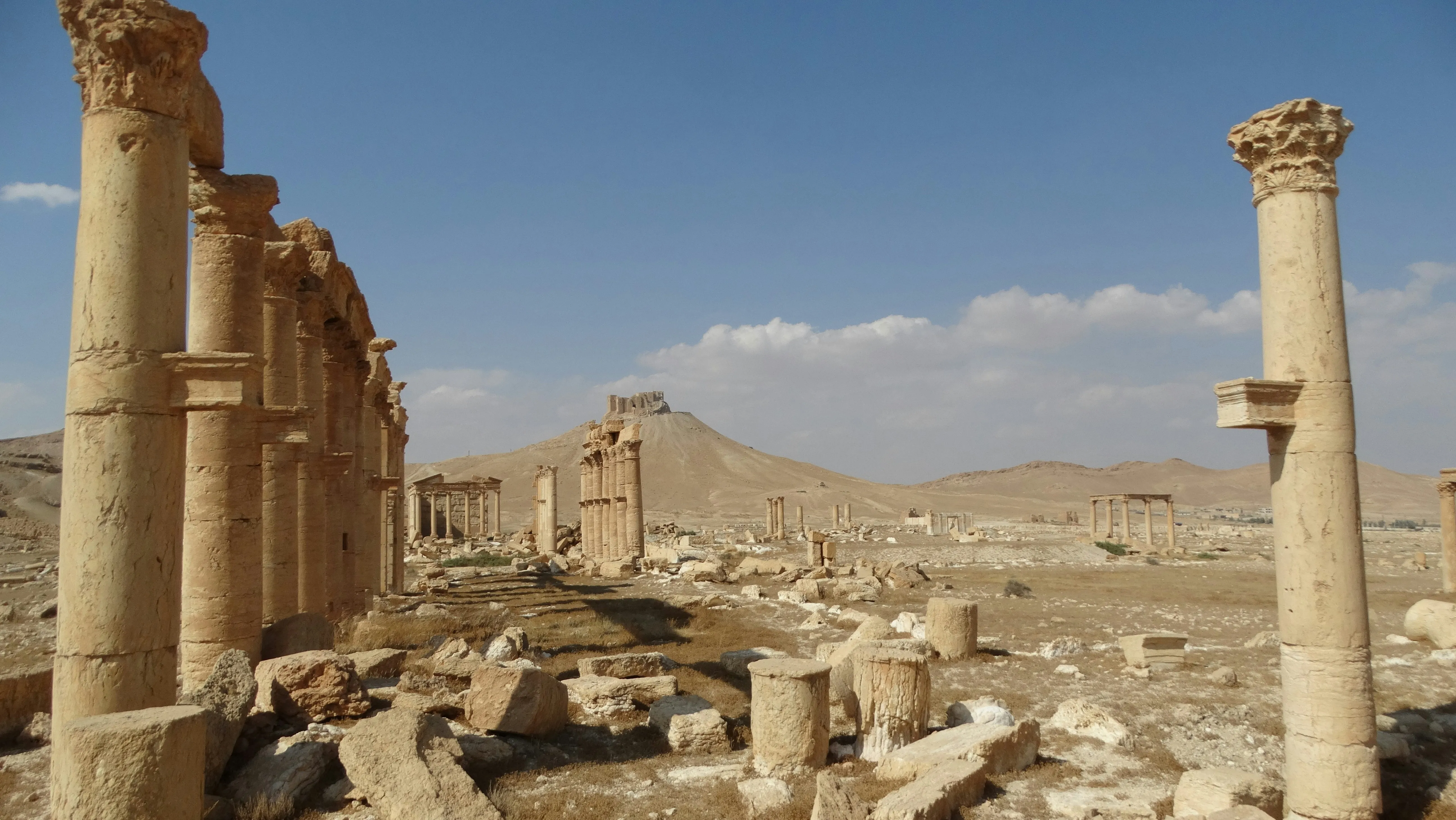
In the heart of the Syrian desert lies Palmyra, an oasis that houses the ruins of one of the most important cities of antiquity. This archaeological site is famous for its Great Colonnade, the Temple of Bel, and the Roman theater, structures that reflect the fusion of Greek and Roman techniques with local Persian traditions. The contrast between the ochre of the carved stones and the intense blue of the desert sky creates a very particular visual landscape, evoking the time when this city was a vital meeting point for the commercial caravans that crossed the region.
The country’s diversity is also manifested in its mountainous and coastal areas. Near the Mediterranean coast rises the Krak des Chevaliers, a medieval fortress that stands out for its excellent state of conservation and its double-walled defensive design. Nearby, in the city of Hama, the visitor can contemplate the giant wooden waterwheels (norias) on the Orontes River, ancient irrigation structures that even today emit their characteristic sound as they turn. For those seeking a different natural environment, the Anti-Lebanon mountain range hosts villages like Maaloula, where Aramaic is still spoken and whose houses seem to hang from the rock cliffs, offering a unique perspective of life in rural mountain communities.
In the southern zone, near the border, is Bosra, famous for its Roman theater built in black basalt stone, which gives it a dark and solemn appearance very uncommon in other constructions of the period. In addition to the monuments, coastal regions like Lattakia offer a more relaxed atmosphere, with access to beaches and small islands like Arwad, where seafaring tradition and the construction of wooden boats are still prevalent. Exploring these different areas allows one to understand the contrast between the bustle of urban markets, the serenity of deserts, and the freshness of fertile valleys, forming a cultural mosaic of great historical value.
“Tip”: You cannot miss visiting the Umayyad Mosque, the most emblematic place in the country.
✈️ Best season to travel
Syria has a predominantly Mediterranean climate on the coast and arid in the interior, which marks notable differences according to the time of year. Generally, transition periods—spring and autumn—are considered the most balanced for touring the country. During these months, temperatures are moderate, which facilitates walks through archaeological zones and tours through the souks of the main cities without the rigor of summer heat or winter cold.
The choice of the ideal moment depends largely on the type of experience sought. While spring offers greener and more flowery landscapes, especially in areas near the coast and the Orontes valley, autumn provides soft light and clear days. Summer is usually dry and hot, especially in desert regions, while winter can bring rain and low temperatures, offering a different perspective of daily life and greater tranquility at points of interest.
| Season | Months | Typical climate | What to expect | Tourist influx |
|---|---|---|---|---|
| Spring | Mar – May | Mild temperatures and progressively longer days. Scant rain. | Green landscapes, flowering in the valleys, and ideal conditions for cultural visits. | High (⭐⭐⭐) |
| Summer | Jun – Aug | Intense and dry heat in the interior; high humidity on the coast. Clear skies. | More lively night activities and local festivals. Hot days at noon. | Medium (⭐⭐) |
| Autumn | Sep – Nov | Gradual drop in temperatures. Pleasant and dry atmosphere. | Harvest season, clean skies, and good visibility for landscape photography. | High (⭐⭐⭐) |
| Winter | Dec – Feb | Cold climate, with frequent rains and possibility of snow in high areas. | Quiet atmosphere, less crowded museums, and urban landscapes under rain or mist. | Low (⭐) |
🗣️ Basic vocabulary
Although it is possible to communicate in English in hotels and the most frequented areas of Syria, knowing some basic expressions in Arabic—specifically in the Levantine dialect—greatly facilitates daily interaction. Syrians usually value positively that visitors make the effort to use their language, which helps generate a closer and friendlier atmosphere in markets, transport, or restaurants.
Mastering these elementary courtesies will help you navigate daily situations with greater ease. It is not necessary to delve deep into grammar; it is enough to memorize these key words to show respect and improve communication during your stay.
- Marhaba: Hello. It is the most common and simple greeting to start a conversation.
- Shukran: Thank you. An essential word you will use constantly after any service or help.
- Min fadlak (to a man) / Min fadlik (to a woman): Please.
- Na’am / La: Yes / No.
- Afwan: You’re welcome or excuse me. It is used both to respond to a thank you and to ask for way or get someone’s attention politely.
- Wayn…?: Where is…? Very useful for asking for the location of a street, a hotel, or a monument.
- Be-kam?: How much does it cost? Fundamental for checking prices in the souks and local shops.
- Ma’a salama: Goodbye. Used to say farewell and literally means “with peace”.