


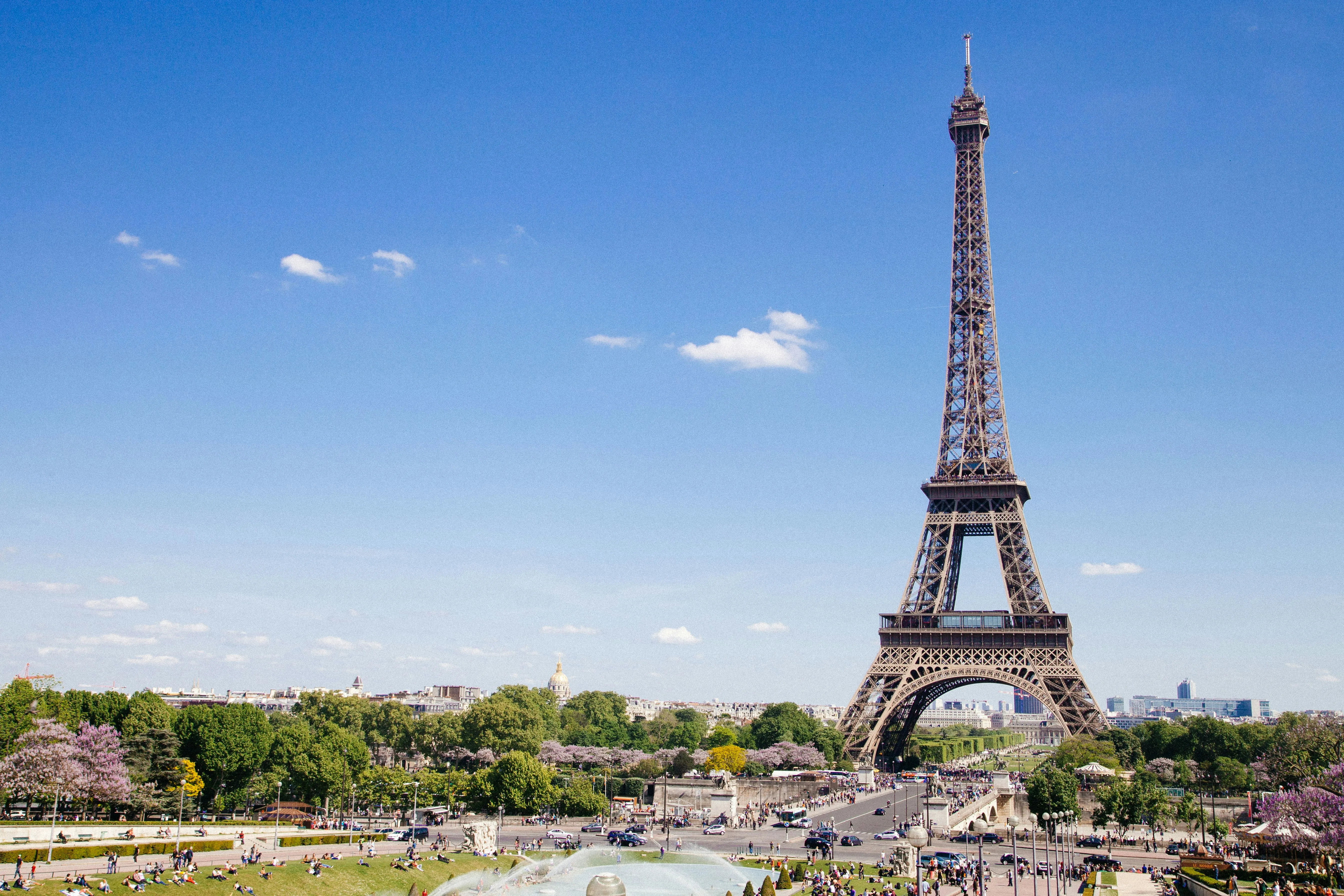
France
A country to combine art, charming villages, Atlantic and Mediterranean coasts, and a gastronomy that always accompanies your route, unhurriedly.
Quick Facts
- Capital
- Paris
- Language
- French
- English in tourist areas; regional languages such as Breton, Occitan, Corsican, Alsatian, Basque, and Catalan
- Currency
- Euro (EUR)
- Best time to visit
- Spring and early autumn, when the weather is pleasant and you can combine cities, countryside, and coast with less crowding.
- Budget per day
- $80 - $250 per day
- Climate
- Temperate climate, with Atlantic and Mediterranean influences; colder winters in the north and Alpine areas, and mild to hot summers depending on the region.
- Connectivity
- good
- Very easy to get a SIM or eSIM at airports, supermarkets, and operators; coverage is usually good even outside major cities.
- Electricity
- Type C/E plug (230 V)
- Local transport
- good
- Card usage
- very widespread
- Tipping
- optional
🗺️ Introduction
France is one of those countries where you can design a trip to your measure without feeling like you lack options. You will find large cities with museums, neighborhoods with personality, and a constant cultural life, but also quiet villages where the perfect plan is to walk unhurriedly, sit on a terrace, and watch the afternoon go by. The best part is that, in a few days, you can go from an urban walk through Paris to a landscape of vineyards, a Mediterranean beach, or a valley with castles.
On a practical level, France is a very rewarding destination: it is usually easy to move by train, accommodation is varied, and the gastronomy accompanies every region with local dishes and products. You will notice clear changes in atmosphere depending on the place: the maritime character of the Atlantic, the southern light of the French Riviera, the rural tranquility of regions like inland Provence, or the mountain feel in the Alps. If you like to combine culture, nature, and good food, you can do it here without great complications, just adjusting your route to whatever you feel like most.
🛡️ General safety
In general, France is a safe country to travel to, especially if you maintain the usual precautions in destinations with high tourist numbers. In large cities and very crowded areas, such as stations, subways, and points of interest, it is where you should be most attentive to pickpockets and petty theft. It is not something that should condition you, but it will help to carry your valuables in a closed place, avoid leaving your phone on unsupervised tables, and not show large amounts of money.
At night, most tourist areas are walkable, although as in any country, there are neighborhoods where it may be better to avoid poorly lit alleys or moving alone unnecessarily. If you rent a car, it is also a good idea not to leave luggage in sight and choose guarded parking lots when possible. In the countryside, risks are usually lower, and in the mountains or on the coast, safety depends more on the weather and following local recommendations, especially if you go hiking.
Tip: In highly visited tourist areas, use a crossbody bag or a backpack with a front closure on public transport to minimize oversights.
📝 Standard entry requirements
Entry requirements for France vary according to your nationality, but as a general rule, the most important thing is to travel with a valid passport or identity document in good condition. If you arrive from a country that is part of the Schengen area or has free movement agreements, the control is usually simpler; if you come from outside, they may ask you to verify the duration of your stay, the reason for the trip, and that you have a reasonable plan (accommodation, itinerary, and return or departure).
At border controls and airports, they may request proof of sufficient means for the trip or medical insurance, depending on the case. Although they do not always ask for it, it is useful to have hotel confirmations or accommodation addresses handy, and departure tickets if your stay is short. It is also advisable to check in advance if your documentation needs additional minimum validity. On the road, if you enter from neighboring countries, controls may be sporadic, but that does not mean you can travel without documentation.
Tip: Save a digital copy of your passport/ID and key reservations on your phone and in the cloud, in case you need to verify them quickly.
🏥 Basic health considerations
At a health level, France has a modern medical system with good coverage, especially in cities. For the traveler, the most common health problems are mild: colds, digestive discomfort, or small injuries from walking more than usual. Even so, if you have regular medication, it is best to take it with you in your carry-on luggage, in its original packaging and, if possible, with a prescription or medical note, especially if it is an ongoing treatment.
In mountain areas or if you are going to do outdoor activities, add precautions: hydration, sun protection, appropriate clothing, and check the weather forecast. In summer, the heat can be intense in some regions, and in winter, the cold and snow in the Alps require planning. It is also a good idea to travel with insurance that covers medical assistance and possible unforeseen events, especially if you are going to ski or hike on demanding routes.
Tip: Carry a simple first-aid kit with the basics (painkillers, bandages, antihistamines) and travel insurance that covers activities if you are going to the mountains.
🚌 Transport within the country
Moving around France is usually quite easy, and that allows you to organize a varied itinerary without wasting too much time on travel. The train is one of the best options: it connects large cities and many towns, and is ideal if you want to combine, for example, Paris with regions like the Loire Valley, Bordeaux, Lyon, or the Mediterranean coast. In large cities, you will also find subways, trams, and buses that work well for day-to-day travel.
If your plan includes small villages, rural areas, or routes through natural parks, renting a car can give you freedom. However, in urban centers, driving and parking can be more stressful and expensive, so it usually pays to leave the car for when you leave the city. On highways there are toll sections, and in some areas there are emission restrictions, so it is advisable to inform yourself before entering certain cities with a vehicle. For short distances, walking is an excellent plan, and in many cities, you can use public bikes or rent one.
Tip: Combine the train for long stretches and urban transport on foot/metro; if you rent a car, pick it up outside the center to avoid traffic and complicated parking.
🤵 Culture and etiquette
French culture is diverse, but there are certain habits that will make coexistence easier and the experience more pleasant. In general, courtesy is valued: greeting when entering shops or small establishments, saying goodbye when leaving, and using simple formulas like “bonjour” or “merci” opens many doors. In restaurants, the pace is usually slower, and food is enjoyed without haste, so it is normal for service not to go at the same speed as in other places.
You will also notice that personal space and the tone of voice indoors are quite respected. If you visit churches, museums, or monuments, it is a good idea to maintain a calm attitude and follow the rules of the place. In markets and bakeries, queuing and waiting your turn is the norm. On public transport, giving up your seat to those who need it and avoiding very loud conversations is a simple way to integrate. If you try to say a few words in French, even if basic, they usually appreciate it.
Tip: Always start with a greeting before asking for something, even if you then continue in another language; it is a small detail that changes the treatment a lot.
🍛 Typical gastronomy
Eating in France is part of the trip, and you don’t need to look for sophisticated restaurants to enjoy it. In almost any region, you can try local products, traditional dishes, and a very lively market culture. You will find bakeries with good bread and pastries, cheese shops with infinite varieties, and small bistros where the cooking is simple but well done. Additionally, each area has its identity: sauces and stews in the interior, fish and seafood on the coast, and more Mediterranean flavors in the south.
If you like to keep trying things, a good idea is to alternate restaurant meals with visits to markets and delicatessens. You can put together a picnic with cheese, fruit, bread, and some charcuterie and it will turn out perfectly. As for drinks, wine is part of the cultural landscape, but there is also cider, craft beers, and regional aperitifs. If you have dietary restrictions, it usually helps to ask calmly and choose places with a clear menu.
| Dish | Description | Type |
|---|---|---|
| Coq au vin | Chicken slowly stewed with wine, mushrooms, and vegetables. | Traditional stew |
| Boeuf bourguignon | Beef stew with red wine and aromatics. | Stew |
| Ratatouille | Vegetables stewed with olive oil and herbs. | Vegetarian |
| Crêpes | Thin pancakes, sweet or savory, easy to find throughout the country. | Street food/Traditional |
| Quiche Lorraine | Savory egg and cream tart with a classic filling. | Baked |
Tip: Try the menu of the day when available; it is usually the easiest way to eat well and discover local recipes.
🏔️ Areas and places to visit
For a first trip, Paris is usually the natural starting point: museums, neighborhoods like Le Marais or Montmartre, walks along the Seine, and a cultural agenda that is always active. But France shines when you leave the capital and start to see contrasts. If you fancy the coast, the French Riviera offers cities like Nice and villages with views, while on the Atlantic you can find wilder environments and wide beaches. For vineyard landscapes and pretty villages, areas like Bordeaux, Alsace, or Burgundy are a safe bet.
If history is your thing, the Loire Valley is perfect for seeing castles, gardens, and small quiet cities. In the interior, regions like Provence or the Auvergne area have rural routes and markets with a great atmosphere. And if you are looking for powerful nature, the French Alps give you trails, lakes, and mountain stations for any level.
Tip: You cannot miss visiting the Eiffel Tower, the most emblematic place in the country.
🗣️ Vocabulary basic
- Bonjour: Hello / Good morning
- Bonsoir: Good afternoon / Good evening
- S’il vous plaît: Please
- Merci: Thank you
- Excusez-moi: Excuse me
- Où est… ?: Where is…?
- Combien ça coûte ?: How much does it cost?
- L’addition, s’il vous plaît: The bill, please
- Toilettes: Bathroom
✈️ Best season to travel
France can be visited all year round, but the experience changes quite a bit depending on the region and the time. In general, spring and early autumn tend to be a sweet spot: the weather is more pleasant, the days lend themselves to walking, and it is easier to combine city, villages, and nature without extremes of heat or cold.
In summer, you can better enjoy the coast and outdoor life, although you will also find more people in very popular destinations. In winter, the main star is the mountain, with the Alps as a reference, and cities have a quieter atmosphere, ideal if you like museums and plans without so many crowds.
| Season | Months | Climate | Crowds |
|---|---|---|---|
| Spring | Mar-May | Mild and variable, ideal for walking | Medium-High |
| Summer | Jun-Aug | Hot; drier in the south | High |
| Autumn | Sep-Nov | Pleasant, with occasional rain | Medium |
| Winter | Dec-Feb | Cold; snow in the mountains | Low (High in ski resorts) |