


Philippines
Discover a dream archipelago with pristine turquoise waters, lush jungles, and legendary hospitality that turns every corner into an unforgettable paradise.
Quick Facts
- Capital
- Manila
- Language
- Filipino (Tagalog) / English
- Cebuano, Ilocano, and numerous local dialects
- Currency
- Philippine Peso (PHP)
- Best time to visit
- From November to May, coinciding with the dry season
- Budget per day
- $30 - $110 per day
- Climate
- Tropical, warm, and humid throughout the year, with a marked dry season and a rainy season with possible typhoons.
- Connectivity
- average
- Very easy to obtain at airports and local shops with physical SIM and eSIM options.
- Electricity
- Type A / B / C (220V)
- Local transport
- acceptable
- Card usage
- cash is used more
- Tipping
- optional
🌎 Introduction
The geography of the Philippines unfolds as an extensive puzzle of islands where the sea is not a limit, but the thread that unites its inhabitants. In this archipelago, the landscape constantly transforms, moving from the imposing rice terraces that climb the mountains of the north to the small tongues of sand that appear discreetly in the south. The rhythm of life here is usually marked by the tides and the passage of the sun, shaping a natural mosaic where the green of the tropical vegetation and the blue of the Pacific envelop practically everything.
Its cultural identity is the result of a slow encounter between Asian roots and a history that has left recognizable traces in the architecture of its churches, the names of its people, and its gastronomy. In daily life, common routines are lived in the bustle of local markets and in the colorful traditional transport that travels through the villages. It is a place where traditions are kept alive through community celebrations and a natural hospitality perceived in the simplest gestures of its inhabitants.
The passage of the seasons divides the year between the months of clear skies and the time when tropical rains intensify the scent of the damp earth. Traveling through its corners allows one to observe the contrast between the energy of urban areas and the stillness of fishing communities that live in harmony with the marine environment. The Philippines thus presents itself as a diverse territory full of nuances, preserving a unique personality forged by geographic isolation and the richness of its cultural exchanges.
🛡️ General safety
The Philippines is a destination that, in general terms, offers a safe and welcoming experience for the international traveler. Hospitality is one of the pillars of its culture, and most tourists visit the archipelago without experiencing significant setbacks. However, as in any destination of great size, safety varies significantly depending on the region and the environment.
General level of safety
- The safety level in the Philippines can be rated as medium. While the main tourist hubs are safe, the country requires the traveler to maintain a vigilant attitude and stay informed about the local situation.
- Compared to other destinations in Southeast Asia, the Philippines may present additional challenges in very specific areas, but for a tourist following the usual routes (Palawan, Cebu, Siargao, or Bohol), a sense of tranquility is the dominant tone.
- It is fundamental to understand that the Philippines is a very diverse archipelago; safety on a remote and quiet island is not the same as in the dense metropolitan areas of the capital.
Crime and common risks
- The most frequent crime affecting tourists is petty theft and pickpocketing, especially in places with large crowds, markets, and public transport.
- Minor scams in prices for services or products are common. It is common for attempts to overcharge for short trips or private tours if the price has not been agreed upon beforehand.
- It is recommended to avoid using ATMs in poorly lit or lonely places to prevent card cloning or robberies after withdrawing cash.
- There are less frequent risks, such as safety incidents in very specific regions of the south (Mindanao) and the Sulu Archipelago, due to internal conflicts. It is advised to avoid these non-tourist areas and follow official travel recommendations.
Safety in cities and tourist areas
- In large cities like Manila and Cebu, safety is acceptable in modern neighborhoods and business centers (such as Makati or Bonifacio Global City), but it can decrease in peripheral or less developed neighborhoods.
- Coastal and island tourist areas tend to be very safe environments where the local community actively looks after the visitor, as tourism is their main source of income.
- To move around with peace of mind, it is ideal to avoid displaying items of excessive value, such as jewelry or professional cameras, in areas that are not strictly touristy.
Safety in transport
- Public transport, such as jeepneys or tricycles, is generally safe, although one should pay attention to personal belongings due to the proximity between passengers.
- For urban displacements, the use of private transport applications (such as Grab) is highly recommended for safety, comfort, and price transparency.
- Regarding conventional taxis, it is important to ensure the driver activates the meter or to agree on a fair price before starting the trip.
- In the Philippines, people drive on the right. Traffic in cities can be chaotic, and road rules are not always strictly followed. If renting a motorcycle on the islands, the use of a helmet is essential, as is having previous experience, given that road conditions can be irregular.
Natural and climatic risks
- The Philippines is located in the “Pacific Ring of Fire,” which implies a recurring risk of earthquakes and volcanic activity. Although they are not daily events, it is convenient to know the basic action protocols.
- The most common risk is from typhoons and floods. The rainy season usually runs from June to November, with August and September being the months of greatest cyclonic activity.
- Extreme heat and humidity can cause dehydration or heatstroke. It is essential to drink bottled water (never from the tap) and use high-factor sunscreen.
Legislation and local rules
- The Philippines has extremely strict laws against drug consumption and trafficking. Penalties are severe and include long prison terms; there are no exceptions for foreigners.
- Respect for authorities and local institutions is fundamental. Aggressive behavior or serious disrespect can lead to legal problems or expulsion from the country.
- In many protected natural areas, there are strict environmental care regulations, such as the prohibition of single-use plastics or smoking on beaches. Non-compliance leads to immediate fines.
Safety for specific groups
- Female travelers: The Philippines is a safe destination for women traveling alone. There is usually no street harassment, although it is always recommended to maintain logical precautions when moving at night in less frequented areas.
- LGTBIQ+ travelers: Philippine society is generally tolerant and open, especially in tourist areas and large cities. Although it is a religiously conservative country, there are no specific safety risks for this group.
- Traveling with children and the elderly: The country is very welcoming to families. However, it must be taken into account that infrastructure (sidewalks, access points) is not always adapted for strollers or people with reduced mobility.
Emergencies and assistance
- The general emergency number in the Philippines is 911, which centralizes police, fire, and medical emergency services.
- The tourist police have a presence in high-traffic areas and are usually friendly and willing to help the visitor.
- In case of an incident, it is recommended to remain calm, not offer resistance in case of robbery, and go to the nearest police station to file a formal report, which is necessary for any travel insurance claim.
Tip: Always use transport applications with fixed prices in large cities to avoid unnecessary negotiations and ensure your trip is recorded by GPS.
📝 Entry requirements
Access to the Philippines for international visitors primarily requires a valid passport. It is common practice for immigration authorities to request that said document has a minimum validity of six months from the moment of arrival in the territory. Additionally, it is recommended that the passport is in good condition and has sufficient pages for the control stamps issued during the entry and exit process.
Regarding stay permits, many travelers can benefit from a visa exemption for tourism purposes, provided the visit is of short duration. This modality usually allows an initial stay of thirty days, which may be sufficient to visit the main attractions of the archipelago. If you wish to prolong the visit, there is the possibility of managing extensions at the competent immigration offices once inside the country.
It is common that, upon arriving at the border control post, personnel request the presentation of an exit ticket, either returning to the point of origin or toward a subsequent destination. This ticket must be dated within the authorized stay period. Likewise, it is advisable to have proof of economic solvency to cover travel expenses, such as accommodation bookings or bank statements, although these are not always systematically requested from all traveler profiles.
Controls at international airports include baggage inspection and compliance with customs rules. There are generic restrictions on the import of plant products, animals, or unprocessed fresh food to protect the local ecosystem. If the traveler needs to transport specific medications, it is very useful to carry the original medical prescription to facilitate the work of customs agents and avoid possible delays.
From a health point of view, it is suggested that the traveler keeps their routine vaccination schedule up to date. There are usually no mandatory vaccine requirements for most tourists, except for specific cases related to previous geographic origin, where a vaccination certificate against yellow fever might be requested. It is always recommended to maintain a preventive attitude and consult general health recommendations before taking the flight.
- Basic documentation: Passport with a validity of more than six months.
- Tourism permits: Visa exemption available for short stays, generally up to thirty days.
- Transport tickets: Requirement to have a confirmed exit ticket from the country.
- Financial resources: Recommendation to carry proof of sufficient funds for the stay.
- Customs regulations: Limitations on the transport of fresh food and control of medications with a medical prescription.
- Health: Recommendation for routine vaccines and specific controls according to the previous area of origin.
🏥 Basic health considerations
You will find a dual reality in the Philippine healthcare system. While in large cities like Manila or Cebu you will have access to top-tier private hospitals with advanced technology and highly qualified specialists, in rural areas or more remote islands, the infrastructure is much more basic and limited. Access for tourists is almost exclusively through private healthcare, as public facilities are often overcrowded and have fewer resources. The cost of medical care for foreigners is high, so any consultation or intervention will involve a significant expense if you are not prepared. You will find that language will not be a barrier in this field, as almost all healthcare staff speak fluent English, allowing you to explain any symptoms clearly.
Taking out travel medical insurance is not a legal requirement to enter the country, but it is absolutely essential from a practical standpoint. Without an adequate policy, you could face astronomical bills in case of an accident or illness. It is fundamental that your insurance includes broad coverage for hospitalization, ambulance transfers and, very especially, medical repatriation and transfer between islands, which can be complex and expensive due to the archipelago’s geography. You will notice that traveling with this protection will allow you to enjoy adventure activities and beaches with much greater peace of mind.
Regarding vaccines, you will not find any that are mandatory to enter the Philippines, unless you come from an area where yellow fever is endemic, in which case you will be asked for the international vaccination certificate. However, it is highly recommended that you keep your routine vaccination schedule up to date. Additionally, travelers are usually advised to protect themselves against hepatitis A and B, as well as typhoid fever, especially if you plan to move through rural areas, spend a lot of time in nature, or eat at local stalls frequently.
If you need to take specific medication for personal treatment, it is best to always transport it in its original packaging and accompanied by a medical prescription translated into English. You will not see severe restrictions on common medications like painkillers or anti-inflammatories, but it is always prudent to carry a small personal first-aid kit with the basics: disinfectant, bandages, gastric protectors, and oral rehydration salts. Although in the main cities you will find many well-stocked pharmacies, on small islands or beach areas, the stock may be very limited, and you might not find exactly what you are looking for.
The greatest health risk you might face is related to the tropical climate. Intense heat and high humidity can cause dehydration or heatstroke if you do not take precautions. Insects are another relevant factor, as in some regions there is a risk of mosquito-borne diseases such as dengue. You will find that using a strong repellent constantly and wearing light clothing that covers the skin at dawn and dusk will drastically reduce any risk. On the other hand, you should not worry about diseases like malaria on the main tourist routes, as the risk is generally low or non-existent in those areas.
Regarding water and food, the golden rule you must follow is never drink tap water. You will find bottled water easily in any shop, hotel, or restaurant, and it is what you should use even to brush your teeth if you have a sensitive stomach. As for food, you can safely try local delicacies as long as the food has been well cooked and is served hot. It is better to avoid consuming raw vegetables or fruits that you do not peel yourself, and be cautious with ice at street stalls if you are not certain it comes from purified water.
In the event of a serious medical emergency, the telephone number to dial is 911. This service coordinates emergencies at a national level. You should keep in mind that, while ambulance service is functional in cities, heavy traffic can cause significant delays. If you are on a remote island, urgent care may require a boat or small plane transfer, so in those cases, immediate communication with your insurance’s assistance center will be the most effective step to manage your care.
As final recommendations for your stay to be perfect, remember to use high-factor sunscreen constantly, as the sun in the archipelago is extremely strong even on cloudy days. Drink fluids frequently even if you do not feel thirsty and try to acclimate to the heat gradually during the first few days. If you plan to go diving, make sure to respect the waiting times before boarding a plane to avoid decompression problems. With these simple guidelines, you will find that your trip through the islands will be a fantastic and worry-free experience.
🚌 Transport within the country
Moving around the Philippines involves adapting to an archipelagic geography, which makes internal flights and ferries the fundamental pillars for traveling between islands. While planes quickly connect the main hubs, maritime transport is the most common option for short and medium routes, with a wide variety of vessels ranging from large ships to small local boats. On the mainland, long-distance buses travel across the larger islands, connecting cities and provinces regularly.
Ease of use for the visitor is acceptable because signage and ticket purchasing procedures are usually handled in English. This facilitates communication at terminals and stations, where staff generally guide tourists in a friendly manner. Although in many cases tickets are purchased in person directly at ticket offices, the general organization allows a traveler without prior experience to navigate the transport system with some autonomy.
There is a marked difference between transport in large cities and rural areas. In metropolitan areas, it is possible to find light rail systems and a huge density of vehicles, while in villages and coastal areas, tricycles and colorful jeepneys predominate, functioning as collective local transport. The latter are a very authentic way to get around, although they require getting used to a slower and less structured pace of travel.
The use of taxis is common in urban environments and airports, offering a comfortable alternative to avoid traffic and high temperatures. Additionally, ride-sharing applications work efficiently in major cities, providing a sense of safety and transparency to the traveler. Conversely, when moving to more remote islands, these options disappear, giving way to motorcycle rentals or the use of private vehicles with a driver.
Regarding reliability and comfort, it is important to keep in mind that city traffic and weather conditions at sea can influence schedules. Punctuality is not always exact, and trips often last longer than initially planned. The traveler should approach displacements with a flexible attitude, understanding that the pace of the country is relaxed and that unforeseen events are part of the experience of moving through an insular environment.
Tip: It is advisable to plan for additional time on all transfers, especially if connections between different means of transport must be made on the same day.
🤵 Culture and etiquette
Philippine society is distinguished by exceptional hospitality and a friendly treatment of visitors, based on the constant search for social harmony. A central concept in its culture is the avoidance of direct confrontation to maintain a pleasant environment in interactions. In daily life, this translates into soft communication and the frequent use of courtesy terms to address others, even among strangers. Respect for elders is a fundamental pillar; it is common to see gestures of deference, such as slightly bowing the head or using honorific titles when speaking with older people or those of higher hierarchical rank.
In public spaces, discreet behavior and a moderate tone of voice predominate, as expressions of anger or loud voices usually generate discomfort. Physical contact is cordial but respectful, generally maintaining a prudent distance during first encounters. Regarding punctuality, there is a flexible perception of time in informal social contexts, where delays are usually accepted naturally and with patience. However, in official or professional settings, adherence to established schedules is valued. Patience and a smile are key social tools that facilitate the resolution of any unforeseen event much more smoothly than insistence or haste.
Customs related to food are one of the country’s most important expressions of generosity. Sharing food is an essential social act, and it is common for newcomers to be invited to join a table. When invited to a home, it is considered a thoughtful gesture to show appreciation for the hospitality and the dishes served. In restaurants, although it is not a strict obligation, tipping is a widespread and well-received practice as recognition for good service, especially when it is not explicitly included in the bill.
Respect for traditions and beliefs is an aspect of great relevance. Due to the deep religious sentiment present in the population, it is important to maintain a solemn attitude and dress modestly when visiting churches, temples, or sacred places. Likewise, caring for one’s own and others’ social image is vital; preventing someone from feeling embarrassed or singled out in public allows interpersonal relationships to develop naturally. Courtesy and the recognition of the dignity of the other person are the best guides for any interaction in the country.
“Tip”: To facilitate harmonious coexistence, it is preferable to use indirect requests or suggestions instead of direct orders, and avoid correcting or criticizing someone openly in front of others, as preserving the interlocutor’s emotional well-being is a fundamental rule of courtesy.
🍛 Typical gastronomy
The gastronomy of the Philippines is the result of a rich mixture of indigenous, Malay, Chinese, Spanish, and American influences. Rice acts as the central axis of the diet, being present in practically every meal of the day. Unlike other neighboring Southeast Asian countries, Filipino flavors do not usually stand out for intense spiciness, but rather for a balance between sour, salty, and sweet nuances, often achieved through marinating and slow cooking.
The use of coconut or cane vinegars, soy sauce, garlic, ginger, and calamansi —a small local citrus— defines the aromatic profile of most of its dishes. In many regions, especially in coastal and southern areas, coconut milk is an essential ingredient that adds a creamy texture to meat, fish, or vegetable stews. The freshness of local products and simplicity in preparation are the hallmarks of its cuisine.
Regarding eating habits, merienda is a deeply rooted custom, consisting of a small snack between the main meals. In restaurants and homes, it is common to use a spoon and fork; the spoon is held in the right hand to cut food and scoop rice, while the fork serves as support. Sharing several dishes in the center of the table is the norm, fostering a social and close atmosphere. To accompany the meal, it is frequent to find tropical fruit juices, mineral water, and locally produced beers.
| Dish | Description | Main ingredients | Where to try it | Tip |
|---|---|---|---|---|
| Adobo | Traditional stew considered the national dish, known for its preservation qualities. | Meat (chicken or pork), vinegar, soy sauce, garlic, and pepper. | Family restaurants and food stalls nationwide. | Always accompany it with white rice to balance the flavor of the sauce. |
| Sinigang | Clear soup with a characteristic, very refreshing sour taste. | Meat or fish, tamarind, tomato, radish, and leafy green vegetables. | Local cuisine restaurants in any region. | Try it especially on hot days for its comforting effect. |
| Lechon | Whole pig roasted over charcoal until the skin is very crispy. | Suckling pig, lemongrass, and local spices. | Very common in celebrations and in the city of Cebu. | Ask for a portion that includes a piece of crispy skin. |
| Pancit Bihon | Sautéed thin rice noodles, of clear Chinese influence. | Rice noodles, assorted vegetables, pieces of meat or shrimp. | Street stalls, markets, and celebrations. | Add a few drops of calamansi juice on top to enhance the flavors. |
| Halo-halo | Cold, colorful dessert served in a glass or large bowl. | Shaved ice, evaporated milk, fruits in syrup, flan, and ube (purple yam puree). | Cafes, ice cream parlors, and dessert stalls. | Mix all the ingredients well before you start eating it. |
📷 Areas and places to visit
The Philippines is an archipelago of notable diversity, where historical heritage blends with unique natural environments. In the capital, Manila, the traveler finds the pulse of the nation and a direct testimony of its past. The walled district of Intramuros allows one to learn about the colonial legacy through the Fort Santiago and the Manila Cathedral, places that contrast with the energy of the modern financial districts. To delve deeper into the country’s culture, the National Museum of the Philippines houses fundamental artistic and anthropological treasures, while the Binondo neighborhood offers a perspective on the commercial and social influence of the world’s oldest Chinese community.
In the north of Luzon island, the landscape transforms into a mountainous and rural environment of great cultural value. Here, the Banaue and Batad rice terraces stand out, an ancestral engineering feat integrated into the mountain slopes. In this same region is Vigan, a city that preserves cobblestone streets and well-preserved Spanish-influenced architecture. Toward the interior, the town of Sagada is recognized for its caves and mountain-linked traditions, offering a different view of highland life, away from the hustle and bustle of large cities.
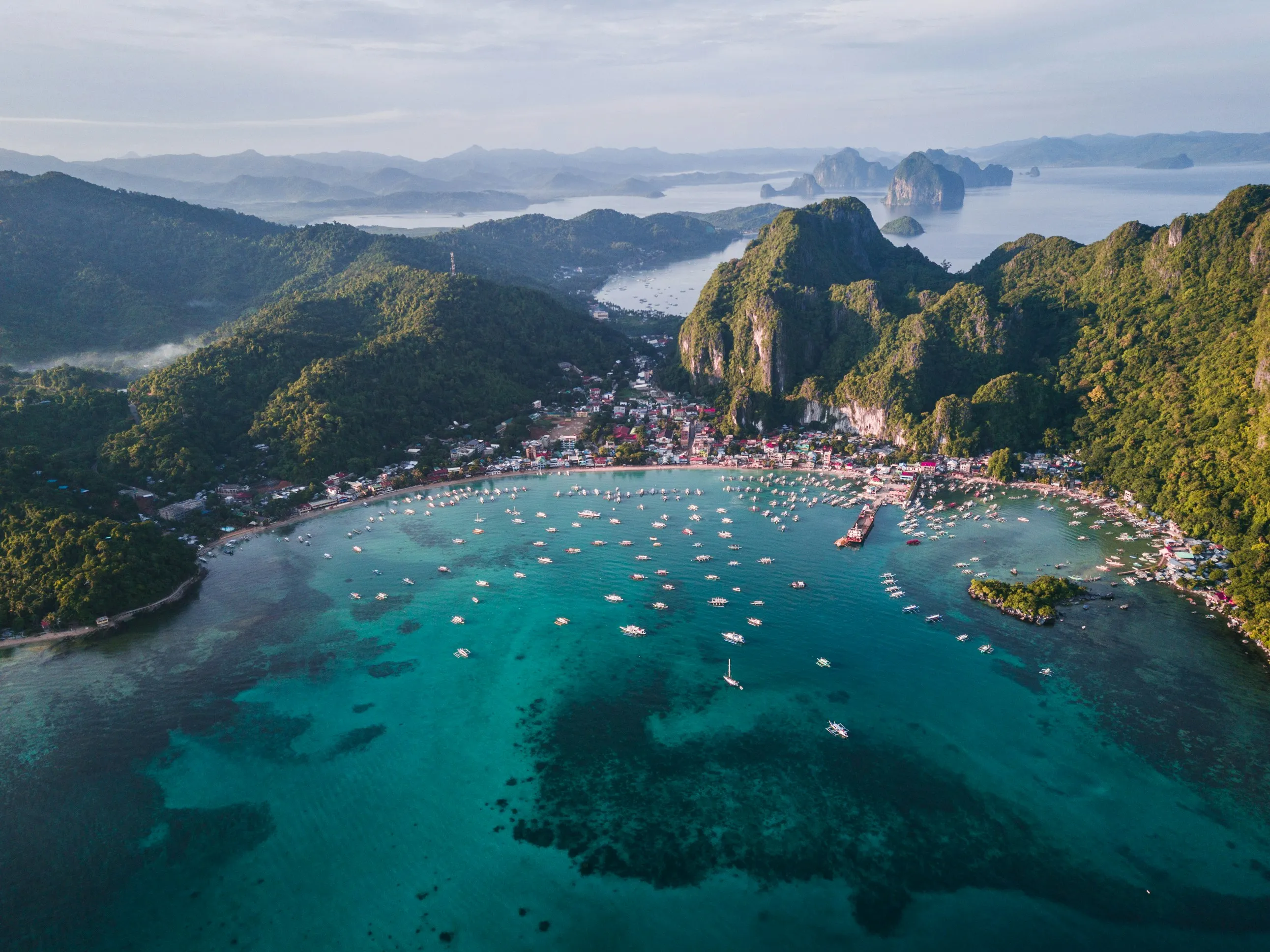
The Palawan region is a reference for those seeking contact with nature in its purest state. In Puerto Princesa, the environment is characterized by its biodiversity and unique geology. Further north, the areas of El Nido and Coron feature limestone formations that hide crystal-clear water lagoons and isolated beaches. These areas are ideal for coastal tours, exploring coral reefs, and observing marine life in a protected environment. The transition between small coastal villages and the magnitude of the cliffs defines the visual character of this part of the country.
In the Visayas islands, interest is split between historical landmarks and natural phenomena. Cebu is an important center due to its historical and religious significance, preserving sites like Magellan’s Cross and the Basilica del Santo Niño. A short distance away, the island of Bohol offers a distinctive landscape with the Chocolate Hills, a series of conical elevations that change color according to the season. This island also features spaces dedicated to the protection of the tarsier, a small primate that is part of the area’s natural heritage.
For those seeking an environment linked to the sea and outdoor activities, islands like Boracay and Siargao offer different but complementary proposals. While the former is known for its extensive shores of fine sand and quiet atmosphere, the latter has consolidated itself as a center for surfing enthusiasts and palm tree landscapes. On the island of Mindanao, the relief becomes imposing with Mount Apo, the highest point of the archipelago, where one can hike through tropical forests and learn about the way of life of local communities that maintain deeply rooted traditions.
Tip: You cannot miss a visit to the Puerto Princesa Underground River, the most iconic place in the country.
✈️ Best season to travel
The Philippines has a tropical climate that divides the year mainly into two periods: the dry season and the rainy season. The choice of when to visit the archipelago usually depends on the activities to be performed, as conditions vary between the mountainous regions of the north and the coastal areas of the south. In general terms, the months with the lowest probability of precipitation are those that allow for easier enjoyment of the diversity of its islands and the clarity of its waters.
During the driest months, visibility for diving is optimal and access to the most remote destinations is easier. Conversely, the rainy season transforms the landscape into an intense green environment and allows for experiencing a quieter side of the country, although it requires greater flexibility in travel plans due to possible meteorological instability and higher humidity.
| Season | Months | Typical weather | What to expect | Tourist influx |
|---|---|---|---|---|
| Spring | Mar – May | Warm and dry. High temperatures and clear skies. | Ideal for beaches, diving, and local festivals. The heat is intense in the cities. | High (⭐⭐⭐⭐) |
| Summer | Jun – Aug | Start of the rains. High humidity and occasional storms. | Greener landscapes and favorable conditions for surfing on certain eastern coasts. | Medium (⭐⭐⭐) |
| Autumn | Sep – Nov | Frequent rainy season and risk of typhoons. | Exuberant nature, fewer people at points of interest, and a quieter environment. | Low (⭐⭐) |
| Winter | Dec – Feb | Cool and dry weather. Very pleasant moderate temperatures. | Favorable time for hiking, cultural tourism, and enjoying the sun without extreme heat. | Very high (⭐⭐⭐⭐⭐) |
🗣️ Basic vocabulary
Although English is an official language in the Philippines and is used in almost every tourist context, learning a few words in Tagalog will help you move around more easily. Local inhabitants usually value it positively when visitors show interest in their language, which can facilitate interactions in markets, shops, or public transport.
It is not necessary to delve deep into grammar, as with a few key expressions you can greet, thank, or ask for basic information effectively during your stay in the archipelago.
- Salamat: Thank you.
- Kumusta: Hello / How are you?
- Magkano?: How much does it cost?
- Oo: Yes.
- Hindi: No.
- Para: Used to notify the driver that you want to get off the transport (very common in jeepneys).
- Paalam: Goodbye.
- Masarap: Tasty / Delicious.