


Bangladesh
Discover a country of infinite rivers, untamed mangrove forests, and genuine hospitality that captivates the most intrepid travelers in South Asia.
Quick Facts
- Capital
- Dhaka
- Language
- Bengali
- English
- Currency
- Bangladeshi Taka (BDT)
- Best time to visit
- From November to February, during the dry and cool season.
- Budget per day
- $20 - $60 per day
- Climate
- Tropical monsoon climate with hot and humid summers followed by mild, dry, and very pleasant winters for tourism.
- Connectivity
- medium
- Very easy to obtain at airports and urban kiosks by presenting a passport.
- Electricity
- Type C, D, G, and K (230V)
- Local transport
- acceptable
- Card usage
- cash is used more
- Tipping
- optional
🌎 Introduction
Bangladesh unfolds as an immense tapestry of greens and water where the great rivers descending from the Himalayas end their journey before merging with the sea. It is a place that breathes at its own pace, marked by the cycle of the monsoons and the astonishing fertility of a land that seems to regenerate with every rain. In this corner of South Asia, life flows between the mazes of mangroves and the gentle hills carpeted with tea plantations, forming a landscape where nature and human presence coexist closely and constantly.
The essence of the country manifests in the simplicity of daily life: the bustle of the markets, the colorful rickshaws that traverse the cities, and the aroma of tea that invites a pause at any corner. Its festivities and its gastronomy, rich in spices and products of the land, reflect a rooted cultural identity and a natural hospitality that defines the character of its people. It is a region of subtle contrasts, where one can observe an authentic and vibrant reality that keeps its personality intact against the passage of time.
🛡️ General safety
Traveling to Bangladesh is an enriching experience that allows you to get to know a hospitable culture and vibrant landscapes. However, as in any developing destination with extreme population density, it is necessary to maintain a constant sense of precaution and be well-informed about the local environment.
General safety level
The safety level in Bangladesh is considered moderate. It is not a country that presents extreme risks for tourists, but it is also not among the quietest destinations in the world. The traveler will find a generally welcoming atmosphere, where foreigners are usually received with curiosity and kindness.
- The country requires a vigilant attitude, especially in large urban centers and border areas.
- The political situation can be volatile at times, which can lead to demonstrations or strikes (locally called hartals).
- Compared to other Southeast Asian destinations, Bangladesh receives less mass tourism, which makes the traveler stand out more and requires them to be more aware of their surroundings.
Crime and common risks
Most visits to Bangladesh pass without serious incidents, although petty crime is the most frequent risk for tourists.
- Pickpocketing and bag snatching are common in very crowded places, such as markets, train stations, and bus terminals.
- Snatching from moving vehicles (motorcycles or rickshaws) can occur; it is recommended not to carry bags hanging toward the side of the road.
- There are minor scams related to currency exchange on the street or excessively inflated prices for foreigners. It is preferable to use official exchange houses and agree on prices beforehand.
- Although rare, cases of violent robbery have been reported in isolated areas or during the night, so it is discouraged to travel through dark or sparsely frequented places without local company.
Safety in cities and tourist areas
Bangladeshi cities, especially Dhaka, are incredibly dense and chaotic, which conditions the perception of safety.
- In Dhaka, neighborhoods like Gulshan, Banani, and Baridhara are considered the safest and have a greater police presence and services oriented toward foreigners.
- Urban public transport is usually extremely full, which facilitates the action of pickpockets.
- It is recommended to avoid crowds and demonstrations of a political or religious nature, which can arise spontaneously.
- In rural areas and natural destinations like the Sundarbans or Cox’s Bazar, safety is acceptable, as long as the instructions of local guides are followed and national park rules are respected.
Transport safety
Transport is one of the aspects where the traveler must take extreme precautions, mainly due to road accident rates.
- In Bangladesh, people drive on the left.
- Traffic is very congested and traffic rules are respected to a limited extent. Accidents are frequent on national highways.
- Intercity buses often travel at high speeds and aggressively; it is recommended to opt for trains (upper class) or internal flights for long journeys if seeking greater safety.
- To move around the city, it is preferable to use ride-sharing applications (such as Uber) instead of random taxis, as they allow journey tracking via GPS and have fixed rates.
- Rickshaws are a traditional and authentic means of transport, but they should only be used for short distances and avoiding fast-traffic avenues.
Natural and climatic risks
Bangladesh is a geographically vulnerable country to various natural phenomena due to its location in the delta of large rivers.
- Floods and monsoons are recurrent between the months of June and October. During this period, many areas can be flooded, hindering transport and increasing the risk of waterborne diseases.
- Cyclones are a real risk in coastal areas, especially during seasonal transitions (April-May and October-November).
- Extreme heat and high humidity can affect the health of travelers who are not accustomed to it, making constant hydration necessary.
- It is recommended to follow local weather warnings and avoid traveling to coastal areas if there are tropical storm alerts.
Local legislation and norms
Bangladesh is a Muslim-majority country with conservative social traditions. Compliance with laws and respect for local customs is fundamental to avoid legal problems.
- The consumption and possession of drugs is strictly prohibited and carries very severe prison sentences, including life imprisonment or the death penalty in serious cases.
- Alcohol consumption is restricted. It is only allowed in international hotels or licensed private clubs. Drinking in public places is illegal and socially unacceptable.
- One must dress modestly: both men and women should cover shoulders and knees. For women, the use of loose clothing is recommended to avoid unwanted attention.
- Failure to comply with rules in sacred places (mosques or temples) can be grounds for expulsion or fines.
Safety for specific groups
- Female travelers: Bangladesh is not a dangerous country for women, but it can be exhausting due to constant attention and staring. It is fundamental to dress conservatively and avoid walking alone at night or in poorly lit areas.
- LGTBIQ+ travelers: Homosexuality is illegal in Bangladesh and the country is socially very conservative. Absolute discretion is recommended, and any public display of affection should be avoided, as it could lead to legal problems or aggression.
- Children and elderly: The main challenge is the lack of accessible infrastructure, extreme noise, pollution, and heat. It is recommended to travel with relaxed itineraries and hire private transport with air conditioning.
Emergencies and assistance
The emergency response system has improved in recent years, although it can be slow due to traffic in the cities.
- The national emergency number is 999 (police, ambulance, and fire department).
- The Tourist Police has a presence in major destinations (such as Cox’s Bazar or the Sundarbans) and is specifically trained to help foreign visitors.
- In case of an incident, it is recommended to remain calm, not resist in case of robbery, and go to the nearest police station to file an official report (FIR - First Information Report).
- It is essential to have comprehensive travel insurance that includes medical evacuation, as high-quality hospitals are concentrated only in the capital.
”> Tip: Download city maps for offline use and always use transport apps with real-time tracking to move around Dhaka; it is the safest and most economical way to avoid misunderstandings with prices.”
📝 Entry requirements
To undertake a trip to Bangladesh, the primary document every traveler must have ready is a valid passport. Generally, this document is required to have a minimum validity of six months from the moment of entry into the country, in addition to having some blank pages for immigration control stamps. It is advisable that the physical condition of the passport be optimal to facilitate procedures at border posts.
Regarding access to the territory, most international visitors need to obtain a tourist visa. Depending on current international agreements, this permit can be processed in advance at a consular representation or, in certain cases, requested directly upon landing at the main international airports. The maximum stay usually granted for recreational purposes is approximately thirty days, although this may be subject to the discretion of the competent authorities at the time of entry.
It is common for a return ticket from the country or a ticket for onward travel to a new destination to be requested at checkpoints as a guarantee that the traveler does not intend to exceed the permitted time. Likewise, it may be necessary to demonstrate the availability of sufficient financial funds to cover all expenses derived from the stay. Entry procedures usually include data collection and a standard review of travel documentation in a routine control environment.
Regarding customs rules, common restrictions apply to the import of certain goods. It is important to be cautious with the transport of medications, for which it is highly recommended to carry the original medical prescription. The entry of fresh products, certain foods, or high-value electronic equipment may be regulated, so a prior declaration can be useful to avoid delays.
In the area of health, it is advisable to check recommendations on vaccination before starting the journey. Although a specific vaccination record is not always required for all traveler profiles, some immunizations may be suggested depending on the areas recently visited. Maintaining a sanitary prevention criterion is a common practice to enjoy a peaceful stay in the region.
- Passport validity: A minimum period of six months’ validity after arrival is recommended.
- Visa management: A necessary procedure that can be done in advance or, in certain cases, upon arrival at the destination.
- Length of stay: The usual period for tourist activities is typically thirty calendar days.
- Departure documentation: Possessing a return or transit ticket to another country is a common practice at controls.
- Financial solvency: Possible requirement to prove financial means for support during the trip.
- Customs regulations: Control of substances, prescription medications, and limits on items of personal value.
- Health prevention: Recommendation to check the status of vaccines and general health regulations for the geographical area.
🏥 Basic health considerations
When preparing for your trip to Bangladesh, you will see that it is a fascinating destination but one that requires some health planning so that your experience is perfect. You will find that the country’s healthcare system has two very distinct sides. On one hand, the public network is usually quite saturated and has limited resources. On the other hand, in large cities like Dhaka or Chittagong, you will have access to private clinics and hospitals with much higher quality standards, where most of the medical staff speaks English fluently. The cost of private medicine is high for the local standard of living, but it is usually affordable compared to prices in Western countries.
Taking out travel medical insurance is not a mandatory requirement to enter the country, but it is something totally essential for your peace of mind. You must ensure that your policy includes broad coverage for hospitalization and, very especially, for medical repatriation. In case of a serious emergency outside the main cities, you may need a rapid transfer, and the costs of these services without insurance are extremely high.
Regarding vaccines, the most important thing is that you have your routine vaccination schedule up to date. There are no mandatory vaccines to enter Bangladesh, unless you are coming from a country where yellow fever is endemic. As a recommendation, it will be good for you to be protected against Hepatitis A, typhoid fever, and tetanus. Ideally, you should consult with a tropical medicine center a few weeks before departing so they can give you personalized guidelines according to the area you are going to visit.
If you travel with specific medication, I recommend that you always carry it in its original container and accompanied by a medical prescription in English. You will find pharmacies in the cities, but it is not always easy to locate specific brands or ensure the composition of local drugs. A small first-aid kit with disinfectant, bandages, pain relievers, and some stomach protection will get you out of more than one tight spot during your travels.
The most common health risks in Bangladesh are related to the tropical climate. The heat and humidity can be suffocating, so you must pay attention to hydration to avoid heatstroke. Being a country with many areas of stagnant water and monsoons, mosquitoes are the protagonists. You can avoid diseases like dengue or malaria by using a good, high-concentration insect repellent and wearing clothes that cover most of the body at dawn and dusk.
Hygiene with water and food will be your best ally to avoid stomach problems. You must always drink bottled and sealed water, even for brushing your teeth if you have a sensitive stomach. You will find delicious street food, but I advise you to opt for dishes that you see are cooked at high temperatures at the moment and avoid raw vegetables, already peeled fruits, or ice in drinks. The general level of hygiene is basic, so carrying a hand sanitizer gel in your backpack will be a total success.
For any emergency situation, the telephone number you should dial is 999. This service centralizes assistance from police, fire department, and ambulances. Keep in mind that, due to the intense traffic in Bangladeshi cities, ambulances may take longer than expected to arrive, so in critical situations, it is sometimes more efficient to travel to the hospital in a private transport or taxi.
To finish, I leave you with some very simple tips that will help you a lot. Try to maintain constant hand hygiene, always use closed footwear in rural areas, and do not forget to wear a good sunscreen. With these basic precautions, you will only have to worry about enjoying the hospitality and incredible landscapes that await you in this corner of Asia.
🚌 Transport within the country
Traveling through Bangladesh offers a variety of options that reflect the country’s particular geography. The train is one of the most used means to connect the main cities, allowing for a leisurely observation of the landscape. Buses cover practically the entire national territory, connecting urban and rural centers with constant frequency. In the southern regions and delta areas, fluvial transport via ferries and boats is an essential and traditional option for moving between districts. Likewise, the airplane allows for quick internal journeys between the country’s most important airports.
For a visitor, using public transport can present certain challenges due to signage, which is often mainly in the local language, although in central stations and airports, it is possible to find signs in English. The purchase of tickets for long-distance journeys usually requires some planning, as demand is very high and seats can sell out in advance. It is common for travelers to need to go to the physical ticket offices at stations to manage their transfers.
In large cities, movement is intense and dynamic. The recent incorporation of the metro in some points has begun to speed up transfers, coexisting with a high density of three-wheeled vehicles and private cars. The use of mobile applications to request transport services is common in urban centers, facilitating mobility without the need to negotiate every journey. Conversely, in rural areas, travel is simpler and slower, often depending on shared vehicles or small boats.
The general feeling for the tourist is that of a very crowded transport system where punctuality can be affected by dense traffic and weather conditions. Travel times are usually longer than the distances suggest, so a patient approach is necessary. Comfort varies notably depending on the type of service hired, with different levels of equipment existing in both trains and long-distance buses.
Tip: It is advisable to plan journeys with sufficient time margin and show flexibility, as traffic conditions and weather usually influence the actual duration of the trips.
🤵 Culture and etiquette
Society in Bangladesh is distinguished by profound hospitality and a deeply rooted sense of community. Social interactions are usually guided by courtesy and respect for others, especially toward the elderly or those in positions of authority. When greeting, verbal expressions of respect are frequently used; physical contact between men, such as a handshake, is common in urban and professional contexts, while between people of different sexes, a verbal greeting or a slight nod of the head is usually chosen, maintaining a respectful social distance.
In public spaces, behavior tends to be moderate. Although cities are vibrant and noisy environments, in personal dealings, a measured volume of voice and a calm attitude are preferred. Affectionate physical contact between couples is not common in public, as it is considered a matter belonging to the private sphere. Conversely, it is common to observe people of the same sex walking hand in hand or arm in arm as a sign of sincere friendship and companionship, without other connotations.
Daily life is marked by rhythms that can be more flexible than in other regions. Punctuality is valued in official environments, but in social gatherings, there is greater temporal laxity. A fundamental aspect of local etiquette is the use of the right hand to perform important actions, such as giving or receiving objects, paying, and, very especially, for eating. The left hand is traditionally reserved for personal hygiene tasks, so avoiding its use in social contexts is a highly appreciated gesture of good manners.
When visiting private homes or places of worship, it is an essential rule to remove your shoes before entering. In these environments, respect is also manifested through clothing, which is usually modest and covers shoulders and legs. In mosques and temples, silence and a solemn attitude are essential. Regarding tips, although they are not mandatory, they are considered a well-received gesture of gratitude in restaurants and tourist services, reflecting appreciation for careful attention.
“Tip”: If someone offers you an invitation to eat or have tea, it is common for the host to insist several times; accepting with a smile after a slight initial resistance is considered a polite way to acknowledge their generosity.
🍛 Typical gastronomy
The cuisine of Bangladesh is characterized by its close relationship with the natural environment, where the numerous rivers that cross the country define the daily diet. Rice and fish are the fundamental pillars of their diet, to the point that there is a popular saying that defines the inhabitants of the region as “people of rice and fish.” Unlike other nearby regions, great importance is given here to freshwater varieties, which are prepared with a wide range of local spices.
The flavor profile of Bangladeshi dishes is deep and aromatic, frequently relying on the use of mustard oil, which provides a spicy touch and a very particular aroma. Spice blends usually include turmeric, cumin, coriander, and the characteristic panch phoron, a combination of five whole seeds. Legumes, especially lentils or dal, accompany almost any main meal, providing texture and balance to meat or vegetable stews.
Regarding social habits, food is an act of hospitality and coexistence. It is common for diners to use their right hand to eat, mixing the rice with the curries manually to better appreciate the textures, although cutlery is also available in city restaurants. Schedules usually follow a regular pattern, with a substantial breakfast, a leisurely lunch, and a dinner that is usually served somewhat later than in other countries.
Regarding drinks, tea (cha) is the most widespread option and is consumed at any time of the day at small street stalls or in homes, generally served with milk and quite a bit of sugar. Due to local customs, alcohol consumption is very restricted and is not part of the usual offering. Instead, it is common to find tropical fruit juices according to the season, such as mango or lime, and refreshing yogurt-based drinks.
| Dish | Description | Main ingredients | Where to try it | Tip |
|---|---|---|---|---|
| Kacchi Biryani | Festive dish of rice and meat slow-cooked in a sealed pot. | Basmati rice, mutton, potatoes, and aromatic spices. | Specialized restaurants in Dhaka and celebrations. | It is usually accompanied by a simple salad and yogurt drink (borhani). |
| Shorshe Ilish | The national dish, consisting of Hilsa fish cooked in a thick sauce. | Ilish fish (Hilsa), mustard seeds, mustard oil, and green chilies. | Traditional food restaurants throughout the country. | It is a fish with many bones, so it is recommended to eat it slowly. |
| Bhuna Khichuri | Comforting dish of rice and legumes with a thick and tasty texture. | Rice, yellow lentils (moong dal), ginger, and spices. | Popular breakfast and lunch spots. | Ideal for rainy days or when looking for a nutritious and mild meal. |
| Shingara | Small triangular fried pastry, very popular as a snack. | Wheat flour dough, chopped potatoes, peanuts, and spices. | Street stalls and tea houses in the afternoon. | Try them freshly made to enjoy their crunchy texture. |
| Mishti Doi | Sweet fermented yogurt with a slightly caramelized flavor. | Whole milk, sugar or palm molasses, and lactic cultures. | Sweet shops in the Bogra region or in Dhaka. | It is traditionally served in clay bowls that help maintain freshness. |
📷 Zones and places to visit
Dhaka, the capital of the country, is usually the first point of contact for travelers and offers a fascinating contrast between ancient history and the bustle of a constantly growing metropolis. In the heart of the city lies Old Dhaka, a maze of narrow streets where it is possible to visit the Lalbagh Fort, an unfinished 17th-century Mughal fortress, and Ahsan Manzil, known as the Pink Palace, which stands out for its architecture along the Buriganga River. Traveling through its avenues aboard a traditional rickshaw allows you to observe daily life and discover monuments like the Star Mosque or the historic Curzon Hall, a reflection of the region’s colonial past.
Toward the south of the country, the landscape changes radically upon entering the Sundarbans, the largest mangrove forest in the world and a World Heritage Site. This vast network of canals and small islands is home to the majestic Bengal tiger and a unique biodiversity that includes crocodiles, spotted deer, and a wide variety of birds. Boat excursions through its quiet waterways offer an immersive experience in nature, allowing a close look at an ecosystem that is vital for the protection of the Bangladeshi coast.
In the region of Bagerhat, history lovers will find an Islamic architectural ensemble of great value. The Sixty Dome Mosque is the most representative monument of this enclave, characterized by its multiple domes and thick reddish brick walls that have resisted the passage of centuries. This rural area invites a leisurely walk between ponds and ancient structures that show the importance this urban center had during the 15th century.
The northeastern zone, centered on Sylhet and Srimangal, is famous for its rolling hills covered in infinite tea fields. The intense green of the plantations defines the landscape of this region, where it is common to take walks along the paths that traverse the tea gardens and visit the Ratargul Swamp Forest, one of the few freshwater swamp forests in existence. It is an ideal place to learn about life in rural communities and enjoy a cooler and more serene environment than that of the large cities.
For those seeking vestiges of ancient Buddhist civilizations, the north of the country houses Paharpur, where the Somapura Mahavihara is located. This is one of the most important ancient monastic institutions in South Asia, whose central structure dominates the archaeological complex. Its walls decorated with terracotta plaques tell stories of past eras and offer a different perspective on the religious and historical diversity that has shaped the territory’s identity.
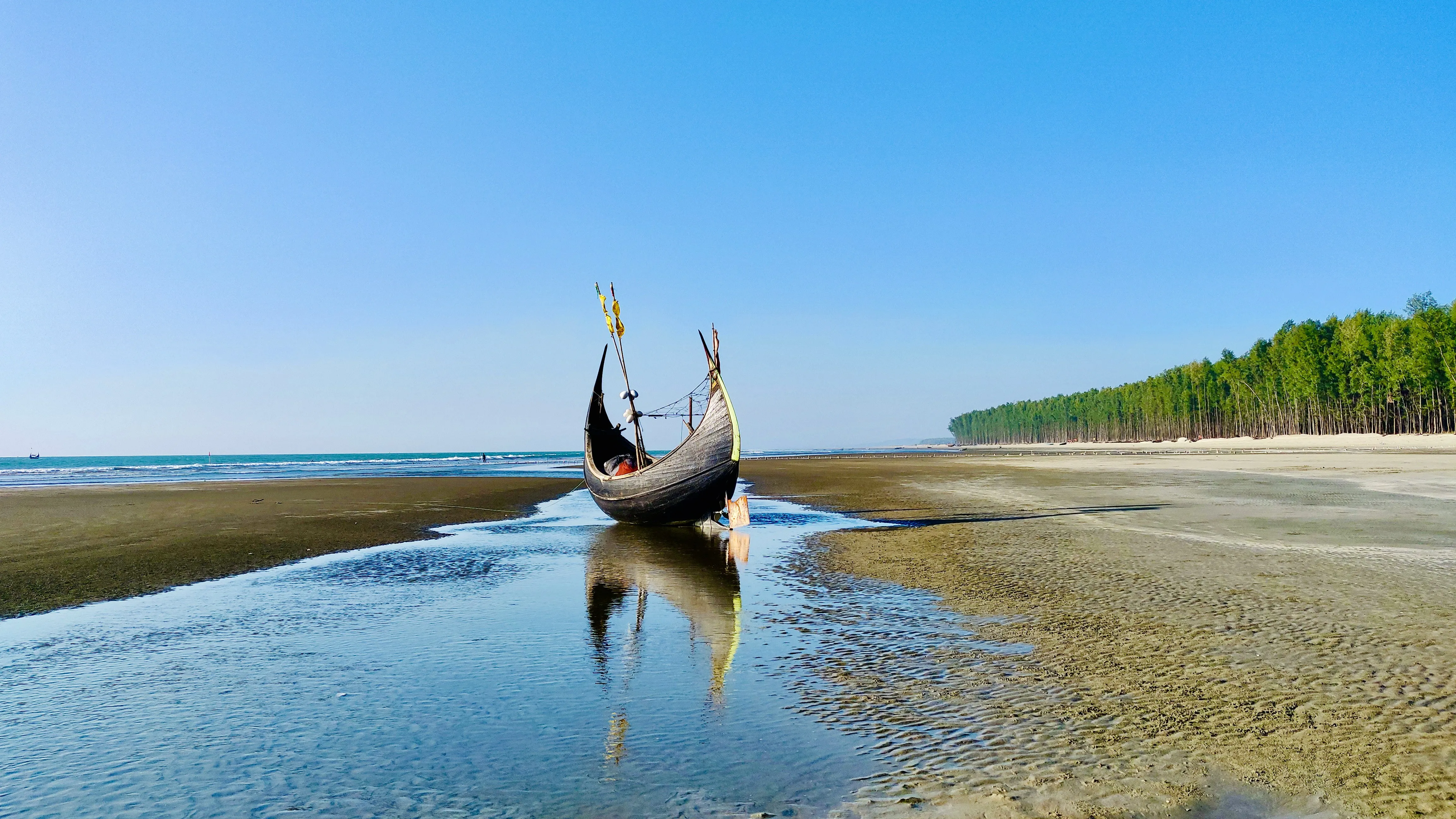
Southeastern Bangladesh offers unique mountainous and coastal landscapes. In Cox’s Bazar, one of the longest natural sand beaches in the world extends, a popular meeting point to observe local maritime life and traditional fishing boats called sampans. On the other hand, the region of the Chittagong Hill Tracts, which includes areas like Bandarban and Rangamati, stands out for its hills, the deep blue of Kaptai Lake, and the cultural richness of the ethnic groups that inhabit these lands, offering a complementary vision to that of the fluvial plains of the rest of the nation.
“Tip”: You cannot miss visiting the Sundarbans, the most emblematic place in the country.
✈️ Best season to travel
The choice of date to visit Bangladesh significantly influences the travel experience, mainly due to its subtropical climate marked by the cycle of monsoons. Generally, the months that coincide with the boreal winter offer the most pleasant conditions for moving around the country, as temperatures are moderate and rainfall is minimal, which facilitates both land transport and journeys through its numerous rivers.
Beyond the climatology, each season transforms the landscape deeply. While the dry months allow for comfortable exploration of natural reserves and archaeological sites, the rainy season provides the environment with intense greenery and unique vitality in its waterways. Knowing the particularities of each period helps plan a stay that fits each traveler’s expectations, whether seeking cultural festivities or the observation of local wildlife in the Sundarbans.
| Season | Months | Typical climate | What to expect | Tourist influx |
|---|---|---|---|---|
| Spring | Mar – May | Intense heat and increasing humidity; occasional storms at the end of the period. | Celebration of the Bengali New Year (Pohela Boishakh) and vibrant tropical landscapes. | Medium ⭐⭐ |
| Summer | Jun – Ago | Monsoon season with frequent and heavy rain; very humid environment. | Full-flowing rivers, floating markets at their peak, and exuberant nature. | Low ⭐ |
| Autumn | Sep – Nov | Transition toward dry weather; pleasant temperatures and clearer skies. | Optimal river navigation and festivals after the retreat of the monsoon rains. | Medium ⭐⭐ |
| Winter | Dic – Feb | Dry weather, sunny days, and cool nights; very mild temperatures. | Ideal season for wildlife viewing, hiking, and comfortable cultural visits. | High ⭐⭐⭐ |
🗣️ Basic vocabulary
Learning some words in Bengali can make daily life much easier during a trip through Bangladesh. Although in urban areas and professional environments it is possible to communicate in English, local inhabitants positively value the effort of using their native language in everyday situations, such as greeting or thanking for a service.
Knowing these basic expressions will allow you to move with more ease in markets, transport, or when interacting with the people you meet during the journey, making communication more fluid and natural in the practical moments of the trip.
- As-salamu alaykum: Hello / General greeting.
- Dhanyabaad: Thank you.
- Ji: Yes.
- Na: No.
- Thik ache: It’s okay / Agreed.
- Koto?: How much does it cost?
- Khub bhalo: Very good / Very well.
- Maaf korben: Excuse me / Sorry.