


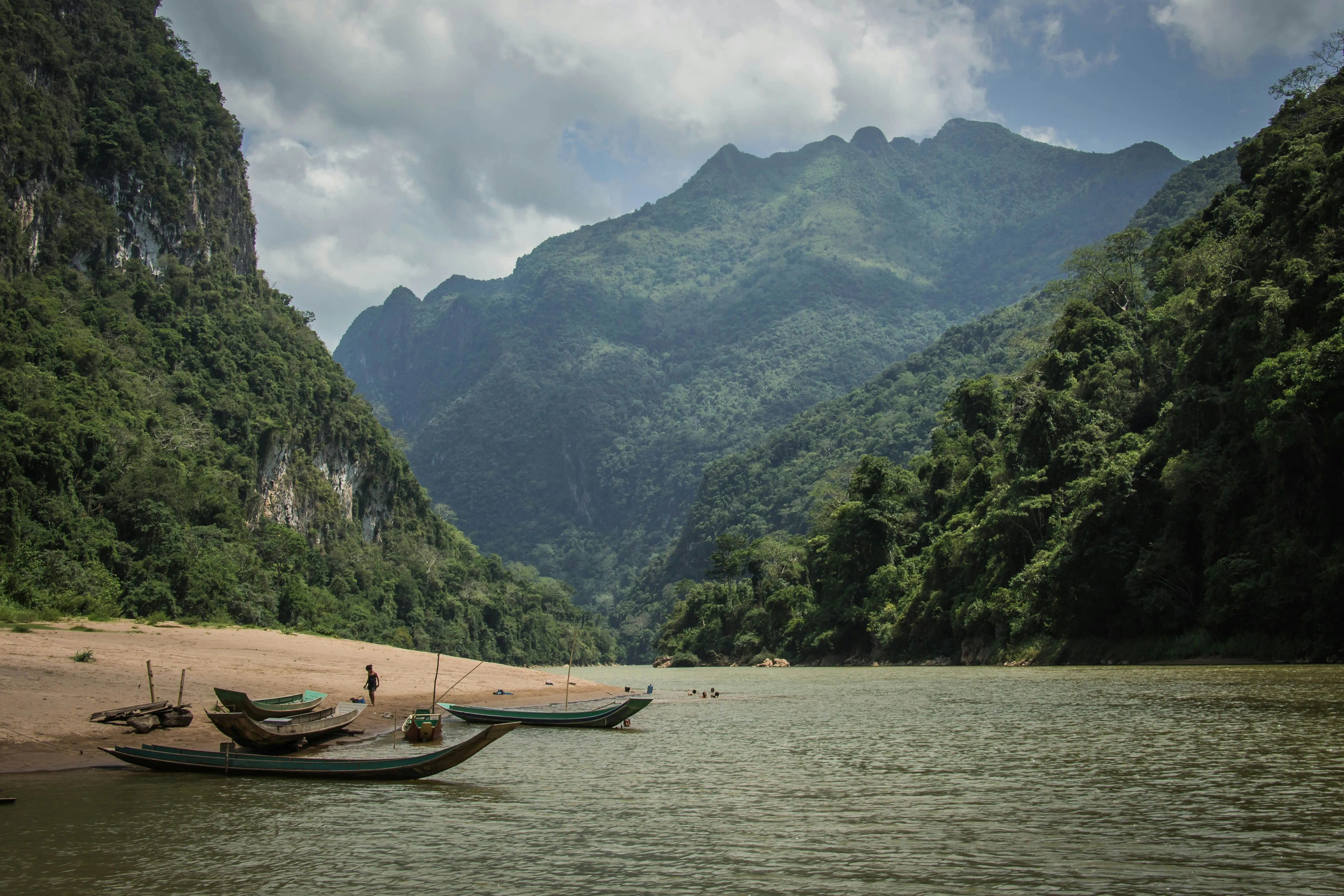
Laos
Discover the serenity of its Buddhist temples, mountainous landscapes, winding rivers, and a welcoming culture in the most authentic heart of Southeast Asia.
Quick Facts
- Capital
- Vientiane
- Language
- Lao
- French, English
- Currency
- Lao Kip (LAK)
- Best time to visit
- From November to March, during the dry and cool season
- Budget per day
- $20 - $60 per day
- Climate
- Tropical monsoon with a cool dry season and a hot one, followed by a rainy season between May and October.
- Connectivity
- low
- Very easy to obtain at airports and local telephone stalls
- Electricity
- Type A/B/C/E/F (230V)
- Local transport
- limited
- Card usage
- cash is used more
- Tipping
- optional
🌎 Introduction
Between the mountains of Southeast Asia and the leisurely course of the Mekong River, Laos unfolds at its own pace, away from the haste that often characterizes the region. It is a territory where geography dictates the character of its people, marked by an exuberant nature that embraces every corner. Here, the day usually begins with the silence of monks walking through the streets at dawn and the aroma of sticky rice being prepared in homes, a daily scene that reflects the identity of a people who value simplicity and calm.
The country’s personality manifests in the karst profiles of the north as well as in the southern plains, where the cycle of the seasons organizes life and celebrations. During Pi Mai, the traditional New Year, water refreshes the warm April atmosphere in a festival that unites communities. Between temples of elegant architecture, coffee plantations on high plateaus, and a gastronomy based on fresh products and aromatic herbs, a natural coexistence is perceived between deep-rooted traditions and an environment that remains the protagonist of the landscape.
🛡️ General safety
Laos is considered, in general terms, a very safe destination for international travelers. The country is characterized by a slow pace of life and a culture deeply influenced by Buddhism, which translates into an atmosphere of tranquility and hospitality toward visitors.
Compared to other Southeast Asian destinations, the risk level in Laos is in a low range. However, as with any trip, it is essential to maintain basic common sense and be informed about local particularities to ensure a trouble-free experience.
Crime and common risks
Most visits to Laos are incident-free. However, there are certain minor risks worth knowing:
- Theft and snatching: These are the most common types of crime, especially in areas crowded with tourists. There are cases of bag or backpack snatching from moving motorcycles, especially in Vientiane and Luang Prabang.
- Minor scams: Some tuk-tuk drivers or market vendors may try to charge excessive prices. It is always advisable to agree on the price before starting any service.
- Unexploded Ordnance (UXO): This is a specific risk in Laos in rural and remote areas (especially in Xieng Khouang province and areas near the border with Vietnam). It is vital not to go off marked trails in these regions, as there are still remains of explosives from past conflicts.
- Substance consumption: Penalties for drug possession or trafficking in Laos are extremely severe. Additionally, consuming products offered as “happy” (in food or drink) can entail serious health risks and serious legal problems.
Safety in cities and tourist areas
Urban centers in Laos are generally safe, even after dark, although caution is recommended in poorly lit streets.
- Vientiane and Luang Prabang: These are the most visited and safest cities. In Luang Prabang, the atmosphere is particularly relaxed due to its World Heritage status, although it is advisable to watch your belongings at the Night Market.
- Vang Vieng: Formerly known for lack of control on the river, the area has greatly improved its safety. Even so, it is wise to be cautious with adventure activities and ensure that operators have equipment in good condition.
- Special Economic Zones: It is recommended to avoid or exercise extreme caution in the Special Economic Zones located in the northwestern border provinces, where casino activities and little conventional authority presence have been reported.
Safety in transport
Transport in Laos presents logistical challenges rather than personal safety ones, due to the terrain and the state of infrastructure.
- Driving: In Laos, they drive on the right. The condition of the roads can be poor, especially during the rainy season.
- Motorcycle rental: This is very common but carries risks. Many travelers suffer accidents due to lack of experience or the poor condition of the roads. The use of a helmet is mandatory, and it is strongly recommended to have medical insurance that covers motorcycle accidents.
- Public transport and train: The new high-speed train connecting Vientiane with the Chinese border is a very safe, modern, and efficient option. Night buses are safe, although mountain journeys can be slow and winding.
- Taxis and Tuk-tuks: They are safe but lack seat belts in most cases. It is recommended to use transport apps (such as Loca) to get fair prices and journey traceability.
Natural and climatic risks
The geography of Laos directly influences the risks that travelers should consider:
- Monsoon season (May to October): Heavy rains can cause flooding and landslides, especially in northern mountainous areas. Some road travel may be interrupted.
- Extreme heat: During the months of March to May, temperatures can exceed 40°C. It is essential to maintain constant hydration and avoid direct sun exposure during the central hours of the day.
- River rises: If you participate in activities on the Mekong River or its tributaries, keep in mind that currents can be strong and water levels change rapidly during the rainy season.
Local legislation and norms
Laos is a conservative country with laws that can differ significantly from Western ones:
- Religious respect: It is mandatory to dress modestly (shoulders and knees covered) when visiting temples. Touching someone’s head or pointing with your feet is considered a serious lack of respect.
- Photography: It is forbidden to photograph military installations, government buildings, or security personnel.
- Personal relationships: Local laws strictly prohibit sexual relations between foreign citizens and Lao nationals unless they are married, although in tourist areas the application of this rule is variable.
- Documentation: It is mandatory to always carry the original passport or a clear copy of it. Authorities may request it at any time.
Safety for specific groups
- Solo female travelers: Laos is a very safe destination for women traveling alone. Respect for women is high, although it is recommended to avoid walking through isolated or unlit areas at night as a general precaution.
- LGTBIQ+ travelers: Homosexuality is legal in Laos. There is no active persecution, but society is very conservative. Discretion is recommended, and public displays of affection should be avoided, something that applies to all couples, regardless of orientation.
- Traveling with children and the elderly: The country is welcoming to families, although limited medical infrastructure outside of Vientiane is a factor to consider. Uneven sidewalks and heat can be a challenge for people with reduced mobility.
Emergencies and assistance
Emergency service infrastructure in Laos is limited, especially in rural areas.
- Main numbers:
- Police: 191
- Ambulances / Medical Emergencies: 195
- Firefighters: 190
- Medical assistance: For serious incidents, most travelers are transferred to medical centers in neighboring Thailand (Udon Thani or Bangkok), as hospitals in Laos lack advanced equipment.
- Recommendation: It is essential to take out travel insurance with medical evacuation coverage before entering the country. In case of an incident, contact your insurance company and the nearest consular section of your country (often located in Vientiane or Bangkok) immediately.
Tip: Always avoid leaving your passport as a deposit when renting motorcycles or bicycles; instead, offer a photocopy and a cash deposit to avoid possible extortion or undue retention.
📝 Entry requirements
To plan a trip to Laos, the first aspect to consider is the international identity document. Travelers must have a passport with a minimum validity that, generally, must be at least six months from the intended date of entry into the territory. It is essential that the document is in good condition and has enough blank pages for immigration control stamps.
Regarding access for stays for leisure purposes, most international visitors need to process a tourist visa. This permit usually authorizes a maximum stay in the country of up to thirty days. This process can be managed in various ways, usually in advance or, in many cases, upon arrival at major international airports and certain designated land border crossings.
During the entry process, immigration authorities may request the presentation of an exit ticket, either returning to the place of origin or to a third destination, as a guarantee that the tourist will not exceed the permitted stay time. Likewise, although it is not usually a requirement strictly applied to all travelers, there is a possibility that proof of economic solvency or sufficient funds to cover expenses during the stay in the country may be required.
Customs controls at access points are usually calm, but it is useful to know the common restrictions. Entry of personal effects within reasonable limits is allowed. However, the transport of certain medications for personal use may require the presentation of a translated medical prescription to avoid misunderstandings. Regarding products of animal or vegetable origin, there are general regulations that restrict their entry to protect the local ecosystem.
From a health point of view, it is strongly recommended to travel with travel insurance that offers broad coverage. In terms of immunization, it is advisable to have the standard vaccination schedule up to date. In some specific cases, especially if you have recently traveled through areas where certain diseases are endemic, an international vaccination certificate, such as for yellow fever, may be requested.
Below is a summary of some of the key points to consider for entry:
- Passport validity: It is recommended that the document be valid for at least six months.
- Visa management: The usual permitted stay is usually around thirty days for tourist activities.
- Proof of exit: It is advisable to have a transport reservation confirming departure from the national territory.
- Currency and valuables: Large amounts of foreign currency must be declared upon arrival according to current regulations.
- Baggage restrictions: There are common limitations on alcohol, tobacco, and products that may be considered sensitive to the local culture.
- Health recommendations: It is suggested to consult with a travel medicine center about vaccinations advisable for tropical zones.
🏥 Basic health considerations
Laos is a destination that will captivate you with its slow pace and nature, but it is important to know that its health infrastructure is limited. You will find that the public health system has basic resources, so for any medical problem, it is most recommended to go to private clinics in cities like Vientiane or Luang Prabang. Staff in these private centers usually speak English or French, which will greatly facilitate communication. You should keep in mind that for cases of extreme gravity or complex surgical interventions, it is common to be transferred to hospitals in Thailand, which have international standards. The cost of private care and medical evacuations is high, so it is wise to travel with foresight.
Taking out medical travel insurance is not a legal requirement to enter the country, but it is something absolutely essential. You should choose a policy that offers very broad coverage, especially regarding medical repatriation and air ambulance transfer. Since local centers may not be sufficient for serious emergencies, having insurance that manages and pays for your transfer to another country will give you the necessary peace of mind to enjoy your stay. Also, ensure it includes direct payment of bills so you don’t have to shell out large amounts of cash.
Regarding vaccines, none are mandatory to enter Laos, unless you come from an area where yellow fever is endemic, in which case they will ask for the vaccination certificate. However, it is highly recommended to have your official vaccination schedule updated. I advise you to consult with a professional about hepatitis A, hepatitis B, and typhoid fever vaccines, as they are recommended for most travelers visiting Southeast Asia. Complex processes are not necessary; a simple prior visit to an international vaccination center will clear up any doubts.
If you are on any medical treatment, it is most sensible to carry all the personal medication you will need during the trip in its original packaging. Although you will find pharmacies in urban areas, they may not have the exact brand or specific component you use. You will find it very useful to carry a medical prescription or a certificate signed by your doctor, preferably in English, to avoid problems at customs controls. A small travel first-aid kit with basics, such as bandages, antiseptics, painkillers, and some stomach protection, will be of great help.
The most common health risks are linked to the tropical climate. You will find high temperatures and high humidity, which can cause dehydration or heat stroke if you don’t take care of yourself. Mosquitoes are another factor to consider, as they can transmit diseases like dengue, especially in the rainy season. Therefore, the constant use of a good repellent and wearing clothes that cover the skin at dawn and dusk are your best prevention tools. There are no high altitude risks on normal tourist routes, but it is always wise to walk at your own pace in mountain areas.
As for the consumption of water and food, you must remember that tap water is not drinkable. You will find bottled water everywhere, and it is what you should use even for brushing your teeth if you want to be cautious. Regarding food, you can try delicacies in street markets, but you should observe that food is well cooked and served hot. Avoid raw vegetables or fruits that you cannot peel yourself in places where hygiene causes you doubt. In general, the level of cleanliness in restaurants for tourists is acceptable, but it is always better to act with common sense.
For emergency situations, the phone number you should know is 1195. In the capital, Vientiane, there is a very efficient volunteer rescue service called Vientiane Rescue that handles accidents and emergencies. You should know that outside of large cities, ambulances may take time to arrive or may not be equipped with advanced technology, so in case of a minor incident, sometimes the fastest way is to use private transport to get to the nearest clinic.
As final practical tips, I suggest you always use sun protection and avoid swimming in river waters that are not clearly recommended for bathing, to avoid local parasites. Maintaining good hand hygiene with hydroalcoholic gel before every meal will save you most common digestive problems. By following these guidelines, your experience in Laos will be much safer and more pleasant.
🚌 Transport within the country
Getting around Laos has undergone a major transformation in recent years with the opening of the high-speed train, which efficiently connects several of the most prominent points in the north. However, for the rest of the territory, buses and shared vans remain the fundamental pillars of transport, allowing access to provinces and rural areas through roads that cross mountainous landscapes. In certain regions bathed by the Mekong River, river transport in passenger boats continues to be a common and slow alternative for traveling between towns.
The use of public transport is accessible to visitors, especially in urban centers where signage at departure points is usually clear. Although the local language is the main vehicle for communication, it is common to find staff with basic knowledge of English at ticket counters and tourist centers. Ticket management is usually simple and, in many cases, the accommodations themselves act as intermediaries to facilitate the organization of transfers without the need to travel to the stations.
In the main cities, daily movement relies on tuk-tuks and the use of transport apps for private vehicles, which offers a comfortable and direct way to move. Conversely, in rural areas, options are reduced to collective transport vehicles that operate with more limited schedules and depend on occupancy. While the railway stands out for its punctuality and modernity, road journeys can be slower due to the terrain, so it is advisable to plan for generous travel times.
For traveling long distances, especially between the north and south of the country, internal flights are an option that saves time compared to land routes. The general feeling for the traveler is that of a country with infrastructure in full development, where traditional methods coexist with new services that have improved comfort on major routes. Transport reliability has grown, although a peaceful travel pace is still maintained, consistent with the destination’s natural environment.
Tip: It is advisable to organize transfers with sufficient time margin, especially during peak seasons, to ensure availability on the routes most in demand by visitors.
2. Culture and etiquette
Lao society is characterized by a calm and friendly nature, where courtesy governs most daily interactions. The traditional greeting, known as the nop, consists of joining the palms of the hands at chest or face level while slightly bowing the head, a gesture used for both greeting and expressing gratitude or saying goodbye. It is common for the treatment of others to be respectful and gentle, avoiding at all times raising the voice excessively or showing obvious signs of anger or impatience in public, as maintaining composure and serenity is considered a fundamental virtue for coexistence.
Respect for the body and personal space follows specific guidelines that are worth observing. The head is considered the most sacred part of the body, so it is not appropriate to touch another person’s head, even in gestures of affection toward children. Conversely, the feet are perceived as the least noble part; therefore, it is recommended not to point at objects or people with them, not to cross them showing the sole of the foot toward someone, and to avoid placing them on furniture. Likewise, very effusive physical displays of affection in public spaces are not frequent, always preferring a discreet and moderate attitude in social behavior.
Spirituality plays a central role in the life of the country, which requires special attention in religious settings. When visiting temples, it is essential to dress modestly, covering shoulders and knees, and it is mandatory to remove shoes before entering sacred buildings or private homes. There is deep reverence toward Buddhist monks; in particular, women must avoid physical contact with them and not hand objects directly from hand to hand. During ceremonies such as the morning almsgiving, the visitor is expected to maintain a prudent distance and remain silent so as not to interfere with the solemn nature of the act.
In the sphere of social relations and meals, hospitality is a deeply rooted value. Meals are usually shared moments where flexibility and calm predominate over the rigidity of schedules; punctuality tends to be relaxed, adapting to a less strict pace of life. Regarding table manners, it is common to share several dishes among diners, often using hands to consume sticky rice. Regarding gratifications, although tipping is not a traditional obligation in the local culture, it has become a well-received gesture in sectors linked to tourism as a thank you for dedicated service.
“Tip”: In any situation of doubt or small conflict, responding with a smile and maintaining a low tone of voice is the most effective way to maintain harmony and receive a positive response from the local population.
🍛 Typical gastronomy
The cuisine of Laos is one of the great surprises of Southeast Asia for its freshness and its balance of flavors. Unlike other neighboring countries, the central axis of any meal is sticky rice, which is traditionally served in wicker baskets. This rice is not eaten with cutlery but is molded with the fingers to form small balls that serve to pick up the rest of the food, turning the act of eating into a tactile and community experience.
Lao flavors are characterized by a combination of sour, spicy, and bitter notes, with a very moderate use of sweetness. Among the essential ingredients are lemongrass, galangal, kaffir lime leaves and, above all, padaek, an intense-flavored fermented fish paste that adds unique depth to dishes. Additionally, the consumption of fresh herbs, such as mint and cilantro, is constant in almost all preparations, providing a very characteristic lightness.
Regarding social habits, eating is usually a shared activity. It is common for several dishes to be served in the center of the table so that all diners can serve themselves freely. Schedules usually follow the rhythm of the sun: breakfast is early and usually consists of noodle soups, while dinner is moved forward to dusk. Although formal restaurants exist in major cities, much of the gastronomic life occurs in night markets and street stalls, where food is prepared to order with local products.
Regarding etiquette, it is important to remember that locals value hospitality and simplicity. In many traditional establishments, customers are expected to remove their shoes before entering a platform or carpeted area. To accompany the meal, local beer and coffee, especially that grown in the south of the country, are the most common options. It is also common to find herbal infusions and natural tropical fruit juices that help mitigate the heat and spice of certain dishes.
| Dish | Description | Main Ingredients | Where to try it | Tip |
|---|---|---|---|---|
| Larb | Considered the national dish, it is a salad of minced meat or fish seasoned with fresh herbs. | Meat or fish, lime, chili, mint, and toasted rice powder. | Local restaurants and food stalls throughout the country. | Always accompany it with sticky rice to balance the flavor of the dressing. |
| Tam Mak Hoong | Green papaya salad, known for its combination of strong and spicy flavors. | Green papaya, tomato, lime, chili, and fermented fish paste. | Street markets and quick food stalls. | If you don’t tolerate spice well, state it clearly when ordering, as it is usually very intense. |
| Khao Piak Sen | Homemade rice noodle soup, very popular as comfort food or a traditional breakfast. | Rice noodles, chicken or pork broth, fried garlic, and herbs. | Market stalls in the morning and soup specialty shops. | Add the bean sprouts and fresh herbs served on the side to give it texture. |
| Mok Pa | White fish steamed inside a banana leaf, which gives it a soft texture. | Fish, lemongrass, dill, spring onion, and kaffir lime leaves. | Restaurants on the banks of the Mekong River or in Luang Prabang. | Be careful when opening the banana leaf packet so as not to burn yourself with the aromatic steam. |
| Sai Oua | Pork sausage flavored with a wide variety of local spices and herbs. | Pork, lemongrass, galangal, chili, and lime leaves. | Night markets, especially famous in Luang Prabang. | It is ideal as a snack to eat while walking through the markets. |
📷 Areas and places to visit
The city of Luang Prabang, declared a UNESCO World Heritage Site, is considered the cultural and spiritual center of the country. Located at the confluence of the Mekong and Nam Khan rivers, this destination stands out for its well-preserved architecture, which combines traditional wooden buildings with colonial influences. Walking through its historic center allows you to contemplate the temple of Wat Xieng Thong, one of the most significant for its intricate mosaics and sweeping roofs. At dawn, it is possible to observe the daily ritual of monks walking the streets in silence. Additionally, the night markets offer a sample of local handicrafts, while on the outskirts, the Kuang Si Waterfalls invite you to see their turquoise pools surrounded by a wooded environment.
Following the river course south is Vientiane, the Lao capital. Unlike other capitals in the region, this city maintains a slow and calm pace. Among its points of interest stands out the Pha That Luang, a large golden stupa that is the most important national symbol. The Patuxai, a triumphal arch inspired by European models but with local decorative motifs, offers panoramic views of the urban environment. The city’s museums, such as the Textile Museum or the COPE Visitor Centre, provide a deep insight into history and traditional arts. Near the capital, the Buddha Park features a unique collection of religious sculptures located in a garden by the river.
The Vang Vieng area represents the meeting point between active tourism and natural mountain landscapes. This region is famous for its impressive limestone formations and rice fields. The Nam Song river is the backbone of the area’s activity, allowing for river tours or visits to geologically relevant caves such as Tham Chang. The surroundings have crystal-clear lagoons and trails leading to viewpoints located at the top of karst crags. It is a place where the contrast between the tranquility of the valleys and the possibilities for exploring nature define the visitor’s experience.
In the north, the Xieng Khuang region guards one of the continent’s greatest archaeological mysteries: the Plain of Jars. This is a landscape dotted with hundreds of large stone containers whose age dates back thousands of years. For those seeking a deeper connection with the rural environment, the towns of Nong Khiaw and Muang Ngoy, accessible via the Nam Ou River, offer a landscape of rugged mountains and immersion into local village life, where traditions remain active and contact with nature is constant and direct.
The south of the country shows a different facet, marked by the imposing presence of the Mekong River and historical heritage. In Champasak province is the temple complex of Wat Phou, a structure of Khmer origin predating the famous temples of Angkor, located at the foot of a sacred mountain. Further south, the 4,000 Islands or Si Phan Don region offers a river archipelago where time seems to stop. On islands like Don Det or Don Khone, it is common to travel the paths by bicycle to see the ruins of the old railway or the Khone Phapheng waterfalls. Finally, the Bolaven Plateau stands out for its cool climates, extensive coffee plantations, and high waterfalls like Tad Fane, completing the diversity of landscapes that define this territory.
Tip: You cannot miss visiting Luang Prabang, the most emblematic place in the country.
✈️ Best time to travel
Choosing the right time to visit Laos depends largely on the activities you wish to perform, as the country has a tropical climate marked by the rhythm of the monsoons. Generally, the most balanced time to travel through the territory is between the months of November and February, when temperatures are milder and rains are scarce, facilitating road travel and navigation on the Mekong River.
During the rest of the year, the landscape changes drastically. While the hottest months can be intense in the lowlands, the rainy season transforms the environment into a vibrant green orchard, allowing waterfalls to be seen at their full splendor. It is a destination that offers constant cultural and natural experiences, although humidity and visibility conditions vary significantly from one season to another.
| Season | Months | Typical Climate | What to expect | Tourist influx |
|---|---|---|---|---|
| Spring | Mar – May | Intense heat and dry environment. | Somewhat hazy skies and traditional festivities like the Lao New Year (Pi Mai) in April. | ⭐⭐ Medium |
| Summer | Jun – Aug | Frequent rains and high humidity. | Very green landscapes, rice fields in their full glory, and high-flow waterfalls. | ⭐ Low |
| Autumn | Sep – Nov | Transition from rain to dry weather. | End of the monsoon, improvement of hiking routes, and optimal conditions for river navigation. | ⭐⭐⭐ Medium - High |
| Winter | Dec – Feb | Cool, dry, and sunny days. | Pleasant temperatures for exploring temples and cities; cool nights in northern mountainous areas. | ⭐⭐⭐⭐ High |
🗣️ Basic vocabulary
Learning some basic words in Lao will help you manage better during your trip and connect more naturally with the local population. Although in major tourist hubs like Luang Prabang or Vientiane it is common for some English to be spoken, using local expressions is perceived as a gesture of respect and courtesy.
It is not necessary to delve into the tonal complexity of the language for everyday situations. Knowing simple terms to greet, say thank you, or ask a price will facilitate your interactions in markets, restaurants, and public transport.
- Sabaidee: Hello (general greeting for any time of day).
- Khob chai: Thank you.
- Bor pen yang: You’re welcome or no problem.
- Sabaidee bor?: How are you?
- Jao: Yes.
- Bor: No.
- Tao dai?: How much does it cost?
- Nam: Water