


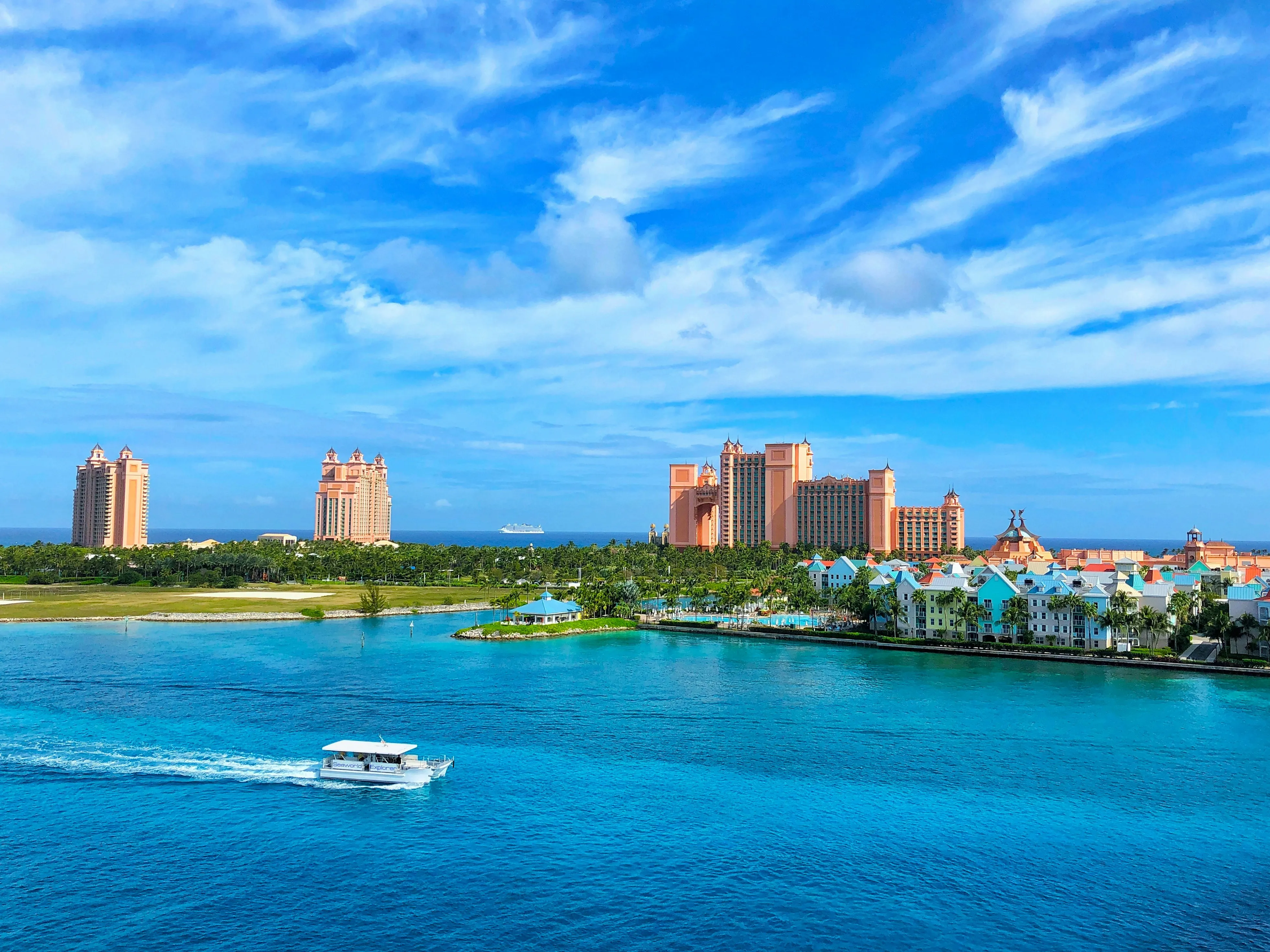
Bahamas
Paradise archipelago of crystal clear waters and white beaches offering unique diving experiences, absolute relaxation, and a vibrant Caribbean culture in every corner.
Quick Facts
- Capital
- Nassau
- Language
- English
- Bahamian Creole
- Currency
- Bahamian Dollar (BSD) and United States Dollar (USD)
- Best time to visit
- From December to May, during the dry season and outside the hurricane season.
- Budget per day
- $150 - $500 per day
- Climate
- Warm tropical climate all year round, with a wet season and hurricane risk between June and November.
- Connectivity
- good
- Very easy to obtain at airports and local stores; there are various eSIM options.
- Electricity
- Type A/B (120V)
- Local transport
- limited
- Card usage
- widespread
- Tipping
- yes
🌎 Introduction
While sailing through the waters that separate the Atlantic from the Caribbean Sea, a mosaic of hundreds of islands and cays emerges, forming a landscape where intense blue blends with light-toned sands. Beyond the usual image of its coasts, this corner of the world is defined by the horizontality of its relief and a constant light that bathes both the lively ports and the most solitary spots. It is a space where geography seems to dissolve among reefs and channels, offering a sense of vastness and calm that marks the character of each of its districts.
The identity of this archipelago is perceived in the slow pace of its streets and in a character shaped by the heritage of diverse cultures. Traditions such as Junkanoo, with its parades full of percussion and color, coexist with wooden architecture in pastel tones and a daily life closely linked to the cycles of the sea. At the table, the prominence of the sea conch and fresh products marks the beat of a simple gastronomy, while the climate, softened by constant breezes, allows one to appreciate the passing of the seasons through the nuances of its vegetation and the serenity of its waters.
🛡️ General Safety
The Bahamas is a destination that, in general terms, offers a safe and welcoming environment for the millions of tourists who visit each year. The safety rating for the traveler is at a medium-high level, similar to other popular Caribbean destinations. Although the vast majority of visits pass without any type of incident, as in any international destination, it is necessary to maintain basic common sense and be attentive to local particularities to guarantee a pleasant stay.
The safety context varies significantly between residential areas or isolated tourist areas and the denser urban centers. While in the Out Islands tranquility is the absolute norm, in cities like Nassau or Freeport, greater attention is recommended.
Common crime and risks
Most incidents affecting tourists are of a non-violent nature. The most common risks include:
- Pickpocketing and crimes of opportunity: Especially on very crowded public beaches, cruise ship shopping areas, and flea markets.
- Minor scams: There may be cases of overcharging for unregulated services or excessive insistence from street vendors.
- Areas to avoid: In Nassau, it is recommended to avoid the area known as “Over-the-Hill” (south of Shirley Street), especially after dark, as it is an area with higher local crime rates that tourists do not usually frequent.
Safety in cities and tourist areas
Safety in tourist areas, such as Paradise Island or large hotel complexes (resorts), is very high and has constant private security. However, in urban centers it is advisable to follow these guidelines:
- Nighttime movements: It is recommended to avoid walking through poorly lit areas or solitary streets in downtown Nassau or Freeport once the sun sets. It is preferable to use taxis to move around at night.
- ATMs: Preferably use those located inside banks, hotels, or shopping centers.
- Belongings: Do not leave valuables, cameras, or wallets unsupervised on the sand while swimming at public beaches.
Safety in transportation
Transportation in the Bahamas has important particularities that every traveler should know:
- Driving: In the Bahamas, driving is on the left, a legacy of its British past. If you decide to rent a car, use extreme caution at roundabouts and intersections.
- Taxis: They are a safe and reliable medium. It is essential to agree on the price of the journey before getting into the vehicle, as many do not use meters.
- Public transport (Jitneys): Local minibuses are economical and safe during the day, although they do not usually operate late at night.
- Maritime transport: If you use recreational boats or jet skis, ensure that the provider has the necessary licenses and safety equipment (life jackets).
Natural and climatic risks
The main risk factor on the islands is meteorological and seasonal:
- Hurricanes: The official hurricane season runs from June to November. During these months, it is vital to stay informed through local meteorological services.
- Extreme heat: Temperatures can be very high and humidity intense. Constant hydration and the use of high-factor sun protection are recommended to avoid heatstroke.
- Sea currents: On some beaches in the Out Islands, currents can be strong. Always respect signaling flags and warnings from locals.
Local legislation and norms
The Bahamas has laws that can be stricter than those of other countries in certain aspects:
- Prohibited substances: There is a zero tolerance policy for the possession or consumption of illegal drugs. Prison sentences and fines are severe, even for minimal amounts.
- Public behavior: Although the atmosphere is relaxed, it is a country of traditional values. It is recommended to dress appropriately (not just in a swimsuit) when outside beach or pool areas, especially in public buildings and churches.
- Fishing and the environment: There are very strict regulations on fishing and the collection of coral or sea shells. Non-compliance can lead to significant fines.
Safety for specific groups
- Women travelers: The Bahamas is generally safe for women traveling alone. However, it is advised to avoid walking alone in isolated areas or remote beaches during the night and to maintain the same caution one would have in any large city.
- LGTBIQ+ travelers: Although homosexuality is not illegal, Bahamian society is conservative. Discretion is recommended, and avoiding excessive public displays of affection to prevent uncomfortable situations or misunderstandings.
- Children and the elderly: The country is a family destination par excellence. Medical services in the main tourist areas are of good quality, although for serious problems in the Out Islands, evacuation to Nassau might be necessary.
Emergencies and assistance
In case of needing help during your stay, these are the main channels:
- Emergency numbers: The main number for police, ambulance, and fire is 911 or 919.
- Police assistance: The tourist police are visible in the most frequented areas of Nassau and are usually friendly and helpful to the visitor.
- Medical recommendation: It is highly recommended to travel with travel insurance with broad medical coverage, as private health services can be expensive for foreigners.
Tip: Before leaving the hotel, leave your original documents (passport) and excess cash in the safe, and carry only a copy and the money necessary for the day.
📝 Entry requirements
To undertake a trip to the Bahamas, the primary document that every visitor must have prepared is their passport. It is recommended that this document has a validity that covers the entire intended stay and, if possible, maintains a margin of validity of several months after the return date. Likewise, it is convenient that the passport is in optimal condition and has free pages for immigration control stamps.
Regarding access permits, most people traveling for tourism purposes do not usually require the processing of a prior visa for vacation stays. The maximum time allowed to remain in the archipelago under this modality is usually about ninety days, although it is the immigration personnel at the point of entry who determine the final authorized period of stay for each traveler.
During the entry process, it is common for authorities to request the presentation of a return ticket or continuation to another destination, as a way to ensure that the visitor plans to leave the country within the allowed time. In addition, it may be necessary to demonstrate sufficient financial resources to cover expenses during the visit, either by showing electronic means of payment or cash.
Controls at entry points are standard processes where compliance with customs regulations is reviewed. Travelers can bring in their personal use items, but there are limitations on the entry of certain fresh food products or items for commercial purposes. In the case of transporting medications, it is advised that these remain in their original packaging and that the traveler carries the corresponding prescription or medical report to avoid inconveniences.
From a health point of view, vaccinations are not generally required to enter the territory. However, in specific situations where the traveler comes from regions with a risk of transmission of certain diseases, an international certificate of vaccination against yellow fever could be requested. It is suggested to keep the usual vaccination schedule up to date for any international travel and to have travel insurance that provides peace of mind in the event of any health emergency.
- Valid passport with sufficient validity margin for the duration of the trip.
- Confirmed onward ticket to the place of origin or to a third country.
- Proof of financial solvency to cover maintenance during the stay.
- Medical documentation for the entry of prescription medications.
- Health certificates or specific vaccination according to the traveler’s origin.
- Customs declaration of goods when personal item limits are exceeded.
🏥 Basic health considerations
When preparing for your trip to the Bahamas, you will see that the healthcare system operates quite efficiently, although it has its particularities. In the most populated islands, such as New Providence (Nassau) and Grand Bahama (Freeport), you will find private hospitals and clinics of an excellent level, with professionals who have usually been trained abroad and speak English perfectly. However, you must bear in mind that in the more distant islands, known as the Out Islands, resources are much more limited and you will only have small clinics for basic consultations. The cost of private medicine is very high, with prices that can resemble those of the United States, so any unforeseen event can be expensive if you are not well prepared.
Travel medical insurance is not a mandatory document to cross the border, but it is considered absolutely essential for any traveler. It is fundamental that your policy includes very broad coverage for hospitalization and surgery, but above all, it must cover medical repatriation. In case of a serious accident or a complicated illness outside of Nassau, it is very likely that you will need a medicalized plane transfer to a more equipped hospital or even to another country, a service that has an astronomical cost if you have to pay for it out of pocket.
Regarding vaccinations, there are none mandatory if you travel from most countries. The only exception is the yellow fever vaccination certificate, which will only be requested if you come from an area where this disease is endemic. The most sensible thing is to check that your regular vaccination schedule is up to date, including booster doses for tetanus or hepatitis, to travel with total peace of mind and focus only on enjoying the beaches.
If you are following a specific treatment, you will find it very important to bring all your personal medication from home. Make sure to transport it in its original containers and always accompany it with a medical prescription or report from your doctor, preferably in English, to avoid problems at customs. Although in the main cities you will see well-stocked pharmacies, in more remote areas it is difficult to find very specific medications, so a small basic first-aid kit with analgesics, antiseptics, and band-aids will get you out of more than one predicament.
Common health risks in the Bahamas are mainly related to the tropical climate. The Caribbean sun is very intense, so sunburns and heatstroke are the most common problems among tourists. You will also find mosquitoes and sand flies (small sand insects) that can be quite annoying at dusk or in areas with lots of vegetation. There are no risks from altitude or cold, and insect-borne diseases have a very low incidence, but prevention is always better than cure.
Regarding the consumption of water and food, you will see that the general level of hygiene is quite good. Tap water in urban areas is usually potable, although many people prefer to drink bottled water due to the strong chlorine taste of desalinated water. In food stalls and restaurants, you can try local specialties, such as the famous conch salad, with total confidence, as food handling standards are usually correct and safe for the visitor.
In case you have a serious medical emergency, the telephone number you should dial is 911 or 919. In Nassau and Freeport, the ambulance service is fast and will take you to the nearest health center. If you are on one of the smaller islands, urgent care may take a bit longer due to the need to coordinate transport by boat or plane, so it is always advisable to first contact the local medical center of the island where you are.
As final practical recommendations, don’t forget to pack a powerful insect repellent and a high-factor sunscreen that is respectful of the marine environment. Drink plenty of water throughout the day to stay hydrated and always keep a copy of your insurance policy and assistance phone numbers handy. With these basic precautions, your only concern in the Bahamas will be deciding on which beach you are going to watch the sunset.
🚌 Transportation within the country
To move around this archipelago, travelers usually combine journeys by air, sea, and land. Connections between the different islands are made mainly through internal flights in small aircraft or by ferries and boats that link the main points. These maritime services are fundamental for mobility between the different geographic points, allowing access to areas that do not have landing strips.
In the most populated centers, terrestrial public transport is based on networks of small buses that cover circular or linear routes. Their operation is simple and the use of the local language facilitates communication with drivers to find out about stops. However, this service is much more frequent during daylight hours and usually decreases significantly at the end of the day, being a more common option in urban areas than in more remote natural environments.
The use of taxis is one of the most widespread alternatives for direct journeys or transfers from arrival points, such as ports and airports. They are easily found in tourist areas and offer a comfortable service, although they lack automatic metering systems in some regions. On the other hand, car rental is common for those seeking independence, always remembering that the direction of traffic is on the left and requires initial adaptation in driving.
The transportation experience changes significantly when visiting the less developed islands. While in the main cities there is a more organized infrastructure, in rural areas options are limited. In these quieter destinations, it is very common for visitors to move on foot or use golf carts, which have become a practical and standard means of transport for getting around small settlements and local paths.
Tip: When planning maritime travel between islands, it is advisable to confirm departures with little notice, as weather conditions can influence the regularity and punctuality of boats.
🤵 Culture and etiquette
In the Bahamas, courtesy and mutual recognition are fundamental pillars of daily coexistence. It is common for people to greet each other when crossing paths, even among strangers, using polite formulas such as “good morning” or “good afternoon”. Addressing others with respectful titles such as “Sir” or “Ma’am” is a common practice that reflects an attitude of consideration toward the interlocutor, especially when interacting with older people or those in positions of authority. Communication is usually friendly, and a measured treatment that allows for the exchange of greetings before getting directly into business or personal matters is valued.
Behavior in public spaces is usually moderate and respectful. Although the atmosphere in recreation areas is relaxed, clothing is expected to suit the context; for example, the use of swimwear is reserved exclusively for beaches and pool areas. When entering commercial establishments, restaurants, or public buildings, it is standard to dress appropriately and discreetly, avoiding remaining shirtless or in swimwear, which is considered a sign of deference toward the community and the social environment.
In the field of gastronomy and services, personal interaction is essential. Meals are considered moments for socializing, so the pace may be calmer than in other purely urban environments. Regarding rewards, it is a widespread practice to thank good service through tipping, which usually ranges between 15% and 20% in restaurants and cafes, provided that the service charge is not already automatically included in the final bill.
Society places great importance on community values and religious traditions. Sundays are traditionally days dedicated to rest and worship, so many local businesses may have reduced hours or remain closed. When visiting places of worship or participating in traditional festivities like Junkanoo, it is essential to maintain an attitude of respectful observation and follow the hosts’ instructions to integrate harmoniously into the population’s celebrations and rites.
“Tip”: Maintaining a friendly and patient attitude in daily interactions is the best way to integrate, as local culture enormously values formal politeness and respect for measured communication times.
🍛 Typical gastronomy
The cuisine of the Bahamas is a reflection of its insular geography and its rich multicultural history. It is based mainly on the products offered by the Atlantic Ocean, combining African and Caribbean techniques and influences to create dishes with intense but balanced flavors. The most emblematic ingredient of the archipelago is the conch (queen conch), a mollusk with firm meat and mild flavor that is prepared in multiple ways, from fresh salads to crispy fritters, and forms the basis of the local diet.
Eating habits on the islands are usually relaxed and adapt to the tropical climate. Traditional breakfasts are especially substantial, often including boiled or stewed fish accompanied by corn grits or potato bread. For lunch and dinner, the focus is on fresh seafood, snapper, grouper, and rock lobster. These products are usually accompanied by the classic peas n’ rice, seasoned with thyme, tomato, and occasionally a touch of bacon to add depth to the flavor.
Regarding drinks, the local culture values refreshing and natural flavors. The consumption of coconut water directly from the fruit and “switcher,” a lemonade made with local limes, is very common. Rum is the main component of many social preparations, although it is always served in an environment of moderation and coexistence. Dinners are usually the main moment for social gathering, where the service pace is leisurely, inviting diners to enjoy the conversation and the surroundings.
In restaurants and food stalls known as “shacks,” the service stands out for being close and hospitable. Although in the busier areas hours are broad and flexible, in more traditional establishments it is recommended to respect local meal times to find the freshest product. Dress is usually informal in most places, although for dinners in higher category establishments, it is customary to use a somewhat more careful style, leaving beach clothes aside.
| Dish | Description | Main Ingredients | Where to Try It | Tip |
|---|---|---|---|---|
| Conch Salad | Refreshing raw mollusk salad marinated on the spot. | Conch, lime juice, orange, onion, pepper, and chili. | Beach stalls and local markets in Nassau or Freeport. | Ask for it to be prepared in front of you to appreciate the freshness of the product. |
| Cracked Conch | Conch fillets tenderized by pounding, breaded, and fried. | Conch, flour, local spices, and oil for frying. | Family restaurants and local fast food stalls. | It is usually accompanied by spicy sauce or a slice of fresh lime. |
| Bahamian Rock Lobster | Local spiny lobster, generally prepared on the grill. | Rock lobster, butter, garlic, and herbs. | Seafood specialty restaurants in the Out Islands. | The optimal consumption season is between August and March. |
| Peas n’ Rice | The essential accompaniment to almost any Bahamian main dish. | Rice, pigeon peas, tomato, onion, and thyme. | Any restaurant or eatery in the archipelago. | It is the base of local cuisine; try it to understand the everyday flavor. |
| Guava Duff | Traditional dessert in the form of a steamed sweet roll. | Fresh guava, sponge cake dough, and butter sauce with rum. | Bakeries and dessert menus in traditional restaurants. | Don’t forget to ask for the hot butter sauce, which is fundamental. |
📷 Areas and places to visit
The archipelago of the Bahamas is made up of hundreds of islands and cays, each with its own identity that combines colonial history, relaxed life, and preserved natural environments. The capital, Nassau, located on the island of New Providence, is the neuralgic and cultural center of the country. Walking through its old town allows one to observe the colonial architecture in pastel colors, highlighting the Parliament Square and the historic Queen’s Staircase, a structure of sixty-six steps hand-carved in limestone rock. To delve deeper into the region’s past, the Pompey Museum offers a detailed view of the social history and memory of slavery in the archipelago.
On the island of Grand Bahama, the environment changes toward an atmosphere that combines urban development with virgin nature. The Lucayan National Park is one of the most relevant points, as it houses one of the most extensive underwater cave systems in the world. Through trails and walkways, the visitor can discover diverse ecosystems, from mangroves to sand dunes, culminating in spots like Gold Rock Beach, where low tide reveals a singular landscape of undulating sand that blends with the horizon.
To the east are the so-called Out Islands, where the pace of life is notably slower and more traditional. Eleuthera is famous for its narrow and elongated silhouette, which allows for the observation of unique geographic phenomena. One of its most representative points is the Glass Window Bridge, a narrow strip of rock where the visual contrast between the deep, dark waters of the Atlantic Ocean and the transparent turquoise blue of the Bahamas bank can be appreciated. Very close by, Harbour Island preserves the charm of its 18th-century wooden houses and is world-famous for its pink sand beach, whose tone is due to the pulverization of microscopic marine organisms.
The Exuma Cays archipelago represents the wildest and most crystalline facet of the country. This set of more than three hundred cays is a privileged setting for sailing and observing wildlife in the wild. The Exuma Cays Land and Sea Park functions as a protected reserve where marine biodiversity is the absolute protagonist. It is common to take excursions in small boats to meet the swimming pigs of Big Major Cay or to observe native iguanas, activities that have been organically integrated into the area’s tourism offer.
Other regions offer specific attractions for those interested in geology and underwater life. Andros, the largest island, is famous for its blue holes, deep natural pools that connect with flooded caves, and for hosting one of the most extensive coral reefs on the planet. On the other hand, the Abaco islands stand out for their nautical heritage and picturesque towns, such as Hope Town, where its red and white striped lighthouse continues to guide sailors and remains one of the last kerosene lighthouses in operation, symbolizing the union between modernity and maritime tradition.
Tip: You cannot miss visiting Exuma, the most emblematic place in the country.
✈️ Best season to travel
Choosing the right time to visit the Bahamas depends largely on climate preferences and the type of experience sought. Generally, the archipelago enjoys a pleasant tropical climate throughout the year, allowing for the enjoyment of its beaches in almost any month. However, the period between late December and April is usually considered the most balanced, as temperatures are mild and rainfall is infrequent, offering clear days and moderate humidity.
Throughout the year, the archipelago experiences variations that transform the landscape and the rhythm of the islands. While the cooler months coincide with the highest influx of visitors looking to escape colder climates, the summer and early autumn months present a warmer and more humid environment. This summer period, although it coincides with the rainy season, allows for enjoyment of warmer waters and a quieter atmosphere on the less populated islands.
| Season | Months | Typical climate | What to expect | Tourist influx |
|---|---|---|---|---|
| Spring | Mar – May | Warm and pleasant temperatures with little rain. | Marine wildlife sightings, long sunny days, and local festivals. | ⭐⭐⭐⭐ (High) |
| Summer | Jun – Aug | Hot and humid weather with occasional tropical storms. | Very warm waters ideal for diving and lush vegetation. | ⭐⭐⭐ (Medium) |
| Autumn | Sep – Nov | High humidity and greater probability of precipitation. | A slower pace of life, dramatic skies, and uncrowded beaches. | ⭐⭐ (Low) |
| Winter | Dec – Feb | Cool environment, sunny days, and mild nights. | Cultural celebrations like Junkanoo and optimal sailing conditions. | ⭐⭐⭐⭐⭐ (Very high) |
🗣️ Basic vocabulary
Although English is the official language of the Bahamas, a local dialect with its own turns of phrase and expressions reflecting its cultural heritage is spoken on the islands. Knowing some of these terms is very useful for connecting better with residents, understanding local menus, or simply navigating daily situations with ease during your stay.
It is not necessary to master the grammar of the Bahamian dialect, but using certain words naturally facilitates communication in markets, restaurants, and transportation. Below is a list of common terms and expressions that any traveler will find useful.
- What’s happenin’?: This is the most common informal greeting, equivalent to our “how’s it going?” or “what’s up?”.
- Bey: A generic term to refer to a person (similar to “kid”, “guy”, or “friend”).
- Sip sip: Refers to gossip, rumors, or recent local news.
- Switcha: Name given to homemade lemonade, a very common drink to accompany meals.
- Potcake: This is the name given to the island’s stray dogs; you will hear it frequently when walking through residential areas.
- Conch: Pronounced “konk,” it is the sea snail or conch, the country’s staple food that you will see on almost every menu.
- Jam: Word used to describe a very crowded place or a traffic jam.
- Bush tea: Infusion made with local plants, very common at breakfast or as a traditional remedy.