


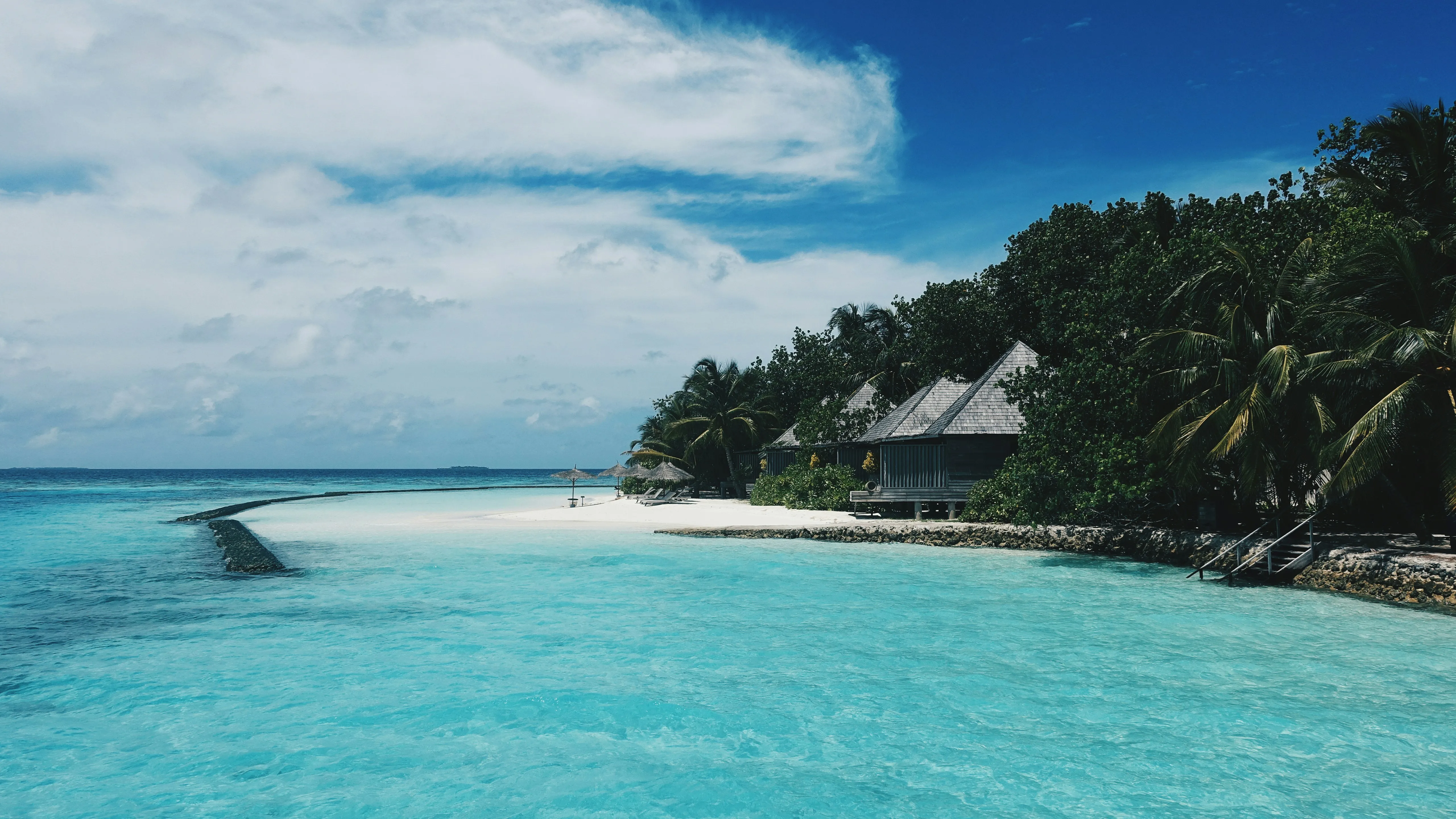
Maldives
A dream archipelago with crystal-clear waters, white sand beaches, and vibrant coral reefs, ideal for enjoying relaxation and extreme diving.
Quick Facts
- Capital
- Malé
- Language
- Dhivehi
- English
- Currency
- Maldivian Rufiyaa (MVR) and US Dollar (USD)
- Best time to visit
- From November to April during the dry season
- Budget per day
- $70 - $500 per day
- Climate
- Warm and humid tropical climate all year round, with a marked monsoon season between May and October.
- Connectivity
- medium
- Very easy to obtain at the international airport and on the main islands.
- Electricity
- Type G (230V)
- Local transport
- limited
- Card usage
- acceptable
- Tipping
- optional
🌎 Introduction
The Maldives unfold over the Indian Ocean like an extensive constellation of small islands where water and sand set the pace of daily life. In this corner of the world, the landscape is defined by the constant presence of the sea, which conditions everything from the architecture of its villages to the slow-paced character of its inhabitants. Far from the rush, the environment invites one to observe how the horizon merges with the deep blue, in a setting where nature maintains a delicate and constant balance.
Beyond its coastal image, the archipelago beats through a culture forged by centuries of navigation and shared traditions. On the inhabited islands, the sound of boduberu drums and the movement of dhonis—hand-built wooden boats—reveal an identity connected to its roots. Daily life is organized around monsoon cycles and a simple gastronomy based on coconut and fresh fish, reflecting the essence of a community that has learned to thrive in harmony with the ocean.
🛡️ General Safety
The Maldives is generally considered one of the safest and most peaceful destinations in the world for travelers. As a country composed of more than a thousand islands, most of which are dedicated exclusively to resorts, the environment is extremely controlled and tranquil.
- The general safety level is high, especially on the private islands where hotels are located.
- Compared to other international destinations, the crime rate is very low.
- The context for the traveler is one of absolute relaxation; however, as in any destination, it is important to maintain common sense, especially in more populated areas like the capital.
Crime and common risks
Although serious incidents are exceptional, there are some minor risks to keep in mind to avoid setbacks during your stay.
- Petty theft can occur on public beaches on local islands or in the busier areas of the capital, Malé. It is recommended not to leave valuables unattended on the sand.
- Minor scams are rare but can occur in the form of inflated prices for tourists in unofficial transport services or in some local souvenir shops.
- It is important to watch your belongings on public ferries or collective transport boats, where there is more passenger traffic.
Safety in cities and tourist areas
Safety dynamics vary significantly between private resorts and urban areas or islands inhabited by the local population.
- In Malé, the capital, the atmosphere is safe but much more chaotic due to traffic and population density. You can walk peacefully at any time, although it is preferable to avoid dark and less-traveled alleys at night.
- The local islands (where guesthouses are located) are very safe and welcoming communities. Respecting local customs ensures an incident-free stay.
- Public transport in urban areas, mainly buses in Malé and Hulhumalé, is safe and efficient for tourists.
Transport safety
Transport in the Maldives is predominantly maritime and aerial, which implies different considerations than in other land-based countries.
- The use of speedboats and ferries is the most common way to get around. It is essential to follow the crew’s safety instructions and use life jackets if sea conditions are adverse.
- Seaplanes are a very safe and regulated means of transport, although they operate strictly during daylight hours.
- Regarding land driving, it is mainly limited to Malé and some larger islands. Driving is on the left. However, due to dense motorcycle traffic and narrow streets, renting vehicles is not recommended for tourists; using taxis is much safer and more practical.
Natural and climatic risks
Given its location and low-altitude geography, the main risks in the Maldives are related to the marine environment and the tropical climate.
- The monsoon climate defines two seasons: the dry monsoon and the wet monsoon (from May to October). During the rainy season, intense storms and strong waves can occur, which could affect maritime transfers.
- Marine currents can be very strong, even near the shore. It is strongly recommended to check with hotel staff before snorkeling or swimming in unsupervised areas.
- Extreme heat and UV radiation are constant risks. It is vital to stay hydrated and use high-factor sunscreen, even on cloudy days, to avoid heatstroke or severe burns.
Legislation and local norms
The Maldives is an Islamic country, and its legislation reflects religious laws and customs that tourists must strictly respect to avoid penalties.
- The import of alcohol, pork products, or religious material that may be considered offensive is strictly prohibited. Alcohol can only be legally consumed within private resorts.
- Drug trafficking and consumption carry extremely severe prison sentences and very high fines.
- On local islands (outside of resorts), it is mandatory to dress modestly. Women must cover their shoulders and knees, and the use of bikinis is permitted only in areas specifically designated as “Bikini Beaches.”
- Excessive public displays of affection are frowned upon and may cause discomfort or even reprimands in local communities.
Safety for specific groups
- Female travelers: The Maldives is a safe destination for women traveling alone. Harassment is not common, although it is recommended to dress discreetly on inhabited islands to respect local culture and avoid unnecessary attention.
- LGTBIQ+ travelers: Same-sex relationships are illegal under local law. Although there is great tolerance and discretion in private resorts, it is recommended to avoid any public displays of affection on local islands and in the capital to avoid legal or social problems.
- Traveling with children and the elderly: It is an ideal destination for families. The main risks for these groups are dehydration and falls on docks or wet areas. Medical services in resorts are usually well-equipped for first aid.
Emergencies and assistance
Having travel insurance that covers medical evacuation is essential, as the main hospitals are in Malé and transfers from remote islands can be very expensive.
- Police: 119
- Ambulances / Medical Emergencies: 102
- Firefighters: 118
- Most resorts have a resident doctor or infirmary to treat minor incidents immediately. In case of a serious incident on a local island, the police are usually cooperative and efficient with tourists.
Tip: Always carry a digital copy of your passport and avoid swimming alone in channels between islands, as currents can change quickly without warning.
📝 Entry requirements
To plan a trip to the Maldives, the first aspect to consider is the possession of a passport with a validity that, generally, must extend at least six months beyond the intended date of arrival. This archipelago usually offers great facilities for international visitors, allowing most tourists to obtain an entry visa directly upon landing at the main airport, without the need for prior consular procedures in most cases.
The maximum duration of this tourist stay is usually thirty days, a period typically considered sufficient to tour the different atolls and enjoy the country’s vacation offerings. During immigration controls at points of entry, authorities frequently request travelers to present an exit ticket, either back to the place of origin or to a third destination, in addition to a confirmation of accommodation reservation or proof of having sufficient funds to cover expenses during the stay.
Regarding customs regulations, it is important to keep in mind that the country maintains certain restrictions based on its local culture and laws. There is a clear limitation on the introduction of alcoholic beverages and pork products, as well as certain objects that may be considered contrary to local norms. In the case of traveling with personal medications, it is highly recommended to accompany them with their corresponding translated medical prescription to facilitate passage through security checks and avoid potential seizures of unidentified drugs.
From a health perspective, there are usually no mandatory vaccination requirements for general tourist entry, with the usual exception of those travelers coming from areas where yellow fever is endemic, who are typically required to present an international vaccination certificate. Nevertheless, it is considered good practice to ensure that general recommended vaccinations for international travel are up to date and to have travel insurance with broad health coverage, given the geographical dispersion of the islands and the logistics required for certain medical transfers.
The fundamental points for entering the territory are detailed below:
- Identity document: Passport with validity exceeding six months.
- Stay permit: Tourist visa usually issued upon arrival.
- Stay period: Standard period of up to thirty calendar days.
- Proof of solvency: Possible requirement for a return ticket and proof of hotel reservation.
- Customs controls: Restrictions on the entry of alcohol, specific meat products, and sensitive audiovisual material.
- Health: Yellow fever certificate requirement only for arrivals from specific risk zones.
🏥 Basic health considerations
When preparing for your trip to the Maldives, you will see that the country has a health system that varies greatly depending on where you are. In the capital, Malé, you will find the main hospitals, such as the public IGMH hospital and the private ADK clinic, which offer a fairly acceptable level of care. However, you must keep in mind that on local islands and in resorts, infrastructure is much more limited. Most hotels have a doctor or nurse for minor cases, but in any serious situation, a transfer to the capital will be necessary. The cost of private healthcare for tourists is quite high, so you will find that any consultation or treatment can represent a significant expense. Regarding language, you will have no problems communicating, as the vast majority of medical staff speak English fluently.
Taking out travel medical insurance is not a mandatory requirement to enter the country, but it is something totally essential and recommended for peace of mind. A fundamental aspect you should check in your policy is that it includes medical evacuation, as transfers by speedboat or seaplane from a resort to a hospital in Malé are extremely expensive. Also, ensure it covers hospitalization and, in the worst case, repatriation, to prevent a health setback from ruining your vacation budget.
Regarding vaccines, there are none that are mandatory to enter the archipelago, unless you come from an area where yellow fever is endemic, in which case they will ask for the international vaccination certificate. The most sensible thing is to have your official vaccination schedule up to date. Generally, for a tourist staying in controlled areas, specific additional vaccines are not usually required, although you can always consult a professional medicine center if you plan a very long stay on local islands less accustomed to tourism.
If you need to carry your own medication, you must be cautious, as laws in the Maldives are very strict regarding the entry of narcotic or psychotropic substances. Whenever you carry medications of this type or chronic treatments, it is vital to accompany them with their original medical prescription translated into English and to keep them in their original packaging. For a basic first aid kit, I advise you to carry painkillers, gastric protectors, and, above all, a good disinfectant for small wounds you might get from coral while swimming.
The greatest health risks you will encounter are related to the tropical climate. The sun is very intense due to the proximity to the equator, so burns and heatstroke are the most common risks. You should also protect yourself from mosquitoes, especially if you visit local islands or areas with a lot of vegetation, to avoid annoying bites. On the other hand, although the risk is low, it is wise to be mindful of potential cuts from coral or stings from marine fauna while snorkeling, as in this climate wounds tend to become infected easily if not cleaned well immediately.
Regarding water and food, the golden rule is do not drink tap water, as it is usually desalinated seawater or stored rainwater that is not suitable for direct consumption. You will find bottled or treated water in all accommodations without problems. Hygiene in resorts is usually of an excellent standard, and you will be able to try the local cuisine with total safety. If you decide to eat at simpler stalls on local islands, simply use common sense and opt for food that is well-cooked.
For any serious medical emergency, the phone number you should dial is 102, which corresponds to the ambulance service. Keep in mind that, due to the country’s geography, urgent care can depend heavily on the availability of vessels for transfer, so it is always better to first contact the staff at your accommodation so they can coordinate the fastest possible assistance.
As final tips, remember to hydrate constantly with bottled water even if you are not thirsty and use biodegradable sunscreen frequently to avoid burns and to protect the marine ecosystem. Do not forget to carry a good insect repellent and, for any small wound caused by the sea, wash it well with fresh water and apply antiseptic to avoid complications during your stay.
🚌 Transport within the country
Getting around this archipelago requires understanding that maritime and aerial transport are the fundamental pillars of mobility. Being a group of scattered islands, travelers typically use seaplanes, speedboats, or the public ferry to move between different atolls. While domestic flights and speedboats regularly connect the most distant points, the traditional boat system is a common option for journeys between islands inhabited by the local population.
Using transport is generally simple for the visitor, as signage and directions are usually available in English in addition to the local language. The management of transfers is facilitated from the main points of arrival, such as the international airport, where staff kindly guide newcomers toward their respective docks or internal aviation terminals.
There is a marked difference between the capital and the rest of the country regarding land transport. In the city of Malé and on the island of Hulhumalé, it is possible to find a network of buses and taxi services that allow for quick road travel. However, once the urban environment is left behind, mobility becomes exclusively aquatic or aerial, adapting totally to the geography of each atoll.
In areas where they operate, taxis are a comfortable and easy-to-use alternative for short trips within urbanized islands. Regarding general reliability, services are usually consistent and organized, although it is important to keep in mind that both maritime transport and seaplane flights depend directly on weather conditions, which can occasionally influence the fulfillment of scheduled times.
“Tip”: It is recommended to check the boat frequency in advance, as maritime services can vary according to the day of the week or the state of the sea.
🤵 Culture and etiquette
The society of the Maldives is governed by a combination of local traditions and values deeply rooted in its cultural identity. When visiting the archipelago, interpersonal treatment is characterized by kindness and a calm attitude, where politeness is fundamental for establishing fluid communication. In public settings on local islands, discreet behavior and a moderate tone of voice are valued, avoiding excessively effusive gestures that may disturb the atmosphere of calm that predominates in the daily life of its inhabitants.
Regarding non-verbal communication, the greeting is usually verbal or through a slight nod. In encounters between people of different sexes, it is advisable to observe if the local person takes the initiative before attempting to shake hands. Likewise, respect for hierarchies and older people is a social pillar, so addressing them with special deference facilitates integration in any community context. In daily interactions, patience is an appreciated virtue, as the notion of time can be more flexible than in other international environments.
Customs regarding the table and the home also follow specific guidelines that the traveler should know. It is common practice to remove your shoes before entering a private home and in some local commercial establishments as a sign of consideration. When handing over objects, making payments, or during meals, it is preferable to use the right hand, in line with regional traditions. Regarding gratifications, tips are well-received in the service sector, although in many establishments a predetermined percentage is already included in the final bill.
Finally, it is essential to show special sensitivity in everything related to the religious sphere and places of worship. During prayer times, activity on local islands usually pauses briefly, and it is appreciated if the visitor maintains an observant and respectful attitude. In these environments, choosing appropriate clothing that covers shoulders and knees is interpreted as a gesture of esteem toward local customs, allowing the coexistence between tourism and traditional life to develop harmoniously and balanced.
Tip: Before photographing local inhabitants or their private property, it is advisable to request permission with a kind gesture or word to ensure that their privacy and personal space are respected.
🍛 Typical gastronomy
The cuisine of the Maldives, traditionally known as Dhivehi gastronomy, is a faithful reflection of its insular geography. As an archipelago located in the Indian Ocean, its fundamental pillars are tuna, coconut, and starches, mainly rice and taro. The essence of its dishes lies in the freshness of the fish, which is consumed in various ways: from fresh or smoked to dried (the famous “Maldive fish”). Coconut, for its part, is used in all its forms, whether grated, as milk, or as oil, providing a creamy texture and a mild flavor that balances the use of spices.
Eating habits on the islands are marked by simplicity and the influence of neighboring South Asian cultures. Flavors tend to be spiced and sometimes hot, with the recurrent use of curry leaves and local chilies. One of the most rooted traditions is the consumption of hedhikaa, small savory or sweet snacks served in the mid-afternoon. Breakfast also takes on special importance, being considered one of the most complete meals of the day, designed to provide energy before daily tasks.
Regarding etiquette and customs, it is important to keep in mind that the Maldives is a country with a Muslim culture. This implies that the consumption of alcohol is strictly prohibited on local islands and in the capital, with its availability limited exclusively to private tourist resorts. On inhabited islands, it is common to find informal establishments where food is served at a slow pace. Although cutlery is used in tourist environments, in local domestic settings it is common to eat with the right hand, a practice that is part of their cultural identity.
Meal times are usually regular, although the restaurant offerings on local islands tend to close during prayer hours. To accompany dishes, Maldivians usually opt for black tea, highly valued in the region, or for fresh tropical fruit juices and coconut water. The gastronomic experience in this destination is, in short, an invitation to discover pure marine flavors in a relaxed and authentic atmosphere.
| Dish | Description | Main ingredients | Where to try it | Tip |
|---|---|---|---|---|
| Mas Huni | The most traditional breakfast, a fresh and flavorful mixture. | Grated tuna, coconut, onion, and chili. | Local cafes and guesthouses. | Always accompany it with roshi flatbread and hot tea. |
| Garudhiya | A clear fish soup or broth, aromatic and very nutritious. | Fresh tuna, water, salt, and sometimes citrus. | Local cuisine restaurants in Malé or islands. | Add a few drops of lime and a bit of rice to enhance the flavor. |
| Mas Riha | A creamy fish curry with an intense aroma of spices. | Tuna, coconut milk, curry, and chili. | Any Dhivehi gastronomy restaurant. | It is ideal for lunch alongside a portion of boiled rice. |
| Bis Keemiya | A type of fried pastry similar to a samosa. | Puff pastry, cabbage, hard-boiled egg, and onion. | Hedhikaa (snack) stalls in the afternoon. | Enjoy it freshly made while it is still crispy. |
| Kulhi Boakibaa | Spicy fish cake with a dense texture and baked. | Smoked tuna, grated coconut, rice, and ginger. | Tea establishments and social gatherings. | Try it as a snack if you are looking for a spiced and different flavor. |
📷 Zones and places to visit
The archipelago of the Maldives is geographically organized into an extensive chain of coral atolls distributed from north to south in the Indian Ocean. This unique territorial arrangement sets the tone for any visit, dividing the experience between the vibrant urban life of its capital and the absolute serenity of its islands and sandbanks. Each area of the country offers a different nuance, allowing visitors to discover everything from important historical remains to marine ecosystems of great natural value.
The city of Malé, the capital, is the fundamental starting point for understanding Maldivian culture. On this densely populated island, the traveler can explore the Friday Mosque (Hukuru Miskiy), a 17th-century architectural gem built with coral stone and decorated with intricate carvings. Very close by is the Islamic Centre, with its distinctive golden dome, and the National Museum, which houses a collection of objects narrating the history of the ancient sultanate. Walking through its streets allows one to observe the contrast between the modernity of its buildings and the tradition of its local markets, where fresh fish and agricultural products are the protagonists of daily commercial exchange.
For those interested in the authentic life of the archipelago, the local islands such as Maafushi, Thulusdhoo, or Dhiffushi represent a very enriching alternative. Unlike closed resorts, on these islands, one lives alongside the Maldivian population, which facilitates access to regional gastronomy and local customs. It is the ideal place to witness Bodu Beru performances, a traditional dance and music based on the sound of drums, or to observe the work of artisans who still use ancestral techniques in boat building.
The natural environment reaches its maximum expression in Ari Atoll, one of the regions most recognized for its biodiversity. This area is famous for its coral reefs and for being one of the best spots for observing large marine fauna, such as whale sharks or manta rays, in their natural habitat. Sandbanks, small stretches of white sand that emerge in the middle of turquoise water lagoons, are characteristic elements of this landscape and can be found scattered across almost all atolls, offering an environment of peace and isolation difficult to find in other destinations.
In the extreme south of the country, Addu Atoll offers a different perspective thanks to its geographical configuration and its historical past. Having hosted ancient British-influenced infrastructure, the area features a network of roads connecting several islands, allowing for bicycle routes that cross villages and coastal landscapes fluidly. This atoll is distinguished by its wetlands and for being a refuge for various bird species, making it a point of interest for nature observation enthusiasts beyond underwater activities.
Another area that stands out for its uniqueness is Vaadhoo Island, located in the Raa Atoll. This place has gained notoriety for the natural phenomenon of bioluminescence, where phytoplankton on the seashore emit a bluish light when agitated by waves, creating a very particular visual effect during the night. Additionally, the use of dhonis, traditional wooden boats, remains the most authentic way to travel between the islands, allowing the traveler to enjoy the vastness of the ocean and the sunsets in a slow and traditional way.
Tip: You cannot miss visiting Ari Atoll, the most iconic place in the country.
✈️ Best season to travel
The Maldives are a tropical destination where temperatures remain constant and warm throughout the year, usually ranging between 26 °C and 31 °C. The choice of the ideal time for a visit usually depends on personal preferences regarding rainfall and the state of the sea, factors conditioned by the two monsoons that set the rhythm of the archipelago.
While the months with clear skies coincide with the highest influx of visitors, the rainy season offers a different atmosphere, with lusher vegetation and optimal conditions for certain water sports. In any season, the clarity of its waters and the great marine biodiversity allow for full enjoyment of nature, whether under the sun or under tropical rain.
| Season | Months | Typical weather | What to expect | Tourist influx |
|---|---|---|---|---|
| Spring | Mar – May | Hot and humid weather with clear skies at the start; transition to light rains in May. | Very calm waters ideal for diving and excellent marine visibility. | ⭐⭐⭐⭐ (High) |
| Summer | Jun – Aug | Constant temperatures with frequent rain and moderate wind. | Optimal conditions for surfing due to the swell and manta ray sightings. | ⭐⭐ (Low) |
| Autumn | Sep – Nov | High humidity with intermittent showers that usually clear quickly. | Very green landscapes, intense sunsets, and great marine life activity. | ⭐⭐⭐ (Medium) |
| Winter | Dec – Feb | Dry weather, sunny days, and very little rainfall. | Calm sea, ideal for beach activities, snorkeling, and sailing between atolls. | ⭐⭐⭐⭐⭐ (Very high) |
🗣️ Basic vocabulary
Although English is widely used in hotels and tourist areas of the Maldives, knowing some terms in Dhivehi, the local language, is very helpful for integrating better into the daily life of the islands. Using simple words in everyday situations, such as when shopping in a local store or talking to staff, is usually well-received and facilitates more fluid and friendly communication.
It is not necessary to delve into grammar to manage with ease. Simply memorizing a few courtesy expressions will serve you for greeting, thanking, or responding to basic questions during your stay, especially if you visit islands inhabited by the local population.
- Assalaamu alaikum: Hello (commonly used formal greeting).
- Shukuriyya: Thank you.
- Labba: Yes (polite response, frequently used).
- Noo: No.
- Kihineh?: How are you? or how is it going?
- Varah rangalhu: Very well.
- Adhes-kohfa: Please.
- Dhanee: Goodbye