


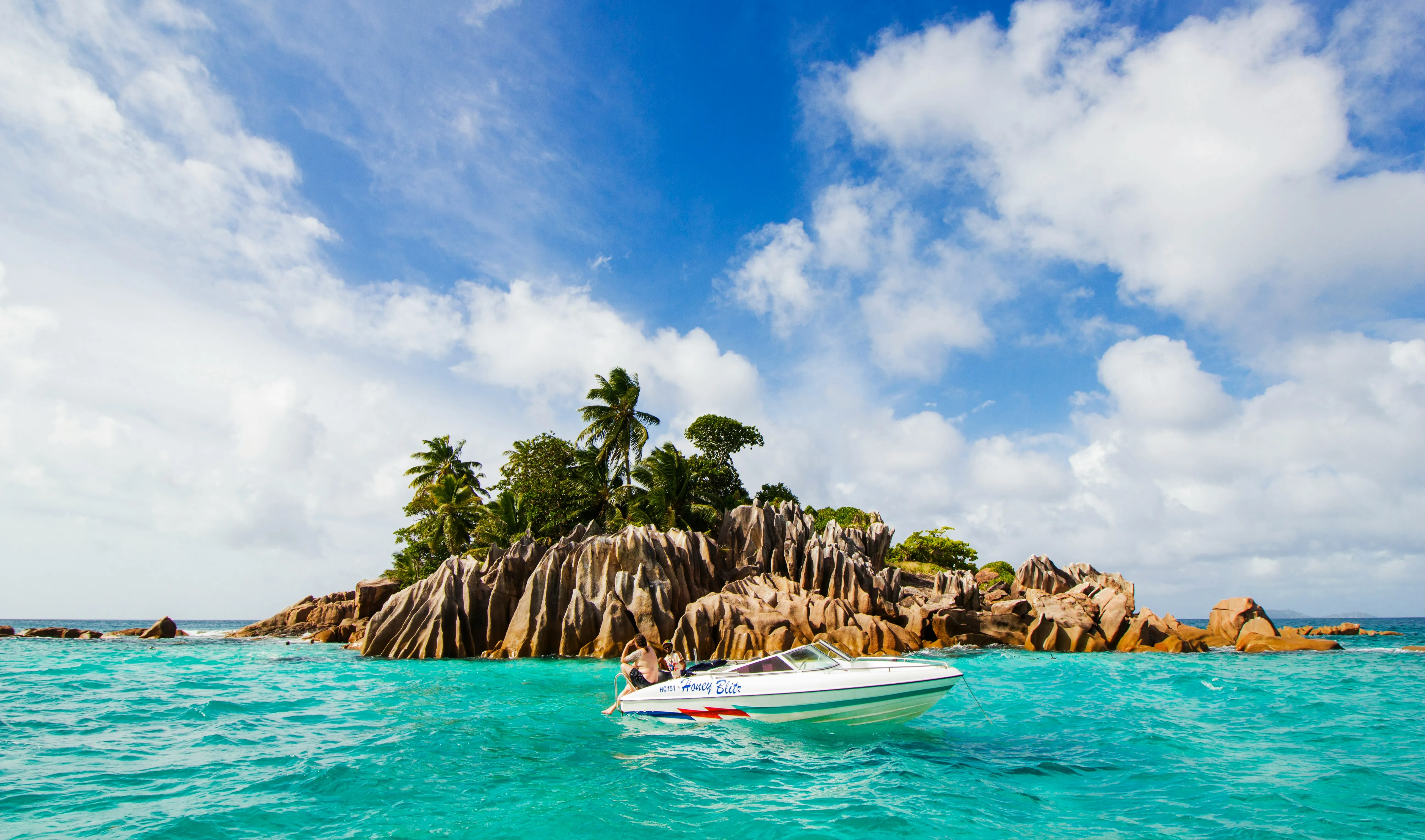
Seychelles
A dream archipelago in the Indian Ocean with white sand beaches, crystal-clear waters, and a unique biodiversity ideal for sun lovers.
Quick Facts
- Capital
- Victoria
- Language
- Seychellois Creole
- English and French
- Currency
- Seychelles Rupee (SCR)
- Best time to visit
- From April to May and from October to November
- Budget per day
- $120 - $450 per day
- Climate
- Warm and humid tropical climate throughout the year, with stable temperatures and seasonal rains between November and March.
- Connectivity
- medium
- Very easy to get at the airport and local shops
- Electricity
- Type G (240V)
- Local transport
- acceptable
- Card usage
- acceptable
- Tipping
- optional
🌎 Introduction
In the midst of the warm waters of the Indian Ocean, the Seychelles islands present themselves as a mosaic of granite and coral. Beyond the habitual image of its shores, this corner of the world hides a jungle interior where the rhythm of life continues to be marked by the cycle of the winds and the sea. It is a place where time seems to pass at a different speed, facilitating a slow encounter with a nature that preserves plant and animal species unique on the planet, such as its famous giant tortoises or the singular coco de mer.
The country’s identity is felt in its markets and small towns, where the scent of cinnamon and vanilla mixes with that of freshly caught fish. Creole heritage is manifested in a gastronomy that simply balances spices and local products, but also in the hospitality of its people and in a language with a musical sound. Throughout the year, local traditions and music with African roots bring color to the days, reflecting a blend of cultural influences that have shaped a diverse and peaceful society.
Depending on the season, the trade winds transform the landscape and daily activities, offering everything from periods of absolute calm to moments of great vitality on its coasts. Traveling its paths allows one to understand the variety of a territory that, despite its manageable scale, alternates cloudy mountains with shallow lagoons where marine life develops naturally, offering a balanced vision between the exuberance of the environment and the daily life of its inhabitants.
🛡️ General safety
Seychelles is considered one of the safest destinations in Africa and the world for international tourism. The archipelago enjoys remarkable political and social stability, allowing travelers to enjoy its islands with a great sense of freedom. Although the risk level is very low, as in any tourist destination, it is essential to maintain common sense and follow certain basic guidelines to avoid minor incidents.
General safety level
- The safety level in Seychelles is rated as high. It is a country where serious incidents involving tourists are extremely rare.
- The indicative comparison with respect to other global destinations places Seychelles at a low risk level, similar to that of many European countries or luxury island destinations.
- The context for the traveler is one of absolute tranquility; the country lives mainly from tourism and there is a great institutional and social interest in protecting and caring for the visitor.
Common crime and risks
- The most common crimes are non-violent in nature, mainly petty theft or carelessness. The theft of personal items on beaches while tourists are swimming is the most reported incident.
- It is recommended to take extra precautions in less busy areas of the capital, Victoria, especially at night, although it is not considered a dangerous city.
- It is advisable to avoid leaving valuables in plain sight inside rental vehicles or on the terraces of accommodations located at street level.
- Scams are not common, but it is always advisable to agree on prices for informal services before they are performed.
Safety in cities and tourist areas
- In urban centers like Victoria or in tourist hubs like Beau Vallon, safety is constant. The police presence is discreet but effective.
- The differences between the main islands (Mahé, Praslin, and La Digue) are minimal in terms of safety, with La Digue being an even more relaxed environment where bicycle use is the standard.
- To move around with peace of mind, it is enough not to flaunt objects of great value or unnecessary jewelry in busy public areas.
Transport safety
- Public transport (buses) is safe and very economical, although drivers tend to drive at a considerable speed on narrow and winding roads.
- In Seychelles, driving is on the left, a legacy of its British past. If you decide to rent a car, you must pay special attention to the narrowness of the roads and the lack of guardrails in some mountain areas.
- Taxis are safe, but they do not usually use a meter for tourists; it is essential to agree on the price of the journey before getting into the vehicle.
- Ferry transfers between islands are very well regulated, although the sea can be rough at certain times of the year, so people prone to motion sickness should take precautions.
Natural and climatic risks
- Seychelles is not located on the main track of tropical cyclones, so hurricanes are very infrequent.
- The most relevant risk for the tourist is strong marine currents. On some beaches, especially during the monsoon change (from May to September), swimming can be dangerous. Always respect warning signs on beaches.
- Extreme heat and UV radiation are real risk factors. It is necessary to use high-factor sunscreen and stay hydrated to avoid heat stroke.
- Torrential rains can occur suddenly, causing localized flooding or landslides on mountain roads, mainly between December and February.
Local legislation and regulations
- Seychelles has very strict laws regarding environmental protection. It is forbidden to collect shells, corals, or any protected species to take out of the country. Fines can be very high.
- Drug trafficking and consumption are punishable by very severe prison sentences. There is no tolerance for the consumption of narcotic substances, even in tourist settings.
- Nudism is not legally permitted and “topless” is frowned upon on some local public beaches, although it is tolerated on the beaches of large hotels.
Safety for specific groups
- Women travelers: Seychelles is a very safe destination for women traveling alone. Precautions are the same as anywhere else in the world, such as avoiding walking in dark or isolated areas at night.
- LGTBIQ+ travelers: Although homosexuality was decriminalized in 2016, Seychellois society remains conservative in some aspects. Discretion in public displays of affection is recommended, especially outside international resorts, to avoid uncomfortable situations.
- Travel with children and the elderly: The country is ideal for families. Infrastructure is adequate and health risks are low (there is no malaria or yellow fever, unless coming from an endemic area).
Emergencies and assistance
- The main emergency number in Seychelles is 999 for police, fire, and ambulance.
- Emergency services are efficient, although on more remote islands medical assistance may be limited. The main hospital is located in Victoria (Mahé).
- In case of any incident, it is recommended to go to the local police, who are usually friendly and multilingual (they speak English and French in addition to Creole).
- It is essential to travel with comprehensive medical insurance that includes repatriation, as private medical care for tourists can be costly.
Tip: Always watch your belongings on the beach and never leave them unattended while swimming; this is the time when the vast majority of petty thefts occur on the islands.
📝 Entry requirements
To start a trip to this archipelago, it is fundamental that every visitor has a valid passport that covers the entire period of their stay. It is recommended that the document be in optimal condition and that its expiration date be after the planned date of departure. Upon arriving at entry points, authorities usually verify that the documentation meets international identification standards to allow access to the territory.
In the area of access policy, this destination is characterized by allowing entry for tourist purposes without the need to manage a prior visa for the vast majority of travelers. Instead, it is common for a visitor permit to be issued at the time of landing or arrival, which is usually valid for a set time that fits the needs of a standard vacation. This permit can be renewed in case a longer stay is desired, following the corresponding local procedures.
During migration controls, it is common for the traveler to be asked to present a return ticket or a continuation of the trip to another country. Likewise, proof of accommodation is usually required, such as a hotel reservation or the address of the planned stay. Similarly, authorities may ask for evidence of having sufficient financial funds to cover personal expenses during the visit, something that can be proven through various common financial means.
Regarding customs regulations, there are standard restrictions on the entry of certain products. It is common to limit the quantities of items such as tobacco and alcoholic beverages intended for personal use. Special attention is paid to the introduction of fresh food, plants, and animal products for biosecurity reasons. In the case of carrying medications, it is advisable to carry them in their original containers and, preferably, accompanied by a medical prescription to facilitate routine inspections.
From a health point of view, specific vaccination certificates are not usually required for entry, except in specific situations where the traveler comes from regions with a risk of transmission of certain diseases. However, it is considered a recommended practice to have travel insurance with broad coverage and to be up to date with general health recommendations for tropical environments. Maintaining basic hygiene and health precautions will contribute to a more pleasant travel experience.
- Identity document validity: Must be valid throughout the planned stay.
- Prior visa procedure: Generally not required for short tourist stays.
- Stay permit: A visitor permit is usually granted upon entering the country.
- Exit requirements: A confirmed return ticket is commonly requested.
- Accommodation: It is recommended to have a confirmed reservation to present at the control.
- Solvency: Authorities may require proof of economic capacity for the trip.
- Health: Vaccination certification only in cases of origin from risk zones.
Places of interest and natural heritage
The archipelago stands out for its immense biological richness and its landscapes that seem frozen in time. The geographical distribution allows for the enjoyment of different environments, from mountains covered in jungle to beaches with crystal-clear waters.
- Mahé Island: It is the main hub where the capital is located. It stands out for its mix of culture, local markets, and a coast dotted with calm bays and granitic formations.
- Praslin Island: It houses natural reserves that are internationally recognized for protecting unique plant species. It is a key point for those seeking direct contact with endemic flora and fauna.
- La Digue Island: Known for its relaxed atmosphere and the widespread use of sustainable means of transport. Its beaches are considered among the most beautiful in the world due to its peculiar granite rocks.
- Marine reserves: The underwater environment is ideal for observing coral reefs and a great diversity of aquatic species in protected areas.
Gastronomy and local culture
The cuisine of the islands is a rich and aromatic fusion that reflects the various historical influences that have passed through the region. It is based mainly on the use of fresh local ingredients and a wide variety of spices.
- Fish and seafood: They are the pillar of the local diet, prepared in multiple ways, with grills and stews with coconut milk being common.
- Spiced curries: The use of spices such as ginger, chili, and local curry brings intense flavors to meat and vegetable dishes.
- Tropical fruits: Mango, papaya, and coconut are used in main dishes as well as in desserts and refreshing drinks.
Additional considerations for the stay
To enjoy a harmonious stay, it is useful to know some details about the daily operation and the environment of the islands.
- Climate and clothing: Being a tropical climate, the use of light clothing made of natural fabrics and adequate sun protection is recommended.
- Travel: The connection between the main islands is usually made through ferry services or short-duration internal flights.
- Environmental protection: There is a strong awareness of ecosystem conservation. Visitors are invited not to collect shells or damage corals.
- Currency and transactions: The use of credit cards is common in tourist establishments, although having some local currency is practical for small expenses in markets or less urban areas.
🏥 Basic health considerations
If you are planning to travel to the Seychelles, you will see that it is a fairly safe destination from a health point of view, although it is always advisable to know how everything works there to avoid unforeseen events. You will find the main healthcare system concentrated on the island of Mahé, specifically in its capital, Victoria. Although there are health centers and clinics on the more populated islands like Praslin or La Digue, you will see that for complex cases, the norm is a transfer to the central hospital. The level of healthcare is acceptable for common problems, but for serious emergencies, options are more limited. As a tourist, you will be able to access both public and private healthcare, although the latter is the most recommended for speed and comfort. Be aware, however, that medical costs for foreigners are high, so any consultation or treatment will have a considerable price. You will not have communication problems, as medical staff speak English and French perfectly.
Taking out travel medical insurance is not just a recommendation, but you will find it is a practical requirement to obtain the mandatory travel authorization to enter the country. It is essential that your insurance has broad coverage that includes hospitalization and medical repatriation, as in cases of extreme gravity you might need a transfer to another country with more advanced facilities.
Regarding vaccines, the only one required on a mandatory basis is the yellow fever vaccine, but only if you come from a country where this disease is endemic. For all other travelers, it will be enough to have your official vaccination schedule up to date. Generally speaking, you might consider vaccination against hepatitis A or typhus if you plan to go far off the tourist routes, but for a conventional trip, nothing special is usually necessary.
If you need to bring your own medication, you will find that the safest way is to transport it in its original packaging and accompanied by the medical prescription or a certificate, preferably in English. This will avoid complications at customs, especially if it involves psychotropic or narcotic medications, which are highly controlled. In local pharmacies, you will find basic products, but if you use something very specific, it is best to take it with you from the start of the trip.
Regarding common health risks, the greatest enemy you will encounter is the equatorial sun. You will see that it burns with great intensity even on cloudy days, so the use of high sun protection is essential to avoid burns. You should also protect yourself from mosquitoes, which are most active at dawn and dusk. Although there is no malaria on the islands, isolated cases of other insect-borne diseases can occur, so using a good repellent will save you trouble. Otherwise, there are no major risks from dangerous animals, beyond being careful with sea urchins or the occasional stonefish if you walk in coral areas.
Regarding water and food, you will see that tap water on the main islands like Mahé and Praslin is technically potable, although most travelers prefer to drink bottled water due to the taste and to avoid any stomach upsets. Hygiene in food establishments is usually very good, so you can try the delicious local gastronomy without fear, always applying the common sense you would have anywhere else.
In case you find yourself in a health emergency situation, the telephone number you should dial is 999. This number centralizes police, fire, and ambulance services. You will see that the urgent care service works well in populated areas, although if you are on a remote island or in an isolated resort, response times could be longer.
As final tips, it will be very useful to carry a small first-aid kit with basics such as disinfectant, plasters, painkillers, and an antihistamine. Always stay well hydrated to combat the humid heat and you will see that, following these simple guidelines, your stay in the Seychelles will be completely pleasant and safe.
🚌 Transport within the country
Moving around the Seychelles requires combining travel by sea, air, and land. The ferry is the most common means of transport for traveling between the main islands of Mahé, Praslin, and La Digue, while internal flights quickly connect the capital with other more distant islands. Once on land, visitors usually opt for public buses or car rentals to explore the interior with greater autonomy.
Terrestrial public transport is easy for visitors to use. Bus stops are usually clearly marked and routes cover much of the territory of the islands of Mahé and Praslin. Language does not represent an impediment to understanding directions or interacting with drivers. To use this service, the process of obtaining tickets is straightforward, facilitating the tourist’s integration into the local rhythm.
The transport experience varies significantly depending on the location. In Victoria, the capital, vehicle movement is more intense and resembles that of a small city, while in rural areas traffic is very scarce and the atmosphere much calmer. A singular case is the island of La Digue, where motorized vehicles are very limited and the use of the bicycle becomes the main and most practical means of getting around.
Taxis are a comfortable alternative and are commonly present at strategic points such as the airport, ferry docks, and areas with a high concentration of accommodation. It is a service that offers reliability and speed for specific transfers or when traveling with luggage. In general, transport in the archipelago stands out for its safety, always adapting to the geographical environment of each island.
“Tip”: It is advisable to check the ferry frequency in advance, as schedules can vary depending on the season and weather conditions.
🤵 Culture and etiquette
Seychellois society is characterized by a harmonious blend of diverse influences that have given rise to a kind and hospitable character. When interacting with local residents, it is fundamental to start any conversation with a formal greeting, whether in French, English, or Seychellois Creole, as it is considered an essential sign of politeness and recognition towards the interlocutor. Although the atmosphere of the archipelago invites relaxation, it is positively valued to maintain a respectful and steady treatment, avoiding immediate demands or excessive haste in daily interactions.
In public spaces, behavior is usually discreet and quiet. A moderate voice volume and respect for the personal space of others are appreciated. Regarding punctuality, there is usually a flexible attitude towards informal commitments, something integrated into the local pace of life; however, in professional contexts or organized services, the fulfillment of agreed schedules is expected. Regarding physical contact, a cordial but contained treatment is common, where the handshake is the standard form of initial greeting.
Customs related to the table reflect the importance of hospitality and the enjoyment of local products. If one has the opportunity to visit a private home, it is a gesture of courtesy to bring a small gift for the hosts. Regarding tipping, although many establishments already include a service charge on the bill, leaving an additional tip is received as a sign of appreciation for good service, without it being a strict obligation. Likewise, before taking photographs where people are prominent subjects, it is fundamental to request prior consent to respect their privacy.
Respect for traditions and religious beliefs, mostly Christian, is a central pillar of coexistence on the islands. When visiting places of worship, it is necessary to dress modestly, ensuring that shoulders and knees are covered as a sign of consideration. This same sensitivity extends to the preservation of natural heritage, which is a source of great national pride. Observing environmental protection regulations and maintaining an attitude of care towards fauna and flora is considered an indispensable part of the correct behavior of any visitor to the archipelago.
Tip: To foster a fluid and positive interaction, it is highly recommended to adopt the slow pace of the islands and avoid showing impatience in shops or restaurants, as courtesy and calm are the keys that open all doors in the local culture.
🍛 Typical gastronomy
The cuisine of Seychelles, popularly known as Creole gastronomy, is the result of a rich blend of African, French, Indian, and Chinese influences. This fusion has given rise to a culinary identity of its own where fresh fish and seafood are the undisputed stars. Due to its geographical location, seafood is caught daily and prepared in various ways, from grilled over charcoal to integrated into complex stews.
The flavors of the islands are characterized by the generous use of spices and herbs. Ingredients such as ginger, garlic, turmeric, cilantro, and different varieties of chili are commonly combined with coconut milk to create aromatic and creamy sauces. Rice is the essential accompaniment in almost all meals, serving as a base to balance the intensity of Creole flavors.
Regarding eating habits, island inhabitants usually have a light meal at noon, with takeaway stalls being very common, offering quality traditional dishes to those looking for a quick option. Dinner is usually a more relaxed and social moment. In restaurants, etiquette is generally informal and relaxed, in keeping with the tropical setting, although it is advisable to maintain an appropriate dress code in higher-end establishments during the evening.
Regarding drinks, fresh tropical fruits such as mango, papaya, or passion fruit are transformed into natural juices on every corner. Coconut water is a widespread refreshing option, as are local infusions, among which citronella tea stands out. Although traditional fermented drinks and local beer productions exist, the consumption of infusions and natural juices is the most common option to accompany the daily diet.
| Dish | Description | Main ingredients | Where to try it | Tip |
|---|---|---|---|---|
| Grilled fish | Whole fish marinated and roasted directly over fire. | Fresh fish, garlic, ginger, and chili. | Beach food stalls and markets. | Ask them to adjust the spice level to your preference. |
| Octopus curry | Creamy and aromatic stew with a spice base. | Octopus, coconut milk, cinnamon, and Creole curry. | Traditional restaurants in Mahé and Praslin. | Always accompany it with a generous portion of white rice. |
| Ladob | Versatile preparation that can be served as a savory dish or dessert. | Breadfruit or banana, coconut milk, and vanilla. | Local cuisine buffets and eating houses. | The sweet version is excellent if served slightly warm. |
| Satini | Grated salad that serves as a refreshing garnish. | Green papaya or shark, onion, and chili. | Takeaway food stalls. | It is the perfect accompaniment for fried fish dishes. |
| Bouillon Brède | Light green leaf soup similar to a vegetable broth. | Moringa leaves or local spinach and broth. | Family restaurants on the islands. | Ideal for a light dinner or as a soft starter. |
📷 Areas and places to visit
The archipelago of the Seychelles is distributed in a group of islands where nature and history are intertwined in a balanced way. The island of Mahé is the main entry point and houses the capital, Victoria. In this small city, the pace is slow and allows for the discovery of cultural landmarks such as the Clock Tower, a monument evoking the colonial era, or the colorful Arul Mihu Navasakthi Vinayagar Hindu Temple. Walking through its streets inevitably leads to the Sir Selwyn Selwyn-Clarke Market, where local products and the daily life of residents show the country’s most authentic side.
For those seeking an immersion in history and art, the National Museum of History in Victoria offers a detailed perspective on the archipelago’s past. Beyond the urban core, Mahé has the Morne Seychellois National Park, a mountainous area that occupies a large part of the island. Here, trails allow for the observation of native vegetation and reach viewpoints offering general views over the coastline and nearby islands, contrasting the intense green of the forest with the blue of the ocean.
The island of Praslin is another fundamental hub for any visitor. It is known mainly for housing the Vallée de Mai, a site declared a World Heritage Site where the coco de mer grows, a species unique in the world. The environment of the valley is a dense tropical forest that seems to have stopped in time. Praslin also stands out for its coastal areas, such as Anse Lazio, characterized by its wide stretches of sand and its sheltered environment, ideal for observing the maritime landscape without the crowds of other tourist regions.
In a more relaxed environment is La Digue, an island where motorized transport is limited and the bicycle is the main means of getting around. This particularity allows for a quiet and close atmosphere. One of the most relevant points of interest here is L’Union Estate, an old colonial plantation where one can still observe the traditional production of copra and vanilla, in addition to visiting a historic house of typical architecture. Near this estate is the area of Anse Source d’Argent, recognized for its enormous granite formations bordering the coast, creating a unique natural landscape.
In addition to the main islands, there are protected areas such as Curieuse Island, where the conservation of Aldabra giant tortoises is managed. Excursions to this area allow for close encounters with efforts to preserve local fauna. For birdwatching enthusiasts, the Cousin Island Special Reserve is an example of ecological recovery, serving as a refuge for numerous endemic bird species not found elsewhere in the world.
The contrast between the more developed areas of Mahé and the serenity of the smaller islands allows for a look at the different realities of Seychelles. While in urban areas one can enjoy Creole gastronomy in small restaurants and local fairs, in rural and maritime areas activity is centered on respect for the natural environment and the practice of slow activities such as hiking or observing marine life in the marine national parks.
Tip: You cannot leave without visiting the Vallée de Mai, the most emblematic place in the country.
✈️ Best time to travel
Seychelles enjoys a warm tropical climate all year round, allowing for a visit in almost any month. The experience in the archipelago is mainly marked by the trade winds, which define two distinct seasons: one drier and cooler, and another warmer and more humid. The choice of the ideal time will depend on whether one seeks calm at sea for underwater activities or prefers a cooler climate to explore the hiking trails in the interior of the islands.
In general, the transition months between the monsoon winds, especially April and October, usually offer the most balanced conditions. During these periods, the wind subsides and the waters become exceptionally clear and calm. However, each time of year has its own attractions, from observing marine fauna to the flowering of endemic species that transform the landscape of the granitic and coral islands.
| Season | Months | Typical climate | What to expect | Tourist influx |
|---|---|---|---|---|
| Spring | Mar – May | Warm temperatures (25-30 °C) and calm winds. | Excellent visibility for diving and snorkeling. Bird nesting season. | ⭐⭐ Medium |
| Summer | Jun – Aug | Cooler and drier climate; constant southeast winds. | Somewhat rougher sea, ideal for surfing and sailing. Sunny days and less humidity. | ⭐⭐⭐ High |
| Autumn | Sep – Nov | Return of moderate heat and decrease in wind. | Calm waters again. Whale shark spotting season begins in October. | ⭐⭐ Medium |
| Winter | Dec – Feb | Humid and hot environment with frequent tropical rains. | Very green and lush landscapes. Rains are usually intense but brief. | ⭐⭐⭐ High |
🗣️ Basic vocabulary
Although English and French are official languages in Seychelles and are spoken in most tourist establishments, Seychellois Creole (seselwa) is the language used by the local population in their daily lives. Learning a few basic expressions not only facilitates daily interactions but is also usually appreciated by the island inhabitants as a gesture of courtesy towards their culture.
Mastering a few greetings or words of thanks will be useful in markets, bus stops, or when talking to accommodation staff. Below are some of the most common words and phrases you can use during your stay:
- Bonzour: Hello / Good morning.
- Orevwar: Goodbye.
- Mersi: Thank you.
- Silvouple: Please.
- Ki manyer?: How are you?
- Bien, mersi: Fine, thank you.
- Pa de kwa: You’re welcome.
- Wi: Yes.
- Non: No