


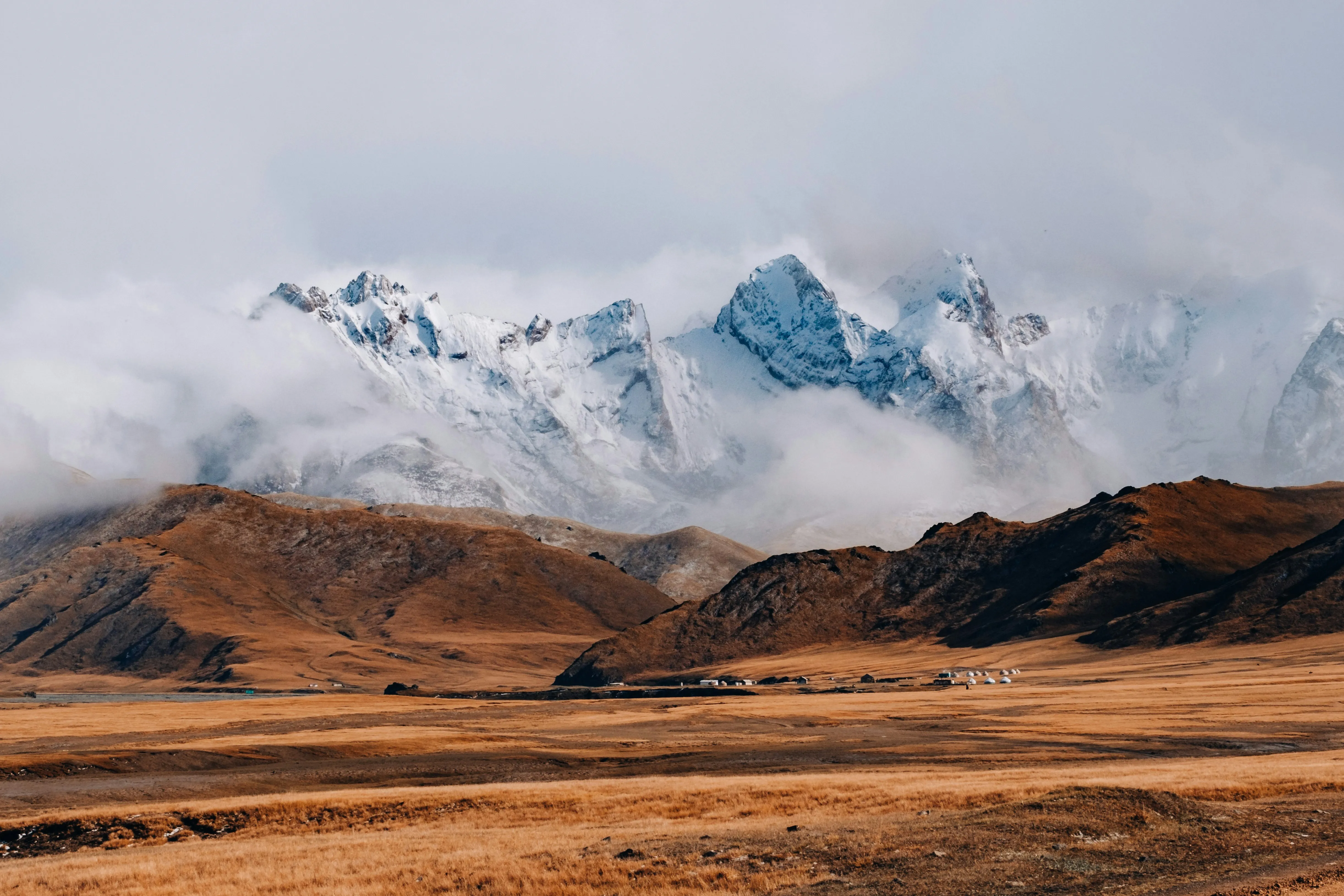
Kyrgyzstan
A destination of wild mountains and alpine lakes where nomadic culture lives on among pristine landscapes ideal for lovers of authentic adventure.
Quick Facts
- Capital
- Bishkek
- Language
- Kyrgyz
- Russian
- Currency
- Kyrgyzstani Som (KGS)
- Best time to visit
- From June to September for hiking and access to high mountain areas.
- Budget per day
- $25 - $70 per day
- Climate
- Continental climate with hot summers and freezing winters. Mountain regions experience extreme alpine conditions for much of the year.
- Connectivity
- medium
- Very easy to obtain at airports and urban centers by presenting a passport.
- Electricity
- Type C / F (220V)
- Local transport
- acceptable
- Card usage
- cash is used more often
- Tipping
- optional
🌎 Introduction
In the heart of Central Asia, the landscape is defined by the relief of the Tian Shan mountains, which naturally set the rhythm of life for its inhabitants. It is a land where nomadic heritage remains present in everyday life, manifesting in the vast expanses of pastures that change color with the passing of the seasons. Here, the horizon is often dominated by high-altitude peaks and deep valleys, offering an environment where nature maintains a constant and balanced presence.
The country’s identity is perceived in daily details, such as the aroma of freshly baked bread in the markets or the slow hospitality around a teapot. During the warmer months, life shifts toward mountain lakes and high meadows, while winter transforms the valleys with a different light and an atmosphere of stillness. It is a corner of the world that keeps its customs alive, from traditional celebrations to respect for the cycles of the land and livestock.
🛡️ General safety
Kyrgyzstan is a destination that, in general terms, is considered safe for international tourists. The country stands out for the hospitality of its people and a peaceful environment, especially in the rural and mountain areas that constitute its main attraction.
- The risk level is usually rated as low-medium. It is not a country that presents extreme dangers, but it requires the logical caution of any international trip.
- Compared to other global destinations, Kyrgyzstan sits in a favorable position, being one of the most open and accessible countries in Central Asia.
- The context for the traveler is one of freedom of movement, although it is always advisable to stay informed about the specific political situation, as sporadic demonstrations can occur in the capital that should be avoided.
Crime and common risks
Violent crime against tourists is extremely rare. Most reported incidents involve petty crimes of an opportunistic nature.
- Theft and pickpocketing: These are the most frequent incidents, especially in crowded places like traditional markets (bazaars) and bus stations.
- Minor scams: Some travelers have reported attempts at overcharging in taxis or street stalls if the price is not agreed upon beforehand.
- Identity checks: Although it has decreased, occasionally people identifying as police may ask to see documentation to try to impose arbitrary fines. It is recommended to show a photocopy of your passport and keep the original safe.
Safety in cities and tourist areas
Main cities, such as Bishkek (the capital) and Osh, have adequate safety infrastructure and a visible police presence.
- In urban centers, walking during the day is very safe. At night, it is advisable to travel along well-lit avenues and avoid peripheral neighborhoods or sparsely populated parks.
- The Osh Bazaar in Bishkek is a spot where extra caution should be taken with belongings due to crowds.
- In trekking and mountain areas, the risk is not crime, but isolation. It is essential to inform local accommodations of your planned route or hire certified guides.
Safety in transportation
Transportation is one of the points where travelers should pay more attention, mainly due to the state of infrastructure in remote areas.
- Public transport: “Marshrutkas” (shared minibuses) are safe and the most common means, although they are often very full.
- Taxis and private services: It is recommended to use mobile transportation apps to ensure a fixed fare and trip tracking. Avoid accepting rides from unofficial drivers at airports.
- Driving: In Kyrgyzstan, driving is on the right. If you decide to rent a vehicle, keep in mind that mountain roads can be dangerous due to their layout, the weather, and the presence of livestock on the road. Driving at night outside of cities is strongly discouraged.
Natural and climatic risks
The country’s mountainous geography conditions natural risks, which are usually linked to altitude and meteorology.
- Seismic activity: Kyrgyzstan is in a seismic risk zone, so earthquakes of varying intensity can occur. It is useful to know basic self-protection rules.
- Mountain climate: Weather changes are sudden. Even in summer, temperatures can drop below freezing in high areas. Storms and heavy snowfall can block roads and mountain passes unexpectedly.
- Flooding and landslides: During spring and the snowmelt, some rural routes may be affected by mud or rising rivers.
Local legislation and norms
Respecting local laws is fundamental to avoiding unnecessary legal complications during your stay.
- Documentation: It is mandatory to always carry identification. A copy of your passport and visa (if required) is usually sufficient for routine checks.
- Drugs: Legislation regarding narcotics is extremely strict. Possession of even minimal amounts carries high prison sentences.
- Photography: It is forbidden to photograph military installations, government buildings, airports, or critical infrastructure (such as bridges). When in doubt, it is better to ask.
- Behavior: Although it is a hospitable country, respectful behavior is expected in places of worship and more traditional rural areas.
Safety for specific groups
- Female travelers: Kyrgyzstan is generally safe for women traveling alone. However, it is recommended to dress modestly in rural areas and avoid walking alone in isolated or poorly lit areas at night.
- LGTBIQ+ community: Homosexuality is not illegal, but Kyrgyz society is socially conservative. Discretion is recommended, and public displays of affection should be avoided to prevent situations of hostility or unwanted attention.
- Children and the elderly: The country is welcoming to families. The main challenge for these groups is the lack of accessible infrastructure in natural areas and the altitude, which can affect people with respiratory or heart problems.
Emergencies and assistance
In case of needing urgent help, these are the protocols and numbers to follow:
- Single emergency number: 112 (handles all types of emergencies).
- Police: 102.
- Ambulances: 103.
- Firefighters: 101.
Tourist police are increasingly common in Bishkek and are trained to help foreign visitors. In case of lost documents or serious incidents, contact your country’s nearest consular representation immediately.
Tip: Always carry a card with your accommodation address written in Cyrillic script, as it will greatly facilitate communication with taxi drivers or emergency services who do not speak English.
📝 Entry requirements
To plan a trip to Kyrgyzstan, the first fundamental step is to ensure you have a valid passport, whose validity should generally extend at least six months beyond the planned end date of the stay. This document is the key piece for international identification and must be in perfect condition to avoid inconveniences at border posts.
Regarding entry into the territory, the country maintains an open policy toward international tourism, allowing citizens of numerous nationalities to enter for recreational purposes without needing to process a prior visa for short-term stays. In cases where the stay exceeds the usual exemption period or for profiles that require it, it is usually possible to manage an electronic authorization or a consular permit in advance. The maximum duration of stay for tourists is usually around sixty days, allowing an ample margin to tour the main natural and cultural attractions of the destination.
Upon crossing the border, whether by air at main airports or through land crossings, control personnel might request supplementary documentation. It is common to be asked to show an exit ticket from the country or an itinerary confirming the intention to leave the national territory. Likewise, although not always systematically required, it is recommended to have proof of financial solvency or sufficient funds to cover expenses derived from accommodation and maintenance during the visit at hand.
Customs regulations are an aspect that requires special attention from the traveler. The entry of medication is regulated, especially if they are substances containing strong analgesic or psychotropic components, so it is advisable to carry the original medical prescription translated if necessary. As for other goods, there are standard limits for tobacco and alcohol, and caution is recommended with the entry of fresh food products. For leaving the country, it is vital to know that certain objects considered cultural heritage, such as old carpets or pieces of art, might require official certification to be legally exported.
From a health perspective, mandatory vaccines are not usually established for most international traveler profiles, unless coming from areas with specific epidemiological risks. Nevertheless, it is considered prudent to be up to date with generally recommended vaccines, such as Hepatitis A, typhoid fever, or tetanus. Having travel medical insurance with broad coverage is a highly valued precautionary measure to face any incident during the trip efficiently.
Below are the summarized key points for access to the territory:
- The passport must be the main travel document and have a residual validity of at least six months.
- A large part of visitors can enjoy a visa exemption for standard tourist periods.
- It is convenient to have a proof of transportation for the exit from the country at the end of the stay.
- Attention should be paid to regulations regarding the entry of specific drugs to avoid confiscation.
- Declaring large sums of cash is a common and recommended practice when entering through customs.
- No exceptional health requirements are demanded, but following general vaccination advice for travelers is recommended.
🏥 Basic health considerations
When you plan your trip to this destination, it is fundamental that you think about your well-being to enjoy it to the fullest. You will find that the healthcare system in Kyrgyzstan has its peculiarities and marked differences between urban and rural areas. In main cities like Bishkek, you will have access to private clinics offering an acceptable and modern standard of care, while in the provinces, infrastructure is usually much more limited and basic. You will notice that most medical staff speak Russian or Kyrgyz, so finding someone who masters English can be a significant challenge, especially in public centers. Private healthcare prices are moderate, but for any specialized care, the cost can rise quickly.
Although it is not a mandatory legal requirement to cross the border, taking out travel medical insurance is something you will appreciate from the first minute. It is vital that your policy includes broad coverage for medical repatriation and, especially, mountain rescue. Since much of the country’s appeal is hiking and remote nature, any evacuation could be extremely costly if you do not have the backing of insurance. Make sure your coverage does not have exclusions for altitude activities, as you will exceed 2500 meters in height very easily.
Regarding vaccines, you will see that none are mandatory to enter the country. It is most recommended that you check that your standard vaccination schedule is up to date. Depending on the type of trip you are going to take, you might consider protecting yourself against hepatitis A and typhoid fever, which are advisable if you plan to move through rural areas or try a lot of local food. If you plan to spend a lot of time in contact with animals or in pristine nature areas, consulting about the rabies vaccine is a good idea.
If you usually take medication regularly, it is in your best interest to be very cautious with what you pack in your suitcase. Kyrgyzstan maintains strict laws regarding the entry of psychotropic substances and strong analgesics. It is very important to avoid carrying medications containing codeine or opioid derivatives without a clear justification. Always carry your medicines in their original packaging and accompany everything with a translated medical prescription, preferably into Russian, so you do not have problems at customs checks.
The most common health risk you might experience is altitude sickness. Much of the territory is at a considerable elevation, so you might feel headaches or fatigue if you ascend too quickly. You will see that the best thing is to take the first few days slowly and stay very well hydrated. In spring and early summer, if you walk through pasture areas, be careful with ticks, as in some regions they can transmit diseases. Otherwise, the climate is dry and the sun is very intense in the mountains, so your skin and eyes will need constant protection to avoid burns.
Regarding hygiene and food, I advise you to always opt for drinking bottled water or filtered water, as tap water is usually not suitable for direct consumption. As for gastronomy, you can try delicious dishes in markets and stalls, but always ensure that the food is well cooked and served hot. Washing your hands frequently or using disinfectant gel before eating will save you from most typical traveler stomach problems.
In case you need urgent help, the phone number for medical emergencies is 103. You should keep in mind that ambulances may take time to arrive due to the condition of some roads or dense traffic in the capital. In situations that are not life or death, you will often find it faster to travel by your own means to the nearest hospital, especially in mountain areas where access is complicated.
As final recommendations for your safety, always carry a small first aid kit with basic items like disinfectant, bandages, and some gastric protector. If you stay well hydrated, respect acclimatization times in high areas, and watch what you drink, your stay in this incredible country will be a fantastic experience without health setbacks.
🚌 Transportation within the country
Moving around Kyrgyzstan is mainly based on the use of the road network, as the country’s mountainous terrain conditions most travel. Minibuses, known locally as marshrutkas, are the most common means of transport to connect major towns and offer an extensive network that reaches almost any inhabited corner. The railway has a very limited presence and is little used for tourism, while domestic flights are a functional alternative to bridge the distance between the most important cities in the north and south.
For a visitor, using public transport can present certain initial challenges due to signage, which is usually in local languages and mostly uses the Cyrillic alphabet. Ticket purchasing for bus and minibus services is done directly at stations or from the driver, without the need for complex procedures, although communication can be limited if basic words in Russian or Kyrgyz are not known.
There is a clear distinction between urban environments and rural areas. In large cities, one can use buses and trolleybuses that cover regular routes with quite a bit of frequency. However, to access natural parks and mountain areas, travelers usually depend on shared taxis or vehicle rentals, preferably all-terrain, as many secondary routes are unpaved and require more robust transportation.
Taxi service is very common and easy to use in cities through various mobile applications, which facilitates mobility without the need to negotiate. Regarding reliability and punctuality, it is important to keep in mind that many intercity transports do not operate with fixed schedules, but rather depart once the vehicle is full of passengers. This means planning must be flexible, as wait times and trip durations can vary according to demand and road conditions.
“Tip”: It is recommended to go to the departure stations early in the morning to secure a seat in vehicles covering long routes and avoid long waits.
🤵 Culture and etiquette
Social interaction in Kyrgyzstan is deeply marked by hospitality and a fundamental respect for social hierarchy, where older people occupy a place of honor and deference. In daily dealings, greetings are usually formal; between men, a handshake is common, while in encounters between men and women, it is customary to wait for her to initiate the gesture or opt for a verbal greeting accompanied by a slight bow. Maintaining a moderate tone of voice in public spaces and acting with discretion are valued behaviors that facilitate harmonious coexistence with the local population.
Regarding behavior in social settings, the notion of punctuality can be more flexible in informal contexts, although greater precision is expected in professional appointments or contracted services. Physical contact in public is generally limited between people who do not have a relationship of trust, and effusive displays of affection are not usually common in open spaces. It is important to observe the environment to adapt behavior, always maintaining an attitude of openness and kindness toward local customs, which are usually very receptive to visitors who show genuine interest.
Domestic life and visits to private homes are governed by specific rules of courtesy. It is an essential practice to remove your shoes when entering a house or certain carpeted spaces, leaving the footwear at the entrance as a sign of respect and hygiene. During meals, bread is considered a sacred element; it must be treated with care, avoiding wasting it or placing it upside down on the table. Accepting constant offers of tea and food is a way to honor the host’s generosity, even if only a small amount is consumed symbolically.
In religious settings, such as mosques, and in more traditional rural areas, it is recommended to dress modestly, covering shoulders and knees to integrate into local sensitivity. When visiting these places, silence and observing the instructions of those in charge are fundamental. Regarding services, in major cities, it is common for restaurants to include a service charge on the bill, but if this is not the case, a moderate tip is a well-received gesture that recognizes the service provided without there being a rigid rule on the percentage.
“Tip”: When participating in a meal or being invited to a home, avoid directly rejecting offered food; it is much more subtle and respectful to try a small amount of what is offered to show gratitude for the hospitality received.
🍛 Typical gastronomy
The cuisine of Kyrgyzstan is a faithful reflection of its nomadic heritage and its strategic location on the historic Silk Road. Its flavors are characterized by being simple but comforting, based mainly on the use of meat, dairy products, and bread or pasta doughs. As a high-mountain country, the traditional diet is designed to provide the energy needed for the cold climate, so dishes are usually abundant and nutritious.
Lamb, beef, and horse meat form the base of most recipes, usually slow-cooked or boiled to preserve its natural flavor. The fundamental accompaniment is bread, known locally as lepyoshka, a circular flatbread baked in clay ovens that is never missing from the table. Dairy is also a protagonist, from thick yogurt to kurt, balls of dry, salty cheese that shepherds carry with them during their long days.
Customs around the table are an essential aspect of local culture. Kyrgyz hospitality dictates that any guest must be received with tea, served in small bowls called pialas. It is common to eat at low tables or directly on carpets on the floor (dastorkon), especially in rural areas or in yurts. An important rule of courtesy is not to waste bread or place it upside down, as it is considered a sacred element.
Regarding hours, restaurants are usually open continuously from noon until night. When visiting local establishments, it is observed that eating is a slow social act. In addition to tea, it is common to find traditional fermented drinks like kymyz (fermented mare’s milk) or bozo (cereal-based drink), which have intense, sour flavors highly valued by the local population.
| Dish | Description | Main ingredients | Where to try it | Tip |
|---|---|---|---|---|
| Beshbarmak | Considered the national dish, its name means “five fingers” because it is traditionally eaten with the hands. | Chopped horse or lamb meat and wide handmade noodles. | Family celebrations and regional food restaurants. | It is usually served with a concentrated broth on the side to drink during the meal. |
| Lagman | Long hand-pulled noodles that show the influence of neighboring cultures in the region. | Pasta, beef, peppers, radishes, and oriental spices. | Local cafes and market stalls throughout the country. | It can be ordered as a soup or stir-fried (Boso Lagman) depending on preference. |
| Plov | A Central Asian classic consisting of rice cooked in a large cauldron with a mix of sweet and savory flavors. | Rice, lamb meat, yellow carrots, onion, and garlic. | Especially famous in the Osh region, in the south of the country. | Mix all ingredients well to enjoy the flavor infused into the rice. |
| Manti | Large steamed dumplings or dough filled with meat, similar to other regional dumplings. | Minced meat (usually lamb), onion, and animal fat. | Traditional cuisine restaurants and guesthouses. | Try accompanying them with a spoonful of sour cream or a bit of vinegar. |
| Samsa | Flaky pastry turnovers baked in clay ovens (tandyr) until crispy. | Lamb or beef meat, onion, and sometimes pumpkin. | Street stalls and bakeries in any city. | Be careful when biting into them, as the inside is usually very hot and releases juice. |
📷 Areas and places to visit
Kyrgyzstan presents itself to the traveler as a destination where nomadic heritage and high-mountain nature define the landscape. The capital, Bishkek, is usually the main point of entry and stands out for its urban layout of wide avenues and abundant green spaces. In the heart of the city lies Ala-Too Square, a space surrounded by buildings of sober architecture that houses the National Historical Museum, fundamental for understanding the country’s evolution from its tribal roots to the post-Soviet era. Walking through Oak Park or getting lost among the stalls of the Osh Bazaar allows one to observe daily life, where local products and felt handicrafts are the stars.
A short distance from the capital is the Ala Archa National Park, a protected area that offers a first contact with the Tian Shan range. It is a very popular area for hiking routes leading to glaciers and snowy peaks, allowing one to enjoy fresh mountain air without long journeys. Following the route east, you reach one of the most relevant geographical points in the country: Issyk-Kul Lake. This immense body of saline water, which never freezes, is surrounded by mountains and charming small towns like Cholpon-Ata, known for its ancient stone petroglyphs.
On the eastern end of the lake is Karakol, a city that stands out for its cultural and architectural diversity. It is a place of great interest for visiting the Dungan Mosque, built entirely of wood and without the use of metal nails, and the Holy Trinity Cathedral, a Russian Orthodox church also made of wood that integrates perfectly into the forested environment. From this base, it is common to take excursions to the Jeti-Oguz valley, famous for its reddish rock formations and its trails that cross alpine meadows where it is common to see livestock grazing freely.
To experience the essence of nomadic life, Song-Kul Lake is a mandatory stop. Located at more than 3,000 meters altitude, this enclave lacks permanent structures and is the place where shepherds set up their yurts during the summer months. Here, activities focus on contact with local traditions, such as horseback riding and observing the daily chores of mountain inhabitants. It is an environment of great serenity that contrasts with the activity of urban areas, offering a balanced perspective of Kyrgyz identity.
In the southern zone, the city of Osh offers a different atmosphere, marked by its antiquity and historical importance on the Silk Road. The main point of interest is the Sulayman-Too Mountain, a World Heritage site. This sacred massif has caves that house small museums and trails leading to viewpoints with panoramic views of the city and the Fergana Valley. Finally, one cannot forget the Burana Tower, an ancient minaret located near the city of Tokmok that remains one of the few vestiges of the ancient city of Balasagun, surrounded by a notable collection of balbals or stone steles.
“Tip”: You cannot miss visiting Issyk-Kul Lake, the most emblematic place in the country.
✈️ Best time to travel
Kyrgyzstan is a destination where the mountainous relief defines travel possibilities. Due to its continental climate, the experience changes significantly according to the calendar, offering everything from accessible alpine landscapes in the warm months to quiet, snowy valleys during the winter. The choice of the ideal time will depend on whether you seek to explore high mountain routes or prefer to enjoy local culture in the cities with more moderate temperatures.
Generally, the summer months are the busiest due to the opening of mountain passes and the possibility of staying in yurt camps. However, the shoulder seasons like spring and autumn provide a different perspective, with the awakening of flora or the changing colors of the forests, allowing you to get to know the country with fewer visitors and a serene atmosphere.
| Season | Months | Typical climate | What to expect | Tourist influx |
|---|---|---|---|---|
| Spring | Mar – May | Mild temperatures in the valleys and frequent rains that favor the snowmelt. | Awakening of nature, fields of wildflowers, and cultural celebrations like Nowruz. | ⭐⭐ Medium / Low |
| Summer | Jun – Aug | Hot days in the cities and cool, pleasant temperatures in high areas. | Access to high mountain lakes, hiking routes, and living with shepherds in the meadows. | ⭐⭐⭐⭐ High |
| Autumn | Sep – Nov | Gradual drop in temperatures with clear skies and dry air. | Landscapes with golden tones, harvest time in the valleys, and optimal conditions for photography. | ⭐⭐⭐ Medium |
| Winter | Dec – Feb | Intense cold with constant snowfall, especially in mountain regions. | Snow sports, frozen winter landscapes, and a slower urban life. | ⭐ Low |
🗣️ Basic vocabulary
On a trip through Kyrgyzstan, knowing some basic terms of the local language will allow you to navigate daily situations better, such as greeting when entering accommodation or asking for directions. Although Russian is widely spoken in the cities, using Kyrgyz is a gesture of courtesy that usually facilitates a more direct and friendly connection with the people you meet during your journey.
Managing these expressions will help you move with more confidence through markets, transportation, and rural areas, where the local language is the main link. It is not necessary to master the grammar, simply to have a basic repertoire for the most common day-to-day interactions.
- Salamatsyzby: Hello (polite and general form).
- Rakhmat: Thank you.
- Ooba / Jok: Yes / No.
- Kanchadan?: How much does it cost?
- Kechiresiz: Excuse me or sorry.
- Jakshy kalynyzdar: Goodbye (literally, “stay well”).