


Turkey
Discover a fascinating bridge between cultures where historical monuments, lunar landscapes, and vibrant bazaars merge into a unique and unforgettable experience for the traveler.
Quick Facts
- Capital
- Ankara
- Language
- Turkish
- English, Kurdish, Arabic
- Currency
- Turkish Lira (TRY)
- Best time to visit
- Spring (April to June) and autumn (September to November) for its mild climate.
- Budget per day
- $35 - $130 per day
- Climate
- Mediterranean climate on the coasts with warm summers and mild winters, and continental in the interior with more extreme seasons.
- Connectivity
- good
- Very easy to obtain at airports and official stores, with wide availability of eSIM.
- Electricity
- Type C / F (230V)
- Local transport
- good
- Card usage
- widespread
- Tipping
- optional
🌎 Introduction
Walking through these lands means traveling across a natural bridge between two continents, where the murmur of the Bosphorus and the echo of ancient civilizations coexist with the rhythm of modern life. Daily life often pauses before a small glass of tea, a symbol of the hospitality that defines the character of its people. From the bustle of the bazaars, filled with the aroma of spices, to the serenity of fishing villages, the country’s identity is built on layers of history perceived in every detail, whether in the architecture of a great mosque or in the ritual of a shared table.
The geography offers landscapes that transform with the seasons, showing very different faces depending on the time of year. While the valleys of singular rock formations take on ochre tones under the afternoon sun, the southern waters maintain their turquoise hue during the warm months. The gastronomy, varied and based on fresh products from the land, also reflects that mix of influences that has shaped a culture rich in nuances, where local traditions remain alive in balance with the present.
🛡️ General safety
Planning a trip to Turkey is, generally, a safe and rewarding experience. The country has a highly developed tourism infrastructure, and authorities grant high priority to the protection of foreign visitors, given that tourism is a fundamental pillar of its economy.
- The general safety level is rated as medium-high, placing it on par with other major Mediterranean destinations.
- The atmosphere in the main areas of interest is calm and informative, with a constant police presence that is usually very helpful to the traveler.
- Turkey is a country of contrasts, so the perception of safety may vary slightly between modern metropolises and more remote rural areas, although hospitality is a common rule throughout the territory.
Crime and common risks
Although violent crimes are infrequent, the traveler should be alert to petty crime situations that usually occur in crowded places.
- Pickpocketing of wallets and mobile phones is the most common risk, especially in areas of Istanbul such as Sultanahmet Square, the Grand Bazaar, or the Spice Bazaar.
- There are common scams directed at tourists, such as people insistently offering guide services or the “shoe shiner scam,” where a mistake is feigned to start a conversation that ends in a request for money.
- It is recommended to pay special attention in nightlife establishments in less touristy areas, where cases of exorbitant prices not previously indicated on the menu have been reported.
Safety in cities and tourist areas
Major Turkish cities are well-guarded and have a network of security cameras and frequent patrols in urban centers.
- The historical centers and tourist neighborhoods of Istanbul, Antalya, Izmir, or the Cappadocia region are very safe to walk during the day and early evening.
- Public transport (metro, tram, and ferries) is considered safe and efficient. However, it is advised to watch your belongings on the busiest tram lines.
- In cities, it is common to find security checks (scanners and metal detectors) at the entrance of shopping centers, museums, and some public buildings, which contributes to the sense of protection for both citizens and tourists.
Safety in transport
Moving around Turkey is simple, but requires knowing some peculiarities of traffic and local driving customs.
- In Turkey, people drive on the right.
- The use of taxis is widespread. It is recommended to always use official vehicles (yellow in color) and ensure the meter is turned on. In large cities, it is preferable to request transport through official mobile applications to avoid misunderstandings regarding the price.
- Driving in Turkey can be aggressive for those not used to it. In cities, traffic is dense and priority rules are not always strictly respected, so extreme caution is recommended if choosing a rental vehicle.
- The long-distance bus network is of excellent quality and is considered one of the safest and most comfortable methods for traveling between regions.
Natural and climatic risks
The traveler should consider the geography and climate of the country, which can present certain seasonal challenges.
- Turkey is located in a zone of seismic activity. Although major earthquakes are not everyday occurrences, it is a latent risk. Modern constructions and hotels usually comply with strict safety regulations.
- During the summer, the Aegean and Mediterranean regions can experience extreme heat, with temperatures exceeding 40 degrees Celsius. There is a risk of forest fires in wooded areas during the summer season.
- In mountainous regions and eastern Anatolia, winters can be very harsh, with heavy snowfalls that can block secondary roads.
Legislation and local norms
Respect for local culture and laws is vital to avoid uncomfortable situations or serious legal problems.
- It is mandatory to always carry an original identity document (passport), as authorities may request it during routine checks.
- There are very strict laws against insulting the Turkish nation, its flag, or the figure of Atatürk (the founder of the republic). Any lack of respect in this regard can lead to serious legal consequences.
- The trafficking and consumption of narcotics is punished with very high prison sentences.
- It is forbidden to take photographs of military installations, air bases, or government security buildings.
Safety for specific groups
- Female travelers: Turkey is a safe country for women, although in less touristy or more traditional areas, it is recommended to dress with some modesty to avoid unnecessary attention. When visiting mosques, it is mandatory to cover the head, shoulders, and legs.
- LGTBIQ+ travelers: Homosexuality is legal, but Turkish society tends to be conservative outside the most cosmopolitan neighborhoods of Istanbul. Public displays of affection may be frowned upon in traditional areas, so discretion is advised.
- Travel with children and the elderly: Turkey is a culture that highly values family. Children are welcome almost everywhere. For the elderly, the biggest challenge may be the uneven terrain (cobblestones) of historical centers.
Emergencies and assistance
The country has a well-organized and coordinated emergency response system.
- The single telephone number for emergencies is 112. From this number, you can request medical, police, or fire assistance.
- There is a specific unit called the Tourism Police, with agents who usually speak several languages and are located at the points of highest visitor influx to handle reports or loss of documentation.
- In case of requiring medical assistance, private hospitals in large cities offer high-quality services, although it is strongly recommended to travel with travel insurance with extensive medical coverage.
Tip: Always keep a digital copy of your passport in the cloud or in your email and avoid carrying all your cash in one place while browsing crowded markets.
📝 Entry requirements
To organize a trip to this destination, it is essential to have a valid passport whose validity extends, generally, several months beyond the planned date of the end of the stay. Depending on the traveler’s nationality, access may require the management of a prior electronic authorization or obtaining a visa at the entry points, usually allowing a maximum stay of up to ninety days in a six-month period for leisure or tourism purposes.
It is common for border controls to ask the visitor for proof of an exit ticket from the country, whether returning to the place of origin or to a third destination. Likewise, authorities might require proof that sufficient financial funds are available to cover all planned expenses during the stay. Inspection processes at airports are usually detailed, so it is recommended to maintain a collaborative attitude with security personnel.
Regarding customs regulations, there are common limitations on the introduction of certain products. It is important to pay attention to the permitted quantities of tobacco, alcohol, and perfumes. If traveling with specific medications, it is advisable to carry the original medical prescription. Additionally, there are usually strict restrictions on the entry of fresh food and objects that could be considered antiques or national heritage without the proper permits.
From a health perspective, mandatory vaccinations are not usually required for international travelers moving in a conventional manner, unless coming from geographical areas with very specific epidemiological risks. Nevertheless, it is considered a recommended practice to be up to date with the standard vaccination schedule and to have travel insurance with broad coverage for any medical eventuality that might arise during the journey.
- Identity document: The passport is usually the preferred document, with a minimum recommended validity of six months.
- Stay permits: Many visitors can obtain a visa exemption or an electronic permit for short tourism stays.
- Proof of solvency: Possibility of requiring proof of accommodation and financial capacity for the trip.
- Luggage and customs: Control of valuable goods and restrictions on the import of pharmaceutical products without a prescription.
- Health: Recommendation to take out private health insurance before starting the trip.
🏥 Basic health considerations
If you are planning a trip to Turkey, you will be glad to know that the country has a fairly solid health infrastructure, especially in large cities and more touristy areas. You will find that the level of private healthcare is excellent, with modern clinics and cutting-edge technology that often exceed international standards. Although a public system exists, for a tourist it is most recommended to always go to private centers, as care is faster and the staff usually speaks English fluently. Keep in mind that medical costs for foreigners can be high, so it is essential to be prepared before leaving home.
Taking out travel medical insurance is not just a recommendation, it is practically a necessity to move with peace of mind. Although they will not always ask for it as a requirement to enter the country, having a policy that covers hospitalization, medical transfers, and repatriation will save you many problems. A simple health setback without insurance could translate into bills of thousands of euros. Make sure your coverage is broad and that you always have your company’s assistance number at hand.
Regarding vaccines, usually you do not need any mandatory doses to enter as a tourist. The most important thing is that you have your vaccination schedule up to date, following basic international health recommendations. For some travelers planning to get lost in more rural areas or stay for long periods, vaccines against Hepatitis A or Tetanus may be advised, but for a conventional trip through the most well-known tourist spots, your usual vaccines will be sufficient.
If you follow a specific treatment, it is best to bring your medication from home in its original packaging. It is very useful to carry a copy of the medical prescription or a report in English if the medication is very specific or contains controlled substances. If you forget something, do not worry too much, because pharmacies in Turkey, identified by a sign that says Eczane, are everywhere and are very well stocked. You will be able to buy most basic first-aid products without any difficulty.
Regarding risks depending on the environment, the most relevant factor is usually the climate. During the summer months, the heat in areas like Antalya or the interior of Anatolia can be very intense, so sunburn and dehydration are the most common risks. In mountain areas or during the winter, the cold can be severe, so it is advisable to be well-equipped. As for fauna, although you will see many well-cared-for stray dogs and cats in cities like Istanbul, it is best not to interact too much with them to avoid any small scratches or risk of minor illnesses.
Regarding hygiene and food, the main recommendation is that you always drink bottled water, as tap water, although usually treated, can have a strong taste or a mineral composition that affects sensitive stomachs. Regarding food, you can try incredible delicacies at almost any stall, as the level of food hygiene is generally good. Just use common sense and choose places where you see that the product rotates quickly and there is a good influx of local people.
If you find yourself in a medical emergency situation, the number you should dial is 112. This is the unified emergency number and works efficiently. Ambulances in urban areas usually arrive quickly and are well-equipped to stabilize you until you reach the nearest hospital.
As final practical tips, remember to pack a high-factor sunscreen and insect repellent if you are going to visit humid or rural areas. Do not forget to carry a small first-aid kit with pain relievers and something for heavy digestion, as Turkish cuisine is delicious but very spicy. If you feel unwell, contact your insurance first so they can tell you which clinic to go to, thus avoiding unnecessary waits or upfront payments.
🚌 Transport within the country
Moving around Turkey is easy thanks to a transport network that efficiently connects different regions. The long-distance bus is one of the most used means due to its wide coverage, linking almost any town in the country. To cover extensive routes between distant points, the domestic flight is a frequent option, while the high-speed train has gained importance for connecting some of the main cities. In coastal areas and in those cities divided by water, the ferry is a practical and common alternative for daily commutes.
In large cities, the public transport system, which includes metro, tram, and urban buses, is well-organized and has clear signage, facilitating orientation for visitors. The ticket purchasing process is usually done through automatic points intuitively. While the frequency is high in urban centers, in rural areas transport often depends on smaller vehicles that connect nearby villages with less frequency, which requires somewhat slower planning.
The taxi service is very widespread and easy to locate at almost any point, offering a direct alternative for specific routes. In general, the means of transport in this country stand out for their comfort and reliability, maintaining appropriate punctuality in their regular services. For those looking for more autonomy, car rental allows for exploring less accessible areas, as main roads are in good condition and connect the points of greatest tourist interest smoothly.
“Tip”: It is recommended to check routes in advance to become familiar with the available connections between the different means of transport.
🤵 Culture and etiquette
Hospitality is a fundamental pillar in Turkish society, where the visitor is usually received with an open and generous attitude. In daily interactions, the treatment is usually kind and close, with respect for elderly people or those in hierarchy being positively valued. When greeting, a firm handshake is the norm in formal and initial social contexts, while among people with more trust, closer physical contact is common, such as kisses on the cheeks or hugs.
The social rhythm allows for some flexibility with punctuality in informal meetings, although in the professional field and in tourist services, punctuality is expected. In public spaces, it is recommended to maintain a moderate voice volume, especially on transport or in crowded areas, to integrate naturally into the environment. Behavior in the most cosmopolitan cities is usually similar to that of other large international urban centers, while in rural settings or more traditional neighborhoods, there is a tendency toward greater sobriety in gestures and dress.
Regarding culinary customs, sharing a meal is a social act of great importance. It is very common for tea (çay) to be offered as a welcoming gesture in shops, offices, or homes; accepting it is interpreted as a sign of courtesy and appreciation toward the host. Regarding tips, although they are not strictly mandatory, it is common to leave a small percentage, generally between 5% and 10%, in dining establishments if the service has been satisfactory.
When visiting places of worship, such as mosques, it is fundamental to observe specific rules of respect. Access requires removing shoes before entering and dressing in a way that covers shoulders and knees; in the case of women, it is also necessary to cover the hair with a scarf. During moments of prayer, it is essential to maintain silence and avoid walking in front of people who are praying, always showing an attitude of consideration toward local religious practices.
“Tip”: When you are offered tea in a social or commercial setting and you no longer wish to drink more, leave the teaspoon lying across the top of the cup or simply thank the person verbally, as leaving the cup empty without more can be interpreted as a sign for you to be served another round.
🍛 Typical gastronomy
Turkish gastronomy is the result of a complex historical heritage that combines influences from Central Asia, the Middle East, and the Mediterranean. This cuisine is characterized by the use of fresh ingredients, careful preparation, and a balance between meats, vegetables, and legumes. Dishes are usually not excessively spicy; instead, they seek to highlight the natural flavor of products through the use of aromatic spices such as cumin, sumac, paprika, and fresh herbs like dill or mint.
Olive oil and yogurt are fundamental pillars of the daily diet. Yogurt, in particular, is used both as an accompaniment in savory dishes and in sauces or refreshing drinks. Bread also occupies a sacred place at the table; it is common to find different freshly baked varieties at every meal, as it is considered an essential element to accompany stews and vegetable creams. Grilling and baking are the most frequent cooking techniques, especially for lamb, beef, and chicken.
Social customs are intrinsically linked to the act of eating. The Turkish breakfast is one of the most important traditions, conceived as an abundant ritual to share. In lunches and dinners, it is common to start with a series of mezes, which are small dishes served in the center of the table for all diners to try. As for drinks, the consumption of black tea is constant throughout the day and functions as a gesture of hospitality. Coffee has a more leisurely role and is served after meals, standing out for its artisanal preparation and its characteristic sediment.
In restaurants, the atmosphere is usually welcoming and the service attentive. There are no strict etiquette rules, although it is common for the meal to be considered a social gathering time without haste. Meal times are broad and flexible, adapting to both urban and rural areas. At the end of the meal, it is frequent for establishments to offer a tea as a courtesy, thus closing the gastronomic experience in a traditional way.
| Dish | Description | Main ingredients | Where to try it | Tip |
|---|---|---|---|---|
| Kebabs | Marinated meat cooked on a vertical rotisserie or grilled skewers. | Lamb, beef, peppers, and spices. | Lokantas and restaurants nationwide. | Try the Adana variant if looking for a spicier flavor. |
| Meze | Selection of small appetizers served in the center of the table. | Hummus, eggplant, yogurt, cheese, and olives. | Meyhanes (taverns) and coastal restaurants. | It is the best option to taste many different flavors in a single meal. |
| Lahmacun | Very thin and crispy dough topped with a mixture of meat and vegetables. | Minced meat, tomato, onion, and parsley. | Food stalls and venues specializing in doughs. | Roll it up with fresh parsley and a squeeze of lemon before eating. |
| Pide | Long-shaped bread dough baked with various ingredients. | Cheese, meat, spinach, or egg. | Traditional wood-fired oven restaurants. | Often known as Turkish pizza and ideal for a quick lunch. |
| Baklava | Pastry made of thin layers of dough filled with nuts and syrup. | Filo pastry, pistachios or walnuts, and sugar syrup. | Traditional pastry shops in Gaziantep or Istanbul. | Enjoy it with a Turkish tea to balance its sweet flavor. |
📷 Areas and places to visit
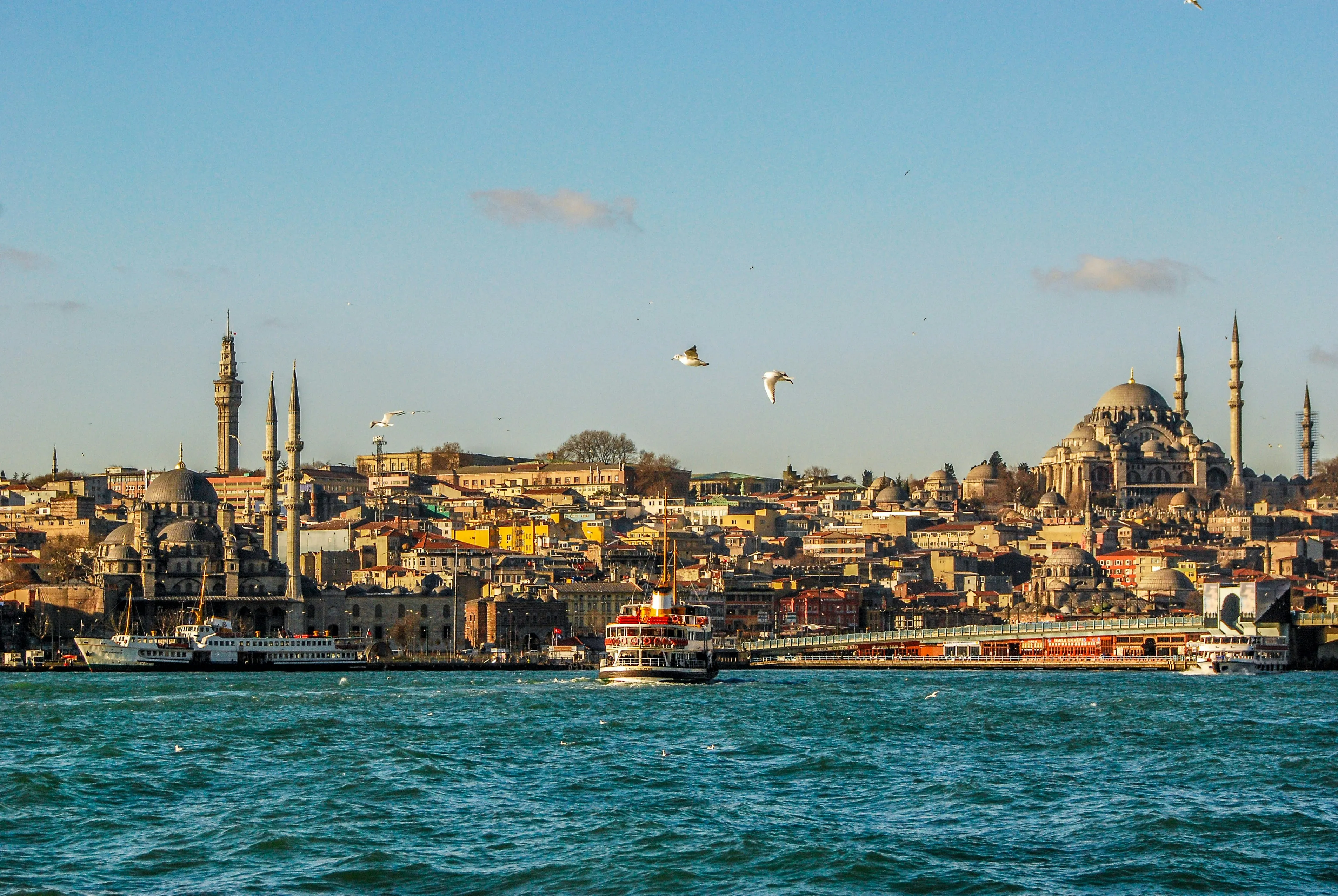
Turkey presents itself as a mosaic of cultures and landscapes where history seems to stop at every corner. The city of Istanbul acts as the great backbone of the country, being the only metropolis in the world set on two continents. Walking through the Sultanahmet neighborhood allows for the discovery of the architectural coexistence between the Blue Mosque and the ancient basilica of Hagia Sophia, two structures that define the city’s skyline. The commercial pulse is felt strongly in the Grand Bazaar and the Spice Bazaar, while the Bosphorus Strait offers a different perspective of the palaces and ancient wooden residences lining the coast, connecting the waters of the Black Sea with the Sea of Marmara.
Toward the interior of the country, the region of Cappadocia offers a geological landscape that seems taken from another world. Its rock formations, known as fairy chimneys, hide underground cities and temples carved directly into the stone beneath the surface. The Göreme Open Air Museum is a key point to understand the artistic and religious legacy of this area. In addition to its historical value, the region is famous for hiking trails through pink-toned valleys and for the possibility of observing the terrain from an elevated perspective, allowing one to appreciate the magnitude of its valleys and caves.
On the western coast, the legacy of the classical world takes center stage in Ephesus. This ancient city houses remains as significant as the Library of Celsus and the Great Theater, offering one of the best representations of Roman urbanism in the Mediterranean. Nearby, in the province of Denizli, lies Pamukkale, a natural phenomenon where mineral-rich thermal waters have created white limestone terraces similar in appearance to cotton. This environment is complemented by the ancient spa city of Hierapolis, where well-preserved necropolises and theaters looking out over the natural pools can be observed.
The Turquoise Coast, located in the south, combines the appeal of the Mediterranean coastline with Lycian heritage. Cities like Antalya preserve a historical center, known as Kaleiçi, where Roman gates and medieval walls coexist with a modern port atmosphere. Along this coast, natural spots such as the beaches of Fethiye or the sunken ruins of Kas are found. Activities here usually focus on sailing through small coves and exploring archaeological sites that look directly out to the sea, offering a constant contrast between the intense blue of the water and the mountainous relief of the Taurus range.
Finally, the political capital, Ankara, shows the most modern and administrative facet of the country, housing the Atatürk Mausoleum, a site of great architectural and symbolic relevance. In contrast, the eastern regions, less traveled but equally fascinating, present monuments such as Mount Nemrut, where huge stone statues guard a royal burial mound at a high altitude. This diversity between the bustle of large cities, the peace of coastal towns, and the mysticism of interior mountain areas makes each region contribute an essential piece to understanding the cultural and geographical complexity of this destination.
“Tip”: You cannot leave without visiting Hagia Sophia, the most emblematic place in the country.
✈️ Best time to travel
Turkey is a destination of great geographical extent and landscape diversity, allowing it to be visited at any time of the year depending on the experience sought. Generally, the transition seasons offer an ideal balance for visiting both historical cities and inland natural sites, as temperatures are moderate and days are usually clear.
While the coastal areas of the Aegean and Mediterranean have a typically Mediterranean climate, the center of the Anatolian peninsula experiences more marked variations between day and night. The choice of travel time will influence not only the weather but also the ease of access to certain monuments and the atmosphere found in the streets and bazaars.
| Season | Months | Typical weather | What to expect | Tourist influx |
|---|---|---|---|---|
| Spring | Mar – May | Mild and pleasant temperatures, with occasional rains. | Green landscapes, tulip blooms in the cities, and ideal conditions for hiking. | Medium ⭐⭐⭐ |
| Summer | Jun – Aug | Dry heat in the interior and humid on the coast. Clear skies. | Sun and beach season, outdoor festivals, and days with many hours of light. | High ⭐⭐⭐⭐⭐ |
| Autumn | Sep – Nov | Moderate temperatures that progressively drop. | Clear skies, autumn colors in nature, and a calm atmosphere for cultural visits. | Medium ⭐⭐⭐ |
| Winter | Dec – Feb | Cold, with frequent rains on the coast and snow in the interior and mountains. | Snowy landscapes in Cappadocia, mountain activities, and a more leisurely urban life. | Low ⭐⭐ |
🗣️ Basic vocabulary
Learning a few basic words in Turkish can make your day-to-day much easier during your trip through Turkey. Although it is common in the most touristy areas for hospitality staff to speak English, knowing fundamental greetings and expressions of courtesy helps interactions in shops, markets, or transport flow more smoothly.
It is not necessary to master the grammar, but using these terms in daily situations will allow you to navigate with more confidence and show interest in the local culture during your visits and daily tasks.
- Merhaba: Hello.
- Teşekkür ederim: Thank you.
- Lütfen: Please.
- Evet: Yes.
- Hayır: No.
- Affedersiniz: Excuse me or sorry.
- Hesap, lütfen: The bill, please.
- Ne kadar?: How much is it?