


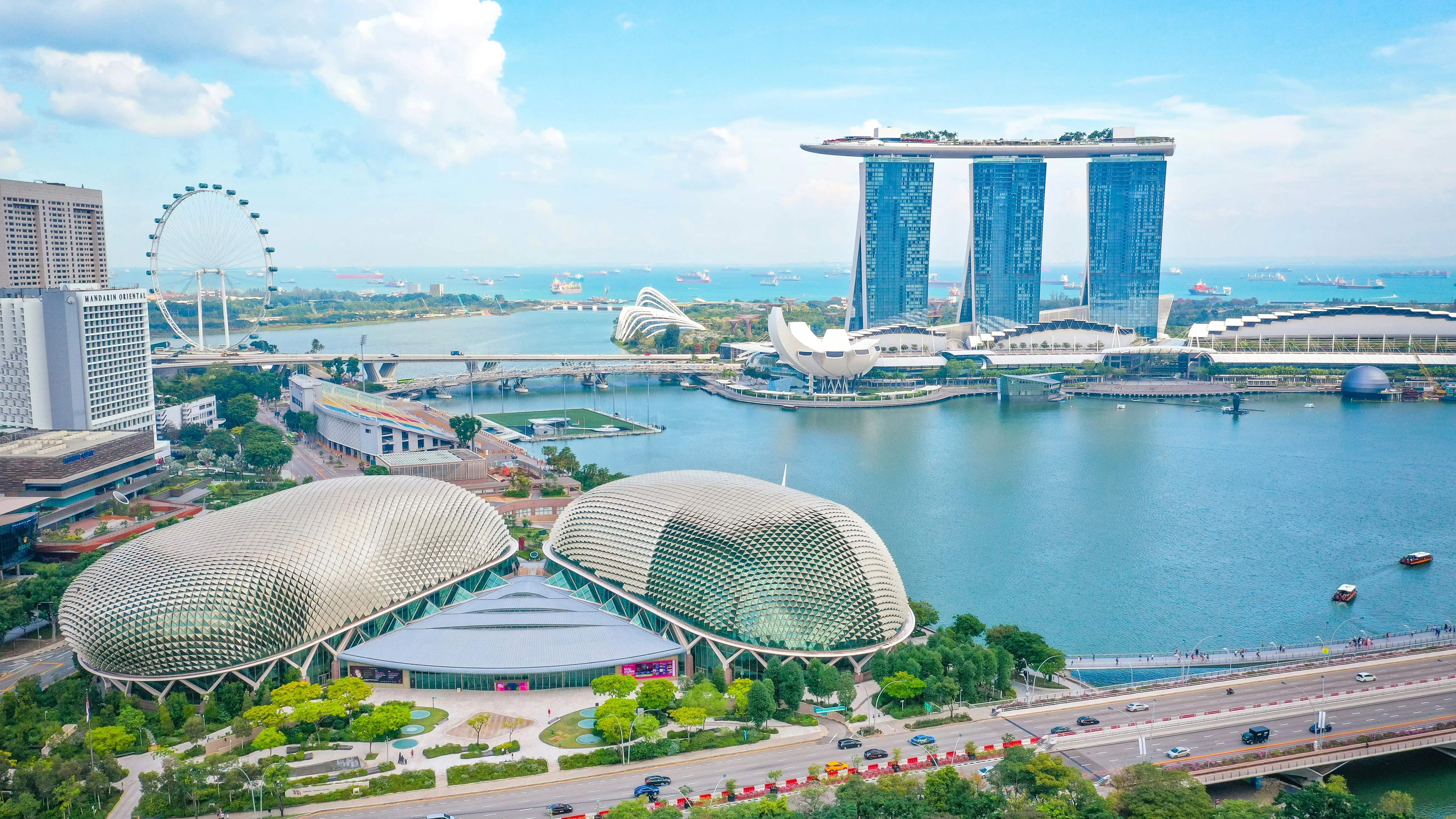
Singapore
A vibrant metropolis where nature merges with futuristic skyscrapers, offering exceptional gastronomy and a fascinating cultural mix in an impeccable environment.
Quick Facts
- Capital
- Singapore
- Language
- English
- Mandarin, Malay, Tamil
- Currency
- Singapore Dollar (SGD)
- Best time to visit
- From February to April to avoid the heavy rain season.
- Budget per day
- $80 - $250 per day
- Climate
- Equatorial, characterized by warm temperatures and constant high humidity with frequent rainfall throughout the year.
- Connectivity
- good
- Very easy to obtain at the airport and convenience stores.
- Electricity
- Type G (230V)
- Local transport
- good
- Card usage
- widespread
- Tipping
- optional
🌎 Introduction
Peering into this corner of Southeast Asia is to enter a world where tropical vegetation coexists with architecture that gazes calmly toward the horizon. Under a warm climate that remains constant throughout the year, life unfolds among tree-lined streets and green spaces that seem to reclaim their place against the asphalt, creating a unique and serene urban landscape.
The island’s identity is perceived in the natural blend of its neighborhoods, where the scent of spices from the markets coexists with the architecture of old traditional houses. Daily life is savored in its street food centers, meeting points where recipes of Chinese, Malay, and Indian origin cross at every table, reflecting a diversity celebrated with the same intensity during Chinese New Year or Deepavali.
Beyond its technological image, there is a slow rhythm in its gardens and in the flow of water along the coast. It is an environment that shows how cultural heritage and the present intertwine without stridency, offering a balanced vision where modernity does not forget its roots or the importance of nature in the common space.
🛡️ General Safety
Singapore is internationally recognized as one of the safest and most stable destinations in the world for travelers. Its reputation for order and cleanliness is not just aesthetic but is reflected in its extremely low crime rates, allowing tourists to enjoy the country with a peace of mind difficult to find in other metropolises.
General safety level
- The safety level in Singapore is considered extremely high. It is common for the country to occupy the top spots in global citizen safety indices.
- Compared to other international destinations, the risk to the traveler is very low. One can walk through almost any area at any time of the day or night without a real sense of danger.
- The context for the traveler is that of a highly regulated environment, where respect for rules is the foundation of coexistence and public safety.
Crime and common risks
- Although it is a very safe country, it is not totally free of crime. Minor thefts, such as pickpocketing or phone theft in very crowded areas (airports or shopping centers), can occur, although they are infrequent.
- Commercial scams are rare, but it is always recommended to check prices and conditions in electronics stores in highly touristy areas before making a payment.
- A rare but authority-mentioned risk is that of cybercrimes or scams through public Wi-Fi networks; therefore, using secure connections for banking transactions is recommended.
- There are no “off-limits” or dangerous zones, but it is wise to maintain basic common sense in places with large crowds.
Safety in cities and tourist areas
- The urban center, ethnic neighborhoods (such as Little India or Chinatown), and nightlife areas are constantly monitored by security cameras and police patrols, often in plain clothes.
- Public transport is one of the safest in the world. Metro stations (MRT) and bus stops are lit, clean, and have assistance staff.
- There are no significant safety differences between neighborhoods; even less touristy areas maintain the same standards of order and protection.
- It is recommended to walk calmly but avoid leaving personal items (such as phones or bags) to “reserve” a table in food courts (hawkers), even though it is a common local practice.
Transport safety
- Public transport (MRT and buses) is excellent, punctual, and very safe. Safety incidents on these means are practically non-existent.
- Taxis and private transport services (such as Grab) are strictly regulated. Drivers are usually professional and vehicles are in perfect condition. It is recommended to always use official vehicles or authorized applications.
- In Singapore, driving is on the left. If you decide to rent a vehicle, you must keep in mind that traffic rules are strictly enforced and traffic can be heavy, although drivers are usually respectful of signals.
- The use of seat belts is mandatory for all occupants and the use of mobile phones while driving is strictly prohibited.
Natural and climatic risks
- Singapore is not located in a major seismic activity zone, so the risk of earthquakes is very low.
- The main factor to consider is the extreme heat and humidity constant throughout the year, which can cause exhaustion or dehydration if precautions are not taken.
- Torrential rains are common and can cause sudden and brief flooding, especially during the monsoon season (from November to January).
- Occasionally, the country can be affected by haze, caused by forest fires in neighboring regions, which can affect air quality. It is recommended to check pollution levels if you have respiratory problems.
Local legislation and norms
- Singapore is famous for its strict laws. Behaviors that in other countries are minor offenses can carry heavy fines or prison sentences here.
- It is forbidden to import or sell chewing gum (except for therapeutic purposes). Littering, smoking in unauthorized places, or eating and drinking on public transport carries heavy financial fines.
- Drug laws are extremely severe, including the death penalty for trafficking and long prison sentences for consumption, even if it occurred before entering the country but is detected in a check.
- Vandalism (including graffiti) is punished with physical penalties (caning) and prison. It is essential to always respect local signs and norms to avoid legal problems.
Safety for specific groups
- Female travelers: Singapore is one of the safest destinations in the world for women traveling alone. Street harassment is almost non-existent and nighttime safety is very high.
- LGTBIQ+ travelers: Although Singapore has recently decriminalized same-sex relations, society remains somewhat conservative in certain aspects. Excessive displays of affection in public, regardless of orientation, are usually avoided by locals.
- Children and the elderly: The country is ideal for traveling with family or the elderly due to the excellent infrastructure, sidewalk accessibility, hygiene, and efficiency of medical services.
Emergencies and assistance
- In case of need, emergency services are fast and highly efficient.
- Police: 999
- Ambulance and Firefighters: 995
- Emergency personnel usually speak English perfectly, which facilitates communication for foreign tourists.
- In case of losing a passport or requiring legal assistance, the corresponding embassy or consulate in the city should be contacted immediately.
Tip: Download a local transport application (such as Grab) to move around with fixed prices and total safety, and always remember to carry a bottle of water to combat the tropical humidity.
📝 Entry Requirements
To plan a trip to Singapore, the first fundamental aspect is to have a valid passport with a residual validity of at least six months from the moment of entry into the territory. This document is the key piece for international identification and must be in good condition to avoid inconveniences at border control points.
In most cases of visits for tourist purposes, international travelers do not usually require a prior visa for short-term stays. Upon arriving in the country, immigration authorities usually grant a visit pass whose duration can vary, usually ranging between 30 and 90 days, depending on various administrative factors and the visitor’s origin. It is advisable to have documentation proving the purpose of the trip if required by agents.
During the entry process, it is frequent for tourists to be asked to present a confirmed onward/return ticket, either back to the place of origin or to a third destination, to ensure the traveler intends to leave the country within the permitted period. Additionally, proof of sufficient funds to cover the expected expenses during the stay without needing to perform paid activities in the country may occasionally be requested.
Controls at airports and other access points are known for their order and efficiency. The use of biometric technology to register the entry of visitors is common. Regarding health safety, there are usually no specific vaccination requirements for most profiles, although a yellow fever vaccination certificate may be requested from people who have recently been in areas where the disease is endemic.
Singapore has detailed customs regulations that travelers must consider when preparing their luggage. There are significant restrictions on the import of certain products. For example, it is advisable to carry personal medications in their original packaging accompanied by a medical prescription if they are specially controlled drugs. Likewise, the entry of tobacco, alcohol, and certain foods is subject to quantity limits and, in some cases, the payment of taxes or total prohibition, as is the case with some specific consumer items regulated locally.
The following summarizes the key points for access to the country as a tourist:
- Have a passport with a minimum validity of six months.
- Have a return or onward flight ticket.
- Verify the need to complete an electronic arrival declaration shortly before landing.
- Check that daily medications are properly identified.
- Possess proof of financial solvency for the planned period of stay.
- Consult the allowed limits for the entry of consumer products such as alcohol or tobacco.
- Check if a yellow fever certificate is required based on previously visited countries.
🏥 Basic Health Considerations
You will find in Singapore one of the most advanced and efficient health systems in the world. The quality of medical care is excellent in both public and private hospitals, although as a tourist you will most likely end up going to private centers for speed of care. You must keep in mind that healthcare for foreigners is not free and costs are high, ranking among the highest in the region. Health personnel are very well trained and you will be able to communicate with them in English without any difficulty, as it is the official language in the professional and administrative fields.
Taking out travel medical insurance is not a legal requirement to enter the country, but it is absolutely essential for your peace of mind. We recommend that your policy has broad coverage that includes hospitalization, emergency surgery and, very importantly, medical repatriation to your country. Without insurance, any health setback could result in a very significant financial outlay that would seriously affect your travel budget.
Regarding vaccines, generally you will not need any special protection beyond having your routine vaccination schedule up to date. The yellow fever vaccination certificate is only mandatory if you come from a country where this disease is endemic. Even so, it is always a good idea to consult with an international medicine center before leaving, but you will see that for a standard trip through the city-state, extraordinary measures are not usually required.
You must be very careful with the medication you plan to carry in your luggage. Singapore has very strict laws against drug trafficking and this affects certain drugs that are common elsewhere. If you need to carry specific medications for chronic treatment, it is essential that you carry them in their original packaging accompanied by a medical prescription in English explaining the treatment. For medications containing controlled substances, such as some strong painkillers or psychotropics, you might even need prior authorization from the local health authority (Health Sciences Authority).
Regarding risks based on the environment, the main factor you will notice is the extreme heat and humidity. You could suffer from dehydration or heatstroke if you don’t take care, so drinking liquids constantly is vital. Singapore is an area where dengue, transmitted by mosquitoes, is endemic. You should not be alarmed, but it is recommended that you use insect repellent, especially if you visit parks or areas with a lot of vegetation. There is no risk of malaria in the city, so in that aspect you can be totally calm.
One of the great advantages of this destination is that tap water is drinkable and totally safe for human consumption, something that does not happen in many neighboring countries. You will find that hygiene levels are very high everywhere. You can try the delicious food in the hawkers (street food centers) with total safety, as these stalls are subject to very rigorous health inspections and display a hygiene rating visible to the public.
If you find yourself in a medical emergency, the phone number you should dial is 995. This service manages the emergency ambulances of the civil defense force. If you have a health problem that is not a life-threatening emergency, you can go to primary care clinics spread across the city, known as General Practitioners (GP), which usually have long hours and very professional care.
Finally, we suggest some practical tips: always carry a refillable water bottle, use high-factor sunscreen even if the sky looks cloudy, and wear natural fabrics that breathe well. If you follow these basic guidelines, you will enjoy your stay in this corner of Southeast Asia without major concerns for your health.
🚌 Transport Within the Country
Mobility through Singapore is mainly based on a coordinated public transport network that connects most of the territory effectively. The metro and the bus are the most common means of transport for moving between different districts and points of interest. Due to the country’s geographical size, there are no internal flights, with all activity concentrated on land transport and, for nearby islands, the use of ferries.
The experience for the visitor is simple, as signage is clear and English is commonly used in all stations and vehicles. The systems for paying for trips are modern and designed so that anyone can use them intuitively from their arrival, facilitating access to different lines without the need for complex processes.
As a state with a mostly urban environment, infrastructure is constant in almost the entire territory. In peripheral or less dense areas, the frequency may vary slightly compared to the center, but punctuality and reliability are characteristic notes of the entire system. This allows travelers to organize their movements with a high degree of predictability.
Taxis and transport services managed through mobile applications operate regularly across the island. These vehicles offer a regulated service and are an alternative for direct door-to-door trips. The feeling of cleanliness and comfort is a constant in the different available means, facilitating a smooth and organized transport experience.
Tip: When planning short distance trips on foot, it is useful to observe that many stations and buildings are connected by covered walkways, allowing you to walk protected from weather variations.
🤵 Culture and Etiquette
Singapore stands out for being a society with deeply rooted multicultural coexistence, where mutual respect among different ethnicities and religions forms the basis of daily interaction. When greeting, a soft handshake is the general norm in professional and social contexts, although toward elderly people it is common to show special deference, using slow gestures and maintaining a prudent physical distance if no prior trust exists. Communication is usually direct but always imbued with polite courtesy, prioritizing harmony and tact in conversations in public spaces.
In the course of daily life, punctuality is considered a fundamental sign of consideration for others, both in professional commitments and informal encounters. In shared spaces and public transport, maintaining a moderate voice volume is valued so as not to interfere with the well-being of others, favoring an atmosphere of order and tranquility. A relevant detail of courtesy is the use of the right hand when giving or receiving objects, especially money, business cards, or gifts, as a gesture of attention highly appreciated in various local traditions.
In the gastronomic sphere, the culture of food centers or hawker centers has its own codes, such as using small personal items to reserve a spot at shared tables while ordering food. In full-service restaurants, tipping is not a standard or expected practice, as most establishments already include a service charge in the final bill. If you have the opportunity to visit a private home, it is an essential courtesy to remove your shoes before entering, leaving them in the designated area at the entrance.
Visiting places of worship and temples requires an attitude of quiet reflection and appropriate clothing covering shoulders and knees as a sign of respect toward local religious sensibilities. It is fundamental to observe specific indications regarding the use of cameras and maintain a discreet attitude during celebrations or rites. Family and social hierarchy is also a relevant factor, so addressing interlocutors with their corresponding titles or in a measured way contributes to creating an environment of trust and mutual respect.
“Tip”: It is advisable to discreetly observe the behavior of local residents in new environments, such as temples or ceremonies, to adapt your own behavior and always act with the greatest cultural sensitivity.
🍛 Typical Gastronomy
Singapore’s cuisine is a faithful reflection of its demographic diversity, fusing Chinese, Malay, and Indian influences with touches from other Southeast Asian cultures. This blend has given rise to a unique culinary identity where contrasts of flavors, textures, and aromas are the protagonists. Food is a fundamental pillar of social life in the city-state, and the offer varies from simple street stalls to more elaborate proposals, always maintaining a deep respect for traditional recipes.
The epicenter of local gastronomic culture is the hawker centres, large open-air venues housing numerous stalls specialized in specific dishes. In these spaces, it is common to see diners from all social strata sharing a table. A local curiosity is the practice of reserving a seat by placing a packet of tissues on the table before going to order food, an accepted custom that helps organize the flow of people during peak hours.
Regarding ingredients, rice and noodles form the basis of most preparations. Spices such as ginger, galangal, and lemongrass are frequently used, as well as coconut milk to provide creaminess to curries and soups. Seafood also occupies a prominent place, taking advantage of the country’s geographical location. Flavors usually fluctuate between spicy, sweet, and salty, often all found in the same dish to create a complex but pleasant balance.
Table habits vary according to the type of cuisine: chopsticks are used for dishes of Chinese origin, while for Indian or Malay specialties, the use of a spoon and fork is common or, in more traditional contexts, even hands. Regarding drinks, Kopi (local coffee) and Teh (tea) are the preferred options, frequently served with condensed milk. It is also very common to accompany meals with tropical fruit juices or refreshing barley-based drinks to counteract the humid and warm climate.
| Dish | Description | Main ingredients | Where to try it | Tip |
|---|---|---|---|---|
| Hainanese Chicken Rice | Poached chicken served with aromatic rice cooked in chicken broth. | Chicken, rice, ginger, garlic, and soy sauce. | Hawker centers and food courts. | Don’t forget to accompany it with the chili and ginger sauce served on the side. |
| Chilli Crab | Crab sautéed in a thick, sweet, and slightly spicy tomato-based sauce. | Crab, tomato sauce, chili, and egg. | Seafood restaurants and coastal areas. | Order some fried buns (mantou) to dip in the leftover sauce. |
| Laksa | Rice noodle soup with a base of coconut milk and spices. | Rice noodles, coconut milk, prawns, and curry paste. | Food stalls and historical districts. | It is usually served with cut noodles, so it can be eaten with just a spoon. |
| Satay | Grilled meat skewers served with a characteristic sauce. | Meat (chicken, beef, or lamb), turmeric, and peanut sauce. | Night markets and outdoor grill areas. | It is best enjoyed by dipping the skewer generously in the peanut sauce. |
| Roti Prata | Indian-influenced flatbread, crispy on the outside and soft on the inside. | Wheat flour, clarified butter (ghee), and water. | Indian food stalls and 24-hour establishments. | You can order it plain or filled, and it is ideal for both breakfast and dinner. |
📷 Areas and Places to Visit
Singapore is a destination that surprises with its ability to integrate avant-garde architecture with exuberant nature and neighborhoods full of history. One of the most recognizable and photographed areas is the surroundings of Marina Bay, where the urban profile merges with the water. Walking along its waterfront allows you to observe the contemporary design of the city, which takes on a different dimension at night when the lighting completely transforms the landscape. It is an ideal area for walking and enjoying the sea breeze while contemplating the integration of large engineering works into the urban environment.
Very close to this modern core are the Gardens by the Bay, a space that exemplifies the concept of a garden city. This park stands out for its vertical structures covered in vegetation and its large greenhouses that house botanical species from varied climates. For those looking for a slower contact with nature, the Singapore Botanic Gardens, declared a World Heritage Site, offers wide stretches of trails, lakes, and a unique collection of orchids in an environment that preserves the charm of historical gardens.
The country’s cultural diversity is manifested with great clarity in its ethnic neighborhoods, each with its own visual and auditory identity. In Chinatown, the visitor can walk through streets flanked by restored shophouses where traditional businesses coexist with temples of great artistic value, such as the Buddha Tooth Relic Temple. On the other hand, the Little India neighborhood envelops the traveler with its brightly colored facades, the scent of spice markets, and the detailed architecture of religious centers like the Sri Veeramakaliamman temple.
A short distance away, the Kampong Glam district shows the city’s Malay-Muslim legacy. This neighborhood is centered around the majestic Sultan Mosque and is known for its narrow streets filled with urban art, fabric shops, and perfumes. It is an area that combines religious tradition with a modern and creative atmosphere, offering a very interesting contrast to the skyscraper financial districts.
The Civic District represents the historical and administrative heart, where colonial-era buildings are preserved and today house important cultural institutions. Among them, the National Gallery Singapore and the National Museum of Singapore are essential stops to understand the social and artistic evolution of the region through their permanent exhibitions. This area invites a walking tour to discover monuments, commemorative statues, and old bridges that cross the river, connecting the foundational past with the prosperous present.
For those seeking leisure and relaxation, Sentosa Island offers sandy beaches, coastal trails, and various entertainment facilities. It is a space designed for rest, away from the commercial pulse of the center. In contrast, lovers of hiking and wildlife observation can head into the Bukit Timah Nature Reserve or walk the Southern Ridges, a series of bridges and elevated trails that connect several parks and allow you to see the city from the treetops, showcasing the biodiversity that inhabits the island.
Finally, areas like Orchard Road offer a different perspective centered on commercial activity and urban dynamism, with kilometers of galleries and modern spaces. Conversely, quieter areas like the MacRitchie Reservoir allow you to enjoy secondary tropical rainforest and perform outdoor activities in a serene setting. These contrasts between the hypermodern and the natural, between the traditional and the cosmopolitan, are what define the experience of exploring this country.
“Tip”: You cannot miss visiting Gardens by the Bay, the most iconic place in the country.
✈️ Best Season to Travel
Singapore is a destination that can be visited at any time of the year due to its geographical location near the equator, which guarantees warm and constant temperatures. Unlike other countries, it does not present marked thermal seasons; instead, its climate is mainly divided by monsoon regimes, which influence the frequency of rain and environmental humidity.
The choice of the ideal time depends on whether one prefers to avoid the most intense precipitation or seeks to coincide with cultural festivities that transform the urban landscape. Generally, the transitional months between monsoons offer a balance between sunny days and a vibrant atmosphere, allowing one to enjoy both the innovative green spaces and the varied cultural offerings of the city-state.
| Season | Months | Typical weather | What to expect | Tourist influx |
|---|---|---|---|---|
| Spring | Mar – May | Warm and with clear skies. Less rain than in other months. | Flowering in botanical gardens and ideal conditions for outdoor activities. | ⭐⭐⭐ (Medium) |
| Summer | Jun – Aug | High temperatures and a drier environment, though with possible haze episodes. | Gastronomic festivals, urban events, and a very dynamic atmosphere in the streets. | ⭐⭐⭐⭐⭐ (High) |
| Autumn | Sep – Nov | Gradual increase in humidity and occasional afternoon showers. | Traditional festivals of lights and preparations for major cultural events. | ⭐⭐⭐ (Medium) |
| Winter | Dec – Feb | Wettest and slightly cooler season. Frequent but brief rains. | Festive decorations, Lunar New Year celebrations, and very exuberant vegetation. | ⭐⭐⭐⭐⭐ (High) |
🗣️ Basic Vocabulary
Although English is the primary language in Singapore, in everyday life “Singlish” is widely used—a blend of English with words of Malay, Chinese, and Tamil origin. Knowing some of these terms will be very useful, especially when moving through food markets or interacting with local residents, as it facilitates communication in daily situations.
It is not necessary to master the grammar, but understanding these expressions will help you navigate more smoothly and better understand directions or local customs during your stay.
- Can: Means “yes” or that something is possible. It is a short and very frequent affirmative response.
- Chope: To reserve a seat in a food center (hawker centre), generally by leaving a packet of tissues on the table.
- Uncle / Auntie: A respectful way to address older people, such as taxi drivers or food stall vendors, even if they are not family.
- Tabao: Used to order food to go.
- Makan: A word of Malay origin meaning to eat.
- Shiok: An expression used to indicate that something, especially food, is delicious or of great quality.
- Kopi / Teh: Coffee and tea, respectively. These are the basic terms you will see in traditional coffee shops.
- Lah: A particle added to the end of sentences for emphasis, although it has no concrete meaning on its own.