


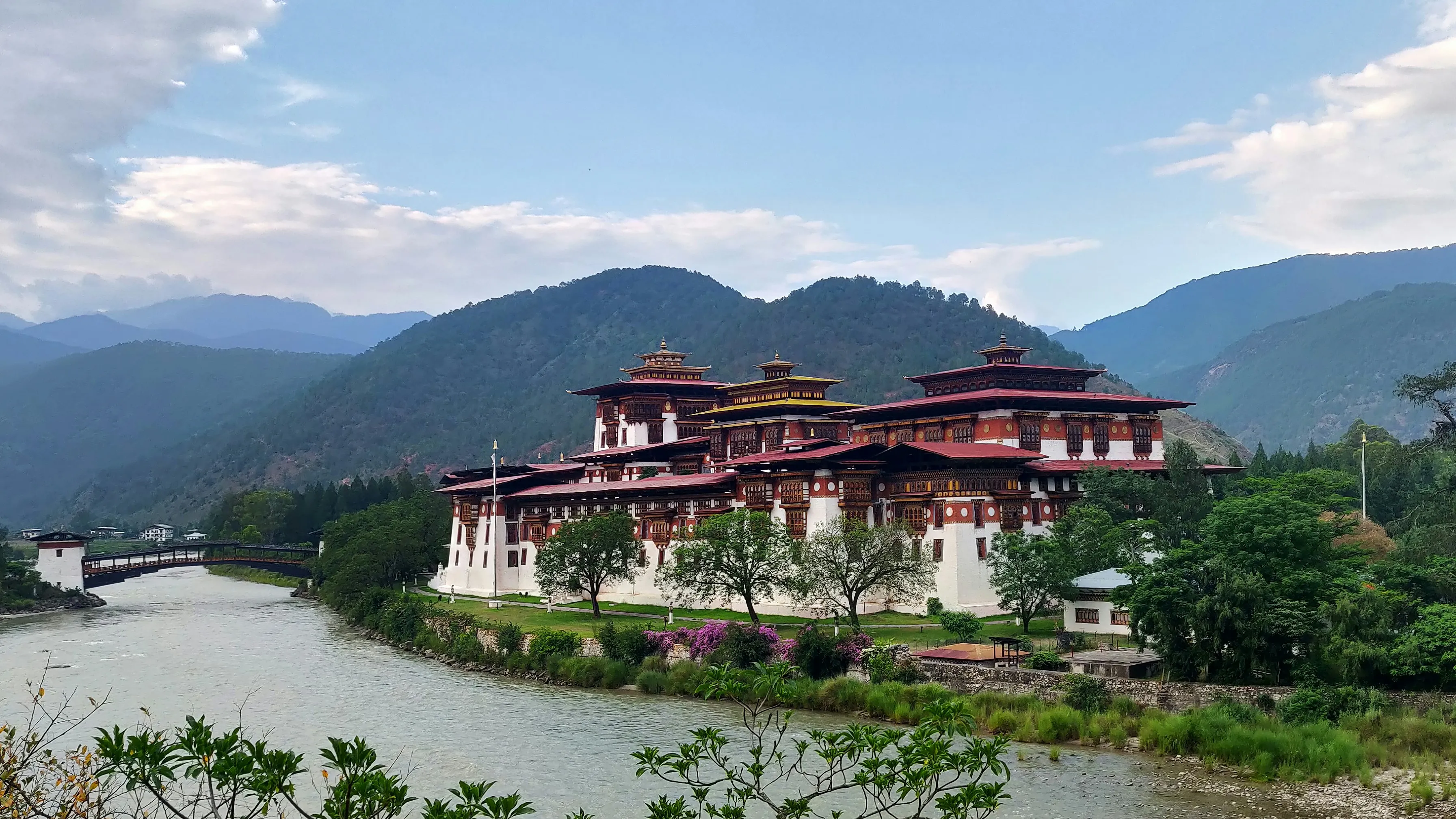
Bhutan
Explore this Himalayan kingdom of sacred monasteries and ancient traditions where Gross National Happiness guides sustainable development in a privileged natural environment.
Quick Facts
- Capital
- Thimphu
- Language
- Dzongkha
- English, Nepali
- Currency
- Bhutanese Ngultrum (BTN)
- Best time to visit
- From March to May and from September to November to avoid the monsoons.
- Budget per day
- $220 - $500 per day
- Climate
- Alpine climate in the north with perpetual snow and temperate in the central valleys, becoming subtropical in the southern plains.
- Connectivity
- low
- Easy to obtain with a passport at Paro airport or main cities.
- Electricity
- Type C, D, and G (230V)
- Local transport
- limited
- Card usage
- cash is used more
- Tipping
- optional
🌎 Introduction
In the folds of the Himalayan mountain range, where the air grows fresher and the valleys open up between snowy peaks, lies a territory that seems to be governed by its own rhythm. Daily life in this corner of Asia takes place between fortresses that crown hills and rice fields that transform the landscape with the passing of the seasons. It is not uncommon to find groups of neighbors practicing archery in the meadows or to see how vibrant prayer flags flutter their messages in the wind near crystal-clear rivers.
The identity of this place is perceived in the naturalness with which its inhabitants wear their traditional costumes and in the aroma of chili with cheese escaping from family kitchens. The natural environment, which ranges from dense pine forests to slopes covered with rhododendrons in spring, remains in constant balance with an architecture of white walls and carved woods. It is a destination that shows itself with serenity, where ancestral traditions coexist organically with the present.
Beyond the mountain postcard, there is an atmosphere of calm and a deep respect for the environment that defines its unique character. Whether during the celebration of its local festivals, full of music and symbolism, or under the clear autumn sky, the country offers a diversity of nuances that invite slow observation. It is, in essence, a meeting space between the most untamed nature and a culture that has known how to preserve its essence with pride and simplicity.
🛡️ General safety
Bhutan is considered one of the safest and most peaceful destinations in the world for travelers. The country maintains an extremely low crime rate, allowing for a relaxed travel experience without the usual worries of other international destinations.
The country’s cultural context, deeply influenced by Buddhist values and the philosophy of Gross National Happiness, fosters an environment of great respect, honesty, and hospitality toward visitors. As a guideline, the risk to the physical or material integrity of the tourist is rated as very low, being one of the most controlled and friendly environments for international tourism.
Crime and common risks
- Violent crimes against tourists are practically non-existent in Bhutan.
- Petty theft, such as pickpocketing or phone theft in crowded places, is extremely unusual, although it is always recommended to maintain basic common sense and not leave valuables in sight.
- There are no reported organized scam networks targeting foreigners, largely because most travelers move under the supervision of official guides.
- An uncommon risk that is worth mentioning is encountering stray dogs. Although they are generally peaceful during the day, they can become territorial and noisy at night, so it is recommended to avoid walking alone in dark areas where there are groups of animals.
Safety in cities and tourist areas
- In cities like Thimphu or Paro, safety is excellent. It is safe to walk through their streets at any time, even after sunset.
- Urban centers and tourist neighborhoods do not have “no-go zones” or dangerous areas; the atmosphere is family-oriented and calm at all times.
- To move around with total peace of mind, simply follow the instructions of local guides and respect the privacy of residents when taking photographs, especially in residential or less touristy areas.
Transport safety
- Driving in Bhutan is on the left, following the British system.
- Public transport is limited and mainly consists of local buses. For tourists, the most common and safest means is a private vehicle with a driver provided by the travel agency.
- Roads in Bhutan are narrow, winding, and cross high mountain areas, which requires very expert driving. Most tourists are not allowed to drive rental vehicles due to the complexity of the terrain.
- It is recommended to avoid road travel during the night, as many routes lack lighting and may present obstacles such as landslides or animals on the road.
Natural and climatic risks
- The most relevant natural risk is landslides, which occur mainly during the monsoon season (from June to August). These can block main roads and cause significant delays in the itinerary.
- Bhutan is located in a zone of seismic activity, so there is a risk of earthquakes, although large-magnitude events are not frequent.
- Altitude sickness (soroche) is an important safety factor for those trekking on Himalayan routes. It is essential to perform a progressive acclimatization and stay hydrated.
- During the winter, some areas may suffer road closures due to snow and ice, especially on high mountain passes.
Legislation and local norms
- Bhutan has very strict and unique laws regarding tobacco. Smoking is prohibited in most public places and the sale of tobacco is highly regulated. Tourists can import a limited amount for personal consumption upon payment of taxes, but must keep the receipt at all times.
- Religious respect is fundamental. It is mandatory to dress modestly (covering shoulders and legs) to enter monasteries, temples (lhakhangs), and fortresses (dzongs).
- It is strictly forbidden to climb mountains over 6,000 meters in height, as they are considered sacred places and the home of deities.
- Failure to comply with rules in sacred places or the trafficking of antiquities can carry serious penalties, including heavy fines or prison sentences.
Safety for specific groups
- Women travelers: Bhutan is an extraordinarily safe destination for women traveling alone. Respect for women is the norm and cases of harassment are practically nil.
- LGTBIQ+ travelers: Although homosexuality was legally decriminalized a few years ago, Bhutanese society remains conservative in social terms. It is recommended to avoid excessive public displays of affection, regardless of sexual orientation, to respect local customs.
- Traveling with children or the elderly: The country is very welcoming to families. However, it must be considered that many points of interest require walking on uneven or steep terrain, which can be physically demanding for people with reduced mobility or very young children.
Emergencies and assistance
- Police: 113.
- Ambulances / Medical Emergencies: 112.
- Fire Department: 110.
- Emergency services operate efficiently in urban areas. In rural or mountain areas, assistance may take longer due to the topography of the terrain, so it is always recommended to inform the guide of any prior health issues.
Tip: Always keep the contact information of your local tour operator at hand, as in Bhutan they are directly responsible for your safety and well-being, and they are the fastest link to resolve any logistical or medical unforeseen events.
📝 Entry requirements
To undertake a trip to this destination, most international visitors require a passport with a validity of at least six months beyond the planned date of arrival. It is recommended that the document be in optimal condition and have enough free pages to stamp the necessary entry and exit permits during transit through the borders.
Regarding the visa, access is usually regulated through obtaining a residence permit managed prior to arrival. This document is generally processed digitally or through authorized entities, and is usually linked to the payment of a sustainable development fee. This payment contributes directly to the preservation of the country’s natural and cultural heritage, maintaining a balanced tourism model that respects the environment.
The permitted duration of stay usually corresponds to the period requested in the travel permit and the days covered by the corresponding fees. Upon entry, it is common for authorities to request the presentation of a return ticket or continuation ticket to another destination, as well as documents confirming the reservation of tourist services or accommodation during the stay.
Border controls at airports and enabled land points are common and usually carried out smoothly for travelers who have their documentation in order. It is advisable to keep the entry permit accessible, either physically or in electronic format, to show it to immigration officials when required.
Customs regulations are specific regarding the entry of certain personal consumption items. The entry of tobacco and its derivatives is subject to strict regulations and, in most cases, requires the payment of special taxes at the point of entry. There are also limitations on the introduction of products such as fresh food, plants, or chemical substances. Similarly, the export of antique objects or pieces of cultural value is regulated to protect the historical legacy.
Regarding health requirements, generally no mandatory vaccines are established for all travelers, although it is worth checking if there are particular recommendations according to the area of origin or the regions planned to be visited. It is suggested to have international medical insurance with broad coverage that includes assistance and transfers, given the particular mountainous geography that characterizes a large part of the territory.
- Validity of the identity document: A minimum margin of six months on the passport is suggested.
- Visa processing: An entry permit managed in advance of the start of the trip is frequently required.
- Tourism contribution: Access usually involves the payment of a daily fee linked to the sustainable development of the destination.
- Transport tickets: It is advisable to have the entry and exit reservations for the country at the time of the migration control.
- Product restrictions: The entry of tobacco is subject to taxes and clear limits at customs.
- Heritage protection: It is recommended to avoid the acquisition of objects considered antiquities without the proper certification for their export.
- Health prevention: It is advisable to have a medical insurance policy with coverage for activities in mountain environments.
🏥 Basic health considerations
When preparing for your trip to this kingdom in the clouds, it is important to know that the healthcare system in Bhutan is simple and focuses mainly on public care. In the capital, Thimphu, you will find the National Referral Hospital, which is the best-equipped center in the country. If you move to more rural areas, you will see that assistance becomes much more limited and basic. Although the government offers free health to its citizens, as a tourist you will have to pay for the medical services you use, so having financial backing is key. An important advantage is that most medical staff speak English fluently, so you will be able to explain what is happening to you without major communication difficulties.
It is absolutely essential that you take out high-coverage travel medical insurance before boarding the plane. It is not only recommended, but to process your entry permit, it is often assumed that you have it. Your policy must without fail cover medical evacuation and repatriation, as if you suffer a serious incident in the mountains, transfer by helicopter to specialized centers in neighboring countries is the only option and has a very high cost. Make sure your insurance also covers trekking activities if you plan to do any route above 3,000 meters.
Regarding vaccines, you will not find any legal obligation to enter Bhutan, unless you come from an area where yellow fever is endemic. The most practical thing is to have your vaccination schedule up to date, including the usual booster doses. As a preventive measure, you could consider vaccination against Hepatitis A and Typhoid, especially if you plan to try food at local stalls or visit remote villages where water hygiene is not as controlled.
If you follow a specific treatment, it is best to take all the necessary medication for the total duration of the trip with you. Do not rely on finding specific brands in local pharmacies, as supply is limited. It is highly advisable to carry medicines in their original packaging and accompanied by a copy of the medical prescription translated into English. There are no severe legal restrictions for common medications, but it is always better to be cautious with substances that could be considered psychotropic.
The biggest health challenge you might face is altitude sickness. Since a large part of the country is at a considerable elevation, you may feel dizzy, have a headache, or feel fatigued during the first few days. The key is to ascend gradually and stay very well hydrated. Additionally, the mountain sun is very treacherous, so you will find that the use of sunscreen and glasses is vital to avoid burns. In the southern areas, which are lower and jungle-like, mosquitoes can be annoying, although the risk of diseases transmitted by them is quite low on the usual tourist routes.
Regarding the consumption of water and food, the golden rule is do not drink tap water. You can find bottled water easily or use filtering systems and purification tablets. The food is usually safe and delicious, but you should avoid raw vegetables or fruits that you cannot peel yourself if you want to avoid stomach setbacks. Hygiene in restaurants for tourists is usually good, but it is always a good idea to carry a hand sanitizer gel.
For any serious medical emergency, the number you should dial is 112. This service coordinates ambulance assistance, although you must take into account that, due to the geography of the country and the state of some roads, response time may be longer than what you are used to in urban areas.
As final tips for your stay to be perfect, I suggest you take the first few days very calmly to acclimatize your body to the altitude. Always carry a small first-aid kit with basic items like band-aids, painkillers, and something for digestion. If you are prone to motion sickness, remember that the roads in Bhutan have many curves, so carrying some motion sickness medication will be very useful during road trips.
🚌 Transport within the country
Moving around Bhutan is an experience mainly conditioned by its mountainous geography. Road transport is the most common means to move between different regions, with private vehicle with a driver being the most widespread option among visitors. Although there are some domestic flights that connect strategic points of the country, their operation is limited and closely depends on weather conditions, which can be changeable in the Himalayas.
Public transport, mostly composed of buses, is used mainly by the local population. For a traveler, using these services can be less intuitive because frequencies are not always regular and the purchase of tickets is done in person. Nevertheless, signage on the main roads is usually clear and language does not usually represent an insurmountable barrier at the points of greatest influx.
In major cities like Thimphu or Paro, the use of taxis for urban trips is common, offering a simple and direct way to move through the main hubs. On the other hand, in rural areas, transport options are considerably reduced, depending almost exclusively on pre-arranged vehicles to access the most remote valleys and monasteries.
The general feeling when traveling through the country is one of a slow pace. Due to the state of the mountain roads and the winding nature of the terrain, speed is reduced, which influences the perception of punctuality. However, vehicles intended for tourism usually offer a good level of comfort, allowing the journeys, although long in time, to be an opportunity to observe the natural environment.
Tip: It is essential to keep in mind that travel times by road are always higher than what the kilometric distance suggests due to the topography of the terrain.
🤵 Culture and etiquette
Bhutanese society deeply values courtesy, discretion, and mutual respect in all daily interactions. When greeting, it is common to use terms that denote deference, and it is common to observe a slight bow of the head as a sign of consideration toward the interlocutor. In personal dealings, it is preferred to maintain a soft tone of voice and avoid loudness or excessive displays of affection in public spaces, maintaining a respectful physical distance that favors an atmosphere of calm and harmony in daily life.
When visiting temples, monasteries, or fortresses (dzongs), it is fundamental to follow certain guidelines that reflect appreciation for the country’s spiritual traditions. It is a general rule to always circulate in a clockwise direction when circling religious monuments, stupas, or prayer wheels. Before entering sacred interior spaces, shoes must be removed and one must ensure to dress modestly, covering shoulders and legs. Silence and a reflective attitude are essential in these enclosures, where the figures of monks and religious hierarchies occupy a place of high social recognition.
In the realm of gastronomy and social gatherings, hospitality is a fundamental pillar. When receiving or delivering any object, whether it is a gift, money, or a cup of tea, it is recommended to use both hands or the right hand while slightly supporting the arm with the left, a gesture that symbolizes honesty and respect. During meals, it is common to wait for the hosts to give the signal to begin. Regarding tipping, while it is not part of a traditional obligation, it has become a well-received and valued gesture of gratitude in the tourist services sector for the effort dedicated.
Punctuality is perceived as a form of respect toward others’ time, especially in formal appointments or scheduled excursions. However, local inhabitants usually show a flexible and patient attitude toward unforeseen events, so maintaining a calm posture in the face of any change of plans is always well-regarded. In general, etiquette in this destination is based on moderation and a deep sense of decorum, always seeking that the visitor feels integrated through an attentive and slow observation of local customs.
“Tip”: Avoid pointing directly at people, statues, or sacred places with your index finger; instead, use an open palm facing upward, as it is considered a much more respectful and appropriate gesture.
🍛 Typical gastronomy
The cuisine of Bhutan is distinguished by a bold and generous use of chili, which in this country is not considered a simple condiment, but a fundamental vegetable in the daily diet. Flavors are usually intense and comforting, designed to provide energy in a high-mountain environment. The central element of almost any meal is red rice, a local variety that grows at high altitudes, has a slight nutty flavor and a firm texture that perfectly accompanies stews with consistent sauces.
The national dish par excellence is Ema Datshi, a simple but emblematic combination of chilies and melted cheese that reflects the essence of the Bhutanese palate. Eating habits are traditionally simple; families usually gather around shared dishes where the freshness of organic ingredients is the priority. Although pork and beef are common, there is a large variety of vegetarian options due to the strong influence of Buddhism in the local culture, highlighting the use of wild mushrooms, ferns, and legumes.
From a cultural point of view, food is linked to rituals of hospitality. It is common for hosts to offer Suja, a traditional tea made with yak butter and salt, which is highly appreciated for its ability to hydrate and warm the body. Regarding etiquette, it is common for locals to eat with their hands, although in restaurants oriented toward travelers, cutlery is always provided. A curious custom is zhey-zhey, a gesture of courtesy that consists of refusing food two or three times when it is first offered, finally accepting it to show gratitude.
Meal times in Bhutan are usually early, especially dinner, which is served shortly after sunset in the more rural areas. In the main cities, the offer is more flexible, but the preference for seasonal products is maintained. It is important to keep in mind that the spiciness level can be high by international standards, so it is usually advisable to ask about the intensity of the dish before starting, although recipes prepared for visitors are usually moderated.
| Dish | Description | Main ingredients | Where to try it | Tip |
|---|---|---|---|---|
| Ema Datshi | The national dish, a chili stew in cheese sauce. | Green or red chilies and local cheese (datshi). | Traditional restaurants in Thimphu and farmhouses. | Accompany it with plenty of red rice to soften the spiciness. |
| Kewa Datshi | A creamy and mild stew, similar to potatoes with cheese. | Potatoes, cheese, and thin slices of chili. | Guesthouses and local restaurants. | It is the ideal option if you prefer a less spicy dish than Ema Datshi. |
| Phaksha Paa | Pork stew with chilies, often with seasonal vegetables. | Pork, dried red chilies, and radish or spinach. | Bhutanese cuisine restaurants in Paro. | Look for versions that include sun-dried pork strips. |
| Momos | Steamed or fried dumplings, very popular as a snack. | Flour dough filled with meat, cheese, or vegetables. | Street stalls and cafes in urban areas. | Try them with the chili sauce (ezay) served separately. |
| Jasha Maroo | A spicy and very aromatic chicken stew. | Minced chicken, ginger, garlic, onion, and chilies. | Punakha restaurants and hotels across the country. | The strong ginger flavor is what makes it refreshing and different. |
📷 Areas and places to visit
Bhutan is a destination where traditional architecture, spirituality, and nature intertwine organically. Traveling through the country, one perceives a subtle contrast between the more developed valleys and the rural regions that preserve a centuries-old lifestyle. The central axis of any visit usually begins in Thimphu, the kingdom’s capital. Unlike other international capitals, there are no traffic lights here and the pace is slow. In this city, it is essential to see the Memorial Chorten, a stupa with golden spires that serves as a spiritual meeting point for local inhabitants, and the Tashichho Dzong, an imposing fortress-monastery that houses the seat of government and the monarch’s throne.
Near the capital, the Buddha Dordenma, a bronze statue of monumental proportions, presides over the valley from a hill. In addition to religious points, Thimphu offers an immersion into Bhutanese culture through the National Library, the Zorig Chusum Institute, where the thirteen traditional arts and crafts are taught, and the Textile Museum, which shows the importance of fabrics in national identity. Local markets are also areas of interest for observing daily life and craftsmanship in wood and metal.
The Paro valley is another essential stop, not only because it houses the country’s only international airport, but for its historical richness. In this area, the Rinpung Dzong stands out, an example of defensive architecture with massive walls that dominate the landscape. Nearby, the National Museum of Bhutan, located in an old circular watchtower, allows for a deeper dive into the natural and cultural history of the region. Rice fields and traditional houses painted with symbolic motifs define the landscape of this fertile valley.
Toward the east lies Punakha, which was the country’s capital until the mid-20th century. This region enjoys a milder climate, allowing for the cultivation of fruits and vegetables. The most representative place is the Punakha Dzong, strategically located at the confluence of the Pho Chhu and Mo Chhu rivers. This building is considered one of the most harmonious in the country due to its structure and natural location. In the vicinity, the Chimi Lhakhang temple attracts visitors interested in local traditions related to fertility and the figure of the “Divine Madman.”
For those seeking an experience more linked to nature and trekking, the Phobjikha valley offers a vast glacial landscape. It is an important conservation area, known for being the wintering ground for black-necked cranes, birds revered in local culture. In this rural setting sits the Gangtey monastery, which offers panoramic views over the valley. Walks through the natural routes of this area allow for the observation of the biodiversity of the Himalayan range without great technical difficulties.
The Bumthang region is considered the spiritual center of Bhutan and consists of four main valleys. It is the ideal place to see the oldest temples, such as Jambay Lhakhang or Kurjey Lhakhang, where legends about the origins of Buddhism in the country are preserved. The area is also famous for its seasonal festivals, known as Tshechus, where mask dances and colorful costumes are the protagonists. Life in Bumthang is markedly rural, allowing the tourist to visit small cheese dairies and factories of local products that contrast with the urban life of the main cities.
As one moves toward the east of the country, the terrain becomes steeper and population centers more scattered. Areas like Trashigang offer a less explored vision, ideal for meeting nomadic communities and seeing more complex weaving techniques. Regardless of the region visited, the integration of the fortresses or dzongs into the natural environment and the absence of disproportionate modern constructions give the entire territory an atmosphere of visual and cultural cohesion that is very characteristic.
“Tip”: You cannot leave without visiting the Taktshang monastery, the most emblematic place in the country.
✈️ Best season to travel
Choosing the right time to visit Bhutan depends largely on the activities one wishes to perform, whether trekking mountain trails or participating in its colorful festivals. Generally, the country’s climate is conditioned by altitude, offering marked contrasts between the Himalayan peaks and the southern valleys. Transitional seasons are the most frequent among travelers, as they provide a balance between moderate temperatures and clear skies.
During spring and autumn, the landscape transforms, offering very different pictures: from the flowering of the forests to the absolute clarity of the snowy peaks after the rainy season. However, less crowded seasons, such as winter or summer, allow for a quieter and more everyday side of the kingdom, provided one has the appropriate gear for the cold or rain.
| Season | Months | Typical climate | What to expect | Tourist influx |
|---|---|---|---|---|
| Spring | Mar – May | Mild temperatures and moderately long days. | Flowering of rhododendrons and wildflowers; celebration of the Paro Tshechu festival. | High (⭐⭐⭐⭐) |
| Summer | Jun – Aug | Prevalence of the monsoon; high humidity and frequent rains. | Landscapes of intense green, clouds on the peaks, and greater tranquility in the temples. | Low (⭐) |
| Autumn | Sep – Nov | Clear skies, fresh air, and very stable weather. | Panoramic views of the Himalayan range, cultural festivals, and harvest season. | Very high (⭐⭐⭐⭐⭐) |
| Winter | Dec – Feb | Sunny days with blue skies; intense cold and snow in high areas. | Sighting of black-necked cranes in high valleys and trekking on low-altitude routes. | Medium - Low (⭐⭐) |
🗣️ Basic vocabulary
Although English is very widespread in tourist services and urban areas of Bhutan, knowing some expressions in Dzongkha, the national language, is very useful for daily life. Bhutanese people greatly value the effort of visitors to communicate in their language, which facilitates a smoother and closer interaction in markets, temples, or small villages.
To manage comfortably, it is not necessary to delve into grammar; memorizing a few polite phrases is enough. These words will help you greet, show gratitude, or make simple inquiries during your travels and visits, making your travel experience more authentic and respectful of the local culture.
- Kuzuzangpo la: Hello (formal and common greeting).
- Kadrin chhe la: Thank you very much.
- Tashi delek: Greeting of good wishes or “good luck”.
- Choe gaday bay yoe?: How are you?
- Legshom: Fine (response to the previous question).
- Ga de chi mo?: How much does it cost?
- Ola: Yes.
- Me: No.
- Zhimbay: It’s delicious (ideal for use at meals).