


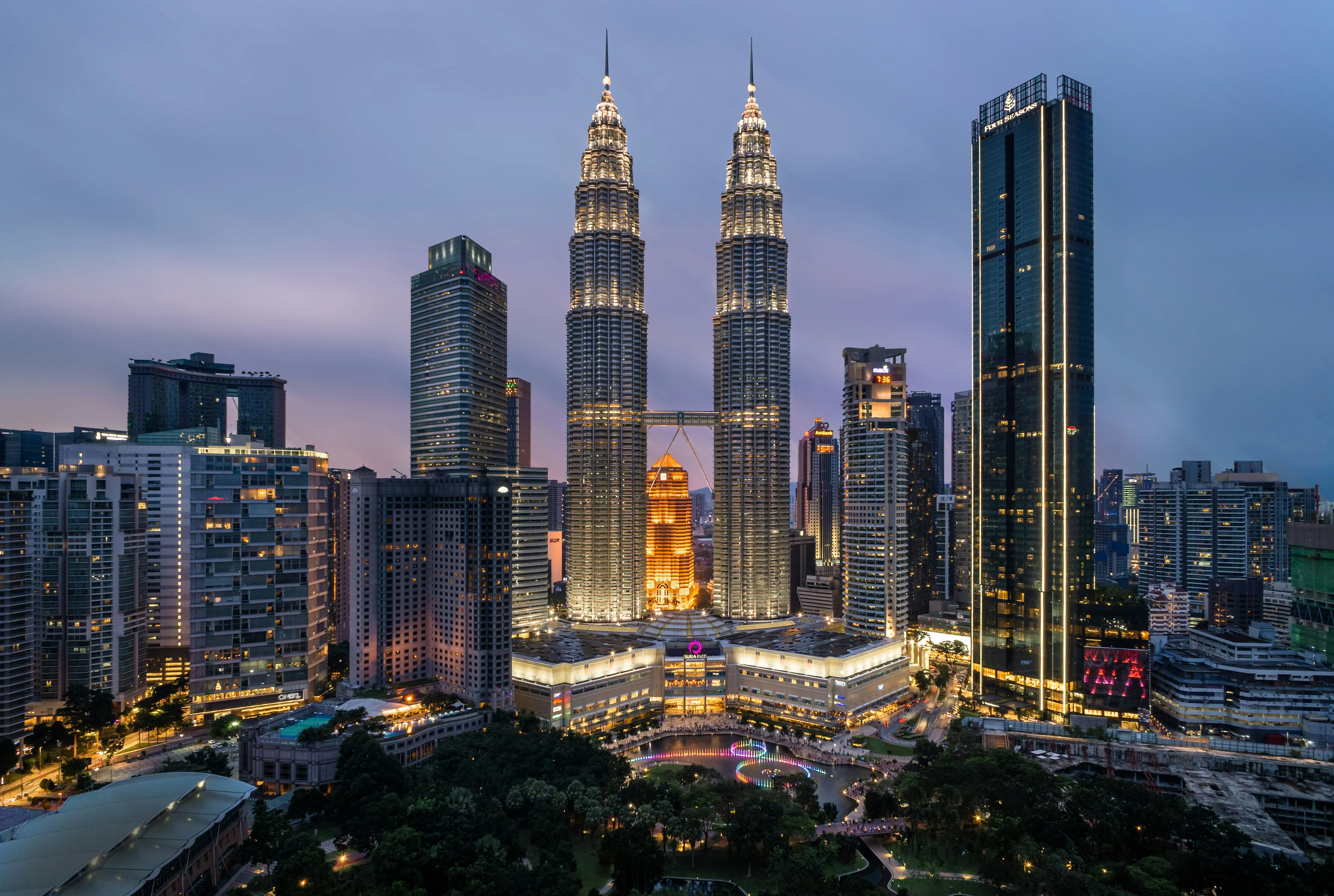
Malaysia
A fascinating destination that combines urban modernity, ancient jungles, and paradisiacal beaches, offering a rich cultural and gastronomic diversity unique in Southeast Asia.
Quick Facts
- Capital
- Kuala Lumpur
- Language
- Malay
- English, Chinese, and Tamil
- Currency
- Malaysian Ringgit (MYR)
- Best time to visit
- From March to October for the east coast and from November to March for the west coast.
- Budget per day
- $30 - $100 per day
- Climate
- Warm and humid equatorial climate throughout the year, with frequent tropical rains that vary by region and monsoon.
- Connectivity
- good
- Very easy to get at airports and local shops, with eSIM options available.
- Electricity
- Type G (240V)
- Local transport
- good
- Card usage
- acceptable
- Tipping
- optional
🌎 Introduction
Malaysia stretches between mainland Southeast Asia and the island of Borneo, forming a territory where tropical jungles coexist with modern-profile cities. It is a place where the daily rhythm is set by both the monsoon cycles and the constant movement in its markets and ports. This geographical duality defines an environment of pleasant contrasts, where the freshness of the highlands dedicated to tea cultivation offers a natural counterpoint to the warmth of its coastal areas.
Walking through its streets means encountering a natural coexistence of traditions, aromas, and languages. The smell of spices at food stalls and the architecture of its temples tell a shared story among diverse cultures that have made this corner their home. From the celebrations that fill the cities with color on significant dates to the simple routine of sharing a plate of rice at a wooden table at sunset, the country maintains its own identity that is perceived in the small details of everyday life.
The variety of the Malaysian landscape allows for a leisurely transition between the thick forest and the calm of fishing villages. It is a region where nature and urban life have found a particular balance, keeping ancient customs alive in an environment that looks forward. The hospitality of its people and the richness of its cuisine, influenced by centuries of exchanges, form the essence of a destination with its own personality.
🛡️ General Safety
Malaysia is considered one of the safest and most stable destinations in Southeast Asia. The country offers a welcoming environment for international tourism, with modern infrastructure and a generally peaceful atmosphere. The level of safety for travelers is high, placing it in a very favorable position compared to other global destinations. Although minor risks exist, as in any popular tourist destination, most visits take place without any type of incident.
The context for the traveler is that of a multicultural and respectful country, where the coexistence between different ethnicities and religions marks the daily rhythm. Local authorities value tourism positively and strive to maintain a protected environment for those who visit its cities, islands, and national parks.
Common Crime and Risks
Crime affecting tourists is, for the most part, non-violent in nature. The most common risks include:
- Pickpocketing: Pickpockets may operate in very crowded areas, such as night markets, transport stations, or popular shopping centers.
- Snatch theft from motorcycles: This is a theft method that occasionally occurs in large cities. Thieves take advantage of the agility of motorcycles to grab bags or phones from people walking near the roadway.
- Minor scams: Situations of overcharging for some informal services or “friendship scams” can occur, where locals try to take tourists to specific establishments to obtain commissions.
- Card fraud: Although it has decreased, it is advisable to always monitor credit cards and use ATMs located inside banks or safe shopping centers.
Safety in Cities and Tourist Areas
Urban centers, especially Kuala Lumpur, George Town (Penang), and Melaka, are safe for walking even after dark, as long as the usual precautions of any large city are followed.
- Kuala Lumpur: Tourist areas such as Bukit Bintang or the vicinity of the Petronas Towers have surveillance and good lighting. It is recommended to keep belongings on the side of the sidewalk away from traffic.
- Urban public transport: Monorail trains, the LRT, and modern buses are very safe environments and have security cameras and surveillance personnel.
- Rural areas and islands: In nature or beach destinations (such as Langkawi or the Perhentian Islands), the crime rate is practically non-existent, although it is always prudent not to leave valuables unattended on the sand.
Transport Safety
Transport in Malaysia is one of the most efficient in the region, allowing for very peaceful travel.
- Driving: In Malaysia, people drive on the left. Main roads and highways are in excellent condition, although traffic in cities can be dense and somewhat chaotic.
- Taxis and private transport: The use of ride-hailing apps (such as Grab) is highly recommended. They are safe, the price is fixed in advance, and the journey is recorded by GPS. If opting for a conventional taxi, it is essential to ensure they use the meter.
- Rental vehicles: It is common to rent motorcycles on the islands. Extreme caution should be taken regarding the condition of the vehicle and the mandatory use of a helmet, as traffic accidents are the most real safety risk for the tourist.
Natural and Climatic Risks
Malaysia has a tropical climate, which implies certain natural phenomena that the traveler should be aware of:
- Monsoons: The country experiences two monsoon seasons. The northeast monsoon (from November to March) especially affects the east coast of the peninsula and Borneo, and can lead to the closure of ferry services and diving activities.
- Floods and torrential rains: Heavy rains are common and can cause rapid localized flooding. Generally, they do not pose a life-threatening danger, but they can disrupt transport.
- Heat and humidity: Extreme heat is a health risk factor. It is vital to stay hydrated and avoid prolonged exposure to the sun during the central hours of the day.
- Haze: During periods of drought, a smoke haze can occasionally appear due to agricultural burning in the region, which affects air quality.
Legislation and Local Norms
It is fundamental to remember that Malaysia is a country with strict legislation and a majority Muslim culture in many of its regions.
- Drugs: Malaysia has extremely severe laws against the trafficking and consumption of illegal substances, which can include very long prison sentences or even the death penalty. There is zero tolerance.
- Public behavior: Respectful behavior is expected. Excessive displays of affection in public may be frowned upon or considered inappropriate in less liberal areas.
- Clothing: To visit temples, mosques, and government buildings, it is mandatory to dress modestly (shoulders and knees covered).
- Alcohol: Although consumption is legal for non-Muslims and it is easily found in tourist areas, there are more conservative states (such as Kelantan or Terengganu) where access is more limited and social norms are stricter.
Safety for Specific Groups
- Women travelers: Malaysia is a very safe destination for women traveling alone. However, it is recommended to dress respectfully toward the local culture to avoid unwanted attention, especially in rural or less touristy areas.
- LGTBIQ+ travelers: Homosexuality is not legal in Malaysia and there is significant social conservatism. It is recommended to maintain an attitude of maximum discretion and avoid public displays of affection to prevent legal or social inconveniences.
- Traveling with children and the elderly: Malaysia is an excellent destination for families. Infrastructures are accessible, and respect for children and the elderly is a fundamental basis of local culture.
Emergencies and Assistance
The country has professional and well-equipped emergency services, especially in urban areas.
- Main emergency number: The unified number for emergencies (Police, Ambulance, and Fire Department) is 999.
- Tourist Police: In cities like Kuala Lumpur, there is a Tourist Police unit (easily identifiable by their uniforms and armbands) trained to assist international visitors.
- Medical care: Private hospitals in large cities are of an international standard. It is essential to travel with comprehensive health insurance, as costs for foreigners can be high.
Tip: Always use mobile transport apps instead of street taxis to ensure a fair price and GPS tracking of your journey at all times.
📝 Entry Requirements to the Country
When planning a trip to Malaysia, the first fundamental step is to ensure that your passport has a minimum validity of six months from the planned moment of arrival in the territory. It is highly recommended that the document is in perfect physical condition and has enough free pages for the entry and exit stamps that immigration authorities will place at the corresponding checkpoints.
A large proportion of international visitors can enter the country for tourism purposes without the need to arrange a prior visa. In these cases, an authorization to stay for a specific period is usually granted, which habitually ranges between 30 and 90 days, depending on current international agreements. It is advisable to verify the general situation for each traveler profile, although most tourists enjoy simplified access for short-term stays.
Upon arriving at entry points, whether they are international airports or land borders, immigration personnel may request proof of an onward ticket from the country or for the continuation of the journey to a third destination. Likewise, on occasion, proof of possessing sufficient financial funds to cover the planned expenses during the stay may be required. Control processes usually include the registration of biometric data, a standard procedure in modern border management.
Regarding customs regulations, there are standard restrictions on the entry of certain products. It is important to pay attention to the permitted quantities of personal items and avoid bringing in fresh food products or materials that may be considered sensitive by local authorities. If traveling with specific medication, it is prudent to carry the original medical prescription to facilitate any routine inspection of luggage.
From a health point of view, there are usually no specific vaccination requirements for most travelers, unless coming from areas with a risk of transmission of very specific diseases. Nevertheless, it is advisable to consult general health recommendations and have travel insurance that offers broad coverage to guarantee a peaceful stay in the face of any unforeseen event.
The following are some additional practical aspects for entering and staying in the country:
- Customs control is usually carried out randomly, focusing on compliance with tobacco and alcohol allowances.
- It is common to be asked to complete a digital arrival registration before presenting yourself at the immigration counter.
- Respect for local regulations regarding dress and behavior is positively valued by border authorities.
- It is recommended to always keep a digital copy of travel documentation in a safe and accessible place.
- Local currency can be easily obtained at exchange offices and ATMs present at all arrival points.
🏥 Basic Health Considerations
When you prepare your trip to Malaysia, you will discover that it is one of the countries with the best medical infrastructure in Southeast Asia. In large cities like Kuala Lumpur or Penang, you will find private hospitals of excellent quality that have state-of-the-art technology and very well-trained professionals. Most doctors and nurses speak fluent English, so you will be able to explain what is happening to you without major difficulties. Although a public system exists, as a tourist it is most normal to be referred to private medicine, where prices are reasonable but can increase quickly if you need specific tests or to stay overnight.
It is not mandatory to present health insurance to cross the border, but taking out travel insurance is an essential recommendation that you should not overlook. Since there are no free healthcare agreements for foreigners, any consultation or treatment will come out of your pocket. Make sure your policy includes broad coverage for hospitalization, medical transfers, and repatriation. Having this support will allow you to enjoy the beaches and jungles with the peace of mind that, in the face of any mishap, you will be well attended to without ruining your budget.
Regarding vaccines, there are none mandatory to enter the country, unless you are coming from an area where yellow fever is endemic, in which case they will ask for the international certificate. The most practical thing is to verify that you have your usual vaccination schedule up to date. Depending on the type of trip you are going to take, you could discuss the Hepatitis A and typhoid fever vaccines with your doctor, especially if you plan to get lost in rural areas or try absolutely every food stall you see.
If you need to travel with specific medication, remember that Malaysia has very strict laws regarding controlled substances. Always carry your medications in their original packaging and make sure to have a medical prescription handy, preferably in English, explaining the treatment. For common ailments, you will see that pharmacies in cities are very well stocked and pharmacists usually give very professional advice on basic medications for pain or minor digestive problems.
The tropical climate will be your main travel companion, and with it come some risks that you can easily manage. Humidity and high temperatures can cause dehydration or heat stroke if you don’t take care of yourself. Additionally, in some areas you will find mosquitoes that can transmit dengue, so the use of a good repellent is fundamental, especially at dawn and dusk. There is no risk of malaria in the main tourist areas, but if you are going to venture into very deep jungles, it is advisable to inform yourself beforehand.
Regarding water and food, although tap water in cities is usually treated, it is most recommended to always drink bottled or filtered water to avoid typical traveler stomach discomfort. Gastronomy is one of the country’s strong points and you will be able to try incredible dishes on the street. Malaysia has fairly acceptable hygiene standards; just make sure that the food is cooked to order and that the stalls have a lot of movement from local customers, which is usually a sign of freshness.
If you find yourself in an emergency situation, the number you should dial is 999. This is the centralized emergency telephone for ambulances, police, and fire department. In urban centers, assistance is usually quite fast, although if you are in isolated areas of Borneo or on small islands, logistics can be somewhat slower.
As final tips for your day-to-day, don’t forget to apply sunscreen frequently, even if the sky is overcast, as the sun hits with great force near the equator. Always stay well hydrated and wear light cotton or natural fiber clothing that allows your skin to breathe. With these basic precautions, you will find that Malaysia is a very safe and comfortable destination from a health point of view.
🚌 Transport Within the Country
Malaysia has a varied infrastructure that facilitates movement between its different regions. Domestic flights are the most common way to cover the distances between Peninsular Malaysia and the states on the island of Borneo. For land journeys through the peninsula, the bus is the most widespread medium, as it connects almost all towns with a modern road network. For its part, the train offers a regular service that mainly runs along the western coast, joining important cities comfortably. In coastal areas and archipelagos, the ferry is the essential transport for transfers between islands.
Ease of use is one of the characteristics of the Malaysian transport system for visitors. Signage in English is frequent in stations and airports, which simplifies orientation during journeys. Purchasing tickets is a direct process that can be done at the terminals themselves and official points of sale. Customer service staff usually have a good command of languages, which speeds up communication and the resolution of doubts about routes.
There is a notable contrast between the infrastructures of metropolitan areas and rural zones. In the capital and its surroundings, one can enjoy metro and light rail networks that speed up urban displacements. In contrast, in less populated environments or natural settings, travelers usually opt for vehicle rentals or the use of taxis, which allow for greater flexibility to explore places where collective transport is less frequent.
Private transport services managed by mobile apps are very widespread and function stably, providing a predictable alternative to conventional taxis. In general terms, the means of transport in the country are perceived as reliable and punctual. Vehicles intended for passenger transport are usually equipped with air conditioning systems, which guarantees an adequate sense of comfort against the tropical climate outside.
Tip: it is advisable to always carry a light item of clothing during long journeys, as the use of air conditioning in buses and trains is usually very intense.
🤵 Culture and Etiquette
Malaysia is a society characterized by its multicultural diversity and a deep sense of mutual respect among its communities. When interacting with the local population, a cordial greeting is usually the starting point; although a handshake is common in urban contexts, many people prefer a more subtle gesture, such as placing the right hand on the chest after a brief contact or making a small nod of the head. In public spaces, it is positively valued to maintain a moderate tone of voice and a calm attitude, avoiding excessive displays of affection or gestures of anger, as social harmony and discretion are fundamental pillars of daily coexistence.
In interpersonal dealings, courtesy manifests through a slow-paced communication where direct confrontation is avoided. The concept of preserving personal prestige and that of others is very important, so corrections or criticisms are usually made privately and gently. Regarding physical contact, it is convenient to remember that the head is considered the most sacred part of the body, so touching it should be avoided, even in gestures of affection toward children. Regarding the use of space, punctuality is appreciated in formal appointments and transport services, although in more relaxed social situations there is a natural flexibility that the traveler will perceive as normal.
Daily habits related to eating and visits require observing certain uses of the right hand. This is considered the preferred hand for eating, handing over objects, or making payments, while the left is reserved for personal hygiene tasks. When visiting a private home or certain traditional shops, it is a common rule to remove your shoes before entering, leaving the shoes at the door as a sign of respect for the cleanliness of the home. In restaurants and cafes, tipping is not a social obligation nor is it systematically expected, although leaving the change or a small tip is a gesture well-received by the service staff.
Respect for religious beliefs and social hierarchies is essential for smooth integration. When accessing mosques, temples, or shrines, it is necessary to dress modestly, covering shoulders and knees, and always removing footwear at the entrance. It is important to observe if there are areas reserved exclusively for prayer or restricted access to certain rituals. Likewise, respect for the elderly is a fundamental value reflected in the order of greetings or the attention paid to them during a conversation. Maintaining an observant attitude and following the example of locals will help the visitor move naturally in any environment.
Tip: Always use your right hand to give or receive money, documents, or food, and if you need to point to a direction or an object, preferably do so with the thumb of the right hand resting over the rest of the closed fingers, as pointing with the index finger can be too direct in certain contexts.
🍛 Typical Gastronomy
The cuisine of Malaysia is a faithful reflection of its cultural diversity, fusing Malay, Chinese, and Indian traditions into a rich and varied culinary proposal. This mix of influences has given rise to complex flavors where the balance between spicy, sweet, and sour predominates. Rice and noodles form the base of most meals, serving as an accompaniment for a wide range of curries, meats, and vegetables that use fresh ingredients from the region.
Among the essential components of its dishes, coconut milk stands out, used to provide creaminess, and a spice base known as rempah, which usually includes lemongrass, galangal, ginger, and turmeric. The use of sambal, a spicy chili paste, is almost universal and is often served as a side condiment. Additionally, belacan (fermented shrimp paste) provides a deep and characteristic flavor to many local preparations, granting that particular aroma of Southeast Asian cuisine.
Eating habits in the country are strongly marked by the culture of street stalls and hawker centers, open spaces where various food stalls are concentrated. It is common for locals to have several light meals throughout the day. Regarding etiquette, in traditional Malay and Indian establishments, it is frequent to eat with the right hand, although the use of cutlery or chopsticks is fully widespread and accepted in all types of venues. Due to the Muslim majority of the population, many restaurants have halal certification, which implies the absence of pork products.
To accompany the food, drinks are usually sweet and refreshing to contrast with the spices. Teh tarik, a black tea with condensed milk that is mixed by pouring it from one container to another to create foam, is the national drink par excellence. Also common are tropical fruit juices and kopi (local coffee), which is served in different ways according to the preference for sweetness or milk. Hours are quite broad, especially in main cities, where it is possible to find freshly prepared food at almost any hour.
| Dish | Description | Main Ingredients | Where to try it | Tip |
|---|---|---|---|---|
| Nasi Lemak | Considered the national dish, it consists of aromatic rice cooked in coconut milk. | Rice, coconut milk, dried anchovies, peanuts, hard-boiled egg, and sambal. | At any breakfast stall or Malay cuisine restaurants. | Mix it all with the sambal to balance the flavor of the coconut with the spice. |
| Satay | Marinated meat skewers grilled over charcoal. | Chicken, beef, or lamb, turmeric, and peanut sauce. | Night markets and specialized street stalls. | Don’t forget to dip the meat generously in the accompanying peanut sauce. |
| Laksa | Noodle soup with a spicy and aromatic broth that varies by region. | Rice noodles, fish or shrimp broth, coconut milk, and tamarind. | In Penang (sour version) or in Melaka (creamy version). | Try the different regional variants, as the flavor changes a lot from one area to another. |
| Char Kway Teow | Flat rice noodles stir-fried over very high heat in a wok. | Rice noodles, shrimp, cockles, bean sprouts, and soy sauce. | Hawker centers throughout the country. | Consume it freshly made to enjoy the slightly smoky texture of the stir-fry. |
| Roti Canai | Indian-influenced flatbread, crispy on the outside and tender on the inside. | Wheat flour, water, and ghee, served with lentil curry (dhal). | ”Mamak” style establishments (Indian-Muslim venues). | It is an ideal option for a light breakfast or an informal dinner at any time. |
📷 Zones and Places to Visit
Malaysia presents itself as a destination of contrasts where the modernity of its urban centers coexists in harmony with millenary jungles and ancestral traditions. The tour of the country usually begins in its capital, Kuala Lumpur, a metropolis that symbolizes the growth of Southeast Asia. In it, the urban landscape is defined by the silhouette of the Petronas Towers, but also by neighborhoods with a strong cultural identity such as Chinatown and Little India. Walking through its streets allows you to discover Hindu temples, mosques of contemporary architecture, and the Islamic Arts Museum, which houses one of the most important collections in the region. A short distance from the center are the Batu Caves, a set of natural caves that house shrines and are a fundamental point of pilgrimage.
Towards the north of the peninsula, the island of Penang stands out for its capital, George Town, declared a World Heritage Site. This city is famous for its well-preserved colonial architecture, its street art, and its temples, such as Kek Lok Si. The area is known for its vibrant gastronomic offer and its night markets, where the mix of Malay, Chinese, and Indian cultures is reflected. Following the historical route, Malacca offers a different perspective, showing the legacy of the old Portuguese, Dutch, and British colonies through its reddish buildings and its quiet navigable river.
For those looking for more direct contact with nature, the Cameron Highlands provide a respite thanks to their cool climate and extensive tea plantations. It is an ideal region for hiking routes among green hills and visiting local farms. On the other hand, the Taman Negara National Park invites you to enter one of the oldest tropical jungles on the planet. Here, activities focus on jungle walks, bird watching, and tours along suspension bridges over the treetops, allowing you to get to know the country’s biodiversity at a steady pace.
The Malaysian coast has archipelagos that are international benchmarks for relaxation and water activities. On the western coast, Langkawi stands out for its geological formations and its quiet beaches, as well as a cable car that offers panoramic views of the surrounding islands. On the east coast, the Perhentian Islands are a recurring destination for diving and snorkeling due to the clarity of their waters and the richness of their coral reefs. These areas allow you to enjoy a relaxed maritime environment, away from the hustle and bustle of big cities.
Finally, the territory of Malaysia on the island of Borneo, divided into the states of Sarawak and Sabah, offers a wilder experience focused on conservation. In this region, it is possible to visit orangutan rehabilitation centers and explore immense cave systems in the Gunung Mulu National Park. Mountain fans find an important challenge in Mount Kinabalu, being one of the highest peaks in the region. This part of the country stands out for its indigenous communities and a virgin nature that notably differentiates the rural environment from the more industrialized areas of the peninsula.
Tip: You cannot miss visiting the Petronas Towers, the most emblematic place in the country.
✈️ Best Season to Travel
Malaysia is a tropical destination that maintains warm temperatures and constant humidity throughout the year. Located near the equator, the climate is not divided into the four traditional seasons of temperate zones but is governed mainly by the monsoon systems that affect the east coast and the west coast of the peninsula, as well as the Borneo region, differently.
The choice of the ideal time for the visit depends largely on the areas you wish to explore. While one side may experience clear skies, the other may be in the middle of the rainy season. In general terms, the country offers a diverse travel experience where nature always looks lush and cultural festivities are distributed throughout the entire calendar, allowing you to always find a suitable spot for tourism.
| Season | Months | Typical Climate | What to Expect | Tourist Inflow |
|---|---|---|---|---|
| Spring | Mar – May | Warm and humid; transition after the northeast monsoon. | Opening of the islands on the east coast and optimal conditions for diving and snorkeling. | Medium (⭐⭐) |
| Summer | Jun – Aug | Dry on the east coast; moderate rains in the west. | Favorable weather for visiting national parks and the Perhentian or Redang islands. | High (⭐⭐⭐) |
| Autumn | Sep – Nov | Increase in rainfall across almost the entire country. | Very green landscapes, festivals like Deepavali, and less crowding at historical sites. | Medium - Low (⭐⭐) |
| Winter | Dec – Feb | Heavy rains in the east; dry and sunny on the west coast. | Chinese New Year celebrations and ideal conditions on islands like Langkawi or Penang. | High (⭐⭐⭐) |
🗣️ Basic Vocabulary
Although English is very widespread in tourist areas of Malaysia, knowing some words in Bahasa Melayu, the local language, will help you connect better with the people and move around with more ease. It is a gesture that local inhabitants usually appreciate and that facilitates everyday situations in markets, restaurants, or transport.
It is not necessary to master the grammar to manage successfully; it is enough to memorize a few key terms that will allow you to show courtesy and solve basic needs during your stay in the country.
- Apa khabar?: How are you? (commonly used as a greeting).
- Terima kasih: Thank you.
- Sama-sama: You’re welcome.
- Ya / Tidak: Yes / No.
- Maaf: Sorry or excuse me.
- Berapa?: How much does it cost?
- Di mana…?: Where is…?
- Sedap: Tasty or delicious (very useful at street food stalls).