


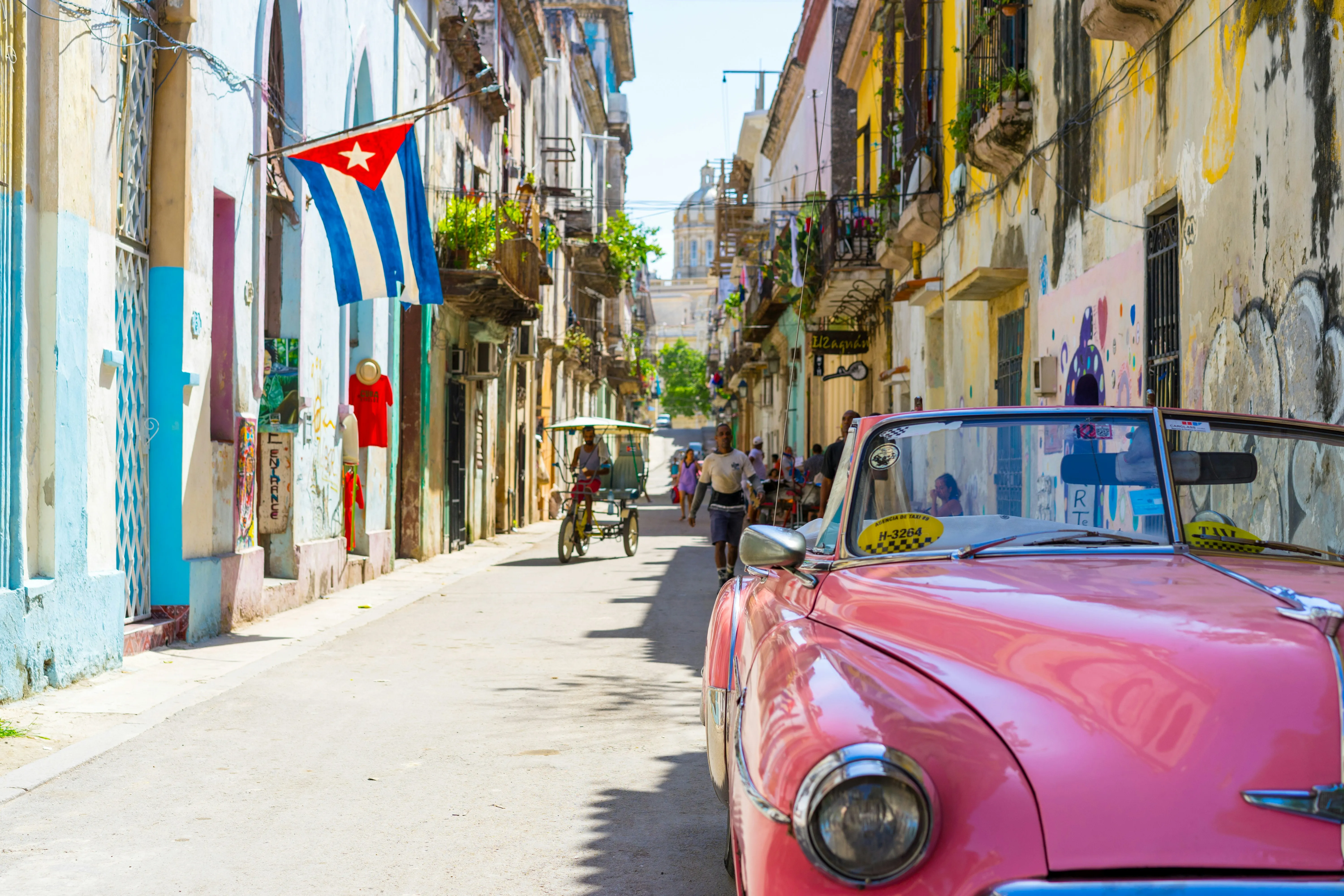
Cuba
Cuba seduces with its blend of colonial history, pristine beaches, and Caribbean rhythms, offering an authentic cultural experience under a warm and welcoming tropical sun.
Quick Facts
- Capital
- Havana
- Language
- Spanish
- None
- Currency
- Cuban Peso (CUP)
- Best time to visit
- From November to April, during the dry and less hot season.
- Budget per day
- $40 - $150 per day
- Climate
- Moderate tropical climate with a dry winter season and a rainy, humid season during the summer months.
- Connectivity
- low
- Available via temporary ETECSA cards at official points, although the signal can be unstable.
- Electricity
- Type A/B (110V)
- Local transport
- limited
- Card usage
- cash is used more
- Tipping
- optional
🌎 Introduction
Cuba is often perceived as an archipelago where the rhythm of life has its own cadence, far from the usual rush. Walking through its streets allows a glimpse of an architecture that narrates centuries of history and a daily life that unfolds naturally in squares and porches. The island’s identity has been forged in a deep miscegenation, where Spanish and African roots coexist organically in the music, traditions, and that spontaneous conversation that arises easily between neighbors and travelers.
The natural environment offers a balanced contrast between the marine horizon and the greenery of the interior. While the coastline is marked by the constant presence of the sea and a warm light that envelops everything, the Cuban countryside maintains a slow pace, with its reddish earth valleys and the plantations that form part of its most recognizable physiognomy. It is a setting of soft nuances, where the aroma of freshly brewed coffee and the atmosphere of popular celebrations compose an atmosphere as authentic as the landscapes that surround it.
🛡️ General safety
Cuba is considered, in general terms, as one of the safest destinations in the Caribbean and Latin American region for international travelers. The country maintains strict social and police control, which translates into a very low violent crime rate. Tourists are usually viewed with respect and as an important source of income for the country, so authorities prioritize their protection.
Despite this low risk assessment, it is fundamental for the traveler to understand the country’s socio-economic context. Cuba goes through periods of scarcity and economic difficulties, which can lead to an increase in petty theft or scams. The environment is mostly calm and hospitable, allowing walking through many areas even at night, always applying the common sense one would have in any other international destination.
Common crime and risks
Although serious crimes are unusual, there are minor risks that are worth knowing to avoid setbacks during the stay:
- Thefts and pickpocketing: These are the most frequent incidents, especially in high-traffic areas such as Old Havana, the Malecón, or the beaches of Varadero. They usually occur due to carelessness on terraces, beaches, or public transport.
- Scams and “Jineterismo”: It is common for local people to approach very politely to offer help, recommend a restaurant, or sell supposedly authentic tobacco at a low price. Often, this ends in a request for money or an inflated commission at the recommended establishment.
- Irregular currency exchange: It is recommended to avoid exchanging currency on the street with strangers. Although the informal market exists, the risk of receiving counterfeit bills or being cheated in the count is real.
- Snatching: Although very rare, it can occur in poorly lit or very crowded streets. It is recommended not to wear flashy jewelry or hang cameras conspicuously.
Safety in cities and tourist areas
Safety varies slightly depending on the area, although the general tone is one of stability and calm.
- Urban centers: Cities like Havana, Santiago de Cuba, or Trinidad are safe. However, in Old Havana and Central Havana, some streets may have deficiencies in public lighting, which can generate a subjective feeling of insecurity, even if the real risk remains low.
- Beach areas: In tourist hubs like Varadero or the Cayos, safety is extremely high and access is usually more controlled, which reduces common crime to almost a minimum.
- Movement recommendations: It is advisable to move through the busiest areas. If visiting a peripheral or non-tourist neighborhood at night, the ideal is to use an official taxi for the trip.
Transportation safety
Moving around Cuba requires paying attention to certain logistical and infrastructure details:
- Driving: In Cuba, driving is on the right. The state of the main roads is acceptable, but secondary roads often have potholes, a lack of signage, and stray animals. It is strongly recommended to avoid driving at night due to poor lighting and the presence of vehicles without lights (such as bicycles or carts).
- Rental vehicles: They are a popular option, but the car should be checked thoroughly upon receipt. In case of breakdown, assistance services can be slow outside the main cities.
- Taxis: There are official (state) taxis and private vehicles (known as “almendrones”). Official ones are safer and have taximeters or regulated fares. In private ones, it is essential to agree on the price before getting in.
- Public transport: Urban buses are usually very full, which facilitates the work of pickpockets. For interurban routes, the Viazul company is the standard and safe option for tourists.
Natural and climatic risks
Cuba’s climate is tropical, which implies certain seasonal phenomena that the traveler should consider:
- Hurricanes: Hurricane season runs from June to November, with a higher probability between August and October. Cuba has a very efficient Civil Defense system for evacuation and protection, but flights and services may be interrupted.
- Extreme heat: Temperatures and humidity are very high all year round, especially in July and August. The risk of dehydration or heat stroke is relevant.
- Floods: During periods of heavy rain, some low-lying areas of cities (especially near Havana’s Malecón) may suffer coastal or rain-induced flooding.
Local legislation and norms
Cuba has strict laws that are rigorously applied, and ignorance of them does not excuse compliance:
- Drugs: There is a zero-tolerance policy regarding the trafficking and consumption of narcotic substances. Penalties are very severe, and conditions in penitentiary centers are difficult.
- Documentation: It is mandatory to always carry a passport or a copy of it, as well as the tourist card and mandatory medical insurance.
- Political activities: It is recommended to avoid participating in demonstrations, protests, or local political activities, as they can lead to arrests or expulsion from the country.
- Photography: It is strictly forbidden to photograph military installations, government buildings, or security personnel.
Safety for specific groups
- Female travelers: Cuba is a very safe destination for women traveling alone. They may experience constant comments on the street (the so-called “piropo”), which although generally not aggressive, can be annoying or invasive.
- LGTBIQ+ travelers: Social acceptance has grown significantly in recent years, especially after the approval of new family laws. However, in rural areas, there may still be conservative attitudes. Public displays of affection are generally accepted in tourist areas.
- Children and the elderly: The country is very welcoming to families. The main risk for these groups is the heat and irregularities in the sidewalks, which can cause falls or difficulties for people with reduced mobility.
Emergencies and assistance
In case of needing help, these are the key points to keep in mind:
- Emergency numbers:
- National Revolutionary Police (PNR): 106.
- Fire Department: 105.
- Ambulances / Medical Emergencies: 104.
- Emergency services: The police are visible and usually help tourists in case of need. However, bureaucratic procedures to report a theft can be slow.
- Medical Assistance: The healthcare system for tourists is independent of the local one and is managed through the Servimed centers. It is fundamental to have travel insurance with broad coverage to access these services quickly.
”> Tip: Always carry a photocopy of your passport with you and keep the original in your accommodation’s safe, along with most of your cash and valuables.”
📝 Entry requirements
To organize a pleasure trip to Cuba, it is essential to keep in mind that access to the territory requires the presentation of a valid passport. Generally, it is recommended that this document has a minimum validity of six months from the moment of arrival at the airport. In addition to personal identification, most international travelers must obtain a tourist card in advance, a specific document that enables entry for recreational purposes and is usually requested by authorities before boarding or upon landing.
The permitted stay under tourist status usually has an initial duration of ninety days, although in many cases there is the possibility of requesting an extension to extend the visit for a similar period. During the entry process, it is common for customs personnel to request confirmation of a return ticket, which guarantees that the visitor plans to leave the territory within the permitted time. Likewise, on some occasions, proof of sufficient financial funds to cover the expenses planned during the stay may be required.
At entry points, routine checks are carried out to ensure compliance with current regulations. It is important to know the restrictions on the import of certain items, especially regarding medicines, fresh food, or products of animal origin, whose entry may be limited or subject to specific regulations. Personal items and common electronic devices do not usually present issues, provided the quantities are considered reasonable for an average traveler.
From a health point of view, mandatory vaccinations are not usually required for most traveler profiles, although it is advised to keep the standard immunization schedule up to date. A relevant aspect is the convenience of having travel insurance that includes medical coverage, as having adequate protection is a recommended practice and frequently verified by local authorities to ensure that any health incident can be attended to without setbacks during the stay on the island.
- Essential documentation: Passport with extended validity and a tourist card processed prior to the start of the journey.
- Period of stay: Initial maximum stay of three months, with the option to manage additional extensions at the corresponding offices.
- Proof of return: Proof of outbound transportation and, occasionally, accreditation of financial resources for the stay.
- Customs regulations: Restrictions applicable to perishable products, certain communication equipment, and high volumes of drugs without a clear prescription.
- Health safety: Recommendation to have an international medical assistance policy and basic vaccinations in order.
🏥 Basic health considerations
In Cuba, you will see that the healthcare system has a hard-earned prestige, although it works differently for visitors. As a tourist, it is common for you to access a specific care network called Servimed, which has modern clinics and hospitals oriented toward the traveler. You will find medical staff with excellent training and, of course, they will assist you in Spanish without any communication problems. The costs of these international services are moderate, but it is always necessary to pay for the assistance, so it is not a good idea to travel without financial backup or prior coverage.
You must be very clear that to enter the country travel medical insurance is mandatory. It is a legal requirement that migration authorities may check upon your arrival. Your policy must include, at a minimum, coverage for hospitalization, emergency medical expenses, and repatriation. If for any reason you arrive without insurance, you will be forced to contract one at the airport itself with the state insurance entity, which could be more expensive or less comprehensive than one contracted beforehand.
Regarding vaccines, there are no mandatory vaccines to enter the island from most destinations. It is most recommended that you have your standard vaccination schedule updated. Some travelers prefer to be vaccinated against hepatitis A or tetanus as a preventive measure, but it is not something required to move around the country. You can always consult with your health center before leaving, but you will see that common vaccines are more than enough.
A fundamental point in your trip is the subject of medication. You will find that in local pharmacies there is sometimes a shortage of certain products, so the smartest thing is to carry a complete personal first-aid kit with you. You should include analgesics, anti-inflammatories, stomach protectors, and any medicine you take regularly. If you carry specific medication or prescription drugs, it is highly recommended that you attach the medical certificate or original prescription to avoid any inconvenience at customs when entering the country.
Regarding risks depending on the environment, the tropical climate sets the main guidelines. Intense heat and humidity can play tricks on you, so you will have to watch your hydration to avoid heat stroke. Being a Caribbean environment, mosquitoes are present and can transmit diseases such as dengue or zika at certain times of the year. For this reason, the use of a good repellent and light clothing that covers the skin at sunset will be your best defense. You will not find risks from altitude or other serious climatic hazards beyond the intensity of the sun.
Regarding water and food, the golden rule is to always drink bottled water. It is not advisable to consume tap water, not even for brushing your teeth if you have a delicate digestive system. You can enjoy the delicious local gastronomy in paladares and restaurants, but try to avoid raw vegetables or fruits that you do not peel yourself. At street food stalls, always make sure that the food is well cooked and hot at the time of serving.
If you have a medical emergency, the telephone number you should know is 104, which is the ambulance and emergency service. In the most touristy areas and main cities, the emergency service works quickly. If you are in a rural area, assistance might take a bit longer, but there will always be a medical post or a nearby clinic where they can provide basic first aid.
As final tips for your stay, remember to always carry a high-factor sunscreen to avoid burns that ruin your beach days. Don’t forget to include a hand sanitizer in your backpack to use before eating. If you follow these simple guidelines and act with common sense, you will see that your stay on the island will be peaceful and you will only have to worry about enjoying the landscape and its people.
🚌 Transport within the country
Moving around the island requires prior planning, as transport methods have very specific characteristics. The bus is the most common resource for long-distance trips, connecting the main cities and points of interest. Although domestic flights exist, their frequency is lower and they focus on connecting the ends of the territory. On the other hand, the train is an infrequent option for tourism due to the irregularity of its services and the duration of the journeys.
In the cities, visitors usually opt for taxis, which operate both privately and shared. The ease of moving autonomously is greater in urban areas, where signage is more frequent, although the management of tickets for long trips is usually done in person at the stations. In rural areas, the transport offer is much more limited, which makes travel largely dependent on the availability of local drivers or vehicle rentals.
The feeling of comfort and punctuality is variable depending on the service chosen. Road travel often takes longer than expected due to the state of some roads and intermediate stops. Therefore, the reliability of schedules is not always absolute, and it is common for trips to develop at a slow pace. Communication with transporters is easy thanks to the common language, which facilitates obtaining information about routes and destination points.
Tip: It is advisable to confirm departure times some time in advance to anticipate possible adjustments in the travel schedule.
🤵 Culture and etiquette
Cuban society is characterized by a close and communicative treatment in daily interactions. When greeting, the use of a handshake is common in formal contexts, while among acquaintances, a kiss on the cheek or a hug is frequent, without this being considered a lack of respect. Direct eye contact during a conversation is interpreted as a sign of frankness and trust, and it is common for local inhabitants to engage in spontaneous dialogues with visitors, always maintaining a tone of cordiality and hospitality.
In public spaces, social dynamics are governed by norms of coexistence where the voice volume is often high and gestures are very expressive. These traits are part of the local communication style and should not be perceived as signs of tension. Regarding punctuality, there is a certain flexibility in social encounters, although in the field of tourist services and professional transport, an effort is made to maintain rigor. It is important to observe an attitude of patience and understanding in the face of possible waits, which is considered part of everyday normality.
One of the most ingrained customs is the queue system in public spaces. Upon arriving at any place where one must wait, it is essential to ask who is the last one (“el último”) to establish the order of arrival, as lines are not always linear or visible. Regarding meals, an invitation to a coffee is a very common gesture of courtesy that is usually accepted as a sign of appreciation. Although service may be included in some establishments, tipping is a common practice and well-valued by service sector workers as recognition for good service.
Respect for the elderly is a fundamental pillar in the country’s social structure, always granting them preference in treatment and passage. Similarly, in the presence of religious sites or monuments of a historical nature, the visitor is expected to maintain respectful behavior and attire appropriate to the environment, avoiding the use of excessively informal clothing in solemn places. Family and professional hierarchy is also relevant, so addressing older people or those of higher rank with courtesy terms helps to generate a climate of mutual trust.
“Tip”: When joining a wait in any establishment or transport stop, always identify the person preceding you by asking out loud “¿quién es el último?”, which will allow you to secure your place respectfully and fluidly.
🍛 Typical gastronomy
The gastronomy of Cuba is the result of a fusion of Spanish, African, and Caribbean influences, resulting in what is known as creole cuisine (cocina criolla). It is a cuisine based on products from the land, where the simplicity of the ingredients is compensated by slow and flavor-filled preparations. Rice and beans constitute the fundamental basis of the daily diet, presented in different ways according to the region or family recipe.
The characteristic flavors of the island do not come from spiciness, but from the use of herbs and spices such as cumin, oregano, and bay leaf, along with the omnipresent sofrito of onion, garlic, and green pepper. Viandas, the name given to tubers such as cassava (yuca), sweet potato, or malanga, usually accompany almost all main dishes, commonly served with mojo, a sauce based on garlic, oil, and citrus.
In the social sphere, eating is an act of coexistence that usually extends without haste. Meal times are similar to those in other Western countries, with a light lunch and a more complete dinner. In urban areas, it is very common to visit paladares, which are restaurants managed by families in their own homes, where a close treatment and traditional recipes are offered. Cuban coffee, short, intense, and sweet, is the indispensable closing of any gastronomic encounter.
Drinks also occupy a relevant place in the local culture. In addition to the well-known cocktails made with rum, it is common to consume fresh tropical fruit juices and guarapo, which is the juice extracted directly from sugar cane. In restaurants, the etiquette is usually informal, although more careful attire is appreciated for dinners in higher-category establishments in the main cities.
| Dish | Description | Main Ingredients | Where to try it | Tip |
|---|---|---|---|---|
| Ropa Vieja | Shredded beef cooked in a flavored tomato sauce. | Beef, peppers, onion, garlic, and tomato. | Restaurants and paladares in Havana and colonial cities. | Accompany it with white rice to make the most of all the sauce. |
| Arroz Congrí | Mixture of rice and black beans cooked together with a sofrito. | Rice, black beans, bacon or pork fat, and spices. | Common throughout the island, in both homes and restaurants. | It is the perfect side dish for any type of roasted meat. |
| Lechón Asado | Young pig roasted slowly until the skin is crispy. | Pork, sour orange, garlic, and lard. | Especially popular in rural areas and during celebrations. | Ask for some “chicharrón” (the toasted skin). |
| Yuca con Mojo | Boiled tuber served with a citrus and garlic sauce. | Cassava, garlic, olive oil or lard, and sour orange juice. | Classic side dish on almost any traditional menu. | Eat it freshly made so the texture is soft and doesn’t harden. |
| Ajiaco Cubano | Thick and nutritious stew that combines meats and various tubers. | Pork, jerked beef, corn, cassava, malanga, pumpkin, and plantain. | Specialized restaurants in traditional interior cuisine. | It is a very substantial dish, ideal for a single and complete meal. |
📷 Areas and places to visit
Cuba is a destination that stands out for its ability to transport the traveler to different eras through its architecture, its landscapes, and its pace of life. The natural starting point is usually Havana, a city that shows a fascinating contrast between the majesty of its colonial past and the dynamism of its more contemporary neighborhoods. Strolling through Old Havana, a World Heritage site, allows you to discover historic squares, fountains, and restored buildings that coexist with the daily lives of its inhabitants. Nearby, the Malecón stretches as a social meeting point facing the sea, connecting the old part with the Vedado neighborhood, where the architecture becomes more modern and important cultural centers and art galleries are found.
To the west of the island lies the province of Pinar del Río, where the landscape changes drastically towards a rural and green environment. The Viñales Valley is one of the most recognized natural areas, characterized by mogotes, rounded rock formations that stand out among the tobacco plantations. It is an ideal place for hiking routes, visiting natural caves, or learning about traditional cultivation methods. This region offers a quiet and authentic perspective of life in the Cuban countryside, away from the bustle of the capital.
In the central area, the city of Trinidad remains one of the best-preserved colonial centers in Latin America. Walking through its cobbled streets and observing the colorful facades of the Plaza Mayor is an experience that allows you to understand the sugar history of the region. In its surroundings, the Valle de los Ingenios shows the remains of old estates, while for those seeking nature, the proximity of the Escambray mountain range offers trails leading to waterfalls and natural pools. Nearby, the city of Cienfuegos provides a different nuance with its rectilinear layout and marked French influence, visible in buildings such as the Tomás Terry Theater.
The country’s diversity continues towards the east, reaching Santiago de Cuba, considered the cultural capital and cradle of various musical rhythms. This city has a strong historical identity, housing places such as the Castillo de San Pedro de la Roca, a fortress that protected the bay from maritime incursions. The atmosphere in Santiago is different from the rest of the island, with a mix of traditions reflected in its festivals and in the life of its squares. On the other hand, the city of Camagüey invites you to get lost in its irregular urban layout, originally designed to confuse navigators, and dotted with numerous churches and welcoming squares.
For those interested in the marine environment, Cuba has an extensive coastline and cays that offer some of the most representative coastal landscapes in the Caribbean. Varadero is the best-known coastal area, famous for the extension and clarity of its waters, although the country offers more natural alternatives in the Northern Cays, such as Cayo Santa María or Cayo Coco. These places are ideal for bird watching, diving in coral reefs, or simply enjoying the natural environment in a disconnected atmosphere. The combination of urban history, rural traditions, and marine ecosystems forms a range of options that allows one to know the multiple facets of the island.
Tip: You cannot miss Old Havana, the most emblematic place in the country.
✈️ Best time to travel
Cuba has a tropical climate that allows visiting at any time of the year, although the experience may vary according to the chosen season. Primarily, the calendar is divided into two periods: the dry season, which coincides with the cooler months, and the rainy season, characterized by an increase in temperatures and humidity. The choice will depend on whether you are looking to enjoy the sun on the coasts or if you prefer to explore nature and historic cities in a quieter environment.
During the drier months, the weather is especially favorable for urban tours and outdoor activities, as temperatures are moderate and the probability of precipitation is low. Conversely, the summer months offer a more vibrant and hot atmosphere, ideal for those who prioritize beach time, despite the occasional showers that are usually intense but short-lived.
| Season | Months | Typical climate | What to expect | Tourist influx |
|---|---|---|---|---|
| Spring | Mar – May | Warm and pleasant temperatures, with little rain. | Green landscapes, bright days, and cultural events in cities. | ⭐⭐⭐ (Medium) |
| Summer | Jun – Ago | Intense heat and high humidity. Brief showers in the afternoon. | Very lively atmosphere, local festivals, and ideal days for swimming. | ⭐⭐⭐⭐ (High) |
| Autumn | Sep – Nov | Mild temperatures. Higher probability of rain and wind. | Lush natural environments and greater tranquility in destinations. | ⭐⭐ (Low) |
| Winter | Dic – Feb | Dry climate, sunny days, and cool nights. | Optimal conditions for hiking and visiting historic centers. | ⭐⭐⭐⭐⭐ (Very high) |
🗣️ Basic vocabulary
Although the official language is Spanish, Cuba has its own turns of phrase and expressions that set the pace of daily conversation. Knowing some of these terms not only facilitates communication in everyday situations, such as using transport or buying something to eat, but also allows for a more fluid and natural interaction with the island’s inhabitants.
It is not necessary to delve deep into the local slang, but handling a basic vocabulary of courtesy and some key words will help you move with greater confidence and clarity during your stay.
- ¿Qué bolá?: Informal greeting equivalent to “how are you?” or “what’s up?”.
- Asere: Very common term used to refer to a friend or companion.
- Guagua: Word used to refer to the public transport bus.
- ¿Cuánto es?: Direct and useful expression to ask the price of a product or service.
- Chao: Common and friendly way to say goodbye.
- Por favor: Essential formula of courtesy to make any request.
- Gracias: Essential word to show appreciation in daily interactions.
- ¡Dime!: Frequent expression used to indicate that one is listening or to invite the interlocutor to speak.