


South Africa
Explore a country of amazing contrasts, with wild safaris, majestic mountains, and vibrant coastal cities offering a unique and rich cultural and natural diversity.
Quick Facts
- Capital
- Pretoria, Cape Town, Bloemfontein
- Language
- English
- Afrikaans, Zulu, Xhosa and other local dialects
- Currency
- South African Rand (ZAR)
- Best time to visit
- From May to September for safaris; from November to March for the beaches.
- Budget per day
- $45 - $160 per day
- Climate
- Predominantly temperate and sunny climate, with dry winters in the interior and mild summers on the coast.
- Connectivity
- medium
- Very easy to obtain at airports and official phone stores.
- Electricity
- Type D, M, N (230V)
- Local transport
- acceptable
- Card usage
- very widespread
- Tipping
- yes
🌎 Introduction
At the southern tip of the African continent, the landscape unfolds between two oceans, offering a setting where nature and urban life coexist in a unique way. It is a territory of balanced contrasts, where the sunset light tints the savanna plains in ochre tones while, just a few kilometers away, the pulse of cosmopolitan cities sets the pace of daily life. Here, the seasons are reversed relative to the Northern Hemisphere, allowing the summer sun to accompany the months of December and January among vineyards and rugged coastlines.
The identity of these lands is perceived in the mixture of languages heard in its streets and in the aroma of the embers of a braai —the traditional barbecue— which usually gathers families and friends around the table. This diversity is also reflected in a gastronomy that fuses local, European, and Eastern influences, creating flavors that tell the story of its inhabitants. From the peaks of the Drakensberg Mountains to the traditions that remain active in rural areas, there is an atmosphere of respect for the past and an attentive look toward the present.
Daily life passes with its own cadence, marked by the leisurely observation of wildlife in freedom or a stroll through the gardens that dot its geography. It is a place that invites calm observation, whether following the trail of memory in its cultural spaces or contemplating the vastness of the starry sky on nights in the Karoo desert. Overall, it is a destination with a recognizable personality, forged through a complex history and manifested today in a coexistence of cultures and landscapes.
🛡️ General safety
South Africa is a fascinating destination that offers a unique combination of wild nature, vibrant culture, and stunning landscapes. However, traveling to this country requires a conscious and preventive approach regarding safety. Although the vast majority of tourists complete their visit without incident, it is fundamental to be well-informed about the surroundings and follow local recommendations to enjoy a pleasant and safe experience.
General safety level
- The general safety rating in South Africa is at a medium level, with the particularity that there are very marked contrasts depending on the area and time of day.
- Compared to other international destinations, South Africa demands higher vigilance than what one would have in most European or North American countries, especially in large urban centers.
- The context for the traveler is that of a country with excellent and safe tourist infrastructure, but one that coexists with social challenges that lead to levels of crime that the tourist must be aware of to avoid risky situations.
Common crime and risks
- The most common crimes that can affect visitors are pickpocketing and robbery, often focused on valuables such as mobile phones, cameras, and jewelry.
- ATM scams are frequent; apparently friendly people may try to “help” the traveler to clone their card or see their PIN code.
- Vehicle theft or theft of belongings from inside the car (known as smash-and-grab) occurs mainly at traffic lights in urban areas.
- As a less frequent but mentionable risk, there are incidents of robberies in solitary hiking areas of some cities, so it is always recommended to perform these activities in groups.
Safety in cities and tourist areas
- In cities like Johannesburg, Cape Town, and Durban, safety varies drastically from one neighborhood to another. The central business districts (CBD) of large cities are usually dynamic by day but not recommended at night.
- Tourist areas like the V&A Waterfront in Cape Town or Sandton in Johannesburg have very high levels of private security and are very safe for walking.
- It is fundamental to avoid entering townships (informal settlements) on your own; if you wish to visit them, it should always be done through an organized tour with local guides.
- It is recommended not to walk the city streets once it has grown dark, even for short distances, with door-to-door transport services being preferable.
Safety in transport
- Conventional public transport (such as local minibuses) is generally not recommended for tourists due to reckless driving and potential internal security issues.
- Private app-based transport services (such as Uber) are widely used, reliable, and considered one of the safest options for moving around the city.
- Regarding rental cars, in South Africa, you drive on the left. The use of seat belts is mandatory, and using a mobile phone while driving is prohibited.
- It is advised to drive with windows closed and doors locked, especially at traffic lights or in slow traffic areas. Avoid driving on secondary or unknown roads at night.
Natural and climatic risks
- South Africa does not usually present serious seismic or cyclonic risks, but extreme heat in certain regions and times of year can be a health risk factor.
- During the austral summer (December to February), the risk of wildfires is high, especially in the Western Cape province.
- Ocean currents in the Indian and Atlantic Oceans can be very strong; it is recommended to swim only at beaches patrolled by lifeguards and to respect the signaling flags.
- In safari zones, the main natural risk comes from wildlife. It is vital to strictly follow the rules of the national parks: do not exit the vehicle except in permitted areas and maintain a prudent distance from the animals.
Legislation and local norms
- South Africa has very strict laws against drug trafficking and consumption; prison sentences are severe and prison conditions are difficult.
- It is prohibited to photograph government installations, military buildings, police stations, or critical infrastructure (such as airports or bridges).
- The use of drones is heavily regulated, especially in National Parks, where their use without a permit is totally prohibited to protect wildlife from poaching.
- Failure to comply with local laws, even through ignorance, can lead to arrests, high fines, or immediate expulsion from the country.
Safety for specific groups
- Female travelers: It is a safe destination if basic precautionary rules are followed. It is recommended to avoid walking alone at night and to be discreet when socializing in unfamiliar environments.
- LGTBIQ+ travelers: The South African constitution is one of the most progressive in the world and explicitly protects the rights of the community. In large cities, acceptance is high, although in rural areas it is advisable to maintain a more discreet attitude due to more conservative social attitudes.
- Children and the elderly: The country has excellent private medical services. It is important to travel with comprehensive medical insurance. In the case of children, it is recommended to visit malaria-free safari areas (such as Madikwe or Pilanesberg) to avoid preventive medication.
Emergencies and assistance
- The general emergency number for the Police is 10111.
- For medical emergencies or ambulances, the number is 10177.
- There is a unified emergency number from mobile phones which is 112.
- Emergency services and police in tourist areas are usually efficient. In case of being a victim of a crime, it is essential to file a report at the nearest police station for subsequent procedures with insurance or the embassy.
Tip: Always maintain a low profile, do not display valuables unnecessarily, and trust your instinct; if an area or situation does not inspire confidence, use private transport to leave immediately.
📝 Entry requirements
To undertake a trip to this destination, the fundamental document is the passport, which must have a minimum validity that usually extends at least six months beyond the planned departure date from the territory. It is common for border authorities to request that the document has at least two consecutive blank pages for entry and exit stamps, thus ensuring that the immigration record is made correctly and legibly.
Most international travelers visiting for leisure purposes can obtain a tourist stay permit upon arrival at border control points, without the need for complex prior procedures in a large number of cases. This permit usually authorizes a stay of up to ninety days, a period of time considered sufficient to visit the main attractions of the country. However, it is advisable to verify if the traveler’s nationality requires prior management to obtain a travel authorization or visa before boarding.
During the entry process, immigration officers may request the presentation of a return ticket or departure to a third country as a guarantee that the territory will be left within the permitted period. Similarly, it may be requested to prove possession of sufficient economic means to cover all expenses during the stay, either through recent bank statements, international credit cards, or cash.
Standard controls at international airports are usually exhaustive but organized, focusing on security and compliance with current regulations. Regarding customs restrictions, it is important to declare any item that exceeds the permitted limits for personal use, especially regarding tobacco or alcohol. The entry of fresh food, plants, or products of animal origin is usually strictly regulated to protect the local ecosystem and prevent the introduction of pests.
In the health field, there are usually no generalized vaccination requirements for all visitors. However, in certain contexts, an international certificate of vaccination against yellow fever may be required, especially if the traveler comes from areas where the disease is endemic or if they have made a prolonged layover in those territories. If specific medications for personal treatments are transported, it is advisable to accompany them with a clear medical prescription to facilitate luggage inspections.
The following are the key points for organizing documentation and access to the country:
- Personal documentation: Passport with extended validity and enough space for official stamps.
- Stay permits: Temporary authorization for tourist purposes usually managed at the point of entry.
- Travel guarantees: Proof of departure transport and evidence of financial resources for maintenance.
- Customs regulations: Control over agricultural, biological products, and goods of commercial value.
- Health and prevention: Verification of specific vaccine certificates according to the flight origin and general health recommendations.
- Luggage and medication: Medical justification for transporting prescribed drugs and compliance with limits on personal use items.
🏥 Basic health considerations
Preparing for a trip to South Africa requires paying attention to certain health details so that your experience is as smooth as possible. In general, you will find a country that has excellent medical infrastructure, especially in urban areas and in the private sector, which is what you will likely use as a visitor.
The healthcare system in South Africa is very clearly divided between public and private healthcare. As a tourist, you will notice that private clinics and hospitals offer a first-rate quality of care, comparable to that of any European or North American country. However, you should keep in mind that costs in these centers are high, so any consultation or treatment without adequate backing can represent a significant expense. Healthcare staff usually speak English, which will greatly facilitate communication if you need to explain what is happening to you.
Taking out travel medical insurance is not a legal requirement to enter the country, but it is totally essential in practice. It is fundamental that your policy includes broad coverage of medical expenses, hospitalization, and, very especially, medical repatriation. If you plan to visit nature reserves or safari areas far from cities, make sure the insurance covers ambulance transfers or even aerial evacuation, as distances can be very large.
Regarding vaccines, the first thing you should know is that you will only be required to provide a vaccination certificate against yellow fever if you come from a country where this disease is endemic. For most travelers, it is most recommended to have the standard vaccination schedule up to date, which includes tetanus, diphtheria, and hepatitis B. Depending on the areas you visit, you might consider with your doctor the vaccines for hepatitis A and typhoid fever, especially if you plan to move through more rural areas.
If you need to take regular medication, the ideal is to travel with a sufficient quantity for your entire stay in its original packaging. It is highly recommended that you carry a medical prescription or a certificate signed by your doctor, preferably in English, detailing the active ingredient and the dose. South Africa has strict laws on certain drugs, so carrying this documentation will save you trouble at customs. A basic first-aid kit with pain relievers, disinfectant, bandages, and some antihistamines will be very useful.
Regarding health risks by region, the main factor to take into account is malaria. This disease is not present in the whole country, but it is in specific areas such as Kruger National Park, northern KwaZulu-Natal, and parts of the Limpopo and Mpumalanga provinces. If you are going to visit these areas, it is best to consult about the appropriate prophylaxis and use potent repellents, especially at dawn and dusk. On the other hand, the intensity of the sun is very high, so protecting yourself from ultraviolet radiation and staying hydrated is essential to avoid heatstroke. It is also good to know that the risk of waterborne diseases is very low in cities, but it is always wise to be cautious in remote areas.
Regarding water and food, you will be glad to know that in major cities like Cape Town, Johannesburg, or Durban, tap water is potable and of very good quality. You can drink it without fear, as well as wash fruit or use ice cubes. In rural areas or more isolated safari camps, you will find bottled water easily or treated water. Food hygiene is usually excellent in restaurants and tourist establishments, so you can try local gastronomy with confidence, although it is always reasonable to use common sense with street food that is not well cooked.
In case you suffer a medical emergency, the number to dial is 112 from a mobile phone, which will connect you with emergency services. There are also very efficient private ambulance services, such as Netcare 911 or ER24, which are usually the fastest option for those with private insurance.
As final practical tips, remember to apply insect repellent generously if you are in areas of vegetation, not only for mosquitoes but also for ticks that can transmit tick-bite fever, a bothersome but generally mild febrile process. Stay well hydrated during safaris and don’t forget that prevention is your best ally for enjoying the incredible nature of South Africa without setbacks.
🚌 Transport within the country
To travel across South Africa, travelers usually combine different means of transport depending on the distance and destination. Planes are the most common option for moving between large urban centers due to the enormous size of the territory. Once at the destination, car rental becomes the primary tool for exploring freely, especially for those wishing to visit national parks or travel along coastal routes. There are also long-distance bus services that regularly connect the most important cities in the country.
The use of conventional public transport within cities presents contrasts. Although there are networks of modern trains and bus systems in exclusive lanes in certain metropolitan areas, their reach is usually limited to very specific routes. Signage and traveler information are mostly in English, which facilitates orientation and journey management for any international visitor.
A clear difference is perceived between large cities and the rural environment. In urban areas, infrastructure is advanced and allows for fluid mobility, while in rural or remote areas, public transport is very scarce or non-existent. In these environments, the traveler depends almost entirely on a private vehicle or organized transfers to move between different points of interest.
Taxis and transport services managed through mobile apps are a very common and practical option for tourists. They are especially useful for direct trips between accommodation and places of interest, offering a comfortable and flexible alternative. These services are common throughout the country and allow for agile mobility without the need to know the regular transport routes in depth.
The general feeling regarding comfort and reliability is positive, especially in services focused on the visitor. Internal flights usually stand out for their regularity, while road journeys are typically straightforward thanks to the good condition of the main highways, although it is worth noting that the pace of travel can be slower on secondary roads or in inland areas.
Tip: When planning travel, keep in mind that road distances may be greater than they appear on the map, so it is recommended to allow enough time for journeys between regions.
🤵 Culture and etiquette
South African society is defined by its multicultural diversity, which is reflected in a coexistence of various languages and traditions that shape the country’s identity. When interacting with residents, the greeting is a fundamental pillar of courtesy; it is common to exchange a few kind words and show genuine interest before starting any business, whether in a shop or a social setting. A firm handshake, accompanied by direct eye contact, is the most common form of greeting and conveys trust and mutual respect between parties.
Interpersonal interaction is usually warm and communicative, with special value placed on respect for elders and people in positions of responsibility. It is advisable to address others formally using titles of courtesy until invited to use more informal terms. In public spaces, general behavior is moderate, maintaining a discreet voice volume, although the social atmosphere is usually relaxed and prone to fluid conversation.
Punctuality is managed differently depending on the context. While strict punctuality is expected in professional appointments, there is greater flexibility in social encounters. It is useful to understand that notions of time can be relative in informal settings, so maintaining a patient attitude is key. If invited to a home for a braai (the traditional South African barbecue), it is considered a gesture of courtesy to ask beforehand if you can contribute any drink or food, as these gatherings are social events of a collaborative nature.
In the field of dining and services, the culture of tipping is an established and expected practice. In restaurants, it is standard to leave gratuities ranging between 10% and 15% of the total bill. Likewise, in urban areas, the presence of car guards who assist drivers is common; in these cases, it is customary to give a small amount in recognition of their work, which is part of the daily etiquette of the country.
When visiting rural areas or communities with deeply rooted traditions, it is essential to show an attitude of deference and sensitivity. It is recommended to always request permission before taking photographs of people or private property. In places of worship or during local rites, observing the behavior of those present and following their instructions ensures respectful treatment of the beliefs and social hierarchy of the community, facilitating a natural and positive integration during the stay.
Tip: Patience and kindness are fundamental in all social interactions. When in doubt about the appropriate protocol, observing local behavior or asking respectfully are the best ways to navigate the country’s rich cultural complexity naturally.
🍛 Typical gastronomy
The gastronomy of South Africa is a faithful reflection of its history and the coexistence of diverse cultures, which has earned it the nickname of the rainbow cuisine. This diversity is manifested in a fusion of indigenous African traditions with European colonial influences—primarily Dutch, British, and French—and a marked Asian heritage from the Malay and Indian communities. The result is a varied table where intense flavors, a balanced use of spices, and a strong presence of meat products predominate.
The central axis of social and food life in the country is the braai, a local version of the barbecue that transcends the simple act of cooking. More than a meal, it is a cultural event where various types of meat are prepared over wood or charcoal embers. In these gatherings, the meat is usually accompanied by pap, a type of maize porridge that forms the basis of the daily diet for a large part of the population, providing a soft texture that contrasts with the smoky flavors of the grill.
Another fundamental pillar of South African culinary identity is the Cape Malay influence, originating from the Cape Town area. This trend brings an aromatic and slightly sweet dimension to savory dishes, through the use of ingredients such as curry, dried apricots, and raisins. It is common to find preparations that combine minced meat with spices and creamy toppings, achieving a balance of flavors much appreciated by both locals and visitors.
Regarding habits and etiquette, meal times usually follow a conventional pattern, with lunch around noon and dinner from six or seven in the evening. In restaurants, it is standard practice to leave a tip of at least 10% on the total bill. To accompany dishes, rooibos tea is the most popular caffeine-free infusion, while the country enjoys a solid reputation for its wine production, especially in the Western Cape regions, where local wines are the preferred accompaniment for dinners.
| Dish | Description | Main ingredients | Where to try it | Tip |
|---|---|---|---|---|
| Bobotie | Spiced minced meat pie with a top layer of egg and milk. | Beef or lamb, spices, nuts, and egg. | Traditional cuisine restaurants in Cape Town. | Try it with a side of yellow rice with raisins. |
| Biltong | Cured and dried meat strips, similar to jerky. | Beef or game meat (ostrich or kudu) and spices. | Specialized stalls, markets, and grocery stores. | It is the ideal snack for long road trips. |
| Bunny Chow | Hollowed-out bread loaf filled with meat or vegetable curry. | White bread, curry meat, and intense spices. | Fast food establishments or local shops in Durban. | It is traditionally eaten with the hands, without cutlery. |
| Boerewors | Traditional spiral-shaped sausage with a spicy flavor. | Minced beef, pork, and spices like coriander. | Outdoor markets and social barbecues (braais). | Make sure it is cooked over wood embers for better flavor. |
| Koeksisters | Sweet fried dough braided and dipped in cold syrup. | Flour, sugar, ginger, and cinnamon. | Bakeries and pastry stalls throughout the country. | Eat it cold to enjoy the contrast of textures. |
📷 Areas and places to visit
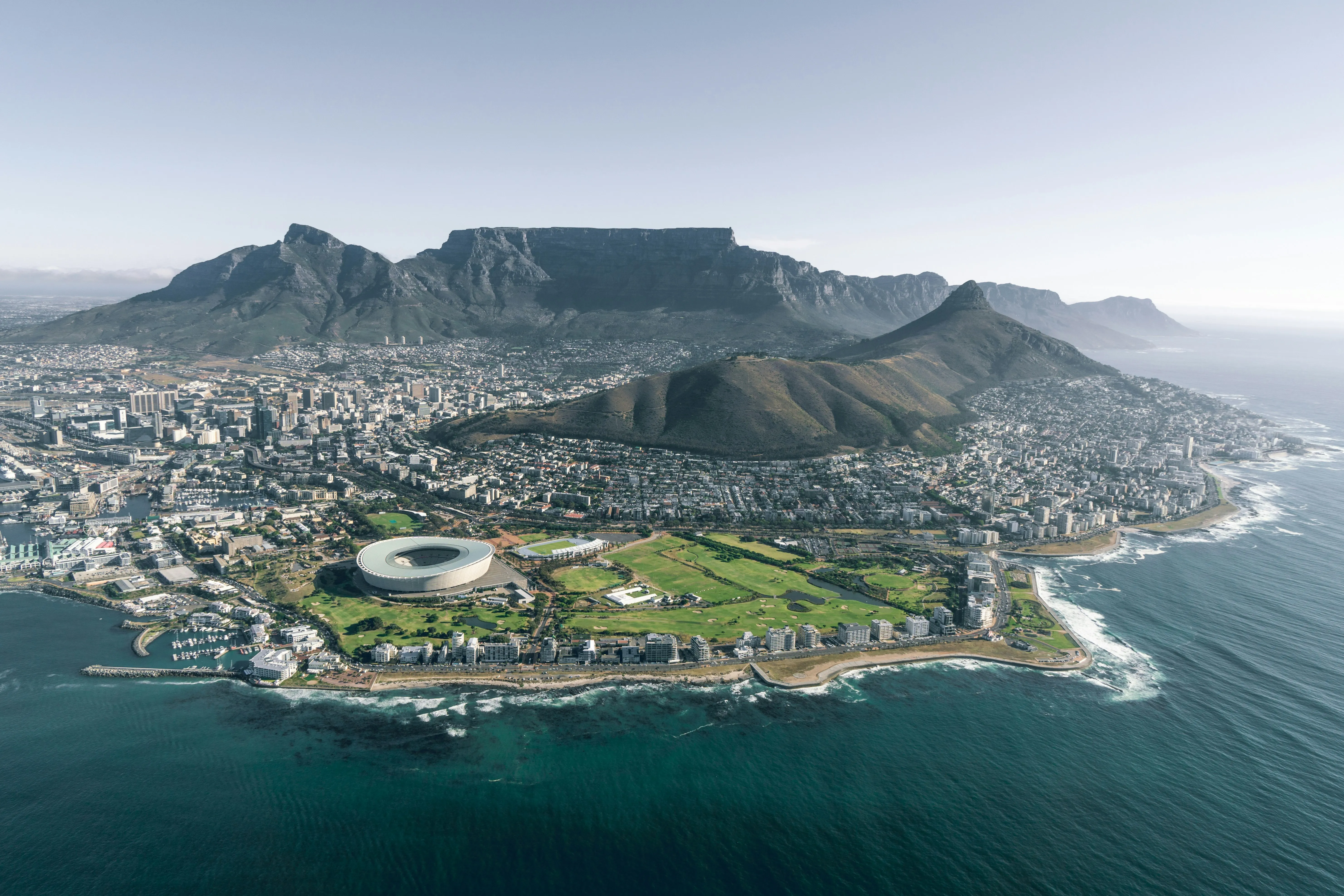
South Africa is a destination of marked contrasts where urban modernity is interwoven with untamed nature. The starting point for many travelers is usually Cape Town, a city located between the ocean and the imposing Table Mountain. This flat-topped feature defines the horizon and offers multiple trails for those seeking panoramic views of the coast. In the city, the Bo-Kaap neighborhood stands out for its colorful facades and cultural heritage, while the Victoria & Alfred Waterfront serves as a hub of social activity with its markets, docks, and museums.
A short distance from the urban center, the Cape Peninsula invites a journey along coastal roads that lead to the Cape of Good Hope and Cape Point. In this area, it is common to find small colonies of penguins on beaches like Boulders Beach and fishing villages that maintain a leisurely pace of life. Inland, the Cape Winelands region, with towns like Stellenbosch and Franschhoek, offers a landscape of hills and valleys where colonial architecture blends with extensive plantations, ideal for learning about the country’s agricultural and wine tradition.
To the east lies the Garden Route, one of the most internationally known coastal journeys. This itinerary passes through lagoons, dense forests, and cliffs, connecting places like Knysna and Tsitsikamma National Park. It is a region conducive to direct contact with nature, with suspension bridges over river mouths and hiking routes bordering the Indian Ocean. Nearby, the coastal city of Port Elizabeth serves as the gateway to various reserves where local fauna is protected in low scrub environments.
In the northeast of the country, the environment changes drastically to give way to the savanna. Kruger National Park is the most important area for wildlife viewing, allowing visitors to see the habitat of elephants, lions, and leopards, among many other species, up close. Very close to this ecosystem is the Panorama Route, a journey that winds through the Drakensberg mountains and offers stops at natural viewpoints such as the Blyde River Canyon, one of the largest green canyons in the world.
The historical and cultural pulse is felt with special force in Johannesburg, the country’s largest city. In the Soweto neighborhood and at the Apartheid Museum, the recent history of the nation is explained in detail, providing essential context for understanding current social reality. Nearby, Pretoria, the administrative capital, stands out for its government buildings like the Union Buildings and its wide avenues that are covered in flowers during the austral spring.
Finally, the KwaZulu-Natal province offers a mix of warm beaches and rugged mountains. The city of Durban is known for its mixed cultural influence and promenades, while inland, the uKhahlamba-Drakensberg range presents high mountain landscapes with ancestral rock paintings. This region allows visitors to learn about the Zulu culture legacy through different settlements and cultural centers that keep their traditions alive in a rural setting.
Tip: You cannot miss visiting Kruger National Park, the most emblematic place in the country.
✈️ Best time to travel
South Africa is a destination that can be visited all year round due to its geographical and climatic diversity. Being in the Southern Hemisphere, the seasons work inversely to those in the Northern Hemisphere, offering different experiences depending on the region and the chosen month. The climate is predominantly temperate, with sunny days that invite exploration of its extensive coasts as well as its national parks and mountain areas.
The choice of the ideal time will depend on the traveler’s priorities. While the cooler, drier months are ideal for wildlife viewing in the north, the warmer months favor coastal tourism in the south. In general terms, the shoulder seasons offer a pleasant balance, with mild temperatures and landscapes that change color, allowing one to enjoy most of the country’s attractions without the thermal extremes of mid-summer or winter.
| Season | Months | Typical climate | What to expect | Tourist influx |
|---|---|---|---|---|
| Spring | Sep – Nov | Mild and pleasant. Rains begin in the interior. | Flowering of wild fields, whale watching on the coast, and ideal weather for hiking. | Medium ⭐⭐ |
| Summer | Dec – Feb | Hot and humid in the north; dry and sunny in Cape Town. | Long days, ideal for beaches and outdoor activities. Season of festivities and great urban vitality. | High ⭐⭐⭐ |
| Autumn | Mar – May | Mild temperatures and clear skies. Little wind. | Landscapes with golden tones, harvest season in the vineyards, and stable conditions for travel. | Medium ⭐⭐ |
| Winter | Jun – Aug | Cool and dry in the north; cold and rainy in the southwest. | Optimal time for safaris, as vegetation is low and animals concentrate at waterholes. | Medium / Low ⭐ |
🗣️ Basic vocabulary
Although English is the primary language in most tourist and commercial areas of South Africa, the country has eleven official languages that reflect its diversity. Knowing some basic words, mainly in isiZulu or Afrikaans, will allow you to interact more closely in everyday situations, such as greeting in a market or thanking for a service in a restaurant.
Mastering these terms does not require deep study and is very practical for connecting with the local population during the trip. Here is a selection of useful expressions for your stay:
- Sawubona: Hello (traditional Zulu greeting).
- Ngiyabonga: Thank you (in Zulu).
- Dankie: Thank you (in Afrikaans).
- Howzit: Very common informal greeting equivalent to “how’s it going?”.
- Lekker: Adjective used to describe something good, pleasant, or delicious.
- Robot: Local term for traffic lights, very useful if you ask for directions to move around the city.
- Braai: Name given to the social barbecue, an essential cultural event in the country’s daily life.